Test Strategy to the Overall Testing Approach
A Test Strategy is a foundational document that defines the overall approach to software testing within an organization or across multiple projects. It establishes the principles, standards, and direction that guide testing activities and ensures consistency in how quality is validated. While individual projects may differ in scope and complexity, a well-defined test strategy provides a unified testing philosophy that applies across teams and releases.
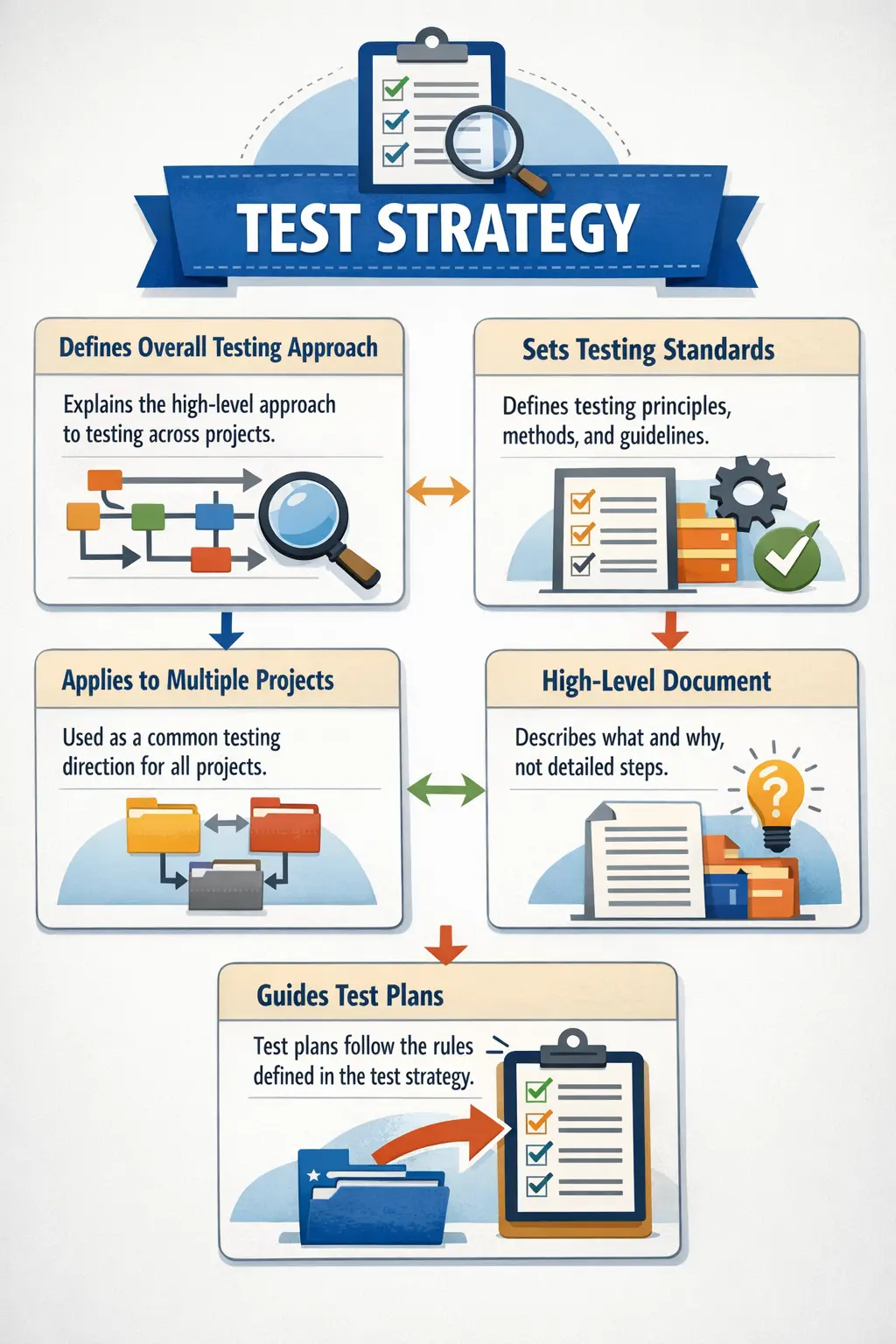
A Test Strategy is a high-level document that defines the overall testing approach, principles, scope boundaries, and standards followed across projects or an entire organization. It provides guidance on how testing should be conducted and what quality objectives must be achieved.
A test strategy primarily answers one fundamental question:
“What is our overall approach to testing?”
Unlike a test plan, which focuses on the details of a specific project, a test strategy provides a broader vision for testing. It defines the rules and standards that testing teams follow, ensuring consistency and quality across projects. Organizations that maintain a clear test strategy often achieve better testing efficiency and more predictable quality outcomes.
A test strategy is useful because testing decisions should not be reinvented from scratch for every project. If one team follows strong defect triage, another team uses informal defect reporting, one project performs regression carefully, and another project skips regression under pressure, the organization will not have consistent quality. A test strategy creates a shared baseline. It tells teams what quality means, how risk should be handled, which testing levels are expected, and how results should be reported.
In practical terms, the test strategy is the quality direction for the organization or product group. It does not replace project-specific planning, but it shapes that planning. A test plan answers how testing will be done for one project or release. A test strategy answers how the organization generally approaches testing across projects, releases, platforms, and teams.
Purpose of a Test Strategy
The primary purpose of a test strategy is to establish a consistent testing approach. Without a standardized approach, different teams may adopt different testing practices, leading to inconsistent quality levels and confusion among stakeholders. A test strategy ensures that all testing activities follow the same guiding principles.
Another important purpose is to define testing standards and expectations. Organizations need clear guidelines regarding test coverage, testing types, documentation standards, and defect management practices. A test strategy provides this structure and ensures that testing activities meet defined quality standards.
Test strategies also align testing with business goals. Software testing is not only about finding defects but also about ensuring that the system meets business requirements and user expectations. A test strategy connects testing activities with business priorities and risk areas.
The strategy document also serves as a reference for decision-making. When teams face uncertainty about testing approaches or priorities, they can refer to the test strategy for guidance. This reduces ambiguity and helps teams make consistent decisions.
A well-defined test strategy is particularly valuable in organizations with multiple projects running simultaneously. It ensures that testing practices remain uniform and that quality standards are maintained across the organization.
A test strategy also improves scalability. As teams grow, it becomes difficult to maintain quality through verbal guidance alone. New testers, new developers, new project managers, and new vendors need a common reference. The strategy explains expectations without depending completely on individual experience or memory.
Another purpose is governance. Testing decisions often involve trade-offs between time, cost, quality, and risk. A strategy helps teams make those trade-offs consistently. For example, it may define that critical business flows must always be regression tested before release, or that security testing is mandatory for applications handling sensitive data. These principles protect quality when delivery pressure increases.
Characteristics of a Test Strategy
A test strategy is typically a high-level document that focuses on guiding principles rather than detailed instructions. It defines what should be done and why it should be done, but it does not usually describe step-by-step procedures. Those details are usually covered in project-specific test plans.
One of the key characteristics of a test strategy is that it is not project-specific. Instead, it applies to multiple projects or even the entire organization. This makes the test strategy a long-lived document that remains relevant across product releases and development cycles.
Because of its broad scope, a test strategy is usually created and approved by senior QA leadership or quality management teams. This ensures that the strategy reflects organizational goals and industry best practices.
Another important characteristic is stability. While project-specific test plans may change frequently, a test strategy changes less often. Updates usually occur only when testing processes or technologies change significantly.
The test strategy serves as a framework within which individual project test plans are developed. Each project adapts the strategy to its specific needs while maintaining alignment with the overall testing philosophy.
A good test strategy is broad but not vague. It should provide enough direction to guide real decisions, but not so much detail that it becomes impossible to maintain. For example, it may state that regression testing must be risk-based and include critical business flows, but it should not list every regression test case for every project. Those details belong in project test plans or regression suites.
It should also be practical. A strategy that demands every possible testing type for every release may look strong but fail in real execution. A useful strategy defines mandatory practices, recommended practices, and risk-based exceptions. This makes it realistic for different project sizes and delivery models.
Testing Objectives
One of the most important components of a test strategy is the definition of testing objectives. These objectives describe the overall quality goals that testing activities are expected to achieve.
Testing objectives typically include ensuring functional correctness, verifying business requirements, and maintaining system reliability. They may also include goals related to usability, security, and performance.
Clearly defined objectives help testing teams understand what quality means in the context of the organization. They also help prioritize testing activities based on business value and risk.
For example, an organization developing financial software may emphasize accuracy and security as primary testing objectives, while a consumer application may focus more on usability and responsiveness.
Testing objectives ensure that testing efforts are aligned with organizational priorities.
Testing objectives should be written in a way that helps prioritization. If the organization builds banking software, accuracy, security, auditability, and reliability may be more important than visual polish. If the organization builds consumer mobile apps, usability, compatibility, performance, and crash-free behavior may receive more emphasis. Clear objectives prevent teams from treating all quality attributes equally when risk is not equal.
Objectives also help define what success looks like. A team cannot claim testing is successful only because many test cases were executed. Success should be connected to business confidence, risk reduction, defect discovery, coverage of critical requirements, and readiness for release. The test strategy sets that direction.
Scope of Testing
The test strategy defines the general scope of testing across projects. This includes the types of systems and features that must be tested and any areas that may be excluded.
Defining scope boundaries is important because it clarifies expectations and prevents misunderstandings. It ensures that stakeholders understand which quality areas are covered by testing and which are handled separately.
For example, a test strategy may define that functional testing and usability testing are mandatory for all projects, while performance testing may be conducted only for high-traffic systems.
Clearly defined scope boundaries help testing teams focus on the most important quality areas.
Scope boundaries are especially important when multiple teams share quality responsibilities. For example, functional QA may own feature validation, a performance team may own load testing, a security team may own vulnerability assessment, and business users may own final acceptance. The strategy should clarify these ownership boundaries at a high level so project plans can assign work correctly.
The strategy may also define minimum testing expectations. For instance, every release may require smoke testing, functional validation, regression coverage for impacted areas, and defect reporting. Additional testing such as performance, security, accessibility, or compatibility may be triggered by risk, project type, or regulatory requirement.
Testing Types
A test strategy typically defines the types of testing that must be performed. This provides a consistent approach across projects and ensures that important quality areas are not overlooked.
Functional testing is usually the foundation of the testing process. It ensures that system features behave according to requirements.
Non-functional testing types such as usability testing, compatibility testing, and security testing may also be defined in the strategy. These testing types help ensure that the system meets broader quality expectations beyond functional correctness.
The strategy may also include support for user acceptance testing. This ensures that business users are involved in validating the system before release.
Defining testing types at the strategy level ensures that projects follow a consistent quality model.
The strategy should explain not only which testing types exist, but when they are expected. For example, smoke testing may be required for every build before detailed testing begins. Regression testing may be required before every release. Compatibility testing may be required for customer-facing web applications. Accessibility testing may be required for public-facing government or enterprise applications. Security testing may be required for systems handling user data or financial transactions.
This guidance prevents teams from deciding testing types randomly. It also helps project managers plan time and resources because they know which quality activities are mandatory and which are risk-based.
Test Levels
Test levels define the stages at which testing is performed. A test strategy usually defines standard test levels to be followed across projects.
Integration testing ensures that different components of the system work together correctly. System testing validates the complete application in an environment similar to production.
Acceptance testing verifies that the system meets business requirements and is ready for release.
Defining test levels ensures that testing is performed systematically and that no important stage is skipped.
This structured approach improves quality and reduces the risk of defects reaching production.
A mature test strategy may also describe how responsibility is distributed across levels. Developers may be expected to own unit testing. Developers and QA may collaborate on integration testing. QA may own system testing and regression. Business stakeholders may support acceptance testing. This prevents gaps where each team assumes another team is responsible.
Clear test levels also support shift-left testing. If integration risks are identified early, teams can test interfaces before full system testing. If acceptance criteria are clarified early, business validation becomes smoother. Strategy-level guidance encourages testing throughout the lifecycle rather than only at the end.
Test Design Techniques
A test strategy often defines the test case design techniques that testers should use. This ensures that test cases are created systematically and that test coverage is consistent across projects.
Techniques such as Equivalence Partitioning, Boundary Value Analysis, Decision Table Testing, and State Transition Testing may be included in the strategy.
Experience-based techniques such as exploratory testing and error guessing may also be encouraged.
By defining recommended techniques, the strategy ensures that testers apply proven methods rather than relying on random testing.
This leads to better defect detection and more efficient testing.
Defining test design techniques also helps improve tester skill consistency. Junior testers may otherwise write test cases only from visible screens. The strategy can encourage them to use techniques that improve coverage: boundary values for ranges, equivalence classes for input groups, decision tables for business rules, state transitions for workflows, use cases for real user goals, and error guessing for experience- based risks.
The strategy should not force every technique on every feature. Instead, it should guide selection. The right technique depends on the testing problem. This makes test design more thoughtful and efficient.
Entry and Exit Criteria
High-level entry and exit criteria are usually defined in the test strategy. These criteria establish general rules for when testing should begin and when it can be considered complete.
Entry criteria may include stable builds, approved requirements, and available test environments.
Exit criteria may include completion of planned testing activities and resolution of critical defects.
These criteria provide a consistent definition of readiness and completion across projects.
Having standardized criteria helps maintain quality consistency.
Standard criteria also prevent weak release decisions. If one project exits testing with open critical defects while another project blocks release for the same condition, stakeholders lose trust in the testing process. A strategy-level definition gives teams a consistent baseline. Individual projects can add stricter criteria when risk requires it.
Entry and exit criteria should still remain practical. The strategy may define general expectations, while each test plan defines project-specific details. For example, the strategy may state that critical defects must be resolved before release, while a project plan may define exact severity thresholds and sign-off rules for that release.
Defect Management Approach
Defect management is a critical part of software testing. A test strategy typically defines how defects should be reported, tracked, and resolved.
The strategy may define severity and priority classifications to ensure consistent defect evaluation. It may also describe defect triage practices and communication procedures.
Standardized defect management improves collaboration between testers and developers.
It also ensures that critical defects receive appropriate attention before release.
The defect management approach should also define communication expectations. Serious defects may require immediate escalation. Defects blocked by unclear requirements may require business analyst review. Disputed defects may require triage with QA, development, product, and business stakeholders. These practices help teams resolve issues consistently rather than relying on informal conversations.
A strong strategy also defines what information a defect report should contain. Steps to reproduce, expected result, actual result, environment, test data, screenshots, logs, and severity help developers fix issues faster. Standard defect quality improves the entire delivery process.
Test Environment Strategy
The test environment strategy defines how test environments should be managed and used across projects.
This includes principles for environment setup, configuration control, and access management.
A stable and consistent test environment is essential for reliable testing results. The test strategy ensures that environment practices are standardized.
Environment management is particularly important in large organizations where multiple teams share testing infrastructure.
A test environment strategy may define how environments are requested, who owns them, how configuration is controlled, how test data is refreshed, and how environment outages are communicated. It may also define rules for using production-like environments, mock services, test payment gateways, email/SMS simulators, and third-party integration sandboxes.
Environment instability is one of the biggest causes of testing delays. A strategy cannot eliminate every environment problem, but it can define ownership and discipline. This reduces repeated confusion and makes test results more reliable.
Automation Strategy
A modern test strategy often includes automation principles. It should define why automation is used, what types of tests are good candidates for automation, which tools or frameworks are preferred, and how automated tests fit into the delivery pipeline. Automation should not be treated as simply converting every manual test into a script.
A practical automation strategy usually prioritizes stable, repeatable, high-value scenarios. Smoke tests, critical regression flows, API contract checks, data-driven validations, and frequently executed scenarios are strong candidates. Highly unstable UI flows, rarely used scenarios, or features changing every sprint may not be good immediate automation targets.
The strategy should also define ownership. Some teams expect QA automation engineers to own automated regression. Other teams expect developers to own unit and integration automation while QA owns end-to-end checks. Without clear ownership, automation suites often become outdated and unreliable.
Test Data Strategy
Test data is another area that benefits from strategic guidance. Many testing delays occur because the required data is unavailable, corrupted, inconsistent, or too close to production-sensitive information. A test strategy can define how test data should be created, maintained, refreshed, masked, and protected.
The strategy may state that sensitive production data must not be used directly, that masked data should be used for realistic scenarios, or that reusable data sets should be maintained for regression. It may also define who owns data preparation and how data issues are escalated.
Good test data strategy improves repeatability. If every tester creates data differently, results may vary. If reusable data sets exist for common roles, statuses, account types, and business conditions, testing becomes faster and more reliable.
Risk and Mitigation Strategy
Risk management is an essential part of testing strategy. A test strategy identifies high-risk areas and defines general approaches for risk mitigation.
High-risk areas may include complex business logic, external integrations, and security-sensitive features.
Mitigation strategies may include additional testing, early testing involvement, or specialized testing activities.
Risk-based testing ensures that testing efforts focus on areas with the greatest impact.
The risk strategy should describe how teams identify and prioritize risk. Common factors include business impact, technical complexity, change frequency, defect history, customer usage, regulatory exposure, integration dependency, and production incident history. Areas with higher risk should receive deeper coverage and earlier testing.
Risk mitigation may include additional reviews, extra test design, pair testing, automation, performance checks, security review, production monitoring, or phased rollout. The strategy should make it clear that testing effort is not spread equally across all features; it is guided by risk.
Metrics and Reporting
Metrics and reporting standards are usually defined in the test strategy. Metrics provide measurable indicators of testing progress and quality.
Common metrics may include test case execution status, defect counts, and defect resolution rates.
Reporting standards ensure that stakeholders receive consistent and meaningful information about testing activities.
Standardized reporting improves transparency and decision-making.
Metrics should be meaningful rather than decorative. Counting test cases alone does not prove quality. Useful reporting explains what has been tested, what remains untested, what defects are open, which risks remain, whether exit criteria are met, and whether stakeholders can make an informed release decision.
A strong strategy may define standard report formats for daily execution, defect summaries, release test summaries, and quality dashboards. This helps stakeholders compare status across projects without learning a different reporting style for every team.
Test Strategy vs Test Plan
A test strategy and a test plan serve different purposes, even though they are closely related.
A test strategy defines the overall testing philosophy and standards. It applies across multiple projects and remains stable over time.
A test plan focuses on a specific project and provides detailed instructions for testing activities.
The test strategy provides direction, while the test plan provides execution details.
Understanding this difference is important in both real-world testing and interviews.
The relationship between the two is simple: the strategy guides the plan. If the strategy says regression testing must be risk-based, the project test plan explains which regression areas are selected for that release. If the strategy says critical defects must be resolved before release, the test plan defines the specific exit criteria for the project. The strategy gives direction; the test plan applies it.
This distinction matters because teams sometimes overload the test strategy with project details. When that happens, the strategy becomes hard to maintain. Project-specific scope, schedule, resources, and deliverables should remain in the test plan.
Manual Tester’s Perspective
Manual testers rely on the test strategy to understand organizational testing expectations. The strategy helps testers understand the quality goals and standards that must be followed.
Testers apply the defined test design techniques when creating test cases. They also follow defect management and reporting standards defined in the strategy.
Alignment with the test strategy ensures that testing activities contribute to overall quality goals.
Understanding the test strategy helps testers make better testing decisions.
From a manual tester's perspective, the strategy provides boundaries and expectations. It tells the tester which testing types are important, what documentation standards to follow, how defects should be reported, what quality risks matter, and how much evidence is expected. This helps testers work consistently even across different projects.
Testers should not treat the strategy as a document only for leads or managers. Understanding it helps them make better daily decisions, such as when to escalate a risk, how to classify a defect, when to suggest regression coverage, or which test design technique fits a feature.
Test Strategy in Agile and DevOps
In Agile and DevOps environments, the test strategy should support fast feedback and continuous quality. It may define expectations for shift-left testing, story-level acceptance criteria review, continuous integration checks, automated regression, exploratory testing, and production monitoring. The strategy should adapt to iterative delivery rather than assume testing happens only after development is complete.
Agile test strategy should also encourage collaboration. Quality is not only QA responsibility. Developers, testers, product owners, business analysts, DevOps engineers, and support teams all contribute. The strategy should clarify how these roles collaborate across the lifecycle.
In DevOps, release speed can increase significantly. Without a clear strategy, teams may push faster than they can validate. A DevOps-friendly test strategy defines automated quality gates, minimum smoke coverage, rollback considerations, monitoring expectations, and post-release validation practices.
Governance and Review of Test Strategy
A test strategy should be reviewed periodically. Testing tools, delivery models, business risks, compliance needs, and application architecture change over time. A strategy that was effective five years ago may not support cloud systems, microservices, mobile applications, API-first architectures, or CI/CD pipelines properly.
Review ownership usually belongs to QA leadership or quality governance groups, but feedback should come from project teams. Testers can identify practical gaps. Developers can identify automation and integration concerns. Product owners can identify business risk changes. Operations teams can identify production quality trends.
Strategy updates should be controlled and communicated. If defect severity definitions, automation tools, reporting expectations, or testing standards change, teams need to know. A strategy has value only when it is understood and used.
Real-Time Example
Consider an organization developing multiple business applications. The test strategy might specify that manual testing is mandatory for business-critical functionality.
The strategy might require regression testing before every release to ensure that existing functionality remains stable.
User acceptance testing support might also be mandatory for all major releases.
Each project would then create a test plan that follows these rules while adapting them to project-specific requirements.
This ensures consistent quality across projects.
The same organization might also define that all customer-facing applications must support compatibility testing on approved browsers, that all systems handling personal data require security review, and that all high-risk releases require formal test summary reporting. These rules then guide individual project test plans. A small internal tool may have a lighter plan, while a financial transaction platform may have a stricter plan, but both remain aligned with the same strategic direction.
This example shows why the strategy should not be overloaded with project-specific schedules. It should define reusable standards. Each project then converts those standards into practical execution steps.
Common Mistakes
One common mistake is confusing a test strategy with a test plan. A test strategy should remain high-level, while detailed instructions belong in the test plan.
Another mistake is making the test strategy too detailed. Excessive detail makes the document difficult to maintain and reduces its long-term usefulness.
Some organizations fail to update their test strategy when testing processes evolve. Outdated strategies can lead to inconsistent practices.
A good test strategy remains clear, relevant, and adaptable.
Another common mistake is creating a strategy that is too generic. Statements such as "testing should be done properly" or "quality is important" do not guide real decisions. A useful strategy should define practical expectations: which testing levels are expected, how risk is assessed, how defects are classified, what reporting is required, and how automation is approached.
Some organizations create a test strategy but do not train teams on it. If testers and project teams do not know the strategy exists, it will not influence behavior. The strategy should be part of onboarding, planning discussions, quality reviews, and process improvement activities.
Another mistake is ignoring feedback from real projects. If teams consistently find that a strategy rule is impractical, outdated, or unclear, it should be reviewed. A test strategy should provide stability, but it should not become rigid bureaucracy.
Interview Perspective
Test strategy is a common interview topic because it demonstrates understanding of testing processes at a higher level.
A short answer might describe a test strategy as a high-level document that defines the overall testing approach and standards.
A detailed answer would explain that the test strategy defines testing principles, scope boundaries, testing types, and quality goals for multiple projects.
Interviewers often expect candidates to understand the difference between test strategy and test plan.
Project-based answer:
In a real organization, a test strategy defines the common testing approach followed across projects. It may define testing objectives, scope boundaries, testing levels, testing types, test design techniques, defect management standards, environment principles, automation approach, metrics, reporting, and risk management. Each project then creates a test plan that follows this strategy and adapts it to project scope, schedule, resources, and risks.
A strong interview answer should mention that a test strategy is high-level and relatively stable, while a test plan is project-specific and more detailed. The strategy gives direction; the plan explains execution.
Practical Test Strategy Checklist
A useful test strategy should define overall testing objectives, quality priorities, scope boundaries, testing levels, testing types, test design techniques, defect management rules, test environment principles, test data approach, automation direction, risk-based testing approach, metrics, reporting standards, and governance.
It should clarify what is mandatory for all projects and what is risk-based. It should define ownership where needed, especially for automation, environments, defect triage, and reporting. It should also explain how project-specific test plans should align with the strategy.
Finally, the strategy should be reviewed periodically. If tools, architecture, delivery model, business risk, or compliance expectations change, the strategy should evolve. A good strategy is stable enough to guide teams, but flexible enough to remain relevant.
Key Takeaway
A Test Strategy provides the vision and direction for software testing across projects and teams. It defines the principles and standards that ensure consistent and effective testing practices.
While test plans focus on project-level execution, the test strategy defines the broader approach that guides all testing activities.
Organizations with a clear test strategy achieve better quality consistency, improved efficiency, and more predictable testing outcomes.
A strong strategy does not remove the need for judgment. Instead, it gives teams a common foundation for making better testing decisions. It helps testing scale across projects while keeping quality practices aligned with business risk and organizational goals.