Software Testing
Introduction to Software Testing
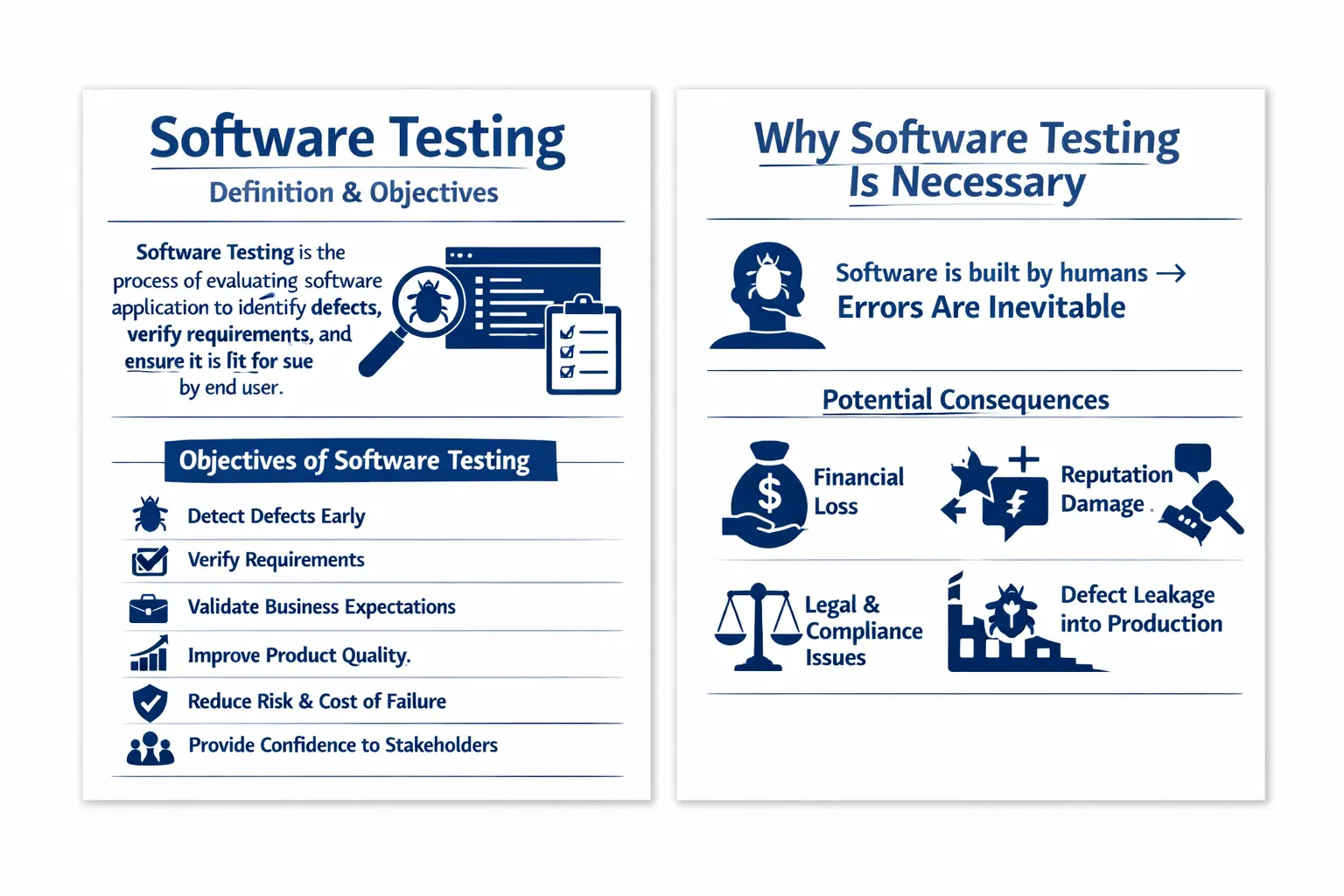
Software testing is a systematic and structured process used to evaluate a software application for defects, correctness, and fitness for use. Its purpose is to ensure that the application meets specified requirements and delivers real value to end users. In modern software development, testing is not a final step performed just before release; it is a continuous quality practice that begins early and evolves alongside development. Testing provides objective insight into the state of a product so that teams and stakeholders can make confident decisions.
Software Testing as a Quality Practice
Software testing is best understood as a disciplined quality practice rather than a single activity performed at the end of development. In traditional thinking, testing was often treated as the final gate before release. Developers completed the work, testers checked the completed product, and the team attempted to fix issues close to the deadline. Modern software delivery has shown that this approach is risky. When testing starts late, defects are discovered late, business rules are clarified late, and the cost of correction becomes high. A better approach is to involve testing thinking from the beginning, when requirements are discussed and designs are still flexible.
A tester does not only ask whether a screen opens or a button works. A tester asks whether the software solves the intended problem, supports real workflows, handles expected and unexpected inputs, and gives users a dependable experience. This makes testing both technical and analytical. It requires knowledge of the application, awareness of business goals, understanding of users, and the ability to identify risk. The strongest testers are not people who simply follow steps; they are people who investigate software carefully and communicate quality information clearly.
Testing also creates visibility. Without testing, stakeholders may assume that a feature works because it was developed, but development and correctness are not the same thing. A feature can be coded and still fail in practical use. It can pass a basic happy path and still fail for boundary values, invalid data, slow networks, permission differences, browser variations, or integration dependencies. Testing gives the team evidence about what is working, what is not working, what remains risky, and what needs further investigation.
Testing Begins with Understanding Requirements
Effective testing starts before a tester touches the application. The first step is to understand the requirement. A requirement describes what the system should do, why the behavior is needed, and which rules must be followed. If the requirement is unclear, testing becomes guesswork. A tester may execute many cases but still miss the real business expectation. This is why requirement analysis is one of the most important skills in software testing.
During requirement review, testers look for ambiguity, missing rules, contradictions, incomplete workflows, and hidden assumptions. For example, a requirement may say that users can reset their password, but it may not specify what happens if the email is not registered, if the reset link expires, if the user enters a weak password, or if the same link is used twice. These questions are not small details. They affect user experience, security, and defect risk. By asking such questions early, testers help prevent defects before they are built into the product.
Requirement understanding also helps testers design meaningful test scenarios. A test scenario is not just a technical path through the application; it represents a business situation that needs validation. Good scenarios come from real user goals, business rules, risk areas, and edge cases. When testers understand the requirement deeply, they can create scenarios that provide genuine confidence rather than superficial coverage.
Testing Validates Both Expected and Unexpected Behavior
Many beginners think testing means checking whether the application works when valid data is entered. That is only one part of testing. Positive testing confirms that the system behaves correctly under normal conditions. For example, a valid user should be able to log in, a valid payment should be processed, and a properly completed form should be submitted successfully. These checks are essential because they confirm that the main business workflow works as expected.
Negative testing is equally important. Real users make mistakes, systems receive unexpected inputs, and integrations sometimes send unusual data. A strong application must handle these situations safely and predictably. If a mandatory field is empty, the system should show a clear validation message. If an invalid password is entered, access should be denied. If a user tries to access unauthorized data, the application should protect that data. Negative testing verifies that the system does not collapse when conditions are imperfect.
Boundary and edge case testing further strengthen quality. Many defects appear near limits, such as minimum and maximum values, date boundaries, character limits, file size limits, and quantity limits. If a password must be between 8 and 16 characters, testing only a 10-character password is not enough. A tester should consider 7, 8, 16, and 17 characters because boundary points are common defect zones. This analytical thinking separates structured testing from random usage.
Testing Supports Risk-Based Decisions
It is impossible to test everything. Even a simple application can have many combinations of inputs, devices, browsers, user roles, configurations, data states, and workflows. Because exhaustive testing is not practical, testers must prioritize. This is where risk-based testing becomes important. Risk-based testing focuses more effort on areas where failure would have the highest impact or where defects are most likely to occur.
A payment feature, login system, data export flow, or role-based access feature may require more testing than a minor cosmetic change. A newly modified module may require more attention than a stable module that has not changed. A feature used by thousands of customers may be riskier than an internal tool used by a small team. Testers use this kind of reasoning to decide where to invest time.
Risk-based testing does not mean ignoring low-risk areas completely. It means matching testing effort to business and technical risk. This helps teams make better release decisions. When time is limited, risk-based testing helps answer the practical question: what must be tested first so that the team can reduce the most serious uncertainty?
Manual Testing and Automation Work Together
Manual testing and automation are often discussed as if they compete with each other, but in real projects they serve different purposes. Manual testing is powerful when human judgment, exploration, observation, and domain understanding are needed. A manual tester can notice confusing wording, awkward workflows, inconsistent behavior, and usability problems that automation may not catch. Manual testing is especially useful for new features, exploratory testing, requirement validation, and user acceptance testing.
Automation is powerful for repeatable checks. Once a behavior is stable and important, automated tests can run it repeatedly across builds. Automation is useful for regression testing, smoke testing, API checks, repetitive data validation, and cross-browser execution. It saves time when the same checks must be executed often. However, automation does not decide what should be tested. Test design still requires human thinking.
A mature testing strategy uses both. Manual testing discovers, evaluates, and explores. Automation protects stable behavior from regression. The combination gives the team both adaptability and repeatability. A project that depends only on manual testing may become slow as the application grows. A project that depends only on automation may miss human experience issues and poorly understood risks. Balanced testing produces stronger quality feedback.
Software Testing in the Development Lifecycle
Testing has a role throughout the software development lifecycle. During requirement analysis, testers review stories, acceptance criteria, and business rules. During design, they think about workflows, dependencies, risks, and testability. During development, they clarify scenarios, prepare test data, and sometimes validate early builds. During test execution, they run planned cases, explore the application, report defects, retest fixes, and support release readiness decisions.
In Agile projects, testing is continuous. Testers collaborate with developers and product owners throughout the sprint. They do not wait until all coding is complete. They help refine acceptance criteria, identify edge cases, and validate increments as they become available. This helps teams find issues earlier and reduce last-minute surprises.
In maintenance projects, testing is equally important. Even small changes can affect existing behavior. A bug fix in one area may accidentally break another area. A configuration change may affect deployment. A database change may affect reports. Regression testing, sanity testing, and impact analysis help teams manage these risks safely.
The Tester as a Quality Communicator
A tester's job is not only to find defects but also to communicate them effectively. A defect report should explain what happened, what was expected, how to reproduce the issue, which environment was used, and what evidence supports the finding. Clear reporting saves time for developers and reduces unnecessary back-and-forth. A vague report such as "login not working" is much less useful than a report that includes steps, data, expected result, actual result, screenshot, logs, and browser details.
Testers also communicate risk. A test summary report does not merely list pass and fail counts. It explains what was tested, what was not tested, which defects remain open, which areas are risky, and whether the product is ready from a quality perspective. This information helps product owners, managers, and stakeholders make informed decisions.
Good testing communication is objective. Testers should avoid exaggeration and avoid hiding problems. Their role is to provide accurate quality information. Sometimes the decision may be to release with known issues because the business accepts the risk. Sometimes the decision may be to delay release. In both cases, testing contributes by making the state of the product visible.
Real-World Example of Testing Thinking
Consider a simple login feature. A beginner may test only one case: enter a valid username and password and verify that the dashboard opens. This is a useful check, but it is not enough. A tester thinks more broadly. What happens with an invalid password? What happens with an empty username? Are error messages clear? Is the password hidden? Does the system prevent access after logout? Can a locked user log in? Does the session expire correctly? Is the account protected against repeated failed attempts?
The same thinking applies to almost every feature. For a checkout flow, testers consider valid payment, failed payment, expired card, empty cart, price changes, coupon rules, tax calculation, address validation, order confirmation, and payment gateway failure. For a file upload feature, testers consider file type, file size, duplicate upload, network interruption, progress indication, and security risks. This is why software testing requires analytical depth.
Testing is therefore not simply execution. Execution is only one visible part of the work. Before execution, testers analyze. During execution, they observe. After execution, they report, retest, and summarize. This complete thinking cycle is what makes testing valuable in real projects.
Skills Needed for Software Testing
A good tester needs several skills. Requirement understanding is essential because the tester must know what the system is supposed to do. Analytical thinking helps identify scenarios, risks, boundaries, and exceptions. Communication skills help testers ask questions, report issues, and explain quality status. Domain knowledge helps testers understand business workflows and user expectations.
Technical awareness is also useful. Even manual testers benefit from understanding browsers, APIs, databases, logs, networks, and basic architecture. This knowledge helps them investigate defects more effectively and communicate with developers. As testers grow, they may learn automation, performance testing, security basics, and CI/CD concepts. But the foundation remains the same: understand the product, think critically, and evaluate quality carefully.
Curiosity is another important trait. Testers should be willing to ask what else could happen, what might fail, what assumptions are hidden, and how real users might behave. Discipline is equally important because testing requires documentation, repeatability, and careful evidence. A curious but undisciplined tester may find issues but struggle to communicate them. A disciplined but incurious tester may follow cases but miss important risks. Strong testers develop both qualities.
How Beginners Should Approach Software Testing
Beginners should approach software testing as a thinking discipline before treating it as a tool-based activity. It is tempting to start with test management tools, automation tools, or browser automation frameworks, but those tools are useful only when the tester understands what needs to be tested and why. A beginner should first learn how to read requirements, identify scenarios, write clear test cases, prepare meaningful test data, execute carefully, and report defects with evidence.
A practical way to begin is to take a simple feature and ask structured questions. What is the main user goal? What is the expected happy path? What inputs are valid? What inputs are invalid? What fields are mandatory? What limits exist? What messages should appear? What should happen if the user cancels, refreshes, goes back, or tries the same action twice? These questions help the tester move beyond surface-level checking and begin thinking like a quality analyst.
Beginners should also practice writing defects clearly. A good defect report includes a short summary, environment, preconditions, steps to reproduce, test data, expected result, actual result, severity, and evidence. This structure helps developers reproduce the issue quickly. It also helps testers build credibility because the report is objective and actionable. A defect that cannot be reproduced or understood may waste time even if the underlying issue is real.
Another important habit is learning from every execution cycle. After testing a feature, a beginner should review what was missed, which defects were found, which assumptions were wrong, and which scenarios should be added next time. Testing skill improves through reflection. Over time, testers build a mental library of common failure patterns: missing validation, incorrect calculations, broken navigation, inconsistent messages, data not saved, permission leaks, session issues, and edge case failures.
Software testing also requires patience. Not every defect is obvious, and not every issue appears on the first attempt. Some failures depend on data state, timing, browser behavior, user permissions, or integration responses. A good tester observes carefully, repeats steps when needed, compares actual behavior with requirements, and avoids jumping to conclusions. This steady, evidence-based approach is what makes testing reliable.
As beginners grow, they can expand into specialized areas such as API testing, database validation, mobile testing, performance testing, security testing, and automation. These areas are valuable, but they all build on the same foundation: understand the expected behavior, identify risk, execute with discipline, and communicate findings clearly. Mastering the fundamentals of software testing makes every advanced testing skill easier to learn.
Why Software Testing Is Important
Software is created by people, and wherever humans are involved, mistakes are unavoidable. Requirements may be misunderstood, logic may be implemented incorrectly, and integrations between systems may introduce unexpected behavior. If these problems reach production, they can result in financial loss, damage to reputation, or legal and compliance risks. Software testing exists to reduce these risks by identifying issues before customers experience them. In this way, testing protects both the user experience and the business itself.
Objectives of Software Testing
The goal of software testing is broader than simply finding bugs. Testing helps confirm that requirements are correctly implemented and that business rules are followed. It validates that workflows support real user needs and that the system behaves as expected in practical situations. Through this process, testing improves product quality, reduces the cost of failures, and builds confidence among stakeholders. Effective testing turns release decisions into informed choices rather than assumptions.
Understanding Quality in Software
Quality in software extends beyond whether a feature works. An application must also be reliable, stable, and easy to use. It should perform well under expected load and protect user data from security risks. A system that functions correctly but is slow, confusing, or insecure still presents quality issues. Testing allows teams to evaluate these attributes objectively, ensuring that quality is measured rather than assumed.
Role of a Manual Tester
A manual tester contributes critical human perspective to the testing process. By understanding requirements and business logic, a tester can evaluate the application from an end-user's point of view. Manual testers design realistic scenarios, execute tests thoughtfully, and document defects clearly. They validate fixes and support release decisions with evidence. Their value lies in observation, critical thinking, and domain understanding, which are especially important in areas like usability and exploratory testing.
What Software Testing Is Not
There are common misconceptions about testing that can limit its effectiveness. Testing is not random clicking through an application, nor is it an attempt to prove that the software works perfectly. It is also not an activity that happens only after development is complete, and it does not replace the developer's responsibility for building quality into the product. Testing reveals the current state of quality, but quality itself must be built throughout the development process.
Verification and Validation
Two important perspectives in testing are verification and validation. Verification focuses on determining whether the product is being built correctly according to specifications and requirements. This often involves reviews and walkthroughs. Validation focuses on whether the right product is being built for the user, which requires executing the application in realistic scenarios. Both perspectives are necessary to ensure that the final product is both correct and useful.
Errors, Defects, and Failures
In software testing terminology, an error refers to a human mistake made during requirements, design, or coding. A defect, commonly called a bug, is the flaw in the software that results from that mistake. A failure occurs when the software behaves incorrectly during execution. Failures are what users see, but they originate from underlying defects caused by earlier errors.
Cost of Defects
The cost of fixing defects increases as a project progresses. When a problem is found during the requirement or design stage, it is relatively inexpensive to correct. The same problem becomes more costly during development and far more expensive after release to production. Early and continuous testing helps identify issues sooner, significantly reducing rework and overall project cost.
Principles of Software Testing
Software testing is guided by well-established principles. Testing can demonstrate the presence of defects but cannot prove their complete absence. Exhaustive testing of every scenario is impossible, so prioritization based on risk is essential. Starting testing early saves both time and money. Defects often concentrate in certain areas, and test cases must be refreshed over time to remain effective. Testing approaches also depend on context, and even a system with no known defects can fail if it does not meet user needs.
Manual Testing in Real Projects
Manual testing continues to play a major role in real projects. It is particularly valuable when evaluating requirements, exploring new features, and assessing usability from a human perspective. It also supports user acceptance testing and complex business logic validation. While automation is powerful for repeatable checks, it cannot fully replace human reasoning and adaptability.
Testing Deliverables
Testing activities produce artifacts that support communication and accountability. These include documented scenarios, structured test cases, prepared data, and clear defect reports. Execution records and summary reports provide visibility into testing progress and product quality. Such deliverables help teams track coverage, understand risks, and maintain historical knowledge.
Common Beginner Challenges
New testers often face challenges as they build experience. Some begin testing without fully understanding requirements or focus only on positive scenarios. Others may overlook edge cases or write unclear defect descriptions. Over time, effective testers learn to think from the user's perspective and to approach testing analytically rather than mechanically.
Conclusion
Software testing is analytical, risk-focused, user-centered, and quality-driven. It is not merely a phase in the lifecycle but a mindset integrated into development. A strong understanding of testing fundamentals forms the foundation for advanced areas such as automation, performance, and security testing. Tools and frameworks are valuable, but it is the tester's thinking, judgment, and focus on quality that ultimately make the difference.