Entry Criteria
Introduction to Entry Criteria
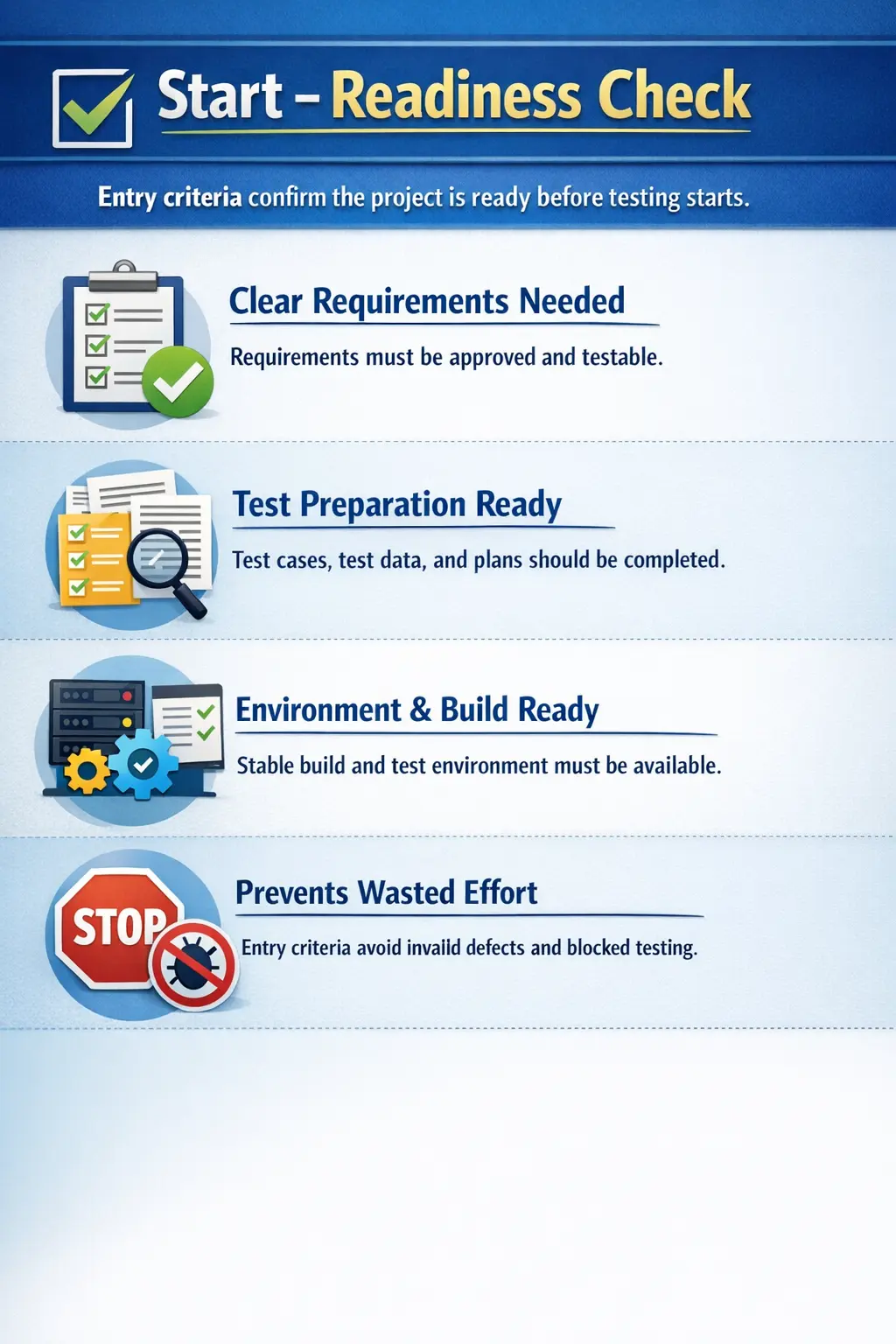
Entry Criteria are predefined conditions that must be satisfied before a testing activity or testing phase begins. They act as readiness checkpoints to confirm that the necessary inputs, resources, and environments are in place. In simple terms, entry criteria answer one key question: are we ready to start testing?
Why Entry Criteria Matter
Entry criteria matter because testing can only produce useful information when the team is ready to test. Many projects lose time because testing begins before the requirements are clear, before the build is stable, before the environment is configured, or before test data is available. When this happens, testers spend effort reporting blockers, chasing clarifications, and raising defects that are not true product defects. Entry criteria prevent this by defining the minimum readiness conditions before a phase begins.
In practical terms, entry criteria protect the testing team from starting work under conditions that will produce unreliable results. If a build cannot be installed, test execution cannot meaningfully start. If the login feature is not deployed, login test cases cannot be executed. If requirements are still changing every hour, test cases may become outdated before they are used. Entry criteria turn these concerns into visible checkpoints rather than hidden frustrations.
Entry criteria also help project managers and stakeholders understand testing readiness. Instead of asking testers to "just start testing," the team can explain which prerequisites are met and which are still pending. This creates a more disciplined conversation around schedule, risk, and quality. Testing becomes a controlled activity rather than a rushed reaction to development completion.
Entry Criteria as Readiness Checkpoints
Entry criteria can be understood as readiness checkpoints. They do not guarantee that testing will find all defects, and they do not guarantee that the product is high quality. They simply confirm that the conditions are suitable for the next testing activity to begin. This distinction is important. Entry criteria are about starting readiness, while exit criteria are about completion readiness.
For example, before test execution begins, the team may require approved test cases, prepared test data, a deployed build, a stable environment, required user access, and completion of smoke testing. These conditions do not mean the product is defect-free. They mean testers can now execute planned tests in a meaningful way. If these conditions are missing, execution may be blocked or misleading.
Good entry criteria should be clear, observable, and agreed by the team. A vague criterion such as "system should be ready" is not useful. A better criterion is "the latest build is deployed to the QA environment and smoke testing is passed." This can be checked. Entry criteria should remove ambiguity, not create more discussion.
Requirement Readiness in Detail
Requirement readiness is one of the most important entry conditions for testing. Testers cannot design effective scenarios if they do not understand what the system is supposed to do. Requirements should be available, reviewed, approved, and testable. Acceptance criteria should be clear enough to support positive, negative, boundary, and workflow scenarios.
Requirement readiness does not mean every tiny detail must be perfect, especially in Agile projects. However, the team should have enough clarity to test the intended behavior. If a story says "user should be able to upload a file" but does not specify allowed file types, size limits, error messages, duplicate file behavior, or permission rules, the requirement is not fully testable. Starting test design too early may lead to incorrect or incomplete cases.
Testers add value by reviewing requirements before execution begins. They can identify ambiguity, contradiction, missing business rules, unclear data needs, and untestable statements. This review is part of readiness. A requirement that looks complete to development may still be incomplete from a testing perspective.
Test Plan and Strategy Readiness
A test plan or test strategy provides direction for testing. It defines scope, approach, responsibilities, types of testing, environments, tools, timelines, risks, and deliverables. Entry criteria for test design or execution may require that the test plan is prepared and approved. Without this direction, testing can become inconsistent and reactive.
For example, if the test strategy does not clarify whether compatibility testing is required, testers may discover too late that multiple browsers or devices must be covered. If performance testing is in scope but not planned, the team may lack tools, data, or environment capacity. If regression scope is not defined, testers may either miss important checks or spend time on low-value areas.
Planning readiness also supports realistic scheduling. Testing effort depends on scope, complexity, environment availability, data preparation, and risk. Entry criteria ensure that this planning happens before execution pressure begins.
Test Case and Test Data Readiness
Test case readiness means that test cases or scenarios have been prepared, reviewed, and approved at the appropriate level. A tester should not enter execution with unclear or incomplete test cases unless the task is intentionally exploratory. For planned execution, test cases guide coverage, consistency, and reporting.
Test data readiness is equally important. Many test cases cannot be executed without the right data. A login test needs valid and invalid users. A payment test may need specific cards or payment states. A report test may need transactions across dates and statuses. A role-based access test needs users with different permissions. If this data is not available, execution will be delayed or improvised.
Good entry criteria should confirm that required data is identified and prepared before execution begins. This prevents testers from spending execution time creating data manually, waiting for access, or using unsuitable data that produces unreliable results. Where sensitive data is involved, entry criteria should also confirm masking or anonymization as needed.
Environment and Access Readiness
A ready test environment is essential for reliable testing. The environment should have the correct build, configuration, database version, integrations, test accounts, permissions, and connectivity. If the environment differs significantly from expected conditions, test results may not reflect product quality.
Environment readiness is often a major source of delays. Testers may be assigned to execute cases, but the application may not be deployed, services may be down, emails may not be sent, APIs may point to wrong endpoints, or access may not be granted. Entry criteria make these prerequisites visible before execution begins.
Access readiness should not be forgotten. Testers need credentials, roles, permissions, VPN access, tool access, defect tracking access, and sometimes database or log access. If access is missing, testers may be blocked even when the build is ready. A complete entry checklist includes both environment and access readiness.
Build Readiness and Smoke Testing
Build readiness confirms that the application version provided for testing is suitable for execution. A build that fails to install, fails to start, or blocks core navigation is not ready for full testing. Basic smoke checks help determine whether the build is stable enough to proceed. Smoke testing is often a key entry condition for deeper functional or regression testing.
For example, before executing detailed checkout test cases, the team may first confirm that the application launches, login works, product search works, cart opens, and checkout page loads. If these basic checks fail, executing hundreds of detailed cases is wasteful. The build should return to development for stabilization.
Build readiness prevents defect noise. If a build is fundamentally broken, testers may log many defects that all come from the same deployment problem. This distorts metrics and wastes time. Entry criteria help separate build acceptance from detailed validation.
Resource and Tool Readiness
Testing requires people, time, and tools. Resource readiness confirms that the right testers are assigned, schedules are aligned, and required tools are available. Even if requirements, build, and environment are ready, testing cannot proceed effectively if the team lacks capacity or access to necessary tools.
Manual testers may need test management tools, defect tracking tools, browser/device access, API clients, log access, screenshot tools, data preparation utilities, and communication channels. In some projects, they may also need support from developers, business analysts, database administrators, or environment teams. Entry criteria can confirm that these dependencies are available.
Resource readiness is especially important in time-bound releases. If testers are assigned too late or split across multiple projects, execution may not finish even if the product is ready. Entry criteria make staffing and scheduling part of readiness, not an afterthought.
Entry Criteria Across STLC Phases
Entry criteria apply to many phases of the Software Testing Life Cycle. Requirement analysis may begin when requirements or user stories are available for review. Test planning may begin when scope and requirements are clear enough for estimation. Test design may begin when the test plan is approved and requirements are testable. Test execution may begin when build, environment, data, and cases are ready.
Each phase has different readiness needs. It would be incorrect to use the same entry criteria for every activity. Requirement review does not need a deployed build. Test execution does. Test closure does not begin just because execution started; it begins when execution is complete enough and exit conditions can be evaluated.
Defining entry criteria phase by phase improves workflow control. It prevents teams from starting the next activity before the current one provides the necessary input. This reduces rework and improves traceability across the testing lifecycle.
Entry Criteria in Agile Projects
Agile teams may not use heavy formal documents, but entry criteria still matter. They may appear as Definition of Ready, story readiness checks, sprint entry checks, or testing readiness conditions. Before a user story is pulled into a sprint, the team may expect acceptance criteria, clear scope, dependencies, test data needs, and design questions to be understood.
During a sprint, entry criteria for testing may include that the story is deployed to a test environment, acceptance criteria are implemented, unit checks are complete, and the tester has required data. Agile does not remove readiness. It makes readiness continuous and lighter.
In Agile, ignoring entry criteria often leads to unfinished stories, late defects, and sprint carryover. Testers may receive stories on the last day with unclear acceptance criteria or unstable builds. A practical readiness checklist helps the team test earlier and more reliably within the sprint.
Entry Criteria and Quality Metrics
Entry criteria protect the meaning of quality metrics. If testing starts when the build is unstable, the defect count may increase, but those defects may reflect readiness failure rather than product quality. If requirements are unclear, rejected defects may increase because testers and developers interpret behavior differently. If environment issues block execution, pass percentage and progress metrics become misleading.
Reliable metrics require controlled conditions. Entry criteria help create those conditions. When the team knows that requirements are approved, test cases are reviewed, data is prepared, and the environment is ready, execution results become more meaningful. Defects found under those conditions are more likely to represent real quality issues.
This is why entry criteria are not bureaucracy. They support accurate reporting. Stakeholders rely on testing metrics to make release decisions, so the conditions under which those metrics are produced matter.
Entry Criteria Checklist Example
A practical entry checklist for test execution may include approved requirements or user stories, reviewed test cases, prepared test data, available test environment, deployed build, passed smoke test, tester access, defect tracking access, required tools, and confirmed execution schedule. The exact checklist should be tailored to the project, but the principle is the same: confirm readiness before execution begins.
For system testing, the checklist may include integrated build readiness, interface availability, external service readiness, and end-to-end data flow validation. For acceptance testing, the checklist may include business user availability, UAT environment readiness, business test data, and signed-off acceptance criteria.
A checklist should be practical, not excessive. Too many formal criteria can slow teams down. Too few can allow premature testing. The best checklist focuses on the conditions that truly affect testing reliability and progress.
Risks When Entry Criteria Are Skipped
Skipping entry criteria creates several risks. The first is blocked execution. Testers may be ready to work, but missing access, unstable environment, or unavailable data stops progress. The second is invalid defects. Testers may report issues caused by incomplete deployment or unclear requirements rather than actual product defects.
The third risk is rework. Test cases written against unclear requirements may need to be rewritten. Test execution performed on the wrong build may need to be repeated. Defects raised against unstable behavior may need retesting after environment fixes. All of this consumes time that could have been saved through readiness checks.
The fourth risk is loss of confidence. If testing results are frequently blocked, noisy, or inconsistent, stakeholders may lose trust in the testing process. Entry criteria help protect that trust by ensuring that testing begins under suitable conditions.
Interview-Ready Understanding of Entry Criteria
In interviews, entry criteria should be explained as predefined readiness conditions that must be satisfied before a testing phase or activity begins. They ensure that testing starts with the necessary requirements, test artifacts, data, environment, build, resources, and tools. Their purpose is to avoid premature testing and improve reliability of test results.
A strong answer should include examples. For test execution, entry criteria may include approved requirements, reviewed test cases, prepared test data, stable QA environment, deployed build, passed smoke testing, tester access, and defect tracking tool readiness. Mentioning these examples shows practical understanding.
It is also useful to compare entry and exit criteria. Entry criteria decide when testing can start. Exit criteria decide when testing can stop or a phase can close. Entry is about readiness; exit is about completion. Both are important for controlled testing.
Final Practical Guidance
Entry criteria should be useful, visible, and realistic. If the criteria are too vague, they will not guide the team. If they are too heavy, teams may ignore them under schedule pressure. The best entry criteria are simple enough to apply consistently and strong enough to prevent avoidable blockers. They should be agreed before the phase begins, not invented after problems appear.
For manual testers, entry criteria are a way to protect testing quality. Before starting execution, a tester should be comfortable asking whether the build is stable, whether the environment is ready, whether test data exists, whether requirements are clear, and whether expected results are known. These questions are not delays; they are part of professional testing discipline. Testing that starts at the right time produces better evidence and better decisions.
Without clear entry criteria, teams may begin testing too early, leading to confusion, rework, and misleading results. Entry criteria bring discipline and timing to the testing process.
Purpose of Entry Criteria
The main purpose of entry criteria is to ensure that testing begins only when meaningful validation can occur. They prevent premature testing that wastes effort and produces false failures. When testers start with the right prerequisites, testing becomes more efficient and reliable.
Entry criteria also protect quality metrics. If testing starts on an unstable build or unclear requirements, the resulting defects may not reflect real product quality. Proper readiness ensures that test results are trustworthy.
Typical Entry Criteria in Manual Testing
Requirement Readiness
Testing should begin only when requirements are finalized, approved, and testable. Clear acceptance criteria help testers design accurate scenarios. When requirements are vague, testing often targets the wrong behavior, leading to rework.
Test Artifact Readiness
Core testing documents must be prepared. This includes an approved test plan, reviewed test cases, and prepared test data. These artifacts guide consistent and complete execution.
Test Environment Readiness
A suitable environment must be available and configured. The application build should be deployed, and testers must have the required access. If the environment is unstable or incomplete, test results become unreliable.
Build Readiness
The build provided for testing should be successfully deployed and at least pass basic smoke checks. Major installation or startup issues should already be resolved. Otherwise, testers spend time reporting issues that block all testing.
Resource Readiness
Testing requires the right people and timing. Testers should be assigned, schedules aligned, and any required tools available. Even with a perfect build, a lack of resources can delay meaningful testing.
Entry Criteria Across Testing Phases
Different testing phases require different readiness conditions. Requirement analysis begins only after requirements are approved. Test planning starts once requirements are signed off. Test design relies on an approved plan. Test execution requires a stable build and ready environment. Test closure begins when defined exit conditions are met.
These checkpoints ensure smooth flow across the testing lifecycle.
A Practical Scenario
Consider starting test execution without stable requirements, a reliable build, or a proper environment. Testers may create incorrect test cases, face repeated failures due to instability, or be blocked entirely. This wastes time and creates noise in defect reports. Entry criteria help avoid such situations by confirming readiness first.
Entry Criteria and Exit Criteria
Entry and exit criteria work together. Entry criteria determine when a phase can begin, while exit criteria determine when it can end. Entry focuses on readiness, whereas exit focuses on completion. Both are needed to control testing effectively.
Risks of Ignoring Entry Criteria
When entry criteria are ignored, teams often see many invalid defects, frequent test blocking, and schedule overruns. Quality metrics become distorted because failures may stem from instability rather than real defects. Over time, this reduces confidence in the testing process.
Interview Perspective
In interviews, entry criteria are typically described as readiness conditions required before starting a testing phase. A strong explanation mentions requirement approval, test case preparation, and environment availability as examples. This shows practical understanding of controlled testing.
Key Takeaway
Entry criteria ensure that testing starts at the right time with the right inputs. They protect tester effort, improve result reliability, and support realistic schedules. Effective testing is not only about how you test, but also about when you start. Entry criteria make that timing intentional rather than accidental.