Exit Criteria in Software Testing: Knowing When Testing Is Complete
Introduction to Exit Criteria
Exit Criteria are predefined conditions that must be satisfied to formally conclude a testing phase. They help teams decide when testing has reached a sufficient level and when it is safe to move forward. In simple terms, exit criteria answer the question: is testing complete and can we proceed?
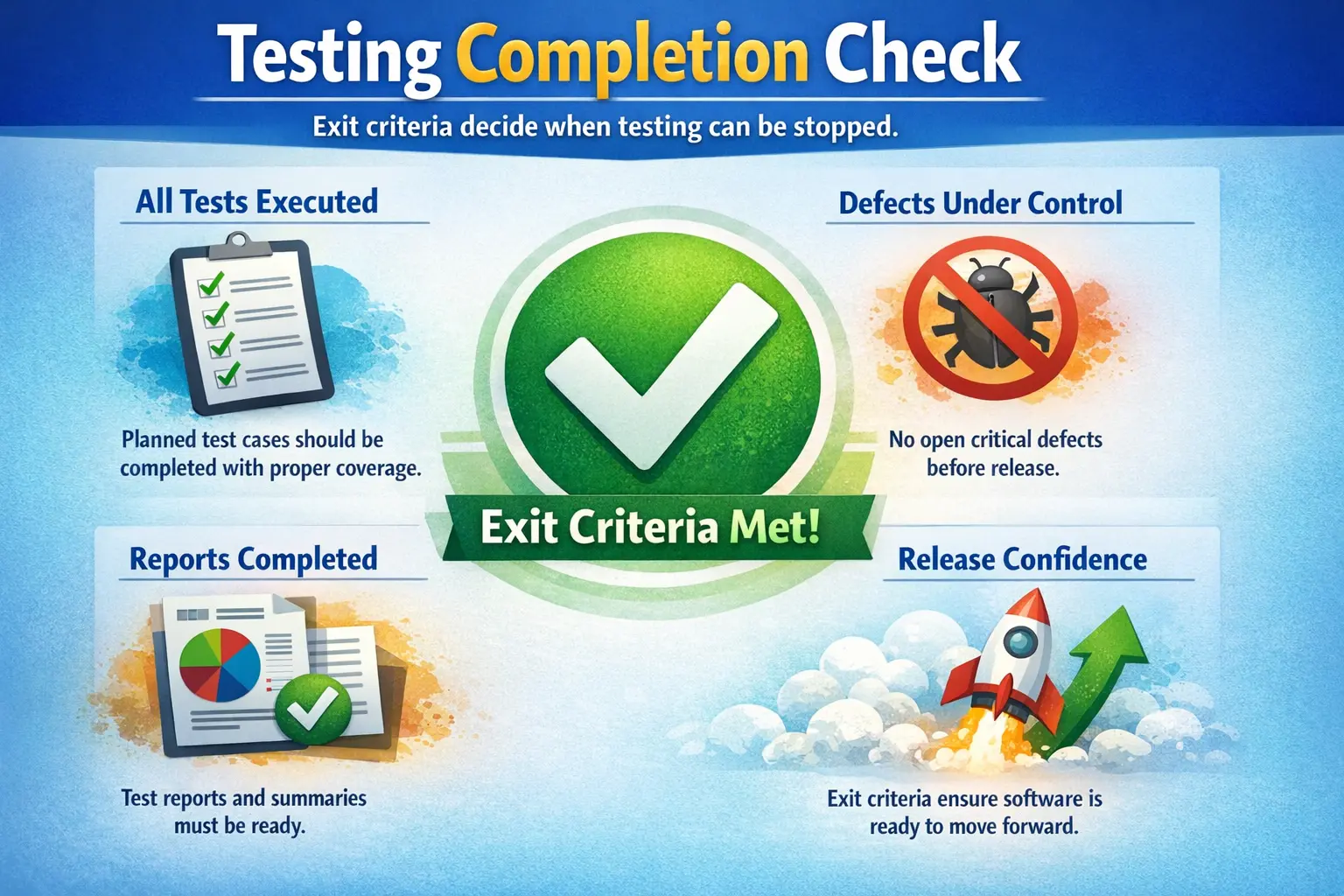
Why Exit Criteria Matter in Real Projects
Exit criteria matter because testing is not an activity that can continue forever. Every project has time, budget, release commitments, business priorities, and production expectations. At the same time, no serious team wants to release a product blindly just because the calendar says the release date has arrived. Exit criteria create a practical bridge between these two realities. They help the team decide whether the current level of testing is enough to support the next decision, whether that decision is moving to the next phase, handing over to user acceptance testing, or releasing the application to production.
In many projects, testing completion becomes a subjective discussion if exit criteria are not defined. One stakeholder may say that enough testing has been done because most planned test cases passed. Another may argue that testing should continue because defects are still being found. A project manager may focus on the delivery date, while a test lead may focus on unresolved risks. Without agreed exit criteria, each person is using a different definition of readiness. This creates conflict, pressure, and inconsistent decisions. Exit criteria avoid this by defining the conditions in advance.
A good exit decision is not based on perfection. It is based on controlled risk. Software testing cannot prove that a system has no defects. It can only provide evidence about what has been checked, what has passed, what has failed, what remains open, and what risk is still present. Exit criteria collect these signals into a structured decision framework. They help the team say, with evidence, that testing has reached an acceptable level for the current phase.
Exit Criteria as Completion Checkpoints
Exit criteria should be understood as completion checkpoints, not as a mechanical checklist created only for documentation. They define the minimum conditions required to close a testing activity responsibly. For example, a system testing phase may require all planned high-priority test cases to be executed, all critical and high-severity defects to be closed or formally accepted, the test summary report to be prepared, and stakeholders to review known risks. These conditions do not guarantee a perfect product, but they create a disciplined stopping point.
The value of exit criteria increases when they are defined before execution begins. If the team waits until the end of testing to decide what completion means, the decision can easily be influenced by schedule pressure. Teams may lower standards because release is near, or they may continue testing without a clear reason because nobody knows what is enough. When exit criteria are agreed at the planning stage, they become a shared contract. Everyone understands what evidence must exist before the phase can be closed.
Exit criteria also help teams maintain consistency across releases. If one release exits testing with open critical defects and another release requires all critical defects to be fixed, quality governance becomes unpredictable. Consistent exit criteria allow teams to compare releases, measure improvement, and build trust in testing outcomes. They make testing completion repeatable rather than dependent on individual opinion.
Test Case Execution Completion
One of the most common exit criteria is test case execution completion. This means the planned test cases for the phase have been executed according to the agreed scope. In manual testing, this usually includes functional test cases, regression test cases, integration-related checks, smoke tests, and business-critical scenarios. The exact set depends on the phase and the risk level of the release. A small enhancement may require limited regression, while a major release may require full regression and end-to-end validation.
Execution completion is important because unexecuted test cases represent unknown risk. If a major business flow was not tested, the team cannot confidently claim that the application is ready. However, exit criteria should not simply say that all test cases must be executed without context. In real projects, some test cases may be blocked by environment constraints, dependency delays, or deferred functionality. In such situations, the important point is that the unexecuted tests are visible, reviewed, and risk-assessed.
A practical exit criterion might state that 100 percent of priority-one and priority-two test cases must be executed, while lower-priority cases may be deferred only with stakeholder approval. This keeps the focus on risk instead of treating every test case as equally important. Test execution completion should therefore be measured together with priority, business impact, and the reason for any remaining gaps.
Defect Status as a Release Gate
Defect status is one of the strongest indicators for exit criteria because open defects directly represent known product risk. A release with open critical defects is usually not a release candidate. Critical defects may include system crashes, data loss, security failures, payment failures, or blocked core workflows. If these defects remain unresolved, exiting testing would simply transfer serious problems to production.
High-severity defects also require careful handling. In many organizations, exit criteria state that no critical or high-severity defects should remain open unless they are formally accepted by business owners. This exception is important because not all high-severity defects have the same release impact. A severe issue in a rarely used admin report may be treated differently from a severe issue in login, payment, or order placement. The key is not to hide the issue. The key is to make the risk explicit and obtain conscious approval.
Medium and low-severity defects may be allowed at exit depending on their volume, impact, and workaround. For example, minor alignment issues, spelling mistakes, or low-risk usability defects may be deferred to a future release. But if the number of low and medium defects is unusually high, it can still indicate poor product stability. Exit criteria should therefore look not only at individual defect severity but also at defect trends, defect density, repeated failures, and the areas where defects are concentrated.
Coverage and Risk-Based Completion
Coverage is another important part of exit criteria. It answers the question of whether the important parts of the application have been tested. Coverage can be viewed from different angles: requirement coverage, test case coverage, business process coverage, platform coverage, browser coverage, device coverage, and regression coverage. The correct type of coverage depends on the application and the testing phase.
Requirement coverage is especially important in manual testing. If a requirement was approved but no test case was executed against it, the team cannot confirm whether that requirement works. Requirement traceability helps identify such gaps. In a mature process, exit criteria may require that all in-scope requirements have corresponding executed test cases or documented exceptions. This creates a direct link between what was requested and what was validated.
Risk-based coverage is often more useful than simple percentage coverage. A project may execute 95 percent of its test cases, but if the remaining 5 percent includes payment, login, or data migration, the release risk is still high. Conversely, a release may have a few low-risk tests deferred without affecting the release decision. Strong exit criteria focus on important coverage, not just large numbers. They help teams test what matters most before declaring completion.
Quality Metrics and Stability Signals
Exit criteria often include quality metrics because metrics give stakeholders a measurable view of product stability. Common metrics include pass percentage, fail percentage, blocked test count, defect count by severity, defect reopening rate, defect aging, regression pass rate, and build stability. These metrics do not replace judgment, but they help the team make decisions using evidence instead of impressions.
A high pass rate is useful only when the test scope is meaningful. Passing 98 percent of low-risk tests does not compensate for failure in a critical business flow. Similarly, a low defect count does not always mean high quality if test coverage was weak. Metrics must be interpreted together. Good exit criteria combine numbers with context. They ask whether the tested areas were important, whether failures are concentrated in risky modules, and whether the product is becoming more stable over time.
Stability signals are especially important near release. If every new build introduces fresh defects in previously working areas, exiting testing is risky even if the current test pass rate looks acceptable. Frequent build failures, repeated defect reopenings, unstable environments, and inconsistent results all suggest that the product is not ready. Exit criteria should capture these signals so that teams do not close testing while instability is still visible.
Documentation and Evidence
Documentation is an important part of exit criteria because testing decisions must be explainable. A team should be able to show what was tested, what passed, what failed, what was not tested, what defects remain open, and what risks were accepted. This evidence is useful for release decisions, audits, future maintenance, and lessons learned. Without documentation, testing completion becomes difficult to verify later.
Typical exit documents include the test execution report, defect summary, requirement coverage status, test summary report, known issues list, risk assessment, and sign-off communication. The level of documentation should match project needs. A regulated financial or healthcare system may require formal documentation, while a small internal tool may use lighter reports. The principle remains the same: the exit decision must be supported by clear evidence.
Documentation should also include deviations from the plan. If some tests were skipped, if an environment issue prevented validation, or if a defect was accepted for release, that information should be recorded. This protects the testing team and gives stakeholders a realistic view of product quality. Exit criteria are strongest when they make both achievements and limitations visible.
Stakeholder Sign-Off and Shared Accountability
Stakeholder approval is often included in exit criteria because testing completion affects more than the QA team. Business owners, product managers, project managers, development leads, and test leads may all have a role in deciding whether the current risk is acceptable. Sign-off does not mean that the product is perfect. It means the responsible stakeholders have reviewed the evidence and agree to proceed.
This shared accountability is important. Testers can report product quality, but they do not own every business decision. A test lead may recommend against release due to open risks, but a business owner may accept a known low-impact issue because of a market deadline. When exit criteria include formal approval, such decisions are documented and transparent. Risk acceptance becomes a business decision, not an accidental omission.
Good sign-off discussions are based on facts. The test team presents execution status, open defects, blocked areas, test coverage, known limitations, and release risks. Stakeholders then decide whether the release can proceed, whether more testing is required, or whether specific defects must be fixed first. Exit criteria provide the structure for this conversation.
Exit Criteria Across the Testing Lifecycle
Exit criteria are not limited to final test execution. Every testing phase or activity can have its own completion conditions. During requirement analysis, exit criteria may include reviewed requirements, clarified ambiguities, identified testable acceptance criteria, and documented assumptions. This ensures that the team does not move into test planning with unclear inputs.
During test planning, exit criteria may include an approved test strategy, defined scope, identified risks, resource allocation, schedule agreement, and tool readiness. During test design, completion may require reviewed test cases, prepared test data, updated traceability, and peer approval. These criteria prevent execution from starting with incomplete preparation.
During test execution, exit criteria focus on executed tests, defect status, coverage, regression results, and risk review. During test closure, exit criteria may include test summary approval, lessons learned, metrics consolidation, archived test artifacts, and final sign-off. This phase-wise view keeps the entire testing process controlled from beginning to end.
Exit Criteria in Agile Projects
In Agile projects, exit criteria still matter, but they are often expressed through sprint-level readiness, definition of done, acceptance criteria, and release criteria. A user story should not be considered done simply because development is complete. It should meet acceptance criteria, pass testing, have no blocking defects, and be reviewed by the appropriate people. This is the Agile form of exit control.
Sprint exit criteria may include completed committed stories, passed acceptance tests, completed regression for affected areas, reviewed defects, and demo readiness. Release exit criteria may include broader regression completion, performance checks, security checks, UAT sign-off, and deployment readiness. Agile does not remove the need for exit criteria. It makes them more frequent and incremental.
The important point in Agile is to keep exit criteria lightweight but meaningful. If they become too bureaucratic, they slow down the team. If they are too vague, quality becomes inconsistent. A balanced approach defines clear completion expectations for stories, sprints, and releases while still supporting fast feedback and continuous delivery.
Exit Criteria Compared with Entry Criteria
Entry criteria and exit criteria work together. Entry criteria define when a testing activity is ready to begin. Exit criteria define when that activity is complete enough to close. Entry criteria protect the team from starting too early, while exit criteria protect the product from moving forward too early. Together, they create control over the start and end of testing work.
For example, test execution may have entry criteria such as approved test cases, deployed build, available environment, prepared test data, and access credentials. The same phase may have exit criteria such as executed priority test cases, no open critical defects, updated defect status, completed regression, and approved test summary. Entry asks, "Can we start?" Exit asks, "Can we stop and proceed?"
Both criteria should be realistic. If entry criteria are too strict, testing may be delayed unnecessarily. If exit criteria are too strict, the team may never be able to close testing. If either is too weak, quality and schedule control suffer. The best criteria are practical, measurable, risk-based, and agreed by the people responsible for delivery.
A Practical Example of Exit Criteria
Consider an e-commerce application preparing for a release that includes checkout improvements, coupon handling, and payment gateway changes. The exit criteria for system testing might state that all critical checkout scenarios must be executed, payment flows must pass across supported payment methods, no critical or high defects can remain open in checkout, regression must pass for login, cart, order placement, and order history, and the test summary report must be reviewed by stakeholders.
During execution, suppose 92 percent of total test cases pass, but a defect remains open where some users are charged twice during a payment retry. Even though the overall pass percentage appears high, the release should not exit testing because the open defect affects money, customer trust, and business risk. Exit criteria prevent the team from being misled by the pass percentage alone.
Now consider another case where a low-priority cosmetic defect remains on an admin-only report page, all critical flows pass, and business stakeholders agree to fix the cosmetic defect in the next sprint. In that case, testing may exit with a known issue because the remaining risk is understood and accepted. This is the practical purpose of exit criteria: not to block every release, but to prevent careless release decisions.
Risks of Ignoring Exit Criteria
Ignoring exit criteria can create serious problems. The most obvious risk is defect leakage, where issues that should have been caught before release reach production users. Production defects are usually more expensive than pre-release defects because they may require emergency fixes, customer communication, data correction, deployment rollback, and support effort. They can also damage trust in the product and the team.
Another risk is false confidence. If testing is closed without reviewing coverage, defect status, and stability, stakeholders may believe the product is ready when important areas were never validated. This creates a mismatch between reported confidence and actual quality. When problems appear later, the team may struggle to explain why testing was closed.
Weak exit control also affects team morale. Testers may feel pressured to sign off on releases they do not trust. Developers may receive urgent production fixes that could have been prevented. Business teams may lose confidence in testing reports. Clear exit criteria reduce these problems by making quality decisions transparent, evidence-based, and shared.
Best Practices for Defining Exit Criteria
Effective exit criteria should be clear, measurable, realistic, and risk-based. A vague statement such as "testing should be complete" is not useful because it does not define what complete means. A stronger criterion says that all priority-one test cases must be executed, no critical defects should remain open, regression for affected modules must pass, and the test summary must be approved. Specific criteria reduce confusion.
Exit criteria should be defined during test planning, not at the end of execution. They should also be reviewed with stakeholders so that expectations are aligned early. The development team, testing team, product owner, and project manager should understand what conditions must be met before testing closes. This prevents last-minute disagreement.
Teams should also review exit criteria after each major release. If criteria were too strict, too weak, or missed an important risk, they should be improved. Exit criteria are not static templates. They should evolve with the product, domain, team maturity, regulatory needs, and production learning.
Interview-Ready Understanding of Exit Criteria
In interviews, exit criteria should be explained as predefined completion conditions used to decide when a testing phase can be formally closed. A strong answer should mention test execution completion, requirement or business coverage, defect status, risk review, documentation, and stakeholder approval. It should also explain that exit criteria do not mean the product has zero defects. They mean the agreed level of testing and quality evidence has been achieved.
A practical interview example makes the answer stronger. For instance, you can say that system testing may exit only when all planned high-priority test cases are executed, no critical or high-severity defects are open, regression testing is complete, the test summary report is prepared, and stakeholders approve known risks. This shows that you understand exit criteria as a real project control mechanism, not just a theoretical definition.
The most important idea is that exit criteria support go-or-no-go decisions. They help teams stop testing responsibly, communicate remaining risk, and proceed with confidence. This is why exit criteria are a key part of professional testing governance.
Final Practical Guidance
Exit criteria should never be treated as a formality. They are one of the main safeguards that protect a product from being released with uncontrolled risk. A team that respects exit criteria knows when testing is complete, what evidence supports that decision, and what risks remain. This creates confidence for testers, developers, managers, and business stakeholders.
At the same time, exit criteria should support delivery rather than block it unnecessarily. Good criteria allow acceptable low-risk issues to be deferred with approval while preventing serious defects from being ignored. They balance quality and practicality. In real-world software testing, that balance is essential.
The simplest way to remember exit criteria is this: they define the evidence required to stop testing responsibly. When the evidence is available, reviewed, and accepted, testing can close with confidence. When the evidence is missing or risk remains uncontrolled, testing should continue or the release decision should be escalated.
Exit criteria bring objectivity to a decision that might otherwise be driven by deadlines or pressure. They ensure that testing ends based on quality signals, not assumptions.
Purpose of Exit Criteria
The purpose of exit criteria is to define clear stopping points for testing. Without them, testing can either stop too early or continue without direction. Exit criteria help ensure that adequate coverage has been achieved and that risk is controlled to an acceptable level.
They also support release and sign-off decisions by providing measurable evidence of quality. This prevents endless testing while still protecting the product from premature release.
Common Exit Criteria in Manual Testing
Test Case Execution Status
A basic expectation is that planned test cases have been executed. Coverage goals should be met so that important areas are not left untested. Execution completeness provides confidence that the system has been reasonably evaluated.
Defect Status
Defect condition is one of the strongest exit indicators. Ideally, no critical or high-severity defects remain open. Medium and low defects may be acceptable if reviewed and approved by stakeholders. The key is that open issues are understood and consciously accepted, not ignored.
Test Results and Quality Indicators
Overall test results should meet agreed expectations. Pass rates, defect patterns, and leakage trends should indicate stability. Risk assessments should be completed so that business owners understand remaining exposure.
Documentation Completion
Testing activities must be properly documented. Execution reports, test summaries, and known issue lists provide transparency. These records support future maintenance and audits.
Stakeholder Approval
Formal sign-off from the test lead and, where applicable, business or user acceptance representatives is often required. This ensures shared accountability for the release decision.
Exit Criteria Across Testing Phases
Different phases have different completion signals. Requirement analysis concludes when requirements are reviewed. Test planning ends when the plan is approved. Test design finishes after test cases are reviewed. Test execution ends when tests are run and major defects are addressed. Test closure completes when the summary is approved.
These checkpoints ensure orderly progression through the testing lifecycle.
Exit Criteria Compared to Entry Criteria
Entry criteria determine when testing can begin, while exit criteria determine when it can end. Entry criteria focus on readiness, and exit criteria focus on completion and quality. Entry criteria guide start-or-wait decisions, whereas exit criteria guide go-or-no-go decisions.
Both are necessary for controlled testing.
A Practical Scenario
Consider a release where critical payment defects are still open or core user flows are failing. Even if many tests have passed, exiting testing in such a state would be risky. Exit criteria protect the business by preventing releases when major risks remain unresolved.
Risks of Weak Exit Criteria
If exit criteria are vague or ignored, teams may release software with incomplete testing. This often leads to higher defect leakage in production, customer dissatisfaction, and emergency fixes. Weak exit control shifts problems from pre-release to post-release, where they are more expensive and visible.
Interview Perspective
In interviews, exit criteria are typically described as the conditions that define when testing is complete. A strong explanation includes quality thresholds, defect status, and coverage expectations as decision factors. This shows understanding of quality governance, not just test execution.
Key Takeaway
Exit criteria ensure that testing ends with confidence rather than guesswork. They create a shared definition of “done” for testing. When clearly defined and respected, exit criteria help teams balance quality, risk, and timelines in a professional and transparent way.