Risk-Based Testing
Software testing aims to ensure that an application works correctly and reliably before it is released to users. However, in real-world projects, testing teams rarely have unlimited time or resources. Deadlines are tight, product complexity is high, and new features are constantly introduced. Because of these constraints, it is not practical to test every possible scenario or combination of inputs.
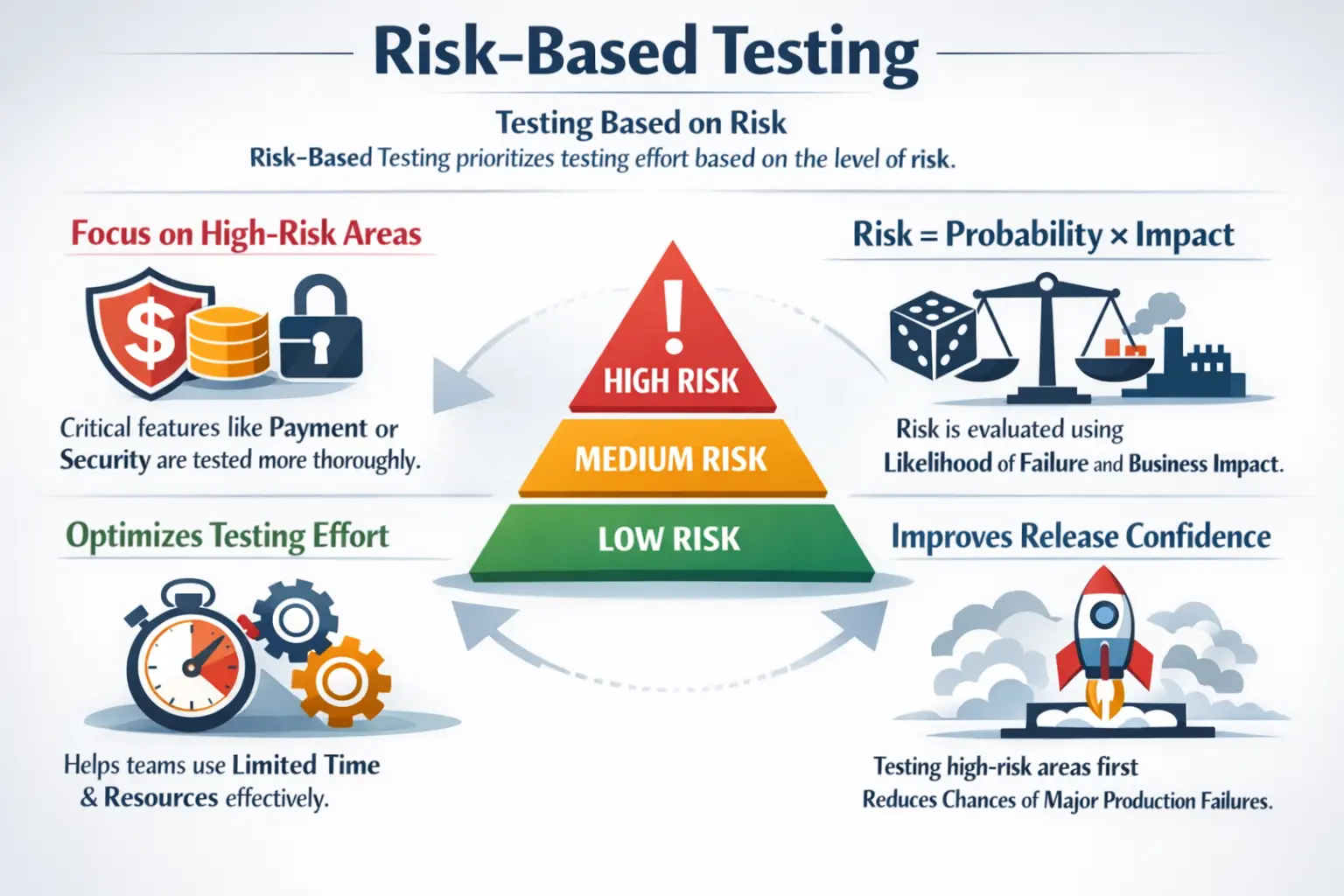
This challenge leads to the adoption of Risk-Based Testing (RBT), a strategic testing approach that prioritizes testing efforts based on the level of risk associated with different parts of the application. Instead of testing every feature with equal intensity, risk-based testing focuses more effort on areas that are most likely to fail or cause the greatest impact if they fail.
Risk-based testing answers a critical question in software quality assurance: “What should we test first and most thoroughly?”
By identifying high-risk areas and prioritizing testing accordingly, teams can detect critical issues earlier, reduce the likelihood of major production failures, and ensure that limited testing resources are used efficiently.
Understanding Risk-Based Testing
Risk-Based Testing is a testing methodology in which the planning, design, and execution of tests are driven by risk analysis. The objective is to ensure that the most important and vulnerable parts of the system receive the most attention during testing.
In this approach, testers analyze the application to identify potential risks. These risks may arise from complex business logic, new or recently modified features, integration points, or areas that have historically produced defects.
Once risks are identified, they are evaluated based on two key factors: the likelihood of failure and the impact that failure would have on the business or users. Features with the highest risk receive the highest testing priority.
This method allows testing teams to concentrate their efforts where defects would cause the most damage, thereby improving product quality while working within project constraints.
Risk-based testing is widely used in agile and large-scale enterprise environments where efficient testing strategies are essential.
What Is Risk in Software Testing
In the context of software testing, risk refers to the possibility that a feature or component may fail and cause negative consequences for the business or its users.
Risk is generally defined as a combination of two elements: probability and impact.
Probability refers to the likelihood that a failure will occur. Certain components may have a higher probability of defects due to complex logic, frequent code changes, or integration with external systems.
Impact refers to the severity of the consequences if a failure occurs. Some failures may only cause minor inconvenience, while others may result in financial losses, security breaches, or system downtime.
Risk can therefore be represented conceptually as:
Risk = Probability × Impact
A feature with a high likelihood of failure and a high impact on business operations represents the highest risk and must be tested thoroughly.
Understanding this relationship helps testing teams make informed decisions about where to focus their testing efforts.
Purpose of Risk-Based Testing
Risk-based testing provides several strategic advantages in modern software development environments.
One of the primary purposes of this approach is to optimize the use of limited testing resources. Testing teams often face strict deadlines, making it impossible to test every feature exhaustively. Risk-based testing ensures that critical areas receive the most attention.
Another important purpose is reducing the likelihood of high-impact failures. By identifying and thoroughly testing high-risk components, teams can prevent defects that could significantly disrupt business operations.
Risk-based testing also improves release confidence. When teams focus on high-risk features first, they gain a clearer understanding of the product’s stability before release.
Additionally, this approach aligns testing efforts with business priorities. Features that directly affect revenue, security, or user experience receive higher testing priority than less critical components.
Overall, risk-based testing helps organizations deliver reliable software while managing time and resource constraints effectively.
Types of Risks in Software Testing
Risks in software projects can arise from multiple sources. Understanding these sources helps testers identify potential issues early in the testing lifecycle.
Business Risks
Business risks refer to failures that directly affect the organization’s financial stability, legal compliance, or customer satisfaction.
For example, a failure in a payment processing system may prevent customers from completing transactions, leading to revenue loss.
Similarly, defects in systems that manage sensitive customer data could lead to regulatory penalties or security breaches.
Customer dissatisfaction is another form of business risk. Poor performance or frequent system crashes can damage an organization’s reputation and lead to loss of users.
Because business risks directly affect the organization’s success, they typically receive the highest testing priority.
Technical Risks
Technical risks arise from the complexity of the system or its underlying architecture.
Components that involve complex calculations, algorithms, or data transformations often carry higher technical risk because they are more prone to defects.
New features also represent technical risk. When developers implement new functionality, the code has not yet been fully validated, increasing the likelihood of defects.
Integration points between systems are another common source of technical risk. When multiple systems interact with each other, compatibility issues or communication failures may occur.
Testing teams must pay special attention to technically complex areas to ensure system stability.
Project Risks
Project risks relate to challenges within the development process rather than the software itself.
One example is tight project timelines. When deadlines are aggressive, developers may have less time to test their code thoroughly before handing it over to testers.
Another project risk is an inexperienced team. Developers or testers who are unfamiliar with the technology stack may unintentionally introduce defects.
Environment instability is also a project risk. If test environments are unreliable or frequently unavailable, testing progress may be delayed.
Recognizing project risks helps teams plan mitigation strategies and adjust their testing priorities accordingly.
Risk Identification from a Tester’s Perspective
Identifying risks is a collaborative activity that involves testers, developers, business analysts, and project managers. However, testers play a key role because they analyze requirements and system behavior closely.
One factor testers consider when identifying risk is requirement complexity. Features with complicated business logic often have a higher chance of defects.
Testers also review past defect history. Components that have previously generated many defects may continue to be problematic in future releases.
Another factor is change impact. Recently modified modules or new features are more likely to contain defects.
Integration dependencies also influence risk assessment. Systems that interact with external services or APIs may fail due to communication or compatibility issues.
Non-functional requirements such as performance, security, and scalability can also introduce risks if they are not thoroughly validated.
Through careful analysis, testers can identify areas where testing should be prioritized.
Risk Assessment
Once risks have been identified, they must be evaluated to determine their priority.
Risk assessment typically involves evaluating two parameters: likelihood and impact.
Likelihood measures how likely it is that a failure will occur. This can be categorized as high, medium, or low based on historical data, complexity, or frequency of change.
Impact measures the severity of the consequences if a failure occurs. High-impact failures may affect revenue, security, or core business functionality.
Combining likelihood and impact produces a risk priority level.
For example, a payment system failure may have high likelihood and high impact, making it a critical risk.
In contrast, a failure in a rarely used informational feature may have low likelihood and low impact.
Risk assessment helps testing teams allocate their resources effectively.
Test Prioritization Using Risk
After risks are assessed, testing activities are prioritized accordingly.
Features with high risk receive the most comprehensive testing coverage. Testers design extensive test cases covering positive scenarios, negative scenarios, boundary conditions, and integration cases.
Medium-risk features receive standard testing coverage. Testers validate core functionality and perform necessary negative testing.
Low-risk features may only receive basic validation or sanity testing.
This prioritization ensures that the most critical features are tested first and most thoroughly.
By aligning testing depth with risk level, teams can maximize defect detection within limited timeframes.
Manual Tester’s Role in Risk-Based Testing
Manual testers play an important role in implementing risk-based testing strategies.
One of their responsibilities is participating in risk identification and assessment discussions during requirement analysis.
Testers contribute valuable insights because they understand system behavior and past defect patterns.
Another responsibility is designing test cases that focus on high-risk scenarios. Instead of distributing testing effort evenly, testers concentrate on areas where failures would have the greatest impact.
Testers also prioritize test execution according to risk levels. High-risk test cases are executed earlier in the testing cycle to identify critical defects as soon as possible.
Communication is another important responsibility. Testers must clearly communicate identified risks and potential impacts to stakeholders.
By actively participating in risk management, testers help ensure that testing efforts align with project priorities.
Real-Time Example of Risk-Based Testing
Consider an online banking application that includes several modules such as account management, payment processing, profile management, and informational pages.
The payment processing module represents a high-risk component because failures could prevent financial transactions and affect customer trust.
Testing teams would therefore design extensive test cases for this module, including validation of transaction flows, error handling, security checks, and integration with external payment systems.
The account management module may represent medium risk because errors could inconvenience users but may not directly affect financial transactions.
Testing for this module would include functional validation and basic negative testing.
Informational pages that display static content represent low risk. Testing may only involve verifying that pages load correctly and display accurate information.
By prioritizing testing effort based on risk, the team ensures that critical functionality is thoroughly validated before release.
Risk-Based Testing vs Exhaustive Testing
Risk-based testing differs significantly from exhaustive testing.
Exhaustive testing attempts to test every possible input combination and scenario within the system.
While this approach may theoretically detect all defects, it is impractical for real-world applications because the number of possible combinations can be extremely large.
Risk-based testing, on the other hand, focuses on prioritization. Instead of testing everything equally, teams concentrate on the most critical areas first.
This approach is more practical and aligns better with business priorities.
Most modern software projects rely on risk-based testing rather than exhaustive testing due to time and resource constraints.
Common Mistakes in Risk-Based Testing
Although risk-based testing is highly effective, certain mistakes can reduce its effectiveness.
One common mistake is ignoring business input during risk assessment. Business stakeholders often understand the potential impact of failures better than technical teams.
Another mistake is treating all features as having equal risk. Doing so defeats the purpose of prioritization.
Some teams also fail to revisit risk assessments when requirements change. As the system evolves, new risks may emerge.
Effective risk-based testing requires continuous reassessment and collaboration between technical and business teams.
Risk-Based Testing Mindset
Risk-based testing is not simply a technique for reducing test cases. It is a mindset for making smarter testing decisions. The tester accepts that time is limited, defects are not distributed equally, and some failures are far more damaging than others. Instead of pretending that every feature deserves the same effort, risk-based testing asks the team to focus attention where failure would hurt the most.
This mindset requires testers to think beyond test case counts. Executing many low-risk tests may look productive, but it may not protect the release. A smaller number of well-chosen tests around payment, authentication, customer data, reporting accuracy, or compliance may provide much stronger release confidence. The value of testing is measured by risk reduction, not only by volume.
Risk-based thinking also helps testers communicate better with stakeholders. Instead of saying "we need more time to test everything," testers can explain which areas create the highest release risk and why. This makes testing discussions more practical and business-focused. Stakeholders can then decide whether to add time, reduce scope, accept risk, or change priorities.
A mature risk-based tester is not careless with low-risk areas. Basic validation is still needed across the application. The difference is depth. High-risk areas receive deeper functional, negative, boundary, integration, regression, and exploratory testing. Low-risk areas receive appropriate but lighter validation. This balance makes testing both efficient and defensible.
Risk Probability in Detail
Probability refers to how likely a failure is to occur. Testers estimate probability by looking at complexity, change frequency, defect history, technology maturity, team experience, integration dependencies, and requirement clarity. The more unstable or complex an area is, the higher the probability of defects.
New features usually have higher probability because they have not been proven in previous releases. Recently modified areas also carry higher probability because changes can introduce unintended side effects. A module that has repeatedly produced defects in the past should also be treated as more likely to fail again.
Complex business logic increases probability. A simple static content page may have low defect probability, while a loan eligibility engine with multiple rules, calculations, exceptions, and user categories has much higher probability. The more decision paths a feature contains, the more opportunities exist for defects.
External dependencies increase probability as well. If a feature depends on third-party APIs, payment gateways, email services, identity providers, or data feeds, failures may occur due to integration mismatches, timeouts, configuration errors, or version changes. Testers should consider these dependencies during risk assessment.
Risk Impact in Detail
Impact describes the seriousness of the consequence if a failure occurs. A feature may have low probability of failure but very high impact if it fails. For example, an authentication failure may not happen often, but if users cannot log in, the business impact is severe. Similarly, a rare data corruption issue can be more serious than many common visual defects.
Business impact includes revenue loss, customer dissatisfaction, legal penalties, operational disruption, reputational damage, and support cost. A checkout failure in an e-commerce site directly affects revenue. A privacy defect in a healthcare system may create regulatory exposure. A reporting defect in finance may affect business decisions.
User impact should also be considered. If a defect blocks a core user journey, affects many users, or prevents users from completing important tasks, the impact is high. Even if the technical issue is small, the user-facing consequence may be significant.
Impact is often best understood with business input. Testers may understand technical behavior, but product owners and business stakeholders understand operational consequences. Risk-based testing works best when impact is evaluated collaboratively rather than by the test team alone.
Risk Matrix for Testing Priority
A risk matrix is a simple way to combine probability and impact. The matrix usually classifies each feature or scenario as high, medium, or low risk. A feature with high probability and high impact becomes a top testing priority. A feature with low probability and low impact receives lighter coverage.
For example, payment processing may have high impact because failure affects revenue and customer trust. If the payment module is newly changed or integrated with a new gateway, probability is also high. This places payment processing in the highest risk category and justifies deep testing.
A static help page may have low probability and low impact. It still needs basic validation, such as checking that the page loads and content is correct, but it does not require the same depth as payment testing. This is how the risk matrix guides effort allocation.
Risk matrices do not need to be complex. A simple table with feature, probability, impact, risk level, and testing approach is often enough. The value comes from making risk decisions visible and agreed upon. When priorities are documented, testing choices become easier to explain.
Risk-Based Test Planning
Risk-based testing should begin during test planning, not only during execution. During planning, the test team identifies critical business flows, high-change areas, complex modules, integrations, and historically unstable components. These areas shape the test strategy, estimation, schedule, and resource allocation.
The test plan should clearly state how risk affects scope. High-risk areas may require detailed test cases, exploratory sessions, regression coverage, negative testing, boundary testing, integration testing, and business validation. Medium-risk areas may receive standard functional and regression coverage. Low-risk areas may receive smoke or sanity-level checks.
Risk-based planning also affects scheduling. High-risk tests should be executed earlier in the cycle. Finding a major payment or login defect on the final day creates schedule pressure and release risk. Testing critical areas early gives developers more time to fix issues and testers more time to re-test and regress.
Planning should also include contingency. If high-risk areas are unstable, additional test cycles may be needed. If critical dependencies are unavailable, alternate testing strategies such as mocks, staged data, or partial validation may be required. Risk-based planning prepares the team for realistic project conditions.
Risk-Based Test Case Design
In risk-based testing, test case design depth depends on risk level. High-risk features require more detailed test design. Testers should cover happy paths, negative scenarios, boundary values, role-based behavior, exception handling, integration points, data validation, and end-to-end flows. The goal is to reduce the chance of serious defects escaping.
Medium-risk features need balanced coverage. Testers validate core business behavior, important negative conditions, and reasonable edge cases. They may not test every rare combination, but they ensure the feature works correctly for common and meaningful scenarios.
Low-risk features still need testing, but the scope may be lighter. A low-risk informational page may need content verification, link checks, and basic layout validation. It may not need extensive negative testing or deep regression unless it is connected to a broader workflow.
Risk-based design should also avoid duplication. If a low-risk area has many repetitive test cases, the team may reduce them and shift effort toward higher-risk functionality. The purpose is not to reduce quality; it is to place quality effort where it has the greatest value.
Risk-Based Test Execution
Risk-based execution determines the order in which tests are run. High-risk test cases should be executed early. This helps teams discover critical defects sooner and avoid late surprises. If a high-risk module fails early, the team can adjust plans, fix defects, and perform additional regression.
Execution order matters because time often runs out. If low-risk cases are executed first and high-risk cases are left for the end, the team may discover serious defects too late. Risk-based execution protects the schedule by front-loading important validation.
Risk-based execution is especially useful during regression testing. After a change, testers may not have time to run the full regression suite. Risk analysis helps select the most important regression cases based on changed areas, impacted workflows, business criticality, and defect history.
Testers should update execution priorities as new information appears. If early testing reveals many defects in a module, that module may become higher risk and require additional coverage. Risk-based execution is dynamic, not fixed once at the beginning.
Risk-Based Regression Testing
Regression testing is one of the best places to apply risk-based thinking. Full regression may be too large to execute after every change, especially in Agile or continuous delivery environments. Risk-based regression helps testers choose the most important existing functionality to re-test.
Regression risk depends on what changed and what depends on it. If a change affects authentication, regression should include login, logout, password reset, session timeout, role-based access, and protected pages. If a change affects tax calculation, regression should include checkout, invoice, refund, reporting, and order history.
High-risk regression suites usually include critical business flows, frequently used workflows, high-defect modules, integration points, and areas affected by recent changes. Low-risk cases may be rotated across cycles or executed less frequently depending on time and automation coverage.
Risk-based regression does not mean randomly skipping tests. It means selecting tests based on impact analysis and business priority. The selection should be documented so stakeholders understand what was covered and what risk remains.
Risk-Based Testing in Agile Projects
Agile teams work in short iterations, so risk-based testing is highly valuable. Testers must make quick decisions about what to test deeply within a sprint. Risk discussions should begin during backlog refinement, where user stories, acceptance criteria, dependencies, and complexity are reviewed.
During sprint planning, testers can identify high-risk stories and plan stronger coverage for them. A story involving payment, customer data, security, or complex business rules may need more test design effort than a simple content update. This helps the team estimate testing effort more realistically.
During the sprint, risks may change. A story that looked simple may become risky if requirements change, development is delayed, or defects appear. Agile testers should continuously reassess risk during daily collaboration and adjust testing priorities accordingly.
At the end of the sprint, risk-based testing supports the Definition of Done. A story should not be considered done if high-risk acceptance criteria remain untested or critical defects are unresolved. Agile speed should not come at the cost of hidden risk.
Risk-Based Testing in Release Decisions
Risk-based testing directly supports release decisions. Stakeholders do not only need to know how many tests passed; they need to know whether the highest-risk areas were tested and whether any serious risks remain. A release with many passed low-risk tests but failed critical flows is not ready.
Test reports should highlight risk coverage. For example, the report may state that all critical checkout scenarios passed, authentication regression passed, and no high-severity defects remain in payment. This gives stronger release confidence than a generic pass percentage.
If high-risk areas remain untested or blocked, the report should say so clearly. Stakeholders may decide to delay release, reduce scope, add testing time, or accept risk. Risk-based reporting helps them make conscious decisions rather than assumptions.
Release decisions should be based on known risk. Risk-based testing provides the evidence needed to understand that risk. It makes quality discussions more meaningful because they focus on business impact and product readiness.
Practical Example: E-Commerce Risk-Based Testing
Consider an e-commerce application with product browsing, search, cart, checkout, payment, order confirmation, profile management, and static help pages. If the team has limited testing time, it should not test every area with equal depth. Checkout and payment carry high business impact because defects can prevent revenue and damage customer trust.
Product search may be medium risk because it affects customer experience and conversion, but it may not directly process money. Static help pages may be low risk because they provide information and are less likely to cause severe business failure. This classification guides testing depth.
For checkout and payment, testers should cover successful payment, failed payment, timeout, duplicate click, coupon interaction, tax calculation, shipping charges, order creation, confirmation email, inventory update, and refund impact. For static pages, basic content and link validation may be enough.
If defects are found in payment during early execution, the risk level remains high and additional regression may be needed. If static pages pass basic checks, the team can avoid spending excessive time there. This is risk-based testing in action.
Practical Example: Healthcare Risk-Based Testing
In a healthcare application, risk-based testing becomes even more important because failures can affect patient safety, privacy, and compliance. Features such as patient record access, prescription updates, appointment scheduling, diagnosis history, and lab result reporting may have different risk levels.
Patient record security is high risk because unauthorized access can violate privacy laws and damage trust. Prescription updates are high risk because incorrect data may affect treatment. Appointment reminders may be medium risk depending on business context. Informational pages may be lower risk.
High-risk healthcare features require role-based access testing, audit trail validation, data accuracy checks, negative testing, boundary testing, and workflow validation. Testers must verify not only that the feature works but also that unsafe actions are prevented.
This example shows that risk is domain-dependent. The same type of feature may have different risk in different industries. A profile update may be low risk in a casual app but high risk in a medical or banking system if sensitive information is involved.
Risk-Based Testing and Defect History
Defect history is one of the most useful inputs for risk-based testing. Modules that produced many defects in previous releases often deserve more attention in future testing cycles. Past behavior does not guarantee future failure, but it provides strong evidence of potential weakness.
Testers should review previous defect reports, production incidents, reopened defects, and customer complaints. If a module repeatedly fails around boundary values, calculations, integrations, or permissions, those areas should receive deeper testing. Defect history helps teams focus on real patterns instead of guesses.
Reopened defects are especially important. They may indicate incomplete fixes, unclear requirements, or difficult logic. A feature with many reopened defects should be considered higher risk even if the current change appears small.
Production defects should strongly influence risk priority. If a defect escaped to production in a particular workflow, that workflow should receive stronger regression and exploratory testing in later releases. Risk-based testing learns from history.
Risk-Based Testing and Impact Analysis
Impact analysis and risk-based testing work closely together. Impact analysis identifies what may be affected by a change. Risk-based testing decides how deeply those impacted areas should be tested. Together, they help teams manage change safely.
Suppose a change modifies discount calculation logic. Impact analysis may identify checkout, invoice, order summary, refund, and reporting as affected areas. Risk-based testing then prioritizes these areas based on business impact and failure probability. Checkout and invoice may receive deeper testing than internal reporting if release time is limited.
Without impact analysis, risk-based testing may miss affected areas. Without risk-based thinking, impact analysis may produce too much scope without prioritization. Combining both gives a practical and focused strategy.
Testers should document both the impacted areas and the risk level assigned to each. This makes testing decisions transparent and helps stakeholders understand why certain areas receive more attention.
Risk-Based Testing Checklist
A practical checklist helps teams apply risk-based testing consistently. First, identify business-critical workflows. These usually include revenue, security, compliance, data integrity, customer access, and high-volume user journeys. Second, identify recently changed or newly developed areas because they have higher probability of defects.
Third, review historical defect patterns. Modules with frequent defects, production incidents, or reopened issues deserve more attention. Fourth, identify integration points and external dependencies. These areas often fail due to configuration, data mapping, timeout, or compatibility problems.
Fifth, classify each area by likelihood and impact. Sixth, define the testing depth for high, medium, and low-risk areas. Seventh, execute high-risk tests early. Eighth, update risk assessment when new defects, changes, or blockers appear.
Finally, report testing results in risk terms. Instead of saying only how many test cases passed, explain whether high-risk areas were validated successfully and whether any serious risks remain. This makes the checklist useful from planning through reporting.
Reporting Risk-Based Testing Results
Risk-based testing results should be reported differently from ordinary execution results. The report should show whether high-risk areas were tested, what defects were found, what risks remain, and whether release confidence is acceptable. Stakeholders need risk visibility, not just test counts.
A useful report may categorize results by risk level. High-risk features can be listed with execution status, defect status, blocker status, and release recommendation. Medium and low-risk areas can be summarized more briefly. This structure keeps attention on the most important quality concerns.
If a high-risk feature is not fully tested, the report must state that clearly. For example, "Payment refund regression remains blocked due to gateway downtime; release risk is high if refund flow is included." This is more useful than hiding the issue under general blocked case counts.
Risk-based reporting helps stakeholders make informed decisions. They can decide to fix, defer, test more, reduce scope, or accept risk. The tester's role is to provide honest evidence and clear interpretation.
Best Practices for Risk-Based Testing
The first best practice is to involve business stakeholders in risk assessment. Testers and developers may understand technical probability, but business users understand operational impact. Combining both views creates better risk decisions.
The second best practice is to reassess risk continuously. Risk changes when requirements change, defects appear, fixes are applied, environments fail, or new dependencies are introduced. A risk assessment made at the beginning of a release should not remain frozen.
The third best practice is to test high-risk areas early. Early testing gives the team time to fix, re-test, and regress critical issues. Late discovery of high-risk defects creates release pressure and poor decision-making.
The fourth best practice is to document assumptions and coverage. If a low-risk area receives only basic testing, note that decision. If a high-risk area is blocked, report it clearly. Documentation makes risk decisions transparent.
The fifth best practice is to use risk-based testing as a quality strategy, not as an excuse to skip testing. The goal is not to do less testing blindly. The goal is to apply the right amount of testing in the right places.
Interview-Ready Explanation
In software testing interviews, candidates are often asked to explain risk-based testing.
A concise explanation states that risk-based testing prioritizes testing activities based on the likelihood and impact of potential failures.
A more detailed explanation highlights that risk-based testing focuses testing effort on high-risk areas first to optimize resources and reduce business risk.
Providing examples such as prioritizing payment processing over informational pages demonstrates practical understanding.
Understanding risk-based testing shows that a tester can align quality assurance efforts with real-world project constraints.
Key Takeaway
Risk-Based Testing is a strategic approach that focuses testing effort on the most critical and vulnerable areas of an application.
By evaluating both the probability of failure and the impact of potential defects, testing teams can prioritize their efforts effectively.
This approach ensures that high-risk components are tested thoroughly while optimizing limited testing time and resources.
Risk-based testing improves release confidence, reduces business risk, and aligns quality assurance activities with business priorities.
Ultimately, risk-based testing ensures that the most important parts of the system receive the attention they deserve, helping organizations deliver reliable software in complex and time-sensitive environments.