Test Plan to Planning Software Testing Activities
A Test Plan is one of the most important documents in software testing. It provides a structured approach for planning and controlling testing activities throughout the project lifecycle. Without a clear test plan, testing efforts can become disorganized, leading to missed requirements, unclear responsibilities, and inconsistent testing practices. A well-prepared test plan ensures that testing activities are predictable, systematic, and aligned with project goals.
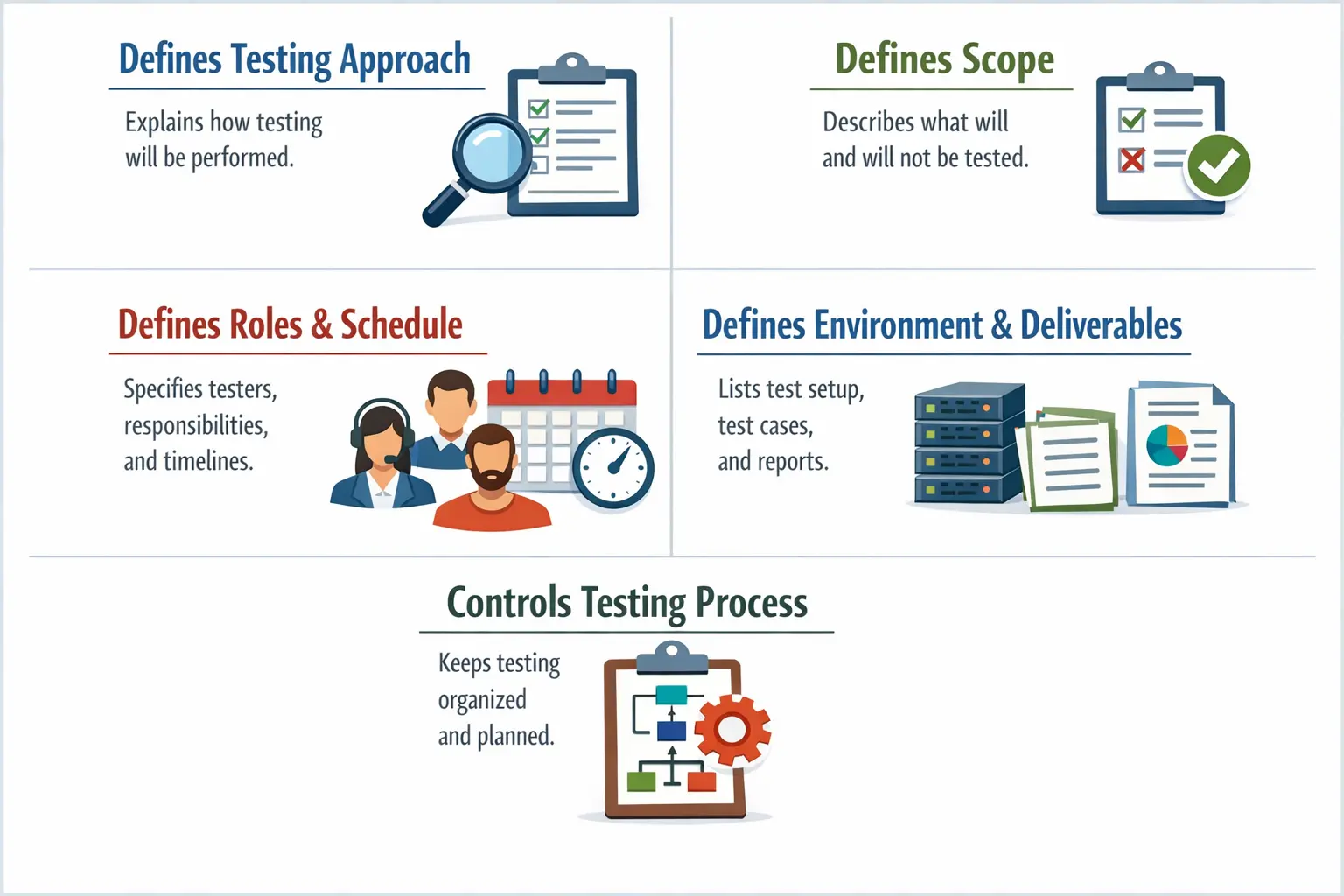
A Test Plan is a formal document that describes the scope, approach, resources, schedule, and responsibilities of testing activities for a project. It defines how testing will be conducted and serves as a roadmap for the entire testing process.
A test plan essentially answers one central question:
“How will testing be performed?”
This document is used by testers, developers, project managers, and stakeholders to understand how testing will be executed and controlled. It also serves as a reference throughout the project and often becomes part of official project documentation.
A test plan is not just a formality or a document created for process compliance. It is a practical management tool. It helps the team decide what must be tested, how deeply it must be tested, when testing will happen, who will perform each activity, what environments are required, what risks may affect testing, and what evidence will be produced at the end. When a project becomes busy, the test plan becomes the reference that prevents confusion.
In real projects, testing often fails not because testers do not know how to test, but because planning is weak. Requirements may change, builds may arrive late, test data may be missing, environments may be unstable, or responsibilities may be unclear. A good test plan anticipates these practical issues and gives the team a shared operating model before execution begins.
Purpose of a Test Plan
The primary purpose of a test plan is to clearly define how testing activities will be organized and executed. Software testing involves many moving parts including test cases, environments, schedules, and resources. Without planning, it is difficult to ensure that testing is complete and effective.
A test plan defines the scope and objectives of testing so that all stakeholders understand what will be validated and what will not. This prevents confusion and ensures that expectations are aligned across teams.
Another important purpose is to establish timelines and responsibilities. Testing activities must be coordinated with development and release schedules. A test plan helps ensure that testing tasks are completed on time and that responsibilities are clearly assigned.
The test plan also identifies potential risks and mitigation strategies. Software projects often depend on external systems, unstable builds, or limited resources. Planning for these risks helps reduce project delays and quality issues.
The document also serves as a reference point throughout the testing process. Testers use the test plan to guide their work, and managers use it to track progress and ensure compliance with project standards.
A test plan also supports decision-making. If a release date is approaching and testing is not complete, the team can use the test plan to review priority, risk, pending scope, open defects, and exit criteria. It becomes easier to decide whether to continue testing, reduce scope, defer low-risk areas, or escalate blockers. Without a plan, these decisions often become emotional or deadline-driven instead of evidence- driven.
Another purpose is communication. Testing involves many stakeholders, and each stakeholder may have different expectations. Business users may care about critical workflows. Developers may care about defect clarity. Project managers may care about schedule. Compliance teams may care about documentation. A test plan brings these expectations into one document so they can be reviewed and agreed upon early.
Importance of a Test Plan
A test plan is essential for maintaining control and structure in a software testing project. It ensures that testing is not performed randomly but follows a defined strategy and process.
One of the most important benefits of a test plan is stakeholder alignment. Developers, testers, and project managers must share a common understanding of the testing approach. The test plan ensures that everyone agrees on the testing scope and expectations before testing begins.
A test plan also improves planning and predictability. When testing activities are defined in advance, project managers can estimate timelines and resource requirements more accurately. This leads to better project control and fewer surprises during execution.
Another key benefit is preventing scope creep. Without a test plan, testing scope may gradually expand as new requests are added. A clearly defined test plan establishes boundaries and ensures that additional testing activities are formally approved.
Test plans are also important for compliance and auditing purposes. Many organizations require documented testing processes to demonstrate quality assurance practices. A test plan provides evidence that testing activities were planned and executed systematically.
In regulated industries such as banking, healthcare, and insurance, test plans are often mandatory documentation.
Even in non-regulated projects, test plans are useful because they reduce dependency on individual memory. If a tester leaves the project, if a new test lead joins, or if the project is paused and resumed later, the test plan explains what was intended. This continuity is important for long-running products and enterprise systems where releases happen repeatedly.
A test plan also improves accountability. When roles, deliverables, scope, and schedule are written down, it becomes easier to track progress and identify blockers. It also prevents the common situation where everyone assumes someone else is handling environment setup, test data preparation, or defect triage.
Test Planning as a Risk Control Activity
Test planning is not only about listing test cases. It is also about controlling risk. Every project has risks: unstable requirements, late builds, complex integrations, unavailable test data, tight timelines, unclear ownership, third-party dependencies, and critical defects near release. A strong test plan identifies these risks before they become emergencies.
Risk-based planning helps the team decide where testing effort should be focused. A payment module, login security flow, customer registration, fund transfer, medical record update, or tax calculation may require more coverage than a low-impact static page. The test plan should reflect this priority. Testing effort should follow business risk, not simply the number of screens.
Risk control also includes mitigation. If a third-party API may be unavailable, the plan may include a mock service. If test data is difficult to prepare, the plan may assign data preparation early. If environments are unstable, the plan may define smoke checks before full execution. This makes testing more predictable.
Structure of a Test Plan (IEEE-Style)
A standard test plan usually follows a structured format based on IEEE testing standards. This structure ensures that all important aspects of testing are covered in a consistent manner.
The exact format may vary by organization, but the intent remains the same. A test plan should be clear enough for testers to execute, detailed enough for leads to manage, and understandable enough for stakeholders to approve. It should not be filled with generic text that could apply to any project. A useful test plan is specific to the application, release, scope, risks, and team.
Test Plan Identifier
The test plan identifier provides a unique name or number for the test plan document. It usually includes a version number so that changes can be tracked over time.
Version control is important because test plans often evolve as the project progresses. Each update should include a new version number and revision history.
This section ensures traceability and proper document management.
Introduction
The introduction provides a high-level overview of the test plan. It explains the purpose of testing and the context of the project.
This section typically describes the application under test and the objectives of testing. It may also reference requirement documents or design specifications.
The introduction helps readers quickly understand the scope and purpose of the testing effort.
Test Items
Test items refer to the modules or components that will be tested. This section identifies the parts of the system included in the testing scope.
Examples of test items include login modules, payment processing components, reporting systems, or user interfaces.
Clearly defining test items helps ensure that no important components are overlooked during testing.
Features to Be Tested
This section describes the functionalities that will be validated during testing. It defines the functional areas included in the testing scope.
For example, features to be tested in an e-commerce application might include product search, shopping cart functionality, checkout process, and order confirmation.
Clearly identifying features to be tested ensures that testing coverage is complete and aligned with requirements.
Features Not to Be Tested
This section explicitly identifies functionalities that are excluded from testing. Defining exclusions is as important as defining inclusions.
Features may be excluded due to time constraints, project priorities, or separate testing activities such as performance or security testing.
Clearly stating what will not be tested prevents misunderstandings and unrealistic expectations.
This section is often underestimated. Many conflicts happen because stakeholders assume something is being tested when it is not. For example, a QA team may test functional flows but not performance, security, accessibility, or cross-browser coverage unless those are explicitly planned. Listing exclusions protects the team from hidden assumptions and gives stakeholders a chance to raise concerns before testing starts.
Test Approach
The test approach describes the overall testing methodology and strategy. It explains how testing will be performed.
This section typically includes testing levels such as system testing and integration testing. It may also describe manual testing approaches and test case design techniques.
The test approach helps stakeholders understand the testing process and ensures consistency across testing activities.
The test approach should explain the testing levels and types that are relevant to the project. It may include smoke testing, functional testing, integration testing, system testing, regression testing, usability checks, compatibility checks, or acceptance support. It should also mention whether testing will be manual, automated, or a combination of both. If automation is included, the plan should define what will be automated and what will remain manual.
The approach should also explain test design techniques where useful. For example, the team may use Equivalence Partitioning and Boundary Value Analysis for input validation, Decision Table Testing for business rules, State Transition Testing for workflow status changes, and Use Case Testing for end-to-end business flows. This makes the test design approach more professional and transparent.
Entry and Exit Criteria
Entry criteria define the conditions that must be satisfied before testing can begin. These conditions may include stable builds, available environments, and approved requirements.
Exit criteria define the conditions required to complete testing. These conditions may include execution of all planned test cases and resolution of critical defects.
Entry and exit criteria ensure that testing begins and ends in a controlled and measurable way.
Entry criteria protect the testing team from starting too early. If the build is unstable, requirements are not approved, test data is unavailable, or the environment is not ready, formal testing may produce noisy results. Exit criteria protect the business from stopping too early. If critical defects remain open or major flows are not tested, release confidence is weak. Together, entry and exit criteria create discipline.
Test Deliverables
Test deliverables are the outputs produced during testing. These documents provide evidence of testing activities and results.
Typical deliverables include test cases, test execution reports, defect reports, and summary reports.
Defining deliverables in advance ensures that documentation requirements are met.
Test Environment
The test environment section describes the hardware and software configurations used for testing.
This includes operating systems, browsers, databases, and network configurations.
A well-defined test environment ensures consistent and repeatable testing results.
Environment configuration errors are a common cause of testing issues, making this section particularly important.
The test environment section should be precise. It should define URLs, application versions, database versions, supported browsers, operating systems, mobile devices, test accounts, integrations, email/SMS services, payment simulators, and any feature flags required for testing. If multiple environments exist, such as QA, staging, and UAT, the plan should explain the purpose of each.
Environment readiness should also be tracked. A technically correct test plan is not useful if the environment is unavailable during execution. Many teams include environment owners and support contacts in the plan so issues can be resolved quickly.
Test Data
Test data is one of the most practical parts of test planning. A project may have good test cases and a stable environment, but testing can still be blocked if data is missing. The test plan should describe what data is required, who will prepare it, how it will be refreshed, and whether sensitive data must be masked.
For example, a banking project may need active accounts, inactive accounts, locked users, beneficiaries, low-balance accounts, high-value transaction accounts, and different customer types. An e-commerce project may need products in stock, out-of-stock products, discount coupons, different shipping addresses, and test payment cards. Planning this data early prevents execution delays.
Roles and Responsibilities
This section defines the responsibilities of each team member involved in testing.
Responsibilities may include test planning, test case creation, test execution, and defect tracking.
Clearly defined roles improve accountability and coordination.
Stakeholders such as project managers and developers may also be included in this section.
Test Schedule
The test schedule outlines testing timelines and milestones. It defines when testing activities will begin and end.
Milestones may include test case completion, test execution phases, and reporting deadlines.
A realistic test schedule helps ensure that testing aligns with project timelines.
The schedule should account for more than execution days. It should include test planning, test case design, test data preparation, environment readiness, smoke testing, functional execution, defect retesting, regression, reporting, and closure. If defect fixing and retesting time are not considered, the schedule will be unrealistic.
Test schedules should also include dependencies on development. If builds are delivered late, testing cannot magically finish on the original date without reducing scope, increasing resources, or accepting risk. A good test plan makes these dependencies visible.
Risks and Mitigation
Software testing projects often face risks such as unstable builds, resource shortages, or external dependencies.
This section identifies potential risks and defines strategies to reduce their impact.
For example, a project might depend on a third-party API that may be unavailable during testing. A mitigation strategy might include using mock services.
Risk planning improves project stability and reduces delays.
Assumptions and Dependencies
Assumptions describe conditions expected to be true during testing. Dependencies describe external factors that testing relies on.
For example, testing may assume that development will deliver stable builds on schedule.
Dependencies may include external services, hardware availability, or data preparation.
Identifying assumptions and dependencies helps prevent misunderstandings.
Approvals
The approvals section includes sign-off from stakeholders who agree with the test plan.
Approvals confirm that the testing approach and scope have been accepted.
This provides formal authorization to begin testing activities.
Manual Tester’s Role in Test Planning
Manual testers contribute significantly to the creation and execution of test plans. Testers help define testing scope by identifying important user scenarios and system functionalities.
Testers also help identify risks and dependencies because they understand testing challenges and system behavior.
During test execution, testers follow the test plan to ensure consistency and completeness.
When project scope changes, testers may need to update the test plan to reflect new requirements or priorities.
Active involvement of testers ensures that the test plan is realistic and practical.
Manual testers are often closest to the real behavior of the application, so their input is essential. They can identify high-risk flows, confusing requirements, missing test data, environment concerns, and areas where users are likely to face problems. A test plan created without tester input may look complete on paper but fail during execution.
Testers also help make the plan executable. They understand how long test case creation may take, which regression areas are heavy, which modules are unstable, and which integrations frequently fail. Their practical experience improves estimation and avoids unrealistic commitments.
Test Plan vs Test Strategy
A test plan is often confused with a test strategy, but the two documents serve different purposes.
A test plan is project-specific and provides detailed information about testing activities for a particular project. It includes scope, schedule, environments, and responsibilities.
A test strategy is usually defined at the organizational level and describes general testing principles and standards followed across projects.
Test strategies provide high-level guidance, while test plans provide detailed execution instructions.
For example, an organization may have a test strategy stating that all projects should use risk-based testing, maintain traceability, automate stable regression scenarios, and follow defect severity standards. A specific test plan then explains how those principles will be applied to a banking mobile app release, an e-commerce checkout enhancement, or a healthcare reporting module.
In simple terms, the test strategy is the broader rulebook, while the test plan is the project-specific execution map. Both are useful, but they should not be confused.
Test Plan in Agile Projects
In Agile projects, test planning still matters, but it may be lighter and more iterative. Instead of a large document created once at the beginning, Agile teams may maintain a living test plan that evolves across sprints. The plan may define sprint testing approach, regression scope, automation focus, environments, responsibilities, and release-level risks.
Agile test planning should happen during backlog refinement, sprint planning, and release planning. Testers should identify testable acceptance criteria, data needs, dependencies, and risk areas before development is complete. This shift-left planning helps reduce surprises late in the sprint.
A lightweight Agile test plan may be stored in a wiki, test management tool, project board, or release checklist. The format is less important than the clarity. The team should still know what is in scope, what is out of scope, what risks exist, what environments are used, and what must be true before release.
Test Plan and Traceability
Traceability connects requirements, test cases, defects, and execution results. A test plan should define how traceability will be maintained. This is especially important in projects where stakeholders need to know whether every requirement has been covered.
Traceability helps answer important questions: Which requirements have test cases? Which test cases have passed? Which requirements are blocked by defects? Which areas have not been tested? Without traceability, test status becomes vague and difficult to defend.
In regulated industries, traceability may be mandatory. Even in ordinary projects, it improves transparency and helps teams avoid missed requirements.
Test Metrics and Reporting in a Test Plan
A test plan should define what metrics will be tracked and reported. Common metrics include test cases planned, test cases executed, pass count, fail count, blocked count, defect count, defect severity, defect aging, retest status, and requirement coverage.
Metrics should support decision-making, not just reporting. For example, a high pass percentage may look good, but if critical payment tests are blocked, the release may still be risky. Similarly, a high defect count in a low-risk module may be less serious than one open critical defect in a fund transfer module. The test plan should encourage meaningful interpretation of metrics.
Reporting frequency should also be planned. Daily status reports may be needed during active execution, while weekly summaries may be enough during test design. Release-level test summary reports should align with exit criteria and stakeholder needs.
Real-Time Example
Consider a banking application project. The test plan might define account management and fund transfer features as part of the testing scope.
Performance testing might be excluded if it is handled by a separate team.
The test environment might include supported browsers and operating systems.
One major risk might be dependency on external payment services. A mitigation strategy might include using test environments or simulators.
This example shows how a test plan provides practical guidance for testing activities.
A stronger banking test plan would also define supported user roles, such as retail customer, corporate customer, bank admin, and support user. It would identify test data such as active accounts, dormant accounts, insufficient balance accounts, blocked beneficiaries, and high-value transfer users. It would define environments for core banking integration, OTP service, SMS/email notification, and transaction reporting.
The plan would also document risks. External payment or core banking systems may be unstable. Test OTPs may fail. Transaction data may need masking. Performance and security testing may be handled by separate teams. Without documenting these points, the team may discover blockers only after execution starts.
How to Review a Test Plan
A test plan should be reviewed before execution begins. Reviewers should check whether the scope is clear, exclusions are explicit, approach is realistic, roles are assigned, schedule is achievable, environment is available, test data is planned, risks are identified, and entry and exit criteria are measurable.
The review should involve QA leads, testers, project managers, business analysts, developers, and other relevant stakeholders. Each group sees different risks. Developers may identify technical dependencies. Business analysts may identify missing business flows. Testers may identify execution blockers. Managers may identify schedule or resource conflicts.
Review comments should be resolved before formal approval. A test plan with unresolved assumptions can create confusion later.
Maintaining and Updating the Test Plan
A test plan should not become outdated. If requirements change, release scope changes, environments change, resources change, or risks change, the test plan should be updated. An outdated test plan can be worse than no test plan because it gives a false sense of clarity.
Version history is important. Each update should explain what changed and why. This is useful when stakeholders later ask why certain features were included, excluded, delayed, or tested differently.
In Agile teams, test plan updates may be lightweight but should still be visible. A release test plan may be updated sprint by sprint as new stories are added and risks are discovered.
Common Mistakes in Test Planning
One common mistake is creating overly generic test plans that do not reflect the specific project requirements. A test plan must be tailored to the project to be useful.
Another mistake is failing to update the test plan when project scope changes. Outdated test plans can lead to confusion and incomplete testing.
Ignoring risks and dependencies is another frequent problem. Unexpected issues can delay testing if risks are not identified early.
Effective test planning requires continuous review and updates.
Another common mistake is copying a test plan from an older project without adapting it. Templates are useful, but blindly reused content creates weak planning. Every project has different scope, risks, dependencies, environments, and stakeholders. The test plan must reflect the current project.
A further mistake is writing vague entry and exit criteria. Statements such as "testing starts when build is ready" or "testing ends when testing is complete" are not useful. Criteria should be measurable. For example, "smoke tests passed", "test environment deployed", "all critical test cases executed", and "no open severity 1 defects" are clearer.
Some teams also ignore test data planning. This creates execution delays even when test cases and environments are ready. Test data should be treated as a first-class planning item, not an afterthought.
Interview Perspective
Test plans are a common topic in software testing interviews because they demonstrate understanding of testing processes and project organization.
A short answer might be:
A test plan is a document that defines the scope, approach, resources, and schedule of testing activities.
A more detailed answer would explain that a test plan describes how testing will be conducted, what will be tested, who will perform testing, and how risks will be managed.
Interviewers often expect candidates to understand both the purpose and structure of a test plan.
Project-based answer:
In a real project, a test plan explains how testing will be performed for a specific release or project. It includes scope, features to be tested, exclusions, test approach, entry and exit criteria, test environment, test data, roles and responsibilities, schedule, risks, mitigation, deliverables, and approvals. It helps the team align expectations and execute testing in a controlled way.
A strong interview answer should also mention that a test plan must be updated when scope or risks change. It is not just a document created once; it is a practical guide for managing testing activities.
Practical Test Plan Checklist
Before approving a test plan, check whether the project scope is clear, objectives are defined, features to be tested are listed, features not to be tested are documented, and the test approach is realistic. Confirm whether testing levels and types are specified and whether manual and automation responsibilities are clear.
Also check entry criteria, exit criteria, test deliverables, environment details, test data needs, roles, schedule, risks, assumptions, dependencies, and approvals. If any of these sections are vague, the team may face confusion during execution.
Finally, confirm that the test plan is project-specific. A useful test plan should clearly reflect the application, release, team, risks, and business priorities being tested.
Key Takeaway
A Test Plan is the foundation of organized and effective software testing. It defines how testing will be performed, what will be tested, and who will perform testing activities.
Without a test plan, testing becomes unpredictable and difficult to manage. With a well-defined test plan, testing becomes structured, controlled, and transparent.
A strong test plan improves communication, reduces risks, and ensures consistent testing practices across the project lifecycle.