Features of Java – A Complete Overview
Java is one of the most widely used programming languages in the world. Its popularity is not accidental. It is built on a carefully designed set of language and runtime features that make it reliable, portable, secure, scalable, and suitable for enterprise-grade systems.
These features were intentionally created to solve real-world software development problems such as platform dependency, memory management complexity, security risks, and system instability. Let us examine the core features of Java in detail.
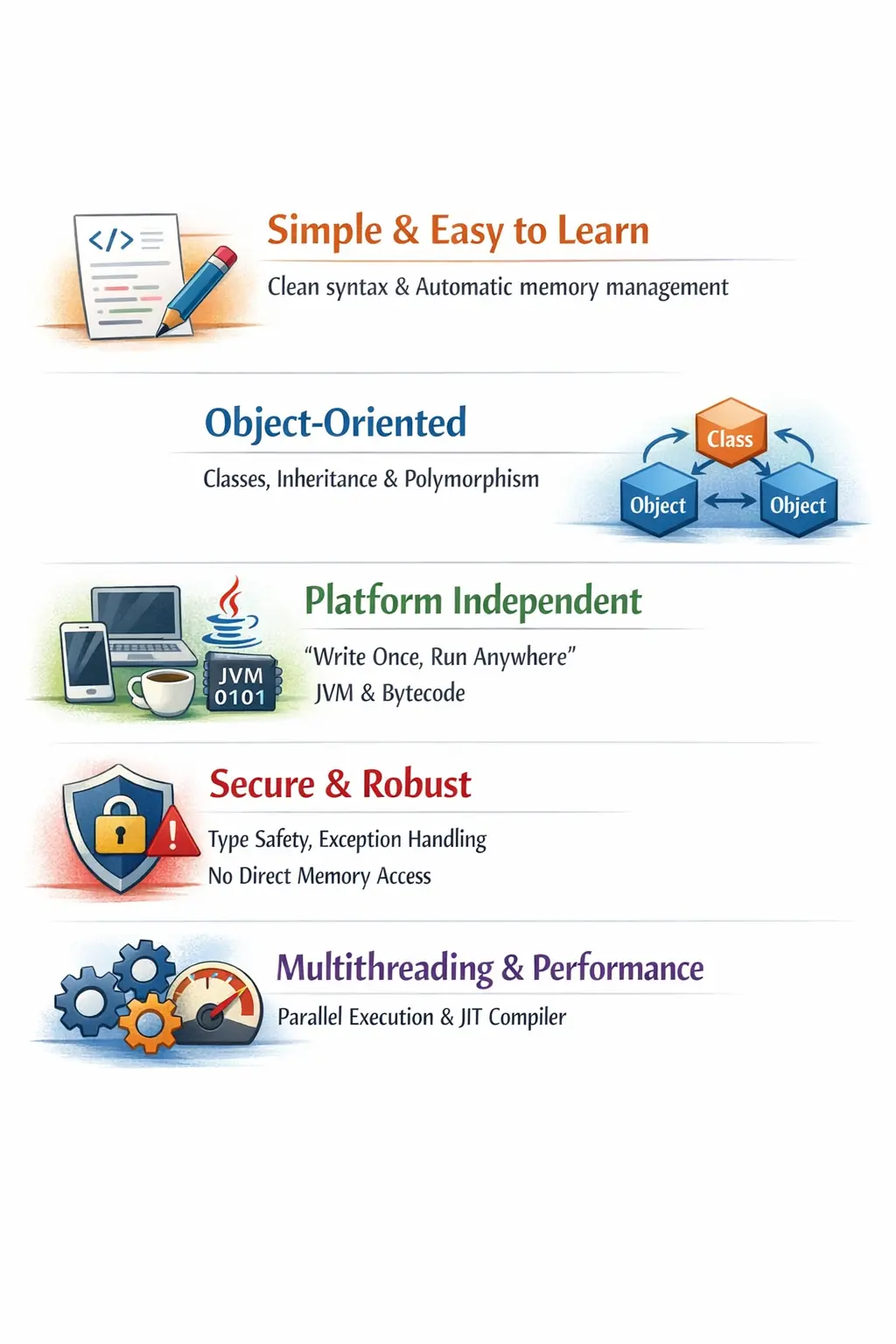
Why Java Features Matter
Java’s features matter because they explain why the language has remained useful for decades. A programming language does not survive in enterprise systems only because it is popular in tutorials. It survives because it solves practical problems repeatedly and reliably. Java was designed to help developers build applications that can run across environments, remain stable under real usage, handle errors safely, support large codebases, and evolve over time. These qualities are not accidental additions; they are part of Java’s core design.
When beginners learn Java features, they often memorize words such as simple, object-oriented, secure, robust, portable, and multithreaded. Memorization is not enough. Each feature has a real engineering purpose. Platform independence reduces deployment friction. Object-oriented design helps organize large systems. Garbage collection reduces memory management mistakes. Exception handling improves reliability. Multithreading helps applications use resources efficiently. Security mechanisms protect execution. Together, these features make Java suitable for real-world software that must be maintained and trusted.
Java Was Designed for Practical Software Engineering
Java was created to solve problems that developers faced in building software across different machines and environments. Earlier systems often required platform-specific compilation and careful memory handling. This created complexity and risk. Java introduced a runtime model where source code is compiled into bytecode and executed by the JVM. This allowed the same program to run on different operating systems as long as the JVM was available. That decision shaped many other Java features.
Java also emphasized a disciplined programming style. Strong typing, object-oriented design, packages, access control, exception handling, and standard libraries all support maintainability. This is especially important in large projects where many developers work together. A language feature is valuable only when it improves the development process or the final product. Java’s features were designed to make software easier to build, safer to run, and easier to maintain over time.
Simple Does Not Mean Limited
Java is called simple because it removed several difficult and error-prone features from languages such as C and C++. For example, Java does not support pointer arithmetic, manual memory deallocation, or multiple inheritance through classes. These omissions reduce the chance of memory corruption, dangling pointers, and complex inheritance conflicts. Java still remains powerful, but it avoids exposing developers to many low-level hazards by default.
Simplicity also appears in Java’s readable syntax and structured programming model. A Java program usually has clear class definitions, method signatures, access modifiers, variable types, and exception handling. This explicitness can feel verbose at first, but it helps large teams understand code. In real projects, code is read more often than it is written. Java’s simplicity supports long-term readability and collaboration.
Object-Oriented Design for Maintainability
Java’s object-oriented nature is one of its most important features. Object-oriented programming allows developers to model software using classes and objects that combine data and behavior. This makes programs easier to organize because related information and operations can be grouped together. Instead of writing one large procedural program, developers can divide responsibilities across classes such as User, Account, Product, Order, Payment, Report, or LoginPage.
The four major object-oriented principles are encapsulation, inheritance, polymorphism, and abstraction. Encapsulation protects internal data and exposes controlled access. Inheritance allows code reuse through parent and child classes. Polymorphism allows the same method call to behave differently depending on the object. Abstraction hides unnecessary implementation details and exposes essential behavior. These concepts help developers create flexible and maintainable systems.
In test automation, object-oriented design is especially useful. A Selenium framework may use base classes, page objects, utility classes, reusable components, and configuration managers. Without object-oriented structure, automation code quickly becomes duplicated and fragile. Java’s OOP support helps automation projects grow in an organized way.
Platform Independence Through Bytecode
Platform independence is one of Java’s defining features. Java source code is not compiled directly into operating-system-specific machine code. Instead, it is compiled into bytecode. Bytecode runs on the Java Virtual Machine. Since JVM implementations exist for Windows, Linux, macOS, and other environments, the same bytecode can run across platforms. This is the foundation of the Write Once, Run Anywhere idea.
This feature matters in modern development because applications often move across environments. Developers may write code on laptops, run builds on CI servers, test in staging environments, and deploy to cloud or Linux production servers. Java reduces the need to rewrite application logic for each environment. For testers, this also matters because a Java-based Selenium or API automation framework can run locally and in a CI/CD pipeline with minimal code changes.
Architecture Neutral Execution
Java is architecture neutral because compiled bytecode is not tied to one processor architecture. The JVM handles the details of running bytecode on the underlying hardware. Whether the system uses x86, ARM, or another processor type, the Java program relies on the JVM layer. This separates the application from hardware-specific instructions and helps create consistent behavior across systems.
Architecture neutrality is useful in distributed systems and enterprise environments. Large organizations may run applications on different servers, containers, cloud platforms, and hardware configurations. Java’s execution model makes application behavior more predictable. It also supports long-term portability because hardware can change without requiring application source code to be rewritten.
Portability Beyond Operating Systems
Portability is closely related to platform independence, but it is broader. Java supports portability through bytecode, fixed-size primitive data types, standard libraries, and consistent language rules. In some languages, the size of a primitive data type can vary depending on the machine. Java defines primitive sizes clearly, which helps programs behave consistently across environments. This predictability is valuable when applications handle calculations, files, data exchange, or network communication.
Portability also helps enterprise deployment. A Java application may move from development to testing, staging, and production. It may run inside containers or cloud infrastructure. The more consistent the runtime behavior, the easier it is to diagnose problems and maintain confidence. Java does not remove all environment issues, but its portability features reduce many common platform-related risks.
Security as a Core Language Goal
Java was designed with security in mind because it was expected to run in networked environments. Java does not allow direct pointer manipulation, which prevents many low-level memory access problems. Bytecode verification checks code before execution to ensure it follows rules. Class loading mechanisms control how classes are loaded into the runtime. These features create a safer execution model than languages that expose more direct system access by default.
Security is important in enterprise software because applications often handle sensitive data. Banking systems, insurance platforms, healthcare software, identity systems, and payment services require strong protection. Java’s security model, combined with frameworks, libraries, authentication systems, authorization controls, and secure coding practices, makes it suitable for such domains. The language alone does not guarantee security, but it provides a strong foundation.
Robustness and Error Handling
Java is called robust because it includes features that reduce common programming errors and improve runtime stability. Strong type checking catches many mistakes during compilation. Exception handling gives developers a structured way to manage unexpected conditions. Garbage collection reduces memory management errors. Runtime checks help detect invalid operations. These features do not prevent all bugs, but they reduce many categories of failures.
Exception handling is especially important. Real applications face missing files, invalid input, network failures, database errors, timeout issues, and external service problems. Java allows developers to use try, catch, finally, throw, and throws to handle such situations. Good error handling prevents abrupt failures and helps applications respond predictably. In test automation, robust exception handling also helps frameworks report failures clearly instead of crashing without useful information.
Automatic Memory Management
Automatic memory management is one of Java’s most practical features. Developers create objects, and the JVM manages memory allocation and garbage collection. When objects are no longer reachable, the garbage collector can reclaim memory. This reduces the need for manual memory management and helps prevent common problems such as dangling pointers and accidental memory corruption.
However, garbage collection does not mean developers can ignore memory usage completely. Poor design can still create memory leaks if objects are unnecessarily referenced for too long. Large collections, static references, unclosed resources, and inefficient object creation can still cause memory pressure. Java reduces low-level memory risks, but good engineering discipline is still required. The feature improves safety while still expecting developers to write thoughtful code.
Multithreading for Concurrent Execution
Java supports multithreading at the language and library level. Threads allow multiple tasks to run concurrently within the same application. This is valuable for server applications, background processing, user interface responsiveness, file processing, network communication, and parallel execution. Java provides classes and APIs to create, manage, synchronize, and coordinate threads.
Multithreading improves responsiveness and resource utilization, but it also introduces complexity. Shared data must be handled carefully to avoid race conditions, inconsistent state, and deadlocks. Java provides tools such as synchronized blocks, locks, concurrent collections, executors, and thread-safe utilities. In automation, parallel execution in TestNG or Selenium Grid depends on thread-safe framework design. Java’s multithreading support is powerful because it gives developers both capability and control.
High Performance Through the JVM and JIT
Java is sometimes misunderstood as slow because it runs on a virtual machine. In reality, modern Java can perform very well because the JVM includes advanced optimizations. The Just-In-Time compiler identifies frequently executed bytecode and compiles it into optimized native machine code during runtime. This allows Java to balance portability with strong performance.
Performance also depends on the developer’s design choices. Efficient algorithms, proper data structures, good database queries, caching, thread management, and resource handling all matter. Java provides the runtime foundation, but high performance still requires good architecture. This is why Java is used in enterprise backends, trading systems, search systems, and high-volume services when designed properly.
Distributed and Network-Oriented Design
Java was designed during the rise of networked computing, so it includes strong support for communication across systems. Java provides APIs for networking, input and output, remote communication, database connectivity, and web services through its ecosystem. This made Java suitable for client-server applications, distributed systems, enterprise integrations, and later microservices.
Distributed capability is important because modern applications rarely run as isolated programs. A web application may communicate with authentication services, payment gateways, databases, message queues, cloud storage, third-party APIs, and reporting services. Java’s libraries and frameworks make these interactions practical. Frameworks such as Spring Boot further simplify building distributed backend services and APIs.
Dynamic Class Loading
Java is dynamic because classes can be loaded at runtime when they are needed. This supports flexible application behavior, plugin-like architectures, framework-based development, and runtime linking. Many Java frameworks rely on dynamic behavior to discover classes, load configurations, create objects, apply annotations, and manage dependencies.
Dynamic loading helps Java applications become extensible. An application does not always need to know every class at compile time. Frameworks can load and wire components based on configuration or annotations. This feature is one reason Java became strong in enterprise frameworks, application servers, and test automation tools. It allows systems to be structured, yet flexible.
Java’s Rich Standard Library
Another major feature of Java is its rich standard library. Java includes built-in support for strings, collections, dates, files, streams, networking, concurrency, input and output, regular expressions, security, and many utility functions. This library reduces the need to write common functionality from scratch. Developers can focus on business logic while relying on tested platform APIs for common tasks.
The standard library is especially valuable for beginners and professionals. Beginners can learn data structures through the Collections Framework. Automation engineers can use file handling, properties files, lists, maps, exceptions, and streams in real frameworks. Backend developers use networking, concurrency, security, and data processing APIs. Java’s library ecosystem extends this even further through third-party frameworks and tools.
Java Features in Enterprise Projects
In enterprise projects, Java features work together. Platform independence helps deployment. Object-oriented design supports large codebases. Security protects sensitive data. Robustness improves stability. Multithreading supports concurrent users. Performance optimizations allow high-volume processing. Distributed support enables communication across services. Portability supports movement across environments. Maintainability comes from structure and ecosystem support.
This combination is why Java is common in banking, insurance, healthcare, retail, telecom, government, education platforms, and automation frameworks. Enterprise systems usually need long-term stability rather than short-term novelty. Java’s features support that need. The language is mature, but maturity is an advantage when software must run reliably for years.
Java Features in Test Automation
Java’s features are also useful for test automation. Object-oriented programming supports Page Object Model and reusable components. Exception handling helps manage Selenium failures such as timeouts and missing elements. Collections help manage test data. File handling supports properties, JSON, CSV, Excel, and reports. Multithreading supports parallel test execution. Platform independence allows the same framework to run locally and in CI/CD pipelines.
A well-designed Java automation framework benefits from the same features that benefit application development. Clear packages, classes, inheritance, interfaces, utilities, configuration management, and logging make automation code maintainable. This is why Java remains one of the most common languages for Selenium and API automation in enterprise teams.
Common Misunderstandings About Java Features
One misunderstanding is that platform independence means Java does not need an operating system. Java still runs on an operating system through the JVM. The point is that Java bytecode can run on different systems where compatible JVMs exist. Another misunderstanding is that garbage collection means memory problems never happen. Garbage collection reduces manual memory errors, but inefficient object usage can still cause memory pressure.
Some beginners assume Java is slow because it uses a virtual machine. Modern JVMs are highly optimized and use JIT compilation. Another common mistake is writing Java in a procedural style and ignoring object-oriented design. Java is most effective when its features are used properly. Understanding the purpose behind each feature helps developers avoid these misconceptions.
Interview-Ready Understanding of Java Features
In interviews, Java features should be explained with meaning and examples. A short answer can say that Java is simple, object-oriented, platform-independent, secure, robust, multithreaded, portable, architecture-neutral, distributed, dynamic, and high performing through JIT compilation. A stronger answer explains that Java source code compiles into bytecode, bytecode runs on the JVM, and this execution model enables portability and platform independence.
A practical example makes the answer stronger. A Java Selenium automation framework can be developed on Windows and executed on Linux CI servers because of platform independence. Page Object Model can be implemented cleanly because Java is object-oriented. Parallel execution can be supported because Java has multithreading. Failures can be handled clearly because Java provides exception handling. These examples show that Java features are not theoretical; they solve real project problems.
1. Simple
Java was designed to be easy to learn and use. Its syntax is clean and readable, especially for developers familiar with C or C++. However, Java removed many complex and error-prone features such as pointer arithmetic.
One of the most important simplifications is automatic memory management through Garbage Collection. Developers do not need to manually allocate or deallocate memory.
Why this matters: Developers can focus on writing business logic instead of worrying about low-level memory handling.
Example: There is no need to use malloc() or free() as in C/C++. Memory is automatically managed by the JVM.
2. Object-Oriented
Java is fundamentally object-oriented. Everything in Java revolves around classes and objects. It fully supports:
- Encapsulation
- Inheritance
- Polymorphism
- Abstraction
This design encourages modular and reusable code.
Why this matters: Object-oriented programming improves maintainability, scalability, and code organization.
Example: In automation frameworks, a BasePage class can be reused across multiple Selenium Page Object classes.
3. Platform Independent
Java introduced the concept of “Write Once, Run Anywhere.”
Java source code is compiled into bytecode. This bytecode does not run directly on the operating system. Instead, it runs on the Java Virtual Machine (JVM). Since JVM implementations exist for different operating systems, the same bytecode can run anywhere.
Why this matters: No need to rewrite code for different platforms.
Example: A Java automation framework developed on Windows can run on Linux in a CI/CD pipeline without any changes.
4. Architecture Neutral
Java bytecode is independent of CPU architecture. Whether the underlying processor is x86 or ARM, the JVM handles the hardware-specific execution.
Why this matters: Java applications behave consistently across different hardware systems.
5. Portable
Java ensures portability by:
- Using fixed-size primitive data types
- Generating platform-independent bytecode
Why this matters: Applications produce consistent results regardless of system configuration.
Portability is especially important in enterprise systems deployed across multiple environments.
6. Secure
Security is a core strength of Java. It provides:
- No direct memory access
- Bytecode verification before execution
- ClassLoader mechanism
- Controlled execution environment
Why this matters: Java is suitable for applications that handle sensitive financial or personal data.
Example: Banking systems, payment gateways, and enterprise platforms frequently use Java because of its strong security model.
7. Robust
Java is designed to minimize runtime errors and crashes. It provides:
- Strong type checking
- Compile-time and runtime validation
- Exception handling mechanisms
- Automatic Garbage Collection
Why this matters: Applications become more stable and less prone to system failures.
Example: Using try-catch blocks prevents abrupt termination due to runtime exceptions.
8. Multithreaded
Java supports multithreading at the language level. It allows multiple threads to run simultaneously, improving application responsiveness and CPU utilization.
Why this matters: Multithreading enhances performance and scalability.
Example: Parallel test execution in TestNG uses Java’s multithreading capabilities.
9. High Performance
Although Java is platform independent, it does not compromise heavily on performance. It uses a Just-In-Time (JIT) compiler, which converts bytecode into native machine code at runtime.
Why this matters: Java balances portability with near-native execution speed.
10. Distributed
Java was designed with networking capabilities in mind. It provides built-in APIs for networking and distributed computing.
Why this matters: Java applications can easily communicate across networks.
Example: Client-server systems and microservices architectures often use Java for backend communication.
11. Dynamic
Java supports dynamic class loading and runtime linking. Classes can be loaded when required during execution.
Why this matters: Applications can be extended without recompilation, making systems more flexible and adaptable.
Summary of Java Features
| Feature | Core Idea |
|---|---|
| Simple | Easy syntax, automatic memory management |
| Object-Oriented | Class-based modular design |
| Platform Independent | JVM-based execution |
| Secure | Safe memory and execution environment |
| Robust | Strong error handling and type checking |
| Multithreaded | Parallel execution capability |
| High Performance | JIT compilation |
| Portable | Consistent behavior across systems |
| Dynamic | Runtime class loading |
Common Mistakes by Beginners
- Confusing “platform independent” with “platform free”
- Assuming Java is slow by default
- Ignoring proper exception handling
- Writing procedural-style code instead of using OOP principles
- Misunderstanding how garbage collection works
Understanding these misconceptions helps developers use Java effectively.
Interview-Ready Explanation
Short answer:
Java is a simple, object-oriented, platform-independent language that provides security, robustness, multithreading, and high performance.
Detailed answer:
Java compiles source code into bytecode that runs on the JVM, enabling platform independence. It provides automatic memory management, strong security mechanisms, exception handling, multithreading support, and JIT compilation. These features make Java highly suitable for enterprise, scalable, and distributed applications.
Key Takeaway
Java’s core strengths lie in portability, security, robustness, and scalability. Its architecture was designed to solve real-world engineering challenges, which is why it continues to remain relevant and dominant in enterprise systems, automation frameworks, and distributed applications even decades after its creation.