Error Guessing to Experience-Based Test Design
Software testing relies on both structured techniques and practical experience. While formal test design methods such as Equivalence Partitioning, Boundary Value Analysis, and Decision Table Testing provide systematic coverage, they cannot predict every possible defect scenario. Real-world applications often fail in unexpected ways that are difficult to anticipate using purely rule-based techniques. This is where Error Guessing becomes an important and highly effective testing approach.
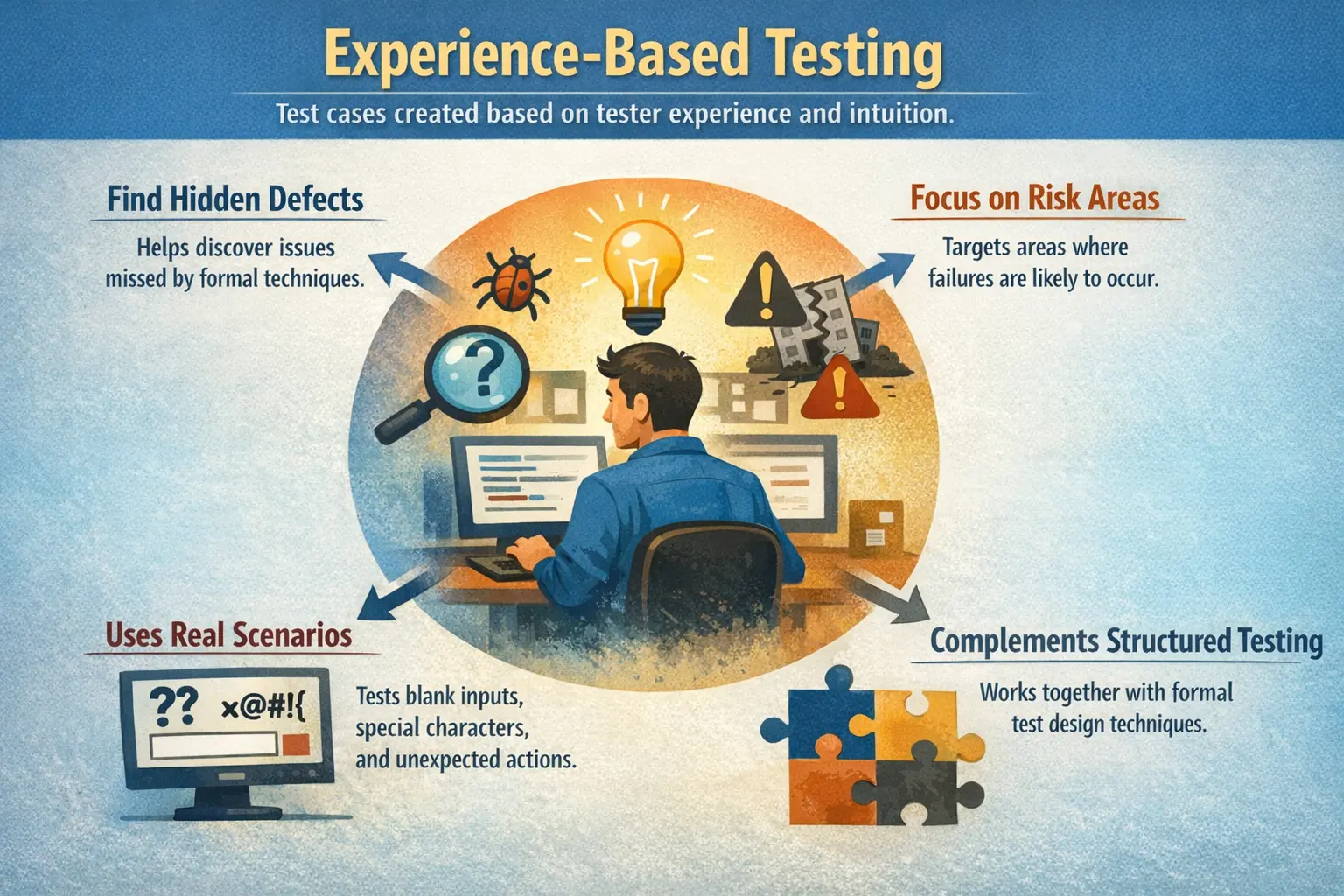
Error Guessing is an experience-based test design technique in which testers anticipate possible defects based on their knowledge, intuition, and previous experience with similar systems. Instead of following a predefined method or mathematical model, the tester uses judgment and insight to identify areas where defects are likely to occur. Error Guessing addresses a practical question that every tester encounters during a project:
“Where is the system likely to fail?”
This technique is widely used in manual testing because experienced testers develop a strong sense of how applications behave and where weaknesses typically exist. Error Guessing complements structured testing techniques by focusing on defect-prone areas that may otherwise remain untested. When used effectively, it helps uncover critical defects that formal test cases might miss.
Error Guessing is especially valuable because real users do not always behave exactly as requirements describe. They may leave fields empty, paste large text, click buttons repeatedly, refresh during processing, use old links, enter unexpected characters, switch tabs, lose network connection, or abandon a workflow midway. These behaviors are difficult to capture fully through formal techniques alone. A skilled tester uses Error Guessing to think like a real user, a careless user, a power user, and sometimes even a malicious user.
The strength of Error Guessing is not that it replaces structured testing. Its strength is that it adds practical intelligence to structured testing. Equivalence Partitioning may tell the tester what input groups to cover. Boundary Value Analysis may tell the tester which limits to test. Decision Table Testing may tell the tester which condition combinations matter. Error Guessing then asks, "What else might go wrong in this area based on experience?" That extra thinking often reveals defects that would otherwise escape.
Understanding the Purpose of Error Guessing
The primary purpose of Error Guessing is to identify defects that are not easily discovered through structured testing techniques. Formal test design techniques rely on requirements, specifications, and logical rules to design test cases. However, real-world defects often arise from unexpected interactions, unusual inputs, or implementation mistakes that cannot always be predicted from documentation alone.
Error Guessing leverages the tester’s experience and understanding of software behavior to anticipate these problems. It helps testers think beyond the documented requirements and consider how the system might behave under unusual or incorrect conditions.
Another important purpose of Error Guessing is improving test coverage. Even well-designed test suites may contain gaps, particularly in edge-case scenarios. By applying Error Guessing, testers can expand coverage into areas that structured techniques may overlook.
Error Guessing also plays an important role in detecting real-world issues. Users do not always follow expected workflows, and their behavior can be unpredictable. Error Guessing helps simulate such unpredictable behavior and ensures the system can handle it gracefully.
This technique also complements structured testing by adding flexibility. While formal techniques provide systematic coverage, Error Guessing provides depth in high-risk areas.
Error Guessing also improves the tester's ability to challenge assumptions. Requirements usually describe expected behavior, but they may not describe every invalid behavior. A requirement may say that a file can be uploaded, but it may not explicitly mention empty files, duplicate files, corrupted files, files with very long names, files with unsupported characters, or upload interruption. Error Guessing pushes testers to explore these practical risks.
Another purpose is speed. In fast-moving projects, testers may not always have time to document every possible scenario before starting. Error Guessing allows them to quickly investigate suspicious areas while still using judgment. This is useful during build verification, hotfix validation, exploratory sessions, production issue reproduction, and late-cycle testing when time is limited.
The Experience-Based Nature of Error Guessing
Unlike formal test design techniques, Error Guessing does not follow strict rules or procedures. Instead, it relies on human expertise and insight. Experienced testers develop intuition through years of working with different applications and encountering various types of defects.
This intuition allows testers to recognize patterns and anticipate problems. For example, a tester who has worked extensively with web forms knows that input validation is often a source of defects. Similarly, a tester familiar with financial applications may focus on calculation errors and rounding issues.
The experience-based nature of Error Guessing makes it both powerful and flexible. Testers can adapt their approach based on the application being tested, the risks involved, and the time available.
However, this flexibility also means that Error Guessing depends heavily on tester skill. A beginner tester may not identify as many potential defects as an experienced tester. Over time, testers improve their Error Guessing abilities by studying defects and learning from previous projects.
Experience does not mean only years of work. It also means actively learning from every defect. A tester who studies why defects happened will become better at guessing future defects. For example, if several defects were caused by missing null checks, the tester will naturally try blank and null-like inputs in future modules. If a previous release had duplicate payment issues after double-clicking a button, the tester will remember to try repeated submissions in similar workflows.
Error Guessing also improves when testers discuss defects with developers, business analysts, support teams, and other testers. Developers can explain common implementation risks. Support teams can describe real customer mistakes. Business analysts can explain rules that users often misunderstand. These insights sharpen the tester's ability to predict where failure may occur.
Foundations of Error Guessing
Error Guessing is not random testing. Although it may appear unstructured, it is guided by logical reasoning and experience. Testers rely on several sources of knowledge when applying this technique.
One important source is past defect history. Testers often review defects from previous releases or similar applications to identify patterns. If a certain module has historically contained many defects, it becomes a high-priority area for Error Guessing.
Another important foundation is domain knowledge. Understanding how a business process works helps testers identify potential weaknesses. For example, in a banking application, testers know that transaction processing and account balances are critical areas that require careful validation.
Testers also rely on their knowledge of common developer mistakes. Developers frequently make certain types of errors, such as incorrect validation logic or improper handling of null values. Experienced testers learn to anticipate these issues.
Familiarity with similar applications also improves Error Guessing effectiveness. If a tester has worked with multiple e-commerce systems, they can anticipate typical issues such as payment failures or cart synchronization problems.
Production incidents are another strong source. If users have reported timeout issues, duplicate records, missing notifications, rounding differences, or session problems in the past, those patterns should guide future Error Guessing. A good tester does not forget production pain. They convert it into better test ideas.
Technical awareness also helps. Testers do not need to be developers to use Error Guessing effectively, but knowing basic implementation risks improves their thinking. For example, APIs may fail with null values, databases may truncate long text, date conversions may behave differently across time zones, and frontend validation may not protect backend services. This awareness helps testers choose sharper scenarios.
Error Guessing Is Not Random Testing
A common misunderstanding is that Error Guessing means randomly clicking around the application. That is not correct. Random action without a purpose may occasionally find a defect, but it is unreliable and difficult to explain. Effective Error Guessing is purposeful. The tester has a reason for each action based on risk, history, domain knowledge, or common defect patterns.
For example, entering a negative amount into a payment field is not random. It is based on the knowledge that numeric validation often fails. Double-clicking a submit button is not random. It is based on the knowledge that duplicate submissions can happen. Uploading a file with a long name is not random. It is based on the knowledge that file systems, databases, and UI labels may have length limits.
The difference is intent. Random testing asks, "What happens if I do anything?" Error Guessing asks, "Based on experience, what specific action is likely to expose a weakness?" This makes the technique professional, repeatable, and useful.
Common Error Guessing Scenarios
Many error-prone scenarios appear repeatedly across different applications. Experienced testers often begin Error Guessing by exploring these common areas.
- Blank or null inputs frequently cause defects when required values are missing.
- Special characters can reveal weaknesses in input validation and parsing logic.
- Boundary violations may expose issues with very large values and unusual input combinations.
- Unexpected user actions like refreshes or abrupt browser closures can break workflows.
- Repeated actions such as multiple clicks may trigger duplicates or inconsistent states.
These scenarios illustrate how Error Guessing focuses on realistic risks rather than theoretical coverage.
Date and time inputs are another rich area for Error Guessing. Testers may try leap-year dates, month-end dates, expired dates, future dates, daylight saving changes, or timezone differences. Many systems behave correctly for ordinary dates but fail at calendar edges or when server and client time differ.
Session-related scenarios are also common. What happens if the user stays idle and then submits the form? What happens if the user logs out in another tab and continues working in the first tab? What happens if the same user logs in from two browsers? These are realistic user behaviors, and they often reveal weak session handling.
Data consistency scenarios are equally important. A tester may try editing the same record from two tabs, deleting an item that is already used elsewhere, submitting the same request twice, or changing data after it has been approved. These scenarios are based on common workflow and concurrency risks.
Error Guessing for Forms
Forms are one of the easiest places to apply Error Guessing because users can enter many types of unexpected data. A tester can try blank fields, spaces only, leading and trailing spaces, very long text, numbers in name fields, letters in numeric fields, special characters, emojis, copied text from documents, HTML-like input, and unsupported language characters.
Error Guessing also looks at behavior around form submission. What happens if the user clicks submit twice? What happens if the user corrects one error but leaves another? What happens if the browser back button is used after submission? What happens if a required dropdown is left at the default value? These scenarios often reveal validation, duplicate-processing, and navigation defects.
A structured technique may cover the official valid and invalid input groups, but Error Guessing expands that coverage with practical user behavior. This makes form testing more realistic and more likely to find production-like issues.
Error Guessing for Payments and Transactions
Payment and transaction workflows are high-risk areas where Error Guessing is extremely valuable. Testers should think about duplicate clicks, browser refresh during payment, network interruption, payment gateway timeout, success response delayed, failure response received after debit, and user closing the browser before confirmation.
Transaction systems must be consistent. A user should not be charged twice because of repeated clicks. A failed transaction should not reduce balance. A successful payment should create an order or receipt. If an external gateway responds slowly, the application should not remain in an unclear state forever. These are practical risks that testers often identify through experience.
Error Guessing in transaction systems should always verify final business impact. It is not enough to check the message on the screen. The tester should check transaction history, balance, order status, receipt, notification, and audit trail where applicable. Many serious defects appear only when the full transaction outcome is reviewed.
Role of Manual Testers in Error Guessing
Manual testers play a central role in Error Guessing because this technique depends on human insight. Testers must actively think about how the system might fail and design tests accordingly.
- Apply creativity and intuition beyond documented requirements.
- Prioritize high-risk application areas where defects are more likely.
- Think from different user perspectives, including careless and malicious behavior.
- Document failures clearly so defects are reproducible and fixable.
Manual testers should also create personal defect checklists. Over time, each tester notices patterns: blank input issues, duplicate submission issues, broken browser-back behavior, role permission gaps, timeout problems, date errors, upload problems, and inconsistent messages. Turning these patterns into a reusable checklist makes Error Guessing more consistent.
Another important role is communicating risk. Error Guessing may uncover areas that are not covered by existing test cases. The tester should explain why those areas matter. For example, "This payment page should be tested for repeated submit because duplicate charging is a business risk." Such communication helps teams prioritize exploratory testing intelligently.
Error Guessing Compared with Formal Techniques
Error Guessing differs significantly from structured test design techniques. Formal techniques follow defined rules and procedures to ensure systematic coverage. Equivalence Partitioning divides input data into groups, Boundary Value Analysis focuses on edges, and Decision Table Testing evaluates condition combinations.
Error Guessing does not follow a predefined structure. Instead, it focuses on likely problem areas based on experience.
Formal techniques provide predictable coverage, while Error Guessing provides targeted exploration. Both approaches are necessary for effective testing.
Formal techniques ensure that important scenarios are not missed. Error Guessing ensures that unexpected scenarios are explored.
Together, these techniques provide a balanced testing strategy that combines structure and flexibility.
A practical testing approach often begins with structured coverage and then adds Error Guessing. For example, a tester may use Equivalence Partitioning to identify valid and invalid input groups, Boundary Value Analysis to test limits, Decision Table Testing to validate rule combinations, and then Error Guessing to explore unusual behavior such as duplicate submissions, unexpected navigation, and corrupted data.
This balance is important. If a tester relies only on structured techniques, hidden real-world issues may remain. If a tester relies only on Error Guessing, coverage may become inconsistent. Together, they provide both disciplined coverage and practical defect discovery.
Real-Time Example: File Upload Testing
File upload functionality provides a good example of Error Guessing in practice. A structured approach might verify that supported file types upload successfully and that file size limits are enforced.
Error Guessing goes further by exploring unusual scenarios. A tester might attempt to upload unsupported file formats or extremely large files. Another scenario might involve uploading files with long or unusual file names.
Testers might also attempt to upload empty files or corrupted files. These scenarios can reveal weaknesses in validation logic.
Error Guessing might also involve interrupting the upload process or refreshing the browser during upload. Such actions can expose defects in error handling and system stability.
Through these tests, Error Guessing reveals problems that structured techniques may overlook.
A tester may also try uploading a file with no extension, multiple dots in the filename, uppercase file extensions, mismatched file content and extension, duplicate filenames, password-protected documents, or files from a network path. These tests come from practical experience with file-handling defects.
After upload, the tester should verify the complete result. Is the file displayed correctly? Can it be downloaded? Is the filename preserved? Is the file scanned if required? Is the size shown correctly? Can an unauthorized user access it? Error Guessing encourages testers to think beyond the upload button and check the full behavior.
Defects Commonly Found Using Error Guessing
- Application crashes caused by unexpected inputs or actions.
- Unhandled exceptions that expose technical errors or silent failures.
- Validation bypass defects where invalid data is accepted.
- Poor error handling that confuses users and blocks corrective action.
These defects often have significant impact on user experience and system stability.
Error Guessing also finds authorization defects. A tester may try accessing restricted pages directly, changing record identifiers in the URL, using old links after logout, or performing admin actions with a normal user account. These scenarios often reveal gaps that are not obvious in happy-path testing.
Another defect category is inconsistent state. A workflow may show success but leave the record in the wrong status. A cancelled order may still appear active. A failed upload may still create a database entry. A timed-out session may still allow one more action. These defects are often discovered when testers use experience to question what happens after unusual interruptions.
Importance in Real Projects
Error Guessing plays a critical role in real-world testing because software systems are complex and unpredictable. Requirements documents cannot capture every possible scenario, and structured test cases cannot anticipate every defect.
Experienced testers rely on Error Guessing to fill these gaps. This technique helps identify high-risk defects before release.
Error Guessing is particularly valuable in agile environments where time constraints limit detailed test case design. Testers can quickly explore important areas without waiting for formal test cases.
It is also useful in early testing phases when requirements may be incomplete. Testers can begin exploring the system immediately using Error Guessing.
In production support environments, Error Guessing helps testers reproduce customer issues by simulating realistic user behavior.
In real projects, Error Guessing is often used during the final stages of testing when the formal test suite has already passed. At that point, the tester asks what areas still feel risky. Modules with recent code changes, complex integrations, poor past quality, unclear requirements, or high business impact become good candidates for Error Guessing.
Error Guessing is also useful during defect retesting. After verifying that a reported defect is fixed, an experienced tester may try related scenarios that could have been affected by the fix. For example, if a duplicate submission defect was fixed for one form, the tester may check similar forms or related workflows. This helps catch side effects early.
Error Guessing in Agile Projects
Agile teams often work with short timelines, evolving requirements, and frequent releases. Error Guessing fits well in this environment because it allows testers to investigate high-risk areas quickly. During a sprint, testers can use acceptance criteria for structured coverage and then apply Error Guessing around risky behavior.
During refinement, testers can also use Error Guessing to ask better questions. What if the user submits twice? What if the selected item becomes unavailable? What if the session expires during payment? What if the approval is rejected? These questions improve the story before development starts.
In sprint reviews or release testing, Error Guessing helps provide practical confidence. It is not a substitute for planned testing, but it adds a layer of experienced exploration that is very useful in fast delivery cycles.
Error Guessing and Exploratory Testing
Error Guessing and Exploratory Testing are closely related, but they are not identical. Exploratory Testing is a broader approach where testers learn, design, and execute tests at the same time, often guided by a charter. Error Guessing is a specific experience-based technique used to predict likely defects. Error Guessing can be used inside an exploratory testing session.
For example, an exploratory charter may say, "Explore checkout failure handling." During that session, the tester may use Error Guessing to try expired cards, duplicate payment clicks, address changes, gateway timeout, browser refresh, and session expiry. The charter gives direction; Error Guessing provides defect ideas.
This combination is powerful because it keeps exploration purposeful. The tester is not wandering randomly; they are exploring a risk area using experience-based ideas.
Documenting Error Guessing Scenarios
Even though Error Guessing is informal compared with structured techniques, documentation still matters. If a tester finds a defect but cannot reproduce it, the value of the discovery is reduced. Testers should record the scenario, data used, environment, user role, steps followed, expected result, actual result, and evidence such as screenshots, videos, logs, or network details where useful.
Useful Error Guessing scenarios should also be considered for future regression. If a defect was found by double-clicking a payment button, the team may add a regression test for duplicate payment prevention. If a session timeout defect was found, the timeout scenario may be added to the test suite. This turns informal discovery into lasting quality improvement.
A simple checklist or test notes file can be enough. The goal is not heavy documentation. The goal is to make valuable test ideas repeatable and reusable.
Building an Error Guessing Checklist
A reusable Error Guessing checklist helps testers apply experience consistently. The checklist can include blank input, null-like input, spaces only, special characters, long text, invalid formats, negative numbers, decimals in integer fields, duplicate submissions, browser refresh, back button behavior, session timeout, direct URL access, role changes, file upload variations, and network interruption.
The checklist should evolve based on project history. If the team frequently finds timezone defects, date and time scenarios should be added. If duplicate records are common, repeated action scenarios should be emphasized. If security issues appear around roles, authorization guessing should be included.
A checklist does not remove creativity. It supports it. It gives testers a starting point and prevents them from forgetting common risk areas when time is limited.
Error Guessing for Different Domains
Error Guessing becomes stronger when adapted to the business domain. In banking, testers may focus on balances, transaction limits, duplicate transfers, beneficiary validation, interest calculation, session timeout, and audit trails. In e-commerce, they may focus on cart updates, coupon conflicts, payment failure, inventory changes, delivery availability, and order cancellation.
In healthcare systems, testers may focus on patient identity, duplicate records, appointment scheduling, prescription workflows, report access, and privacy restrictions. In payroll systems, they may focus on rounding, tax rules, leave balances, salary components, employee status changes, and cutoff dates.
This domain awareness is what separates strong Error Guessing from generic guessing. The more the tester understands the business, the better they can predict meaningful failures.
Common Mistakes in Error Guessing
- Treating Error Guessing as random testing without purpose.
- Relying only on Error Guessing without structured techniques.
- Poor defect documentation that prevents reproducibility.
- Not recording scenarios for future regression cycles.
Another mistake is focusing only on negative inputs and ignoring unusual workflows. Error Guessing is not limited to invalid data. It also includes unexpected sequences, repeated actions, role changes, timeout behavior, interrupted processes, and recovery scenarios. A system can accept valid data and still fail when the workflow is unusual.
Testers may also apply Error Guessing too late. If it is used only at the end of a release, serious defects may be discovered when there is little time to fix them. It is better to apply experience-based thinking throughout testing, especially when reviewing requirements and designing scenarios.
A third mistake is treating Error Guessing as a solo activity only. Pair testing or group defect brainstorming can improve results because different testers bring different experiences. A short team discussion about likely failure areas can generate strong test ideas quickly.
Interview Perspective
Error Guessing is frequently discussed in software testing interviews because it demonstrates practical testing knowledge.
A short answer might be:
Error guessing is a test design technique based on tester experience to anticipate where defects might occur.
A more detailed explanation would include:
Error guessing leverages tester experience, intuition, and past defect knowledge to identify defect-prone areas beyond structured test cases.
Interviewers may also ask candidates to provide examples of Error Guessing scenarios. Strong answers typically include realistic examples such as invalid inputs or repeated actions.
Project-based answer:
In a real project, I use Error Guessing after covering planned test cases. I look at high-risk modules, recent changes, past defects, and common failure patterns. For example, in a payment flow, I may try double clicking the pay button, refreshing during payment, using expired sessions, interrupting the network, or checking whether failed transactions affect balance. These scenarios are based on experience and help find defects that normal test cases may miss.
A strong interview answer should also mention that Error Guessing is not random testing. It is experience-based, risk-focused, and should be combined with structured techniques for balanced coverage.
Advantages of Error Guessing
- Provides flexibility and adaptability based on system behavior and risk.
- Improves defect detection by targeting high-risk areas.
- Complements structured testing techniques.
- Supports exploration of realistic user scenarios.
- Leverages human expertise as a powerful testing asset.
Another advantage is speed of insight. A skilled tester can quickly identify suspicious areas and test them without waiting for detailed formal test design. This is useful during hotfixes, production issue analysis, and final release checks. Error Guessing also encourages testers to think critically rather than only execute scripted steps.
Limitations of Error Guessing
- Depends heavily on tester experience and domain knowledge.
- Does not guarantee complete coverage because it is not systematic.
- Results may vary between different testers.
- Without documentation, scenarios may not be repeatable.
Despite these limitations, Error Guessing remains an essential technique when used alongside structured methods.
Another limitation is that Error Guessing can be biased by the tester's past experience. A tester may focus heavily on issues they have seen before and miss new risks unique to the current system. This is why Error Guessing should be supported by requirement analysis, risk review, defect history, and collaboration with the team.
It can also be difficult to measure coverage from Error Guessing alone. Structured techniques provide clear coverage models, while Error Guessing provides targeted investigation. Test leads should therefore use it as a complementary method rather than the only basis for test completion.
Practical Error Guessing Checklist
Before completing a test cycle, testers can ask practical questions: What happens with blank input? What happens with very long input? What happens with special characters? What happens if the user clicks twice? What happens if the session expires? What happens if the user refreshes during processing? What happens if the same action is performed from two tabs?
They can also ask workflow questions: Can a user skip a required step? Can a restricted page be opened directly? Can a completed record be edited? Can a failed transaction be retried safely? Can an uploaded file be accessed by the wrong user? These questions help uncover practical defects.
The checklist should be adapted to each project. A payment system, learning portal, healthcare app, and government form will not have the same risks. Error Guessing is strongest when the checklist reflects the application domain.
Key Takeaway
Error Guessing is a powerful experience-based testing technique that allows testers to anticipate defects based on knowledge, intuition, and past experience. By focusing on defect-prone areas and realistic user behavior, Error Guessing helps uncover issues that structured test cases might miss.
Effective Error Guessing is guided by experience rather than randomness. When combined with formal test design techniques, it provides comprehensive coverage and improves software quality.
Error Guessing reminds us that software testing is both a science and an art. Structured techniques provide the science, while tester experience provides the insight needed to discover hidden defects.