Regression Testing: Protecting Stability During Change
Introduction to Regression Testing
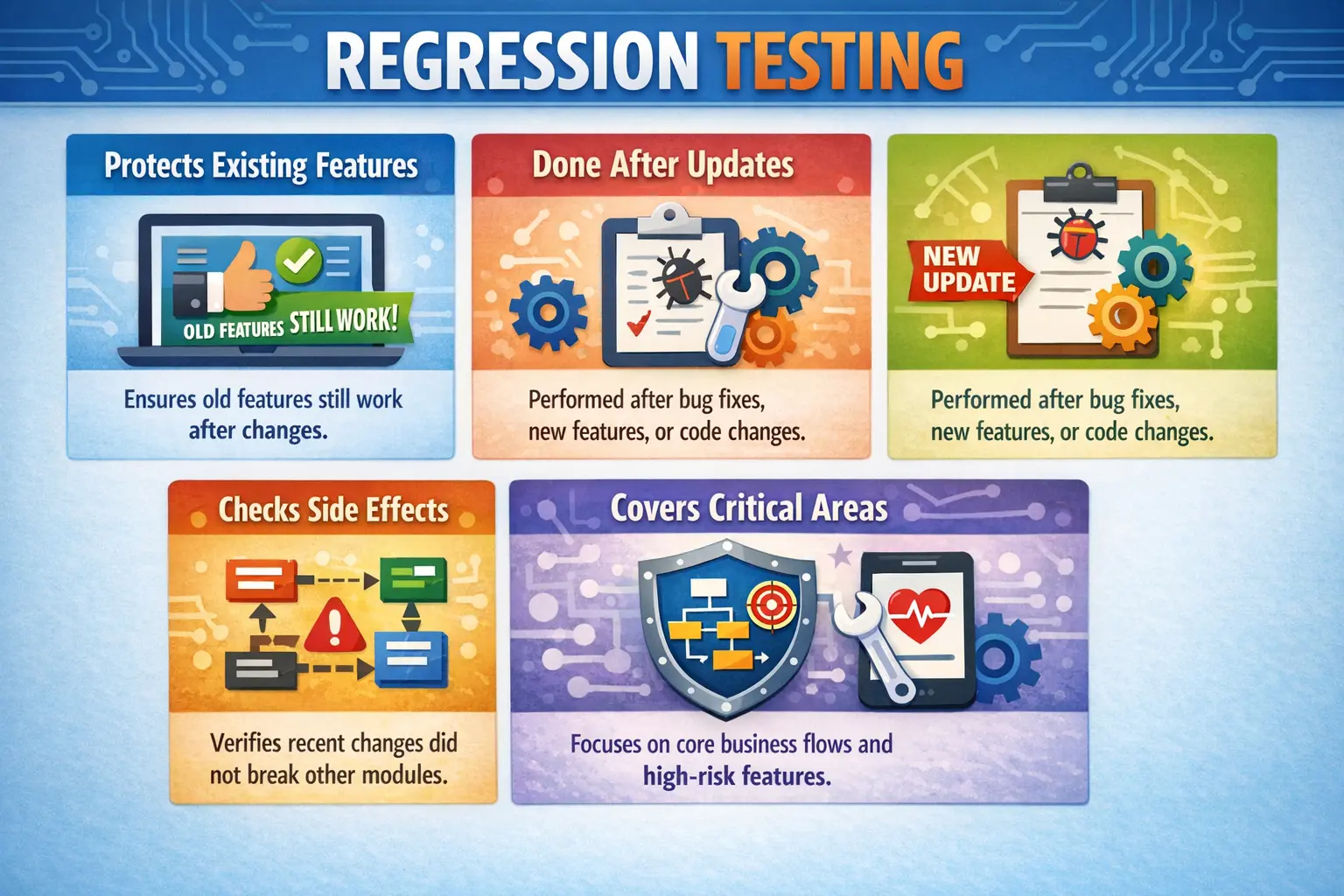
Regression Testing is the process of re-testing previously working functionality after changes have been made to the application. These changes may include bug fixes, new features, configuration updates, or performance improvements. The core purpose is to ensure that existing features continue to function correctly. Regression testing answers an important question: did the recent change break anything that was already working?
In dynamic projects where updates are frequent, regression testing acts as a safeguard against unintended side effects.
Purpose of Regression Testing
The primary goal of regression testing is to maintain application stability while the product continues to change. Modern software is rarely static. Teams fix defects, add features, refactor code, update configurations, change database structures, improve performance, and integrate with new services. Each change may be necessary, but each change also introduces risk. Regression testing controls that risk by checking whether previously working functionality still works.
Even small code changes can impact unrelated modules due to hidden dependencies. A change in login session handling may affect checkout. A change in a shared date utility may affect reports. A change in a validation rule may affect multiple forms. Regression testing detects such unintended consequences early, before users encounter them in production.
It protects critical business flows, ensures overall product reliability, and maintains quality over time. Without regression testing, applications may degrade gradually as more changes are introduced. This degradation is dangerous because teams may believe they are improving the product while accidentally breaking stable behavior that users already depend on.
Regression testing also supports confidence. A team cannot release frequently if every change creates fear. By maintaining a meaningful regression suite, testers give stakeholders evidence that key functionality has been revalidated after change. This makes releases more disciplined and reduces last-minute uncertainty.
When Regression Testing Is Performed
Regression testing is performed after defect fixes, new feature implementations, configuration changes, database changes, integration updates, and before major releases. Any time the codebase or application behavior is modified, regression testing becomes relevant because the change may affect existing functionality.
In Agile environments, regression testing may occur frequently within each sprint. A team may perform targeted regression after each story, broader regression near the end of the sprint, and automated regression in the CI/CD pipeline. This helps teams catch side effects while the change is still fresh.
In traditional models, regression testing is often performed before release milestones. After development and system testing are complete, the QA team runs regression to confirm that the completed release has not broken existing workflows. This is especially important when many changes are bundled together.
Regression testing may also be performed after production hotfixes. A hotfix may be urgent, but it can still create side effects. Even when time is limited, testers should validate the fixed area and the most critical related flows to reduce production risk.
Scope of Regression Testing
The scope typically includes core business functionalities, high-risk areas, modules that previously contained defects, and features dependent on recently modified components. The goal is to validate stability across critical paths rather than focusing only on changed functionality. A regression suite should answer: which existing behaviors are important enough to re-check after this change?
The breadth of regression testing depends on project risk, time constraints, release importance, and change impact. A small UI text change may require only minimal regression. A change to authentication, payment, permissions, calculations, or shared services may require deeper regression because those areas affect many workflows.
Good regression scope is risk-based. It should prioritize features that are business-critical, frequently used, defect-prone, technically complex, or connected to the changed component. Testing everything every time is usually unrealistic. Testing only the changed feature is often too risky. Regression planning finds the practical middle ground.
The regression scope should also evolve. As the product grows, some test cases become outdated, redundant, or low value. New critical flows appear. Defect history changes. A regression suite that is not maintained becomes slow, noisy, and less useful. Effective regression testing requires regular review of what should stay, what should be removed, and what should be added.
Role of the Manual Tester
Manual testers are responsible for identifying regression test cases that represent stable, important, and critical functionality. This requires more than copying old test cases into a list. A tester must understand the application, the business flows, recent changes, previous defects, and dependencies between modules. Regression testing is most effective when testers use judgment to select the right checks for the current risk.
They execute regression suites methodically and log any new defects found during execution. Since regression defects often appear in areas that were not directly changed, defect reports must clearly explain the recent build, the failed existing behavior, the expected result, and why the failure appears to be a regression. This helps developers investigate whether a recent change caused the issue.
Maintaining updated regression documentation is also part of the tester's responsibility. Test cases should reflect current functionality. If a feature changes, the regression case should be updated. If a scenario is no longer relevant, it should be removed. If a production defect escaped, the regression suite should be reviewed to decide whether a new case is needed.
Experienced testers rely on domain knowledge and defect history to select effective regression scenarios. If a module has repeatedly failed in past releases, it deserves more attention. If a shared component is modified, testers think beyond the visible screen and consider every feature that depends on that component.
Types of Regression Testing
Regression testing may vary in scope. Partial regression focuses only on impacted areas related to recent changes. It is useful when the change is small and the affected modules are well understood. For example, if a validation rule changes in the registration page, partial regression may include registration, login, profile creation, and account activation.
Full regression validates the entire application or the complete agreed regression suite to ensure end-to-end stability. It is usually performed before major releases, after large changes, or when many modules have been modified. Full regression provides broader confidence, but it requires more time and planning.
Selective regression targets high-risk and business-critical features. This is common when time is limited and the team cannot run everything. The tester selects scenarios based on business importance, technical impact, defect history, and release risk. Selective regression is practical, but it must be deliberate.
Automated regression is another important form. Stable and repetitive regression cases are strong candidates for automation. Automated regression helps teams run frequent checks quickly, especially in CI/CD pipelines. However, manual regression remains valuable for new workflows, judgment-heavy cases, visual checks, and exploratory investigation.
The choice depends on release size, available time, risk tolerance, automation coverage, and stakeholder expectations. A mature team does not use the same regression scope for every change. It adjusts the depth and breadth based on the situation.
Regression Testing Compared to Re-Testing
Re-testing verifies that a specific defect has been fixed by executing the same test case or failed scenario again. If a login defect was reported because valid users could not log in, re-testing checks that exact login defect after the fix is deployed. The goal is to confirm that the known issue is resolved.
Regression testing, in contrast, validates that other existing features remain unaffected. After the login fix, regression testing may check registration, password reset, user profile, role-based navigation, and logout. These checks confirm that the login fix did not damage related or dependent behavior.
Re-testing is narrow and corrective. Regression testing is broader and preventive. Re-testing asks, "Is the reported defect fixed?" Regression testing asks, "Did the fix or change break anything else?" Both are important, but they serve different purposes.
In real defect workflows, testers often perform re-testing first. If the original defect is still not fixed, there may be no value in performing wider regression around that change. Once re-testing passes, regression can be executed based on impact and risk.
A Practical Scenario
If a fix is applied to the login module, the tester first re-tests the specific login defect to confirm resolution. Suppose the original issue was that users with valid credentials were redirected to an error page. The tester repeats that scenario with the same user type, credentials, and environment to verify that the login now succeeds.
Then regression testing extends to related areas such as registration, password reset, profile updates, session timeout, role-based landing pages, and logout functionality. This ensures that the fix did not introduce side effects in dependent modules.
If the login fix changed a shared authentication service, the tester may also include admin login, API token refresh, remember-me behavior, and access to protected pages. The regression scope grows because the changed component supports many flows.
This scenario shows why regression testing is not random repetition. It is impact-based validation. The tester starts from the change, identifies dependent behavior, and selects existing functionality that could reasonably be affected.
Entry and Exit Considerations
Regression testing begins once a new build containing changes is available and regression cases are identified. The test environment should be stable, test data should be ready, and the team should understand which changes are included in the build. Without this information, testers may select the wrong scope or report failures caused by environment instability rather than product regression.
Entry preparation also includes impact analysis. Testers should review release notes, defect fixes, changed modules, developer notes, and previous defect patterns. This helps decide whether the team should run partial regression, selective regression, or full regression.
Regression testing concludes when selected cases are executed and no critical regression defects remain open. If high-severity regression defects are found, the team must fix them, re-test them, and often rerun related regression checks. Medium or low defects may be accepted only after stakeholder review.
These criteria ensure regression validation is controlled and measurable. Regression testing should not end merely because the schedule is tight. It should end because the agreed scope has been executed and the remaining risk is understood.
Common Regression Defects
Regression testing often reveals broken workflows, unexpected user interface changes, data inconsistencies, and side effects in modules indirectly connected to the change. These issues typically arise due to overlooked dependencies.
Broken workflows are common when a change affects navigation, validation, or shared services. A user may be able to complete the first step of a process but fail at a later step that previously worked. For example, an order may be created successfully but no longer appear in order history.
Data inconsistencies are another common regression category. A value may be saved correctly in one table but displayed incorrectly in another screen. A report may show old calculation logic after a rule change. A user profile update may save but not reflect in related account pages.
User interface regressions may include missing buttons, changed labels, broken layouts, disabled controls, or incorrect error messages. Some UI regressions are cosmetic, but others block functionality or confuse users. Manual testers are especially useful in noticing when a changed screen no longer supports the workflow clearly.
Integration regressions occur when one system continues to work independently but fails when communicating with another system. A payment gateway response may no longer update order status. An email service may stop sending confirmation messages. An API change may break a downstream screen. These defects often appear only when regression testing covers connected flows.
Common Pitfalls
Skipping regression testing due to time pressure is a frequent mistake. Testing only the modified feature without checking related areas increases risk. Poor regression case selection reduces coverage effectiveness.
Another pitfall is maintaining a bloated regression suite. Over time, teams may keep adding cases without removing outdated or duplicate ones. The suite becomes slow, repetitive, and difficult to execute. When a regression suite is too large, teams may skip it or rush through it, reducing its value.
Poor prioritization is equally risky. If a team spends most regression time on low-risk screens while skipping payment, login, data processing, or permissions, the regression effort may look large but still fail to protect the product. Regression testing should be guided by risk, not by test count.
Another mistake is failing to update regression cases after requirements change. An outdated expected result can cause false failures, while an outdated test step can waste execution time. Regression assets need maintenance just like application code.
Effective regression testing requires prioritization, planning, and discipline. It should be intentional, traceable, and regularly improved.
Best Practices for Regression Testing
The first best practice is to perform impact analysis before selecting cases. Testers should understand what changed and which areas depend on it. Impact analysis prevents both under-testing and over-testing.
The second best practice is to prioritize business-critical flows. Login, payment, order processing, data submission, reporting, permissions, and other core workflows should receive attention before low-impact areas. Regression testing protects value, so the most valuable flows should be protected first.
The third best practice is to maintain a lean and current regression suite. Remove obsolete cases, merge duplicates, update expected results, and add cases for important escaped defects. A clean regression suite is easier to trust and easier to execute.
The fourth best practice is to combine manual and automated regression intelligently. Automate stable, repetitive, high-value checks. Keep manual regression for new behavior, complex workflows, visual checks, and cases requiring human judgment. The goal is not to automate everything, but to use each approach where it adds the most value.
The fifth best practice is to communicate regression risk clearly. If time allows only selective regression, stakeholders should know which areas were covered, which were not covered, and what risks remain. Clear communication helps release decisions stay realistic.
Regression Testing in Agile and CI/CD
In Agile and CI/CD environments, regression testing becomes a continuous activity rather than a one-time event before release. Frequent changes require frequent confidence checks. Automated regression suites often run in pipelines, while manual testers perform targeted regression around new stories and high-risk changes.
Agile teams often use layered regression. A small smoke or critical regression suite may run after every build. A broader regression suite may run nightly or before sprint closure. Manual exploratory regression may focus on changed workflows and defect-prone areas. This layered approach balances speed and coverage.
CI/CD does not remove the need for regression testing; it increases the need for smart regression testing. When deployments are frequent, teams need fast feedback on whether important existing behavior still works. Automation helps, but manual analysis is still needed to choose the right coverage and interpret risk.
Interview Perspective
In interviews, regression testing is commonly described as verifying that new changes do not negatively impact existing functionality. A strong explanation emphasizes stability protection and prevention of defect leakage.
A stronger interview answer explains that regression testing is performed after changes such as bug fixes, enhancements, configuration updates, and releases. It validates previously working functionality and focuses on side effects. It is broader than re-testing and is often selected based on impact and risk.
If asked for an example, the login module is easy to explain. After a login fix, the tester re-tests the specific defect and then performs regression around registration, password reset, session handling, profile access, and logout. This shows the difference between confirming the fix and protecting related existing behavior.
If asked whether regression testing should be automated, the answer is that many regression cases are good automation candidates because they are repetitive and stable. However, not all regression testing should be automated. Manual regression remains useful for new, changing, visual, complex, or judgment-based scenarios.
Key Takeaway
Regression Testing is essential in environments where software evolves continuously. It acts as a protective layer that preserves product stability while allowing innovation and change. Without regression testing, every change introduces uncertainty. With it, teams maintain confidence in their releases.
The practical value of regression testing is stability during change. It allows teams to improve software without losing trust in what already works. Every release contains uncertainty, but a well-planned regression strategy reduces that uncertainty to an acceptable level.
Good regression testing is not simply repeating old tests. It is a thoughtful, risk-based process that uses change impact, business priority, defect history, and automation support to protect the product. When teams maintain regression testing carefully, they can release more confidently and prevent old defects from returning unnoticed.