Test Coverage
In software testing, executing test cases alone does not guarantee that the entire system has been validated. A testing team might execute hundreds of test cases, yet important functionality could remain untested. To understand the completeness and effectiveness of testing efforts, teams rely on a concept known as Test Coverage.
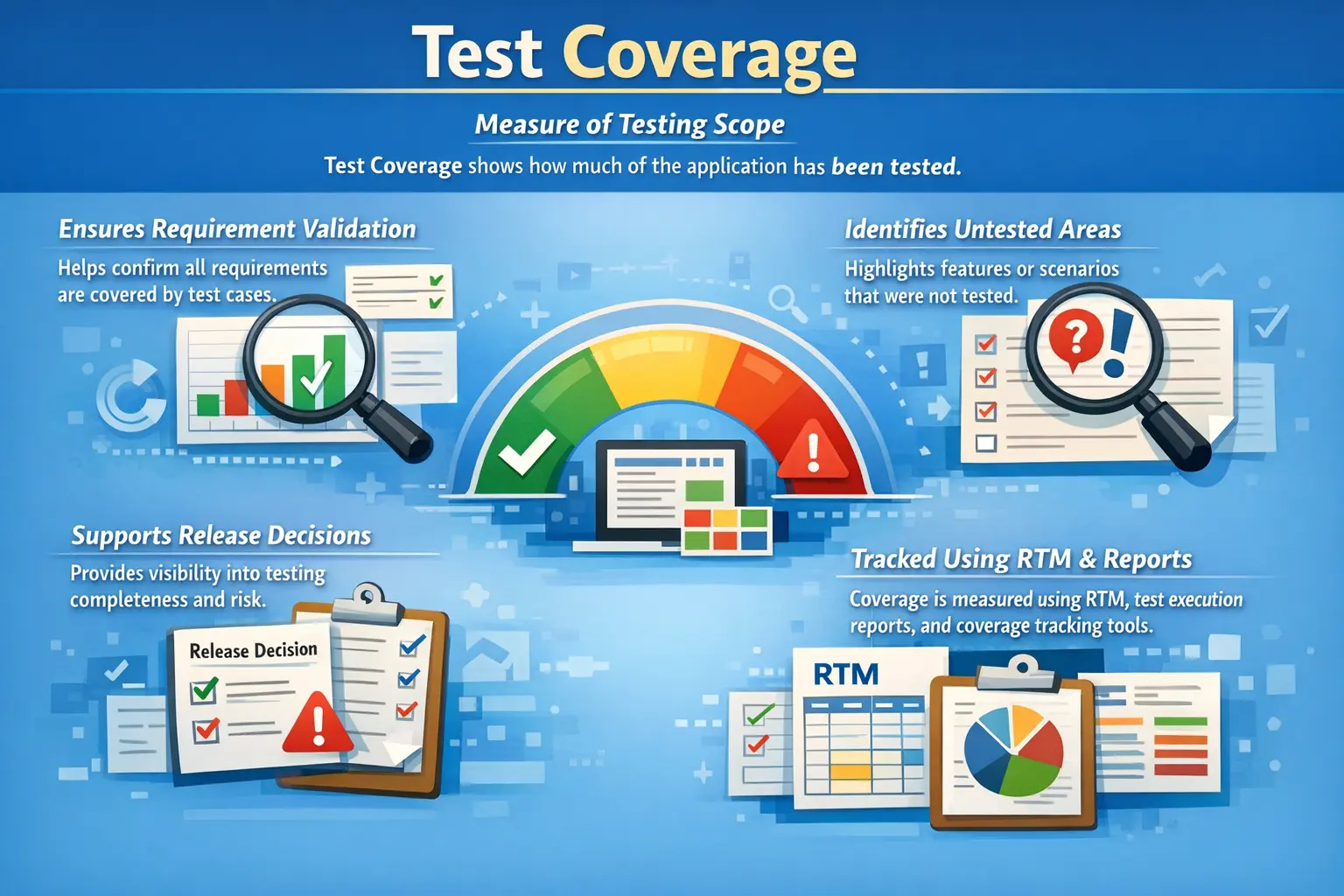
Test coverage measures the extent to which an application’s requirements, features, and risk areas have been validated by testing activities. It provides visibility into what parts of the system have been tested and what areas might still require attention.
Test coverage answers a crucial question in software quality assurance: “How much of the system have we actually tested?”
By analyzing test coverage, testing teams can determine whether their testing efforts are sufficient to support release decisions. It helps identify gaps in testing, ensures alignment with requirements, and provides stakeholders with confidence in the product’s quality.
In modern software development, particularly in large and complex systems, test coverage serves as an essential indicator of testing completeness and risk management.
Understanding Test Coverage
Test coverage represents the proportion of an application’s functionality or requirements that has been validated through testing. It helps testing teams understand whether their test cases adequately cover the system's behavior and business requirements.
Coverage is not limited to counting executed test cases. Instead, it examines whether the tests effectively validate all critical aspects of the application.
For example, if an application contains one hundred functional requirements and testers have designed and executed test cases for ninety-five of them, the requirement coverage would be ninety-five percent.
Test coverage provides a measurable way to evaluate testing completeness. It helps teams understand how thoroughly the system has been tested before a release.
However, it is important to note that coverage does not guarantee defect-free software. High coverage simply indicates that many areas of the system have been tested.
Effective testing requires both broad coverage and high-quality test design.
Purpose of Test Coverage
The primary purpose of test coverage is to ensure that all application requirements are validated during testing. By mapping test cases to requirements, testers can verify that no functionality has been overlooked.
Another important purpose is identifying untested areas. Coverage analysis reveals gaps in testing that may expose the system to risks if not addressed.
Test coverage also helps assess the completeness of testing. When coverage levels are high, stakeholders gain confidence that testing activities have been comprehensive.
Reducing release risk is another benefit of test coverage. By verifying that critical functionality and high-risk areas are tested, teams can minimize the likelihood of major defects reaching production.
Transparency is another key purpose of test coverage. Coverage reports provide stakeholders with clear insights into the progress and scope of testing.
Through these benefits, test coverage helps ensure that testing efforts align with project goals and quality expectations.
Types of Test Coverage in Manual Testing
Test coverage can be analyzed in multiple ways depending on what aspect of the application is being measured. Several types of coverage are commonly used in manual testing environments.
Requirement Coverage
Requirement coverage measures the percentage of requirements that have corresponding test cases and have been validated through testing.
This type of coverage ensures that every requirement defined in project documentation has been tested.
Requirement coverage is typically tracked using a Requirement Traceability Matrix (RTM), which maps each requirement to its corresponding test cases.
For example, if a system contains one hundred requirements and ninety-five of them have been tested, the requirement coverage is ninety-five percent.
High requirement coverage indicates that most system functionality has been validated.
This type of coverage is especially important in projects with strict compliance or regulatory requirements.
Functional Coverage
Functional coverage focuses on validating system features or modules. Instead of analyzing requirements individually, it examines whether major functionalities of the application have been tested.
For example, an e-commerce application may include modules such as product search, shopping cart, payment processing, and order tracking.
Functional coverage ensures that each of these modules has been tested.
Testing teams often track functional coverage by reviewing feature lists or application modules.
This type of coverage helps ensure that complete business workflows are validated.
Functional coverage is particularly useful when testing complex systems with multiple interconnected modules.
Test Case Coverage
Test case coverage measures how many test cases have been executed compared to the number of planned test cases.
For example, if two hundred test cases were planned and one hundred eighty have been executed, the test case coverage is ninety percent.
This metric helps testing teams track execution progress and determine how much testing work remains.
Test case coverage is commonly monitored during test execution phases to ensure that testing tasks are completed according to the schedule.
However, executing test cases alone does not guarantee that all functionality has been covered. Therefore, test case coverage should be analyzed alongside requirement coverage and functional coverage.
Risk Coverage
Risk coverage measures how effectively testing addresses high-risk areas within the application.
Certain features may have higher risk due to complex logic, financial impact, security implications, or frequent changes.
Risk-based testing strategies prioritize testing of these critical components first.
Risk coverage ensures that these high-risk areas receive sufficient testing attention.
For example, in a banking application, transaction processing and account management modules would typically be considered high-risk areas.
Testing teams ensure that these components are tested thoroughly with multiple scenarios, including edge cases and error handling.
Risk coverage helps minimize the likelihood of critical failures in production.
Scenario Coverage
Scenario coverage focuses on testing real-world business workflows.
Instead of testing individual functions in isolation, scenario coverage validates complete end-to-end processes.
For example, in an online shopping system, a business scenario may involve searching for a product, adding it to the cart, making a payment, and receiving an order confirmation.
Scenario coverage ensures that all critical user journeys are tested.
Testing teams design test scenarios that simulate realistic user interactions with the system.
By validating these workflows, testers ensure that the application behaves correctly in real-world usage conditions.
How Test Coverage Is Measured in Manual Testing
In manual testing environments, coverage is typically measured using several tracking tools and documentation methods.
One of the most commonly used tools is the Requirement Traceability Matrix (RTM). The RTM maps requirements to test cases and helps testers track which requirements have been validated.
Test execution reports also provide insights into coverage by showing which test cases have been executed and their results.
Some organizations use coverage dashboards that visually display coverage metrics such as requirement coverage and execution status.
Coverage may also be tracked using spreadsheets or test management tools that maintain detailed records of testing activities.
These measurement methods help testing teams maintain visibility into testing progress and completeness.
Manual Tester’s Role in Test Coverage
Manual testers play a crucial role in ensuring adequate test coverage.
One of their primary responsibilities is mapping test cases to requirements. This ensures that every requirement has corresponding validation scenarios.
Testers must also review requirements carefully to identify potential gaps in coverage.
Another important responsibility is updating coverage status regularly. As test cases are executed, testers update coverage reports to reflect current progress.
Testers also identify and highlight coverage gaps. If certain requirements or scenarios have not been tested, testers must raise these issues with the testing team or project stakeholders.
Coverage analysis also supports release decisions. Testers provide insights into coverage levels to help determine whether testing is sufficiently complete.
Through these activities, manual testers ensure that testing efforts are comprehensive and aligned with project requirements.
Test Coverage vs Test Execution
Although test coverage and test execution are closely related, they represent different aspects of testing.
Test execution focuses on running test cases and recording results such as pass, fail, or blocked.
Test coverage focuses on understanding which parts of the system have been tested.
Execution answers the question: “Did the test pass or fail?”
Coverage answers the question: “What parts of the system have been tested?”
Both metrics are essential for evaluating testing progress and quality.
While execution provides validation results, coverage provides visibility into testing completeness.
Together, they help teams make informed decisions about product readiness.
Common Coverage Gaps
Even well-planned testing efforts can sometimes leave certain areas uncovered.
One common gap occurs when negative scenarios are not tested. Systems must handle invalid inputs and unexpected conditions gracefully.
Error handling is another area that is often overlooked. Testers must ensure that the system responds correctly to failures.
Non-functional requirements such as performance, security, and usability may also receive insufficient coverage.
Regression testing areas may also be skipped when time constraints exist, increasing the risk of introducing new defects.
Identifying and addressing these coverage gaps is essential for ensuring comprehensive testing.
Common Misconceptions About Test Coverage
One common misconception is that achieving one hundred percent test coverage guarantees defect-free software.
In reality, coverage only indicates that certain parts of the system were tested. It does not measure the quality or effectiveness of the tests themselves.
Another misconception is that high coverage automatically ensures high quality.
A poorly designed test suite may achieve high coverage while still missing critical defects.
Coverage should therefore be viewed as an indicator of testing completeness rather than a guarantee of software quality.
Effective testing requires both high coverage and well-designed test cases.
Real-Time Example of Test Coverage
Consider a project preparing for release.
The testing team reviews coverage metrics before final approval.
Functional coverage indicates that all major application features have been tested.
Requirement coverage shows that ninety-eight percent of documented requirements have been validated.
Risk coverage confirms that all high-risk areas have been thoroughly tested.
These metrics indicate that testing has been comprehensive and that the system is ready for release with minimal residual risk.
Such analysis helps stakeholders make confident release decisions.
Interview-Ready Explanation
In testing interviews, candidates are often asked to explain test coverage.
A concise explanation states that test coverage measures how much of the application has been tested.
A more detailed explanation describes how coverage evaluates the extent to which requirements, features, and risk areas have been validated.
Examples of requirement coverage, functional coverage, and scenario coverage demonstrate practical understanding.
Understanding coverage concepts shows that a tester can evaluate testing completeness and identify potential gaps.
Key Takeaway
Test coverage is a critical metric that measures the extent to which an application’s requirements, functionality, and risk areas have been validated through testing.
By analyzing coverage, testing teams can identify gaps, ensure completeness, and provide stakeholders with transparency about testing progress.
Although coverage does not guarantee defect-free software, it helps teams understand residual risk and make informed release decisions.
Ultimately, effective test coverage ensures that testing efforts provide meaningful validation of system functionality, helping organizations deliver reliable and high-quality software.