Test Case Design Techniques for Effective Testing
In software testing, one of the most important responsibilities of a tester is deciding what to test and how to test it. Writing test cases randomly or relying only on intuition leads to incomplete coverage, missed defects, and wasted effort. This is where Test Case Design Techniques play a critical role.
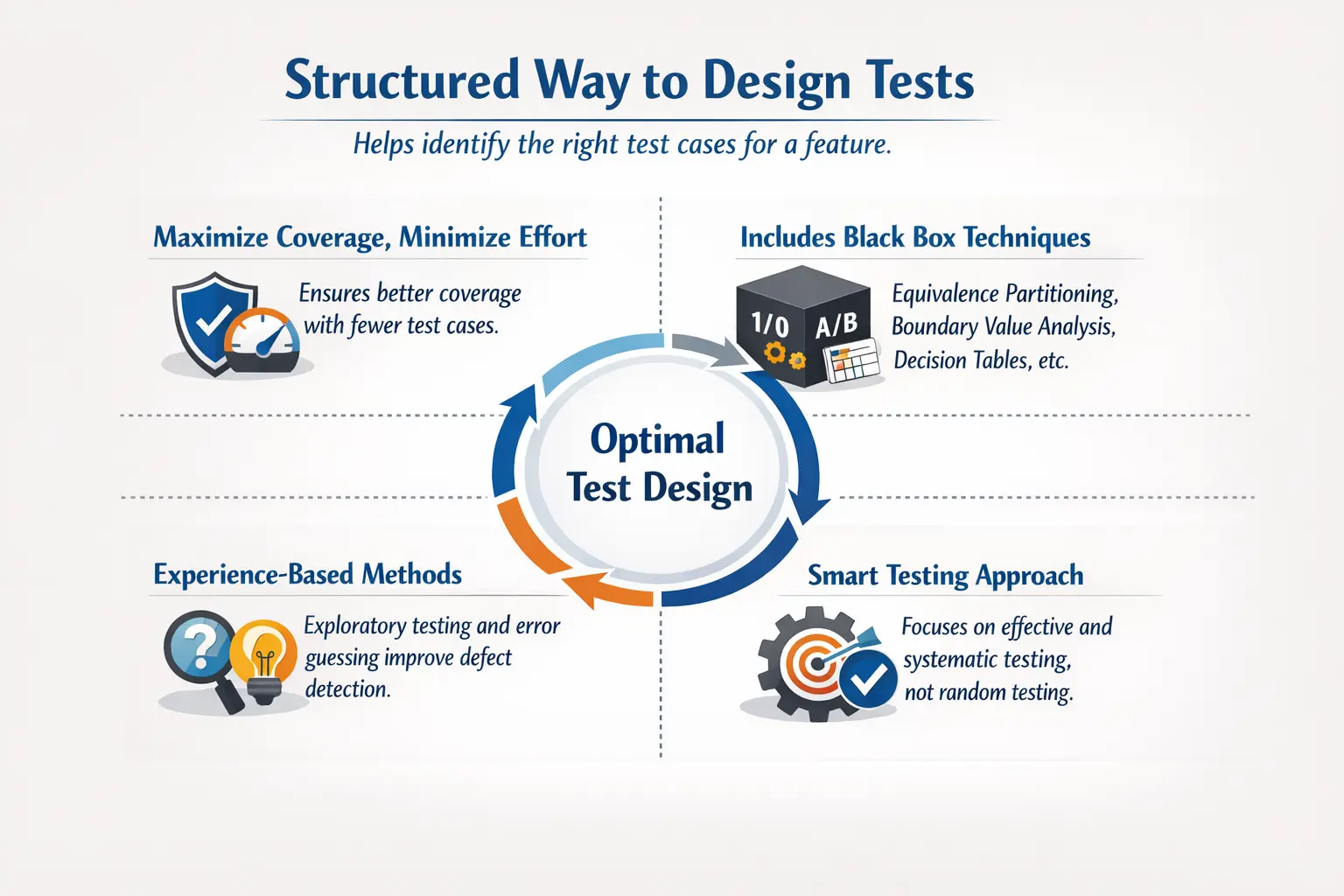
Test Case Design Techniques are structured, systematic approaches used to identify, design, and optimize test cases so that maximum coverage is achieved with minimum effort. These techniques help answer a fundamental question in testing:
“What are the right test cases to test this feature?”
Understanding and applying these techniques is essential for manual testers, automation engineers, QA leads, and anyone involved in ensuring software quality.
In real projects, test case design is where testing becomes thoughtful instead of mechanical. A tester may receive a user story, a business rule, a screen design, or a requirement document, but those inputs do not automatically become good test cases. The tester must interpret the requirement, identify the important conditions, understand possible user actions, think about invalid usage, and decide which examples provide meaningful confidence. Test case design techniques provide that structure.
These techniques are also useful because testing time is almost always limited. A team may have hundreds of possible combinations but only enough time to test the most important ones. Without a technique, testers may either test too little and miss defects or test too much and waste effort. With a technique, the tester can explain why certain cases were chosen and why other cases were not necessary. This makes testing more transparent and defensible.
1. Definition of Test Case Design Techniques
Test Case Design Techniques are formal methods used to derive test cases from requirements, specifications, or system behavior. Instead of guessing scenarios, testers apply logical techniques to systematically identify valid, invalid, and edge conditions.
These techniques:
- Structure the thinking process
- Improve coverage
- Reduce redundancy
- Minimize risk
- Increase defect detection efficiency
In short, they transform testing from an informal activity into a disciplined engineering process.
A good test design technique does not remove the tester's judgment. Instead, it strengthens judgment by giving it a framework. For example, when a tester uses Boundary Value Analysis, the tester is not randomly choosing values near an input limit. The tester is applying the practical knowledge that defects frequently occur at boundaries. When a tester uses a decision table, the tester is not guessing combinations. The tester is systematically mapping conditions to outcomes.
This is especially important for business-critical applications. In finance, insurance, healthcare, education, government portals, and e-commerce systems, small rule mistakes can create serious consequences. A discount rule may calculate the wrong amount, a loan eligibility rule may approve the wrong customer, or a permission rule may expose confidential data. Structured design techniques help testers cover those rules with discipline.
2. Purpose of Test Case Design Techniques
The primary purpose of these techniques is to design effective and efficient test cases.
They help to:
- Improve overall test coverage
- Reduce redundant or duplicate test cases
- Identify edge cases and corner cases
- Design systematic and traceable test scenarios
- Optimize time and effort
- Increase defect detection probability
Testing time is always limited. Therefore, smart test design is more important than writing a large number of test cases.
Another important purpose is communication. Well-designed test cases show stakeholders how requirements are being interpreted. When a business analyst reviews a decision table or a set of boundary cases, misunderstandings become visible early. The test cases become a practical form of requirement validation. If the expected result is unclear for a certain condition, the team can discuss it before development or release.
These techniques also support automation. Automation is most valuable when it automates meaningful scenarios. If the test design is weak, automation only runs weak tests faster. A strong manual test design foundation helps automation engineers select stable, high-value cases for regression suites, smoke suites, and data-driven tests.
3. Why Test Case Design Techniques Matter
In real-world projects, exhaustive testing is impossible. For example, if a field accepts values from 1 to 10,000, you cannot test all 10,000 values manually.
Without structured techniques:
- Random testing misses critical defects
- Important boundary conditions get ignored
- Complex business logic remains partially tested
- Test suites become unnecessarily large
Structured test case design techniques reduce risk and increase confidence. They are also a frequent interview topic, especially for QA, SDET, and manual testing roles.
Good testers are not those who write more test cases; they are those who design smarter ones.
Test design techniques matter even more when requirements are complex. A simple text field may need only a few input checks, but a tax rule, insurance premium calculation, approval workflow, subscription plan, or access-control matrix can have many combinations. Without a technique, important scenarios are easy to miss. With a technique, coverage becomes visible and gaps become easier to identify.
They also help reduce maintenance cost. A large test suite filled with duplicate or low-value cases becomes difficult to update when requirements change. Smart design reduces repetition and focuses on representative scenarios. This makes the test suite easier to maintain, easier to review, and easier to convert into automation where appropriate.
4. Types of Test Case Design Techniques
Test case design techniques are broadly categorized into three groups:
- Black Box Techniques
- White Box Techniques
- Experience-Based Techniques
Manual testers primarily focus on Black Box and Experience-Based techniques, while White Box techniques are more relevant to developers and automation engineers.
4.1 Black Box Techniques
In Black Box Testing, the tester does not know the internal code. The focus is on inputs, outputs, and business behavior. These techniques are most commonly used in manual testing.
Equivalence Partitioning
Equivalence Partitioning divides input data into logical groups (partitions) that are expected to behave similarly. The idea is simple: if one value in a partition works correctly, other values in that partition are assumed to behave similarly.
Example: A field accepts numbers between 1 and 100.
Partitions:
- Valid partition: 1 to 100
- Invalid partition: less than 1
- Invalid partition: greater than 100
Instead of testing all 100 values, you test representative values from each partition. This technique significantly reduces the number of test cases while maintaining coverage.
Equivalence Partitioning is useful when large input ranges or many possible values exist. The tester groups values by expected behavior and selects one or more representative values from each group. For a username field, partitions may include valid usernames, blank usernames, usernames with unsupported characters, usernames longer than the allowed limit, and usernames that do not exist in the system. Testing one carefully selected value from each partition gives better coverage than testing many similar values from the same group.
The main risk with Equivalence Partitioning is creating partitions too broadly. If two values appear similar but the system treats them differently, they should not be placed in the same partition. For example, a normal customer, a premium customer, and a suspended customer may all be "users," but they may follow different business rules. Good partitioning requires understanding the domain, not just reading field limits.
Boundary Value Analysis (BVA)
Boundary Value Analysis focuses on testing values at the edges of input ranges. Defects are most likely to occur at boundary values rather than in the middle.
Example: If the valid range is 1 to 100, test:
- 0 (below lower boundary)
- 1 (lower boundary)
- 2 (just above lower boundary)
- 99 (just below upper boundary)
- 100 (upper boundary)
- 101 (above upper boundary)
BVA is extremely powerful for numeric validations and is frequently asked in interviews.
Boundary Value Analysis is often used together with Equivalence Partitioning. First, the tester identifies valid and invalid partitions. Then the tester focuses closely on the edges of those partitions. This is practical because many programming mistakes happen around comparison operators such as less than, less than or equal to, greater than, and greater than or equal to. A developer may accidentally allow 101 when the maximum should be 100, or reject 1 when 1 should be valid.
Boundary testing is not limited to numbers. It can apply to password length, file size, date ranges, maximum cart items, minimum age, transaction limits, upload counts, search result limits, and text field character limits. Whenever a rule has a minimum, maximum, cutoff, threshold, or expiry point, boundary thinking is valuable.
Decision Table Testing
Decision Table Testing is used when business logic involves multiple conditions and rules. It is best suited for complex scenarios like loan approvals, tax calculations, or eligibility criteria.
A decision table lists:
- Conditions
- Possible combinations
- Expected outcomes
For example, a loan approval rule may depend on age, income, and credit score. Instead of testing randomly, you systematically create combinations and expected results. This ensures complete rule validation without missing scenarios.
Decision tables are especially useful when different combinations produce different outcomes. Suppose a discount is applied only when the user is a member, the cart value is above a threshold, and the coupon is valid. Testing each condition alone is not enough because the final result depends on the combination. A decision table makes every meaningful combination visible and helps the team agree on the correct expected result.
In large tables, testers should avoid blindly generating every possible combination when some combinations are impossible or irrelevant. The goal is complete meaningful coverage, not mechanical expansion. A good decision table is reviewed with business stakeholders so that rule priority, default behavior, and exception handling are clear.
State Transition Testing
State Transition Testing is used when an application changes behavior based on previous states. It focuses on valid and invalid state changes.
Example: An ATM machine may have states like:
- Idle
- Card Inserted
- PIN Entered
- Transaction Processing
- Transaction Completed
You test transitions between states to ensure correct behavior. This technique is useful for workflows, login systems, order processing, and status-driven applications.
State Transition Testing is important when the system remembers previous actions. For example, an order may move from Created to Paid, then to Shipped, then to Delivered. The system may allow cancellation only before shipping. A test that checks cancellation in only one state is incomplete. The tester must verify valid transitions, invalid transitions, and behavior when users attempt actions at the wrong time.
This technique is also useful for account lockout, document approval, ticket workflows, subscription status, payment processing, and session management. Any feature that has states such as active, inactive, pending, approved, rejected, locked, expired, or completed can benefit from state-based thinking.
Use Case Testing
Use Case Testing derives test cases from user scenarios or business workflows. Instead of focusing on individual inputs, this technique tests complete end-to-end flows.
Example: E-commerce checkout process:
- User logs in
- Searches product
- Adds to cart
- Makes payment
- Receives confirmation
This validates real-world usage scenarios.
Use Case Testing is valuable because users rarely interact with software one field at a time. They follow a goal. They log in, search, select, submit, pay, approve, download, or update. A feature may pass isolated field-level tests but fail when used in a complete workflow. Use case testing validates the flow from the user's perspective and helps confirm business readiness.
A strong use case test includes preconditions, main flow, alternate flows, and exception flows. For checkout, the main flow may be successful payment. Alternate flows may include applying a coupon, changing quantity, or using a saved address. Exception flows may include payment failure, out-of-stock item, expired coupon, or session timeout. This makes use case testing broader than a simple happy path.
Error Guessing
Error Guessing is an experience-based black box technique. Testers rely on domain knowledge and past experience to predict likely defect areas.
Examples:
- Entering special characters
- Providing extremely large inputs
- Leaving mandatory fields blank
- Attempting SQL injection-like input
Error Guessing is informal but highly effective when combined with structured techniques.
Error Guessing becomes stronger as testers gain experience with a product, domain, and technology stack. A tester who has seen repeated defects in date handling will naturally test leap years, invalid dates, future dates, timezone differences, and expiry boundaries. A tester who has worked with file uploads will check unsupported extensions, large files, duplicate names, empty files, and interrupted uploads. This experience-driven thinking often finds defects that formal techniques do not explicitly list.
However, error guessing should not replace structured design. It should complement it. If a tester uses only error guessing, coverage may depend too heavily on memory and intuition. If a tester uses only formal techniques, some real-world misuse scenarios may be missed. Combining both gives better coverage.
4.2 White Box Techniques (Conceptual Awareness)
White Box Techniques focus on internal code structure.
Manual testers should have conceptual awareness of:
- Statement Coverage
- Branch Coverage
These techniques ensure that code paths are executed and tested. Although primarily developer-focused, understanding these concepts helps manual testers collaborate effectively with development teams.
4.3 Experience-Based Techniques
Experience-Based techniques rely on tester knowledge, intuition, and domain expertise.
These include:
- Exploratory Testing
- Ad-hoc Testing
- Error Guessing
Exploratory Testing involves simultaneous learning, test design, and execution. Ad-hoc Testing is informal and unstructured. These techniques complement structured test case design methods.
Experience-based techniques are particularly helpful when requirements are incomplete, the product is new, or the team is exploring risk areas. Exploratory testing allows the tester to learn from the application while testing it. The tester may begin with a charter such as "explore payment failure handling" and then adjust test ideas based on observed behavior. This approach is flexible and powerful when used responsibly.
The best testers know when to use structured techniques and when to explore. Structured techniques provide planned coverage. Exploratory techniques provide discovery. Together, they help the tester validate both known requirements and unknown risks.
5. When to Use Test Case Design Techniques
Test case design techniques should be applied:
- During requirement analysis
- While writing test cases
- When reducing large test suites
- When testing complex business logic
- During regression optimization
They are not optional. They are a core skill of professional testers.
The best time to apply these techniques is as early as possible. During requirement analysis, testers can already begin identifying partitions, boundaries, business rules, states, and workflows. This early thinking often reveals unclear requirements. For example, if a requirement says "valid age," the tester should ask what the minimum and maximum age are. If a requirement says "eligible customer," the tester should ask which conditions define eligibility.
While writing test cases, techniques help convert understanding into documented coverage. During regression optimization, they help remove unnecessary duplication. During automation planning, they help select high-value scenarios. During defect analysis, they help identify missing cases that allowed the defect to escape. In this way, test case design techniques are useful across the entire testing lifecycle.
6. How to Choose the Right Technique
Choosing the right technique depends on the nature of the feature. If the feature has input ranges, Boundary Value Analysis and Equivalence Partitioning are usually appropriate. If the feature has many condition combinations, Decision Table Testing is stronger. If the feature changes behavior based on status or previous action, State Transition Testing is the right choice. If the feature represents a complete user journey, Use Case Testing should be included.
For example, a password field needs Equivalence Partitioning for valid and invalid password categories, Boundary Value Analysis for minimum and maximum length, and Error Guessing for common weak inputs. A loan approval feature needs Decision Table Testing because multiple conditions influence the result. An order workflow needs State Transition Testing because the allowed actions depend on the current order status.
Testers should avoid forcing every technique onto every feature. The goal is not to show that all techniques were used. The goal is to choose the technique that exposes the most relevant risk. A mature tester selects techniques based on the requirement, domain, risk, time, and business impact.
7. Real-Time Example: Login Feature
Consider designing test cases for a login field.
Using Equivalence Partitioning:
- Valid username and password
- Invalid username
- Invalid password
Using Boundary Value Analysis:
- Minimum password length
- Maximum password length
Using Error Guessing:
- Special characters
- SQL-like inputs
- Empty fields
Using multiple techniques ensures thorough coverage without unnecessary duplication.
A fuller login test design may include successful login with valid credentials, failed login with invalid username, failed login with invalid password, blank username, blank password, locked account, inactive account, password length boundary, special characters, SQL-like input, repeated failed attempts, password reset link behavior, and session creation after login. These scenarios do not come from random thinking. They come from combining several techniques intelligently.
The tester should also consider whether all cases belong in the same test suite. Some cases may be part of smoke testing, such as successful login. Some may be part of functional validation, such as invalid credential handling. Some may be part of security or regression coverage, such as account lockout and session behavior. Good test design includes both scenario selection and suite placement.
8. Combining Techniques for Better Coverage
In real projects, one technique is rarely enough. A single feature may need multiple techniques because different types of risk exist in the same workflow. A registration form may need Equivalence Partitioning for valid and invalid inputs, Boundary Value Analysis for field lengths, Decision Table Testing for eligibility rules, Use Case Testing for the complete registration flow, and Error Guessing for unexpected user behavior.
Combining techniques prevents blind spots. Boundary testing alone may catch range errors but miss business rule combinations. Decision tables may cover rule combinations but miss user workflow problems. Use case testing may cover realistic journeys but miss exact boundary values. Error guessing may find unusual defects but may not provide systematic coverage. A balanced test design uses the strengths of each technique.
This is why experienced testers think in layers. First, they understand the requirement. Next, they identify inputs, rules, states, and flows. Then they choose techniques for each layer. Finally, they remove duplicate cases and prioritize the remaining tests based on risk.
9. Test Case Design and Requirement Traceability
Test case design techniques support traceability because they make it easier to connect test cases back to requirements. A decision table can be traced to a business rule. Boundary cases can be traced to input limits. State transition tests can be traced to workflow rules. Use case tests can be traced to user journeys or acceptance criteria.
Traceability is important when stakeholders ask whether a requirement has been tested. It is also useful when requirements change. If the maximum allowed transaction amount changes, the tester can quickly identify which boundary test cases need updating. If an approval rule changes, the decision table can be updated and impacted test cases can be found.
In regulated or audit-heavy projects, traceability provides evidence that testing was planned and systematic. It shows that test coverage was not based on memory or luck. Even in Agile projects, lightweight traceability helps teams maintain confidence as the product evolves.
10. Test Design and Regression Optimization
Regression suites can become large and slow if every test case is added without careful design. Test case design techniques help optimize regression coverage. Instead of keeping many duplicate tests, the tester can keep representative partition cases, important boundary cases, key decision table combinations, and critical end-to-end workflows.
This is especially useful for automation. Automated regression should not become a collection of every manual test ever written. It should focus on stable, repeatable, high-value scenarios. Test design techniques help identify which cases give the most confidence for the least execution and maintenance cost.
When a defect is found in production, the team can analyze which design technique would have caught it. If the defect was at a limit, boundary coverage may have been weak. If the defect involved a business rule combination, the decision table may have been incomplete. This feedback improves future regression design.
11. Reviewing Test Cases Designed with Techniques
Test case review is an important step after design. Reviewers should not only check spelling or formatting. They should verify whether the right technique was selected, whether important partitions are covered, whether boundaries are correct, whether decision table combinations are meaningful, and whether expected results are clear.
A good review asks practical questions. Are we testing both valid and invalid cases? Are we testing just below, at, and just above the boundary? Are all business rule outcomes represented? Are invalid state transitions covered? Are we testing complete user workflows and not just isolated fields? Are duplicate cases adding value or only increasing effort?
Reviews are also useful for knowledge sharing. Junior testers learn how senior testers think. Business analysts see how requirements are being interpreted. Developers see where logic may be risky. This collaboration improves both test quality and requirement clarity.
12. Common Mistakes in Test Case Design
Many testers make avoidable mistakes:
- Writing too many similar test cases
- Ignoring boundary conditions
- Testing only happy paths
- Not applying techniques systematically
- Skipping decision tables for complex logic
Effective testing is about structured thinking, not quantity.
Another common mistake is confusing test case count with test quality. A suite with two hundred weak cases may provide less confidence than a suite with forty well-designed cases. More test cases also mean more maintenance, more execution time, and more review effort. Quantity matters only when the cases add meaningful coverage.
Testers also sometimes apply techniques mechanically without understanding the business context. For example, boundary values are useful only when the boundary is correct. If the requirement itself is unclear, the tester must clarify it before designing cases. A decision table is useful only when the conditions and outcomes accurately reflect the business rule.
Skipping negative scenarios is another serious mistake. Many defects appear when users enter invalid data, break sequence, attempt unauthorized actions, or use the system in unexpected ways. Good test design includes positive, negative, and edge coverage.
13. Interview Perspective
Test case design techniques are frequently asked in interviews.
Short Answer:
Test case design techniques are systematic methods used to create effective test cases with maximum coverage and minimal redundancy.
Detailed Answer:
These techniques help testers identify valid, invalid, and edge scenarios logically and systematically. By applying structured approaches like Equivalence Partitioning, Boundary Value Analysis, Decision Tables, and State Transition Testing, testers ensure efficient and thorough coverage of requirements.
14. Key Takeaway
Good test case design is not about writing more test cases.
It is about achieving smart coverage with minimal effort.
Structured techniques reduce risk, improve defect detection, and increase confidence in software quality. Mastering these techniques transforms testing from guesswork into a disciplined engineering activity.
A professional tester does not test everything. A professional tester tests the right things intelligently.