Boundary Value Analysis (BVA) for Effective Test Design
In software testing, one of the most powerful observations is this: defects rarely occur in the middle of input ranges—they usually occur at the edges. Developers often implement validations using conditions such as <, >, <=, or >=. A small logical mistake in these comparisons can cause major functional failures. This is exactly why Boundary Value Analysis (BVA) is considered one of the most effective test case design techniques in manual testing.
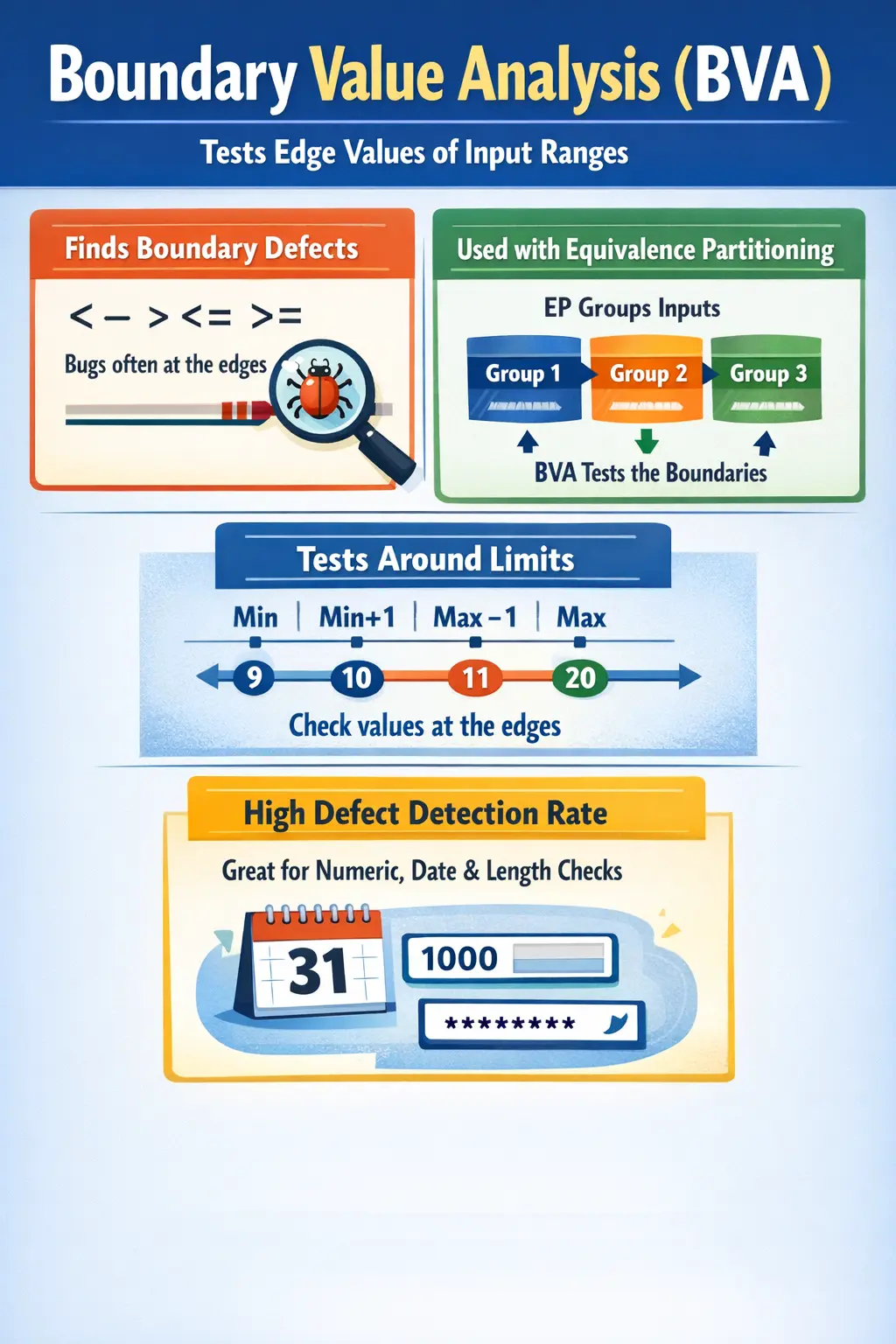
Boundary Value Analysis focuses specifically on testing the values at the boundaries of valid and invalid input ranges. It answers a very important question: “What happens at the edges of valid and invalid input ranges?”
Understanding BVA deeply is essential not only for interviews but also for real-world projects where input validation plays a critical role in system stability and correctness.
Boundary Value Analysis is important because it makes testing focused. A tester does not simply choose data randomly and hope to find a defect. Instead, the tester studies the rule, identifies the minimum and maximum points, and then validates the values that are most likely to expose mistakes. This is why BVA is widely used by manual testers, automation testers, QA analysts, and SDETs. It converts a large input space into a small set of high-value test cases.
In real applications, boundaries are everywhere. Age limits, password lengths, file sizes, upload counts, discount thresholds, tax slabs, transaction limits, date ranges, pagination limits, cart quantities, API request sizes, timeout values, and retry counts all depend on boundary logic. If these limits are handled incorrectly, users may be blocked when they should be allowed, or allowed when they should be blocked. BVA helps testers catch these failures before they reach production.
1. Definition of Boundary Value Analysis
Boundary Value Analysis is a structured test case design technique that concentrates on testing boundary values of input conditions. Instead of testing random values within a range, BVA specifically targets the extreme ends of that range.
If an input field accepts values from 1 to 100, testing values such as 50 or 60 may not reveal validation errors. However, testing values like 1, 100, 0, or 101 is much more likely to uncover defects.
The principle behind BVA is simple yet powerful:
Most defects occur at boundary limits rather than in the middle of the range.
A boundary is not always only a number. It can be a date, length, size, count, percentage, time duration, score, amount, or any ordered value where one side of the limit behaves differently from another. For example, the maximum number of login attempts may be 5. The maximum file upload size may be 10 MB. A coupon may apply only when cart value is greater than or equal to 2,000. Each of these rules has a point where the expected behavior changes. That change point is the boundary.
Good BVA is therefore about identifying behavior change points. If the application behaves the same for 20, 30, and 40, testing all three values may not add much value. But if behavior changes at 18, 60, 5,000, or 10 MB, those points deserve careful attention. This is what separates boundary-focused testing from ordinary input testing.
2. Why Boundary Values Are Important
Boundary values are critical because validation logic is often implemented using relational operators. Even a small mistake in these conditions can cause incorrect behavior.
For example, a developer might mistakenly write:
if (age > 18 && age < 60)
instead of:
if (age >= 18 && age <= 60)
This subtle mistake excludes 18 and 60, which should be valid values. Such defects are common and can significantly impact users.
Boundary-related bugs occur frequently because:
- Developers misinterpret requirements.
- Off-by-one errors are common.
- Incorrect use of < and <= operators leads to validation gaps.
- Upper and lower limits are sometimes handled differently.
Testing boundary values increases the probability of detecting these issues early.
Boundary bugs are often small in code but large in impact. A single missing equals sign can reject valid users, allow invalid transactions, calculate wrong charges, or create compliance issues. In many systems, the middle values work correctly because they are far away from the decision point. The real question is whether the system behaves correctly exactly where the rule starts and exactly where it ends.
Boundary values are also important because business users often describe rules using natural language. A requirement may say "up to 60 years", "more than 5,000", "minimum 8 characters", "within 30 days", or "not later than the due date." Each phrase has a precise technical meaning, but it can be misunderstood during implementation. BVA forces the team to clarify whether a limit is inclusive or exclusive and whether values just outside the limit should be rejected.
3. Relationship Between Equivalence Partitioning and BVA
Boundary Value Analysis is closely related to Equivalence Partitioning (EP), but they serve different purposes.
Equivalence Partitioning divides inputs into logical groups where one representative value is tested from each group. BVA, on the other hand, focuses specifically on the edge values of those groups.
In practice, they are often used together. First, EP identifies valid and invalid ranges. Then, BVA tests the edges of those ranges.
For example, if EP identifies that a valid age range is 18 to 60, BVA ensures that the values 18 and 60 are tested, along with values just outside the range.
EP gives structure. BVA adds precision at critical limits.
In practice, a strong test design often starts with Equivalence Partitioning and then applies Boundary Value Analysis to each range-based partition. EP tells the tester that values below 18 are invalid, values from 18 to 60 are valid, and values above 60 are invalid. BVA then identifies 17, 18, 19, 59, 60, and 61 as the values most worth checking. EP prevents redundant random testing; BVA increases the chance of finding boundary defects.
This relationship is important in interviews and real projects. If a tester uses only EP, they may test 30 as the valid representative value and miss an issue at 18 or 60. If a tester uses only BVA without partition thinking, they may miss invalid formats or separate business groups. The two techniques support each other and should usually be applied together for validation-heavy features.
4. How to Apply Boundary Value Analysis
Applying BVA requires systematic thinking. The following structured approach helps ensure completeness.
Step 1: Identify the Input Range
Understand the requirement clearly. Determine the allowed minimum and maximum values.
Step 2: Identify the Boundaries
Find the smallest and largest valid values defined in the requirement.
Step 3: Select Boundary Values
For each boundary, test:
- Minimum value
- Minimum + 1
- Maximum − 1
- Maximum value
Optionally, include:
- Just below minimum
- Just above maximum
This creates a comprehensive boundary-focused test set.
Step 4: Confirm Expected Results
Selecting boundary values is only half of the work. The tester must also define the expected result for each value. For example, if age must be between 18 and 60 inclusive, then 18 and 60 should be valid, while 17 and 61 should be invalid. If the requirement says age must be greater than 18 and less than 60, then 18 and 60 are invalid. The same numbers can have different expected results depending on the wording.
Step 5: Review Boundary Assumptions
Boundary assumptions should be reviewed with the business analyst, product owner, or requirement owner when wording is unclear. Terms such as above, below, less than, up to, at least, maximum, minimum, before, after, within, and until must be interpreted carefully. A misunderstanding at this point can lead to wrong test cases and wrong defect reports.
5. Inclusive and Exclusive Boundaries
One of the most important concepts in Boundary Value Analysis is understanding whether a boundary is inclusive or exclusive. An inclusive boundary means the limit value itself is allowed. An exclusive boundary means the limit value itself is not allowed. Many real defects happen because this distinction is not handled correctly in code or misunderstood during testing.
If a requirement says "age must be between 18 and 60 inclusive," then both 18 and 60 are valid. If the requirement says "age must be greater than 18 and less than 60," then 18 and 60 are not valid. If it says "cart value should be above 5,000 for discount," the value 5,000 may not qualify. If it says "cart value should be at least 5,000," then 5,000 qualifies. These small wording differences are exactly why BVA is so valuable.
Testers should never assume inclusiveness automatically. The expected result must come from the requirement or from confirmed business clarification. When the requirement is unclear, the tester should raise a question before execution. This prevents unnecessary defect disputes later.
6. Real-Time Example: Age Field Validation
Requirement: Age must be between 18 and 60 inclusive.
Boundary values are:
- 17 (just below minimum)
- 18 (minimum boundary)
- 19 (minimum + 1)
- 59 (maximum − 1)
- 60 (maximum boundary)
- 61 (just above maximum)
Expected results:
- 17 → Invalid
- 18 → Valid
- 19 → Valid
- 59 → Valid
- 60 → Valid
- 61 → Invalid
Testing only 30 would not reveal boundary issues. Testing the edges ensures logical correctness.
7. Types of Boundary Value Analysis
Boundary Value Analysis can be categorized into two primary types.
Normal Boundary Value Analysis
This approach tests only the valid boundary values. It includes:
- Minimum
- Minimum + 1
- Maximum − 1
- Maximum
It does not test invalid values outside the range.
Robust Boundary Value Analysis
Robust BVA includes both valid and invalid boundary values. It tests:
- Just below minimum
- Minimum
- Minimum + 1
- Maximum − 1
- Maximum
- Just above maximum
Robust BVA provides stronger validation coverage because it ensures both sides of the boundary are tested.
Worst-Case Boundary Value Analysis
In some situations, multiple inputs have boundaries at the same time. Worst-case BVA considers combinations of boundary values across multiple variables. For example, if a loan form has age, income, and loan amount limits, each field has its own boundaries. Testing all combinations can quickly increase the number of test cases, so this approach is usually reserved for high-risk systems where boundary interactions matter.
Manual testers should understand the idea even if they do not always apply the full combination set. The practical point is that boundary errors can occur not only in one field, but also when multiple fields are near their limits together. For critical financial, healthcare, compliance, or safety-related systems, these interactions may be worth testing.
8. BVA for Numeric Fields
Numeric fields are the most common area where BVA is applied.
Example: A salary field accepts values between 10,000 and 100,000.
Boundary test values would include:
- 9,999
- 10,000
- 10,001
- 99,999
- 100,000
- 100,001
Such testing ensures that numeric limits are correctly implemented.
9. BVA for Text Length Validation
Boundary testing is also highly effective for length-based validations.
Example: Password length must be between 8 and 12 characters.
Boundary values:
- 7 characters
- 8 characters
- 9 characters
- 11 characters
- 12 characters
- 13 characters
This verifies that length validation logic is correctly implemented.
10. BVA for Date Ranges
Boundary Value Analysis is particularly important in date validations.
Example: Booking dates allowed from January 1 to December 31.
Boundary testing includes:
- December 31 of previous year
- January 1
- January 2
- December 30
- December 31
- January 1 of next year
Date validations are prone to errors, especially in leap years and month-end calculations.
Date boundaries require special care because calendar rules are more complex than simple numeric ranges. Month-end dates, leap years, timezone differences, daylight saving changes, and server-client date mismatches can all create defects. For example, a subscription valid until March 31 may expire incorrectly on March 30 if timezone conversion is wrong. A February 29 date may fail in non-leap-year logic. A booking cutoff at midnight may behave differently depending on whether the system uses local time or UTC.
When testing date boundaries, testers should think beyond the visible date picker. They should consider the business meaning of the date, the time component if applicable, and the system behavior just before and just after the cutoff. Date BVA is especially important in booking systems, insurance policies, payment due dates, subscription expiry, payroll cycles, and compliance reports.
11. BVA for Threshold-Based Systems
Threshold systems often rely on boundary logic.
Examples include:
- Discount percentages
- Tax brackets
- Performance limits
- System timeout thresholds
If a discount applies for orders above 5,000, testing 4,999, 5,000, and 5,001 is critical.
Threshold-based systems are common in business applications because many decisions depend on cutoffs. A customer may receive free shipping above a certain amount. A loan may require manager approval beyond a specific value. A tax percentage may change after a slab limit. A system may lock an account after a fixed number of failed attempts. These are all boundary decisions.
Threshold rules should be tested not only for acceptance and rejection, but also for the exact business outcome. If an order value of 5,000 qualifies for a discount, the test should verify the discount is applied correctly. If 4,999 does not qualify, the test should verify that no discount is applied. If 5,001 qualifies, the test confirms behavior just above the threshold. This makes the test more meaningful than simply checking whether the system shows success or failure.
12. BVA for Decimal and Currency Values
Decimal and currency fields need careful boundary testing because precision and rounding can create subtle defects. A rule may say that a transaction amount must be between 1.00 and 10,000.00. The obvious boundary values are 0.99, 1.00, 1.01, 9,999.99, 10,000.00, and 10,000.01. But testers may also need to consider values with too many decimal places, such as 10.999, or values affected by rounding, such as 99.995.
Financial systems must be especially precise. A system that rounds before validation may behave differently from a system that validates before rounding. For example, if the maximum allowed amount is 100.00, should 100.004 be accepted after rounding to 100.00, or rejected because the raw input exceeds the limit? The answer depends on business rules. BVA helps identify these questions early.
13. BVA for File Size and Upload Limits
File upload rules are another practical area for BVA. Applications often restrict maximum file size, number of files, filename length, or allowed document count. If the maximum file size is 5 MB, testers should check files just below 5 MB, exactly 5 MB, and just above 5 MB. If the system allows a maximum of 10 files, testers should check 9, 10, and 11 files.
Upload boundaries can reveal issues in both frontend and backend validation. The browser may block a file, but the server must still validate it. A progress bar may show upload success while backend processing fails. Large files may trigger timeout behavior. Because uploads involve UI, network, storage, and server validation, boundary testing provides strong practical value.
14. BVA vs Equivalence Partitioning
Boundary Value Analysis and Equivalence Partitioning serve complementary roles.
Equivalence Partitioning focuses on grouping inputs logically.
Boundary Value Analysis focuses on testing the edges of those groups.
BVA typically results in more test cases than EP but provides higher defect detection probability at critical limits.
EP reduces redundancy. BVA increases precision.
15. When to Use Boundary Value Analysis
BVA is most effective when applied to:
- Numeric input fields
- Date validations
- Age and salary fields
- Password length validations
- Input size constraints
- Range-based business rules
- Threshold-based decision logic
Whenever there is a minimum or maximum limit, BVA should be applied.
16. BVA in Form Testing
Forms are one of the most common places where Boundary Value Analysis is used. A registration form may contain fields such as first name, last name, email, password, phone number, age, postal code, and upload document. Each of these fields can have minimum and maximum limits. A name may require at least 2 characters and allow a maximum of 50. A password may require 8 to 20 characters. A phone number may require exactly 10 digits in a particular country.
When testing forms, BVA helps avoid random test data selection. Instead of trying many arbitrary names or passwords, testers choose values around the limits. For a password field with 8 to 20 characters, the strongest boundary set includes 7, 8, 9, 19, 20, and 21 characters. If the password also has complexity rules, those rules should be tested separately or combined carefully with length boundaries.
A good form test also verifies the user experience around boundary failures. If a field exceeds the maximum length, does the system prevent typing, show a clear error, trim the value, or reject the form after submission? Each behavior has different implications. BVA identifies the critical values; complete testing verifies how the application handles those values.
17. BVA in API Testing
APIs often require even stronger boundary testing than user interfaces because API clients can send values that the UI may never allow. A UI may restrict a field to numbers, but an API request can still send negative values, very large numbers, decimal values, null values, or strings. BVA helps validate whether the backend enforces limits independently.
For example, if an API accepts a quantity from 1 to 100, testers should send 0, 1, 2, 99, 100, and 101. They should verify not only the status code, but also the response body, error message, database impact, and downstream behavior where applicable. A boundary failure in an API can corrupt data or affect multiple integrated systems.
API BVA is also useful for pagination, search limits, page size, retry counts, rate limits, and payload sizes. If the maximum page size is 100, values 99, 100, and 101 should be meaningful tests. If an endpoint allows a maximum of 1,000 records in a bulk request, payloads with 999, 1,000, and 1,001 records should be considered. These tests protect system stability and contract correctness.
18. BVA in Automation Testing
Boundary Value Analysis is highly suitable for automation because the test data can be defined clearly and reused consistently. Instead of writing many similar automated tests, teams can create data-driven tests that run a focused set of boundary values. This keeps automation lean while still targeting high-risk validation points.
For example, a data-driven automation test for age validation can run six rows: 17, 18, 19, 59, 60, and 61. Each row has an expected result. When the test fails, the failed value immediately communicates which boundary is broken. This is easier to diagnose than a random input failure.
Automation teams should avoid turning BVA into excessive test data. The goal is not to automate every possible value near a range. The goal is to automate meaningful boundary representatives and keep the suite fast, stable, and maintainable. If every field gets dozens of unnecessary values, the automation suite becomes slow and noisy.
19. BVA During Requirement Review
BVA is useful before test execution begins. During requirement review, testers can identify missing or unclear boundaries. If a user story says "system should allow valid age," the tester should ask what the minimum and maximum ages are. If a story says "file size should be limited," the tester should ask for the exact size limit and whether the limit is inclusive.
This early questioning prevents defects. Developers cannot implement correct validation if the limit is not defined. Testers cannot design correct expected results if the requirement does not specify whether the boundary value itself is allowed. By applying BVA thinking during refinement, QA contributes to requirement quality and reduces rework.
20. BVA and Risk-Based Testing
Boundary testing should be prioritized based on risk. A boundary defect in a comments field may be annoying, but a boundary defect in payment amount, age eligibility, dosage calculation, loan approval, tax slab, or access control can be serious. High-risk boundaries deserve deeper testing, clearer documentation, and sometimes multiple supporting techniques.
Risk-based BVA means testers choose where to spend more effort. For a low-risk field, normal BVA may be enough. For a high-risk financial rule, robust BVA, decimal precision checks, negative cases, integration checks, and regression automation may all be required. The technique remains the same, but the depth changes according to business impact.
21. Writing Clear BVA Test Cases
A strong BVA test case title should explain the boundary being tested. Instead of writing "Validate age field," write "Age equal to minimum limit should be accepted" or "Age just below minimum limit should be rejected." Clear titles make the test case self-explanatory and improve review quality.
Each test case should include the input value, the boundary type, and the expected result. For example, value 18 may be marked as "minimum valid boundary", while 17 may be marked as "just below minimum invalid boundary." This makes execution and defect reporting more precise. If a defect is found, the developer can immediately understand whether the lower boundary, upper boundary, or adjacent invalid value failed.
BVA cases should also include expected messages when applicable. If 17 is invalid for age, the system should show a meaningful message such as "Age must be between 18 and 60." A vague message like "Invalid input" may be less helpful to users. Good BVA testing therefore validates both logic and communication.
22. Common Mistakes in BVA
Many testers make avoidable errors when applying Boundary Value Analysis.
One common mistake is ignoring one side of the boundary. Testing only the minimum and forgetting the maximum can leave gaps.
Another mistake is confusing EP with BVA. EP identifies partitions, while BVA tests edge values.
Some testers test only valid boundaries but ignore invalid boundaries just outside the range.
Another frequent mistake is assuming boundary conditions are always inclusive without verifying requirement wording.
Careful reading of requirements is critical.
Another mistake is testing only the exact boundary values and skipping the adjacent values. If the valid range is 18 to 60, testing only 18 and 60 is not enough for robust validation. The values just outside the range, such as 17 and 61, confirm that invalid input is rejected. The values just inside the range, such as 19 and 59, confirm that the valid range behaves normally near the edges.
Testers may also forget that boundaries can exist in hidden places. A page may show only ten records, a search field may have a maximum query length, a backend service may limit payload size, or a session may expire after a certain number of minutes. If the tester looks only at visible form fields, important system boundaries may be missed.
23. Advantages of Boundary Value Analysis
Boundary Value Analysis offers several advantages:
- High defect detection probability
- Efficient and systematic approach
- Easy to apply
- Suitable for manual testing
- Reduces risk of logical errors
- Essential for validation-heavy applications
It is one of the most cost-effective test case design techniques.
24. Limitations of BVA
Although powerful, BVA has limitations.
It is primarily applicable to ordered data such as numbers, dates, or lengths. It is less effective for complex decision logic where Decision Table Testing is more appropriate.
BVA alone does not guarantee complete coverage. It should be combined with Equivalence Partitioning and other techniques.
Another limitation is that BVA depends on clear boundaries. If the requirement does not define a minimum, maximum, threshold, or ordered condition, BVA may not be the right primary technique. For rules based on combinations of conditions, Decision Table Testing may be better. For workflows that change based on state, State Transition Testing may be more appropriate. A skilled tester chooses the technique that matches the problem.
25. BVA in Real Projects
In real projects, boundary defects can lead to serious consequences.
Examples include:
- Allowing underage users in restricted systems
- Incorrect salary validation in payroll systems
- Incorrect tax calculations
- Security vulnerabilities due to length validation issues
In financial, healthcare, and banking applications, boundary errors can cause compliance failures and financial loss.
Therefore, BVA is not optional—it is mandatory.
Real projects also show why BVA should be repeated during regression. A boundary that worked in one release can break after a later change. For example, a new discount rule may accidentally affect the old discount threshold. A frontend validation update may allow values that the backend rejects. A database schema change may alter maximum field length. Boundary tests should be part of regression suites for critical features.
In Agile teams, BVA is especially useful because stories are delivered quickly and testers must design efficient coverage. During sprint testing, testers can identify boundaries from acceptance criteria, test them manually, and automate the most important ones later. This gives fast feedback without creating an unnecessarily large test suite.
26. Practical BVA Checklist
Before finalizing BVA test cases, testers should verify a few key points. First, confirm the minimum and maximum values. Second, confirm whether the boundaries are inclusive or exclusive. Third, identify values just below and just above each boundary. Fourth, define expected results for every selected value. Fifth, check whether decimal, date, timezone, size, or formatting rules affect the boundary.
Testers should also ask whether the boundary exists only in the UI or must be enforced by the backend. If both layers validate the rule, both may need testing. Finally, high-risk boundary cases should be considered for automation or regression coverage. This checklist keeps BVA practical and repeatable.
27. Interview Perspective
Boundary Value Analysis is a common interview question for QA and SDET roles.
Short answer:
Boundary Value Analysis is a test case design technique that focuses on testing the boundary values of input ranges.
Detailed answer:
BVA tests values at and around the edges of valid and invalid input ranges. Since defects are most likely to occur at boundary conditions, this technique increases defect detection probability by validating minimum, maximum, and adjacent values.
Understanding both conceptual and practical applications is essential in interviews.
Project-based answer:
In a real project, I first identify the valid input range from the requirement. Then I test values at the minimum and maximum boundaries, values just inside the range, and values just outside the range. For example, if age must be between 18 and 60 inclusive, I test 17, 18, 19, 59, 60, and 61. This helps detect off-by-one errors and incorrect validation logic. I usually combine BVA with Equivalence Partitioning for stronger coverage.
28. Key Takeaway
Boundary Value Analysis targets high-risk areas of software applications. Instead of testing random values, it concentrates on edges where defects are most likely to occur.
It complements Equivalence Partitioning and significantly improves validation accuracy.
Testing the middle may prove functionality works. Testing the edges ensures functionality works correctly.
Boundary Value Analysis is one of the most effective manual testing techniques because it balances efficiency with high defect detection capability.
When applied consistently and thoughtfully, it transforms testing from guesswork into precision validation.