Requirement Traceability Matrix (RTM)
In any structured software testing process, one of the most critical questions a tester or project stakeholder can ask is: Have we tested everything that was required? The Requirement Traceability Matrix (RTM) is the artifact that provides a clear, structured answer to this question. It acts as a bridge between requirements and testing activities, ensuring that nothing important is missed and nothing unnecessary is tested.
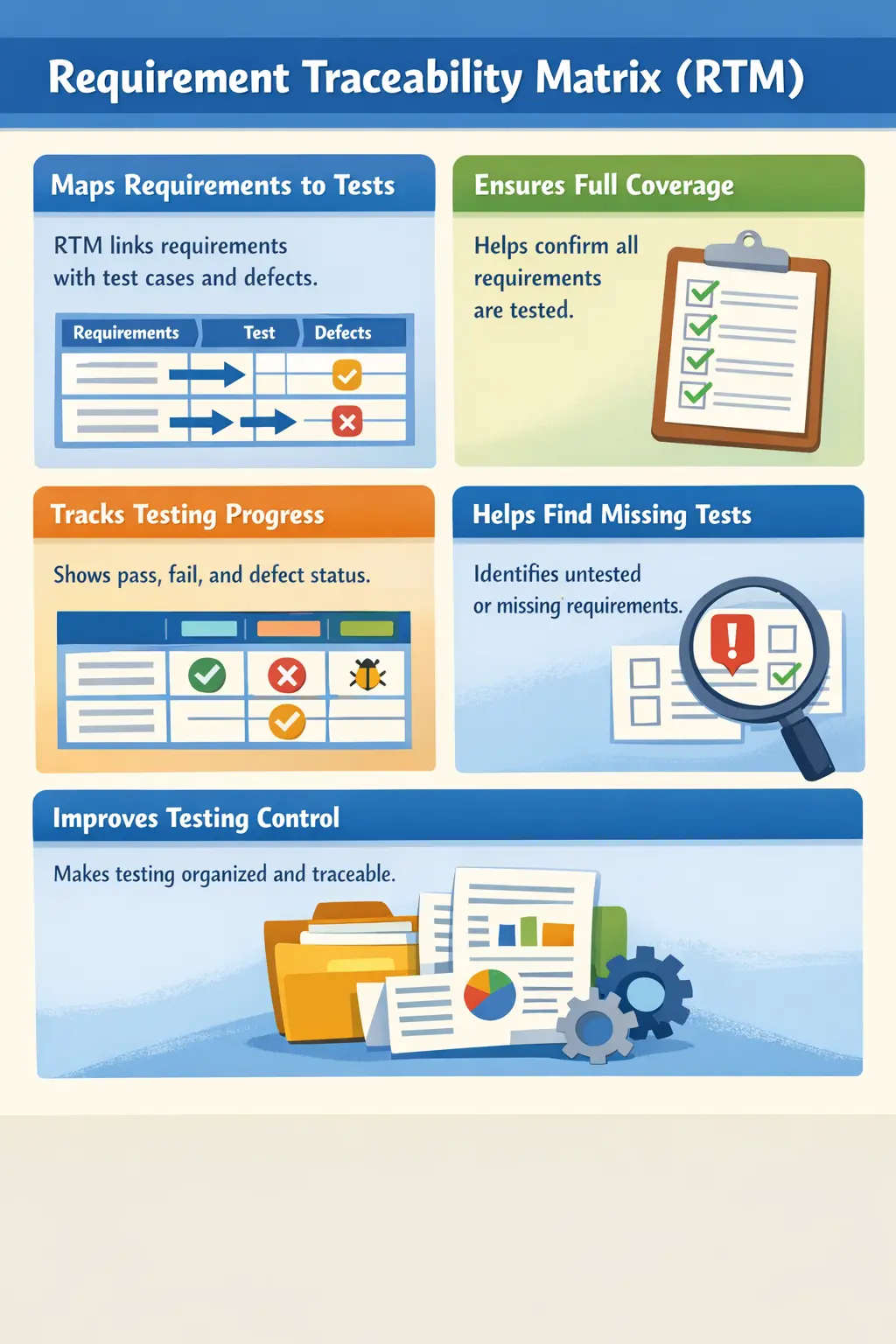
A Requirement Traceability Matrix (RTM) is a document that maps requirements to test artifacts such as test scenarios, test cases, and defects. Its primary objective is to ensure complete requirement coverage. In simple terms, RTM answers: “Are all requirements tested, and is anything missed?”
RTM is not just a spreadsheet; it is a quality assurance control mechanism. It ensures traceability, accountability, and visibility across the lifecycle of a project. For manual testers, understanding and maintaining RTM is a core responsibility, especially in requirement-driven environments such as banking, healthcare, and enterprise systems.
Understanding Requirement Traceability
Traceability refers to the ability to track something from its origin to its final implementation and validation. In the context of software testing, traceability ensures that every requirement is linked to one or more test cases and that every test case can be traced back to a requirement.
Without traceability, testing becomes disconnected from business objectives. Test cases may be executed successfully, but there is no guarantee that all requirements have been validated.
RTM provides structured traceability by mapping:
- Requirement → Test Scenario
- Requirement → Test Case
- Requirement → Execution Status
- Requirement → Defect (if any)
This mapping ensures that the entire testing effort remains aligned with the original business needs.
Requirement traceability is important because software testing is not only about executing test cases. It is about proving that the product being delivered matches what the business requested. A team may execute hundreds of test cases and still miss an important requirement if those test cases are not connected back to documented expectations. Traceability prevents this gap by creating a visible relationship between what was requested, what was built, what was tested, and what defects were found.
In practical terms, traceability gives testers a way to defend the completeness of testing. If a stakeholder asks whether password reset, user role restrictions, invoice generation, or transaction limits were tested, the tester should not rely on memory. The RTM should show the requirement, the related test scenarios, the test cases, the execution status, and any associated defects. This makes the testing answer evidence-based.
Traceability also helps separate meaningful testing from random testing. Without RTM, test cases may grow over time without clear purpose. Some may duplicate each other, some may no longer match current requirements, and some may validate behavior that is no longer needed. By linking every test case to a requirement, RTM keeps the test suite relevant and controlled.
Purpose of Requirement Traceability Matrix
The RTM serves multiple important purposes in software testing and quality assurance.
One of its primary purposes is to ensure 100% requirement coverage. Every requirement documented in the Business Requirement Document (BRD) or Functional Requirement Specification (FRS) must be validated. RTM makes it easy to verify this.
RTM also helps track testing progress per requirement. Instead of only tracking how many test cases have passed or failed, stakeholders can see which specific requirements have been validated and which are still pending.
Another critical purpose is identifying missing or untested requirements. If a requirement exists in documentation but does not appear in RTM, it means it has not been covered in testing. This early detection prevents serious quality gaps.
RTM is also essential for audits and compliance. In regulated industries, auditors may require proof that all requirements were tested. RTM provides this traceable evidence.
Finally, RTM helps assess the impact of requirement changes. When a requirement changes, the RTM immediately shows which test cases and scenarios are affected, enabling faster impact analysis.
RTM also improves test planning. When testers know how many requirements exist and how complex those requirements are, they can estimate test design, test data preparation, execution effort, and regression needs more realistically. Requirements with many linked scenarios usually require more testing effort than simple display requirements.
Another purpose of RTM is supporting release readiness. A release decision should not be based only on the percentage of test cases passed. Stakeholders also need to know whether all critical requirements were tested successfully. RTM provides that requirement-level view. If a few low-risk test cases are pending, the release risk may be acceptable. If one critical requirement has no completed testing, the risk may be serious.
RTM also supports defect impact analysis. When a defect is linked to a requirement, the team can understand which business capability is affected. This is especially useful during defect triage because a defect linked to a high-value business requirement may need faster attention than a defect linked to a rarely used feature.
Why RTM Is Important in Real Projects
In real-world projects, requirements often evolve during development. New requirements are added, and existing ones are modified. Without proper traceability, these changes can lead to confusion and incomplete testing.
RTM ensures structured control over requirement changes. When a new requirement is added, the RTM must be updated, and corresponding test cases must be created. When a requirement is modified, affected test cases can be identified quickly.
RTM also enhances communication between business analysts, developers, and testers. Everyone can see the mapping between requirements and test cases, reducing misunderstandings.
For large-scale enterprise applications with hundreds of requirements, RTM becomes indispensable. It ensures that no business functionality is left untested.
Real projects rarely remain perfectly stable from requirement approval to release. Requirements may be clarified, split, merged, deferred, or changed due to business decisions. When this happens, the RTM becomes a control point. It shows which test artifacts must be created, modified, removed, or re-executed. Without this control, teams may continue testing old behavior while missing the new expectation.
RTM is also valuable when multiple testers work on the same application. One tester may own login, another may own reports, another may own payments, and another may own administration. The RTM gives the team a shared view of coverage. QA leads can review the matrix and identify whether any requirement has no owner, no scenario, no test case, or no execution result.
In client-facing projects, RTM can also reduce disputes. If a client asks why a specific behavior was not tested, the team can review whether that behavior was documented as a requirement. If it was documented, the RTM should show how it was tested. If it was not documented, the discussion can move toward requirement clarification or change management rather than blame.
Types of Traceability
Requirement traceability can be classified into two primary types: forward traceability and backward traceability.
Forward traceability ensures that every requirement is linked to at least one test case. This confirms that all documented requirements are validated through testing. If a requirement has no linked test case, it means it has not been tested.
Backward traceability ensures that every test case is linked to a requirement. This prevents unnecessary testing. If a test case exists without a mapped requirement, it may indicate redundant or irrelevant testing.
Together, forward and backward traceability create a balanced and controlled testing framework. They ensure both completeness and relevance.
Some organizations also maintain bidirectional traceability, where requirements and test cases are fully interconnected in both directions.
Forward traceability is useful for confirming completeness. It starts from the requirement and moves toward test scenarios, test cases, execution, and defects. This helps answer whether every requirement has been covered. It is especially useful during test design reviews because uncovered requirements can be identified before execution begins.
Backward traceability is useful for confirming relevance. It starts from a test case and traces back to the requirement that justifies it. This helps identify unnecessary or outdated test cases. If a test case has no mapped requirement, the tester should ask whether the requirement is missing, whether the test case is obsolete, or whether it represents exploratory or non-functional validation that needs separate justification.
Bidirectional traceability combines both views. It allows the team to move from requirement to test case and from test case back to requirement. This is the strongest form of traceability because it supports both coverage assurance and test suite cleanup.
Levels of Traceability
Traceability can exist at different levels depending on the maturity of the project. At the simplest level, requirements are mapped to test cases. This is enough for many small or medium projects. At a deeper level, requirements may also be mapped to design documents, development tasks, test scenarios, automation scripts, execution results, defects, and release notes.
In a highly controlled project, traceability may cover the full chain from business requirement to functional requirement, design, code module, test case, defect, fix version, and production release. This deeper traceability is useful in regulated industries where teams must prove that every approved requirement was implemented and verified.
Manual testers usually focus on requirement-to-test traceability, but they should understand the larger picture. When testers map requirements to test cases and defects correctly, they contribute to end-to-end quality evidence for the project.
Components of a Requirement Traceability Matrix
A typical RTM contains several key components that allow comprehensive mapping and tracking.
The Requirement ID uniquely identifies each requirement. Requirement IDs are typically assigned by business analysts and may follow a structured naming convention.
The Requirement Description provides a summary of the functionality or business rule being validated.
The Test Scenario ID links high-level testing objectives to requirements. One requirement may map to multiple scenarios.
The Test Case ID provides detailed traceability from requirement to execution-level validation.
Execution Status indicates whether the associated test cases have passed, failed, or are pending.
Defect ID provides linkage to reported defects. If a requirement fails validation, the associated defect ID is recorded for traceability.
These components together create a comprehensive mapping structure that ensures clarity and accountability.
Many RTMs also include priority, requirement type, module name, test case owner, automation status, execution date, defect status, remarks, and sign-off status. These additional fields make the matrix more useful for project control. For example, priority helps identify critical requirements, while automation status helps teams know which requirement validations are covered by automated regression.
Requirement type can also be useful. Functional requirements, non-functional requirements, UI requirements, security requirements, reporting requirements, and integration requirements may need different testing approaches. If the RTM identifies the type, testers can confirm that the correct validation method is being applied.
The remarks column should be used carefully. It can capture useful context such as "blocked due to missing test data," "deferred to next release," or "covered under regression suite." However, it should not become a place where unclear decisions are hidden. Important risks should be visible and properly communicated.
Sample Conceptual RTM
Consider a simplified example.
Requirement REQ-01 describes user login functionality. It is mapped to test cases TC-01 and TC-02. Both test cases pass, so execution status is marked as Pass.
Requirement REQ-02 describes password reset functionality. It is mapped to TC-03, which fails during execution. A defect BUG-101 is logged and linked in the RTM.
Such structured mapping immediately provides visibility into which requirements are validated and which require fixes.
A slightly richer RTM may show REQ-01 mapped to login test cases for valid login, invalid password, locked account, and session creation. The same requirement may also be linked to a defect if login fails for locked accounts. Once the defect is fixed and retested, the RTM can show that the requirement is now fully validated.
For password reset, the RTM may show test cases for valid reset link, expired reset link, already used reset link, invalid email address, and password rule validation. This makes coverage visible at a requirement level. A stakeholder can review one row and understand whether the requirement was tested deeply or only superficially.
The value of RTM increases when the mapping is meaningful. Mapping one requirement to one broad test case may not provide enough confidence for a complex feature. A requirement with several business rules may need several test cases. The RTM should reflect real validation depth, not just formal linkage.
How RTM Is Created
RTM is usually created during the test design phase of the Software Testing Life Cycle (STLC). The process begins once requirements are finalized and approved.
The tester first identifies all requirement IDs from requirement documents. Then, high-level test scenarios are created for each requirement. These scenarios are further expanded into detailed test cases.
Once test cases are written, they are mapped to corresponding requirement IDs in the RTM. This ensures forward traceability.
During execution, test case status is updated in the RTM. If defects are logged, defect IDs are also mapped to affected requirements.
RTM should be treated as a living document that evolves throughout the project lifecycle.
The first practical step in creating RTM is requirement review. Testers should check whether every requirement has a unique ID and whether the requirement is clear enough to test. If requirements are vague, the RTM may still be created, but test case mapping will be weak. Clear requirements produce stronger traceability.
The next step is scenario identification. A single requirement may produce multiple scenarios because the requirement may include normal behavior, alternate behavior, negative conditions, and boundary rules. Mapping these scenarios helps testers think beyond one happy path.
After scenarios are converted into detailed test cases, the RTM should be reviewed. A review can reveal requirements with no test cases, test cases with no requirement, duplicate coverage, missing negative cases, or incomplete boundary coverage. This review is one of the most valuable uses of RTM during test design.
During execution, RTM should not remain static. Status values should be updated as testing progresses. If a test case fails, the defect ID should be added. If a defect is fixed and retested, the updated status should reflect that. If a requirement is deferred, the RTM should show that decision clearly.
Manual Tester’s Role in RTM
Manual testers play a critical role in maintaining RTM.
During test design, testers are responsible for mapping each test case to its corresponding requirement. This ensures complete forward traceability.
During test execution, testers update the execution status in RTM. If a test case fails, the linked defect ID is added.
When requirements change, testers use RTM to analyze impact. They identify affected test cases and update them accordingly.
RTM also helps testers during regression testing. If a requirement has been modified, testers can quickly locate related test cases for re-validation.
Thus, RTM becomes an operational tool, not just a documentation artifact.
Manual testers also use RTM during requirement clarification. If a requirement cannot be mapped to a clear test case, that may indicate ambiguity. For example, a requirement that says "system should be user-friendly" is difficult to map unless it is supported by measurable acceptance criteria. RTM helps expose such weak requirements early.
Testers are also responsible for keeping RTM realistic. It is not enough to create a matrix once and forget it. If test cases are added, removed, rewritten, automated, blocked, or linked to defects, the RTM should reflect those changes. An outdated RTM can be worse than no RTM because it creates false confidence.
QA leads often review RTM to check completeness. They may ask whether all high-priority requirements have test cases, whether all failed requirements have defect IDs, and whether all changed requirements have been retested. Testers who maintain RTM properly make this review faster and more reliable.
During regression planning, manual testers can use RTM to identify impacted areas. If a requirement related to user roles changes, the tester can quickly find all test cases linked to that requirement and include them in regression. This reduces the chance of missing dependent functionality.
RTM vs Test Coverage
RTM and test coverage are related but different concepts.
Test coverage generally refers to the percentage of testing completed. It may indicate how many test cases have been executed or passed.
RTM focuses specifically on requirement mapping. It answers whether each requirement has been validated.
Test coverage may show 90% of test cases executed, but without RTM, there is no guarantee that all requirements are covered.
RTM provides detailed traceability, while coverage provides summary-level visibility.
Test coverage can sometimes create a misleading sense of confidence. A report may say that 95% of test cases passed, but if the remaining 5% belongs to payment, security, or compliance requirements, the release risk may still be high. RTM prevents this misunderstanding by showing which requirements are covered and which remain open.
RTM also improves the quality of coverage measurement. Instead of counting test cases only, the team can count requirement coverage. For example, if 100 requirements exist and 98 have passed validation, the team has a clearer picture of requirement readiness. This is more meaningful than simply saying that 500 test cases were executed.
Test coverage answers "how much testing was done." RTM answers "what business requirements were covered by that testing." Both views are useful, but RTM is more directly connected to requirement completeness and business confidence.
When RTM Is Used
RTM is used throughout the project lifecycle.
During test planning, it helps estimate effort based on the number of requirements.
During test design, it ensures all requirements are mapped to scenarios and test cases.
During execution, it tracks validation progress.
During audits or compliance reviews, it provides documented proof of requirement coverage.
During User Acceptance Testing (UAT), RTM supports sign-off by showing that all business requirements were tested.
When requirements change, RTM assists in impact analysis.
Thus, RTM is relevant at multiple stages, not just during documentation.
During requirement review, RTM thinking helps testers identify testable and non-testable requirements. If a requirement cannot be mapped to a validation method, it may need clarification. During test design, RTM ensures that every accepted requirement has test coverage. During execution, it tracks whether the linked cases passed, failed, or were blocked.
During defect management, RTM helps determine which requirement is affected by a defect. This improves triage because the team can evaluate business impact more accurately. During regression testing, RTM helps identify which requirements and test cases must be revalidated after a change.
During closure, RTM supports final reporting. A test summary report can use RTM data to show requirement coverage, failed requirements, deferred requirements, and accepted risks. This gives stakeholders a requirement-level view of release readiness.
Benefits of Requirement Traceability Matrix
RTM offers significant benefits to software projects.
- It prevents missing requirements during testing.
- It ensures that no unnecessary test cases are created.
- It improves transparency for stakeholders.
- It supports structured impact analysis.
- It strengthens quality assurance processes.
- It provides audit-ready documentation.
- It improves coordination between business and testing teams.
- In highly regulated industries, RTM is often mandatory.
Another major benefit is faster change handling. When a requirement changes late in the project, the team does not need to manually search through all test cases. The RTM shows the affected scenarios and test cases directly. This saves time and reduces the chance of missing impacted validation.
RTM also improves stakeholder confidence. Business users may not understand every test case, but they usually understand requirements. When testers show that every requirement has been mapped and executed, stakeholders can see that testing is aligned with business expectations.
RTM also helps reduce unnecessary testing. If a test case has no requirement link and no risk-based justification, it may be obsolete or redundant. Removing low-value test cases keeps the test suite cleaner and makes regression testing more efficient.
Common Mistakes in RTM Management
One common mistake is failing to update RTM regularly. If execution status or defect mapping is not updated, the RTM loses accuracy.
Another mistake is incomplete requirement mapping. Missing requirement IDs in RTM can lead to untested functionality.
Some teams fail to link defects to requirements. Without defect linkage, impact visibility is reduced.
Another issue is treating RTM as a one-time document rather than a dynamic artifact.
Proper maintenance is essential for RTM effectiveness.
Another common mistake is using vague requirement descriptions without stable IDs. If requirements are identified only by text, it becomes difficult to track changes over time. Unique requirement IDs are essential because descriptions may change, but the ID provides a stable reference.
Some teams also overcomplicate RTM by adding too many columns that no one maintains. A large matrix may look impressive, but if the data is outdated, it has little value. RTM should contain enough information to support traceability and decisions, but it should remain maintainable.
Another mistake is treating RTM as a QA-only document. Business analysts provide requirement IDs and clarifications. Testers provide test mappings and execution status. Developers may use RTM for impact analysis. Project managers may use it for release readiness. RTM works best when it is shared and trusted across roles.
A serious mistake is failing to update RTM after requirement changes. If a requirement is modified but the mapped test cases are not reviewed, testing may validate old behavior. This creates a dangerous gap between current business expectations and actual validation.
Real-Time Example
Consider a banking application with requirements related to fund transfer.
Requirement REQ-10 specifies that users can transfer funds between accounts.
Requirement REQ-11 specifies that transfer limits must be enforced.
Requirement REQ-12 specifies that confirmation messages must be displayed.
Each of these requirements is mapped to multiple test cases.
If a defect occurs in transfer limit validation, the RTM immediately shows which requirement and test cases are affected.
This structured visibility allows efficient resolution and validation.
In this banking example, the RTM may show that REQ-10 is mapped to successful transfer, transfer between own accounts, transfer to saved beneficiary, and transfer with valid remarks. REQ-11 may be mapped to daily limit, per-transaction limit, insufficient balance, and blocked account cases. REQ-12 may be mapped to success message, failure message, SMS notification, and email confirmation.
If a developer changes the transfer limit logic, RTM helps the tester identify that REQ-11 and all related test cases must be retested. The tester does not need to guess which cases are relevant. The traceability is already available.
If a defect is found where transfers above the daily limit are allowed, the defect can be linked to REQ-11. Stakeholders can immediately understand that a business rule related to transfer limits has failed. This is more meaningful than only saying that one test case failed.
RTM and Requirement Changes
Requirement changes are one of the strongest reasons to maintain RTM. When a requirement changes, the team must know which test cases, test data, automation scripts, and defects are affected. RTM provides this visibility.
For example, if password length changes from minimum eight characters to minimum twelve characters, the RTM shows which password-related test cases need updates. Boundary value test cases, negative cases, registration cases, reset password cases, and change password cases may all be affected. Without RTM, some of these cases may be missed.
RTM also helps identify newly added requirements that have no test coverage yet. When a new requirement is added, it should appear in the matrix with corresponding scenarios and test cases. If the requirement exists but the test case fields are empty, the gap is visible immediately.
RTM and Defect Tracking
Linking defects to requirements is one of the most useful parts of RTM. When a test case fails, the defect ID should be recorded against the related requirement. This allows stakeholders to see which requirements are currently failing validation.
Defect linkage is especially helpful during release discussions. A report may show five open defects, but RTM can show whether those defects affect critical requirements or low-risk features. This helps prioritize fixes and supports informed go/no-go decisions.
When defects are fixed and retested, the RTM should be updated. A requirement should not be considered fully validated until its linked test cases have passed and any related defects have been resolved or formally accepted.
RTM and Regression Testing
RTM supports regression testing by identifying test cases related to changed or high-risk requirements. Instead of selecting regression cases randomly, testers can choose cases based on requirement impact. This makes regression testing more focused and defensible.
If a requirement changes, all linked test cases should be considered for regression. If a defect is fixed, test cases linked to the same requirement may need to be rerun. If a high-priority requirement has a history of defects, its linked cases may be included in every regression cycle.
RTM can also identify automation candidates. Requirements that are business-critical, stable, and frequently tested are strong candidates for automation. Mapping automation status in RTM helps teams understand which requirements are protected by automated regression and which still depend on manual testing.
RTM in Agile Environments
Even in Agile projects, RTM remains relevant.
In Agile, user stories replace traditional requirements. Each user story has acceptance criteria.
RTM maps user story IDs to test cases and defects.
Although Agile emphasizes lightweight documentation, traceability is still essential.
Modern tools such as Jira, Azure DevOps, and test management systems automate RTM mapping.
Thus, RTM adapts to Agile environments through digital traceability tools.
In Agile projects, RTM does not always look like a traditional spreadsheet. Traceability may exist through links between epics, user stories, acceptance criteria, test cases, defects, and automation results inside a tool. The principle is the same: every user story or acceptance criterion should be traceable to validation evidence.
Agile teams should keep RTM lightweight but meaningful. Heavy documentation can slow teams down, but absence of traceability can create quality gaps. A practical Agile RTM may map story ID, acceptance criterion, test case, execution status, defect ID, and automation status. This is enough for most sprint-level traceability needs.
RTM is especially useful during sprint closure and release planning. It helps teams confirm which stories are fully tested, which are blocked, which have open defects, and which require regression. This prevents incomplete stories from being treated as done simply because development work is finished.
RTM in Audit and Compliance
In regulated domains, RTM is often more than a helpful testing tool. It may be required evidence. Auditors may ask whether every approved requirement was tested, whether failed requirements were linked to defects, whether defects were resolved, and whether final validation was completed before release.
RTM provides this evidence in a structured form. It shows requirement IDs, test case links, execution status, defect references, and sometimes sign-off information. This makes it easier to prove that the team followed a controlled quality process.
Compliance-focused RTM must be maintained carefully. Missing links, outdated statuses, unclear requirement IDs, or undocumented defect decisions can create audit problems. In such projects, RTM accuracy is not optional; it is part of governance.
RTM in Test Management Tools
Many teams maintain RTM through tools rather than manual spreadsheets. Jira with test management plugins, Azure DevOps, Zephyr, Xray, TestRail, and similar systems can link requirements, stories, test cases, executions, and defects. These tools reduce manual effort and improve real-time visibility.
Tool-based RTM is useful, but it still depends on disciplined usage. If testers do not link test cases to requirements, update execution status, or connect defects properly, the tool cannot produce accurate traceability. Automation helps only when the underlying process is followed.
Manual spreadsheets are still common in smaller projects. They can work well if maintained consistently. The important point is not the tool itself, but whether the team can reliably answer which requirements are tested, which are failing, and which are not covered.
Interview Perspective
RTM is a common interview topic for manual testing roles.
A short answer typically describes RTM as a document that maps requirements to test cases to ensure complete coverage.
A detailed answer explains that RTM ensures every requirement is validated, supports defect tracking, and assists in impact analysis.
Interviewers may also ask about forward and backward traceability.
Clear understanding of RTM demonstrates process-oriented testing knowledge.
In interviews, a strong answer should include purpose, structure, and practical usage. For example: "RTM is a traceability document that maps requirements to test scenarios, test cases, execution status, and defects. It ensures complete requirement coverage, helps identify missed requirements, supports impact analysis when requirements change, and provides evidence for audits and release decisions."
If asked about forward traceability, explain that it ensures every requirement has corresponding test cases. If asked about backward traceability, explain that every test case should trace back to a requirement. If asked about bidirectional traceability, explain that it supports both completeness and relevance.
If asked about your role as a manual tester, explain that you map test cases to requirement IDs, update execution status, link defects, review uncovered requirements, and update the RTM when requirements change. This answer shows practical project involvement rather than only textbook knowledge.
Best Practices for Maintaining RTM
- RTM should always include unique requirement IDs.
- It should be updated regularly during execution.
- It should link defects to requirements.
- It should be reviewed periodically for completeness.
- It should be stored in a shared repository accessible to stakeholders.
- Automation tools should be used when available.
- Consistency and discipline are key to effective RTM management.
RTM should also be reviewed after requirement changes. Whenever a requirement is added, modified, deferred, or removed, the matrix should be updated. Related test scenarios, test cases, data, and defects should be reviewed for impact. This keeps traceability aligned with the current scope.
It is also a good practice to keep RTM simple enough for regular use. A matrix with too many unused fields becomes difficult to maintain. Start with the fields that support real decisions: requirement ID, description, scenario ID, test case ID, execution status, defect ID, and remarks. Add more fields only when they serve a clear purpose.
Teams should also define ownership. Business analysts may own requirement IDs and descriptions. Testers may own test case mapping and execution status. QA leads may own review and completeness checks. Clear ownership prevents the RTM from becoming outdated.
Key Takeaway
The Requirement Traceability Matrix is a powerful quality assurance tool that ensures complete requirement validation. It provides structured mapping between requirements, test cases, and defects, ensuring nothing required is left untested and nothing unnecessary is tested.
RTM strengthens accountability, improves transparency, supports audits, and enhances overall software quality.
In professional testing environments, RTM is not optional—it is essential.