Functional Requirements
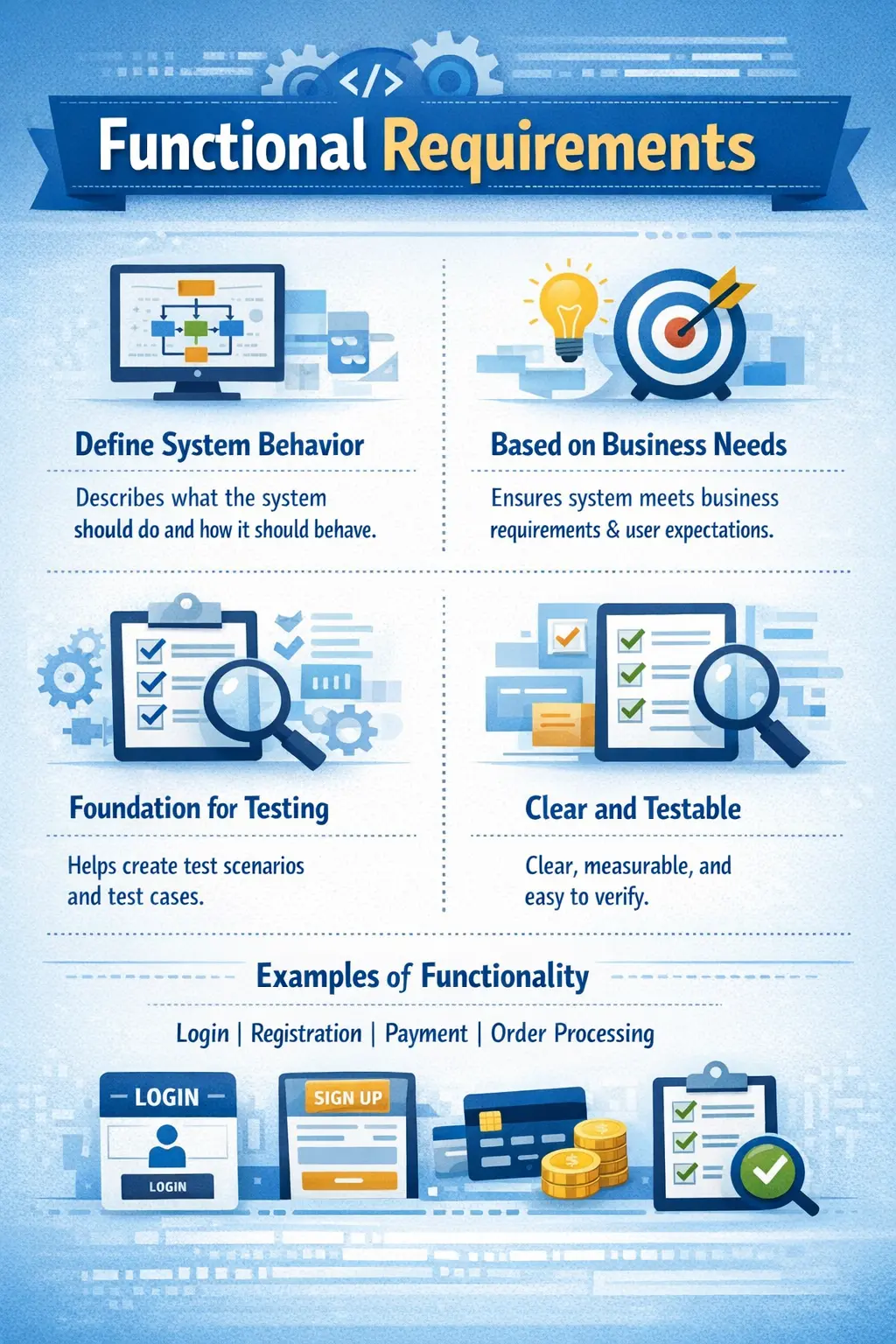
Functional Requirements define the core behavior of a software system. They describe what the system should do, including the features it must provide, the business rules it must follow, and the way it should respond to user actions. Functional requirements form the foundation of system development and testing because they specify the expected behavior of the application.
Functional Requirements answer the essential question: “What functionality must the system provide?” They describe how users interact with the system and how the system processes inputs to produce expected outputs. Without clear functional requirements, development teams may implement incorrect features and testers may validate incorrect behavior.
Functional requirements serve as the primary input for design, development, and testing. Developers rely on functional requirements to implement features, and testers rely on them to design test scenarios and test cases. Properly defined functional requirements help ensure that business needs are correctly translated into working software.
Understanding functional requirements is essential for manual testers because most testing activities are based on verifying functional behavior.
Definition of Functional Requirements
A Functional Requirement specifies the behavior, features, and business rules that a system must support. It describes what the system must do when users interact with it or when specific conditions occur.
Functional requirements define system operations such as login functionality, order processing, account management, and data validation. They describe how the system responds to user inputs and events.
Functional requirements typically include user interactions, system processing logic, and expected outputs. These requirements ensure that the application performs the tasks required by the business.
Functional requirements focus on system behavior rather than technical implementation. They describe expected outcomes without specifying how the system should be built internally.
Well-defined functional requirements provide a clear understanding of expected system behavior for developers and testers.
Purpose of Functional Requirements
Functional requirements serve several important purposes in software development and testing.
Functional requirements define system behavior clearly so that all stakeholders share a common understanding of the application. Clear requirements reduce misunderstandings and prevent incorrect implementations.
Functional requirements provide the foundation for system design. Designers use these requirements to create system architecture and workflows.
Functional requirements guide development activities. Developers implement features based on functional specifications.
Functional requirements enable test case creation. Testers design test scenarios and test cases by analyzing functional requirements.
Functional requirements ensure that business needs are met. Each functional requirement should support a specific business objective.
Functional requirements also support traceability. Requirements can be mapped to test cases and defects using Requirement Traceability Matrices.
Well-defined functional requirements improve product quality and reduce development risks.
Characteristics of Good Functional Requirements
A good functional requirement must be written in a way that allows developers to implement functionality correctly and testers to validate it accurately.
Clear functional requirements use simple and precise language. Each requirement should describe behavior in a way that cannot be misinterpreted. Ambiguous statements often lead to incorrect implementation.
Complete functional requirements describe all necessary behavior. Requirements should include normal scenarios, error conditions, and boundary cases. Missing information often leads to defects.
Consistent functional requirements do not conflict with other requirements. Conflicting requirements create confusion and increase development effort.
Testable functional requirements describe behavior that can be verified objectively. Expected results must be measurable and observable.
Traceable functional requirements can be linked to business needs and test cases. Traceability ensures that all requirements are validated.
Independent functional requirements focus on system behavior rather than technical implementation. Requirements should describe what the system must do, not how it should be implemented.
Well-written functional requirements improve development accuracy and testing effectiveness.
Common Formats of Functional Requirements
Functional requirements can be documented in different formats depending on the development methodology used.
One common format uses "shall" statements. These statements describe system behavior in a precise and formal way. A requirement written in this format clearly specifies expected functionality.
For example, a requirement may state that the system shall allow users to reset their passwords. Another requirement may state that the system shall display an error message when invalid credentials are entered.
Use cases provide another format for functional requirements. Use cases describe user interactions with the system and the sequence of actions required to achieve a goal. Use cases help testers understand workflows and end-to-end functionality.
User stories with acceptance criteria are commonly used in Agile projects. User stories describe features from the user's perspective, while acceptance criteria define expected behavior. Together they form functional requirements.
Different formats serve the same purpose of defining system behavior clearly.
Manual Tester’s Role in Functional Requirements
Manual testers rely heavily on functional requirements because these requirements define what must be tested.
Testers review functional requirements to ensure clarity and testability. If requirements are unclear, testers ask questions to remove ambiguity.
Testers identify missing scenarios by analyzing requirements carefully. Requirements often describe normal behavior but may omit negative scenarios or boundary conditions.
Testers derive test scenarios and test cases from functional requirements. Each functional requirement should lead to multiple test cases.
Testers validate implementation against functional requirements during test execution. Testing verifies that the application behaves as specified.
Testers map functional requirements to test cases in Requirement Traceability Matrices. Traceability ensures that all requirements are tested.
Manual testers play a critical role in ensuring that functional requirements are correctly implemented.
Functional Requirement Examples
Functional requirements can describe a wide range of system behaviors.
Login functionality provides a simple example of functional requirements. A requirement may specify that the system must allow users to log in using valid credentials. Another requirement may specify that the system must display an error message when invalid credentials are entered.
Order processing provides another example. A requirement may specify that the system must calculate the total price including taxes. Another requirement may specify that checkout must be prevented when items are out of stock.
Password reset functionality is another example. A requirement may specify that users must be able to request a password reset link. Another requirement may specify that reset links expire after a certain period.
These examples illustrate how functional requirements define system behavior in different scenarios.
Functional Requirements and Testing
Functional testing is based entirely on functional requirements. Testers verify that the system behaves according to specified requirements.
Functional requirements provide the basis for test scenario identification. Each requirement represents one or more testing objectives.
Functional requirements support test case creation. Test cases define steps and expected results based on requirements.
Functional requirements support defect identification. When actual behavior differs from requirements, a defect is reported.
Functional requirements also support regression testing. Existing requirements must continue to function correctly after changes.
Functional requirements guide all functional testing activities.
Functional vs Non-Functional Requirements
Functional requirements describe what the system does, while non-functional requirements describe how the system performs.
Functional requirements focus on system behavior. Examples include login functionality, payment processing, and order management.
Non-functional requirements focus on performance, security, and usability. Examples include response time requirements and security controls.
Functional testing validates functional requirements.
Non-functional testing validates non-functional requirements.
Both types of requirements are necessary for a complete system.
Understanding the difference between functional and non-functional requirements is important for testers.
Common Functional Requirement Issues
Functional requirements often contain problems that can lead to defects if not identified early.
Vague wording is one of the most common issues. Requirements using words such as "should" or "as required" often lack precise meaning.
Missing validation rules create uncertainty about system behavior. Requirements should specify input validation rules clearly.
Unclear error handling is another common problem. Requirements should specify how the system responds to failures and invalid inputs.
Implicit assumptions may exist when requirement writers assume certain behaviors without documenting them.
Incomplete workflows may occur when requirements describe only part of a process.
Requirement analysis helps identify and resolve these issues early.
Functional Requirements vs Acceptance Criteria
Functional requirements describe overall system behavior at a feature level.
Acceptance criteria define conditions that must be satisfied for a specific user story.
Functional requirements describe what the system must do.
Acceptance criteria describe how the system will be validated.
Functional requirements typically exist at a higher level than acceptance criteria.
Acceptance criteria are often derived from functional requirements.
Both are essential for effective testing.
Functional Requirements and Requirement Traceability
Functional requirements must be traceable to test cases and defects.
Requirement Traceability Matrices map functional requirements to test scenarios and test cases.
Traceability ensures that every requirement is tested.
Traceability helps identify missing test cases.
Traceability also supports impact analysis when requirements change.
Traceability improves confidence in testing completeness.
Functional requirements serve as the foundation for traceability.
Real-World Requirement Analysis Example
Consider a functional requirement that states:
"The system shall allow users to transfer money."
This requirement requires further clarification.
A tester may ask about maximum transfer limits.
The tester may ask about insufficient balance conditions.
The tester may ask about transfer fees.
The tester may ask about authentication requirements.
The tester may ask about error messages.
Clarifying these details improves requirement quality.
Clear requirements reduce defects and improve testing effectiveness.
Common Mistakes in Functional Requirements
One common mistake is writing requirements that are too vague. Vague requirements lead to inconsistent interpretations.
Another mistake is missing negative scenarios. Requirements should describe how the system behaves when errors occur.
Some requirements include implementation details that should belong to design documents rather than requirement documents.
Another mistake is failing to update requirements after changes. Outdated requirements create confusion.
Incomplete requirement reviews increase defect risk.
Avoiding these mistakes improves requirement quality.
Functional Requirements in Agile Projects
Functional requirements are often expressed as user stories in Agile projects.
User stories describe features from the user's perspective.
Acceptance criteria define expected behavior.
Testers review stories during backlog refinement.
Testers ensure acceptance criteria are testable.
Testers identify missing scenarios early.
Functional requirements evolve continuously in Agile environments.
Testers must adapt to requirement changes quickly.
Agile projects require continuous requirement analysis.
Functional Requirements as Business Behavior
Functional requirements should always be understood as business behavior, not just system activity. A button, screen, API, or database update is only meaningful when it supports a business outcome. For example, a login requirement is not merely about accepting a username and password. It is about allowing the correct user to access the correct account securely while rejecting invalid or unauthorized access.
This business-behavior view helps testers design stronger tests. Instead of checking only whether a screen appears, testers ask whether the user goal is completed correctly. If a customer places an order, the system should not only show a success message. It should calculate totals correctly, reserve inventory, create an order record, trigger payment processing, and show confirmation details. The functional requirement must guide all of these expectations.
Functional requirements also help teams avoid building technically correct but business-wrong features. A developer may implement a workflow exactly as written, but if the requirement missed a business rule, the feature can still fail in real use. This is why requirement analysis and tester review are important before development begins.
When functional requirements are written in business language, stakeholders can review them more easily. Business users may not understand implementation details, but they can validate whether the described behavior matches real operations. This improves shared understanding and reduces the risk of late rework.
For manual testers, viewing functional requirements as business behavior encourages deeper validation. The tester checks whether the system supports the intended workflow, handles exceptions correctly, protects data, and produces outcomes that make sense to users and stakeholders.
Analyzing Functional Requirements Before Testing
Before creating test cases, testers should analyze functional requirements carefully. This analysis helps determine whether the requirement is clear enough to test, whether important scenarios are missing, and whether the expected result can be verified objectively. Test execution becomes stronger when this analysis is done early.
The first step is understanding the main flow. The tester identifies who uses the feature, what action is performed, what condition must exist before the action, and what outcome should occur. This creates the foundation for happy path scenarios. Without understanding the main flow, negative and edge scenarios cannot be designed properly.
The second step is identifying alternate and exception flows. Functional requirements often describe only normal behavior, but real users do not always follow perfect paths. They enter invalid data, skip mandatory fields, use expired links, repeat actions, lose sessions, and attempt unauthorized access. Testers must identify these possibilities and confirm expected system behavior.
The third step is checking data and business rules. Many functional requirements depend on data values, user roles, account statuses, inventory levels, dates, limits, or thresholds. If these rules are not defined clearly, testing becomes assumption-based. Testers should ask questions until these rules are measurable and testable.
The final step is considering impact on existing functionality. A new functional requirement may affect reports, notifications, permissions, audit logs, integrations, or downstream workflows. Good testers analyze both the new behavior and its relationship with the existing system.
Questions Testers Should Ask
Effective functional requirement analysis depends on asking useful questions. Testers should ask who the user is, what the user is trying to accomplish, what data is required, what result is expected, and how success will be verified. These questions clarify the main behavior.
Testers should also ask what should happen when the user provides invalid input. If a form requires an email address, what formats are allowed? What message appears for an invalid email? Is the message shown immediately or after submission? Can the user continue after correcting the value? These details directly affect test scenarios.
Role-based questions are important. Does the feature behave the same for admin, customer, guest, manager, and support user roles? Who can view, create, update, delete, approve, or export data? Missing role-based rules often lead to security and authorization defects.
Boundary questions reveal hidden defects. What is the minimum allowed value? What is the maximum allowed value? What happens at the exact limit? What happens beyond the limit? If the requirement does not define boundaries, testers should request clarification before testing begins.
Testers should also ask about dependencies. Does the feature rely on an external API, email service, payment gateway, database job, file upload service, or third-party integration? If the dependency fails, the functional requirement should define how the system responds. Failure behavior is still functional behavior.
Functional Requirements and Business Rules
Business rules are often embedded inside functional requirements. They define how the system makes decisions. Examples include eligibility rules, discount rules, approval rules, tax rules, password rules, transfer limits, and status transitions. These rules must be clear because they directly affect system behavior.
A functional requirement that says “apply discount for eligible customers” is incomplete unless eligibility is defined. Who is eligible? Is eligibility based on membership type, cart value, region, date, coupon status, or purchase history? Can multiple discounts combine? What happens if the discount expires during checkout? These are business rule questions.
Manual testers should pay close attention to business rules because many critical defects occur when rules are misunderstood. A calculation may appear correct for one scenario but fail for another combination of conditions. Decision table testing, equivalence partitioning, and boundary value analysis are useful techniques for validating business rules.
Business rules should be documented in a way that testers can convert into scenarios. If rules are complex, examples help. For example, instead of only writing “loan approval depends on credit score and income,” the requirement should include examples of approved, rejected, and borderline cases.
Clear business rules make functional requirements stronger. They help developers implement correct logic and help testers design complete validation coverage.
Functional Requirements and User Workflows
Functional requirements often describe individual features, but users experience software as workflows. A user may register, verify email, log in, update profile, place an order, complete payment, and receive confirmation. Each step may be a separate requirement, but testing must also confirm that the complete workflow works.
Manual testers should analyze how functional requirements connect to each other. A change in one feature may affect another. For example, a new account status rule may affect login, profile update, payment eligibility, notification delivery, and reporting. If the requirement is analyzed only in isolation, these impacts may be missed.
Workflow analysis helps testers identify end-to-end scenarios. These scenarios validate that the user can complete a business goal from start to finish. They also reveal integration issues that may not appear when testing individual features separately.
Workflows should include both successful and failure paths. If payment fails, what happens to the cart? If document upload fails, can the user retry? If approval is rejected, is the requester notified? These workflow questions improve requirement completeness.
Functional requirements become more useful when they are connected to real user journeys. This connection helps testers validate not only whether a feature works, but whether the system supports the full business process.
Functional Requirements and Test Coverage
Functional requirements are the foundation of test coverage. Each requirement should be traceable to one or more test scenarios. If a requirement has no related test coverage, the team cannot confidently say it has been validated. If a test case has no related requirement, the team should ask why it exists.
Coverage does not mean writing one test case per requirement. A single requirement can produce many scenarios. For example, a login requirement may produce tests for valid credentials, invalid password, locked account, inactive account, empty fields, password visibility toggle, session creation, and logout behavior. The number of scenarios depends on complexity and risk.
Requirement-based coverage helps testers identify gaps. If a requirement includes five business rules and tests cover only two, coverage is incomplete. If acceptance criteria mention negative scenarios but test cases cover only the happy path, important risk remains.
Traceability also supports change management. When a functional requirement changes, testers can quickly identify which test cases need updates. This prevents outdated tests from validating old behavior and reduces regression risk.
Good test coverage is not about volume alone. It is about meaningful validation of required behavior. Functional requirements help testers decide what must be covered and where testing effort should be focused.
Functional Requirements in Regulated Domains
In regulated domains such as banking, insurance, healthcare, aviation, and government systems, functional requirements carry additional importance. Incorrect behavior can cause financial loss, legal exposure, safety risks, or compliance violations. Requirements in these domains must be especially clear and traceable.
For example, a healthcare system requirement related to patient data access must define who can view records, under what conditions, what audit logging is required, and what happens when access is denied. A vague requirement could lead to privacy violations. Testing must validate both functionality and compliance-related behavior.
Banking requirements often include transaction limits, authorization rules, fraud checks, interest calculations, and audit trails. These rules must be precise. A small misunderstanding in a calculation or approval workflow can have serious business impact.
Manual testers working in regulated environments should pay close attention to traceability, evidence, and requirement clarity. Test execution results, defect reports, and coverage matrices may be reviewed during audits. Clear functional requirements make this evidence stronger.
Even in non-regulated projects, the discipline used in regulated domains is useful. Clear requirements, strong traceability, and complete validation improve quality in any software product.
Detailed Example: Login Requirement
Consider a functional requirement that says: “The system shall allow users to log in.” This requirement is too broad by itself. It describes a feature but does not fully define expected behavior. A tester analyzing this requirement should ask several questions before designing tests.
The tester should ask what credentials are required. Does the system use username, email address, phone number, password, OTP, or multi-factor authentication? Are usernames case-sensitive? Are passwords case-sensitive? Is there a remember-me option? Each answer affects test design.
The tester should ask about invalid attempts. What message appears for invalid credentials? Is the account locked after repeated failures? How many attempts are allowed? How long does the lock last? Can an administrator unlock the account? These rules define negative scenarios.
The tester should ask about account status. Can inactive, suspended, deleted, unverified, or expired accounts log in? What message appears for each state? These conditions are often missed if the requirement only describes valid login.
After analysis, the requirement becomes more complete. The tester can design happy path, negative path, boundary, security, and role-based scenarios. This example shows how requirement analysis turns a simple functional statement into testable behavior.
Improving Weak Functional Requirements
Weak functional requirements can usually be improved by making them specific, observable, and testable. A weak requirement says, “The system should handle user registration properly.” A stronger requirement defines required fields, validation rules, duplicate email behavior, confirmation message, email verification, and account creation result.
A weak requirement says, “The user should get a notification.” A stronger requirement defines the notification channel, trigger condition, content expectation, timing, and failure behavior. Does the notification appear in-app, by email, by SMS, or all three? Is it sent immediately or after approval? What happens if delivery fails?
A weak requirement says, “Admin can manage users.” A stronger requirement separates create user, edit user, deactivate user, reset password, assign roles, and view audit history. Broad requirements should often be split into smaller requirements or user stories so each behavior can be built and tested properly.
Improving weak requirements requires collaboration. Testers should not simply criticize requirements; they should ask focused questions and suggest clearer wording. Product Owners and business analysts can then update the requirement so the team shares the same understanding.
Strong functional requirements reduce defects because they reduce assumption. They help developers build the right behavior and help testers validate the right outcomes.
Best Practices for Functional Requirements
Write functional requirements in clear business language. Avoid vague terms unless they are defined. Words such as fast, proper, secure, normal, and user-friendly should be replaced with measurable or observable expectations wherever possible.
Include positive, negative, and boundary behavior. Requirements that describe only the successful path are incomplete. Real systems must handle invalid input, missing data, unauthorized access, duplicate actions, and failure conditions.
Keep requirements focused. A requirement that covers too many workflows becomes hard to understand and hard to test. Split large requirements into smaller, logical pieces that still deliver business value.
Maintain traceability between requirements and tests. This helps confirm coverage and supports impact analysis when requirements change. Traceability also helps teams understand which defects relate to which business requirements.
Review functional requirements collaboratively. Product Owners, business analysts, developers, testers, and stakeholders each bring different perspectives. Collaborative review improves clarity, completeness, and testability before development begins.
Update functional requirements whenever business behavior changes. Outdated requirements are dangerous because they cause testers to validate old expectations and developers to maintain incorrect assumptions. Keeping requirements current protects both test coverage and product correctness.
Interview Perspective
Functional requirements are a common topic in testing interviews.
Interviewers expect testers to understand the importance of functional requirements.
A short answer typically defines functional requirements as system behaviors and features.
A detailed answer explains how testers derive test cases from requirements.
Interviewers may ask for examples of functional requirements.
Understanding functional requirements demonstrates strong testing knowledge.
Functional requirements knowledge is essential for manual testers.
Key Takeaway
Functional Requirements define what the system must do and serve as the foundation for development and testing.
Well-written functional requirements are clear, complete, consistent, and testable.
Manual testers rely on functional requirements to design test scenarios and validate system behavior.
Strong functional requirements improve product quality and reduce development risks.
Functional Requirements are the backbone of manual testing, guiding test design, execution, and validation.