Test Scenario to High-Level Testing Objectives
Test scenarios play a crucial role in the software testing lifecycle because they define what needs to be tested at a high level before detailed test cases are written. They act as a bridge between requirements and test cases, ensuring that the testing effort covers all important functionalities and workflows. Without clearly defined test scenarios, testers may overlook important areas or create incomplete test coverage.
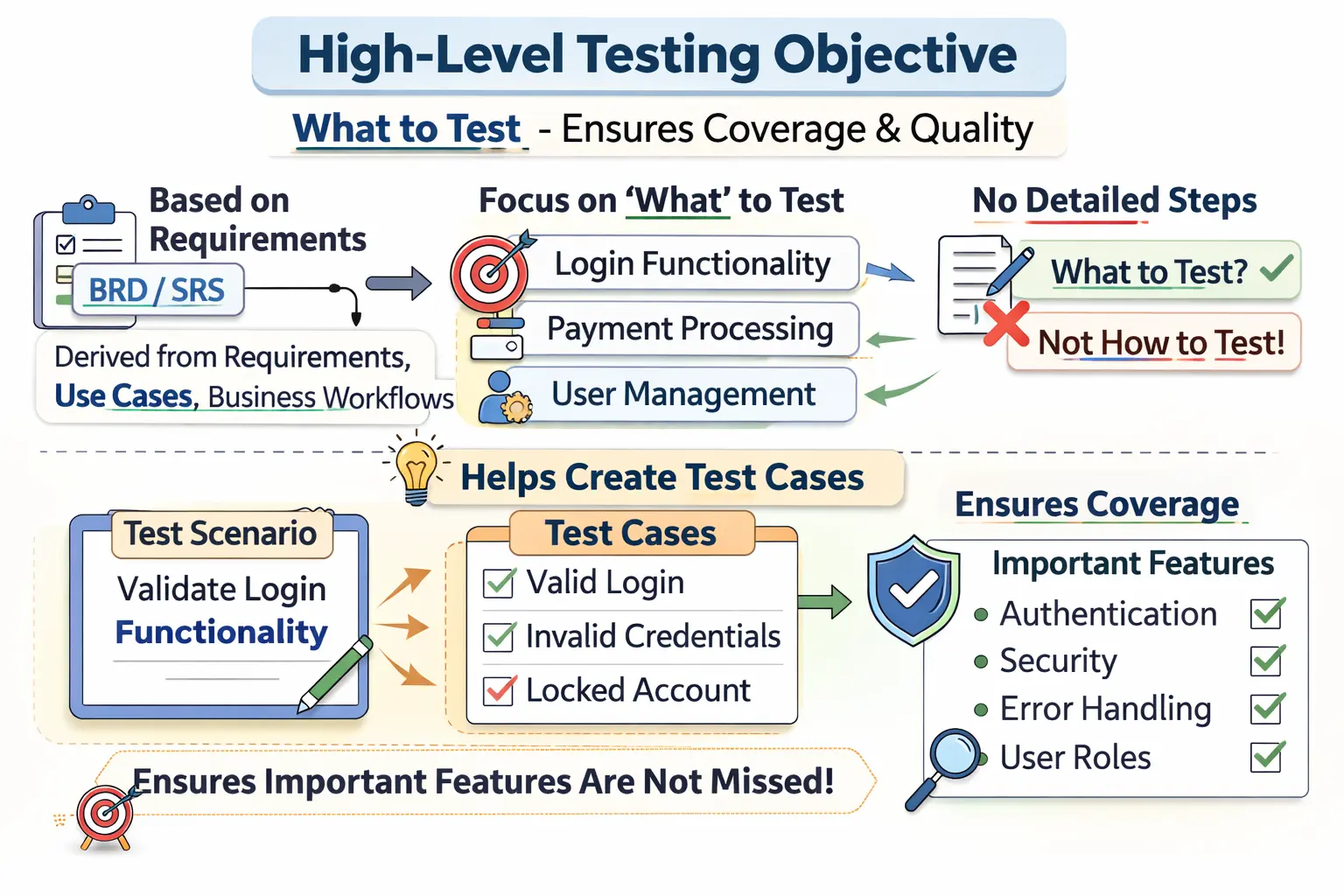
A Test Scenario is a high-level description of what needs to be tested, derived from requirements, use cases, or business workflows. Unlike test cases, test scenarios do not include detailed steps, test data, or expected results. Instead, they focus on identifying the testing objectives that must be validated.
A test scenario answers the essential question:
“What functionality or workflow should be tested?”
Test scenarios represent testing goals rather than execution details. They help testers and stakeholders quickly understand the scope of testing and ensure that all critical functionalities are considered before test case design begins.
A good way to understand a test scenario is to see it as a testing headline. It tells the team which behavior, feature, or workflow must be validated, but it does not yet explain the detailed steps. For example, "Verify user can reset password" is a scenario. The detailed test cases under it may cover valid email, unregistered email, expired reset link, reused link, weak new password, and successful login after reset. The scenario keeps the objective visible while test cases handle execution detail.
This separation is important in professional testing. If testers jump directly from requirements to detailed test cases, they may create many small checks but miss a complete workflow. Test scenarios help testers pause and ask whether the major testing objectives are covered before investing time in detailed scripts.
Understanding Test Scenarios in Software Testing
Software systems are often complex and contain numerous features and workflows. Attempting to directly write detailed test cases without first identifying test scenarios can result in confusion and incomplete coverage. Test scenarios provide structure by organizing testing requirements into manageable high-level objectives.
Test scenarios are usually derived from requirement documents, use cases, or user stories. They represent realistic business situations that must be validated during testing. Each test scenario may expand into multiple test cases that verify different conditions and variations of the scenario.
For example, in a login feature, a single scenario such as verifying successful login may generate multiple test cases covering different browsers, data sets, and conditions.
Because test scenarios are high-level, they are easier for stakeholders to review and understand. Business analysts, developers, and project managers can quickly verify whether all required workflows are covered.
Test scenarios are especially useful when requirements are large. A single requirement document may contain many pages of rules, screens, workflows, and exceptions. Converting that document directly into detailed test cases can be slow and error-prone. Scenario identification creates a middle layer. It allows testers to group related validation areas, confirm coverage with stakeholders, and then expand each scenario into test cases.
They also support early testing involvement. Even before the application is ready, testers can review requirements and identify test scenarios. This helps reveal unclear requirements, missing alternate flows, or incomplete business rules before development is finished.
Purpose of Test Scenarios
The primary purpose of test scenarios is to ensure complete requirement coverage. When testers analyze requirements and identify test scenarios, they can confirm that every important feature and workflow will be tested. This prevents major gaps in testing and reduces the risk of missing critical defects.
Another important purpose is to provide clarity on the testing scope. Test scenarios define the boundaries of testing activities by describing what will be validated. This helps testers understand their responsibilities and helps stakeholders understand what to expect from testing.
Test scenarios also support the process of identifying test cases. Once scenarios are defined, testers can create detailed test cases based on each scenario. This structured approach leads to more organized and efficient test design.
Test scenarios also enable quick reviews by stakeholders. Because scenarios are concise and high-level, they can be reviewed much faster than detailed test cases. Stakeholders can confirm whether the scenarios align with business requirements before test case development begins.
In addition, test scenarios serve as a bridge between requirements and test cases. Requirements describe what the system should do, while test cases describe how testing will be performed. Test scenarios connect these two layers by translating requirements into testing objectives.
Test scenarios also help avoid over-testing and under-testing. If a scenario is too broad, testers can break it down. If there are too many small scenarios, testers can group them at a meaningful level. This makes the test suite easier to review, estimate, and maintain.
Another purpose is release communication. Stakeholders may not want to read hundreds of test cases, but they can review a list of scenarios and quickly understand what areas are covered. This makes test scenarios useful in test planning, coverage reviews, sprint discussions, and test summary reporting.
Characteristics of a Good Test Scenario
A well-written test scenario should be clear, concise, and meaningful. It should focus on business functionality rather than technical details. Test scenarios are not intended to describe how testing will be performed; instead, they describe what needs to be validated.
A good test scenario is usually requirement-driven or business-driven. It should reflect real-world usage of the system and represent actual user goals. Scenarios that do not relate to business workflows often provide little value.
Another important characteristic is technology independence. Test scenarios should not depend on specific tools or implementation details. They should remain valid even if the underlying technology changes.
Test scenarios should also represent end-user intent. They should describe what users want to achieve with the system rather than focusing only on system behavior.
One of the most important characteristics is that a single test scenario can map to multiple test cases. For example, a scenario describing successful order placement may generate many test cases covering different payment methods and product types.
Good test scenarios maintain a balance between clarity and coverage. They should not be too detailed, but they should also not be so generic that they lose meaning.
A good scenario should be independently understandable. Someone reading it should know the feature or workflow being validated without asking for hidden context. "Verify checkout" is understandable but may be too broad for a complex application. "Verify user can place an order using online payment" is clearer because it identifies the workflow and business objective.
Good scenarios also avoid tool language. A scenario should not say "Verify Selenium clicks login button" or "Verify API returns 200" unless the purpose is specifically technical API validation. For business functionality, scenarios should describe user or system behavior in business terms.
Choosing the Right Level of Detail
One of the most practical challenges in writing test scenarios is deciding how broad or narrow they should be. If scenarios are too broad, they do not guide test case design properly. If they are too narrow, they become test cases in disguise. The right level of detail depends on the complexity of the feature and the needs of the project.
For a simple feature, one scenario may be enough. For example, "Verify user can update profile picture" may be a suitable high-level scenario. For a complex payment feature, one scenario called "Verify payment" is too broad. It may need separate scenarios for successful card payment, failed payment, wallet payment, refund flow, saved card usage, and payment timeout handling.
A useful rule is this: a scenario should be broad enough to represent a testing objective, but specific enough that testers can clearly derive meaningful test cases from it. If a scenario cannot be expanded into focused test cases, it may be too vague. If it already contains steps and data, it may be too detailed.
Sources of Test Scenarios
Test scenarios are derived from various project artifacts and documents. The most common source is the Business Requirement Document (BRD), which describes business goals and workflows. The BRD helps testers understand the overall purpose of the system and identify key scenarios.
Functional Requirement Specifications (FRS) are another important source. These documents describe system behavior in detail and help testers identify functional testing scenarios.
User stories and acceptance criteria in Agile projects also provide valuable information for writing test scenarios. User stories describe user goals, while acceptance criteria define the conditions that must be satisfied. Together, they provide a strong foundation for scenario identification.
Use cases are particularly useful for creating test scenarios because they describe interactions between users and the system. Each use case usually leads to multiple test scenarios covering main flows and alternate flows.
Business workflows also serve as important sources of test scenarios. Real-world processes such as placing orders, processing payments, and generating reports provide natural testing scenarios.
Understanding these sources ensures that test scenarios reflect real business needs and system functionality.
Defect history can also be a source of scenarios. If previous releases had repeated issues in payment retry, session timeout, role permissions, or report export, testers can create scenarios to ensure those areas are covered in future cycles. Production incidents are especially valuable because they show where real users experienced problems.
Support tickets and customer feedback can also influence scenario design. Users often describe problems in workflow language: "I could not complete payment", "I did not receive confirmation", "I could not download the report", or "My changes were not saved." These statements can become practical test scenarios.
Writing Effective Test Scenarios
Writing effective test scenarios requires a systematic approach. The process begins with understanding the requirements thoroughly. Testers must read requirement documents carefully and clarify any ambiguities before identifying scenarios.
After understanding the requirements, testers identify the main business objectives. Each objective usually corresponds to one or more test scenarios. Focusing on business objectives ensures that scenarios remain meaningful and relevant.
Testers should consider positive, negative, and alternate flows while writing scenarios. Positive flows represent normal system behavior, negative flows represent invalid inputs or errors, and alternate flows represent variations in user behavior.
Test scenarios should remain brief and outcome-focused. They should describe what should be tested without including detailed steps or test data.
Well-written scenarios allow testers to design test cases efficiently while maintaining complete coverage.
Scenario writing should begin with action-oriented phrases such as "Verify user can...", "Verify system prevents...", "Verify admin can...", "Verify report is generated...", or "Verify error message is shown when...". These phrases keep the scenario focused on observable behavior. They also make scenario lists easier to scan.
Testers should review scenarios against requirements after writing them. Each major requirement should map to one or more scenarios. If a requirement has no scenario, it may be untested. If a scenario does not map to any requirement, the tester should check whether it represents a valid implicit requirement, risk, or exploratory area.
Positive, Negative, and Alternate Test Scenarios
Positive test scenarios validate expected successful behavior. Examples include successful login, successful order placement, successful registration, or successful report generation. These scenarios establish that the core feature works under normal conditions.
Negative test scenarios validate how the system behaves when something is wrong. Examples include login with invalid credentials, payment with insufficient balance, registration with duplicate email, or report generation without required filters. Negative scenarios confirm that the system rejects invalid actions properly.
Alternate scenarios validate valid variations of the main flow. A user may pay with card, UPI, wallet, or cash on delivery. A report may be exported as PDF or Excel. A user may register with email or mobile OTP. These are not failures; they are alternate valid paths. A complete scenario list should include all three types where relevant.
Test Scenario Examples
Consider a login feature in a web application. Several test scenarios may be identified based on requirements.
One scenario may verify that users can log in successfully with valid credentials. Another scenario may verify that the system displays an error message when invalid credentials are used.
Additional scenarios may verify behavior when required fields are empty or when multiple failed login attempts occur.
Each of these scenarios represents a testing objective. Detailed test cases can then be created to verify specific conditions within each scenario.
For example, the scenario for valid login may generate test cases covering different browsers, different user roles, and different environments.
This illustrates how test scenarios provide a structured starting point for test case design.
In an e-commerce application, test scenarios may include verifying product search, product filtering, adding products to cart, updating cart quantity, applying coupons, placing an order, cancelling an order, tracking shipment, returning a delivered product, and receiving refund. Each scenario may later expand into many test cases based on user role, product type, payment method, stock status, and delivery region.
In a banking application, scenarios may include verifying user login, adding a beneficiary, transferring funds, scheduling a payment, downloading a statement, changing transaction limits, and locking the account after failed login attempts. These scenarios represent business workflows, not just screen-level checks.
From Test Scenario to Test Case
Once scenarios are approved, testers convert them into detailed test cases. A single scenario can produce several test cases because the scenario defines what to test, while test cases define how to test it under specific conditions. For example, the scenario "Verify user can log in" may produce test cases for valid credentials, invalid password, blank username, locked account, expired password, and different user roles.
This layered approach keeps test design organized. Scenario review confirms broad coverage. Test case review confirms detailed execution quality. If teams skip the scenario layer, they may produce detailed test cases but still miss important workflows. If they stop at scenarios only, execution detail will be insufficient. Both layers are useful.
Test Scenario vs Test Case
Test scenarios and test cases serve different purposes in the testing process. Test scenarios describe what should be tested, while test cases describe how testing will be performed.
Test scenarios are high-level and broad in scope. They describe functionalities or workflows without specifying detailed steps.
Test cases are more detailed and include execution steps, test data, and expected results.
Test scenarios help ensure complete coverage of requirements, while test cases ensure that each scenario is tested thoroughly.
Because test scenarios are concise, they are easier to review and approve. Test cases require more time to review due to their detailed nature.
Understanding the difference between test scenarios and test cases is essential for both practical testing and interviews.
When to Create Test Scenarios
Test scenarios are usually created during requirement analysis. Identifying scenarios early helps testers understand the scope of testing and identify potential challenges.
They are also created before writing test cases. This ensures that test case design follows a structured approach and that no major workflows are missed.
Test scenarios are often used during test planning to estimate testing effort. By counting scenarios and analyzing their complexity, teams can estimate the time required for testing.
Test scenarios are also useful during test coverage reviews. Stakeholders can review scenarios to confirm that all important functionalities are included.
Creating scenarios at the right time improves testing efficiency and quality.
Creating scenarios early also improves requirement discussions. When testers identify scenarios during requirement analysis, they often discover missing flows or unclear rules. For example, a requirement may explain successful payment but not payment failure. It may describe registration but not duplicate email. Scenario identification brings these gaps to the surface before test execution.
Scenarios should also be revisited when requirements change. If a new payment method is added, a role is introduced, a workflow is modified, or a business rule changes, the scenario list should be updated. An outdated scenario list can lead to outdated test cases.
Test Scenarios in Agile Projects
In Agile projects, test scenarios are often derived from user stories and acceptance criteria. A user story describes what a user wants, and acceptance criteria describe the conditions for completion. Test scenarios convert those conditions into high-level testing objectives.
For example, a user story may say, "As a customer, I want to reset my password so that I can regain access to my account." Test scenarios may include verifying password reset with registered email, verifying error for unregistered email, verifying expired reset link, verifying reused reset link, and verifying successful login with the new password.
In sprint planning, scenarios help estimate effort. A story with two simple scenarios may be small. A story with many positive, negative, alternate, role-based, and integration scenarios may require more testing effort. This makes scenarios useful for both QA planning and team-level estimation.
Test Scenarios and Traceability
Traceability means connecting requirements to test scenarios and test cases. Test scenarios are an important traceability layer because they show whether each requirement has been translated into a testing objective. This helps teams confirm that no major requirement is ignored.
A simple traceability chain may look like this: requirement to test scenario to test case to execution result to defect if any. This chain helps test leads answer coverage questions. If a stakeholder asks whether checkout address validation was covered, the team can trace from requirement to scenario and then to the test cases that validate it.
Traceability is especially important in regulated domains such as banking, healthcare, insurance, and government systems. Even in ordinary projects, it improves confidence and helps during impact analysis when requirements change.
Benefits of Using Test Scenarios
Test scenarios provide several important benefits in the testing process. One major benefit is preventing missing major workflows. When scenarios are identified systematically, testers are less likely to overlook important functionalities.
Another benefit is saving time during test case design. With clearly defined scenarios, testers can quickly identify the test cases required for each scenario.
Test scenarios also improve communication with stakeholders. Because scenarios are easy to understand, stakeholders can review and approve them without needing technical knowledge.
They also support effort estimation by providing a clear picture of testing scope. Teams can estimate testing effort based on the number and complexity of scenarios.
Test scenarios also improve organization and traceability by linking requirements to test cases.
Test scenarios also help teams avoid duplicated test design. When scenarios are listed clearly, testers can see whether two people are covering the same area or whether one important area is missing. This is useful in large teams where multiple testers work on related modules.
They also make test documentation easier to navigate. Instead of searching through hundreds of detailed cases, a reviewer can first scan scenarios to understand coverage at a high level and then drill into test cases only where necessary.
Reviewing Test Scenarios
Test scenarios should be reviewed before detailed test cases are written. A scenario review is faster than a test case review because scenarios are high-level. Business analysts, product owners, developers, and QA leads can quickly confirm whether the important functionality and workflows are covered.
During review, stakeholders should check whether every requirement has at least one scenario, whether negative and alternate flows are included, whether scenario wording is clear, and whether scenarios are too broad or too detailed. Reviewers should also identify duplicate or missing scenarios.
Early scenario review saves time. If a major workflow is missing, it is easier to add it before detailed test cases are created. If a scenario is based on a wrong requirement interpretation, correcting it early prevents many incorrect test cases.
Using Test Scenarios for Estimation
Test scenarios help estimate testing effort because they provide a high-level view of scope. A module with five simple scenarios may require less effort than a module with twenty complex scenarios involving integrations, roles, data conditions, and exception flows.
Test leads can classify scenarios by complexity, such as simple, medium, and complex. A simple scenario may need a few test cases. A complex scenario may need many test cases, special data, environment setup, and regression coverage. This supports realistic planning.
Scenario-based estimation is not perfect, but it is better than guessing effort without scope visibility. It helps teams discuss workload before execution pressure begins.
Common Mistakes in Writing Test Scenarios
One common mistake is writing test cases instead of test scenarios. When scenarios include detailed steps and data, they lose their high-level nature and become difficult to manage.
Another mistake is making scenarios too generic. Scenarios such as "Verify application functionality" provide little value because they do not clearly define testing objectives.
Missing negative and edge scenarios is another frequent mistake. Focusing only on positive scenarios leads to incomplete test coverage.
Failure to map scenarios to requirements is another problem. Without traceability, it becomes difficult to ensure complete coverage.
Avoiding these mistakes improves the quality and usefulness of test scenarios.
Another common mistake is using technical implementation language. A scenario such as "Verify database row is inserted after submit" may be useful for technical validation, but a business scenario should usually be written as "Verify user registration is completed successfully." Technical checks can appear in test cases or backend validation, while scenarios should remain understandable to business stakeholders.
Testers may also forget role-based scenarios. If Admin, Manager, Customer, and Guest users have different permissions, scenarios should reflect those differences. A single scenario called "Verify user access" may be too vague when roles matter.
Another mistake is ignoring post-condition behavior. For example, a scenario may verify order placement, but the tester should also consider whether order history, inventory, payment status, and notification are part of the broader scenario coverage.
Role of Test Scenarios in the Testing Lifecycle
Test scenarios play an important role throughout the testing lifecycle. During requirement analysis, they help testers understand system functionality and identify testing objectives.
During test planning, scenarios help define testing scope and estimate effort.
During test design, scenarios serve as the foundation for creating test cases.
During test execution, scenarios help track testing progress and coverage.
After testing is complete, scenarios provide evidence that requirements have been validated.
This makes test scenarios an essential component of structured testing.
During maintenance, scenarios help with impact analysis. If a requirement changes, the team can identify affected scenarios first and then update related test cases. This is more manageable than searching through detailed test cases without a high-level map.
During regression, scenarios help decide what to include. Critical scenarios can become part of regression suites, smoke suites, or release validation checklists. Low-risk scenarios may be tested less frequently. This supports risk-based testing.
Interview Perspective
Test scenarios are frequently discussed in software testing interviews because they demonstrate understanding of the testing process.
A short interview answer might describe a test scenario as a high-level statement describing what functionality needs to be tested.
A more detailed answer would explain that test scenarios are derived from requirements and represent testing objectives that serve as the basis for detailed test cases.
Interviewers often expect candidates to explain the difference between test scenarios and test cases.
Understanding this distinction is essential for success in testing roles.
Project-based answer:
In a real project, I create test scenarios during requirement analysis before writing detailed test cases. I read requirements, user stories, acceptance criteria, and workflows, then identify high-level objectives such as successful login, failed login, password reset, order placement, payment failure, or report export. Each scenario later expands into multiple test cases with steps, data, and expected results.
A strong interview answer should mention that scenarios describe what to test, while test cases describe how to test. Scenarios help ensure coverage and stakeholder review, while test cases support detailed execution.
Practical Test Scenario Checklist
Before finalizing scenarios, check whether they are mapped to requirements, written at the right level, clear to business stakeholders, and focused on behavior or workflow. Confirm that positive, negative, alternate, and important edge scenarios are included where relevant.
Check whether scenarios are too broad, too technical, duplicated, or missing role-based coverage. Confirm that each scenario can be expanded into meaningful test cases. If a scenario cannot produce useful test cases, it may be too vague.
Finally, review scenarios with stakeholders before detailed test case design. This helps catch missing workflows early and improves overall test coverage.
Key Takeaway
Test scenarios provide a structured way to define what needs to be tested before detailed test cases are created. They ensure complete requirement coverage and provide a clear understanding of testing scope.
By acting as a bridge between requirements and test cases, test scenarios improve organization, communication, and efficiency in the testing process.
While test cases ensure that features are tested correctly, test scenarios ensure that nothing important is missed, making them an essential part of professional software testing.