Impact Analysis
Software systems continuously evolve through change requests, defect fixes, enhancements, and requirement updates. Every change introduced into an application carries potential consequences. Even a small modification in one module may affect multiple workflows, dependent components, or test artifacts. To prevent unintended side effects, teams perform a structured activity known as Impact Analysis.
Impact Analysis is the process of evaluating how a proposed change will affect the application, associated test artifacts, timelines, dependencies, and overall project risk. It is a proactive quality control activity performed before implementing changes.
Impact Analysis answers a critical question in software projects: “What will be affected if this change is implemented?”
For manual testers, impact analysis is a vital responsibility. It determines regression scope, test updates, resource allocation, and release readiness. A well-performed impact analysis prevents unexpected failures, missed regression defects, and release delays.
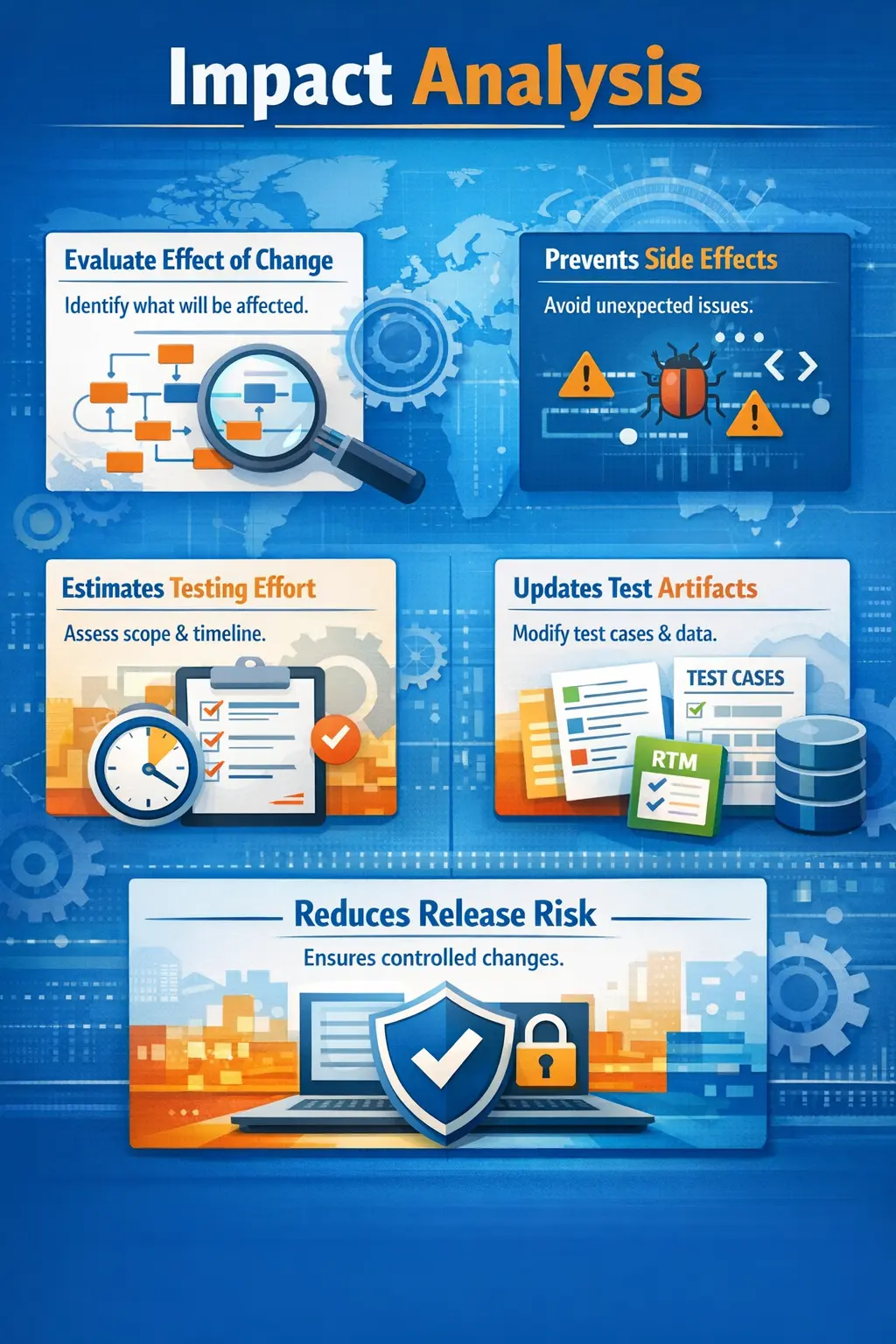
Definition of Impact Analysis
Impact Analysis is a structured evaluation of the consequences of a proposed change. The change may be a requirement modification, a change request, a defect fix, a production patch, or an enhancement.
Impact analysis focuses on identifying affected functionalities, modules, workflows, test cases, test data, documentation, and timelines. It helps the team understand both direct and indirect effects of the change.
Impact analysis is not limited to technical evaluation. It also includes assessment of business risk, release schedules, and testing effort.
In simple terms, impact analysis is a preventive activity performed before executing a change. It reduces uncertainty and supports informed decision-making.
Without impact analysis, even minor updates can introduce major production issues.
Purpose of Impact Analysis
The primary purpose of impact analysis is risk prevention. Changes introduced without evaluation often create unintended consequences.
Impact analysis prevents side effects by identifying dependent modules and related workflows that may break after implementation.
It helps estimate testing effort and timelines. By understanding the scope of impact, testers can determine how much regression testing is required.
Impact analysis identifies regression scope. Instead of re-testing the entire application blindly, testers focus on affected and high-risk areas.
It supports informed decision-making. Stakeholders can evaluate cost versus benefit before approving a change.
Impact analysis reduces release risk. By identifying potential impacts early, teams prevent last-minute surprises.
Impact analysis improves confidence in controlled change management.
When Impact Analysis Is Performed
Impact analysis is performed whenever a change is proposed in the system.
It is commonly performed during change requests. Whenever business requirements are modified, testers must evaluate the impact on functionality and test assets.
Requirement updates also require impact analysis. Even minor wording changes may affect acceptance criteria and test scenarios.
High-severity defect fixes require impact analysis. Fixing one issue may affect related features.
Production issues often require urgent patches. Before implementing production fixes, impact analysis ensures stability.
Release scope changes also require impact evaluation. Removing or adding features affects testing scope and regression strategy.
Impact analysis is a recurring activity in both Agile and traditional projects.
Manual Tester’s Role in Impact Analysis
Manual testers play a central role in impact analysis because they understand functional flows and test coverage.
Testers identify impacted functionalities and modules. They analyze which features are directly affected by the change.
They determine affected test scenarios and test cases. Test cases mapped to modified requirements must be updated.
Testers estimate regression testing scope. They identify related areas that require re-testing.
Testers evaluate test data and environment changes. Some changes may require new data sets or configuration adjustments.
They highlight risks and dependencies to stakeholders. Clear communication ensures proper planning.
Manual testers ensure that impact analysis is thorough and documented.
Functional Impact Analysis
Functional impact analysis evaluates how a change affects system behavior and workflows.
Testers analyze which features are modified directly by the change. For example, a change in tax calculation affects checkout functionality.
They identify dependent modules. If checkout logic changes, order summary and invoice generation may also be affected.
They evaluate workflow-level impact. A single rule change may affect multiple user journeys.
Functional impact analysis ensures that no related feature is overlooked.
Thorough functional analysis reduces the risk of regression defects.
Test Artifact Impact Analysis
Test artifacts include test cases, test scenarios, RTM entries, and test documentation.
Testers identify test cases that must be updated. Outdated test cases may produce incorrect results.
New test cases may be required to validate new or modified functionality.
Requirement Traceability Matrix entries must be updated to reflect requirement changes.
Test reports and documentation may need revision.
Maintaining updated test artifacts ensures traceability and coverage.
Neglecting artifact updates creates inconsistency between requirements and tests.
Regression Impact Analysis
Regression impact analysis identifies existing functionality that must be re-tested.
Not all changes require full regression testing. Risk-based prioritization helps optimize effort.
Testers evaluate which related modules may break due to the change.
They prioritize critical business workflows for re-testing.
Regression scope must balance coverage with time constraints.
Accurate regression planning prevents missed defects and unnecessary testing.
Data and Environment Impact Analysis
Changes often affect test data requirements.
Modified validation rules may require new boundary value data.
Database schema changes may require updated test records.
Configuration changes may require environment updates.
Integration changes may require coordination with external systems.
Ignoring data and environment impact often leads to test execution failures.
Testers must ensure that supporting infrastructure aligns with changes.
Timeline and Risk Impact
Impact analysis includes estimating additional testing effort.
Testers estimate the number of test cases to update or execute.
They assess whether regression scope may affect release timelines.
High-risk changes may require extended testing cycles.
Stakeholders use this information to decide whether to proceed with implementation.
Accurate timeline estimation supports realistic planning.
Impact analysis ensures that risk is evaluated before implementation begins.
Impact Analysis Process from a Tester’s Perspective
Impact analysis follows a structured process.
First, testers review change or defect details carefully. Understanding the change is essential.
Second, they identify affected requirements. Requirement updates often provide clues about impact.
Third, they trace impacted test cases using RTM. Traceability ensures complete coverage.
Fourth, they estimate regression scope. Related modules and workflows are evaluated.
Fifth, they communicate findings to stakeholders. Clear documentation supports decision-making.
This structured approach ensures systematic evaluation rather than superficial analysis.
Real-World Example
Consider a change request that modifies checkout tax calculation logic.
Testers analyze direct impact on checkout functionality.
They identify related features such as order summary, invoice generation, and reporting.
Test cases covering boundary values and decision tables must be updated.
Regression testing includes payment processing, discount calculations, and refund logic.
Test data for different tax scenarios must be prepared.
This example illustrates how a single change affects multiple areas.
Impact Analysis vs Root Cause Analysis
Impact Analysis and Root Cause Analysis serve different purposes.
Impact Analysis evaluates the effect of a change before implementation.
Root Cause Analysis investigates the underlying cause of a defect after it occurs.
Impact Analysis focuses on risk prevention.
Root Cause Analysis focuses on defect prevention.
Impact Analysis supports planning.
Root Cause Analysis supports process improvement.
Both activities are essential but occur at different stages.
Common Mistakes in Impact Analysis
Superficial analysis is a common mistake. Reviewing only direct impact without evaluating dependencies leads to missed defects.
Ignoring dependent modules increases risk significantly.
Skipping regression assessment may cause production issues.
Not documenting analysis results creates confusion and poor accountability.
Underestimating timeline impact leads to unrealistic commitments.
Avoiding these mistakes improves change management effectiveness.
Importance of Documentation
Impact analysis findings should always be documented.
Documentation provides transparency and accountability.
It helps stakeholders understand scope and risk.
It supports audit and traceability requirements.
Documented impact analysis improves team coordination.
Clear documentation reduces misunderstandings.
Impact Analysis in Agile Environments
In Agile projects, impact analysis is performed continuously.
Backlog refinement sessions help evaluate impact before sprint commitment.
Testers collaborate closely with developers to assess scope.
Regression scope is often determined within sprint planning.
Agile teams emphasize fast but structured impact analysis.
Even in Agile, skipping impact analysis increases risk.
Continuous collaboration improves impact assessment accuracy.
Risk-Based Impact Analysis
Not all changes carry equal risk.
Risk-based analysis prioritizes high-impact and high-probability failures.
Critical business workflows receive priority.
Low-risk cosmetic changes may require minimal regression.
Risk-based prioritization optimizes testing effort.
Effective risk analysis improves release stability.
Direct and Indirect Impact
A strong impact analysis separates direct impact from indirect impact. Direct impact refers to the areas explicitly changed by the request, defect fix, or enhancement. If a password rule changes from eight characters to twelve characters, the direct impact includes the password validation logic, related error messages, and any screen where users create or update passwords. These are the most visible areas and usually the first places testers examine.
Indirect impact is more subtle and often more dangerous. It includes areas that depend on the changed component but are not mentioned directly in the change description. The same password rule change may affect registration, login recovery, administrator-created accounts, password reset links, mobile app validation, API validation, and help documentation. If testers consider only the direct impact, defects may escape through these connected workflows.
Indirect impact is usually discovered by understanding dependencies. Testers should ask where the modified rule is reused, which workflows call the changed function, which reports or notifications depend on the data, and whether external systems receive or send related information. This thinking turns impact analysis from a surface-level activity into a practical risk-control technique.
In real projects, many serious regression defects occur because indirect impact was missed. The changed feature may pass its focused test, but a related workflow fails later. For example, a checkout tax calculation change may work on the checkout page but produce incorrect invoice totals, refund values, or accounting reports. Impact analysis must therefore look beyond the immediate screen and follow the business flow.
Impact Analysis Checklist for Testers
Testers can make impact analysis more reliable by using a practical checklist. The first question is whether the requirement or change description is clear enough to test. If the change is ambiguous, analysis should pause until clarification is received. Starting impact analysis with unclear information leads to wrong assumptions and incomplete coverage.
The second question is which business workflows are affected. Testers should identify the main user journey and any alternate paths. A change to a payment rule may affect successful payment, failed payment, retry, cancellation, refund, order history, and notification workflows. Each path should be considered before finalizing scope.
The third question is which test cases need to be updated, added, removed, or re-executed. Some existing test cases may become obsolete because the expected behavior has changed. New scenarios may be required for new business rules. Regression cases must be selected based on dependency and risk, not convenience.
The fourth question is whether test data or environment configuration must change. A rule change may require new boundary values, new user roles, updated database records, additional files, or modified environment settings. If data and environment needs are ignored, test execution may be blocked even when test cases are well designed.
The final question is whether the change affects release risk. If the change touches a critical workflow, is introduced late, or has unclear dependencies, the testing team should communicate the risk clearly. Impact analysis is not only about listing affected test cases; it is also about helping stakeholders make informed decisions.
Impact Analysis for Defect Fixes
Impact analysis is not limited to planned enhancements or change requests. It is equally important when defects are fixed. A defect fix changes code, configuration, data handling, or business logic, and every change can create side effects. Testers should never assume that a defect fix affects only the failed test case.
The first testing activity after a defect fix is usually re-testing. Re-testing verifies that the original defect is fixed using the same steps and data that exposed the issue. However, re-testing alone is not enough. After confirming the fix, testers must consider regression impact. The fixed code may be shared with other workflows, validations, or modules.
For example, suppose a defect is fixed in date validation for an appointment booking feature. The same date validation component may also be used in rescheduling, cancellation, reminders, and reporting. If testers validate only the original booking defect, they may miss a new issue in rescheduling. Impact analysis helps identify these connected areas.
High-severity defects require stronger impact analysis because their fixes often touch critical logic. Production defects also require careful evaluation because urgent fixes may be implemented under pressure. When time is limited, impact analysis becomes even more important because it helps the team choose the most important regression coverage.
Impact Analysis for Requirement Changes
Requirement changes require careful analysis because they affect both product behavior and test expectations. When a requirement changes, old expected results may no longer be valid. Test cases must be updated to match the approved requirement, not the previous behavior. If testers do not update expectations, they may report correct new behavior as a defect.
Requirement changes often affect acceptance criteria. A user story may originally define one success condition, but a later clarification may add additional validations or exceptions. Testers should compare the old and new requirement versions to understand exactly what changed. This comparison helps identify new scenarios, obsolete scenarios, and regression needs.
Business rules are especially sensitive to requirement changes. A change in eligibility, calculation, approval limit, discount rule, or tax rule can affect multiple combinations of data. Testers should use techniques such as boundary value analysis, equivalence partitioning, and decision table testing to ensure the updated rule is covered properly.
Requirement changes also affect documentation and traceability. The RTM should be updated so that each changed requirement maps to current test cases. If the change is approved but traceability is not updated, future audits and regression planning become difficult. Impact analysis should therefore include both test execution and test asset maintenance.
Impact Analysis for UI and UX Changes
User interface changes may look simple, but they can still affect functionality, usability, accessibility, and automation. A button label change may affect user understanding. A field movement may affect tab order. A layout update may cause overlap on smaller screens. A hidden or removed field may affect backend processing if the application still expects that value.
Testers should analyze whether UI changes affect workflows, validations, messages, navigation, and responsiveness. If a page layout is redesigned, testers should verify that all required controls are still visible and usable. They should also check whether keyboard navigation, screen reader labels, and error message placement remain clear.
UI changes often affect automation locators. If IDs, names, labels, or DOM structure change, automated tests may fail even if the functionality is correct. Manual testers working with automation teams should communicate such changes early. This prevents confusion between application defects and automation maintenance issues.
User experience changes should also be evaluated from a business perspective. A shorter workflow may improve usability, but it may remove a confirmation step that previously prevented mistakes. Impact analysis should consider whether the change makes the system easier to use without reducing clarity, control, or data accuracy.
Impact Analysis for Integrations
Integration changes require special attention because they involve multiple systems. A change in one application may affect data sent to another application, response handling, error processing, retries, and reporting. Testers should identify all systems involved in the integration before defining test scope.
Common integration impacts include changed request formats, changed response fields, new status codes, modified authentication methods, timeout changes, and data mapping updates. Even if the user interface remains unchanged, backend integration behavior may change significantly. Manual testers should collaborate with developers, API testers, and business analysts to understand these dependencies.
Integration impact analysis should include both successful and failure scenarios. If a payment gateway changes its response format, testers must validate successful payment, failed payment, pending payment, timeout, retry, duplicate transaction handling, and user notification behavior. Testing only the happy path is risky for integration changes.
Environment readiness is also important. Integration testing may require external system availability, test credentials, sandbox configuration, mock services, or specific data setup. Impact analysis should identify these needs early so that test execution is not delayed later.
Regression Scope Design After Impact Analysis
One of the most valuable outcomes of impact analysis is a well-defined regression scope. Regression scope describes what must be re-tested to confirm that existing functionality remains stable after the change. The scope should be based on affected modules, business criticality, dependency strength, and historical defect patterns.
A good regression scope usually has layers. The first layer covers the changed feature directly. The second layer covers dependent workflows. The third layer covers critical end-to-end business flows that may be affected indirectly. This layered approach gives better confidence than either testing only the changed feature or blindly testing the entire application.
Full regression is not always practical. Large systems may contain hundreds or thousands of test cases. Impact analysis helps testers choose meaningful regression coverage within available time. Risk-based selection is better than random selection because it focuses effort on the areas most likely to fail or cause business damage.
Regression scope should be documented and shared. Stakeholders should know what will be tested, what will not be tested, and why. If time constraints force reduced coverage, the residual risk should be visible. This transparency helps release owners make responsible decisions.
Impact Analysis and Test Data Planning
Test data is often underestimated during impact analysis. A change may appear simple until testers realize that the required data does not exist. For example, a new eligibility rule may require customers with specific age, income, region, account status, and transaction history combinations. Without correct data, test execution cannot validate the change properly.
Testers should identify valid data, invalid data, boundary data, and historical data needs. Some changes affect only new records, while others affect existing records as well. If existing production-like data must be migrated or recalculated, testers should validate before-and-after behavior carefully.
Data privacy and security must also be considered. If a change affects sensitive data such as personal information, payment details, or medical records, test data should be masked or synthetic. Impact analysis should identify whether additional approvals or environment controls are needed for testing.
Good test data planning prevents false failures. If a test fails because the data setup is wrong, the result does not accurately reflect product quality. By analyzing data impact early, testers reduce execution delays and improve result reliability.
Impact Analysis and Release Decisions
Impact analysis supports release decision-making by showing the real cost and risk of a change. Stakeholders often focus on the visible change, but testers help reveal the hidden testing effort and regression exposure. This information is essential when deciding whether a change should be included in the current release or deferred.
If a change is small, low-risk, and isolated, it may be reasonable to include it late in a release. If a change affects core business logic, integrations, or high-volume workflows, it may require more planning and broader testing. Impact analysis helps classify the change realistically rather than emotionally.
During release readiness discussions, testers can use impact analysis results to explain coverage and risk. They can state which areas were impacted, which test cases were updated, which regression tests were executed, which defects were found, and what risks remain. This makes the testing report more meaningful than a simple pass or fail summary.
A release decision should not be based only on whether the changed feature works. It should also consider whether related features remain stable. Impact analysis provides the evidence needed to make that broader judgment.
Documenting Impact Analysis Results
Impact analysis documentation does not need to be overly complex, but it must be clear. A practical record should include the change or defect reference, affected requirements, impacted modules, impacted test cases, regression scope, test data needs, environment dependencies, risk level, and recommended testing effort. This record helps the team stay aligned.
Documentation is useful during execution because it acts as a guide for testers. It is also useful during review because stakeholders can see why certain areas were selected for regression. If a production issue appears later, documented impact analysis helps the team understand whether the impacted area was considered and tested.
In Agile teams, the documentation may be lightweight. It may appear in a user story comment, test notes, checklist, linked test management record, or sprint planning discussion summary. The format matters less than the clarity. The key is that analysis decisions should not exist only in someone’s memory.
Good documentation also supports onboarding. New testers can understand why a regression suite includes certain cases or why a requirement was tested in a specific way. Over time, impact analysis records become a source of project knowledge.
Practical Example: Password Rule Change
Consider a change where the minimum password length is increased from eight characters to twelve characters. At first, this looks like a simple validation change. A superficial impact analysis may identify only the registration page. A thorough analysis reveals a much wider scope.
The direct impact includes registration password validation, password reset validation, change password functionality, error messages, and field-level help text. The tester must update boundary value test cases for eleven, twelve, and thirteen characters. Negative scenarios should verify that shorter passwords are rejected and clear messages are shown.
The indirect impact includes administrator-created passwords, mobile application validation, API-based user creation, imported users, existing users with old passwords, account recovery emails, and security documentation. The team must decide whether existing users are forced to update their passwords immediately or only during the next password change. This business decision affects test scope.
Regression testing should include login, logout, password reset, profile update, account lockout, and user management. If automated tests exist for authentication flows, they may need test data updates. This example shows why impact analysis is essential even for changes that appear small.
Practical Example: Tax Calculation Change
A tax calculation change is a classic example of high business impact. Suppose the business updates tax rules for a specific region. The direct impact includes checkout calculation and order total display. However, the indirect impact may include invoice generation, refund calculation, accounting exports, order history, customer emails, and reports.
Testers should identify all scenarios affected by region, product type, discount, shipping charge, refund, and tax exemption. Decision table testing may be useful because multiple conditions influence the expected result. Boundary and rounding scenarios are also important because financial calculations must be precise.
Test data must include different regions, taxable products, non-taxable products, discounted orders, cancelled orders, partial refunds, and full refunds. If only one normal checkout scenario is tested, the change may still fail in real business conditions.
Regression scope should include payment processing, invoice download, order confirmation email, report export, and refund workflow. This broad scope is justified because tax logic touches revenue, compliance, and customer trust. Impact analysis helps the team recognize that the change is not limited to one calculation field.
Best Practices for Effective Impact Analysis
The first best practice is to perform impact analysis before implementation whenever possible. Early analysis helps the team estimate effort, identify dependencies, and avoid surprises. If analysis is delayed until testing begins, the team may discover too late that the change affects more areas than planned.
The second best practice is to involve multiple roles. Testers understand workflows and coverage, developers understand technical dependencies, business analysts understand requirement intent, and product owners understand priority. Impact analysis becomes stronger when these perspectives are combined.
The third best practice is to use traceability. Requirements, test cases, defects, and change requests should be connected wherever possible. Traceability reduces guesswork and helps testers quickly identify impacted tests. It also supports release reporting and audit needs.
The fourth best practice is to review historical defects. Modules with repeated defects deserve more attention during impact analysis. If a feature has broken several times in the past, even a small change may require stronger regression coverage. Past defect patterns are useful signals for future risk.
The fifth best practice is to communicate assumptions. If testers assume that a change affects only new users, that assumption should be confirmed and documented. Hidden assumptions are a common cause of missed defects. Clear communication turns assumptions into shared understanding.
Interview Perspective
Impact Analysis is frequently discussed in testing interviews.
Interviewers expect testers to understand regression planning and risk evaluation.
A short answer defines impact analysis as evaluating the effect of a change.
A detailed answer explains identifying impacted modules, updating test cases, and estimating regression scope.
Providing examples demonstrates practical understanding.
Strong impact analysis skills indicate mature testing capability.
Key Takeaway
Impact Analysis evaluates the consequences of a change before implementation.
It identifies affected modules, test cases, regression scope, and risks.
Manual testers play a crucial role in performing structured impact analysis.
Accurate impact analysis prevents unintended side effects and protects release quality.
Impact Analysis ensures that changes are controlled, risks are known, and quality is safeguarded before execution.