Software Quality: Building Value and Reliability in Software
Introduction to Software Quality
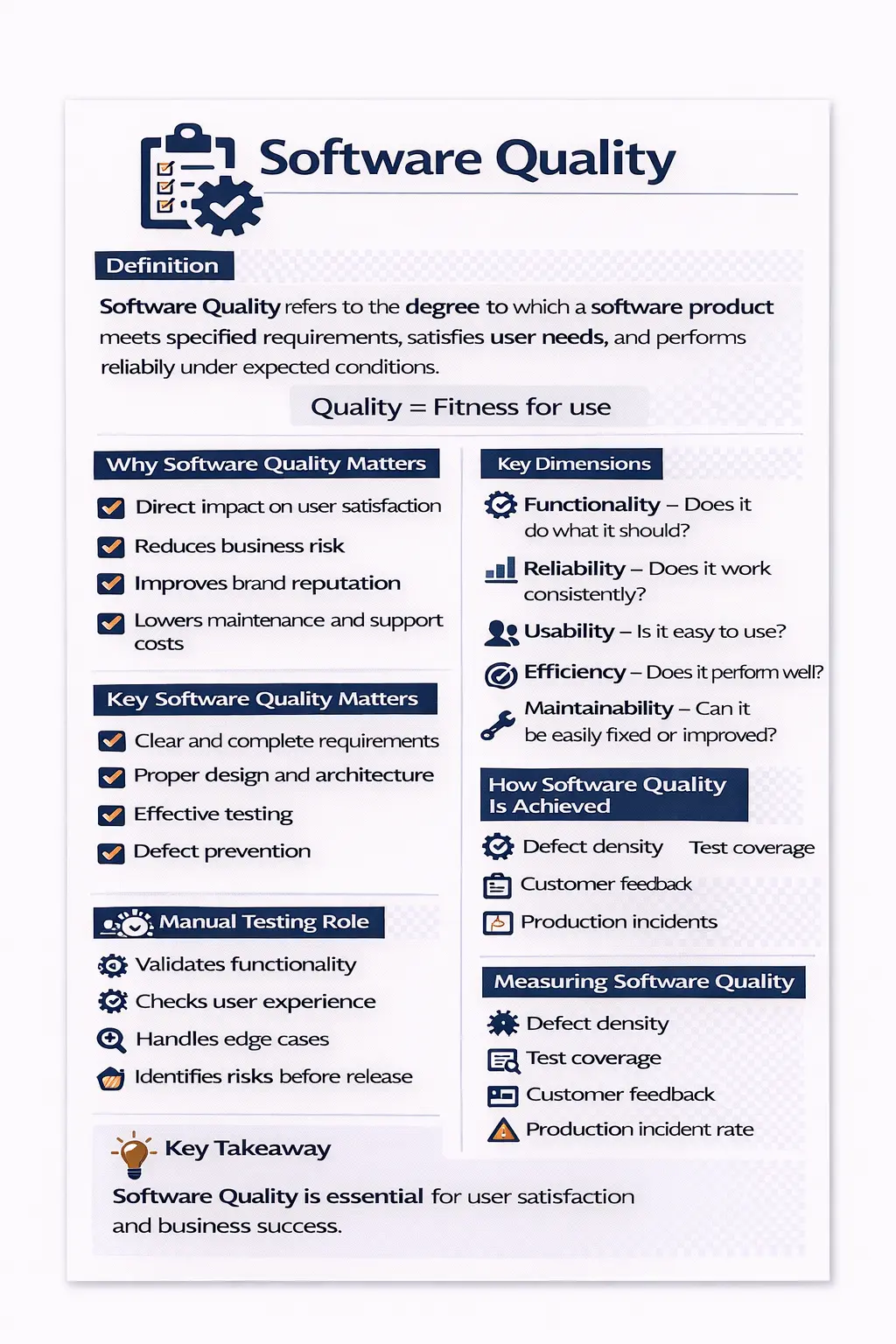
Software quality refers to the degree to which a software product meets specified requirements, satisfies user needs, and performs reliably under expected conditions. In simple terms, quality means fitness for use. A high-quality product is one that not only works according to specifications but also delivers real value to its users. Quality is not a single attribute; it is a combination of correctness, reliability, usability, and performance working together.
Software quality is a central concern in modern development because software systems support critical business operations and everyday user activities. When quality is poor, the impact is immediately visible to both users and organizations.
Software Quality as Fitness for Use
The most practical way to understand software quality is to think of it as fitness for use. A product is not high quality simply because it has modern technology, attractive screens, or a long list of features. It is high quality when it helps the intended users complete their work correctly, safely, efficiently, and with confidence. This means quality must be judged from the user’s point of view as well as from the engineering point of view. A system may be technically impressive, but if users cannot understand it, trust it, or rely on it during real tasks, its quality is weak.
Fitness for use also depends on context. A banking application must be accurate, secure, traceable, and stable. A learning website must be readable, easy to navigate, fast enough on common devices, and available when learners need it. A hospital system must protect sensitive data and support critical workflows without confusion. A stock trading platform must respond quickly and handle transactions reliably. Each product has a different quality profile because each product serves a different purpose. Software quality therefore cannot be reduced to a single universal checklist; it must be evaluated against the product’s actual goals.
Quality Is More Than Working Code
A common mistake is to treat quality as the same thing as working code. Working code is necessary, but it is not enough. The code may run without crashing, yet the product may still produce incorrect results, confuse users, perform slowly, fail under load, expose private data, or become difficult to maintain. Quality includes correctness, but it also includes the experience and reliability surrounding correctness. A feature that works only when the user follows one perfect path is not a strong feature. Good quality software handles normal variation, user mistakes, environmental differences, and future change.
This is why testing teams look beyond the question, “Does it work?” They ask deeper questions. Does it work consistently? Does it work with realistic data? Does it work for different user roles? Does it work after a recent change? Does it fail safely when something goes wrong? Does it communicate clearly with users? Does it protect data? Can it be supported and improved later? These questions turn quality from a narrow technical check into a complete evaluation of product value.
The Relationship Between Requirements and Quality
Requirements are the starting point for software quality because they describe what the product is expected to do. Clear requirements help teams design, build, and test the right behavior. When requirements are incomplete or ambiguous, quality problems often appear later. Developers may implement one interpretation, testers may test another interpretation, and business users may expect something else entirely. This mismatch creates rework, defects, and dissatisfaction.
However, satisfying written requirements does not automatically guarantee quality. Requirements can miss important user expectations. They may describe functionality but not usability. They may define calculations but not explain how errors should be handled. They may mention a report but not define its practical usefulness. High-quality teams therefore treat requirements as a foundation, not as the complete definition of quality. They validate whether the product meets business needs, user expectations, and real workflow conditions.
Quality Across the Software Development Life Cycle
Software quality is built across the full software development life cycle, not added at the end. During requirement analysis, quality begins with clarity, completeness, and testability. During design, quality depends on architecture, data flow, security decisions, usability choices, and integration planning. During development, quality depends on clean implementation, standards, code reviews, and unit checks. During testing, quality is evaluated through functional, regression, exploratory, performance, security, usability, and acceptance testing. During release and maintenance, quality is monitored through incidents, user feedback, analytics, and continuous improvement.
When teams wait until the final testing phase to think about quality, they usually discover issues late and pay more to fix them. Late defects are expensive because they may require requirement changes, code changes, database corrections, retesting, documentation updates, and stakeholder approval. A better approach is to build quality into each step. This is the foundation of strong quality assurance. Quality assurance improves the process so that fewer defects are created, while testing and quality control evaluate the product that has been built.
Functional Quality
Functional quality refers to whether the software performs the functions it is supposed to perform. If a login feature accepts valid credentials, rejects invalid credentials, creates the correct session, redirects users to the right page, and applies role-based access correctly, it has functional quality in that area. Functional quality is often the first thing users notice because it affects whether they can complete basic tasks.
Functional quality requires more than checking the most common successful path. Testers must examine business rules, field validations, calculations, data saving, navigation, permissions, workflows, and error handling. For example, an order placement feature should validate product availability, price calculation, tax rules, delivery address, payment status, confirmation messages, order history, and email notification. If any of these pieces fails, the user may not trust the product. Functional quality is therefore closely connected to business correctness.
Reliability and Stability
Reliability is the ability of software to perform consistently over time. A reliable application does not work correctly only once; it continues to work under expected usage conditions. Stability is closely related. A stable system does not crash frequently, freeze unexpectedly, lose data, or behave differently without reason. For users, reliability and stability create trust. If users feel that an application may fail at any moment, they hesitate to depend on it for important work.
Testing reliability involves repeated execution, regression testing, error recovery checks, session handling, data persistence checks, and sometimes long-duration testing. Testers may check whether a user can continue after a network interruption, whether saved data remains correct after logout and login, whether repeated transactions are processed consistently, and whether the application recovers cleanly from failures. Reliability is especially important for systems that support financial transactions, healthcare operations, education platforms, government services, and business-critical workflows.
Usability as a Quality Attribute
Usability is a major part of software quality because users experience the product through its interface and workflow. A system can be technically correct but still poor in quality if users cannot understand how to use it. Usability includes clear labels, logical navigation, readable content, helpful error messages, consistent layout, accessible controls, and workflows that match user expectations. Good usability reduces training effort, support calls, mistakes, and frustration.
Manual testers are valuable in usability evaluation because they can observe the product as a human user would. They can notice confusing messages, unclear button names, unnecessary steps, inconsistent terminology, and awkward flows. Usability testing does not always require a formal lab. Even a careful review of common user journeys can reveal issues that automated tests cannot detect. A high-quality product should not only produce correct output; it should help users reach that output with clarity and confidence.
Performance and Efficiency
Performance is another important dimension of quality. Users expect pages to load quickly, actions to respond within a reasonable time, reports to generate without excessive delay, and transactions to complete predictably. A feature that is functionally correct but too slow may still be unacceptable. Efficiency also includes responsible use of resources such as memory, CPU, network bandwidth, and database capacity. Poor efficiency can increase infrastructure cost and reduce scalability.
Performance quality should be considered early because many performance problems are related to design decisions. Inefficient database queries, excessive DOM size, large unoptimized images, blocking scripts, poor caching, and unnecessary API calls can make a system slow. Testing can reveal performance issues, but fixing them late may require deeper architectural changes. For this reason, quality-focused teams include performance thinking in design, development, and testing.
Security and Trust
Security is a critical quality concern because users trust software with personal data, financial information, identity details, business records, and confidential operations. A product that exposes data, allows unauthorized access, accepts malicious input, or mishandles sessions cannot be considered high quality. Security defects can damage users, organizations, legal compliance, and reputation. In many modern applications, security is not a separate luxury; it is part of basic quality.
From a testing perspective, security quality includes checking authentication, authorization, input validation, sensitive data handling, session timeout, password rules, error messages, and access control. Testers may not perform deep penetration testing in every project, but they should understand common risks and report suspicious behavior. Good software quality requires the product to be useful and safe at the same time.
Maintainability and Long-Term Quality
Maintainability is the ability to fix, improve, and extend software without excessive effort or risk. Users may not directly see maintainability, but they feel its effects. Poorly maintainable software becomes slower to enhance, harder to test, more expensive to support, and more likely to break when changed. A product with weak maintainability may appear acceptable in the first release but become fragile over time.
Maintainability depends on clean architecture, readable code, consistent naming, reusable components, automated checks, good documentation, and disciplined change management. Testers contribute by identifying regression risk, maintaining clear test cases, reporting defects with useful evidence, and supporting impact analysis. Long-term software quality requires teams to think beyond the immediate release. The product must remain understandable and adaptable as business needs change.
Portability and Compatibility
Portability and compatibility describe how well software works across different environments. A web application may need to run on different browsers, operating systems, screen sizes, devices, and network conditions. An enterprise system may need to integrate with different databases, APIs, identity providers, or deployment environments. If the product works only in one narrow setup, its quality may be limited.
Compatibility testing helps validate this dimension. Testers may check whether important pages render correctly in Chrome, Edge, Safari, and Firefox; whether mobile layouts remain usable; whether downloads work on different platforms; and whether integrations behave consistently. Compatibility issues can be frustrating because they may affect only certain users. A high-quality product should support the environments promised to its users.
Quality from a Business Perspective
Business stakeholders view software quality through outcomes. Does the product support revenue? Does it reduce operational effort? Does it improve customer experience? Does it comply with regulations? Does it reduce support cost? Does it help the organization compete? A technically strong product that does not support business goals may still be considered low value. Quality therefore includes business fitness, not only engineering correctness.
Business quality also involves risk. Some defects are minor cosmetic issues, while others can block sales, cause compliance violations, lose customer data, or stop daily operations. Testing helps stakeholders understand these risks before release. When testers classify defects, summarize execution status, and explain business impact, they help the organization make informed release decisions. Software quality is directly connected to business confidence.
Quality from a User Perspective
Users judge quality based on their experience. They may not know whether the architecture is elegant or whether the code follows best practices. They notice whether the application helps them finish tasks, whether it feels reliable, whether messages are clear, whether it loads quickly, whether data is correct, and whether problems are handled respectfully. A user-centered view of quality keeps the team focused on practical value.
This is why real scenarios are important in testing. A test case that checks one field or one button may be useful, but users experience workflows. They register, search, filter, compare, submit, pay, download, update, cancel, and retry. Quality must be evaluated through these journeys. When testers think like users, they find issues that pure requirement checking may miss.
Quality from a Developer Perspective
Developers often view quality through correctness, design, maintainability, code clarity, performance, and technical reliability. Good development practices reduce defects before testing begins. Unit testing, code reviews, static analysis, consistent architecture, error handling, logging, and clean interfaces all contribute to quality. When developers build with quality in mind, testers can focus more on system behavior and business validation instead of repeatedly finding basic implementation mistakes.
Collaboration between developers and testers improves quality significantly. Testers bring user scenarios and risk thinking, while developers bring implementation knowledge and technical insight. When both perspectives are combined early, the team can identify gaps before they become expensive defects. Quality improves when the team treats testing feedback as part of engineering learning, not as blame.
Quality Metrics and Their Limits
Metrics can help teams understand quality trends, but they must be interpreted carefully. Useful quality metrics may include defect density, defect leakage, escaped defects, test pass percentage, production incidents, mean time to resolution, customer complaints, test coverage, automation stability, and performance trends. These indicators provide signals about product health and process effectiveness.
However, metrics can be misleading if used without context. A low defect count may mean the product is good, or it may mean testing was shallow. A high defect count may mean the product is poor, or it may mean testers are doing a thorough job early enough to prevent production issues. Test coverage may show that many areas were executed, but it does not prove that the best scenarios were selected. Quality metrics should guide conversation and improvement, not replace judgment.
Cost of Poor Software Quality
Poor quality creates visible and hidden costs. Visible costs include defect fixing, retesting, hotfix releases, customer support, refunds, service credits, and incident response. Hidden costs include damaged reputation, lost users, reduced employee productivity, delayed roadmap items, and reduced stakeholder confidence. In regulated domains, poor quality can also lead to legal or compliance penalties.
The cost of defects usually increases the later they are found. A requirement defect found during review may be corrected quickly. The same defect found after development may require code changes and retesting. If it reaches production, it may affect customers, trigger urgent fixes, and damage trust. This is why quality-focused teams invest in early reviews, strong testing, automation where useful, and continuous feedback.
Quality Is a Shared Responsibility
Software quality is not the responsibility of testers alone. Product owners define clear priorities and acceptance criteria. Business stakeholders clarify real needs. Designers shape usable experiences. Developers implement robust solutions. Testers evaluate behavior and reveal risk. DevOps and operations teams support stable deployment and monitoring. Support teams provide feedback from real users. When all these roles contribute, quality becomes a team habit rather than a final gate.
This shared responsibility does not reduce the importance of testing. Instead, it makes testing more valuable because testers become quality advisors and risk communicators. They help the team see what might go wrong, what has been validated, what remains uncertain, and what business impact defects may have. High-quality software is produced when the entire team listens to these signals and improves continuously.
Manual Testing and Human Judgment
Manual testing remains important because quality is not always easy to reduce to scripts. Human testers can recognize confusion, inconsistency, awkward workflows, unclear messages, and business risk. They can explore the application, adjust based on observations, and ask questions that automated checks cannot ask. This is especially valuable for new features, complex workflows, usability evaluation, and scenarios where requirements are evolving.
Automation is valuable for repeated checks, regression coverage, data-driven validation, and fast feedback. But automation does not replace human judgment. Automated tests can confirm that expected conditions are still true, while manual testing can discover unexpected problems and evaluate user experience. Strong software quality usually comes from combining automation efficiency with human insight.
Common Quality Problems in Real Projects
Many real-world quality problems begin with unclear requirements. When teams do not share the same understanding, the product may be built incorrectly even if everyone works hard. Another common source is compressed timelines. When deadlines are tight, teams may skip reviews, reduce testing, defer defects, or release with known risks. Poor communication also causes quality issues when developers, testers, business users, and operations teams work in isolation.
Environment instability is another practical problem. If test environments are unavailable, data is inconsistent, integrations are down, or builds are unstable, testers cannot evaluate quality reliably. Frequent requirement changes, weak regression coverage, lack of test data, and poor defect tracking also reduce quality. Recognizing these root causes helps teams improve the system of work rather than only reacting to individual bugs.
Building a Quality Mindset
A quality mindset means thinking about value, risk, and user impact throughout the project. It means asking whether requirements are clear, whether designs are usable, whether code is maintainable, whether tests reflect real workflows, and whether release decisions are based on evidence. A quality mindset also accepts that defects are not just tester findings; they are learning signals for the whole team.
Teams with a quality mindset do not wait for users to discover serious problems. They review early, test thoughtfully, automate wisely, investigate production feedback, and improve their process. They balance speed with responsibility. They understand that quality is not perfection, but disciplined confidence. The goal is to release software that meets business needs, protects users, and can be supported over time.
Interview-Ready Understanding of Software Quality
In interviews, software quality can be explained as the degree to which a software product meets requirements, satisfies user needs, and performs reliably in real conditions. A strong answer should mention that quality is not only about being defect-free. It includes functionality, reliability, usability, performance, security, maintainability, and compatibility. It should also explain that quality is built throughout the lifecycle through clear requirements, good design, development standards, testing, defect prevention, and continuous improvement.
A practical example makes the answer stronger. A login feature with no known defects may still have poor quality if it is slow, confusing, insecure, inconsistent across browsers, or difficult to recover from failed attempts. High-quality login should be correct, secure, usable, fast, reliable, and clear. This example shows that software quality is broad and user-focused, not just a defect count.
Why Software Quality Matters
Software quality has a direct influence on user satisfaction. When applications behave consistently and meet expectations, users develop trust in the product. Poor quality, on the other hand, leads to frustration, complaints, and loss of confidence.
From a business perspective, quality reduces operational risk and financial loss. It strengthens brand reputation and lowers the long-term cost of maintenance and support. In many industries, quality is also tied to regulatory and compliance requirements, where failures can have legal consequences. For these reasons, quality is not optional; it is a strategic necessity.
Software Quality from a Tester’s Perspective
From a tester’s viewpoint, software quality is evaluated by observing how the application behaves in realistic scenarios. A tester considers whether the system works correctly, whether it behaves as users expect, and whether it remains stable over time. Usability is also a major factor, since a technically correct system can still be difficult to understand or operate. Good quality software also handles invalid or unexpected input gracefully without breaking.
This perspective shows that quality is about user experience as much as technical correctness.
Quality and Defect-Free Software
A common misunderstanding is that defect-free software automatically means high-quality software. In reality, a product can have no known defects and still fail to satisfy users. It might be confusing, missing important features, or difficult to navigate. Quality therefore goes beyond defect counts. Testing must focus on delivering value and usefulness, not just on removing bugs.
Dimensions of Software Quality
Software quality is often viewed through multiple dimensions. Functionality reflects whether the system does what it is supposed to do. Reliability shows whether it works consistently without frequent failures. Usability relates to how easy and intuitive the system is. Efficiency concerns performance and resource usage. Maintainability considers how easily the software can be fixed or improved. Portability addresses whether the software works across different environments.
Together, these dimensions provide a holistic view of quality.
How Software Quality Is Achieved
Quality does not appear at the end of a project; it is built throughout the lifecycle. It begins with clear and complete requirements and continues with sound design and architecture. Structured quality assurance practices help enforce standards and discipline. Effective manual testing uncovers issues and validates behavior. Defect prevention and early detection reduce costly rework. When these elements work together, quality becomes a natural outcome rather than a last-minute effort.
Role of Manual Testing in Software Quality
Manual testing plays a significant role in achieving quality because it brings human judgment into evaluation. Testers verify business logic, examine user workflows, and explore edge cases. They assess whether the user experience aligns with expectations and identify risks that automated checks may miss. This human-centric evaluation helps ensure that the product truly serves its users.
Measuring Software Quality
Although quality can feel subjective, it can be assessed through measurable indicators. Teams often look at patterns in defects, how many issues escape to production, how much of the system is covered by tests, and what feedback comes from customers. Production incident trends also reveal how the system behaves in real use. These measurements provide signals about quality levels and areas needing improvement.
Software Quality in Real Projects
In real projects, quality must be balanced with time and cost. Perfect quality is rarely achievable, and zero defects is an uncommon reality. Teams instead aim for acceptable risk levels based on business priorities. Testing and quality practices help organizations decide when a product is ready for release. Quality, in practice, is about making informed trade-offs rather than chasing perfection.
Common Sources of Quality Problems
Many quality issues originate from unclear requirements, insufficient testing, or tight deadlines. Poor communication between teams can introduce misunderstandings, and unstable environments can create inconsistent results. Recognizing these sources helps teams address quality at its roots rather than only reacting to failures.
Conclusion
Software quality is not accidental. It is planned, built, tested, and continuously maintained. It reflects how well a system meets requirements, supports users, and performs in real conditions. High-quality software earns user trust, reduces business risk, and delivers long-term value. Ultimately, quality is a shared responsibility across the team, and it must be treated as a continuous commitment rather than a final checkpoint.