Quality Assurance (QA): Building Quality into the Process
Introduction to Quality Assurance
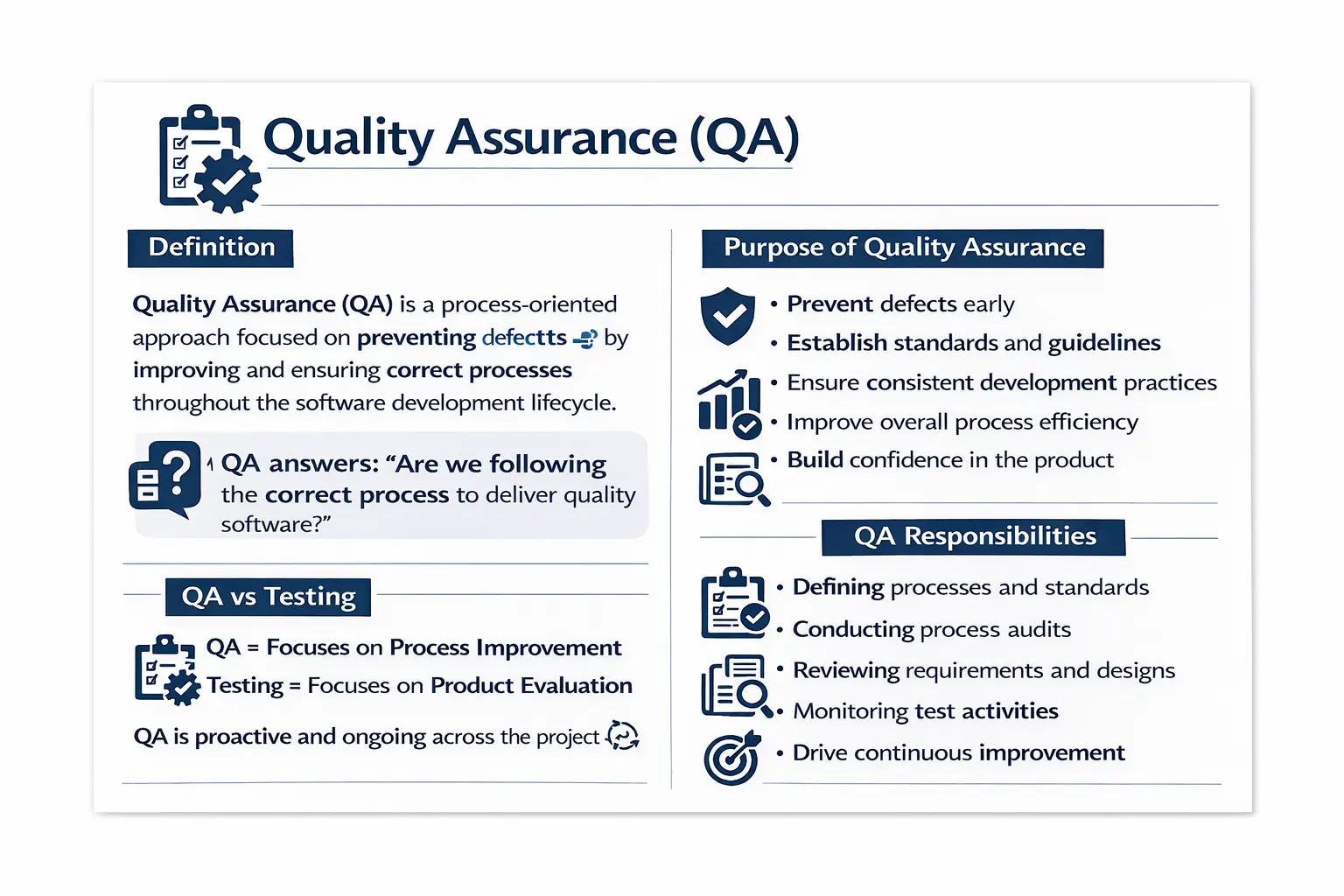
Quality Assurance, commonly known as QA, is a process-oriented discipline focused on preventing defects by ensuring that the right methods, standards, and practices are followed throughout the software development lifecycle. Instead of concentrating only on the final product, QA emphasizes how the product is built. It asks a fundamental question: are we following the correct process to build quality software? By focusing on process quality, QA aims to make good outcomes repeatable and predictable.
Why Quality Assurance Matters
Quality Assurance matters because software quality does not happen only at the moment a tester finds a defect. Quality is shaped by every decision made before that point: how requirements are written, how designs are reviewed, how developers understand acceptance criteria, how test cases are prepared, how defects are reported, how releases are approved, and how lessons are carried into the next cycle. QA exists to make these activities disciplined, repeatable, and measurable. Without QA, teams may still test the final application, but they may repeat the same mistakes in every release.
A useful way to understand QA is to compare it with building safety into a manufacturing process. If a factory checks finished products only at the end, it may reject faulty items, but the same fault may continue appearing again and again. A stronger approach is to improve the process that creates the product. In software, QA plays that role. It helps teams define better practices so fewer defects are introduced during requirement analysis, design, coding, testing, deployment, and maintenance.
This preventive nature is the main reason QA is broader than testing. Testing can confirm whether a feature passes or fails, but QA asks why failures happen, whether the process allowed them to happen, and how the team can reduce similar failures in the future. A team with strong QA practices learns from defects instead of only fixing them. Over time, this improves delivery confidence, reduces rework, and creates a healthier engineering culture.
QA as a Process-Oriented Discipline
The most important point about Quality Assurance is that it is process-oriented. It does not focus only on one screen, one module, one defect, or one release. It focuses on the system of work that produces software. If that system is unclear, inconsistent, or poorly controlled, product quality will also be inconsistent. QA brings structure by defining how work should be planned, reviewed, tested, tracked, and improved.
For example, a QA process may define that every requirement must have clear acceptance criteria before development starts. It may define that test scenarios must be reviewed before execution. It may define how severity should be assigned, how defects should be documented, how regression testing should be selected, and how release readiness should be evaluated. These practices do not guarantee a perfect product, but they reduce uncertainty and make quality decisions more reliable.
Process orientation also helps teams scale. In a small team, people may coordinate informally. As the product grows, informal coordination becomes risky. Different testers may write test cases in different formats, developers may interpret requirements differently, and release decisions may depend on incomplete information. QA creates common working rules so the team can operate consistently even as the project becomes larger and more complex.
QA Starts Before Testing Begins
A common beginner mistake is to think QA starts when test execution starts. In reality, effective QA begins much earlier. It starts when the team reviews requirements, identifies risks, clarifies business rules, and defines what quality means for the feature being built. If requirements are vague, incomplete, or contradictory, even excellent testing may not prevent rework. QA therefore encourages early reviews so defects are prevented at the source.
During requirement analysis, QA helps by asking practical questions. What should happen when the user enters invalid data? Are there boundary conditions? Are all user roles covered? What are the expected messages? What is the priority of this feature? What is the business impact if it fails? These questions may look simple, but they often reveal gaps that would otherwise become defects later.
This early involvement is sometimes called shift-left quality. The idea is to move quality thinking earlier in the lifecycle instead of waiting until the end. Shift-left does not remove the need for test execution. It makes test execution more effective because the team begins with clearer requirements, better testability, and fewer hidden assumptions.
QA in Requirement Reviews
Requirement reviews are one of the most valuable QA activities. Many production defects begin as requirement defects. A missing rule, unclear condition, ambiguous phrase, or unstated dependency can lead to incorrect implementation even when the code is written carefully. QA reduces this risk by reviewing requirements from a quality and testability perspective.
A good QA review checks whether the requirement is complete, clear, measurable, testable, consistent, and aligned with business expectations. If a requirement says "the system should load quickly," QA should ask what "quickly" means. If it says "the user should receive an error message," QA should ask what the message should say and when it should appear. If it says "admin can approve requests," QA should ask what happens when the request is already rejected, expired, duplicated, or owned by another department.
These questions do not slow the team down; they prevent avoidable confusion. When requirements are reviewed properly, developers build with more confidence, testers prepare better test cases, and stakeholders receive behavior closer to what they expected. QA therefore improves both quality and delivery speed by reducing late surprises.
QA in Test Planning
Test planning is another area where QA provides discipline. A test plan or test strategy does not exist just to satisfy documentation needs. It helps the team decide what needs to be tested, how it should be tested, who will test it, what environments are needed, what data is required, what risks exist, and what criteria must be met before release. Without planning, testing can become reactive and incomplete.
In manual testing projects, QA helps define the scope of testing. Some areas may need detailed functional testing, some may need regression coverage, some may need compatibility checks, and some may need focused exploratory testing. QA also helps identify what is out of scope so expectations are realistic. Clear scope prevents both under-testing and uncontrolled expansion of testing effort.
QA-driven planning also improves communication. When the team knows the testing approach in advance, stakeholders can understand timelines, risks, dependencies, and release readiness. This makes quality visible instead of leaving it as an assumption. Good planning does not remove uncertainty, but it gives the team a structured way to manage it.
QA in Test Case Design and Review
Test case design is not only about writing steps. It is about translating requirements, risks, and user behavior into meaningful validation. QA ensures that test cases are clear, traceable, reusable, and aligned with expected behavior. It also encourages coverage of positive scenarios, negative scenarios, boundary values, business rules, and integration points.
Reviewing test cases is an important QA activity because test cases can contain mistakes too. A test case may miss a condition, use incorrect data, contain unclear expected results, or duplicate another test without adding value. QA review helps improve the quality of the testing artifacts before execution begins. This reduces wasted effort and improves defect detection.
Strong QA practice also encourages test cases to be maintainable. If every small UI change breaks many test cases, the test suite becomes expensive to update. If expected results are vague, execution becomes subjective. If test data is not defined, results may be inconsistent. QA brings standards that keep test cases useful over time.
QA in Defect Management
Defect management is more than logging bugs. QA defines how defects should be reported, prioritized, assigned, tracked, retested, reopened, deferred, and closed. A clear defect process prevents confusion and ensures that important issues receive the right attention. It also creates useful data for improving future quality.
A good defect report contains a clear summary, environment details, steps to reproduce, expected result, actual result, evidence, severity, and relevant test data. QA standards help testers write reports that developers can understand and reproduce. Poor defect reports waste time because developers must ask for clarification or may reject issues that are not documented properly.
QA also looks beyond individual defects. If many defects come from the same module, requirement type, developer handoff, or test data problem, QA uses that information to improve the process. This is how defect management becomes preventive rather than only corrective. The goal is not merely to close bugs; the goal is to understand why they appeared and reduce recurrence.
QA and Continuous Improvement
Continuous improvement is central to Quality Assurance. A QA process should not remain fixed forever if the project, team, technology, or risks change. Teams should regularly inspect what is working and what is not. Retrospectives, defect analysis, audit findings, metrics, and release reviews all provide input for improvement.
For example, if many defects are caused by unclear acceptance criteria, the improvement may be to introduce better requirement review checklists. If test execution is delayed because environments are unstable, the improvement may be stronger environment readiness checks. If many defects are reopened, the improvement may be clearer fix verification guidelines. QA converts repeated pain points into process improvements.
This is why QA should be viewed as an ongoing discipline rather than a one-time activity. A team may begin with basic QA practices and mature over time. As quality problems become visible, the team can refine standards, improve reviews, automate checks, strengthen communication, and make delivery more predictable.
QA Metrics Should Guide, Not Blame
Metrics are useful only when they are used responsibly. QA metrics should help teams understand trends and improve processes. They should not become tools for blaming individuals. When metrics are used badly, people may hide defects, avoid raising risks, or optimize numbers instead of improving quality. When metrics are used well, they reveal where the process needs attention.
Common QA metrics include defect leakage, defect density, defect rejection rate, reopen rate, test case execution progress, requirement coverage, automation pass rate, and escaped defects. Each metric tells only part of the story. For example, a low defect count may mean the product is stable, but it may also mean testing was shallow. A high defect count may mean poor development quality, but it may also mean testers are doing deep and valuable testing. QA must interpret metrics with context.
The real value of measurement is conversation. If defect leakage increases, the team should ask why defects are escaping. If reopen rates are high, the team should examine fix quality and retest clarity. If requirement coverage is weak, the team should improve traceability. Metrics should lead to better decisions, not defensive behavior.
QA as a Shared Responsibility
Although QA provides structure and guidance, quality does not belong only to the QA team. Developers, testers, business analysts, product owners, architects, designers, DevOps engineers, and support teams all influence quality. A requirement written poorly can create defects. A design decision can affect usability. A rushed deployment can create production risk. A missing log can make a defect hard to diagnose. QA helps coordinate quality thinking across all these roles.
This shared responsibility is especially important in Agile and DevOps environments. Fast delivery does not work if quality is thrown over the wall to testers at the end. Everyone must contribute: product owners clarify acceptance criteria, developers write maintainable code and unit tests, testers validate behavior and explore risks, and operations teams support stable deployment. QA supports this collaboration by defining practices and making quality visible.
When quality is shared, the QA role becomes more strategic. QA professionals do not only execute test cases; they influence process, risk, coverage, communication, and improvement. This makes QA a key part of delivery success rather than a final checkpoint.
Real-Time Example of QA Thinking
Consider an online registration feature. A testing-only mindset may begin after the page is built: enter valid details, submit the form, verify account creation, try invalid email, and report defects. This is useful, but QA thinking starts earlier. Before development, QA asks whether password rules are defined, whether duplicate email behavior is clear, whether mandatory fields are marked, whether privacy consent is required, whether email verification is needed, and whether the account should be active immediately.
During design, QA checks whether validation messages are user-friendly, whether fields are accessible, whether mobile layout is usable, and whether the process follows security expectations. During development, QA may ensure that coding standards, review practices, and test data needs are followed. During testing, QA validates not only the happy path but also boundary conditions, duplicate data, invalid formats, browser compatibility, and error handling.
After release, QA may analyze support tickets or production defects related to registration. If users are confused by password rules, the process may need better requirement review or UX validation next time. This example shows how QA connects the full lifecycle instead of treating quality as a single test execution phase.
QA, QC, and Testing in Simple Terms
The difference between QA, QC, and testing is an important interview topic. QA is preventive and process-focused. It asks whether the team is following the right process to build quality. QC is detective and product-focused. It checks whether the produced output meets quality expectations. Testing is a major QC activity that executes the software to find defects and verify behavior.
In simple terms, QA defines and improves the process, QC checks the product, and testing is one of the practical ways to perform that product check. For example, QA may define that every critical requirement must have reviewed test cases. QC may review whether the released feature meets defined standards. Testing may execute login, payment, search, or registration scenarios to identify defects.
Understanding this distinction helps testers explain their role better. A manual tester participates in testing, but also contributes to QA when they review requirements, improve test processes, analyze defect trends, suggest checklist improvements, and help prevent repeated issues.
Interview-Ready View of QA
In interviews, Quality Assurance should be explained as a process-focused approach that ensures software is built using defined standards, disciplined practices, reviews, metrics, and continuous improvement. It is not limited to finding bugs. It is about preventing defects and improving the way software is developed and tested. A strong answer should mention prevention, process, SDLC involvement, standards, audits, metrics, and shared responsibility.
A concise interview answer can be: Quality Assurance is a preventive process that ensures quality is built into software development by defining and following standards, processes, reviews, metrics, and improvement practices throughout the SDLC. Testing is part of QA, but QA is broader because it focuses on improving the process, not only checking the final product.
This answer is strong because it clearly separates QA from testing while showing practical understanding. It also reflects real project work, where QA professionals help teams avoid defects, improve consistency, and deliver reliable software with confidence.
Purpose of Quality Assurance
The purpose of QA is rooted in prevention. Rather than waiting to detect problems after they appear, QA works to reduce the chance of defects being introduced in the first place. This is achieved by defining standards, creating structured procedures, and promoting disciplined execution. When processes are consistent and well-defined, teams work more efficiently and produce more reliable results. QA therefore builds confidence not only in the product but also in the team’s ability to deliver quality consistently.
QA and Testing: Understanding the Difference
Quality Assurance and testing are related but not identical. QA is process-focused, while testing is product-focused. Testing evaluates the software to identify defects, whereas QA ensures that the development and testing activities themselves follow effective processes. QA begins early, often before coding starts, and continues throughout the project. Testing is one component within the broader QA framework.
What QA Involves in a Manual Testing Context
In environments where manual testing is practiced, QA shapes how testing is performed rather than just what is tested. It includes defining testing standards, establishing guidelines, and ensuring that teams follow agreed approaches. QA also supports requirement reviews, test strategy planning, and process audits. Metrics are collected and analyzed to understand performance trends, and improvement initiatives are introduced to refine workflows over time. In this way, QA creates structure and discipline around testing activities.
QA Activities Across the SDLC
Quality Assurance influences every phase of the software development lifecycle. During the requirements phase, QA promotes clarity and helps identify ambiguities. In the design phase, it encourages structured reviews and adherence to standards. During development, QA supports compliance with coding and documentation practices. In the testing phase, QA examines process quality and coverage. At release time, QA contributes to quality sign-off and risk evaluation. Even in maintenance, QA plays a role through root cause analysis and process refinement. This lifecycle presence ensures that quality is continuously built in rather than checked at the end.
QA Deliverables
QA produces structured outputs that guide teams and provide visibility. These may include standards, process documents, strategy frameworks, and quality reports. Audit observations and improvement plans also emerge from QA efforts. Such deliverables create transparency, alignment, and accountability across teams.
Role of QA in Agile Projects
In Agile environments, QA is integrated into team activities rather than acting as a separate gatekeeper. QA contributes to sprint planning by ensuring clarity and testability of acceptance criteria. It promotes a shift-left mindset, encouraging early validation and collaboration. QA also supports continuous feedback loops so that improvements can be applied quickly. In Agile, QA helps maintain quality while enabling speed and flexibility.
QA Metrics and Measurement
Measurement is a key aspect of Quality Assurance. Metrics provide insight into how effectively processes are working. Indicators such as defect leakage, defect density, requirement coverage, and reopen trends help teams understand quality patterns. These measurements are not about blame; they are about learning and improving. When used correctly, metrics guide smarter decisions and process refinement.
Common Misconceptions About QA
QA is sometimes misunderstood as being the same as testing or as a role focused only on finding bugs. In reality, QA is broader and more strategic. It is not limited to a single person or phase, and it is not solely responsible for quality. Quality is a shared responsibility across the team. QA simply provides the framework and discipline that make quality achievable and repeatable.
QA in Real Projects
In real-world projects, QA defines how testing and development should be approached, ensuring consistency across teams. This consistency reduces production issues and improves predictability. When teams follow stable processes, delivery quality becomes more reliable. QA therefore supports not just technical quality but also delivery confidence.
QA and Quality Control
Quality Assurance and Quality Control are closely related but serve different purposes. QA is preventive and process-oriented, while Quality Control is detective and product-oriented. QA aims to build quality into the workflow, whereas QC evaluates the final output. Understanding this distinction helps organizations apply both effectively.
Conclusion
Quality Assurance ensures that quality is built into the process rather than inspected at the end. It creates structure, discipline, and continuous improvement within software development. By focusing on how work is done, QA helps teams deliver reliable, high-quality software in a consistent and predictable way. Ultimately, QA is not just a function—it is a mindset that promotes excellence throughout the lifecycle.