Acceptance Criteria
Acceptance Criteria are one of the most critical elements of Agile development and testing. They define the conditions that must be satisfied for a User Story to be considered complete and acceptable. Acceptance Criteria transform high-level requirements into clear and testable conditions that guide development and validation. Without proper Acceptance Criteria, User Stories often become ambiguous, leading to misunderstandings, incorrect implementations, and testing challenges.
Acceptance Criteria answer an essential question in Agile projects: “How do we know this story is done correctly?” They provide a shared understanding between product owners, developers, and testers by defining exactly what behavior is expected from the system.
Acceptance Criteria serve as the foundation for test scenarios, test cases, and acceptance testing. For manual testers, Acceptance Criteria represent the primary source of validation rules. A User Story may describe what the user wants, but Acceptance Criteria define how the system must behave for the story to be accepted.
Well-written Acceptance Criteria improve communication, reduce defects, and ensure consistent delivery of high-quality software.
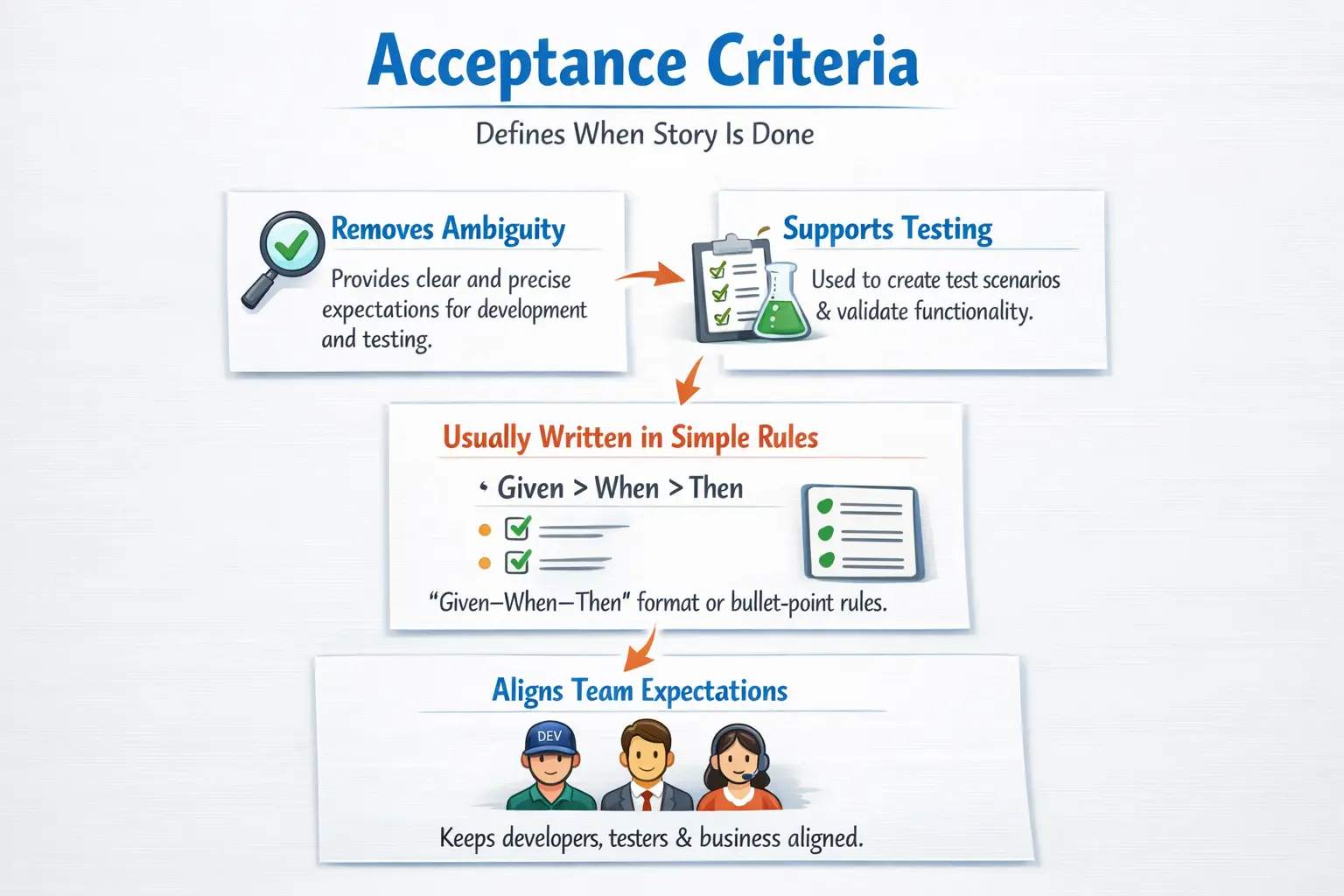
Definition of Acceptance Criteria
Acceptance Criteria are the specific conditions that a User Story must satisfy to be considered complete and acceptable by the business. They describe the expected behavior of the system in a clear and measurable way.
Acceptance Criteria define the boundaries of a User Story by specifying what is included and what is not included. They eliminate ambiguity by describing exactly how the system should respond to various inputs and conditions.
Acceptance Criteria are not technical specifications. They are written in business language so that all stakeholders can understand them. They describe behavior from a user or business perspective rather than from a system implementation perspective.
Acceptance Criteria ensure that development and testing teams work toward the same expectations. Without Acceptance Criteria, developers may interpret requirements differently, and testers may not know how to validate the functionality.
Acceptance Criteria provide the basis for determining whether a story is complete. A story is considered finished only when all Acceptance Criteria have been satisfied.
Purpose of Acceptance Criteria
Acceptance Criteria serve several important purposes in Agile development.
One major purpose is removing ambiguity from User Stories. User Stories are intentionally simple and concise, but this simplicity often leaves room for interpretation. Acceptance Criteria provide the details needed to clarify expectations.
Another purpose is defining clear expectations for system behavior. Acceptance Criteria ensure that developers understand what must be implemented and testers understand what must be validated.
Acceptance Criteria enable objective validation. Instead of relying on subjective judgments such as “the feature looks correct,” Acceptance Criteria provide measurable conditions that determine success.
Acceptance Criteria support acceptance testing. Testers design validation scenarios directly from Acceptance Criteria.
Acceptance Criteria align development, testing, and business teams. Everyone works toward the same definition of success.
Acceptance Criteria also help prevent scope creep by defining exactly what is included in the story.
Importance of Acceptance Criteria in Agile Testing
Acceptance Criteria play a central role in Agile testing. They define the validation rules that testers use to verify functionality.
Acceptance Criteria help testers identify test scenarios early in the development cycle. This early involvement reduces defects and misunderstandings.
Acceptance Criteria also ensure consistency across testing efforts. Different testers working on the same story will validate the same conditions.
Acceptance Criteria help developers implement functionality correctly. Clear requirements reduce the need for rework.
Acceptance Criteria support acceptance testing during Sprint Reviews. Stakeholders evaluate completed stories based on Acceptance Criteria.
Without Acceptance Criteria, testing becomes subjective and inconsistent.
Characteristics of Good Acceptance Criteria
Good Acceptance Criteria share several important characteristics.
They must be clear and unambiguous. Every stakeholder should interpret the criteria in the same way.
Acceptance Criteria must be testable and measurable. Testers should be able to determine objectively whether each criterion is satisfied.
Acceptance Criteria should be business-focused. They should describe system behavior from a user perspective rather than technical implementation details.
Acceptance Criteria should be independent of implementation. They should describe what the system does rather than how it is built.
Acceptance Criteria should be complete but concise. They should include all necessary conditions without unnecessary details.
High-quality Acceptance Criteria improve development efficiency and testing effectiveness.
Writing Effective Acceptance Criteria
Writing effective Acceptance Criteria requires collaboration between product owners, developers, and testers.
Acceptance Criteria should describe expected behavior clearly. Vague statements should be avoided.
Acceptance Criteria should include both positive and negative scenarios.
Acceptance Criteria should cover normal workflows and exceptional conditions.
Acceptance Criteria should use consistent terminology.
Acceptance Criteria should reflect business rules accurately.
Acceptance Criteria should be reviewed by the team before development begins.
Early review ensures that Acceptance Criteria are realistic and testable.
Common Formats for Acceptance Criteria
Acceptance Criteria can be written in different formats depending on project needs. Two formats are commonly used in Agile projects.
Given–When–Then Format (BDD Style)
The Given–When–Then format is widely used because it provides a structured way to describe system behavior.
The "Given" section describes the initial conditions.
The "When" section describes the action performed by the user.
The "Then" section describes the expected outcome.
For example:
Given the user is logged in
When the user clicks the logout button
Then the user is logged out successfully
This format improves clarity and ensures consistent Acceptance Criteria.
Given–When–Then is especially useful for complex workflows.
It also supports Behavior-Driven Development practices.
Rule-Based Format
Acceptance Criteria can also be written as simple rules describing expected behavior.
For example:
Password must contain at least eight characters.
Error message displayed for invalid email.
User cannot submit empty form.
This format is simple and easy to understand.
Rule-based criteria work well for straightforward features and validations.
Both formats are widely used in Agile projects.
Manual Tester’s Role with Acceptance Criteria
Manual testers play a critical role in ensuring Acceptance Criteria are effective.
Testers review Acceptance Criteria for clarity and completeness.
Testers identify missing scenarios or edge cases.
Testers ensure Acceptance Criteria are testable.
Testers convert Acceptance Criteria into test scenarios and test cases.
Testers validate story completion against Acceptance Criteria.
Testers also provide feedback during backlog refinement and sprint planning.
Early tester involvement improves Acceptance Criteria quality.
Acceptance Criteria and Test Scenario Design
Acceptance Criteria are the primary source for designing test scenarios.
Each Acceptance Criterion typically results in one or more test scenarios.
Acceptance Criteria define expected behavior under different conditions.
Test scenarios expand Acceptance Criteria into executable validations.
For example:
Story: Reset Password
Acceptance Criteria:
- Valid email triggers reset link.
- Invalid email shows error message.
- Reset link expires after fifteen minutes.
From these criteria, testers create multiple scenarios covering positive and negative cases.
Acceptance Criteria ensure comprehensive test coverage.
Acceptance Criteria vs User Stories
User Stories and Acceptance Criteria serve different purposes but work together.
User Stories describe what the user wants and why.
Acceptance Criteria define the conditions that must be satisfied.
User Stories provide high-level requirements.
Acceptance Criteria provide detailed validation rules.
User Stories are typically written by Product Owners.
Acceptance Criteria are created collaboratively.
User Stories guide development priorities.
Acceptance Criteria guide validation.
Both are essential for Agile testing.
Acceptance Criteria vs Definition of Done
Acceptance Criteria are often confused with the Definition of Done, but they are different.
Acceptance Criteria are specific to a User Story. They define functional behavior.
Definition of Done applies to all stories. It defines overall completion requirements.
Acceptance Criteria verify feature functionality.
Definition of Done verifies overall quality standards.
Acceptance Criteria may include validation rules such as input checks.
Definition of Done may include requirements such as code review and regression testing.
Understanding this distinction is important for Agile teams.
Real-Time Example
Consider the following User Story:
As a user, I want to reset my password so that I can regain account access.
Acceptance Criteria may include:
- Valid email address triggers password reset link.
- Invalid email address shows error message.
- Reset link expires after fifteen minutes.
- User can set a new password using the reset link.
- Password must meet security requirements.
These Acceptance Criteria define exactly how the feature should behave.
Testers use these criteria to design validation scenarios.
Developers use these criteria to implement functionality.
Stakeholders use these criteria to accept the feature.
Benefits of Well-Defined Acceptance Criteria
Well-defined Acceptance Criteria provide many benefits.
- They improve requirement clarity.
- They reduce misunderstandings.
- They improve collaboration.
- They reduce rework.
- They improve testing accuracy.
- They enable consistent validation.
- They improve release quality.
- Clear Acceptance Criteria increase team productivity.
Common Mistakes in Acceptance Criteria
Poor Acceptance Criteria cause significant project problems.
One common mistake is writing vague criteria such as “system should work properly.”
Another mistake is including implementation details such as database logic.
Missing negative scenarios lead to incomplete testing.
Overloading Acceptance Criteria with unnecessary details reduces clarity.
Incomplete Acceptance Criteria lead to incorrect implementations.
Poor Acceptance Criteria increase defect rates.
Acceptance Criteria in Agile Development
Acceptance Criteria support Agile development by enabling continuous validation.
Acceptance Criteria guide development work.
Acceptance Criteria support test-driven thinking.
Acceptance Criteria enable incremental delivery.
Acceptance Criteria support Sprint Reviews.
Acceptance Criteria help teams measure progress.
Acceptance Criteria improve product quality.
They ensure each story delivers real value.
Why Acceptance Criteria Matter to the Whole Team
Acceptance Criteria matter because they create a shared definition of success for a story. A User Story explains the user need, but the Acceptance Criteria explain how the team will recognize that the need has been satisfied. Without this shared understanding, different people may carry different assumptions into the sprint. The Product Owner may expect one behavior, developers may implement another, and testers may validate a third interpretation.
In Agile teams, speed is valuable only when it produces the right outcome. Acceptance Criteria help teams move quickly without losing clarity. They reduce guesswork before development begins and reduce arguments after implementation is complete. When a story has clear criteria, conversations become more practical because the team can discuss specific behaviors instead of vague expectations.
Acceptance Criteria also protect business value. A feature can be technically complete but still fail to satisfy the user if important conditions are missing. For example, a password reset feature may send an email successfully, but if the reset link never expires, the feature may violate security expectations. Acceptance Criteria make these expectations visible before the feature is built.
For developers, Acceptance Criteria guide implementation. They clarify which inputs, outputs, rules, and outcomes must be handled. For testers, they guide validation. They show which scenarios must pass before the story can be accepted. For Product Owners, they support acceptance decisions. They provide a concrete basis for deciding whether the story meets the business need.
The strongest Acceptance Criteria are not created by one person working alone. They emerge from collaboration. Product Owners bring business intent, developers bring technical awareness, and testers bring scenario thinking. When these perspectives combine, the criteria become clearer, more complete, and more testable.
Acceptance Criteria as a Conversation Tool
Acceptance Criteria are often written as text, but their real value is in the conversation they trigger. A criterion such as “user can upload a profile picture” may sound simple until the team discusses file type, file size, image preview, replacement behavior, deletion behavior, and failure messages. The written criterion starts the conversation, but the conversation reveals the real requirement.
This is why Acceptance Criteria should be reviewed during backlog refinement or before sprint planning. If the team waits until testing to discover missing details, rework becomes more expensive. A tester may find that an upload feature accepts unsupported file types, but by then the developer may need to revisit the design. If the file type rule had been clarified earlier, the defect could have been prevented.
Good teams use Acceptance Criteria to expose assumptions. If someone says, “the system should show an error,” the team should ask what error, under which condition, where it appears, and what the user can do next. If someone says, “the user should be notified,” the team should ask whether notification means email, SMS, in-app alert, or all of them. These questions turn vague expectations into testable behavior.
Acceptance Criteria also help non-technical stakeholders participate. Business users may not understand architecture or code, but they can understand expected behavior. When criteria are written in business language, stakeholders can review them and confirm whether they reflect real-world needs. This improves requirement quality before work begins.
The goal is not to write perfect criteria in the first attempt. The goal is to use criteria as a tool for discovery. As the team discusses the story, unclear areas become clear, hidden rules become visible, and testing becomes more reliable.
Positive, Negative, and Edge Conditions
Effective Acceptance Criteria usually include more than the successful path. A story must describe what happens when things go right, but it should also define what happens when things go wrong or when the user reaches a boundary condition. This is where testers add significant value because they naturally think beyond the happy path.
Positive criteria describe expected successful behavior. For example, “when a registered user enters valid credentials, the user should be logged in and redirected to the dashboard.” This confirms the main business flow. A story cannot be accepted if the primary successful behavior does not work.
Negative criteria describe expected rejection or error handling. For the same login story, negative criteria may state that invalid credentials should deny access and display a clear error message. These criteria are important because reliable software must fail correctly. A system that accepts invalid data or exposes unclear errors creates user frustration and business risk.
Edge conditions describe boundary behavior. If a field accepts a maximum of fifty characters, the criteria should clarify what happens at fifty characters and what happens at fifty-one. If a session expires after fifteen minutes, the criteria should define behavior at expiry. Many defects occur at boundaries because teams discuss normal behavior but forget exact limits.
When Acceptance Criteria include positive, negative, and edge conditions, test coverage becomes stronger. Developers understand the full behavior expected from the story, and testers can create scenarios that validate the feature realistically.
How Testers Review Acceptance Criteria
Testers review Acceptance Criteria with a different lens from developers and Product Owners. They look for ambiguity, missing conditions, hidden dependencies, unclear outcomes, inconsistent terminology, and non-testable statements. This review is most valuable before development begins because unclear criteria often become defects later.
A tester first checks whether each criterion is testable. A statement like “the page should load quickly” is not testable unless “quickly” is defined. A better criterion would specify an expected response time or agreed performance target. A statement like “the user experience should be good” is also too vague. It should be replaced with observable behavior such as clear labels, visible validation messages, or logical navigation.
Testers also check whether the criteria cover important user roles. If a feature behaves differently for administrator, customer, and guest users, the criteria should identify those differences. Missing role-based criteria often cause authorization defects because the team validates only one user type.
Another review area is data variation. A story may work for normal data but fail for empty values, duplicate records, expired records, large values, or special characters. Testers identify these conditions early and ask whether they belong in the story’s acceptance scope. This prevents last-minute arguments during testing.
Testers should also review whether criteria conflict with existing behavior. New stories can affect old features. If a new discount rule changes checkout totals, the tester should consider whether invoices, order history, payment confirmation, and reports are affected. Acceptance Criteria should make important impacts visible.
Turning Acceptance Criteria into Test Cases
Acceptance Criteria are not the same as test cases, but they are a major input for test case design. Each criterion usually becomes one or more test scenarios. The tester expands the criterion into test conditions, test data, expected results, and sometimes detailed steps depending on the team’s documentation style.
For example, a criterion may say, “invalid email should show an error message.” A tester converts this into multiple checks: blank email, email without an at sign, email with spaces, email with unsupported domain format, and valid email for comparison. One criterion can produce several test cases because the system may fail differently for different data.
Testers also connect criteria to business risk. A criterion related to payment, security, compliance, or data loss may require deeper testing than a low-risk visual message. Acceptance Criteria define what must be validated, but testing judgment determines how deeply each area should be explored.
Traceability is useful in structured teams. Test cases can reference the Acceptance Criteria they validate. This helps the team see whether all criteria are covered. It also helps during reviews, audits, and defect analysis. If a defect appears in production, the team can check whether the related criterion existed and whether a test case covered it.
Acceptance Criteria should guide testing, but they should not limit tester thinking. A good tester validates the criteria and then explores related risks. The criteria define the minimum expected behavior. Testing may go further based on product knowledge, defect history, integration impact, and user behavior.
Acceptance Criteria in BDD
Acceptance Criteria are closely related to Behavior-Driven Development because BDD encourages teams to describe behavior through examples. The Given-When-Then format helps express criteria as clear scenarios. This structure is useful because it separates context, action, and outcome.
In BDD style, “Given” describes the starting condition, “When” describes the action, and “Then” describes the expected result. For example, “Given the user has an active account, when the user submits valid login credentials, then the user should be authenticated.” This format makes behavior easier to understand and easier to automate later if the team uses tools such as Cucumber.
BDD-style criteria are especially useful for complex workflows because they reduce ambiguity. Instead of writing a broad statement such as “system should handle account status,” the team can write examples for active account, locked account, expired account, and suspended account. Each example clarifies a business rule.
However, not every Acceptance Criterion must be written in Given-When-Then format. Some simple rules are clearer as bullet-style statements. For example, “password must contain at least eight characters” may not need a full scenario structure. Teams should choose the format that communicates behavior most clearly.
The important principle is that Acceptance Criteria should be understandable, testable, and connected to business behavior. BDD is useful when it improves collaboration and clarity. It should not become a mechanical writing exercise that hides meaning behind rigid syntax.
Acceptance Criteria and Scope Control
Acceptance Criteria help control scope by defining what is included in a story. Agile teams welcome change, but uncontrolled change inside a sprint can disrupt delivery. Clear criteria help the team distinguish between required behavior and new ideas that should become separate backlog items.
For example, a story may define that a user can download an invoice as a PDF. During development, someone may suggest Excel export, email sharing, invoice filtering, and print formatting. These may be useful features, but they may not belong in the current story. Acceptance Criteria help the Product Owner decide whether the suggestion is part of the original scope or future work.
Scope clarity also protects testing. If new expectations are added late without updating criteria, testers may not have enough time to validate properly. This leads to rushed testing and higher defect risk. When criteria are updated intentionally, the team can discuss impact on development, testing, and sprint commitment.
Acceptance Criteria do not prevent change. They make change visible. If the business needs to change the story, the team can adapt. But the change should be discussed openly, not discovered as an unspoken expectation during acceptance or review.
Real Project Example with Detailed Criteria
Consider a User Story for an e-commerce application: “As a customer, I want to apply a coupon code during checkout so that I can receive eligible discounts.” The story is clear at a high level, but it is not enough for development and testing. The team needs Acceptance Criteria to define the exact behavior.
Positive criteria may state that a valid coupon should reduce the order total, the discount amount should be displayed separately, and the final payable amount should update immediately. These criteria define the successful flow and the visible result expected by the customer.
Negative criteria may state that an expired coupon should display an expiry message, an invalid coupon should display a clear error, and a coupon should not be applied if the cart does not meet the minimum purchase amount. These conditions prevent incorrect discounts and improve user guidance.
Edge criteria may state that only one coupon can be applied at a time, the coupon cannot reduce the order below zero, and the discount must be recalculated when cart items are removed. These conditions often reveal hidden complexity. Without them, developers may implement the obvious path but miss important business rules.
From these criteria, testers can design multiple scenarios covering valid coupon, expired coupon, invalid coupon, minimum cart value, cart update after coupon, removing coupon, duplicate coupon attempts, and final order confirmation. This example shows how Acceptance Criteria become the bridge between a simple user need and complete validation.
Improving Weak Acceptance Criteria
Weak Acceptance Criteria can often be improved by replacing vague language with observable behavior. A weak criterion such as “system should validate the form” does not explain which fields are validated, what rules apply, or what the user sees when validation fails. A stronger version identifies mandatory fields, allowed formats, error messages, and submission behavior.
Another weak criterion is “user should get proper message.” The word proper is subjective. A better criterion would state the actual expected message or at least describe the message meaning clearly. For example, “when payment fails, the user should see a message explaining that payment could not be completed and should be asked to try another payment method.”
Criteria should also avoid unnecessary implementation detail. “Data should be inserted into table X” may be useful for developers, but it does not describe user-visible behavior. A better business-level criterion may say, “the submitted order should be saved and visible in order history.” Testers can still validate database behavior if needed, but the Acceptance Criterion should express business outcome.
Weak criteria can be improved during refinement by asking practical questions: who performs the action, what condition exists first, what result should happen, what should not happen, what error appears, what data changes, and how will we verify success? These questions turn unclear statements into testable rules.
Improving Acceptance Criteria is not only a tester responsibility. It is a team responsibility. Product Owners, developers, and testers should all care about criteria quality because everyone is affected when criteria are unclear.
Teams should also revisit Acceptance Criteria after defects or stakeholder feedback. If a missed rule caused a defect, the related criteria should be updated so the same misunderstanding does not repeat. This turns real project learning into better requirements and stronger future testing.
Interview Perspective
Acceptance Criteria are a common Agile interview topic.
A short answer defines Acceptance Criteria as conditions that must be satisfied for a User Story to be accepted.
A detailed answer explains how Acceptance Criteria support testing and validation.
Interviewers often ask how testers use Acceptance Criteria to design test cases.
Understanding Acceptance Criteria demonstrates Agile experience.
Key Takeaway
Acceptance Criteria are the bridge between business expectations and testing validation.
They transform simple User Stories into clear and testable requirements that guide development and testing.
For manual testers, Acceptance Criteria provide the foundation for test scenarios and validation activities.
Well-written Acceptance Criteria improve communication, reduce defects, and ensure that User Stories are completed correctly and consistently.