Software Testing Life Cycle (STLC)
Introduction to STLC
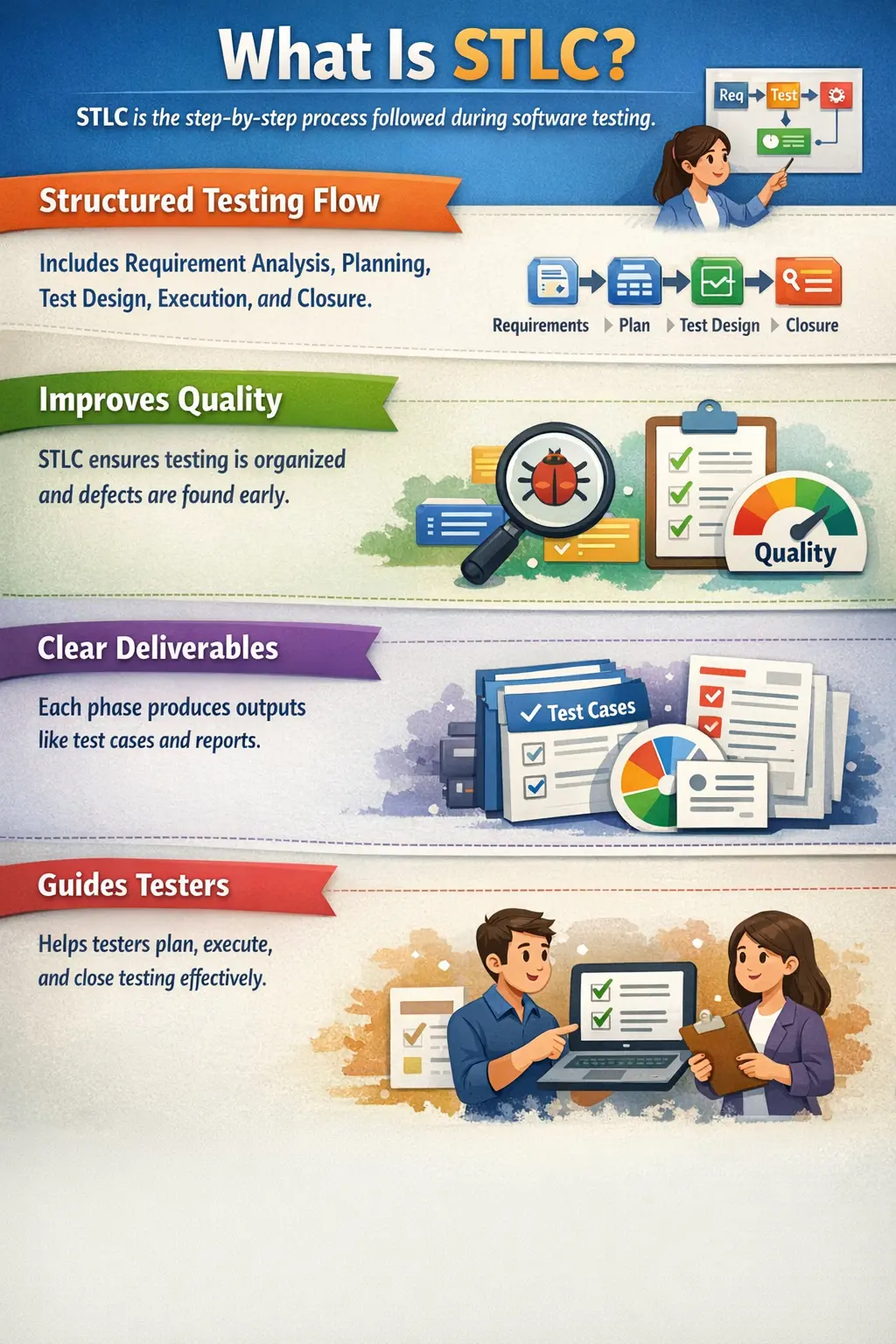
The Software Testing Life Cycle, commonly known as STLC, is a systematic sequence of activities carried out during the testing process to ensure software quality. It defines what testing activities are performed, in what order they occur, and what deliverables are produced at each stage. In simple terms, STLC answers the question: how is testing planned, executed, and closed?
Why STLC Matters in Real Projects
STLC matters because testing without structure quickly becomes inconsistent, difficult to measure, and dependent on individual memory. In a real project, testers handle requirements, test cases, data, environments, builds, defects, regression scope, reports, and release discussions. If these activities are done randomly, important checks may be missed, defects may be reported late, and stakeholders may not have a clear view of product quality. STLC gives testing a disciplined flow so that every important activity has a place and purpose.
The value of STLC is not only in executing test cases. It starts much earlier, when testers analyze requirements and identify what can be tested. It continues through planning, design, environment readiness, execution, defect management, reporting, and closure. This complete view helps teams avoid the common mistake of thinking that testing means only clicking through the application after development is complete. Testing is a lifecycle of preparation, validation, communication, and improvement.
STLC also improves accountability. When testing phases, entry criteria, exit criteria, and deliverables are clearly defined, teams can understand what has been completed and what remains pending. A test lead can see whether test cases are reviewed, whether the environment is ready, whether critical defects are open, and whether exit criteria have been met. Product owners and managers can make release decisions based on evidence rather than assumptions.
STLC as a Testing Roadmap
A useful way to understand STLC is to think of it as a roadmap for testing. It tells the testing team where to begin, what to prepare, how to proceed, and how to close the work properly. Without a roadmap, testing can become reactive. Testers may wait for a build, start executing whatever cases they remember, report defects without consistent evidence, and move to the next build without analyzing what was learned. STLC prevents this by creating a repeatable process.
The roadmap begins with understanding requirements. Before testers can validate a feature, they must know what the feature is supposed to do, who will use it, what business rules apply, and what conditions define success or failure. Then the roadmap moves into planning. The team decides what is in scope, what is out of scope, which types of testing are needed, who will test, what risks exist, and what timeline is realistic.
After planning, the team designs test cases and prepares data. This converts understanding into executable checks. Then the environment must be ready because a poor environment can make even good test cases unreliable. Execution follows, where the product is tested and defects are managed. Finally, closure turns testing results into lessons, metrics, summaries, and release input. Each phase builds on the previous one.
Requirement Analysis as the Foundation
Requirement analysis is the foundation of STLC because every later activity depends on how well the team understands the requirement. If a requirement is vague, incomplete, contradictory, or not testable, the test cases created from it will also be weak. A tester who begins execution without understanding requirements may only verify surface-level behavior and miss important business rules.
During requirement analysis, testers read business requirements, user stories, acceptance criteria, design notes, wireframes, process flows, and any available supporting documents. They ask questions from a testing perspective. What are the valid inputs? What are the invalid inputs? What should happen when data is missing? Are there role-based permissions? Are there boundary conditions? Are error messages defined? Is there any dependency on another system? These questions help uncover gaps early.
This phase is also where testers begin identifying high-level test scenarios. For a login feature, scenarios may include valid login, invalid password, locked account, inactive user, empty fields, password reset, and session timeout. For a payment feature, scenarios may include successful payment, failed payment, duplicate request, gateway timeout, refund, and transaction history. These scenarios later become detailed test cases.
Test Planning as Risk Control
Test planning is where the testing team decides how testing will be controlled. A good test plan does not exist only for documentation. It helps the team align scope, effort, resources, schedule, responsibilities, environments, risks, assumptions, and deliverables. Without planning, testers may discover too late that there is not enough time, the required data is unavailable, or a critical environment dependency is missing.
Test planning should be realistic. It should consider project timelines, complexity, team size, environment availability, automation support, regression needs, and release risk. If the application has payment, authentication, reporting, and integration features, the testing effort cannot be estimated only by counting screens. The team must consider business impact, technical complexity, and defect history.
Planning is also where testing priorities become clear. Not every feature carries the same risk. A spelling issue in a help page is not equal to an incorrect funds transfer. A low-use admin report is not equal to a checkout failure in an e-commerce application. STLC encourages testers to plan based on risk and business importance, so that critical areas receive appropriate attention.
Test Case Design and Coverage Thinking
Test case design converts requirements and scenarios into detailed validation steps. A good test case usually includes a clear objective, preconditions, test data, steps, expected results, and sometimes postconditions. The purpose is not to create long documents for their own sake. The purpose is to make testing repeatable, reviewable, and traceable.
Strong test case design includes positive, negative, boundary, and workflow scenarios. Positive tests verify that the application works when users provide valid inputs and follow expected paths. Negative tests verify how the application behaves when users provide invalid data or perform unexpected actions. Boundary tests check edge values, such as minimum and maximum length, date limits, quantity limits, and amount limits. Workflow tests validate realistic end-to-end usage.
Coverage is a key concern in this phase. Testers need to know whether each requirement has enough validation. A Requirement Traceability Matrix helps by linking requirements to test cases. If a requirement has no test case, coverage is missing. If a test case has no requirement or business purpose, it may need to be reviewed. Traceability helps the team prove what has been tested and what remains uncovered.
Test Data Preparation
Test data is often underestimated, but it can determine whether testing is effective or blocked. Test cases need input values, accounts, records, files, dates, roles, permissions, and sometimes specific database states. If data is not prepared properly, testers may waste time during execution or produce unreliable results. STLC treats test data preparation as a planned activity rather than an afterthought.
Good test data supports multiple types of testing. Positive test data verifies normal behavior, negative data verifies validation and error handling, boundary data verifies edge conditions, and realistic data simulates real user behavior. For a registration form, testers may need valid email addresses, invalid email formats, duplicate usernames, weak passwords, strong passwords, special characters, and long input strings.
In many projects, testers must also consider data privacy. Production data should not be used directly if it contains sensitive information unless it is masked, anonymized, or approved according to policy. Reliable test data helps testers reproduce defects, compare expected and actual results, and repeat regression tests consistently.
Test Environment Readiness
A test environment is the place where testing is executed. It may include application servers, databases, browsers, devices, operating systems, third-party integrations, configuration settings, user accounts, and test data. Even excellent test cases can fail to produce meaningful results if the environment is unstable or incorrectly configured.
Environment readiness should be checked before execution begins. Testers verify that the correct build is deployed, required services are running, URLs are accessible, accounts are available, permissions are correct, data is loaded, and integrations are either available or properly stubbed. If a payment gateway is down, if email delivery is disabled, or if the database contains outdated data, execution may be delayed or misleading.
STLC helps teams surface environment risks early. Instead of discovering problems on the first day of test execution, teams can plan environment setup and readiness checks as a separate phase. This improves schedule predictability and reduces wasted testing effort.
Test Execution and Defect Discovery
Test execution is the most visible phase of STLC because this is where the application is actively tested. Testers execute planned test cases, compare actual behavior with expected results, mark outcomes as pass, fail, blocked, or not run, and capture evidence. When actual behavior differs from expected behavior, testers log defects with clear details.
A good defect report includes a summary, steps to reproduce, expected result, actual result, severity, environment, test data, screenshots, logs, and any other useful evidence. Clear defect reporting helps developers understand and fix the issue faster. Poor defect reports create delays because developers must ask for clarification or may not be able to reproduce the issue.
Execution also includes retesting and regression testing. Retesting verifies that a specific defect fix works. Regression testing verifies that the fix or new change has not broken existing functionality. Both are important. Closing a defect without retesting is risky, and releasing a change without regression coverage can allow new defects to escape.
Test Closure and Learning
Test closure is often skipped when teams are under pressure, but it is an important STLC phase. Closure is where the team evaluates the testing effort, confirms whether exit criteria were met, summarizes results, reviews open risks, and captures lessons learned. It turns testing activity into project knowledge.
A test summary report usually includes scope tested, test execution status, pass and fail counts, defect summary, severity distribution, unresolved defects, risks, deviations from plan, and release recommendation. This report helps stakeholders understand the quality position of the product. It does not guarantee that the product is defect-free, but it provides evidence for an informed release decision.
Closure also supports continuous improvement. If many defects came from unclear requirements, the team can improve requirement reviews. If execution was delayed because the environment was not ready, the team can improve environment planning. If regression took too long, the team can identify candidates for automation. STLC becomes stronger when teams learn from each cycle.
Entry and Exit Criteria as Quality Gates
Entry and exit criteria act as quality gates in STLC. Entry criteria define what must be available before a phase begins. For example, test design should not begin if requirements are not available or are too unclear. Test execution should not begin if test cases are not reviewed, the build is not deployed, or the environment is not ready. Entry criteria prevent teams from starting work under conditions that will likely cause failure.
Exit criteria define what must be completed before a phase ends. Test design may exit when test cases are reviewed, traceability is updated, and test data needs are identified. Test execution may exit when planned cases are executed, critical defects are closed or accepted, regression is completed, and test summary is prepared. Exit criteria prevent teams from declaring completion too early.
These criteria are especially useful during release discussions. If exit criteria are not met, the team can clearly explain what remains open and what risk exists. This makes quality conversations factual rather than emotional.
STLC in Agile Projects
STLC is sometimes wrongly associated only with traditional models. In reality, STLC activities also exist in Agile, but they may happen in shorter cycles. Requirement analysis happens during backlog refinement and sprint planning. Test planning happens at sprint and release level. Test design happens as user stories are clarified. Environment readiness, execution, defect management, regression, and closure happen within or across sprints.
Agile does not remove the need for STLC discipline. It compresses and repeats it. A tester in Agile still needs to understand requirements, prepare scenarios, test data, execute tests, report defects, retest fixes, perform regression, and communicate status. The difference is that these activities happen continuously and collaboratively rather than as one large testing phase at the end.
When STLC discipline is missing in Agile, teams may rush stories, skip regression, ignore test data needs, or close sprints with incomplete validation. A lightweight but clear STLC mindset helps Agile teams preserve quality while delivering quickly.
Manual Tester Responsibilities Across STLC
A manual tester's role across STLC is broad. During requirement analysis, the tester identifies ambiguity, missing scenarios, testability issues, and risk. During planning, the tester contributes to scope, estimation, environment needs, data needs, and prioritization. During test design, the tester creates meaningful scenarios and test cases that cover business behavior, negative paths, and boundaries.
During environment setup, the tester verifies readiness and reports blockers. During execution, the tester validates the product carefully, records results, logs defects, retests fixes, and performs regression. During closure, the tester contributes to summary reports, defect analysis, lessons learned, and release recommendations.
This end-to-end responsibility is why manual testing requires analytical thinking, business understanding, communication, documentation, and risk awareness. A good tester is not only an executor of steps. A good tester helps the team understand the quality of the product.
Practical Example: STLC for a Login Feature
Consider a login feature. In requirement analysis, testers review whether the requirement explains valid login, invalid login, empty fields, inactive users, locked accounts, password rules, session handling, and security messages. They ask questions where behavior is unclear. During test planning, the team decides the scope, browsers, devices, test data, accounts, regression impact, and timeline.
During test case design, testers write scenarios for successful login, wrong password, invalid username, blank fields, case sensitivity, locked account, forgotten password, logout, and session timeout. Test data is prepared with active users, inactive users, locked users, invalid users, and multiple roles. Environment setup confirms that the login build is deployed, authentication service is connected, and test accounts are available.
During execution, testers run cases and log defects. If valid users cannot log in, the issue may be high severity. If the error message is unclear, it may be lower severity but still important for usability. After fixes are deployed, testers retest the failed cases and run regression on related flows such as dashboard access and logout. During closure, the team summarizes execution status, defect status, remaining risks, and release readiness.
Interview-Ready Understanding of STLC
In interviews, STLC should be explained as the structured testing lifecycle that begins with requirement analysis and ends with test closure. A strong answer should mention requirement analysis, test planning, test case design, test data preparation, environment setup, test execution, defect reporting, retesting, regression testing, and closure. It should also mention entry criteria, exit criteria, deliverables, and the relationship between STLC and SDLC.
A practical answer is stronger than a memorized list. For example, saying that requirement analysis helps testers identify unclear requirements, test planning helps manage scope and risk, test design ensures coverage, execution provides evidence of quality, and closure supports release decisions shows real understanding. STLC is not only a sequence of phases; it is a disciplined way to make testing reliable, measurable, and useful to the project.
STLC brings structure and discipline to testing so that it is organized, measurable, and aligned with project goals.
Purpose of STLC
The purpose of STLC is to provide a clear and structured approach to testing. It helps ensure that test coverage is adequate and that defects are identified in a systematic way. By following STLC, teams improve quality, increase predictability, and make better release decisions.
STLC also helps in tracking progress, managing risks, and maintaining transparency in testing activities. Instead of ad-hoc testing, STLC promotes planned and controlled validation.
Phases of STLC
Requirement Analysis
This is the first phase of STLC where requirements are studied from a testing perspective. Testers analyze requirements for clarity and testability. They identify both functional and non-functional scenarios and clarify ambiguities with stakeholders.
The output of this phase typically includes requirement review comments and high-level test scenarios. Early involvement here helps prevent misunderstandings and reduces downstream defects.
Test Planning
Test planning defines how testing will be carried out. The scope, strategy, effort estimation, risks, resources, and schedule are decided during this phase.
Deliverables often include a test plan, test strategy, and effort estimates. Strong planning ensures that testing is realistic, prioritized, and aligned with timelines.
Test Case Design and Test Data Preparation
In this phase, detailed test cases are written to validate requirements. Testers design positive, negative, and edge scenarios. Suitable test data is also prepared.
Common outputs include test cases, test data sets, and a Requirement Traceability Matrix that maps requirements to tests. This phase ensures coverage and traceability.
Test Environment Setup
Testing requires a stable and correct environment. In this phase, testers verify that the environment is ready, configurations are correct, and required access and data are available.
The main outcome is confirmation that the environment is ready for execution. Without this readiness, testing can be blocked or produce unreliable results.
Test Execution
This is the phase where actual testing happens. Test cases are executed, defects are logged, and fixes are verified through re-testing. Regression testing ensures that changes do not break existing functionality.
Deliverables include executed test records, defect reports, and execution summaries. This phase provides visible evidence of product quality.
Test Closure
Test closure formally concludes testing. Teams evaluate whether exit criteria are met, prepare a test summary report, analyze defect trends, and capture lessons learned.
Outputs include a test summary report and closure sign-off. This phase helps improve future testing cycles and provides final quality visibility.
Entry and Exit Criteria in STLC
Entry criteria define when a phase can begin, such as having approved requirements, reviewed test cases, and a ready environment. Exit criteria define when a phase can end, such as completing test execution, closing critical defects, and achieving required coverage.
These criteria prevent premature starts and incomplete finishes.
STLC and SDLC Relationship
STLC focuses on testing activities, while the Software Development Life Cycle focuses on building the product. STLC exists within SDLC and supports it by validating quality. SDLC spans the full product journey, whereas STLC concentrates on quality evaluation.
Understanding this relationship helps testers align their work with development progress.
Role of a Manual Tester in STLC
Manual testers are active throughout STLC. They participate in requirement discussions, design meaningful test cases, execute tests with a user mindset, report defects clearly, and support release decisions. Their involvement ensures that testing reflects real user behavior and business needs.
A Practical Scenario
If the test environment is not ready on time, test execution is delayed. This impacts schedules and postpones defect detection. STLC helps teams anticipate such risks and plan mitigation in advance.
Common Pitfalls
Some teams rush into execution without proper requirement analysis or planning. Others use weak test data or ignore closure activities. These shortcuts reduce test effectiveness and learning opportunities.
Interview Perspective
In interviews, STLC is typically described as the structured sequence of testing activities from requirement analysis to closure. A strong explanation highlights planning, design, execution, and reporting as organized steps that ensure quality.
Key Takeaway
STLC ensures that testing is planned, controlled, and measurable rather than random. It transforms testing into a disciplined process that supports quality, transparency, and informed release decisions. When followed properly, STLC significantly improves the effectiveness of software testing.