User Stories
User Stories are one of the most fundamental concepts in Agile development and testing. They represent requirements in a simple and user-focused format that helps teams deliver value incrementally. Instead of writing long and complex requirement documents, Agile teams capture requirements as short descriptions that focus on what the user needs and why it matters.
User Stories help teams maintain a shared understanding of product functionality and user expectations. They provide a flexible and collaborative way to define requirements while allowing room for discussion and refinement. Because Agile development emphasizes iterative delivery, User Stories are designed to be small enough to implement and test within a single sprint.
User Stories answer a fundamental question in Agile development: “What does the user want and why?”
For manual testers, User Stories are the primary source of testing requirements. Test scenarios, test cases, and acceptance tests are typically derived directly from User Stories and their acceptance criteria.
Definition of User Stories
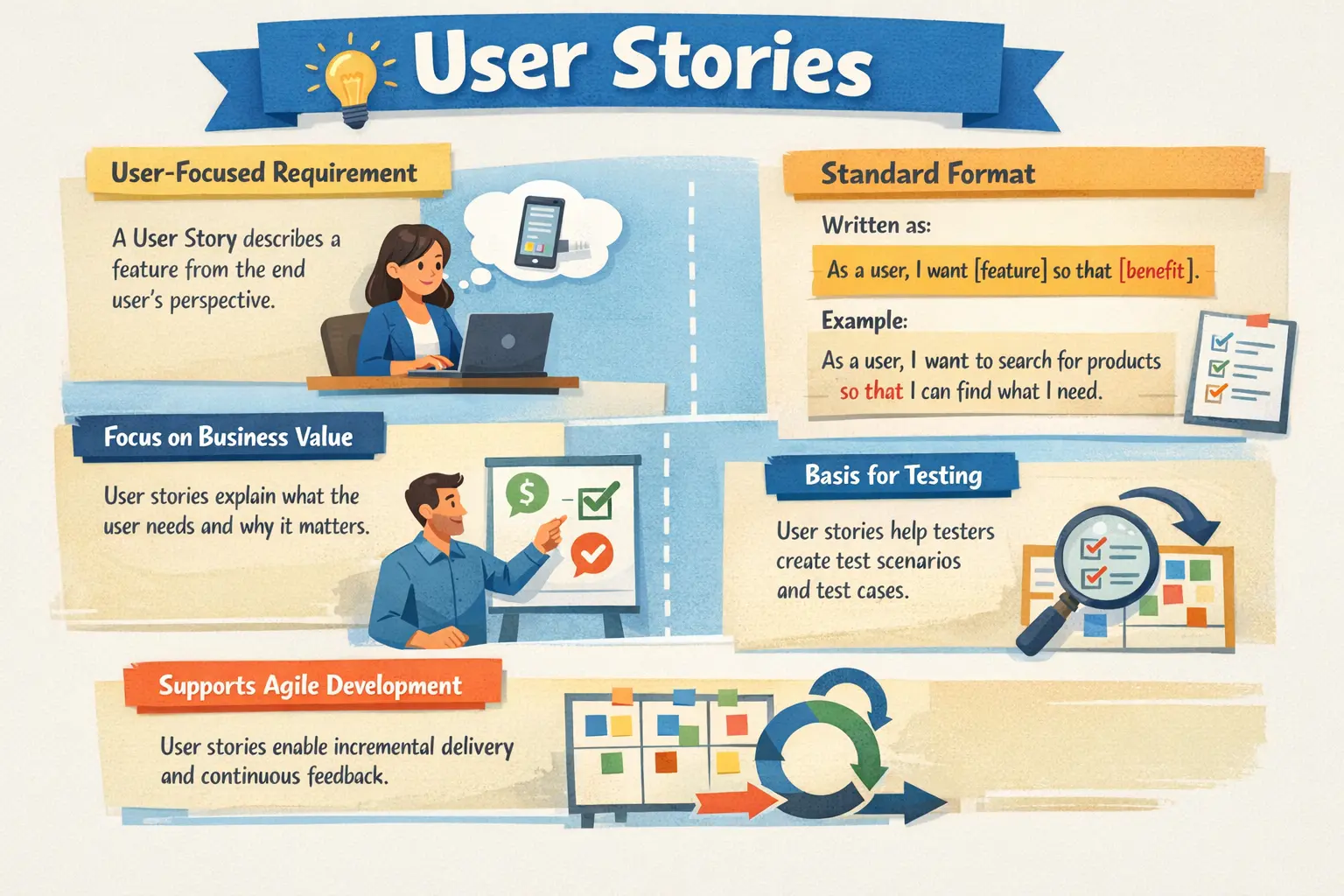
A User Story is a short and simple description of a feature written from the perspective of the end user. It focuses on user value rather than technical implementation.
User Stories describe the needs of users in a way that is easy for both technical and non-technical stakeholders to understand. They provide a shared language between business teams and development teams.
The most common format of a User Story is:
As a <user role>, I want <feature> so that <benefit>.
This structure clearly identifies who needs the feature, what functionality is required, and why it is important.
For example:
As a customer, I want to reset my password so that I can regain access to my account.
This simple structure communicates the requirement effectively without unnecessary technical details.
User Stories are intentionally concise. They are not meant to replace detailed discussions but to encourage collaboration and clarification.
Purpose of User Stories
User Stories serve multiple purposes in Agile projects. They provide a lightweight and flexible way to capture requirements while ensuring that development remains focused on delivering user value.
One major purpose of User Stories is expressing requirements in business language. Unlike traditional requirement documents, User Stories avoid technical complexity and focus on user needs.
Another important purpose is keeping the development process user-focused. By emphasizing user value, teams can prioritize features that deliver the greatest benefit.
User Stories also support incremental delivery. Features are divided into small stories that can be implemented and tested within a sprint.
User Stories encourage collaboration among product owners, developers, and testers. The simple format promotes discussion and shared understanding.
User Stories also serve as the foundation for testing. Acceptance criteria and test scenarios are derived directly from User Stories.
Because User Stories are flexible, they can be refined as the project evolves.
Standard Structure of a User Story
The standard structure of a User Story contains three essential elements.
The first element is the user role. This identifies who will use the feature. The role helps testers understand the context of the requirement.
The second element is the feature or goal. This describes what functionality the user needs.
The third element is the benefit or value. This explains why the feature is important to the user.
For example:
As an administrator, I want to disable inactive accounts so that system security is maintained.
This structure ensures that every User Story has a clear purpose.
Well-written User Stories avoid unnecessary technical details and focus on the user's perspective.
Key Components of a User Story
A complete User Story includes more than just the story statement. Several supporting elements make User Stories useful for development and testing.
The story description explains the user need in simple language.
Acceptance criteria define the conditions that must be satisfied for the story to be considered complete. Acceptance criteria provide clear validation rules for testers.
Story estimates define the expected effort required to implement the story.
Priority determines the order in which stories are implemented.
Supporting notes may include examples, clarifications, or constraints.
Together, these components provide a complete understanding of the requirement.
Characteristics of a Good User Story (INVEST)
Good User Stories follow the INVEST principle. INVEST represents key characteristics that make User Stories effective.
A good User Story should be independent. Stories should not depend heavily on other stories so that they can be developed and tested separately.
User Stories should be negotiable. The details of implementation can be discussed and refined during development.
User Stories must be valuable. Each story should deliver measurable value to users or the business.
User Stories should be estimable. The team should be able to estimate the effort required.
User Stories should be small. Stories should be small enough to complete within a sprint.
User Stories must be testable. Clear acceptance criteria should make validation possible.
Following the INVEST principles improves story quality and testability.
Manual Tester’s Role with User Stories
Manual testers interact with User Stories throughout the Agile lifecycle.
During backlog refinement, testers review User Stories to ensure clarity and completeness.
Testers identify missing scenarios and edge cases early in the process.
Testers help define acceptance criteria that can be validated during testing.
Testers derive test scenarios directly from User Stories.
Testers validate that implemented features meet the acceptance criteria.
Testers also support acceptance testing during Sprint Reviews.
Early tester involvement improves requirement quality and reduces defects.
User Stories vs Traditional Requirements
User Stories differ significantly from traditional requirement documents.
Traditional requirements are often long and detailed documents that describe system behavior in technical terms.
User Stories are short and written in simple language.
Traditional requirements focus on system functionality.
User Stories focus on user value.
Traditional requirements are often difficult to modify.
User Stories are designed to be flexible and adaptable.
Traditional approaches often delay testing until development is complete.
User Stories enable early and continuous testing.
Because of these differences, User Stories support Agile development more effectively than traditional requirements.
User Story Lifecycle from a Testing Perspective
User Stories go through several stages before being completed.
The lifecycle begins when a story is written. The Product Owner usually creates initial User Stories based on business needs.
Stories are refined during backlog refinement sessions. The team discusses the story and clarifies requirements.
Acceptance criteria are defined during refinement or sprint planning.
Testers identify test scenarios based on acceptance criteria.
During the sprint, developers implement the story.
Testers execute tests to validate the story.
If the story meets acceptance criteria, it is accepted.
If issues are found, defects are logged and fixed.
The story is considered complete only when it satisfies the Definition of Done.
Acceptance Criteria and Testing
Acceptance criteria are an essential part of User Stories.
Acceptance criteria define the conditions that must be satisfied for a User Story to be accepted.
They provide a clear basis for testing.
Acceptance criteria eliminate ambiguity and misunderstandings.
Well-written acceptance criteria help testers design accurate test scenarios.
Acceptance criteria also help developers implement features correctly.
Acceptance criteria often describe both positive and negative scenarios.
Clear acceptance criteria improve product quality.
Real-Time Example from a Tester’s Perspective
Consider a User Story:
As a user, I want to upload a profile picture so that my account looks personalized.
From this story, a tester identifies multiple scenarios.
The tester verifies successful image upload.
The tester verifies behavior for unsupported file types.
The tester verifies maximum file size restrictions.
The tester verifies behavior when upload fails.
The tester verifies image display after upload.
This example demonstrates how one User Story can generate multiple test scenarios.
User Stories vs Test Cases
User Stories and test cases serve different purposes.
User Stories describe what needs to be built and why.
Test cases describe how functionality will be tested.
User Stories are high-level requirements.
Test cases contain detailed execution steps.
User Stories are typically written by Product Owners.
Test cases are created by testers.
User Stories focus on business value.
Test cases focus on validation.
Both are essential for successful Agile testing.
Common Issues Testers Should Watch For
Testers must identify potential problems in User Stories early.
One common issue is vague or ambiguous stories. Unclear stories lead to incorrect implementation and testing difficulties.
Missing acceptance criteria create uncertainty.
Stories that are too large cannot be completed within a sprint.
Stories without clear business value reduce project effectiveness.
Non-testable stories create testing challenges.
Identifying these issues early prevents future problems.
Benefits of User Stories
User Stories provide many benefits to Agile teams.
- They improve communication between business and technical teams.
- They keep development focused on user needs.
- They support incremental delivery.
- They simplify requirement management.
- They encourage collaboration.
- They improve flexibility.
- They support continuous testing.
- User Stories help teams deliver value consistently.
Challenges with User Stories
Despite their advantages, User Stories present some challenges.
Incomplete stories may lead to confusion.
Frequent changes may require test updates.
Poor acceptance criteria may cause misunderstandings.
Stories may depend on each other.
Large stories may delay delivery.
Effective collaboration helps overcome these challenges.
Writing Testable User Stories
Testable User Stories are essential for quality testing.
Stories should be clear and specific.
Acceptance criteria should be measurable.
Business rules should be documented.
Edge cases should be considered.
Dependencies should be identified.
Testable stories reduce defects and improve delivery speed.
User Stories in Agile Testing
User Stories are central to Agile testing.
Testing begins during story refinement.
Test scenarios are created during sprint planning.
Testing occurs continuously during development.
Acceptance testing validates completed stories.
User Stories enable continuous quality verification.
Why User Stories Matter in Agile Teams
User Stories matter because they keep Agile teams focused on value instead of activity. A team may write code, design screens, create database changes, and run tests, but those activities only matter when they help a real user solve a real problem. A User Story connects the team’s work to that problem. It reminds everyone that the purpose of development is not simply to complete tasks, but to create useful outcomes.
In traditional requirement approaches, teams often receive large documents that describe what the system should do in formal language. These documents may contain useful detail, but they can also become difficult to read, difficult to change, and difficult for testers to translate into practical scenarios. User Stories reduce this complexity by starting with the user’s need. They do not attempt to document every detail upfront. Instead, they create a starting point for conversation.
This conversation is important because many requirements are not fully understood when they are first written. A Product Owner may know the business goal, but developers may identify technical constraints, testers may identify missing scenarios, and stakeholders may clarify exceptions. User Stories support this learning process. They are not static instructions; they are living requirement items that become clearer through refinement, planning, development, testing, and review.
User Stories also make prioritization easier. Because each story describes user value, the Product Owner can compare stories based on business impact. A story that helps customers complete payment may be more valuable than a minor visual enhancement. A story that supports regulatory compliance may be more urgent than a convenience feature. By keeping value visible, User Stories help teams build the right things first.
For testers, User Stories matter because they define the intent behind the feature. A tester who understands only the screen behavior may test whether fields, buttons, and messages work. A tester who understands the User Story can test whether the feature actually satisfies the user’s goal. That difference is significant. Good testing validates business usefulness, not only technical behavior.
The Three C’s of User Stories
User Stories are often explained using the Three C’s: Card, Conversation, and Confirmation. These three ideas help teams understand that a User Story is more than a sentence written in a backlog tool. The story statement is only the visible part of the requirement. The real value comes from the discussions and validation rules that surround it.
Card represents the short written description of the story. In older Agile practices, stories were written on physical index cards. In modern teams, they usually live in tools such as Jira, Azure DevOps, or similar backlog systems. The card contains the story title, short description, priority, estimate, and related notes. It should be brief enough to understand quickly, but clear enough to start meaningful discussion.
Conversation represents the collaboration that clarifies the story. The Product Owner, developers, testers, designers, and sometimes stakeholders discuss the story to understand business rules, user expectations, edge cases, dependencies, and constraints. This conversation is where many defects are prevented. If testers ask questions early, unclear behavior can be resolved before implementation begins.
Confirmation represents the acceptance criteria and validation conditions. It defines how the team will know whether the story is complete and correct. Confirmation is especially important for testers because it becomes the foundation for test scenarios. Without confirmation, a story may be implemented differently by developers, interpreted differently by testers, and evaluated differently by stakeholders.
The Three C’s prevent teams from treating User Stories as tiny requirement documents. A story should not rely only on written text, and it should not depend only on verbal discussion. It needs both collaboration and clear acceptance criteria. When all three parts are present, the story becomes easier to build, easier to test, and easier to accept.
How User Stories Are Refined
User Story refinement is the process of improving stories before they enter a sprint. During refinement, the team reviews upcoming stories, clarifies requirements, identifies dependencies, discusses acceptance criteria, and estimates effort. This activity is essential because poorly refined stories create confusion during development and testing.
A story may start as a simple idea such as “user can download invoice.” During refinement, the team needs to clarify what type of user can download the invoice, which invoices are available, what file format is required, whether failed downloads need an error message, whether invoice access depends on payment status, and whether the downloaded file must include tax details. These questions turn a vague idea into a testable story.
Testers add strong value during refinement because they naturally think in scenarios. They ask what happens when data is missing, when a user lacks permission, when a file is too large, when a service is unavailable, or when a business rule is violated. These questions do not slow the team down; they prevent rework. A question asked during refinement is much cheaper than a defect found after implementation.
Refinement also helps determine whether a story is too large. Large stories are difficult to estimate, difficult to develop, and difficult to test within a sprint. If a story contains multiple workflows, multiple user roles, or many business rules, it may need to be split. Smaller stories allow faster feedback and more reliable delivery.
A refined story should be understandable, valuable, testable, and small enough for sprint execution. It should not require the team to discover basic requirements during development. Some details may still emerge during the sprint, but the core behavior, acceptance criteria, and business value should be clear before the story is selected.
Writing Acceptance Criteria for User Stories
Acceptance criteria define the conditions that must be satisfied for a User Story to be accepted. They are one of the most important parts of a story because they convert the user need into clear validation rules. Without acceptance criteria, different people may have different ideas of what “done” means.
Good acceptance criteria are specific, measurable, and written in business language. They should describe expected behavior, not internal implementation. For example, “the user should receive a password reset email within two minutes” is clearer than “the reset API should return success.” The first criterion describes business behavior. The second may be useful technically, but it does not fully explain the user outcome.
Acceptance criteria should cover both successful and unsuccessful conditions. A story about login should not only include valid login behavior. It should also describe invalid credentials, locked accounts, missing password, and possibly account status rules. A story about payment should include successful payment, failed payment, duplicate submission prevention, and confirmation behavior where relevant.
Testers often help improve acceptance criteria by making hidden expectations visible. If a Product Owner says that a user should upload a profile picture, the tester may ask about allowed file types, maximum file size, image preview, replacement behavior, deletion behavior, and error messages. These details directly affect testing and user experience.
Acceptance criteria should not become overly technical or excessively long. If the criteria become too large, the story may be too broad. The goal is to define enough behavior to build and test the story confidently. Clear acceptance criteria reduce ambiguity, improve developer understanding, and help testers design accurate test coverage.
Splitting Large User Stories
Large User Stories are one of the most common problems in Agile delivery. A story may look simple at first but contain multiple workflows, roles, rules, integrations, and validations. When such a story enters a sprint, the team may struggle to finish it. Development takes longer than expected, testing starts late, defects are found near sprint end, and the story may spill over into the next sprint.
Splitting stories helps teams deliver value incrementally. A large “manage user account” story can be split into creating an account, editing profile details, changing password, deactivating account, and viewing account history. Each smaller story can be discussed, developed, tested, and accepted more easily. This improves predictability.
Stories can be split by workflow, business rule, user role, data variation, operation type, or priority. For example, an order management feature may be split into placing an order, canceling an order before shipment, viewing order status, and requesting a return. A reporting feature may be split by report type or export format. The best split preserves user value while reducing size.
Testers can help identify natural story splits because they see where testing complexity increases. If one story requires many test scenarios across multiple modules, it may be too large. If acceptance criteria include several independent outcomes, the story may need separation. If testing cannot be completed within the sprint, story size should be questioned during refinement.
Splitting stories is not about creating tiny technical tasks. A technical task such as “create database table” may be necessary, but it is not usually a user story because it does not deliver visible user value by itself. Good story splitting keeps the user outcome intact while reducing delivery risk.
Deriving Test Scenarios from User Stories
Deriving test scenarios from User Stories begins with understanding the user goal. The tester first asks what the user is trying to achieve and why the feature matters. Then the tester studies the acceptance criteria, business rules, user roles, data conditions, and dependencies. This creates a clear testing foundation.
The first scenarios usually cover the happy path. If the story says that a customer wants to reset a password, the happy path verifies that a registered customer can request a reset link, receive the link, set a new password, and log in successfully. This validates the core business flow.
The tester then identifies negative scenarios. What happens if the email is not registered? What happens if the reset link is expired? What happens if the new password does not meet rules? What happens if the user tries to reuse an old password? Negative scenarios confirm that the system rejects invalid actions correctly.
Edge cases and boundary conditions come next. If the reset link expires after a fixed time, the tester should validate behavior just before and just after expiry. If password length has a minimum and maximum value, those boundaries should be tested. User Stories often hide these boundary conditions unless testers actively look for them.
Finally, testers consider regression impact. A password reset story may affect login, account security, session handling, email notifications, and audit logs. Testing only the new screen may not be enough. Good testers use User Stories as the starting point, then expand coverage based on risk and system behavior.
Common User Story Anti-Patterns
One common anti-pattern is a vague story. A story such as “as a user, I want better dashboard functionality” does not provide enough direction. It does not explain what the user needs, what behavior is expected, or how success will be measured. Vague stories create confusion during development and testing.
Another anti-pattern is a technical story disguised as a User Story. For example, “as a developer, I want to create a database index so that queries run faster” may represent useful technical work, but it is not the same as a user-facing requirement. Technical work can exist in the backlog, but teams should be clear when something is a technical task rather than a User Story.
A third anti-pattern is a story without clear business value. If the “so that” part is weak or missing, the team may not understand why the story matters. Business value helps prioritize the story and guides testing. If no one can explain the benefit, the story may need refinement before development.
Overloaded stories are also common. A story that includes login, profile update, notification preferences, and password change is not one story; it is a collection of features. Such stories usually cause late defects and incomplete testing. Breaking them down improves delivery and validation.
Another anti-pattern is missing or poor acceptance criteria. A story statement alone is rarely enough for testing. Without acceptance criteria, testers may design scenarios based on assumptions, developers may implement based on different assumptions, and Product Owners may reject behavior after the work is already built.
User Stories and Definition of Done
A User Story is complete only when it satisfies the team’s Definition of Done. Acceptance criteria define story-specific expectations, while the Definition of Done defines the shared quality standard that applies to work in general. Both are needed.
For example, acceptance criteria may say that a user can download an invoice as a PDF. The Definition of Done may require code review, unit testing, functional testing, regression impact review, accessibility checks, documentation updates, and no open critical defects. A story that meets the acceptance criteria but skips required testing should not be considered done.
Testers use the Definition of Done to protect quality. If testing is incomplete, if critical defects remain open, or if required validation has not happened, the story should not be marked complete. This discipline prevents unfinished work from being presented as complete during Sprint Review.
The Definition of Done also improves team alignment. Everyone understands the quality bar before work begins. Developers know what must be completed. Testers know what must be validated. Product Owners know what acceptance means. This reduces conflict at the end of the sprint.
Real Project Example
Consider a banking application with the User Story: “As a customer, I want to transfer money to another account so that I can send funds quickly.” At first glance, the story looks simple. But during refinement, the team identifies many details. The customer must have sufficient balance, the destination account must be valid, transfer limits must be enforced, and confirmation must be shown after success.
The tester asks about negative scenarios. What happens if the balance is insufficient? What happens if the destination account is closed? What happens if the transfer amount exceeds the daily limit? What happens if the customer submits the same transfer twice? These questions help define acceptance criteria and prevent defects.
The story may be split if it is too large. One story may cover internal account transfer. Another may cover external bank transfer. Another may cover scheduled transfer. Another may cover transfer cancellation. Each story still delivers user value, but the smaller scope makes development and testing more manageable.
During testing, the tester validates successful transfer, insufficient balance, invalid account, maximum amount boundary, confirmation message, transaction history update, and regression impact on account balance. This shows how one User Story becomes a set of meaningful test scenarios grounded in user value and business rules.
Interview Perspective
User Stories are a common Agile interview topic.
A short answer defines a User Story as a simple description of a feature from the user's perspective.
A detailed answer explains the structure, purpose, and role of User Stories in Agile.
Interviewers often ask testers how they derive test cases from User Stories.
Understanding User Stories demonstrates Agile experience.
Key Takeaway
User Stories provide a simple and effective way to capture requirements in Agile projects.
They keep development focused on user value while supporting collaboration and flexibility.
For manual testers, User Stories are the foundation of testing activities, guiding test scenario creation and acceptance validation.
Well-written User Stories make development smoother, testing more effective, and products more valuable to users.