Test Scheduling
Software testing involves multiple activities that must be executed in a specific order and within defined timelines. These activities include requirement analysis, test planning, test design, execution, defect management, and closure. If these activities are not organized properly across the project timeline, testing may start late, resources may be underutilized, and release schedules may be delayed.
To prevent such issues, testing teams use Test Scheduling, a structured process that defines when testing activities will occur, how they will be sequenced, and which resources will perform them.
Test scheduling answers an important operational question in software testing:
“When will each testing activity be performed?”
By creating a clear testing timeline, teams ensure that testing progresses smoothly alongside development activities. Test scheduling helps coordinate multiple testing tasks, manage dependencies, and ensure that testing is completed before the planned release date.
In modern software development environments, especially those involving large teams and complex systems, effective test scheduling is essential for delivering high-quality software on time.
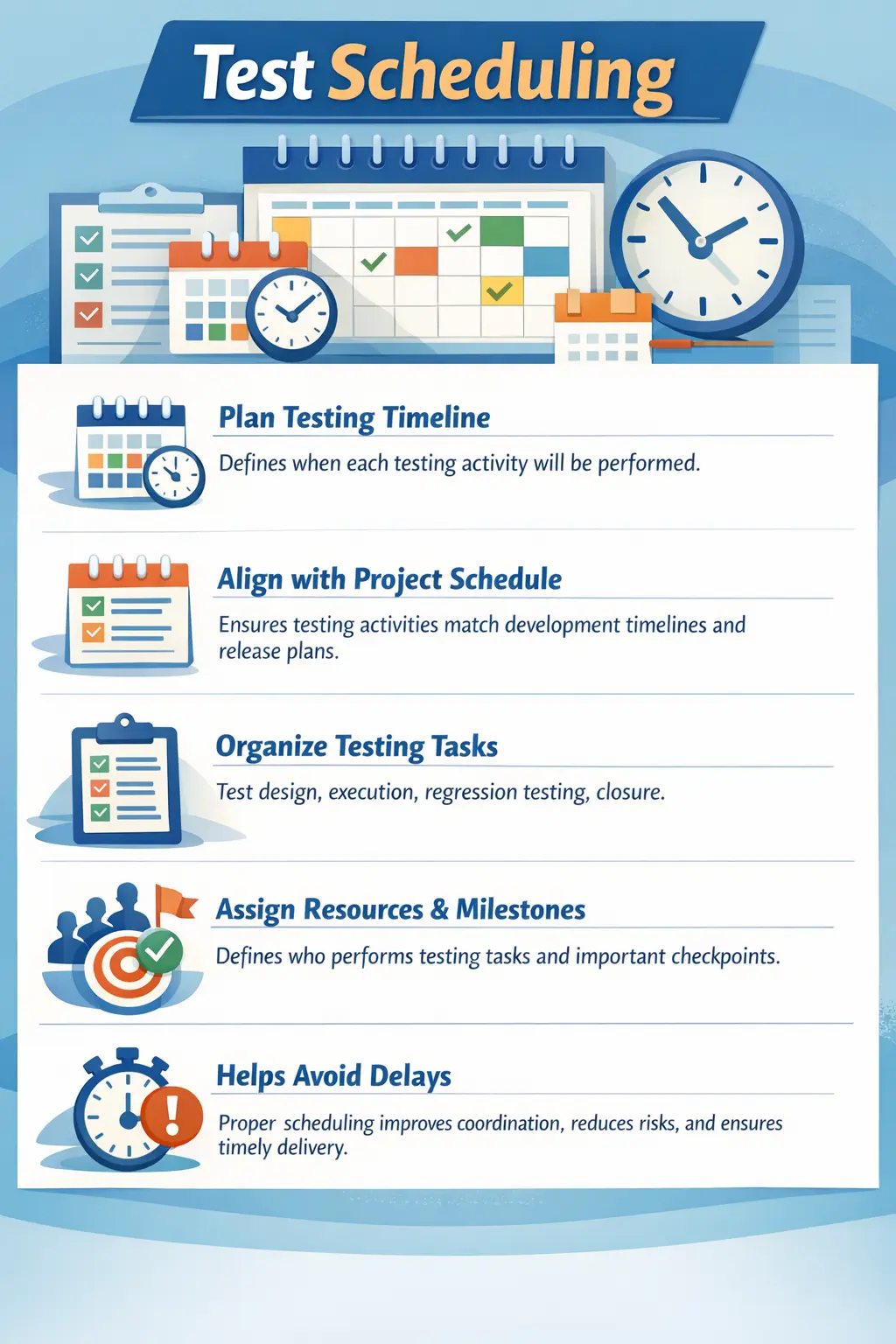
Understanding Test Scheduling
Test scheduling is the process of organizing testing tasks across a defined timeline. It determines when each testing activity should begin and end, the order in which tasks should be performed, and the resources responsible for completing them.
While test estimation predicts how much effort is required, test scheduling translates that effort into a timeline-based plan.
For example, if test case design is estimated to take four days and test execution six days, scheduling determines when these activities will occur within the project timeline.
Test scheduling also considers dependencies between activities. For instance, test execution cannot begin until a stable build is available and the test environment is ready.
By organizing testing activities carefully, teams avoid overlaps, resource conflicts, and unnecessary delays.
A well-defined test schedule ensures that all testing tasks are completed systematically and within the project's planned timeframe.
Purpose of Test Scheduling
The primary purpose of test scheduling is to align testing activities with the overall project timeline. Development and testing often occur simultaneously in modern projects, so coordination between these activities is essential.
Another important purpose is ensuring proper utilization of testing resources. Test scheduling helps assign testers to tasks in a balanced manner so that workloads are distributed effectively.
Test scheduling also helps identify dependencies and constraints early. For example, if test execution depends on an external system integration, this dependency can be incorporated into the schedule.
Reducing delays in testing cycles is another major goal. When activities are scheduled clearly, teams can track progress and detect delays quickly.
Finally, test scheduling improves release predictability. Stakeholders gain visibility into testing progress and can estimate when the product will be ready for release.
Through careful scheduling, testing teams ensure that quality validation occurs at the right time in the project lifecycle.
Inputs to Test Scheduling
Test scheduling does not occur in isolation. Several inputs influence how testing activities are planned and organized.
One key input is the project timeline. The overall project schedule determines when testing must start and when it must be completed.
Another important input is the development delivery schedule. Testing typically depends on the availability of builds produced by the development team.
Test estimation results also influence scheduling decisions. The estimated effort for testing tasks determines the duration assigned to each activity in the schedule.
Resource availability is another important factor. The number of testers available and their skill sets affect how testing tasks are distributed.
Test scheduling must also consider environment readiness. If testing environments or tools are not available, testing activities may be delayed.
Finally, risk assessment plays a role in scheduling. High-risk features may be scheduled for earlier testing so that defects can be detected sooner.
By considering these inputs, testing teams can develop realistic and effective schedules.
Typical Testing Activities Scheduled
Test scheduling typically includes multiple testing activities that occur throughout the testing lifecycle.
The first activity often scheduled is requirement analysis. During this stage, testers review requirements and identify potential test scenarios.
Next, test planning is scheduled. In this phase, the testing strategy, tools, and environments are defined.
Following planning, teams schedule test case design, where detailed test cases are created to validate system functionality.
After test cases are designed, test case review is scheduled to ensure accuracy, completeness, and alignment with requirements.
Another important activity is test data preparation, which involves creating or configuring the data required for executing test cases.
The core testing activity, test execution, is then scheduled. During execution, testers run test cases, record results, and log defects.
Following defect fixes, re-testing is scheduled to verify that issues have been resolved successfully.
Another important phase is regression testing, where previously tested functionality is validated again to ensure new changes did not introduce defects.
Finally, test closure activities are scheduled to summarize testing outcomes and formally conclude the testing phase.
Scheduling these activities ensures that testing progresses in a structured and predictable manner.
Components of a Test Schedule
A comprehensive test schedule typically contains several key components that provide structure and clarity.
Timeline
The timeline defines the start and end dates for each testing activity. It provides a chronological view of when tasks will be performed.
For example, requirement analysis may be scheduled for the first two days of the testing cycle, followed by test case design and execution.
The timeline helps teams track progress and ensure that activities remain aligned with project deadlines.
Milestones
Milestones represent important checkpoints within the testing schedule.
Examples of milestones include completion of test case design, availability of the first testable build, start of test execution, and beginning of user acceptance testing.
Milestones provide visibility into major achievements and allow stakeholders to monitor project progress.
They also help teams identify delays early if milestones are not reached as planned.
Resource Allocation
Resource allocation defines which testers are assigned to specific modules, features, or tasks.
In large projects, multiple testers may work on different components of the system simultaneously.
Allocating resources effectively ensures that testing tasks are distributed evenly and that no tester is overloaded.
Resource allocation also considers tester expertise, ensuring that complex modules are assigned to experienced testers.
Dependencies
Dependencies are conditions that must be satisfied before certain testing activities can begin.
One common dependency is build availability. Test execution cannot start until a stable build is delivered by the development team.
Another dependency may involve environment setup. Testing environments must be configured before testers can begin execution.
External integrations, such as third-party services or APIs, may also create dependencies that affect the testing schedule.
Identifying dependencies early helps teams avoid unexpected delays.
Example Test Schedule
A typical conceptual test schedule may allocate two days for requirement analysis, followed by four days for test case design.
Test case review may take one day, ensuring that all test cases are validated before execution begins.
Test execution may be scheduled for six days, allowing testers to run all planned test cases and log defects.
Regression testing may require two additional days to verify that new changes did not introduce defects.
Finally, test closure activities may be completed in one day to finalize reports and archive testing artifacts.
Such schedules help teams manage testing tasks systematically.
Manual Tester’s Role in Test Scheduling
Manual testers play an important role in the test scheduling process.
One of their responsibilities is providing realistic effort estimates for testing tasks. These estimates help determine the duration of activities within the schedule.
Testers also identify dependencies that may affect testing timelines. For example, if certain test cases require integration with external systems, testers must highlight this requirement.
Another important responsibility is identifying risks that could affect the schedule. For example, unstable environments or incomplete requirements may delay testing progress.
Testers also track actual progress against the planned schedule. If tasks take longer than expected, testers communicate these delays to project stakeholders.
By actively participating in scheduling discussions, testers help ensure that testing timelines remain realistic and achievable.
Test Scheduling in Agile vs Traditional Models
Test scheduling differs between agile and traditional development methodologies.
In agile environments, testing is organized around sprints, which are short development cycles typically lasting two to four weeks.
Testing activities are scheduled within each sprint, and schedules are updated frequently as priorities change.
Agile scheduling is flexible because teams adapt quickly to requirement changes.
In traditional development models, such as the waterfall model, testing is often scheduled as a separate phase after development.
Testing timelines in these models are usually more rigid and defined earlier in the project.
While agile scheduling emphasizes flexibility, traditional scheduling focuses on structured phases.
Understanding these differences helps testers adapt scheduling practices to different project environments.
Common Scheduling Risks
Several risks can affect the success of a test schedule.
One common risk is late build delivery. If development teams deliver builds later than planned, testing activities may be delayed.
Another risk is unstable test environments. Frequent environment failures can disrupt test execution and cause schedule delays.
Frequent requirement changes also pose scheduling risks because they may require additional test case updates or new testing activities.
Underestimating regression testing effort is another common issue. As systems grow, regression testing may require more time than originally planned.
Identifying these risks early helps teams adjust schedules and mitigate delays.
Best Practices for Effective Test Scheduling
Effective test scheduling requires following certain best practices.
Including buffer time for defect fixing and re-testing helps accommodate unexpected delays.
Prioritizing high-risk features early in the schedule ensures that critical issues are detected sooner.
Tracking planned versus actual progress helps teams identify deviations from the schedule.
Clear communication of schedule changes ensures that all stakeholders remain informed about testing progress.
Collaborating with development and project management teams also improves schedule accuracy.
Following these practices helps ensure that test schedules remain realistic and effective.
Test Scheduling vs Test Estimation
Test scheduling and test estimation are closely related but serve different purposes.
Test estimation focuses on predicting the amount of effort required to complete testing tasks.
Test scheduling translates this effort into a timeline that specifies when tasks will occur.
Estimation answers the question of how much work is required, while scheduling answers the question of when that work will be performed.
Together, estimation and scheduling form the foundation of effective test planning.
Why Test Scheduling Is Difficult
Test scheduling is difficult because testing depends on many moving parts that are not fully controlled by the testing team. Testers may be ready to execute, but the build may not be available. The build may be available, but the environment may be unstable. The environment may be ready, but test data may be missing. A schedule that ignores these dependencies may look good on paper but fail during execution.
Another challenge is that testing is affected by defect discovery. A project schedule may allocate five days for execution, but if critical defects are found on the first day, the plan changes. Testers must spend time logging defects, discussing issues, waiting for fixes, re-testing fixes, and performing regression. This means test scheduling must include space for feedback cycles, not just first-time execution.
Requirement changes also make scheduling difficult. If acceptance criteria change during the test cycle, test cases may need updates and already executed cases may require re-validation. In Agile projects this is common, but even traditional projects face change requests and clarifications. A realistic schedule should allow controlled adjustment.
Test scheduling therefore requires more than placing tasks on dates. It requires understanding dependencies, risk, resource availability, defect cycles, and release constraints. A good schedule is practical, flexible, and visible to the people who depend on it.
Building a Test Schedule Step by Step
Building a test schedule begins with understanding the testing scope. The team must know which modules, user stories, features, integrations, and non-functional areas are included. Without clear scope, scheduling becomes guesswork. Scope defines what needs to be planned.
The next step is identifying testing activities. These include requirement review, test planning, test case design, test case review, test data preparation, environment readiness checks, smoke testing, functional testing, defect logging, re-testing, regression testing, reporting, and closure. Each activity should have an estimated effort and expected order.
After activities are identified, dependencies must be mapped. Test case design depends on requirement clarity. Execution depends on build availability, environment readiness, and test data. Re-testing depends on defect fixes. Regression depends on change impact and build stability. Mapping dependencies prevents unrealistic sequencing.
The schedule is then arranged across the available project timeline. High-risk activities should be placed early where possible. Buffers should be added for defects, rework, environment issues, and regression. Finally, the schedule should be reviewed with stakeholders so that development, testing, business, and project management teams share the same expectations.
Scheduling Requirement Analysis
Requirement analysis should be scheduled early because it forms the foundation for test design and execution. During this activity, testers review requirements, user stories, acceptance criteria, wireframes, business rules, and dependencies. They identify gaps, ambiguities, missing scenarios, and testability issues.
If requirement analysis is not scheduled properly, test design may begin with unclear information. This leads to rework later. A tester may write cases based on one interpretation, only to discover during execution that the expected behavior was different. Early analysis reduces this risk.
Requirement analysis time should increase when requirements are complex, business rules are unclear, integrations are involved, or the domain is unfamiliar. A simple UI change may require brief review, while a financial calculation rule or compliance workflow may require deeper discussion with business analysts and product owners.
Scheduling requirement analysis also helps shift testing left. Testers can identify defects in requirements before development is complete. This improves quality and reduces downstream delays.
Scheduling Test Design and Review
Test design includes creating test scenarios, test cases, checklists, test data needs, and traceability mappings. This work should be scheduled before execution begins. If test design is rushed or overlaps too heavily with execution, test coverage may become incomplete or inconsistent.
Test case review should also have a defined place in the schedule. Reviews help identify unclear steps, missing expected results, duplicate cases, missing negative scenarios, and gaps in requirement coverage. Skipping review to save time often creates more delays during execution.
The schedule should allow time for review comments to be resolved. It is not enough to schedule a one-hour review meeting if test cases require updates afterward. Review, correction, and approval are all part of test design completion.
In Agile teams, test design and review may happen within the sprint. Even then, they should be planned. A story cannot be tested effectively if test cases or acceptance scenarios are created only after the build is delivered. Test design should progress alongside development.
Scheduling Test Data Preparation
Test data preparation is often underestimated. Many test execution delays happen because the required data is not ready. Scheduling data preparation separately makes this work visible and reduces last-minute blockers.
Test data may include user accounts, roles, products, transactions, orders, balances, policies, claims, configuration records, uploaded files, or historical data. Some data must be created manually, some must be imported, and some must be generated through application workflows. Each approach takes time.
Data preparation should happen before execution, not during execution whenever possible. If a tester needs an account with a specific balance or an order in a specific state, that data should be identified and prepared early. This keeps execution focused on validation rather than setup.
Data dependencies should be included in the schedule. If database access, environment support, or business approval is needed to create data, those dependencies must be tracked. Test data readiness is a schedule milestone, not a side task.
Scheduling Environment Readiness
Test environment readiness has a major impact on the testing schedule. Even a well-designed test plan cannot proceed if the environment is unavailable, misconfigured, or unstable. The schedule should include environment setup, build deployment, configuration checks, access validation, and smoke testing.
Environment readiness should be confirmed before detailed execution begins. This includes verifying application access, user roles, database connectivity, APIs, third-party services, test tools, and required background jobs. A smoke test can confirm that the build is testable.
Shared environments create additional scheduling challenges. If multiple teams use the same environment, testing windows may need coordination. Data refreshes, deployments, maintenance, and configuration changes can interrupt execution. These constraints should be included in the schedule.
Environment downtime should be tracked as a risk. If the environment has a history of instability, the schedule should include buffer or alternate plans. Ignoring environment risk leads to unrealistic timelines.
Scheduling Test Execution
Test execution is usually the most visible part of the schedule. It should be planned based on test case volume, complexity, tester availability, build stability, and risk priority. High-risk scenarios should be executed early so that major defects are discovered as soon as possible.
Execution should not be scheduled as one large block without structure. It is better to divide execution by module, feature, user story, or test type. For example, the schedule may allocate one day for smoke testing, three days for functional testing of core modules, two days for integration testing, and two days for regression.
Daily execution targets help track progress. If the team plans to execute forty cases per day but completes only twenty, the delay becomes visible early. The schedule can then be adjusted through resource changes, scope prioritization, or blocker resolution.
Execution scheduling should include time for evidence capture, defect logging, test status updates, and communication. These are real activities. If the schedule assumes testers execute cases continuously without reporting or investigation time, it will be inaccurate.
Scheduling Defect Fix, Re-Testing, and Regression
Defect cycles must be part of the test schedule. A schedule that includes only first-time execution is incomplete. Once defects are found, developers need time to fix them, testers need time to re-test them, and the team may need to perform regression testing around affected areas.
Re-testing should be scheduled after fix delivery. If developers deliver fixes late, re-testing may compress near the release date. This creates risk because testers may not have enough time to verify fixes properly. Schedules should include expected fix windows and re-test windows.
Regression testing should be scheduled after significant fixes or changes. The regression scope may depend on impact analysis. High-risk fixes may require broader regression, while low-risk fixes may require limited checks. The schedule should leave room for this variability.
Defect triage meetings may also be scheduled during active testing. These meetings help prioritize defects, assign ownership, and make decisions about fixes, deferrals, or release risk. Including triage in the schedule improves coordination.
Scheduling Buffers and Contingency
Buffers are necessary because testing rarely goes exactly as planned. Builds may be delayed, requirements may change, defects may be more severe than expected, environments may fail, or test data may be unavailable. A schedule without buffer is fragile.
Buffer should be based on project risk. A stable maintenance release may need a smaller buffer. A release with new integrations, payment changes, security updates, or unclear requirements needs a larger buffer. The goal is not to add excessive time but to protect the schedule from realistic uncertainty.
Contingency planning defines what the team will do if things go wrong. If a build is delayed, can testers continue test design or data preparation? If an external service is unavailable, can mocks be used? If time is reduced, which tests will be prioritized? These decisions should be considered before the crisis happens.
Buffer and contingency make schedules more professional. They show that the team understands project risk and has planned for it. A schedule that assumes perfect conditions is usually not realistic.
Resource Allocation in Test Scheduling
Resource allocation determines who will perform each testing activity. The schedule should consider tester availability, skill level, domain knowledge, module ownership, and workload balance. Assigning the wrong resource to a complex task can delay testing even if enough people are available.
Experienced testers may be assigned to high-risk modules, complex business rules, or integration-heavy areas. Junior testers may handle lower-risk validation, data preparation, documentation updates, or execution under guidance. Good scheduling uses team strengths effectively.
Resource allocation should also consider absences, meetings, support responsibilities, and parallel project work. A tester assigned to multiple projects cannot be scheduled as if they are available full-time. Calendar reality matters.
Workload balance is important. If one tester is overloaded with a critical module while others have lighter work, the schedule may fail. Test leads should monitor progress and redistribute work when needed.
Tracking Planned vs Actual Progress
A schedule is useful only if progress is tracked against it. Planned versus actual tracking shows whether testing is moving as expected. If test design was planned for three days but takes five, the schedule must be adjusted. If execution is slower than planned, the reason must be understood.
Progress tracking should include execution count, pass/fail status, blocked cases, defect volume, re-testing status, and remaining scope. These metrics help test leads identify delays early. Waiting until the end of the schedule to discover slippage creates release pressure.
Variance analysis is important. A delay may be caused by poor estimation, environment downtime, high defect count, unclear requirements, or resource unavailability. The response depends on the cause. Tracking only the delay without understanding the cause is not enough.
Planned versus actual data also improves future scheduling. If teams record actual effort and delays, future schedules become more accurate. Historical data is one of the best tools for realistic planning.
Test Scheduling in Agile Sprints
In Agile sprints, test scheduling is shorter and more flexible, but it still matters. Testing activities must fit within the sprint timeline. Testers need time for story analysis, test design, data preparation, execution, defect validation, regression, and sprint closure. If all testing is pushed to the last day, quality suffers.
A good sprint schedule starts during backlog refinement. Testers review stories early and identify testing needs. During sprint planning, stories with high testing complexity should be recognized. The team should avoid overcommitting if testing effort is high.
During the sprint, testers should test stories as soon as they become available rather than waiting for all development to finish. This creates faster feedback. Defects can be fixed while the sprint is still active, reducing carryover.
Sprint schedules should include regression time. Even small stories can affect existing functionality. Teams that ignore regression during sprint scheduling often accumulate hidden risk over multiple sprints.
Test Scheduling in Waterfall Projects
In waterfall projects, testing is often scheduled as a distinct phase after development. The schedule may be more formal and milestone-driven. Requirement analysis, test planning, test design, execution, defect cycles, regression, and closure may each have defined start and end dates.
Waterfall schedules can provide clarity, but they can also create risk if development delays reduce testing time. When testing is placed late in the lifecycle, any upstream delay may compress the testing window. Test managers must monitor dependency risks carefully.
Test design can often begin before development is complete if requirements are stable. This helps reduce schedule pressure. Waiting until code is delivered to begin all testing activities wastes valuable time.
Waterfall test schedules should include multiple defect fix and regression cycles. Assuming a single execution cycle will be enough is risky, especially for large systems. Formal schedules should account for defect discovery and stabilization.
Practical Example: E-Commerce Test Schedule
Consider an e-commerce release that includes search, cart, checkout, payment, order confirmation, and order history. A realistic schedule may begin with two days of requirement review and scenario identification. Test design may take four days because checkout and payment require multiple combinations.
Test data preparation may be scheduled in parallel with test design. Testers need products, user accounts, coupons, shipping addresses, payment sandbox data, and order states. Environment readiness and payment gateway configuration should be checked before execution begins.
Execution may be scheduled by risk. Checkout and payment should be tested early because they affect revenue. Search and cart may follow. Order confirmation and history should be validated after successful order creation. Regression should be scheduled after payment and checkout fixes.
Closure activities may include test summary reporting, defect status review, known issue documentation, and sign-off. This example shows that scheduling is not just assigning dates; it is sequencing dependent activities logically.
Practical Example: Banking Test Schedule
In a banking application, a release may include fund transfer, beneficiary management, statement download, and bill payment. Because financial workflows are high risk, the schedule should prioritize test design and execution for transaction-related features.
Requirement analysis should include business rules such as transfer limits, beneficiary activation time, OTP validation, account balance updates, and transaction history. Test data preparation should include accounts with different balances, user roles, active beneficiaries, inactive beneficiaries, and transaction limits.
Execution should begin with smoke testing and then high-risk fund transfer scenarios. Negative scenarios such as insufficient balance, invalid OTP, inactive beneficiary, and exceeded transfer limit should be scheduled early. Defect fix and regression windows should be clearly included.
The schedule should also include security and access validation because banking applications carry high compliance risk. This example shows how domain risk influences test scheduling.
Test Schedule Review
A test schedule should be reviewed before it is finalized. Reviewers may include the test lead, testers, project manager, development lead, product owner, and environment support team. Each role can identify missing dependencies or unrealistic assumptions.
During review, the team should check whether activities are sequenced correctly, whether timelines are realistic, whether resources are available, whether dependencies are visible, and whether buffers are included. High-risk areas should be scheduled early enough to allow defect resolution.
The review should also confirm alignment with development delivery. If developers plan to deliver a module on Friday, testing for that module should not be scheduled for Monday unless the build and environment will realistically be ready. Schedules must reflect actual delivery expectations.
Reviewing the schedule improves commitment. When stakeholders agree on the plan, they are more likely to support it. It also reduces conflict later because assumptions and dependencies were discussed upfront.
Updating the Test Schedule
A test schedule should not be treated as frozen when project conditions change. If requirements change, builds are delayed, defects increase, or environments become unstable, the schedule should be updated. An outdated schedule gives false visibility.
Schedule updates should be communicated clearly. Stakeholders should know what changed, why it changed, and how the change affects testing completion or release readiness. Silent schedule changes create confusion.
When updating the schedule, test leads may re-prioritize test cases, add resources, extend testing time, reduce low-risk scope, or adjust regression coverage. The decision should be based on risk and business priority.
Frequent updates may indicate deeper planning issues. If schedules constantly change because requirements are unstable or builds are late, the team should address the root cause. Schedule updates are useful, but they should not hide recurring project problems.
Test Scheduling Checklist
A practical checklist helps ensure that the schedule is complete. First, confirm testing scope and release timeline. Second, identify all testing activities, including analysis, design, review, data preparation, execution, defect handling, regression, reporting, and closure. Third, estimate effort for each activity.
Fourth, identify dependencies such as build availability, environment readiness, data setup, external services, and access permissions. Fifth, assign resources based on availability and skill. Sixth, schedule high-risk areas early. Seventh, include buffers for defects and delays.
Eighth, define milestones such as test design completion, build availability, execution start, regression start, and test closure. Ninth, review the schedule with stakeholders. Tenth, track planned versus actual progress during execution.
This checklist turns scheduling into a controlled activity rather than an informal date plan. It helps testers and test leads create schedules that are realistic and actionable.
Best Practices for Professional Test Scheduling
The first best practice is to schedule testing activities early, not after development is almost complete. Early scheduling gives time for analysis, design, data preparation, and dependency resolution. Late scheduling leads to compressed execution and missed defects.
The second best practice is to align with development milestones. Testing cannot proceed without builds, so development delivery dates must be realistic and visible. The schedule should reflect build readiness, not wishful thinking.
The third best practice is to prioritize risk. High-risk modules should be tested early, and regression for critical flows should be protected. If time becomes limited, risk-based scheduling helps teams make better trade-offs.
The fourth best practice is to include defect cycles. Re-testing and regression are not optional extras. They are part of real testing work and must be scheduled.
The fifth best practice is to communicate schedule changes immediately. A schedule is useful only when everyone understands the current plan. Transparent communication keeps stakeholders aligned and prevents surprises near release.
Interview-Ready Explanation
In software testing interviews, candidates may be asked to explain test scheduling.
A short explanation states that test scheduling involves planning testing activities across a timeline and determining when each task will occur.
A more detailed explanation describes how scheduling organizes tasks, resources, dependencies, and milestones to ensure testing is completed efficiently.
Providing examples of scheduled activities such as test design, execution, regression testing, and closure demonstrates practical understanding.
Understanding test scheduling shows that a tester can contribute to project planning and coordination.
Key Takeaway
Test scheduling is a structured process that organizes testing activities across a timeline, defining when each task will occur and which resources will perform it.
By aligning testing activities with project timelines, identifying dependencies, and allocating resources effectively, test scheduling helps teams complete testing efficiently.
Effective scheduling reduces delays, improves resource utilization, and increases the predictability of software releases.
Ultimately, test scheduling ensures that testing activities occur at the right time, enabling teams to deliver high-quality software within planned deadlines.