Test Closure Activities
Software testing is not complete simply because test cases have been executed or defects have been logged. A professional testing process requires a structured conclusion that verifies whether testing objectives were achieved, evaluates the overall quality of the product, and documents insights for future improvement. This structured conclusion is known as Test Closure Activities.
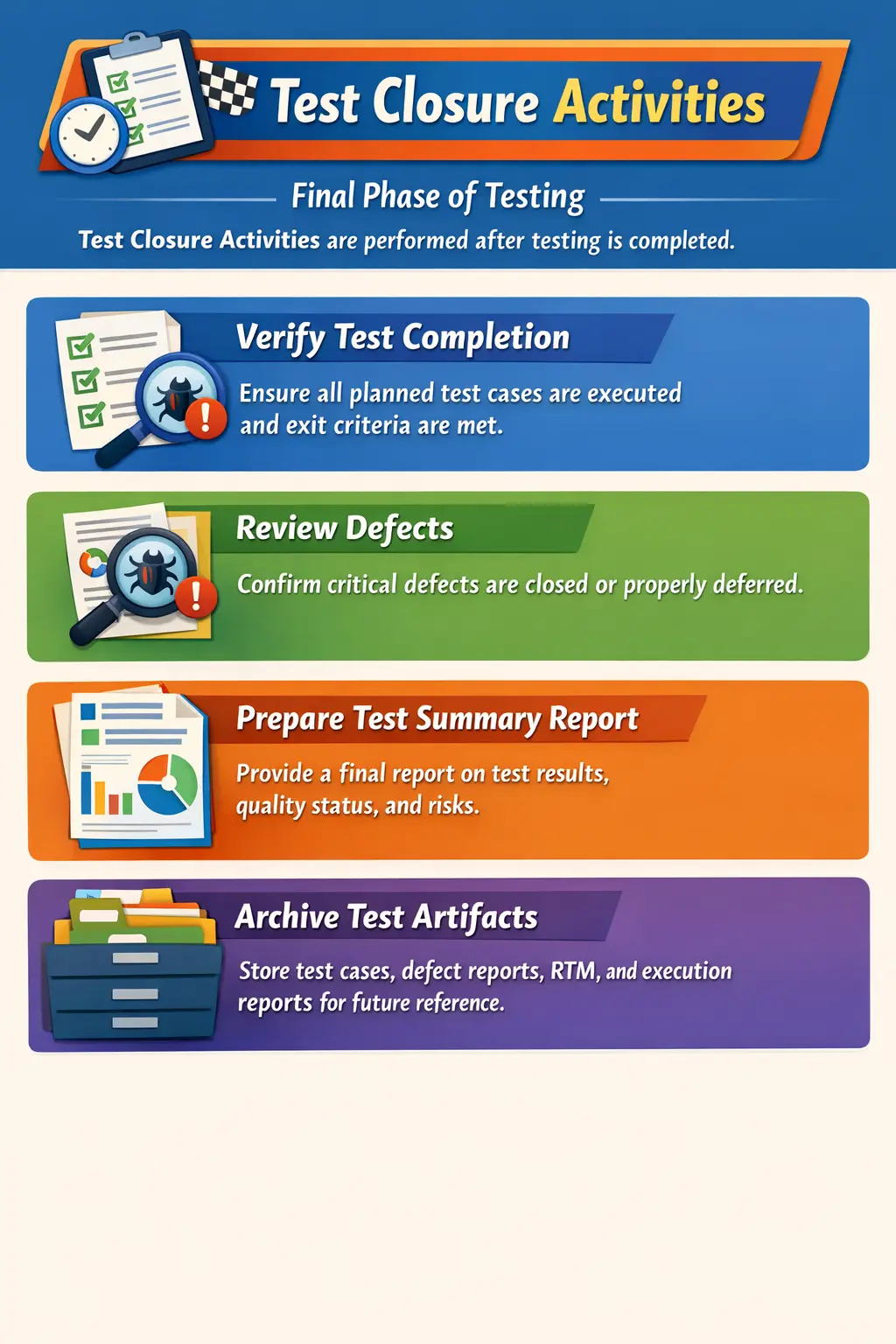
Test closure activities represent the final stage of the testing lifecycle. During this stage, the testing team formally completes testing tasks, reviews outcomes, ensures documentation is finalized, and communicates testing results to stakeholders. It is the point where the testing effort transitions from execution to evaluation and knowledge capture.
Test closure answers an important question in the software development lifecycle:
“Is testing complete, and what did we learn from the process?”
A well-executed test closure phase ensures that testing ends with clarity and accountability rather than uncertainty. It confirms that planned testing activities were completed, product quality was evaluated objectively, and all relevant artifacts are archived for future reference.
Understanding Test Closure Activities
Test closure activities involve reviewing the entire testing effort and ensuring that all testing deliverables are finalized and documented. This phase does not involve executing new test cases but rather evaluating the results of previously executed tests.
In practical projects, test closure ensures that the testing phase concludes in a controlled and traceable manner. Without proper closure, organizations risk losing valuable information such as defect patterns, testing insights, and lessons learned.
Test closure also ensures that testing responsibilities are formally completed. Stakeholders must clearly understand the testing outcomes before the product moves forward in the release process.
This stage also contributes to continuous improvement by identifying areas where testing processes can be optimized in future releases.
Purpose of Test Closure Activities
The primary purpose of test closure is to verify that testing objectives have been achieved and to evaluate whether the product is ready for release.
One of the key goals of test closure is to confirm that all planned test cases have been executed and that the defined exit criteria have been satisfied. Exit criteria are conditions that must be met before testing can officially conclude.
Another important objective is assessing product quality. Test closure provides a final overview of the testing results, including defect trends, execution statistics, and remaining risks.
Test closure also focuses on documenting lessons learned during the testing process. Identifying challenges, improvements, and successful practices helps teams refine their testing strategies in future projects.
Formal test sign-off is another important purpose of this phase. Stakeholders must agree that testing activities have been completed satisfactorily.
Finally, test closure ensures that testing artifacts such as test cases, defect reports, and execution records are preserved for future audits, maintenance, or regulatory compliance.
When Test Closure Is Performed
Test closure activities occur at the end of a testing phase or project milestone.
One common scenario is the completion of system testing. Once all system-level test cases have been executed and evaluated, the testing team initiates closure activities.
Test closure may also occur after User Acceptance Testing (UAT) support is completed. When business users finish validating the application and provide acceptance confirmation, the testing team performs closure tasks.
Another typical situation occurs at the end of a release cycle. Each release in agile or iterative development often includes a mini test closure phase where results are summarized and documented.
Test closure can also happen at project closure, particularly in large enterprise projects where multiple testing phases are executed.
Regardless of the scenario, the purpose remains the same: formally conclude testing and document its outcomes.
Key Test Closure Activities
Test closure consists of several structured activities that collectively confirm testing completion and capture knowledge gained during the project.
Test Completion Check
The first step in test closure is verifying that testing tasks are complete.
The testing team checks whether all planned test cases were executed according to the test plan. This includes verifying pass, fail, and blocked test cases.
Another important activity during this step is confirming that exit criteria have been satisfied. Exit criteria might include conditions such as a minimum pass rate, closure of all critical defects, or completion of regression testing.
Testers also review outstanding defects during this stage. Some defects may remain unresolved but accepted by stakeholders due to business priorities. These defects must be properly documented and categorized as deferred or accepted risks.
This step ensures that testing has reached a logical and controlled completion point.
Defect Closure Review
Defect management plays a critical role in test closure.
During this activity, the testing team reviews all defects reported during the testing phase. The goal is to ensure that each defect has a clearly defined status.
Defects may be categorized as fixed, deferred, rejected, or marked as “won’t fix.” Each classification must be validated and documented properly.
Special attention is given to high-severity defects. Ideally, no critical defects should remain open at the time of test closure. If critical issues remain unresolved, stakeholders must explicitly accept the associated risks before proceeding with release.
Defect closure review helps ensure transparency and accountability in the defect management process.
Test Summary Report Preparation
The test summary report is one of the most important deliverables produced during test closure.
This report provides a high-level overview of testing outcomes. It includes key metrics such as the number of test cases executed, pass and fail percentages, defect counts, and defect severity distribution.
The report also provides an overall assessment of product quality based on testing results.
In addition to numerical metrics, the report highlights major risks, limitations, and testing assumptions. For example, if certain areas were not tested due to time constraints, the report should clearly document this limitation.
The test summary report provides stakeholders with the information needed to make informed release decisions.
Test Artifacts Closure
Throughout the testing lifecycle, numerous artifacts are created and maintained.
These artifacts include test cases, test scenarios, test data, requirement traceability matrices, defect reports, and execution logs.
During test closure, all these artifacts must be finalized and archived.
Archiving ensures that testing documentation remains accessible for future reference. This information may be required for regulatory audits, maintenance activities, or defect investigations.
Proper artifact management also supports knowledge transfer between teams and helps maintain organizational testing standards.
Lessons Learned and Retrospective
One of the most valuable aspects of test closure is identifying lessons learned during the testing process.
Testing teams evaluate what went well and what could be improved. This retrospective analysis helps teams refine testing strategies and processes for future projects.
For example, teams may identify improvements in test planning, environment preparation, or communication between testers and developers.
Documenting lessons learned ensures that valuable experience gained during testing is not lost.
Continuous improvement is a key principle in modern software development, and test closure plays an important role in supporting that principle.
Test Sign-Off
The final step in test closure is obtaining formal test sign-off.
Test sign-off is a documented confirmation that testing activities have been completed and that stakeholders accept the testing results.
This approval is typically provided by the QA lead, project manager, product owner, or other relevant stakeholders.
Test sign-off indicates that the product has met testing objectives and is ready to proceed to the next stage, such as production release.
Formal sign-off also protects the testing team by ensuring that all stakeholders agree on the testing outcomes.
Manual Tester’s Role in Test Closure
Manual testers contribute significantly to the test closure process.
One of their responsibilities is verifying that exit criteria are satisfied. Testers ensure that all planned test cases have been executed and documented correctly.
Testers also provide accurate data related to test execution and defect statistics. This information is used in preparing the test summary report.
Another important responsibility is contributing insights during retrospective discussions. Testers often identify process improvements based on their experience during the testing phase.
Testers may also assist in verifying defect status and ensuring that unresolved issues are properly documented.
By actively participating in closure activities, testers help ensure transparency and accuracy in testing outcomes.
Test Closure vs Test Execution
Test execution and test closure are distinct stages within the testing lifecycle.
Test execution focuses on validating application functionality by running test cases and identifying defects.
Test closure focuses on evaluating the outcomes of testing and documenting final results.
Test execution occurs throughout the testing phase as builds are tested and defects are discovered.
Test closure occurs at the end of the testing phase once execution activities are complete.
While execution produces results such as pass or fail outcomes, closure transforms those results into insights and documented conclusions.
Both stages are essential for maintaining software quality.
Common Mistakes in Test Closure
Organizations sometimes overlook the importance of test closure, leading to several common mistakes.
One mistake is skipping formal closure activities altogether. Without proper closure, teams may lose valuable insights about testing outcomes.
Another common issue is failing to document lessons learned. This prevents teams from improving their testing processes in future projects.
Incomplete archiving of test artifacts is another problem. If documentation is not preserved properly, teams may struggle to investigate issues later.
Some teams also close testing prematurely without resolving critical defects. This increases the risk of production failures.
Avoiding these mistakes ensures that test closure provides meaningful value to the project.
Real-Time Example of Test Closure
Consider a scenario where a company is preparing to release a new version of its e-commerce application.
System testing has been completed, and the testing team begins closure activities.
The team verifies that all planned test cases were executed and confirms that the defined exit criteria have been met.
Next, they review all reported defects and confirm that critical defects have been resolved. Some minor defects are marked as deferred for future releases.
The testing team prepares a test summary report highlighting test execution statistics, defect trends, and overall product quality.
All testing artifacts are archived, and the team documents lessons learned from the testing phase.
Finally, the QA lead provides formal test sign-off, confirming that testing is complete and the product is ready for release.
This structured process ensures that testing ends with clarity and accountability.
Why Test Closure Should Not Be Skipped
Test closure is sometimes skipped when teams are under delivery pressure. After execution is finished, everyone wants to move quickly to release, deployment, or the next sprint. However, skipping closure creates long-term problems. The team may lose important information about defects, risks, coverage gaps, and process improvements. Future teams may not understand what was tested, what was deferred, and what lessons were learned.
A project without test closure often ends with uncertainty. Test cases may be marked complete, but open defects may not be reviewed properly. Some blocked cases may remain unexplained. Test data and reports may be scattered across tools. Stakeholders may assume testing was complete even when certain areas were not validated. Test closure prevents this by creating a formal record of what happened.
Closure also protects the testing team. A clear closure report shows what was executed, what passed, what failed, what defects remain, and what risks were accepted. If a production issue appears later, the team can review documented evidence rather than relying on memory. This is especially important in enterprise, regulated, or customer-facing systems.
Professional testing is not only about finding defects. It is also about communicating quality clearly and preserving knowledge for future improvement. Test closure is the point where testing work becomes a documented quality story that stakeholders can understand and trust.
Entry Conditions for Test Closure
Test closure should begin only when the testing phase has reached a logical completion point. This does not always mean every defect is fixed or every possible scenario is tested. It means the team has completed the planned testing activities to the agreed level and is ready to evaluate outcomes. Starting closure too early can hide unfinished work.
A common entry condition is completion of planned test execution. Most or all test cases in scope should be executed, or any unexecuted cases should be clearly documented with reasons. If important cases remain not run or blocked, closure can still happen only if stakeholders understand and accept the risk.
Another entry condition is defect status review. Critical and high-severity defects should be fixed, closed, deferred with approval, or explicitly accepted as known risks. Closure should not begin casually when severe defects remain unclear. Every major defect must have a decision.
Regression testing should also be completed for areas affected by fixes or changes. A defect fix may solve one problem but create another. If regression is incomplete, closure reports should state that clearly. Closure is about transparency, not pretending that all risk has disappeared.
Exit Criteria Verification During Closure
Exit criteria define the conditions required to end a testing phase. During test closure, the testing team verifies whether these criteria were met. This verification is one of the most important closure activities because it turns the decision to stop testing into an objective evaluation rather than a deadline-driven assumption.
Typical exit criteria include a required test execution percentage, a required pass percentage, closure of all critical defects, completion of regression testing, completion of test summary reporting, and stakeholder approval. Some projects also include criteria for requirement coverage, automation completion, performance validation, or UAT sign-off.
If exit criteria are fully met, the closure decision is straightforward. If exit criteria are partially met, the team must document the gaps and seek stakeholder decision. For example, if ninety-eight percent of cases are executed but two low-risk cases remain blocked, stakeholders may accept closure. If core payment cases are blocked, closure may not be acceptable.
Exit criteria verification should be evidence-based. Testers should use execution records, defect reports, traceability matrices, and test summary data. The conclusion should not depend on verbal claims. Evidence makes closure credible.
Reviewing Test Execution Completion
Test execution completion review checks whether the planned test scope was executed properly. The team reviews total planned cases, executed cases, passed cases, failed cases, blocked cases, not-run cases, and out-of-scope cases. This gives a complete view of execution status.
Passed cases show validated behavior, but failed and blocked cases require deeper attention. Failed cases should be linked to defects and final statuses. Blocked cases should have reasons, owners, and impact. Not-run cases should be justified. A test suite should not simply be marked complete without explaining exceptions.
The review should also consider whether testing covered critical business flows. A high execution percentage is not enough if the untested cases belong to high-risk functionality. For example, completing ninety-five percent of tests means little if the remaining five percent covers payment, authentication, or compliance workflows. Closure must consider business priority.
Execution completion review helps prevent misleading closure. It ensures that stakeholders understand what was actually validated and where uncertainty remains. This transparency supports responsible release decisions.
Open Defect Review and Risk Acceptance
Open defect review is a central test closure activity. Not every defect must be fixed before closure, but every open defect must be understood. The team should review severity, priority, affected module, business impact, workaround availability, and release relevance for each open issue.
Critical defects usually block closure unless there is a formal decision to defer the affected functionality or accept the risk. High-severity defects require careful stakeholder review. Medium and low defects may be deferred if they do not significantly affect business operations or user experience. The decision must be documented clearly.
Risk acceptance means stakeholders consciously agree to release with known issues. This is different from ignoring defects. A defect accepted for release should have a reason, owner, planned fix version if applicable, and known impact. Test closure documentation should capture these details.
Open defect review protects both users and teams. Users are protected because serious issues are not hidden. Teams are protected because release decisions are made with full awareness. Closure should make unresolved risk visible, not bury it.
Preparing the Test Summary Report
The test summary report is the main formal output of test closure. It consolidates test execution results, defect status, coverage, risks, and recommendations into a single document. Stakeholders use this report to understand the final testing outcome and make release decisions.
A strong test summary report includes project or release details, testing scope, test environment, testing period, test execution statistics, defect summary, requirement coverage, major risks, assumptions, exclusions, and overall quality assessment. It may also include a release recommendation such as "recommended for release," "not recommended," or "recommended with known risks."
Numbers are important, but interpretation is equally important. A report that lists only pass and fail counts does not fully explain quality. The report should explain what the numbers mean. For example, if all critical flows passed but reporting has minor defects, that is a different quality picture from a release where many low-risk cases passed but checkout failed.
The test summary report should be factual and balanced. It should not exaggerate minor issues or hide serious concerns. Its purpose is to help stakeholders make informed decisions based on evidence.
Archiving Test Artifacts
Test artifacts are valuable project assets. During closure, the team should organize and archive test cases, test scenarios, test data, execution results, defect reports, RTM documents, test summary reports, sign-off emails, and any relevant evidence. Proper archiving ensures that this information remains available for future reference.
Archived artifacts support maintenance. If a production issue is reported later, testers can review previous execution results and defect history. If a similar feature is developed in the future, archived test cases and lessons learned can speed up planning. If auditors request evidence, archived artifacts provide proof of testing.
Artifacts should be stored in agreed locations such as test management tools, shared repositories, document management systems, or project folders. The final versions should be clearly identified. Drafts, duplicates, and outdated files should not create confusion. Naming conventions and version control help maintain order.
Archiving is not glamorous, but it is important. Without proper artifact closure, valuable knowledge disappears when team members move to other projects. A disciplined archive preserves organizational memory.
Requirement Traceability Closure
Requirement traceability closure verifies that each requirement in scope has corresponding test coverage and execution results. This is usually done using the Requirement Traceability Matrix. The RTM connects requirements to test cases, defects, and final validation status.
During closure, testers should check whether all requirements were tested. Requirements may be marked passed, failed, partially tested, blocked, deferred, or out of scope depending on execution results. This gives stakeholders a requirement-level view of readiness rather than only a test case-level view.
Traceability closure is especially important when some test cases are blocked or deferred. A blocked test case may mean a requirement is not fully validated. The closure report should make this clear. Stakeholders should not assume that every requirement is ready just because overall execution percentage is high.
Traceability also helps future impact analysis. When a requirement changes in a later release, the team can quickly identify related test cases and historical defects. Closing traceability properly improves future testing efficiency.
Lessons Learned in Test Closure
Lessons learned are one of the most valuable parts of test closure because they help teams improve. Testing often reveals process issues that are not visible during planning. These may include unclear requirements, unstable environments, late builds, insufficient test data, communication gaps, or weak defect turnaround.
A lessons learned discussion should identify what went well, what did not go well, and what should be improved next time. The focus should be process improvement, not blame. For example, if test execution was delayed due to missing data, the improvement may be to prepare data during test design rather than waiting for execution.
Positive lessons should also be captured. If daily defect triage helped resolve issues quickly, that practice should continue. If early review of test cases reduced execution confusion, it should become part of the standard process. Lessons learned should capture strengths as well as weaknesses.
Documenting lessons learned is essential. Verbal discussions are useful, but written records make improvement repeatable. Future teams can review previous lessons and avoid repeating the same mistakes.
Test Closure Meeting
Many teams conduct a test closure meeting to formally review the outcome of testing. Participants may include the QA lead, testers, project manager, product owner, business analyst, development lead, and other stakeholders. The meeting focuses on final status, open risks, defect summary, coverage, and sign-off readiness.
The QA lead or test lead usually presents the test summary report. Testers may provide details about unresolved issues, blocked areas, or lessons learned. Developers may comment on defect fixes and technical risks. Product owners may confirm whether known issues are acceptable from a business perspective.
The meeting should result in clear decisions. Is testing complete? Are exit criteria met? Are open defects accepted or deferred? Is additional regression required? Is release recommended? These questions should be answered explicitly.
A test closure meeting should be concise and evidence-based. It should not reopen every defect discussion unless a defect affects closure. The goal is to finalize understanding and agree on next steps.
Test Sign-Off in Detail
Test sign-off is the formal confirmation that testing activities have been completed and stakeholders accept the reported results. It does not mean the product is perfect. It means testing has reached the agreed completion point, results are documented, and remaining risks are known.
A sign-off message or document usually includes release name, build version, testing scope, execution summary, defect summary, known issues, risks, exclusions, and sign-off approval. It may be sent by the QA lead and acknowledged by project stakeholders.
Sign-off should be based on evidence. Before sign-off, the team should verify execution completion, open defect status, regression results, and exit criteria. If sign-off is given despite known issues, those issues should be listed clearly. This prevents misunderstandings after release.
Formal sign-off creates accountability. It confirms that stakeholders reviewed the testing outcome and accepted the product's quality position. For testers, it marks the official completion of the testing phase or release cycle.
Test Closure in Agile Projects
In Agile projects, test closure may happen at the end of each sprint, release, or increment. The process is usually lighter than in traditional projects, but the purpose remains the same. The team still needs to review what was tested, what defects remain, what risks exist, and what improvements should be made.
Sprint-level closure may include confirming that user stories met the Definition of Done, updating test results, closing or carrying forward defects, and contributing to the sprint retrospective. Release-level closure may include a broader summary report, regression results, known issues, and release sign-off.
Agile teams should avoid assuming that fast delivery eliminates closure. Without closure, teams lose visibility into recurring defects, incomplete testing, and process issues. Lightweight closure is still valuable because it supports continuous improvement.
Agile closure works best when integrated into existing ceremonies. Test results can be reviewed during sprint review, process improvements can be discussed during retrospective, and unresolved defects can be carried into backlog refinement. Closure becomes part of the Agile feedback loop.
Test Closure in Regulated Projects
Regulated industries such as banking, healthcare, insurance, aviation, and government often require stronger test closure discipline. In these environments, testing evidence may be needed for audits, compliance reviews, or legal accountability. Closure documentation must be accurate, complete, and traceable.
Regulated test closure often includes formal approval records, signed test summary reports, requirement traceability evidence, defect disposition records, test execution logs, and archived validation evidence. Any open defects or deviations must be documented with justification and approval.
The quality of closure artifacts matters because auditors may review them months or years later. If artifacts are missing or unclear, the organization may struggle to prove that proper testing was performed. Test closure therefore supports compliance as well as quality.
Manual testers in regulated projects must pay close attention to documentation accuracy. Every execution result, defect status, and approval record should be reliable. In such environments, closure is not optional administration; it is a required quality control activity.
Metrics Reviewed During Test Closure
Test closure relies on metrics to summarize testing outcomes. Common metrics include total test cases planned, executed, passed, failed, blocked, and not run. These numbers show execution progress and coverage. However, they should always be interpreted with risk and business context.
Defect metrics are also important. The team reviews total defects logged, defects by severity, defects by priority, defects fixed, defects closed, defects deferred, reopened defects, and rejected defects. These metrics help evaluate application stability and defect management effectiveness.
Coverage metrics may include requirement coverage, regression coverage, automation coverage, or module-wise coverage. These metrics help stakeholders understand whether important areas were validated. Gaps should be clearly documented as risks or exclusions.
Process metrics may include test execution productivity, defect turnaround time, blocker duration, and rework caused by requirement changes. These metrics support lessons learned and future planning. Good closure metrics help teams improve future test cycles.
Handling Deferred Defects During Closure
Deferred defects are issues that are known but not fixed in the current release. During closure, deferred defects must be reviewed carefully. The team should confirm that each deferred defect has a valid reason, business approval, target fix version if applicable, and documented impact.
Defects may be deferred because they are low severity, affect rarely used functionality, have a workaround, or fall outside current release priorities. However, deferral should not be used to avoid fixing serious issues. Critical and high-severity defects require strong justification if deferred.
Deferred defects should be included in known issue documentation if they affect users. Support teams, product owners, and business stakeholders should know what issues may appear after release. Hidden deferred defects can damage trust when users encounter them unexpectedly.
Test closure should also ensure deferred defects are tracked for future resolution. A deferred defect should not disappear after sign-off. It should remain in the defect management system with an agreed status and owner.
Practical Example: Closure for a Banking Release
Consider a banking application release that includes fund transfer, beneficiary management, account statements, and bill payment. During closure, the testing team verifies that all planned functional and regression test cases were executed. Critical flows such as login, fund transfer, OTP validation, and balance update are reviewed first because they carry high business impact.
The defect review shows that all critical defects are closed. Two medium defects remain open: one related to statement date formatting and one related to a warning message in beneficiary management. The product owner agrees to defer both defects because they do not affect transaction accuracy and have low user impact.
The test summary report includes execution metrics, defect summary, requirement coverage, deferred defects, and known risks. The team archives test cases, execution logs, screenshots for critical flows, RTM, and sign-off approval. Lessons learned note that OTP test data was prepared late, causing execution delays.
Formal sign-off is given after stakeholders review the report. This closure process ensures that the release decision is based on evidence, not assumption. It also captures improvements for the next banking release.
Practical Example: Closure for an Agile Sprint
In an Agile sprint, closure may be smaller but still important. Suppose a sprint includes three user stories: user profile update, password reset, and notification preferences. At the end of the sprint, testers verify that all acceptance criteria were tested and that story-level defects are resolved or moved to the backlog.
The team confirms that profile update and notification preferences are done, but password reset has one unresolved defect related to expired reset links. The product owner decides that the story does not meet the Definition of Done and carries it forward. This decision is part of sprint-level test closure.
Testers update execution status, link defects to stories, and provide input during the sprint retrospective. They explain that unclear acceptance criteria for token expiry caused rework. The improvement action is to clarify time-based rules during backlog refinement.
This example shows that Agile test closure does not need heavy documentation, but it still needs clear status, defect decisions, and lessons learned. Lightweight closure supports continuous delivery without losing quality control.
Best Practices for Test Closure Activities
The first best practice is to plan closure from the beginning. Closure is easier when execution results, defect statuses, RTM updates, and artifacts are maintained throughout the test cycle. Waiting until the final day to organize everything creates errors and omissions.
The second best practice is to keep closure evidence factual. Use data from test management tools, defect tracking systems, and approved documents. Avoid unsupported statements such as "quality looks good" without metrics or evidence.
The third best practice is to make risks visible. Closure should clearly state open defects, blocked cases, untested areas, deferred scope, assumptions, and limitations. Stakeholders can accept risk only when they understand it.
The fourth best practice is to capture lessons learned honestly. Teams should identify process improvements without blame. A good closure process improves future testing, not just the current release record.
The fifth best practice is to obtain clear sign-off. Closure should end with a documented decision from the appropriate stakeholders. This confirms shared understanding and prevents confusion after release.
Interview-Ready Explanation
In software testing interviews, candidates are often asked to explain test closure activities.
A short answer states that test closure activities are the final steps performed to conclude testing and document testing outcomes.
A more detailed explanation highlights that test closure includes verifying exit criteria, reviewing defects, preparing test summary reports, archiving test artifacts, capturing lessons learned, and obtaining stakeholder sign-off.
Providing practical examples of closure activities demonstrates a strong understanding of the testing lifecycle.
Key Takeaway
Test closure activities mark the formal completion of the testing phase. They ensure that testing objectives have been achieved, results are documented, and insights are captured for future improvement.
Through activities such as verifying exit criteria, reviewing defects, preparing summary reports, archiving artifacts, and obtaining stakeholder approval, test closure provides transparency and accountability in the testing process.
A well-executed test closure phase ensures that testing concludes with clear outcomes, documented knowledge, and informed decisions about product readiness.