Test Case Review
In software testing, the effectiveness of test execution largely depends on the quality of the test cases created during the test design phase. If test cases are unclear, incomplete, or poorly structured, even the most disciplined execution process will fail to uncover important defects. To ensure the reliability and effectiveness of test artifacts, teams perform Test Case Review before execution begins.
Test Case Review is a structured activity where designed test cases are examined carefully to ensure they are correct, complete, clear, and aligned with requirements. It is a preventive quality activity that improves testing effectiveness by identifying issues in test cases before they are executed.
Test case review answers a critical question in the testing lifecycle: “Are our test cases good enough to find defects?”
For manual testers, this activity is essential. A well-reviewed test suite improves defect detection capability, prevents missed scenarios, and ensures efficient testing during execution.
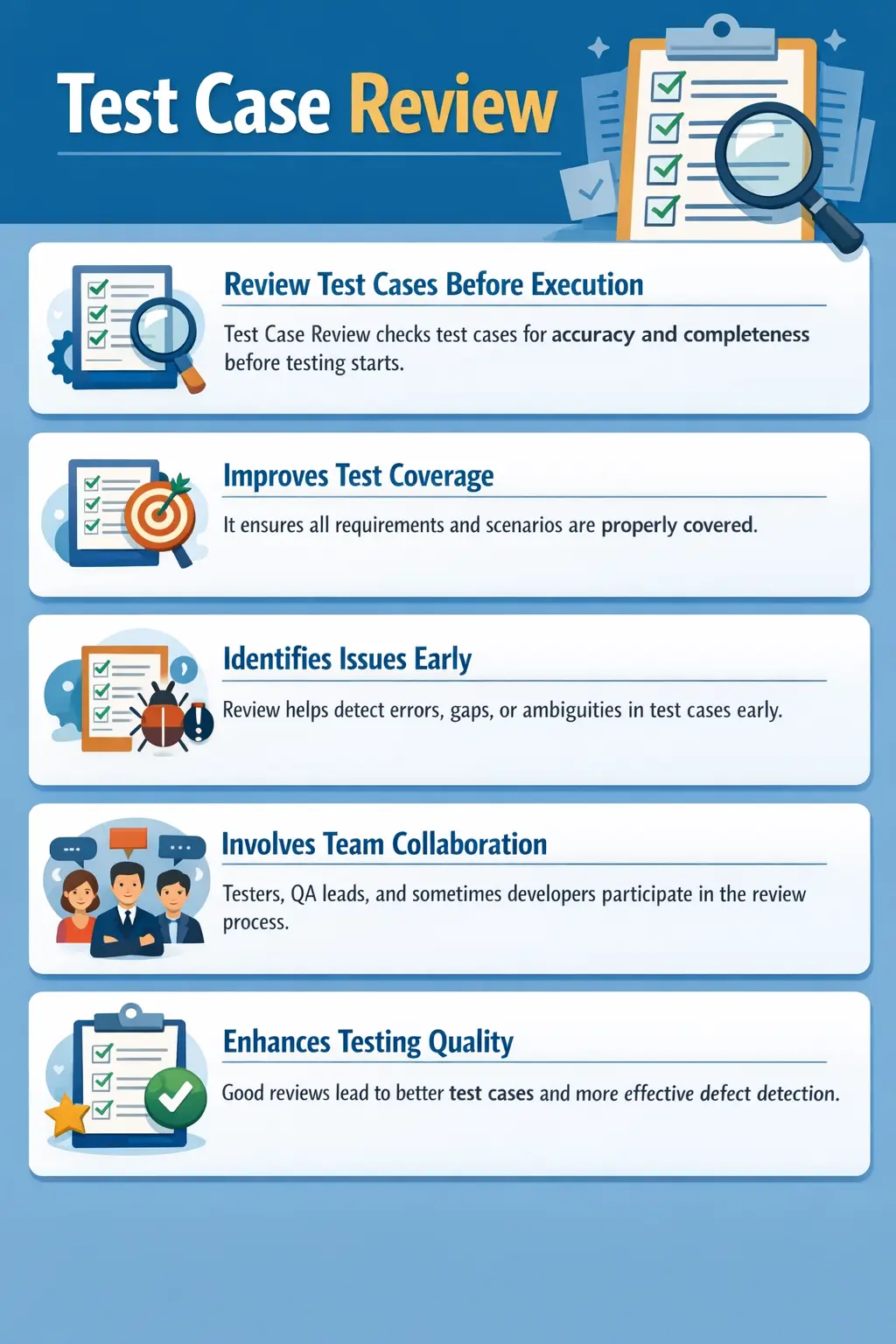
Definition of Test Case Review
Test Case Review is the systematic evaluation of test cases to ensure they meet quality standards before they are used during test execution. The goal of this review is to confirm that test cases are accurate, clear, comprehensive, and traceable to requirements.
During the review process, testers verify that each test case aligns with business requirements, covers all important scenarios, and provides clear instructions for execution. The review also checks whether expected results are properly defined and whether test data and preconditions are included.
Test case review is a preventive activity. Instead of finding defects in the application, the review focuses on finding defects in the test cases themselves.
If test cases contain errors or omissions, they may lead to incomplete validation, incorrect defect reporting, or wasted testing effort. Therefore, reviewing test cases before execution ensures that the testing process is reliable and effective.
Purpose of Test Case Review
The primary purpose of test case review is to identify defects in test cases early in the testing lifecycle. Issues in test cases are much easier to correct during the design phase than during execution.
Test case review improves overall test coverage. Reviewers often identify missing scenarios or additional edge cases that were not originally considered.
It ensures requirement traceability. Every requirement must be mapped to at least one test case to ensure proper validation.
Test case review also reduces rework during execution. If unclear or incorrect test cases are discovered during execution, testers may need to redesign them under time pressure.
Another important purpose is preventing missed scenarios. Without structured review, important test conditions may remain untested.
Through careful review, the testing team ensures that test cases are strong enough to detect defects effectively.
When Test Case Review Is Performed
Test case review is typically performed after test case design and before the start of test execution. This timing ensures that the test suite is validated before it is used to evaluate the application.
Reviews may also occur when requirements change. When new requirements are introduced or existing ones are modified, test cases must be updated and reviewed again.
In many organizations, test case reviews are conducted as part of formal test readiness reviews. These checkpoints confirm that the testing phase is prepared to begin.
Reviews may also occur during sprint cycles in Agile environments. Testers review test cases collaboratively during backlog refinement or sprint planning.
Regular reviews ensure that the test suite remains aligned with evolving requirements.
Participants in Test Case Review
Test case reviews are usually collaborative activities involving multiple roles within the team.
Testers participate in peer reviews where they evaluate each other’s test cases. Peer reviews help identify issues that the original author may have overlooked.
Test leads or QA leads often participate to ensure adherence to testing standards and best practices.
Business analysts or product owners may join reviews when requirement interpretation needs validation. Their involvement helps ensure business alignment.
Developers may participate when test cases involve complex technical logic or integration behavior.
Collaboration among these participants improves the quality and completeness of the test suite.
Requirement Coverage Verification
One of the most important aspects of test case review is ensuring that all requirements are covered.
Reviewers check whether each requirement has corresponding test cases. This is often validated through the Requirement Traceability Matrix.
Missing requirement coverage is a serious issue because untested requirements may result in undetected defects.
Reviewers also evaluate whether multiple scenarios are covered for complex requirements.
Requirement coverage validation ensures that the test suite provides complete functional validation.
Clarity and Correctness of Test Cases
Test cases must be written in a clear and understandable manner so that any tester can execute them without confusion.
During review, reviewers verify that test steps are logically ordered and easy to follow.
Expected results must be clearly defined and measurable. Vague expected results such as “system works correctly” are not acceptable.
Reviewers also ensure that terminology used in test cases matches requirement documentation.
Clarity in test cases reduces execution errors and ensures consistent results across testers.
Evaluation of Test Design Quality
A good test case review evaluates whether proper test design techniques have been applied.
Equivalence partitioning should be used to group similar input values and reduce redundant testing.
Boundary value analysis should be applied to validate edge conditions where defects frequently occur.
Decision tables may be required when business rules involve multiple conditions.
Reviewers ensure that positive, negative, and edge scenarios are included.
Strong test design improves defect detection effectiveness.
Independence and Reusability of Test Cases
Test cases should ideally be independent of each other. If one test case fails, it should not block the execution of others.
During review, testers check whether test cases rely on previous execution states unnecessarily.
Reviewers also evaluate whether test cases can be reused across different test cycles.
Reusable test cases improve long-term testing efficiency.
Independent test cases make execution more flexible and reduce blocking situations.
Test Data and Preconditions
Proper test data is essential for accurate test execution.
Reviewers verify that each test case clearly specifies required input data.
Preconditions must also be documented. Preconditions describe the state of the system required before executing the test case.
For example, a test case validating order cancellation may require an existing order.
Without clear test data and preconditions, execution becomes confusing and inconsistent.
Well-defined data improves reproducibility of results.
Manual Tester’s Role in Test Case Review
Manual testers actively participate in peer reviews of test cases.
They carefully examine test cases written by other testers to identify gaps, ambiguities, or incorrect logic.
Testers provide constructive feedback and suggest improvements.
They update test cases based on review comments and ensure that revisions are documented.
After updates, the test cases must be approved before execution begins.
Active participation in reviews improves both individual and team-level testing skills.
Test Case Review vs Test Case Execution
Test case review and test execution serve different purposes within the testing lifecycle.
Test case review focuses on improving the quality of test artifacts.
Test execution focuses on validating the application against those artifacts.
Review occurs before execution and aims to refine test cases.
Execution occurs after build deployment and produces pass/fail results.
Review outcomes include improved test cases and updated coverage.
Execution outcomes include defect reports and execution metrics.
Both activities are essential to effective testing.
Benefits of Test Case Review
Test case review enables early defect detection within test artifacts.
It improves overall test coverage by identifying missing scenarios.
Execution efficiency increases because testers encounter fewer ambiguities during testing.
Review also improves collaboration and knowledge sharing within the team.
It strengthens requirement understanding and promotes better test design.
Organizations that perform regular reviews often achieve higher testing quality.
Common Mistakes in Test Case Review
Skipping reviews due to time pressure is one of the most common mistakes.
Superficial reviews where reviewers only skim test cases provide little value.
Not documenting review feedback creates confusion and prevents improvement.
Ignoring negative scenarios leads to incomplete coverage.
Another mistake is treating review as a formality instead of a quality activity.
Avoiding these mistakes ensures meaningful review outcomes.
Test Case Review in Agile Environments
In Agile projects, test case reviews are integrated into sprint activities.
Testers collaborate with developers and product owners to validate scenarios early.
Reviews may occur during backlog refinement or sprint planning meetings.
Continuous review ensures that test cases remain aligned with evolving user stories.
Agile teams often emphasize quick yet thorough reviews.
This approach supports rapid development cycles while maintaining quality.
Documentation of Review Results
All review findings should be documented clearly.
Comments, suggestions, and identified issues must be recorded.
Test case authors update their test cases based on review feedback.
The final approved version should be clearly marked.
Documentation ensures traceability and accountability in the review process.
Why Test Case Review Matters Before Execution
Test case review matters because test execution is only as strong as the test cases being executed. If the test cases are incomplete, unclear, duplicated, outdated, or incorrectly mapped to requirements, the execution phase may produce misleading confidence. A test suite can show a high pass percentage and still miss important defects if the underlying test cases were poorly designed.
Reviewing test cases before execution helps the team prevent defects in the testing process itself. A missed negative scenario, an incorrect expected result, or unclear test data can cause testers to miss application defects or report false defects. These issues are cheaper and easier to fix during review than during active execution, when schedules are tight and stakeholders expect progress.
Test case review also improves consistency across testers. In many projects, one tester designs a test case and another tester executes it later. If the test case is not clear enough for another tester to follow, the result becomes dependent on personal interpretation. A reviewed test case should be understandable, repeatable, and executable by any qualified tester on the team.
For managers and stakeholders, test case review increases confidence in testing coverage. It shows that the team is not only executing cases but also validating whether those cases are meaningful. This makes testing more professional and defensible during release discussions.
Reviewing Requirement Alignment
The first and most important review question is whether the test case matches the requirement. A test case should validate approved behavior, not assumptions, outdated understanding, or personal preference. Reviewers should compare each test case with the requirement, user story, acceptance criteria, business rule, or functional specification it is intended to cover.
Requirement alignment includes checking whether the test case validates the correct condition and expected outcome. For example, if a requirement states that a user account should be locked after five failed login attempts, a test case that checks only three failed attempts does not fully validate the rule. The reviewer should identify this mismatch before execution begins.
Reviewers should also check whether requirements are over-tested or under-tested. Some requirements may have many repetitive test cases that add little value, while other important requirements may have only one shallow test case or none at all. A balanced test suite should provide meaningful coverage without unnecessary duplication.
If a requirement is ambiguous, the reviewer should not approve the test case blindly. Instead, the ambiguity should be clarified with the business analyst, product owner, or stakeholder. Test case review often exposes unclear requirements because testers must convert requirements into concrete validation steps. This is one of the hidden benefits of the review process.
Reviewing Test Case Structure
A well-structured test case usually contains a clear title, objective, preconditions, test data, steps, expected results, priority, and requirement reference. During review, each of these parts should be checked for completeness. Missing structure makes execution difficult and reduces traceability.
The title should describe the behavior being tested. A title such as "Login test" is too generic, while "Verify successful login with valid credentials" is more useful. A good title helps testers, leads, and stakeholders understand the purpose of the case without reading every step.
Preconditions should describe the required state before execution begins. If a test case requires a registered active user, a completed order, a specific account balance, or an enabled configuration, that condition must be written clearly. Without preconditions, testers may execute the case under the wrong setup and produce invalid results.
Test steps should be logical, sequential, and specific enough to reproduce the scenario. Steps should not include unnecessary implementation detail, but they must provide enough guidance for consistent execution. The expected result should be attached to the relevant step or clearly stated at the end so the tester knows what to observe.
Expected results must be measurable and objective. A phrase such as "system should work properly" is not acceptable. A better expected result states that the dashboard should open, the order should be created, the confirmation message should display, or the error message should appear. Reviewers should correct vague expected results before approval.
Reviewing Positive, Negative, and Edge Coverage
A strong test suite includes positive, negative, and edge case coverage. Positive test cases confirm that the system works correctly when valid inputs and normal conditions are used. Negative test cases confirm that the system handles invalid inputs, rule violations, and restricted actions safely. Edge cases validate boundaries and uncommon but valid conditions.
During review, testers should check whether the suite is too heavily focused on happy paths. Happy paths are important because they validate baseline behavior, but they are not enough. Many production defects occur when users enter invalid data, exceed limits, skip required fields, use uncommon combinations, or perform actions in unexpected states.
Negative coverage should be tied to business rules. If a field is mandatory, there should be a case for missing input. If a user must have permission, there should be a case for unauthorized access. If a payment cannot exceed a daily limit, there should be a case for exceeding that limit. Reviewers should confirm that invalid scenarios are meaningful, not random.
Edge coverage should focus on boundaries. If a password must be between eight and twenty characters, test cases should include seven, eight, twenty, and twenty-one characters. If an offer expires at midnight, cases should cover before, at, and after the cutoff. Reviewers should ensure that boundary values are not skipped.
Reviewing Test Data Quality
Test data is a major part of test case quality. A well-written test case can still fail during execution if the required data is missing, incorrect, unstable, or unclear. During review, testers should verify whether each test case identifies the data required for execution.
Good test data should match the scenario. If the test case validates insufficient balance, the account must actually have a balance below the transfer amount. If the test case validates expired coupons, the coupon must be expired. If the test case validates role-based access, the user must have the correct role. Generic data descriptions often create execution confusion.
Reviewers should also check whether test data is reusable or fragile. Some test cases depend on data that changes after execution. For example, an order cancellation case may require an order in a specific state. Once cancelled, the same order cannot be reused. The test case should explain how to create or identify suitable data.
Data privacy should be considered as well. Test cases should avoid exposing real customer information, passwords, payment data, or sensitive identifiers. If production-like data is required, it should be masked or handled according to project policy. Test case review should catch unsafe data usage before execution.
Reviewing Expected Results
Expected results are the standard against which actual behavior is judged. If the expected result is wrong, the tester may mark correct application behavior as failed or incorrect behavior as passed. Reviewers should therefore examine expected results carefully.
Expected results should cover visible outcomes and important system outcomes. For example, in an order placement case, it is not enough to say that a success message should appear. The expected result may also include order creation, payment capture, inventory reduction, confirmation email, and order history update. The exact depth depends on the test objective, but critical effects should not be ignored.
For negative scenarios, expected results should describe controlled rejection. If a user enters invalid credentials, the expected result should state that access is denied, a clear message appears, and the user remains unauthenticated. If money transfer fails due to insufficient balance, the expected result should state that no amount is debited. This prevents partial validation.
Expected results should avoid technical uncertainty unless the test is technical in nature. Manual functional test cases should usually describe business-visible outcomes. If a database update or API response must be verified, the test case should clearly explain why and how that validation is performed.
Reviewing Traceability
Traceability connects test cases to requirements, user stories, defects, change requests, or business rules. During review, the team should confirm that each important requirement has test coverage and that each test case has a clear reason to exist. This prevents both missed coverage and unnecessary test cases.
The Requirement Traceability Matrix is often used for this purpose. Reviewers can check whether every requirement ID maps to one or more test cases. For simple requirements, one or two cases may be enough. For complex requirements, multiple cases may be needed to cover positive, negative, edge, and alternate flows.
Traceability also helps during impact analysis. When a requirement changes, the team can quickly identify which test cases need updates. Without traceability, testers must manually search through the test suite, which increases the risk of missing affected cases.
Reviewers should also watch for orphan test cases. These are test cases that do not map to any current requirement or business need. Some may still be useful as regression cases, but others may be outdated. Removing or updating obsolete test cases keeps the suite maintainable.
Reviewing Test Case Priority
Test case priority helps teams decide execution order when time is limited. During review, priorities should be checked for accuracy. Critical business flows, high-risk features, frequently used workflows, and areas with past defects should usually receive higher priority.
A common mistake is assigning high priority to too many cases. If everything is high priority, priority loses meaning. Reviewers should ensure that priority reflects real business and testing risk. High-priority cases should be those that must be executed early or must pass before release confidence can be established.
Low-priority cases are not useless. They may cover cosmetic, low-risk, or rarely used scenarios. However, they can be scheduled later or deferred if time is severely limited. Correct prioritization supports risk-based test execution.
Priority should be reviewed whenever requirements change. A feature that was low priority in one release may become critical in another release due to business focus, customer usage, or compliance needs. Test case review keeps priorities aligned with current project reality.
Peer Review vs Lead Review
Test case review can happen at different levels. Peer review is performed by another tester or team member who checks the test case from a practical execution and coverage perspective. Peer review is useful because a second tester may notice gaps that the author missed.
Lead review is usually performed by a test lead or senior QA member. The focus may include standards, coverage, consistency, risk, estimation, and alignment with the overall test strategy. A test lead may also identify duplicate cases, missing regression coverage, or imbalance across modules.
Business review may be needed for critical scenarios. Business analysts, product owners, or domain experts can confirm whether expected results match business rules. Their participation is especially useful for financial calculations, compliance workflows, approval logic, and customer-facing processes.
Developer review can be useful when the test case involves technical dependencies, integrations, background jobs, APIs, or complex configuration. Developers should not decide what should be tested from a business perspective, but they can help identify technical paths and hidden dependencies that testers should consider.
Formal and Informal Test Case Reviews
Test case reviews may be formal or informal depending on project context. Formal reviews follow a structured process with assigned reviewers, review checklists, documented comments, approval status, and review closure. They are common in regulated, enterprise, or high-risk projects where auditability matters.
Informal reviews are lighter. A tester may ask a peer to review cases, discuss scenarios during a team meeting, or validate coverage with a product owner. Informal reviews are faster and useful in Agile environments, but they should still be meaningful. A quick review is not the same as a careless review.
The level of review should match risk. A low-risk UI text change may need a quick peer review. A payment workflow, medical record update, loan approval rule, or compliance report may need a formal review with business and technical stakeholders. Review effort should scale with impact.
Regardless of formality, the goal remains the same: improve test case quality before execution. The team should choose a review style that supports quality without creating unnecessary process burden.
Test Case Review Checklist
A review checklist helps reviewers stay consistent. The checklist should ask whether the test case maps to a requirement, whether the scenario is valid, whether preconditions are clear, whether test data is defined, whether steps are logical, and whether expected results are measurable.
The checklist should also ask whether positive, negative, and edge scenarios are covered. Reviewers should confirm that important business rules are tested, required fields are validated, boundary values are included, and alternate flows are considered. This prevents overreliance on happy path coverage.
Another checklist area is maintainability. Reviewers should check whether the test case is duplicated, too long, dependent on other cases, hard to execute, or written with unclear wording. A maintainable test case is easier to update and reuse across cycles.
The checklist should include traceability and priority. Each case should have a requirement reference where applicable, and priority should reflect risk. If a test case has no clear requirement, no clear expected result, and no clear priority, it may need revision before approval.
Practical Example: Login Test Case Review
Consider a login feature where the test case title is "Verify login." During review, this title may be considered too vague. The reviewer may suggest changing it to "Verify successful login with valid registered user credentials." This improved title clearly states the scenario and expected behavior.
The reviewer then checks the steps. If the steps say only "enter username and password, click login," they may be acceptable for a simple case, but preconditions should specify that the user account is active and registered. Test data should include a valid username and password or instructions for obtaining them.
The expected result should not merely say "login successful." A stronger expected result states that the user is authenticated, redirected to the dashboard, and the username or profile indicator is displayed. If session creation is important, the test case may also mention that protected pages should be accessible after login.
The reviewer should also check related scenarios. Are there cases for invalid password, blank username, locked account, inactive account, password case sensitivity, and maximum failed attempts? If only the successful login case exists, coverage is incomplete. Review helps identify these missing scenarios early.
Practical Example: Payment Test Case Review
Payment workflows require careful review because the business impact is high. A payment test case should clearly define the cart amount, payment method, user account, environment, and expected result. If any of these details are missing, execution may become unreliable.
During review, the expected result should include more than a success message. A proper payment validation may include payment authorization, order creation, transaction ID generation, inventory update, confirmation email, and order history entry. If the test case checks only the success message, it may miss backend or downstream defects.
Negative payment scenarios should also be reviewed. These may include declined card, insufficient funds, expired card, payment timeout, duplicate submission, and cancelled transaction. Each should define what must not happen, such as no order creation or no inventory reduction when payment fails.
Reviewers should also check whether refund and cancellation scenarios are covered if they are in scope. Payment test case review requires business and technical awareness because many systems are involved in the workflow.
Handling Review Comments
Review comments should be constructive, specific, and actionable. A comment such as "not clear" is less helpful than "add precondition stating that the user account must be active." Specific comments help the test case author make corrections quickly.
The test case author should evaluate each comment and update the test case accordingly. If the author disagrees with a comment, the issue should be discussed rather than ignored. The goal is not to defend the original test case but to improve the final artifact.
Review comments should be tracked until closure. In formal reviews, each comment may have a status such as open, fixed, rejected, or clarified. In informal reviews, tracking may be lighter, but the team should still ensure important feedback is addressed before execution.
Once updates are complete, the reviewer or lead may approve the test case. Approval indicates that the case is ready for execution. Approval does not mean the test case will never change again; it means it is good enough based on current requirements and understanding.
Test Case Review and Defect Prevention
Test case review is a preventive activity because it reduces the chance of defects escaping due to weak testing. A missed test scenario can allow an application defect to pass unnoticed. An incorrect expected result can cause a tester to accept wrong behavior. An unclear test case can produce inconsistent execution. Review prevents these testing defects before they affect product validation.
Review also prevents wasted execution effort. If a test case is impossible to execute because test data is missing, that issue should be found during review. If a test case duplicates another case exactly, the duplicate can be removed or merged. If a test case validates an obsolete requirement, it can be updated or retired.
Early review improves defect detection capability. Reviewers often suggest additional negative, edge, or alternate scenarios that the original author missed. These suggestions increase the chance of finding real product defects during execution.
In mature testing teams, test case review is treated with the same seriousness as code review. Both activities improve quality before execution or deployment. Reviewing test artifacts is part of building quality into the testing process.
Metrics for Test Case Review
Teams can use review metrics to improve test design quality over time. Useful metrics include number of test cases reviewed, number of review comments, number of defects found in test cases, number of missing scenarios identified, and number of test cases reworked after review.
Review defect categories can also be useful. Comments may be grouped as missing requirement coverage, unclear steps, incorrect expected result, missing test data, duplicate case, missing negative scenario, or traceability gap. These categories help teams understand recurring weaknesses in test design.
If many test cases require rework due to unclear expected results, the team may need better test writing guidelines. If many missing scenarios are found, testers may need stronger training in test design techniques. Metrics should guide improvement rather than blame individuals.
Review effectiveness can also be measured indirectly through execution. If reviewed test cases lead to fewer execution clarifications, fewer blocked cases, and better defect detection, the review process is adding value. Good review improves downstream execution quality.
Best Practices for Effective Test Case Review
The first best practice is to review test cases with requirements open. Reviewing test cases in isolation is risky because the reviewer may not know whether the case aligns with business expectations. Requirement context is essential for meaningful review.
The second best practice is to use a checklist. Checklists reduce the chance of missing important review points. They also make reviews consistent across reviewers and teams. A checklist should be practical, not overly long, and should focus on the most important quality criteria.
The third best practice is to keep feedback respectful and objective. Review is not a personal criticism of the test case author. It is a quality activity. Comments should focus on improving clarity, coverage, correctness, and execution readiness.
The fourth best practice is to avoid approving unclear test cases under schedule pressure. If a case is unclear before execution, it will likely create confusion during execution. Fixing test cases early saves time later.
The fifth best practice is to update test cases immediately after review. Delayed updates often lead to forgotten comments, outdated cases, and execution confusion. Review feedback should be resolved before the test suite is marked ready.
Interview Perspective
Test case review is a commonly discussed topic in manual testing interviews.
A short answer defines it as evaluating test cases before execution to ensure quality and completeness.
A detailed answer explains reviewing requirement coverage, clarity, design quality, and test data.
Interviewers may ask how reviews improve defect detection.
Demonstrating understanding of review processes indicates strong testing maturity.
Key Takeaway
Test Case Review is a structured activity that evaluates test cases to ensure they are accurate, complete, and aligned with requirements before execution.
It improves test coverage, prevents missed scenarios, and reduces rework during testing.
Manual testers participate actively in peer reviews, provide feedback, and refine test cases.
Test Case Review ensures that test cases are defect-free before they are used to find defects, strengthening the effectiveness of the entire testing process.