Waterfall Model: A Structured and Sequential SDLC Approach
Introduction to the Waterfall Model
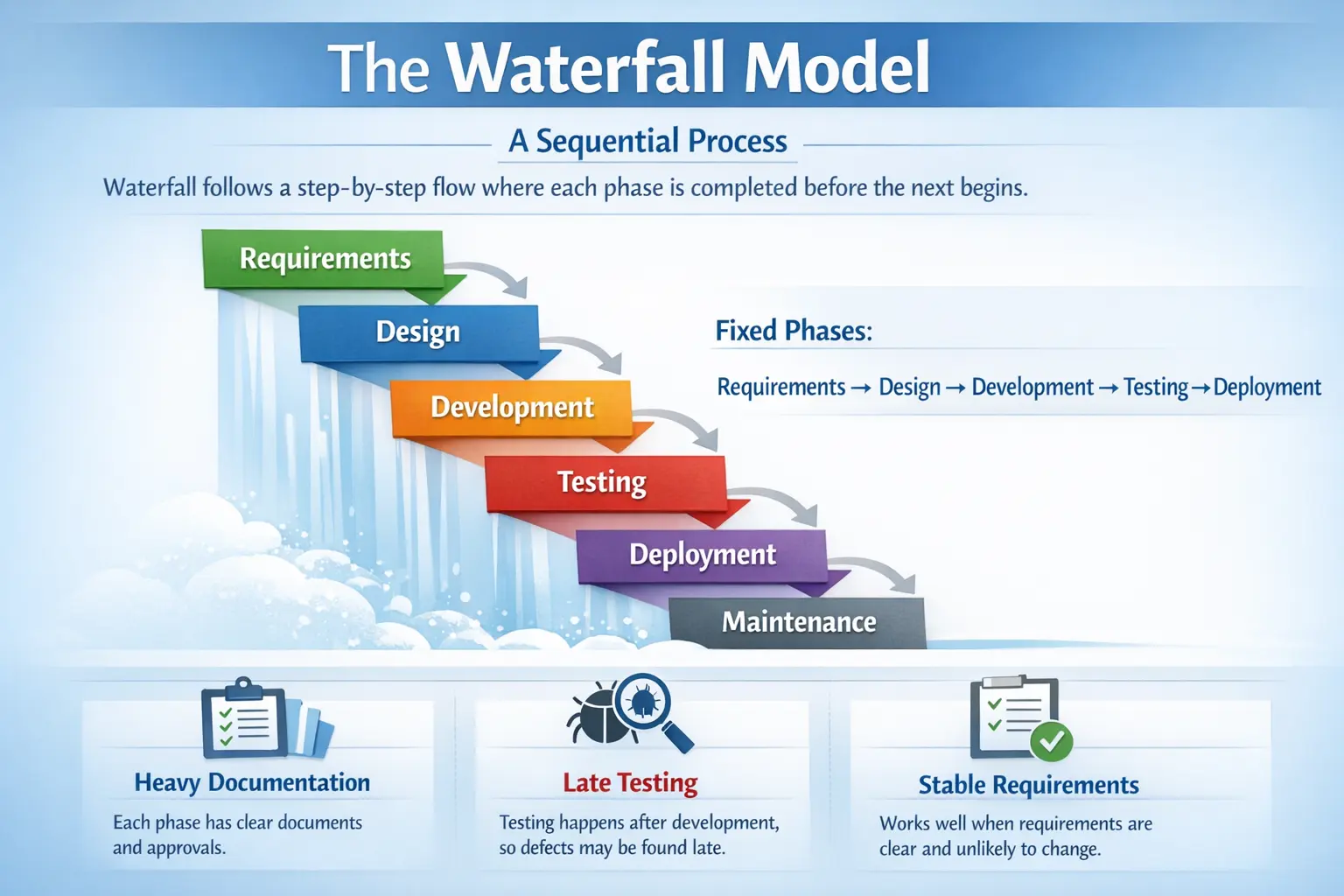
The Waterfall Model is one of the earliest and most traditional Software Development Life Cycle (SDLC) models. It follows a sequential and linear approach where each phase is completed fully before the next one begins. The name “waterfall” reflects how progress flows downward from one phase to the next, with little or no overlap.
This model emphasizes planning, documentation, and formal approvals. Because of its structured nature, it is easy to understand and manage, especially in environments where predictability is important.
Why the Waterfall Model Still Matters
The Waterfall Model still matters because many real-world projects require structure, documentation, approvals, and predictable phase control. Although modern teams often discuss Agile and iterative delivery, Waterfall remains important in environments where scope is fixed, requirements are stable, and formal governance is required. It teaches the foundation of SDLC thinking: understand requirements first, design before coding, build according to the approved design, test the completed product, deploy after approval, and maintain after release.
Waterfall is also useful for understanding why early mistakes become expensive. Because the model moves sequentially, each phase depends heavily on the previous one. If requirements are incomplete, the design may be wrong. If design is weak, development may produce unstable code. If testing starts late, defects may be discovered when they are expensive to fix. Studying Waterfall helps testers understand the importance of early review, clear documentation, and disciplined execution.
Waterfall as a Phase-Gate Model
Waterfall is often called a phase-gate model because each phase acts like a gate that must be completed before the next phase begins. Requirement analysis must be approved before design begins. Design must be approved before development begins. Development must finish before formal testing begins. Testing must be completed before deployment. Each gate usually includes deliverables, reviews, approvals, and sign-off.
This gate-based structure provides control. Project managers can track progress through milestones. Stakeholders can review documents before work moves forward. Teams can know what deliverables are expected at each stage. In regulated industries, this formal structure can be useful because auditors may need evidence that requirements were approved, design was reviewed, testing was performed, and release decisions were documented.
The same structure also creates limitations. If a requirement changes after design and development are complete, the change may require revisiting multiple previous phases. This makes Waterfall less flexible than iterative models. The strength of Waterfall is control; its weakness is delayed feedback and costly change.
Requirement Analysis in Waterfall
Requirement analysis is the most critical phase in the Waterfall Model because it determines the direction for the entire project. Since the model assumes that requirements are understood early, unclear or incomplete requirements can damage every later phase. A requirement document in Waterfall must be detailed enough for designers, developers, testers, and stakeholders to use as a stable reference.
During requirement analysis, teams identify functional requirements, non-functional requirements, business rules, user roles, constraints, assumptions, dependencies, and acceptance expectations. Manual testers can add significant value here by reviewing requirements from a validation perspective. They ask whether a rule is testable, whether expected outcomes are clear, whether error conditions are defined, and whether edge cases are missing.
If testers are excluded from this phase, defects may be built into the project before coding begins. For example, a requirement may say that users can upload documents but fail to define file size limits, supported formats, invalid file handling, duplicate upload behavior, or virus scanning expectations. Finding these gaps early is far cheaper than discovering them during formal testing.
System Design in Waterfall
The system design phase translates requirements into a technical solution. Architects and designers decide how the application will be structured, how components will interact, how data will be stored, how interfaces will be designed, and how integrations will be handled. In Waterfall, the design phase is important because development is expected to follow the approved design closely.
Design deliverables may include high-level design documents, low-level design documents, database schemas, interface specifications, API contracts, wireframes, security models, deployment architecture, and integration diagrams. These deliverables become the blueprint for coding and later testing. If the design is incomplete or unrealistic, development and testing will suffer.
Testers can participate in design walkthroughs to identify testability risks. They may ask whether logs will be available, whether test data can be created, whether error states can be observed, whether APIs can support validation, whether integrations can be simulated in test environments, and whether performance or security requirements are reflected in the design. This early involvement helps prevent designs that are technically possible but difficult to verify.
Development in Waterfall
In the development phase, programmers write code based on the approved design. Since Waterfall expects requirements and design to be stable, developers typically implement according to documented specifications rather than discovering requirements continuously during coding. Unit testing is usually performed by developers to check individual modules before they are integrated into the larger system.
While developers are coding, testers should not wait passively. Manual testers can prepare detailed test cases, test data, requirement traceability, review checklists, and regression planning. They can also clarify questions with business analysts and developers before execution begins. This preparation is important because once development is complete, the formal testing window may be limited and high-pressure.
The development phase also produces early signals about risk. If developers discover that requirements are unclear or design assumptions are wrong, those issues should be escalated quickly. In Waterfall, late change is expensive, so unresolved uncertainty during development can become a major testing and delivery problem.
Testing in Waterfall
Testing in the Waterfall Model usually happens after development is complete. This is one of the model’s defining characteristics and one of its biggest risks. By the time testers receive the build, many decisions have already been made, code has been written, and schedules may be tight. If serious defects are found, the team may need to revisit code, design, or even requirements.
The testing phase includes test execution, defect logging, defect triage, retesting, regression testing, test reporting, and quality assessment. Manual testers validate whether the completed system meets documented requirements. They execute functional scenarios, negative scenarios, boundary conditions, workflow tests, integration tests, and relevant non-functional checks depending on scope. Since testing occurs late, clear test planning and preparation are essential.
A major challenge in Waterfall testing is defect cost. A defect found during requirement review may be corrected quickly. The same defect found during testing may require code changes, retesting, regression, documentation updates, and release delay. This is why strong early reviews are critical even in a model where formal testing is late.
Deployment in Waterfall
Deployment occurs after testing is completed and the product receives required approvals. This phase moves the software into production or a live environment. Deployment may include release planning, environment preparation, configuration, database migration, installation, user training, release notes, smoke testing, and final sign-off. In Waterfall projects, deployment often follows a formal release process because the product is delivered as a larger package rather than in small increments.
Testers may support deployment by performing production smoke checks or validating the released build in a staging environment before rollout. They may also support user acceptance testing before final release. If defects are found during deployment, the impact can be significant because the project is near completion. Rollback planning is important so that the team knows how to recover if the release fails.
Maintenance in Waterfall
Maintenance begins after the software is released. Users may report defects, business teams may request enhancements, environments may change, and security patches may be required. In Waterfall, maintenance may become a new mini-lifecycle. A change request may be analyzed, designed, developed, tested, deployed, and maintained again. This is how traditional Waterfall projects handle post-release evolution.
Testers play a key role in maintenance. They validate bug fixes, perform regression testing, update test cases, and help analyze production issues. Maintenance defects can reveal weaknesses in earlier phases. If many defects come from unclear requirements, requirement review practices need improvement. If many defects come from integration issues, design and testing coverage may need strengthening.
Documentation in the Waterfall Model
Documentation is one of the strongest characteristics of Waterfall. Each phase typically produces formal deliverables. Requirement analysis produces requirement documents. Design produces architecture and design documents. Development produces code and unit test records. Testing produces test plans, test cases, defect reports, execution reports, and test summary reports. Deployment produces release notes and sign-off documents.
This documentation provides traceability and control. It helps teams understand what was agreed, what was built, what was tested, and what was released. In regulated domains, documentation may be mandatory. Auditors may need evidence that requirements were reviewed, testing was completed, and approvals were obtained. Waterfall fits such environments because it naturally supports documentation-heavy governance.
The downside is that documentation can become heavy if it is not managed carefully. Documents may become outdated if changes occur but are not reflected consistently. The goal should be useful documentation, not paperwork for its own sake. Good Waterfall documentation supports clarity, traceability, and accountability.
Role of Manual Testers in Waterfall
Manual testers are often most visible during the testing phase, but their value begins earlier. During requirement analysis, they review documents for ambiguity and missing conditions. During design, they think about testability and validation. During development, they prepare test cases and data. During testing, they execute, report, retest, and assess quality. During deployment, they support smoke testing and sign-off. During maintenance, they validate fixes and perform regression.
In Waterfall, testers must be especially disciplined because formal testing happens late. If test cases are weak, there may not be enough time to recover. If requirements were not reviewed, defects may be discovered too late. If test data is not ready, execution may be delayed. Strong manual testing in Waterfall depends on early preparation and clear communication.
Why Late Testing Is Risky
Late testing is one of the main criticisms of the Waterfall Model. When testing begins only after development, defects are discovered after significant investment has already been made. If the defect is small, the cost may be manageable. If the defect involves a misunderstood requirement, weak architecture, or missing business rule, the cost can be high. Fixing late defects can delay release and create pressure on developers and testers.
Late testing also delays user feedback. Users may not see working software until the project is nearly complete. If the product does not match user expectations, correcting it may require major rework. This is why Waterfall works best when requirements are stable, well-understood, and unlikely to change. If user needs are uncertain, iterative models usually handle feedback better.
When Waterfall Is a Good Fit
Waterfall can be a good fit when requirements are clear, stable, and formally approved. It is useful when the technology is well-understood, the project scope is fixed, the risk of change is low, and stakeholders require documentation and sign-off. It can work well for short projects, migration projects with defined scope, regulatory systems, government contracts, infrastructure upgrades, or legacy enhancements where behavior is already known.
Waterfall is also suitable when contracts require fixed deliverables and formal milestones. In such cases, a sequential model provides management visibility and documentation. The model is not automatically bad; it is simply less flexible. If the project context values predictability more than adaptability, Waterfall may be appropriate.
When Waterfall Is a Poor Fit
Waterfall is a poor fit when requirements are unclear, likely to change, or dependent on user feedback. It is also risky for innovative products where teams need to experiment and learn. If stakeholders cannot define what they want early, a model that locks phases too soon can create misalignment. By the time users see the product, it may no longer match their needs.
Waterfall can also be difficult for complex integrations where technical unknowns are high. If architecture risks are discovered late, the sequential flow becomes fragile. Agile, iterative, or incremental approaches may be better because they allow earlier feedback, smaller releases, and continuous adjustment. Choosing Waterfall should be a context-based decision, not a default habit.
Waterfall and Change Management
Change management is critical in Waterfall because changes after sign-off can affect multiple completed phases. If a requirement changes after design and development are complete, the team must analyze impact across documentation, code, test cases, schedules, and release plans. This is why Waterfall projects often use formal change request processes.
A change request may require approval from stakeholders, project managers, architects, developers, testers, and business owners. The team assesses cost, schedule impact, risk, and priority. This process can feel slow, but it provides control. In projects where scope and budget are contractually fixed, uncontrolled change can be dangerous. Waterfall handles change through governance rather than continuous adaptation.
Waterfall vs Agile in Practice
Waterfall and Agile differ in how they handle uncertainty. Waterfall assumes that requirements can be understood early and delivered through sequential phases. Agile assumes that understanding evolves and therefore uses short iterations, continuous feedback, and incremental delivery. Waterfall emphasizes documentation and phase completion. Agile emphasizes collaboration, working software, and adaptability.
Testing also differs. In Waterfall, formal testing usually happens after development. In Agile, testing happens continuously within each sprint. Waterfall may provide stronger upfront documentation, while Agile provides earlier working software. Neither model is universally better. The best choice depends on project type, requirement stability, stakeholder availability, compliance needs, team maturity, and delivery goals.
Practical Example: Building a Payroll System
A payroll system can fit Waterfall if salary rules, tax formulas, employee categories, approval workflows, and reporting requirements are stable and legally defined. During requirement analysis, the team documents all payroll rules. During design, they plan database structure, calculation logic, access control, and reports. During development, developers implement the approved design. During testing, QA validates salary calculations, deductions, employee roles, tax reports, and edge cases. After approval, the system is deployed and maintained.
This type of project may benefit from Waterfall because accuracy, documentation, and approval are critical. However, if payroll rules are changing weekly or stakeholders are uncertain about workflows, Waterfall becomes risky. The example shows that Waterfall suitability depends on requirement stability and governance needs.
Interview-Ready Understanding of Waterfall
In interviews, the Waterfall Model can be explained as a linear and sequential SDLC model where each phase is completed before the next phase begins. The main phases are requirement analysis, system design, development, testing, deployment, and maintenance. A strong answer should mention that Waterfall is documentation-heavy, requires formal approvals, and works best when requirements are stable and well-defined.
A practical answer should also mention limitations. Testing happens late, changes are costly, user feedback is delayed, and major defects found late can affect schedules. Testers should still be involved early through requirement reviews and design reviews to reduce risk. This balanced explanation shows real understanding rather than simply listing phases.
Core Idea Behind Waterfall
The fundamental idea of the Waterfall Model is that software development should move step by step through clearly defined stages. Each stage produces specific deliverables and usually requires sign-off before the project can move forward.
Once a phase is completed, teams rarely go back. This makes early accuracy in requirements and design extremely important. Mistakes discovered later can be costly because changes are harder to introduce.
Phases of the Waterfall Model
Requirement Analysis
This is the starting point where business and user needs are gathered and documented. The goal is to define exactly what the system should do. Because later phases depend heavily on these requirements, clarity and completeness are critical.
Manual testers contribute by reviewing requirements, identifying ambiguities, and thinking about edge cases. Early questions from testers often prevent major issues later.
System Design
In this phase, the system’s architecture and detailed design are prepared. This includes database design, interfaces, and technical structure. The design acts as a blueprint for development.
Testers review design documents to identify testability concerns and begin outlining high-level test scenarios. Their involvement helps ensure the design supports validation later.
Development
Developers write the code based on the approved design. Unit testing is typically performed by developers to verify individual components.
Manual testers use this time to prepare detailed test cases and review them for coverage and clarity. Understanding feature behavior early helps improve test quality.
Testing
Testing occurs after development is completed. Testers execute test cases, log defects, and verify fixes. Regression testing ensures that new fixes do not break existing functionality.
Because testing happens late in Waterfall, this phase often becomes high-pressure. Any major issue found here can affect timelines significantly.
Deployment
Once testing is completed and approvals are obtained, the software is released to production. This is when users first interact with the system.
Testers may perform final smoke testing and support user acceptance validation before full rollout.
Maintenance
After release, the system enters maintenance. Defects are fixed and enhancements may be added. Testers validate fixes and perform regression checks to ensure stability.
Key Characteristics of the Waterfall Model
The Waterfall Model is known for strict phase-by-phase execution and heavy documentation. Customer involvement is highest during requirements and reduces afterward. Changes later in the lifecycle are difficult and expensive. Since testing occurs near the end, defect detection can be delayed.
These characteristics make Waterfall structured but less flexible.
Advantages of the Waterfall Model
The model is simple and easy to understand. Clear milestones and documentation make tracking progress straightforward. It works well when requirements are stable and unlikely to change. For teams that value predictability and formal processes, Waterfall can be effective.
Disadvantages of the Waterfall Model
One major limitation is late testing, which can delay defect discovery. Changes are costly because earlier phases are already closed. Flexibility is limited, and users do not see working software until late in the project. This can increase the risk of misalignment with user expectations.
When the Waterfall Model Works Best
Waterfall is most suitable when requirements are fixed and well-defined from the beginning. It is often used in regulatory or compliance-heavy environments where documentation and approvals are mandatory. Short, low-risk projects and legacy system updates may also benefit from this model.
Industries like banking and government sometimes prefer Waterfall because of strict process and audit needs.
Waterfall Compared to Agile
Waterfall and Agile differ mainly in flexibility and feedback cycles. Waterfall is sequential, while Agile is iterative. Testing in Waterfall is late, whereas Agile promotes continuous testing. Waterfall relies heavily on documentation, while Agile values working software and collaboration.
Neither is universally better; suitability depends on project context.
Common Misunderstandings
Some assume testing only matters in the testing phase, but good testers stay involved earlier. Others underestimate the time needed for proper testing. Skipping early reviews is another mistake that increases later risk.
Interview Perspective
In interviews, the Waterfall Model is usually described as a linear SDLC approach where each phase is completed before the next begins. A stronger answer mentions heavy documentation, late testing, and suitability for stable requirements.
Key Takeaway
The Waterfall Model works best when requirements are clear and stable. Its structure provides predictability, but late testing increases defect risk and cost. Success in Waterfall depends heavily on strong early requirements, thorough reviews, and disciplined execution.