Requirement Analysis
Requirement Analysis is one of the most important phases in the software testing lifecycle. It is the process of studying, understanding, and validating requirements to ensure they are clear, complete, consistent, and testable before development and testing begin. Effective requirement analysis helps teams understand what needs to be built and how it should behave under different conditions.
Requirement Analysis answers the critical question: “What exactly needs to be built and tested?” Without clear requirements, development teams may build incorrect functionality, and testing teams may validate the wrong behavior. Many software defects originate from misunderstood or incomplete requirements, making requirement analysis essential for quality assurance.
Requirement Analysis is a core part of Shift-Left Testing, where testers participate early in the development lifecycle to prevent defects rather than detect them late. When testers analyze requirements early, they can identify ambiguities, missing scenarios, and potential risks before coding begins.
Strong requirement analysis improves communication between stakeholders, developers, and testers, resulting in higher product quality and more predictable development cycles.
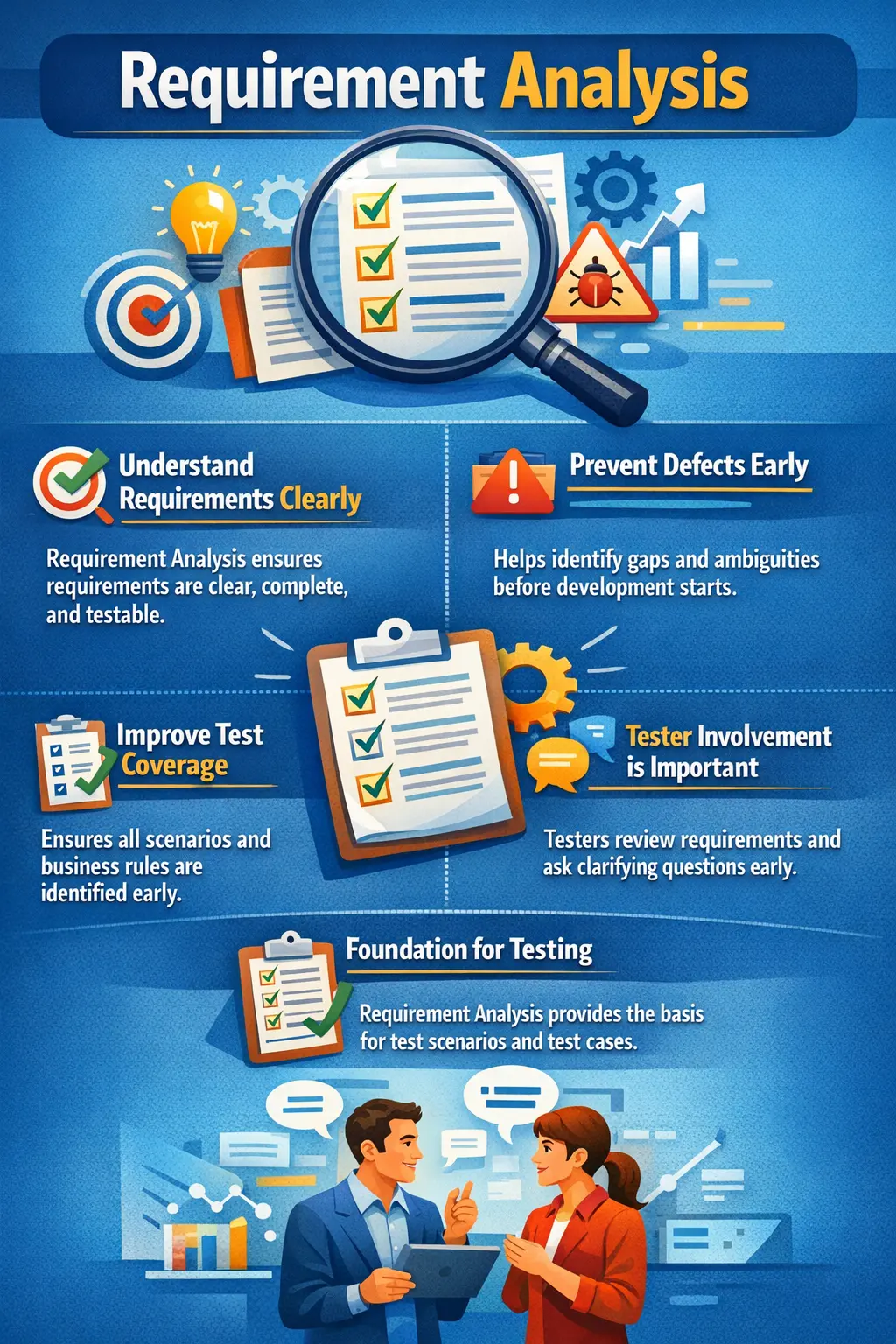
Definition of Requirement Analysis
Requirement Analysis is the process of examining and validating requirements to ensure they are clear, complete, consistent, testable, and aligned with business goals.
The objective of requirement analysis is to ensure that requirements describe the expected system behavior accurately and completely. Requirements must provide enough detail so that developers can implement functionality correctly and testers can validate it effectively.
Requirement Analysis ensures that the development team and testing team share the same understanding of system behavior.
When requirements are properly analyzed, the risk of misunderstandings and defects decreases significantly.
Requirement Analysis forms the foundation for test planning, test design, and test execution.
Purpose of Requirement Analysis
The primary purpose of Requirement Analysis is to build a strong foundation for development and testing. If requirements are unclear or incomplete, the entire project is at risk.
Requirement Analysis helps prevent defects early in the lifecycle. Many defects originate from requirement gaps rather than coding mistakes. Identifying these gaps early reduces development rework and testing delays.
Requirement Analysis eliminates ambiguity by clarifying unclear statements and assumptions. Requirements written in vague language can be interpreted differently by different team members. Requirement analysis ensures that all stakeholders share a consistent understanding.
Requirement Analysis ensures that requirements are testable. A requirement must describe behavior in a way that can be validated objectively. If a requirement cannot be tested, it cannot be verified.
Requirement Analysis also helps identify risks and dependencies. External systems, data requirements, and environment dependencies must be identified early to avoid delays.
Overall, Requirement Analysis provides a structured understanding of what needs to be built and how it will be validated.
Sources of Requirements
Requirements come from multiple sources, and testers must review all relevant documents and discussions to gain a complete understanding of the system.
Business Requirement Documents describe high-level business needs and objectives. These documents explain why a system is needed and what business problems it should solve. They provide context for functional requirements.
Functional Requirement Specifications describe detailed system behavior. These specifications define how the system should behave under various conditions. Functional requirements provide detailed input for test design.
User stories and acceptance criteria are commonly used in Agile projects. User stories describe functionality from the user’s perspective, while acceptance criteria define conditions that must be satisfied for the story to be considered complete.
Use cases describe workflows and interactions between users and systems. Use cases help testers understand end-to-end functionality and user behavior.
Stakeholder discussions and workshops provide additional information that may not be documented formally. Testers often gain important insights by participating in requirement meetings and discussions.
Understanding requirements from multiple sources ensures complete test coverage.
Manual Tester’s Role in Requirement Analysis
Manual testers play a critical role in Requirement Analysis because they evaluate requirements from a validation perspective.
Testers read requirements carefully and interpret them from a testing standpoint. While developers focus on implementation details, testers focus on validation and verification.
Testers ask clarifying questions when requirements are unclear. Questions help remove ambiguity and prevent misunderstandings.
Testers identify missing scenarios that may not have been considered during requirement writing. Missing scenarios often lead to defects in production.
Testers validate business rules and constraints to ensure that requirements reflect actual business needs.
Testers ensure that requirements are testable by verifying that expected results can be measured and validated.
Requirement Analysis allows testers to contribute to quality before development begins.
Clarity in Requirements
Clear requirements are essential for successful development and testing. Requirements must be written in a way that leaves no room for multiple interpretations.
Testers verify that requirements are unambiguous. Words such as “fast,” “user-friendly,” and “as needed” often create confusion because they lack measurable definitions.
Testers verify that terminology is consistent throughout the documentation. If the same feature is referred to by different names in different documents, misunderstandings may occur.
Clear requirements reduce communication gaps and prevent incorrect implementations.
Well-defined requirements enable efficient testing and accurate validation.
Completeness of Requirements
Complete requirements describe all necessary behavior of the system. Incomplete requirements often lead to unexpected defects.
Testers verify that all major scenarios are covered. This includes normal scenarios where the system behaves as expected.
Testers verify that negative scenarios are defined. Requirements should specify how the system behaves when invalid input is provided.
Testers verify that edge conditions are covered. Boundary values often reveal hidden defects.
Testers verify that error handling behavior is defined. Requirements should specify how the system responds to failures and unexpected conditions.
Complete requirements reduce the risk of missing functionality during development and testing.
Consistency of Requirements
Consistency ensures that requirements do not conflict with each other.
Testers verify that no requirement contradicts another requirement. Conflicting requirements create confusion for developers and testers.
Testers verify alignment between different requirement documents. Business requirements, functional specifications, and user stories must describe consistent behavior.
Testers verify that acceptance criteria match requirement descriptions.
Consistent requirements prevent incorrect implementations and reduce rework.
Consistency also improves confidence in system behavior.
Testability of Requirements
Testability is a critical aspect of Requirement Analysis. A requirement must be written in a way that allows objective validation.
Testers verify that expected results can be measured and verified. Requirements such as “system should perform well” are not testable unless performance criteria are defined.
Testers verify that acceptance criteria provide measurable outcomes.
Testers verify that test scenarios can be derived from requirements.
Testable requirements enable efficient test design and reliable validation.
Without testable requirements, testing becomes subjective and unreliable.
Requirement Analysis Activities
Requirement Analysis involves several practical activities performed by testers.
Requirement walkthroughs allow team members to review requirements together. Walkthroughs provide opportunities to clarify unclear statements and resolve conflicts.
Backlog refinement sessions allow testers to review user stories before they enter the sprint. Testers ensure that stories are ready for development and testing.
Acceptance criteria validation ensures that user stories include clear and testable conditions.
Early test scenario identification helps testers understand requirements more deeply and identify missing scenarios.
Risk identification helps teams anticipate potential challenges and plan mitigation strategies.
These activities support early defect prevention.
Common Requirement Issues Found by Testers
Requirement Analysis often reveals common types of requirement issues.
Ambiguous statements are one of the most common problems. Requirements written with vague language can lead to multiple interpretations.
Missing validation rules often result in incorrect system behavior. Input validation must be clearly defined.
Undefined boundary conditions may lead to incorrect behavior at extreme values.
Unclear error handling creates uncertainty about how the system should respond to failures.
Hidden assumptions may exist when requirement writers assume certain behaviors without documenting them.
Identifying these issues early prevents defects later.
Requirement Analysis vs Test Design
Requirement Analysis focuses on understanding what needs to be built and validated.
Test Design focuses on defining how the system will be tested.
Requirement Analysis occurs early in the development lifecycle before test scenarios are written.
Test Design occurs after requirements are understood and clarified.
Requirement Analysis produces clarified and validated requirements.
Test Design produces test scenarios and test cases.
Both activities are essential for effective testing.
Requirement Analysis provides the foundation for Test Design.
Real-Time Requirement Analysis Example
Consider a requirement that states:
“User can withdraw money.”
This requirement is incomplete and ambiguous.
A tester performing requirement analysis may ask several important questions.
The tester may ask about the maximum withdrawal limit allowed per transaction.
The tester may ask how the system should respond if the account balance is insufficient.
The tester may ask whether daily withdrawal limits apply.
The tester may ask what error messages should be displayed.
The tester may ask whether authentication is required before withdrawal.
These questions clarify the requirement and prevent defects.
Early clarification improves development accuracy and testing efficiency.
Common Mistakes in Requirement Analysis
One common mistake is assuming that requirements are correct without questioning them. Requirements often contain gaps and ambiguities.
Another mistake is delaying requirement questions until the testing phase. Late clarification leads to rework and delays.
Ignoring non-functional requirements is another common problem. Performance, security, and usability requirements must also be analyzed.
Failing to document clarifications may result in misunderstandings later.
Requirement Analysis requires careful attention and proactive communication.
Avoiding these mistakes improves project outcomes.
Requirement Analysis in Agile Projects
Requirement Analysis is especially important in Agile projects where requirements evolve frequently.
Testers participate in backlog refinement sessions to clarify user stories.
Testers review acceptance criteria to ensure testability.
Testers identify missing scenarios early.
Testers collaborate with Product Owners and developers.
Agile Requirement Analysis supports continuous improvement.
Early analysis reduces sprint delays.
Requirement Analysis improves sprint predictability.
Requirement Analysis as Defect Prevention
Requirement Analysis is one of the most effective forms of defect prevention because many software defects begin before code exists. A developer may write code correctly according to an unclear requirement, but the resulting feature can still be wrong for the business. In that situation, the root problem is not coding skill; it is requirement misunderstanding. Analyzing requirements early helps prevent this kind of defect.
Requirement defects are expensive because they often spread through multiple project activities. A vague requirement can lead to incorrect design, incorrect development, incorrect test cases, and incorrect user expectations. If the problem is found late, the team may need to revise the requirement, change the code, update tests, retest affected areas, and explain the delay to stakeholders. Early analysis avoids this chain reaction.
Testers are especially useful in defect prevention because they naturally question how the system should behave under different conditions. They think about valid input, invalid input, missing data, boundary values, user permissions, workflow interruptions, and error messages. These questions expose missing information before implementation begins.
Defect prevention also improves team confidence. When requirements are clear and testable, developers know what to build, testers know what to validate, and Product Owners know how the story will be accepted. This shared clarity reduces unnecessary back-and-forth during the sprint.
Requirement Analysis should therefore be treated as a quality activity, not just a documentation activity. Its purpose is not only to read documents; its purpose is to make the expected product behavior clear enough to build and test correctly.
How Testers Read Requirements
Testers read requirements differently from developers, business analysts, and stakeholders. A developer may focus on how to implement a feature. A Product Owner may focus on business value. A tester focuses on how the behavior can be validated and where it may fail. This perspective makes testers valuable during analysis.
A tester first looks for the main business flow. Who performs the action? What condition exists before the action? What does the user do? What result should occur? This helps the tester understand the happy path and the basic purpose of the feature.
After understanding the main flow, the tester looks for alternate flows. What happens if the user enters invalid data? What happens if the user lacks permission? What happens if required data is missing? What happens if the system dependency is unavailable? Alternate flows are often under-documented, but they are important for reliable software.
Testers also look for measurable outcomes. A requirement that says “the system should process quickly” is not testable unless speed is defined. A requirement that says “the user should receive a proper message” is not testable unless the message or message meaning is defined. Testers convert vague expectations into objective validation questions.
Finally, testers compare the requirement with existing behavior. A new feature may affect old workflows, reports, permissions, data rules, or integrations. Requirement Analysis should consider not only the new feature but also its impact on the wider system.
Analyzing Functional and Non-Functional Requirements
Functional requirements describe what the system should do. They include user actions, system responses, business rules, calculations, workflows, and data processing. During Requirement Analysis, testers verify whether these behaviors are clear, complete, and testable.
Non-functional requirements describe how well the system should work. They include performance, security, usability, reliability, compatibility, accessibility, scalability, and maintainability expectations. These requirements are often ignored or written vaguely, but they strongly affect user satisfaction and business risk.
For example, a functional requirement may state that users can submit a loan application. Non-functional requirements may state that the application form should load within three seconds, protect sensitive data, support mobile browsers, provide accessible labels, and remain available during peak usage. If these expectations are not analyzed early, they may be discovered too late.
Manual testers should ask whether non-functional expectations are defined wherever relevant. If a feature handles sensitive information, security requirements matter. If a feature is used by many customers, performance matters. If a feature is public-facing, accessibility and compatibility matter. Requirement Analysis should include these quality attributes.
Strong testers do not treat non-functional requirements as separate afterthoughts. They consider them during early analysis so that design, development, and testing can account for them from the beginning.
Requirement Questions Testers Should Ask
Good Requirement Analysis depends on good questions. Testers should ask questions that reveal missing behavior, unclear rules, hidden assumptions, and validation needs. The goal is not to challenge people unnecessarily; the goal is to make the requirement strong enough to build and test.
For every requirement, testers can ask who the user is, what the user wants to accomplish, what value the requirement provides, and what the expected result should be. These questions confirm the purpose and main behavior of the feature.
Testers should also ask about negative conditions. What happens if the user enters invalid data? What happens if mandatory fields are blank? What happens if the user repeats the action? What happens if the session expires? What happens if the user does not have permission? These questions help define failure behavior.
Boundary questions are also important. What is the minimum allowed value? What is the maximum allowed value? What happens exactly at the limit? What happens beyond the limit? Boundary-related defects are common because requirements often describe normal behavior but not extremes.
Testers should ask about dependencies as well. Does the feature depend on another module, external API, database, report, email service, payment gateway, or third-party system? If yes, how should the system behave when the dependency fails? These questions reduce integration surprises.
Requirement Analysis and Acceptance Criteria
Acceptance criteria are one of the most important outputs of effective Requirement Analysis in Agile teams. A user story may describe the user need, but acceptance criteria define the conditions that must be satisfied for the story to be accepted. Testers use these criteria to design validation scenarios.
During Requirement Analysis, testers verify whether acceptance criteria are specific, measurable, and complete. A criterion such as “user should see an error message” is incomplete unless it explains when the error appears and what the message should communicate. A criterion such as “system should work properly” is not useful because it does not define observable behavior.
Acceptance criteria should include positive scenarios, negative scenarios, and important edge cases. If a story involves login, criteria should cover valid login, invalid login, locked account, empty fields, and possibly session behavior. If a story involves payment, criteria should cover success, failure, timeout, duplicate submission, and confirmation behavior where relevant.
Requirement Analysis also helps identify whether acceptance criteria are too broad. If one story has many criteria covering multiple workflows, the story may be too large. Splitting it into smaller stories can make development and testing more manageable.
Well-analyzed acceptance criteria reduce ambiguity and help the whole team share the same definition of success. They also make sprint execution smoother because developers and testers start with clear validation rules.
Requirement Traceability
Requirement traceability means connecting requirements to test scenarios, test cases, defects, and sometimes releases. Traceability helps teams confirm that every important requirement has been covered by testing and that every test case maps back to a business need.
In structured projects, a Requirement Traceability Matrix may be used to track this relationship. In Agile projects, traceability may be managed through backlog tools, user story links, acceptance criteria, test management systems, or lightweight documentation. The form may differ, but the purpose remains the same: ensure nothing important is missed.
Traceability is useful during change impact analysis. If a requirement changes, testers can identify which test cases need updates. If a defect is found, the team can trace it back to the requirement and determine whether the requirement was unclear, missing, or incorrectly implemented.
Traceability also supports audits and stakeholder confidence. When stakeholders ask whether a business rule has been tested, testers can show the related scenarios and results. This is especially important in regulated domains such as banking, healthcare, insurance, and government systems.
Requirement Analysis provides the foundation for traceability. If requirements are unclear or poorly structured, traceability becomes difficult. Clear, well-analyzed requirements make coverage easier to prove.
Requirement Analysis in Agile Refinement
In Agile projects, Requirement Analysis often happens during backlog refinement. The Product Owner presents upcoming user stories, and the team discusses business value, acceptance criteria, dependencies, risks, and size. Testers should participate actively because this is the best time to improve testability.
During refinement, testers can ask whether the story meets Definition of Ready. Is the story clear? Are acceptance criteria present? Is the story small enough for the sprint? Are dependencies known? Can test scenarios be derived? Is test data available or identifiable? These questions help prevent unready stories from entering a sprint.
Agile refinement also allows testers to identify scenario gaps before sprint planning. If the tester sees missing negative cases or unclear error handling, the Product Owner can clarify before developers begin implementation. This reduces mid-sprint interruptions and late-cycle defects.
Requirement Analysis in Agile is continuous. Requirements may evolve, and new information may appear during development. However, the team should still aim to clarify enough before sprint commitment so that development and testing can proceed smoothly.
Strong refinement practices make sprints more predictable. Stories enter the sprint with clearer expectations, and testers can begin planning validation earlier.
Requirement Analysis and Risk Identification
Requirement Analysis is also a risk identification activity. Some requirements carry more risk than others. A change to a financial calculation, authentication flow, payment process, or data migration has higher impact than a minor label change. Testers should identify these risks early so the team can plan appropriate validation.
Risk may come from complexity, business impact, technical dependency, unclear rules, new technology, integration points, or defect history. If a feature touches many modules or external systems, the testing risk is higher. If the requirement is vague or frequently changing, the delivery risk is higher.
Testers can communicate risk in practical terms. Instead of saying “this needs more testing,” they can explain why: “This change affects account balance calculation and transaction history, so we need to validate calculation rules, audit entries, and regression impact on statements.” This helps the team understand the reason behind testing effort.
Early risk identification also helps with prioritization. High-risk requirements may need more refinement, earlier development, deeper testing, or additional review. Low-risk requirements may need lighter validation. This makes testing effort more efficient.
Requirement Analysis helps teams avoid treating all requirements equally. It guides attention toward the areas where misunderstanding would cause the most damage.
Detailed Practical Example
Consider a requirement for an online banking application: “Customer should be able to transfer funds.” This statement gives a general idea, but it is not enough for development or testing. Requirement Analysis expands it into clear behavior.
A tester begins by asking about account types. Can funds be transferred between own accounts, to another customer, or to an external bank? Are all account types eligible? Are there restrictions for inactive, frozen, or closed accounts? These questions clarify scope.
The tester then asks about limits and business rules. What is the minimum transfer amount? What is the maximum per transaction? Is there a daily limit? Are fees applied? Can scheduled transfers be created? What happens if the balance is insufficient? These questions define testable rules.
The tester also asks about security and confirmation. Does the user need multi-factor authentication? Is a confirmation screen required? Should the user receive email or SMS notification? Can the user cancel a transfer? Is the transfer recorded in transaction history immediately?
By asking these questions early, the tester helps transform a vague requirement into clear acceptance criteria and test scenarios. Development becomes more accurate, testing becomes more complete, and the risk of late defects decreases.
Best Practices for Requirement Analysis
Start analysis early. Testers should not wait until a build is available to understand requirements. The earlier testers review requirements, the more opportunity they have to prevent defects and clarify expectations.
Use examples wherever possible. Examples make abstract requirements concrete. Instead of discussing “eligible users,” define examples of eligible and non-eligible users. Instead of discussing “valid amount,” define minimum, maximum, and invalid values.
Document clarifications clearly. Verbal discussions are useful, but important decisions should be captured in user stories, acceptance criteria, requirement notes, or test documentation. Undocumented clarification can be forgotten or interpreted differently later.
Review both functional and non-functional expectations. A feature may function correctly but still fail if it is slow, insecure, inaccessible, unreliable, or difficult to use. Requirement Analysis should include quality attributes where relevant.
Collaborate continuously. Requirement Analysis is not the tester working alone. It is a shared activity involving Product Owners, business analysts, developers, testers, designers, and stakeholders. The best requirements emerge from discussion, examples, and feedback.
Finally, treat requirement analysis as an ongoing discipline rather than a one-time meeting. When new information appears during development, testing, or stakeholder review, update the requirement, acceptance criteria, and related test scenarios so the team continues working from the same understanding.
This discipline keeps requirement knowledge current and prevents old assumptions from guiding new work. In practical projects, maintaining that shared understanding is often the difference between smooth delivery and repeated clarification cycles.
Interview Perspective
Requirement Analysis is a common topic in software testing interviews.
Interviewers expect testers to understand the importance of requirement clarity and testability.
A short answer usually defines Requirement Analysis as understanding and validating requirements.
A detailed answer explains how testers identify ambiguities and missing scenarios.
Interviewers often expect examples of requirement questions.
Strong understanding of Requirement Analysis demonstrates professional testing skills.
Requirement Analysis knowledge shows that a tester understands defect prevention.
Key Takeaway
Requirement Analysis is a critical activity that ensures requirements are clear, complete, consistent, and testable before development begins.
Strong Requirement Analysis prevents defects early, improves test coverage, and reduces project risk.
Manual testers play a vital role by reviewing requirements carefully, asking clarifying questions, and identifying missing scenarios.
Effective Requirement Analysis builds a strong foundation for development and testing, leading to higher quality software and more predictable releases.