Re-Testing: Verifying That Defects Are Truly Fixed
Introduction to Re-Testing
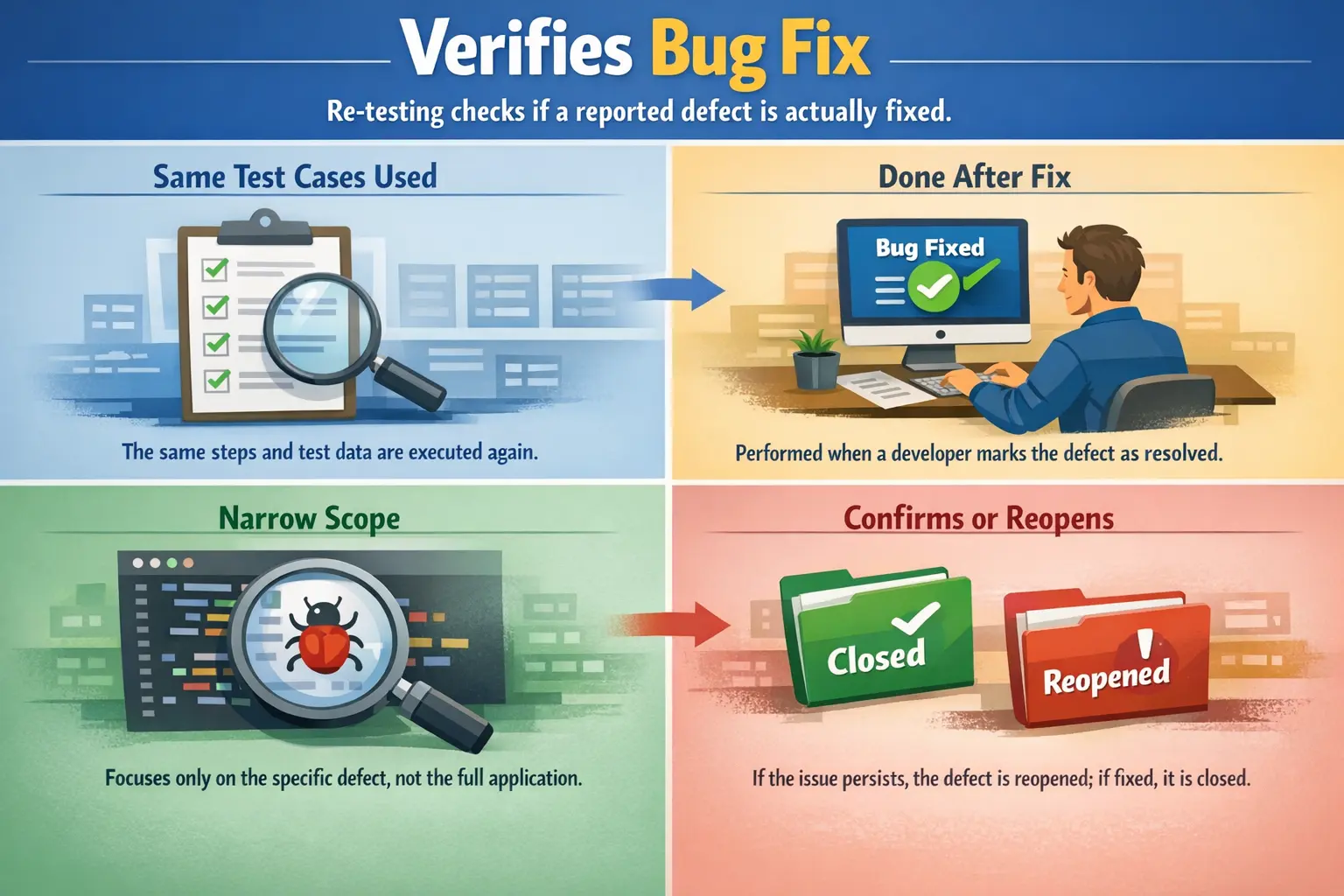
Re-Testing is the process of executing the same test case again to verify that a previously reported defect has been fixed correctly. It focuses strictly on confirming the resolution of a specific issue. In simple terms, re-testing answers the question: is the reported bug really fixed?
Re-testing is a direct validation activity and forms a critical part of defect management.
Purpose of Re-Testing
The primary purpose of re-testing is to confirm that the defect fix works as expected. When a tester reports a defect, the team should not assume the issue is resolved simply because code has been changed or the developer has marked the defect as fixed. Re-testing provides direct evidence. It verifies whether the specific problem that was observed earlier no longer occurs in the fixed build.
It ensures that the intended behavior has been restored and that the fix is complete rather than partial. A partial fix can be dangerous because it may appear correct in one situation but fail in another condition that was part of the original issue. Re-testing helps catch this by repeating the failed scenario carefully with the same steps, data, and expected outcome.
Re-testing also prevents incorrect defect closure, which could lead to repeated failures later. If a defect is closed without verification, the same problem may reappear during regression testing, user acceptance testing, or even production use. This creates rework and reduces trust in the defect management process.
By validating each fix carefully, re-testing supports accurate defect tracking and quality assurance. It creates accountability in the testing lifecycle because every defect moves from reported to fixed to verified based on observed behavior, not assumption.
When Re-Testing Is Performed
Re-testing is performed after a defect is marked as fixed and a new build is made available for verification. The tester should confirm that the fix is included in the deployed build before starting. If the wrong build is tested, the result may be misleading. A defect may appear unfixed simply because the fix has not been deployed, or it may appear fixed in one environment but not another.
Re-testing typically occurs before regression testing begins, since the specific fix must first be validated before checking its broader impact. If the original defect still exists, wider regression around that fix may not be useful yet. The team should first correct the known issue.
Re-testing is part of the defect verification cycle and continues until the issue is either confirmed as resolved or reopened. In some cases, a defect may go through multiple fix-and-retest cycles before it is finally closed. This is normal when the defect is complex, data-dependent, environment-dependent, or tied to unclear requirements.
It may also be performed during sprint testing, system testing, regression cycles, UAT support, or release candidate validation. The timing depends on when the fix is delivered, but the principle remains the same: the exact reported issue must be verified before it can be considered resolved.
Scope of Re-Testing
The scope of re-testing is narrow and specific. It involves executing the exact test case that originally failed, using the same test steps and test data as much as possible. The goal is to compare the new result against the expected behavior defined earlier. Consistency is important because re-testing is about verifying a known failure, not exploring new possibilities.
If a tester changes the input data, changes the user role, uses a different environment, or follows a different path, the result may no longer prove whether the original defect is fixed. There may be valid reasons to add extra checks, but the first re-test should repeat the original failure condition as closely as possible.
Re-testing does not involve checking related modules or validating side effects. That responsibility belongs to regression testing. For example, if a defect in the login page is fixed, re-testing confirms that the specific login defect is resolved. Regression testing checks whether password reset, session handling, profile access, and logout still work after the fix.
This narrow scope makes re-testing efficient and clear. It avoids confusion between defect verification and broader stability validation. Both are needed, but they should not be mixed without purpose.
Re-Testing Compared to Regression Testing
Re-testing and regression testing are often confused, but they serve different purposes. Re-testing focuses on a specific defect fix and uses the same test case that failed previously. It asks whether the reported defect is fixed. Regression testing focuses on ensuring that existing functionality continues to work after changes and uses different test cases covering broader areas.
Re-testing is narrow, direct, and corrective. Regression testing is broader, indirect, and preventive. Re-testing confirms the known issue. Regression testing looks for side effects caused by the fix. If a payment defect is fixed, re-testing confirms that the failed payment scenario now works. Regression testing checks whether order history, invoice generation, confirmation emails, and refund workflows still work.
Re-testing is mandatory for defect closure, while regression testing is strongly recommended to ensure stability. A defect should not be closed unless the tester verifies the fix. Regression testing may vary in scope depending on impact, risk, and available time, but re-testing the defect itself is not optional in a disciplined defect lifecycle.
The sequence also matters. Re-testing usually comes first. If re-testing fails, the defect is reopened. If re-testing passes, the team can decide how much regression testing is required. This sequence keeps the test process logical and efficient.
Role of the Manual Tester
The manual tester re-executes the failed test case carefully and validates whether the issue is resolved. The tester begins by reading the defect report, understanding the original steps, checking the expected and actual results, and confirming that the fix is available in the test environment. This preparation prevents incorrect verification.
During execution, the tester follows the same steps that originally exposed the defect. The tester uses the same or equivalent test data, observes the result, and compares it with the expected behavior. If the issue is resolved, the tester updates the defect status to closed, verified, or passed depending on the project's workflow.
If the problem persists, the tester reopens the defect with updated evidence. This evidence may include screenshots, screen recordings, logs, environment details, build version, and the exact data used. A reopened defect should make it easy for developers to understand that the fix did not resolve the original issue.
Accurate documentation during re-testing maintains transparency and accountability in defect resolution. It also helps managers and stakeholders understand defect status accurately. A defect tracking report is useful only when statuses reflect verified reality.
A Practical Scenario
Consider a defect where the submit button does not respond. The original report states that when a user fills all mandatory fields and clicks Submit, nothing happens. The expected result is that the form should be saved and a confirmation message should appear. After the developer applies a fix, the tester re-executes the same steps that originally exposed the issue.
If the button now works as expected, the defect is marked as closed. The tester may add a comment such as "Verified in build 2.4.1 using the original steps and test data. Form submitted successfully and confirmation message displayed." This makes the verification clear.
If the issue remains, the defect is reopened with updated evidence. The tester should not create a vague comment like "still not working." A better comment would describe the exact result: "Verified in build 2.4.1. After entering valid data and clicking Submit, the button becomes disabled and no confirmation message appears." This helps developers investigate quickly.
If the original issue is fixed but a new issue appears, the tester must use judgment. If the new behavior is directly related to the same fix, the same defect may be reopened with details. If it is a separate issue, a new defect may be logged and linked to the original one. This keeps defect tracking clean.
This direct validation ensures reliability in defect tracking. It proves that closure is based on actual testing, not developer assumption or status changes.
Entry and Exit Considerations
Re-testing begins when a defect is marked as fixed and a new build is available. The tester should confirm that the build contains the fix, the test environment is accessible, and the required test data is available. If these entry conditions are not met, the re-test result may not be reliable.
A good entry point also requires a clear defect report. If the original report does not contain enough detail, re-testing becomes difficult. The tester may need to review comments, ask the developer, or check earlier evidence to reconstruct the failed scenario.
Re-testing concludes when the defect is verified as resolved or formally reopened for further correction. If the fix passes, the defect can be closed according to the team's workflow. If it fails, the defect remains open or is reopened, and the developer must investigate again.
These clear checkpoints ensure that fixes are validated methodically. They also prevent defects from drifting in unclear states such as fixed but not verified, ready for testing but not deployed, or closed without confirmation.
Common Mistakes
One common mistake is modifying the test case during re-testing, which reduces consistency. Another error is skipping re-testing and moving directly to regression testing, leaving defect resolution unverified. Using different test data may also produce misleading results.
Another common mistake is closing a defect based only on developer confirmation. Developer confirmation is useful, but QA verification is still needed. The tester must observe the behavior in the test environment and confirm that the expected result is achieved.
Some testers fail to check the exact original condition. For example, if the original defect occurred only for a specific user role or browser, testing with a different role or browser may not prove the fix. The re-test should match the original failure condition as closely as possible.
Poor comments are another issue. A re-test comment should explain what was verified and in which build. This is especially important when defects are audited later or when multiple people are involved in the fix cycle.
Re-testing must remain controlled and consistent. Its strength comes from repeating the known failed scenario and confirming whether the outcome has changed correctly.
Best Practices for Re-Testing
The first best practice is to preserve the original defect details. Test steps, data, screenshots, logs, and environment information make re-testing easier and more accurate. A well-written defect report becomes the guide for re-testing.
The second best practice is to verify the fix in the correct build. Before executing the re-test, the tester should confirm the build number or deployment note. Testing the wrong build wastes time and can create confusion between QA and development.
The third best practice is to repeat the original failed scenario first. Additional checks may be useful, but the original failure should be verified before expanding the scope. This keeps the re-testing objective clear.
The fourth best practice is to document the result clearly. If the defect is fixed, mention the build and confirmation. If it is not fixed, provide updated evidence. Good comments reduce repeated questions and help the whole team understand the defect status.
The fifth best practice is to follow re-testing with appropriate regression testing when needed. Re-testing confirms the fix, but it does not prove that the fix did not break related functionality. The tester should recommend regression based on impact and risk.
Re-Testing in the Defect Lifecycle
Re-testing is tightly connected to the defect lifecycle. A typical defect may move from new to assigned, in progress, fixed, ready for retest, verified, and closed. Re-testing happens when the defect reaches the fixed or ready-for-retest stage. The tester's verification determines whether the defect can move forward or must return to development.
This makes re-testing important for defect metrics. If defects are closed without proper re-testing, defect closure numbers may look good but quality may remain poor. Accurate re-testing keeps metrics honest.
Re-testing also supports communication between testers and developers. When a defect is reopened with clear evidence, the developer can focus on the unresolved issue. When it is verified and closed, everyone knows that the reported problem has been addressed.
Evidence and Documentation in Re-Testing
Evidence is important in re-testing because the activity directly affects defect status. When a defect is closed, the project record should show why it was closed. When a defect is reopened, the project record should show why the fix was not accepted. Clear evidence protects the tester, helps the developer, and keeps the defect history useful for future reference.
Useful evidence may include screenshots, screen recordings, browser console errors, server logs, downloaded files, transaction numbers, request IDs, timestamps, and test data. The type of evidence depends on the defect. A UI alignment defect may need a screenshot. A failed transaction may need a transaction ID and log timestamp. A data-saving defect may need before-and-after screenshots or database-visible confirmation if that is part of the team's process.
Documentation should be concise but complete. A good re-testing comment does not need to be long, but it should answer the important questions: which build was tested, what steps were repeated, what data was used, what result was observed, and what status decision was made. This is especially useful when multiple builds are produced quickly and several defects are moving through the workflow at the same time.
Poor documentation creates confusion. If a tester simply writes "passed" or "failed" without context, the team may not know whether the original condition was truly checked. If the defect returns later, the lack of detail makes investigation harder. Good re-testing documentation keeps the defect record trustworthy.
Handling Reopened Defects
A reopened defect means the fix did not resolve the original issue or the issue still appears under the required condition. Reopening is not a blame activity. It is part of the normal defect correction cycle. Complex defects sometimes require more than one fix attempt, especially when the root cause is unclear or the behavior depends on data, environment, timing, integration, or user role.
When reopening a defect, the tester should be specific. The update should explain whether the same issue still occurs, whether the behavior changed but remains incorrect, or whether the fix created a closely related failure. This distinction matters. Developers can act faster when they know whether they are dealing with an unchanged defect, a partial fix, or a new symptom.
The tester should also avoid reopening a defect for unrelated behavior. If the original submit button issue is fixed but a different field validation fails, the team may decide to log a new defect and link it to the original one. This keeps defect tracking clean and prevents one ticket from becoming a collection of many separate issues.
Reopened defects should receive attention because they indicate that the first fix was not sufficient. If the same defect is reopened repeatedly, the team may need deeper root cause analysis, better developer-test communication, clearer requirements, or more precise test data. Re-testing can reveal these process gaps.
Re-Testing in Agile and Release Cycles
In Agile teams, re-testing often happens continuously. A tester reports a defect during a sprint, the developer fixes it, the build is updated, and the tester verifies the fix as soon as possible. This quick loop keeps the story moving and reduces the chance that unresolved defects accumulate at the end of the sprint.
During release cycles, re-testing becomes part of release readiness. Open defects must be reviewed, fixed defects must be verified, and unresolved issues must be consciously accepted or deferred. Re-testing provides the evidence needed to say which fixes are truly complete.
In fast-moving environments, testers should pay close attention to build versions. If several builds are deployed in one day, a defect may be fixed in one build but accidentally missing in another. Recording the build used for re-testing avoids confusion and helps the team trace what was verified.
Interview Perspective
In interviews, re-testing is typically defined as executing the same test case again to verify that a defect has been fixed. A strong explanation emphasizes that it validates resolution rather than testing the entire application.
A stronger interview answer also explains that re-testing is narrow, specific, and mandatory for defect closure. It uses the same steps and data that originally failed. If the defect is fixed, it is closed. If it is not fixed, it is reopened with evidence.
If asked to compare re-testing with regression testing, the answer should be clear: re-testing verifies the specific defect fix, while regression testing verifies that other existing functionality was not affected by the fix. Re-testing is about the known issue. Regression testing is about side effects.
If asked for an example, use a simple one. A submit button was not working. After the developer fixes it, the tester repeats the same steps. If the button submits the form correctly, the defect is closed. If it still fails, the defect is reopened.
Key Takeaway
Re-Testing ensures that defect fixes are validated, not assumed. It provides confidence that reported issues are truly resolved before the product moves forward. Without re-testing, defect closure would rely on assumption rather than verification.
The value of re-testing is precision. It focuses on one known problem and asks whether that problem is actually fixed. This narrow focus makes it one of the clearest and most important activities in defect management.
Good re-testing protects the team from false closure, repeated failures, and unreliable defect reports. It also creates a clean handoff to regression testing, where the broader impact of the fix can be evaluated. Together, re-testing and regression testing help teams confirm both correction and stability.