Test Estimation Techniques
Software testing is a critical phase in the software development lifecycle, but it cannot begin without proper planning. One of the most important aspects of planning is understanding how much effort, time, and resources will be required to complete testing activities. This process is known as Test Estimation.
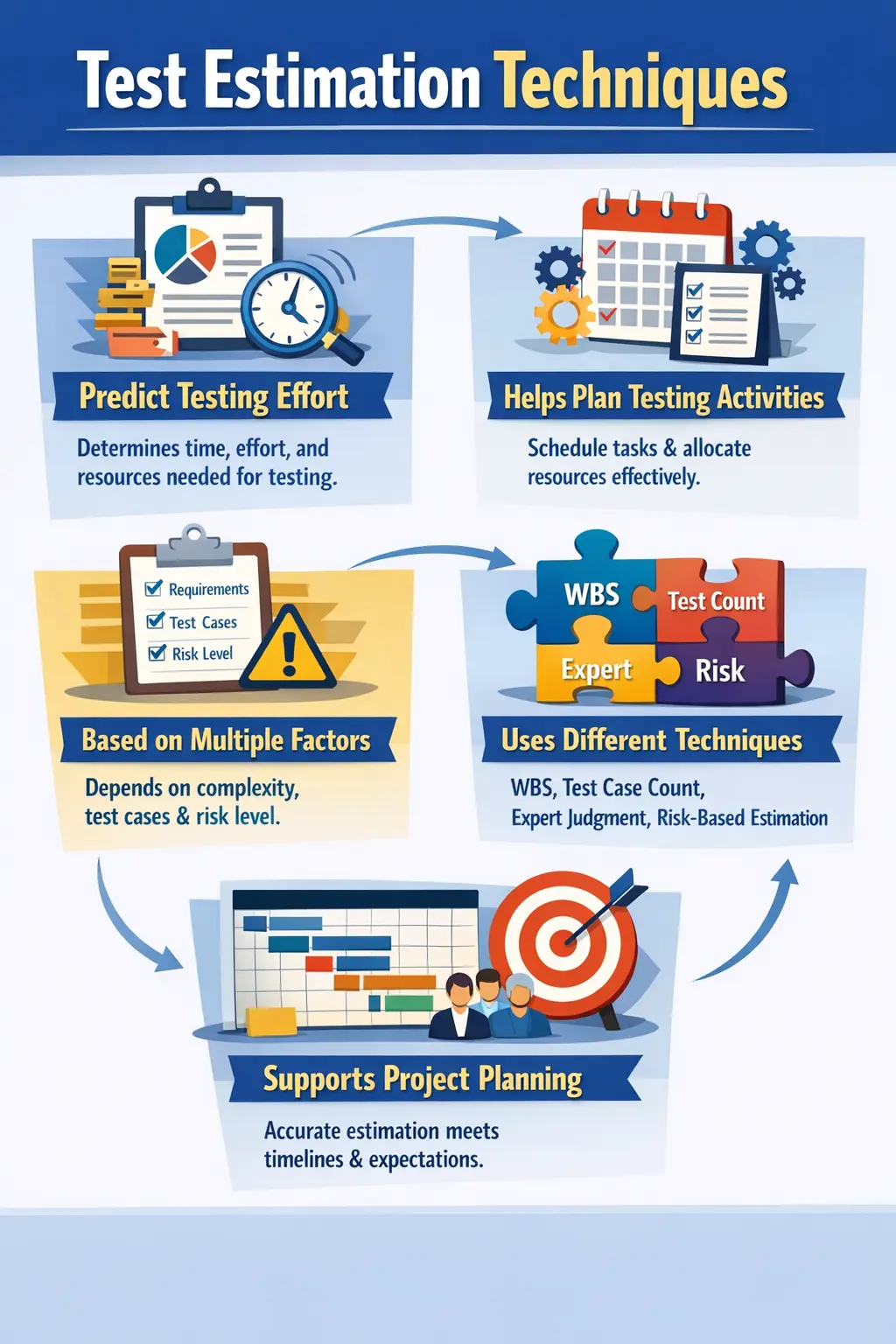
Test estimation involves predicting the effort needed to perform various testing tasks such as requirement analysis, test case design, test execution, defect management, regression testing, and reporting. Accurate estimation allows project managers and testing teams to plan schedules realistically, allocate resources effectively, and ensure that quality objectives are met within project constraints.
In real-world software projects, test estimation plays a crucial role in ensuring predictable delivery and successful release cycles. Without proper estimation, testing teams may face unrealistic deadlines, resource shortages, and increased risk of incomplete testing.
Test estimation answers an important planning question in software projects: “How much testing effort is needed?”
By applying appropriate estimation techniques, testing teams can produce reliable forecasts that support project planning and improve overall testing effectiveness.
Understanding Test Estimation
Test estimation is the process of forecasting the amount of time, effort, and resources required to complete testing tasks within a project or release cycle.
The estimation process typically occurs during the planning stage of testing. Test leads and testers review project requirements, analyze system complexity, and evaluate historical data from previous projects to determine the expected testing effort.
The goal of estimation is not to produce exact numbers but to generate realistic approximations that help guide project planning. Because software projects often involve uncertainty, estimates may evolve as more information becomes available.
Test estimation considers multiple testing activities, including requirement analysis, test design, test environment preparation, test execution, defect reporting, and regression testing. Each of these activities contributes to the total testing effort.
Accurate estimation helps organizations maintain predictable development cycles and ensures that testing activities are neither rushed nor incomplete.
Purpose of Test Estimation
The primary purpose of test estimation is to enable effective project planning. By estimating testing effort early in the project lifecycle, teams can allocate sufficient time for testing and avoid last-minute delays.
One important purpose of test estimation is to establish realistic testing timelines. Projects often involve tight deadlines, and estimation helps determine whether the planned schedule is achievable.
Another purpose is resource allocation. Test estimation helps determine how many testers are required, how long testing will take, and what tools or environments may be needed.
Test estimation also supports project commitments. When organizations promise delivery dates to stakeholders or customers, accurate estimation ensures that these commitments are achievable.
Managing stakeholder expectations is another key benefit. Clear estimation helps project managers communicate realistic timelines and prevent misunderstandings.
Finally, estimation helps reduce schedule and cost risks. When testing effort is underestimated, teams may rush testing or skip important validation activities. Proper estimation minimizes this risk.
Factors Affecting Test Estimation
Several factors influence the accuracy of test estimation. Understanding these factors helps testers produce realistic estimates.
One major factor is the scope and complexity of requirements. Applications with complex workflows, integrations, or algorithms require more extensive testing.
The number of test cases also affects estimation. A larger number of test cases increases the effort required for test design, execution, and maintenance.
The risk level of features plays an important role as well. High-risk features may require deeper testing, more scenarios, and multiple validation cycles.
Another important factor is the quality of requirements. Well-defined requirements make estimation easier, while ambiguous requirements introduce uncertainty.
Test environment stability is also significant. If environments are unstable or frequently unavailable, testing progress may slow down.
Finally, team experience affects estimation accuracy. Experienced testers can estimate effort more accurately because they understand common challenges and historical patterns.
Considering these factors helps teams produce realistic testing estimates.
Common Test Estimation Techniques
Various estimation techniques are used in manual testing to calculate testing effort. Each technique has advantages and is suitable for different project scenarios.
Work Breakdown Structure (WBS)
Work Breakdown Structure is one of the most widely used estimation techniques in testing.
In this approach, the entire testing effort is divided into smaller tasks. Each task is estimated individually, and the estimates are then combined to calculate the total testing effort.
Breaking testing work into smaller components improves accuracy because each task can be analyzed separately.
Typical tasks included in a testing work breakdown structure include requirement analysis, test planning, test case design, test execution, regression testing, and reporting.
For example, a testing project may include tasks such as analyzing requirements, designing test cases, preparing test data, executing test cases, logging defects, and performing regression testing.
Each of these tasks is assigned an estimated effort. The total estimate is obtained by adding the effort required for each task.
This technique provides high transparency because stakeholders can clearly see how the total testing effort is calculated.
Work Breakdown Structure is best suited for projects where requirements are well understood and detailed planning is required.
Test Case Count–Based Estimation
Another common estimation technique is based on the number of test cases.
In this approach, testers estimate the average time required to design and execute a single test case. This average is then multiplied by the total number of test cases to estimate the total effort.
For example, if a tester estimates that executing one test case takes approximately ten minutes and the project contains two hundred test cases, the total execution time would be around two thousand minutes, or approximately thirty-three hours.
This technique is particularly useful when requirements are stable and test cases can be clearly identified early in the project.
However, it is important to consider additional activities such as defect logging, re-testing, and regression testing when using this method.
Test case count–based estimation works best for projects with well-defined test scenarios.
Expert Judgment
Expert judgment is an estimation technique based on the experience and knowledge of testing professionals.
In this approach, experienced testers or test leads analyze project requirements and provide effort estimates based on their past experience with similar projects.
Expert judgment is particularly useful during early project stages when detailed information may not yet be available.
For example, if a tester has previously worked on similar applications, they may be able to estimate testing effort based on historical patterns.
Although expert judgment can be valuable, it is important to support these estimates with data whenever possible.
Combining expert judgment with other estimation techniques often produces the most reliable results.
Analogy-Based Estimation
Analogy-based estimation involves comparing the current project with similar past projects.
If a previous project required a certain amount of testing effort, that estimate can be used as a reference for the current project.
Adjustments are then made to account for differences between the projects.
For example, if the previous project involved testing a system with similar complexity and required four weeks of testing effort, the new project may require a similar timeline with minor adjustments.
This method works best in organizations that maintain historical project data.
Analogy-based estimation helps improve accuracy by leveraging real-world experience.
Percentage-Based Estimation
In some cases, testing effort is estimated as a percentage of development effort.
For example, testing may be estimated to require approximately thirty percent of the development effort.
If development takes one hundred hours, testing effort may be estimated at around thirty hours.
This method is commonly used during early planning stages when detailed information about test cases or system complexity is not yet available.
Although percentage-based estimation provides a quick estimate, it should be refined later using more detailed techniques.
This method is best suited for high-level planning and initial project proposals.
Risk-Based Estimation
Risk-based estimation focuses on allocating testing effort according to the risk level of different features.
High-risk areas receive more testing effort because failures in these areas could have significant consequences.
Low-risk features receive less testing effort.
For example, a payment processing module in an e-commerce application may require extensive testing because failures could affect financial transactions.
In contrast, a static informational page may require only basic validation.
Risk-based estimation is particularly useful in projects with tight deadlines because it ensures that critical functionality receives sufficient testing coverage.
Manual Tester’s Role in Test Estimation
Manual testers play an important role in the estimation process.
Because testers understand system behavior and testing activities in detail, their input is valuable when estimating effort.
Testers contribute by analyzing requirements and identifying the number of test scenarios required.
They also estimate the time required to design and execute test cases.
Another responsibility of testers is identifying assumptions and risks that may affect estimation accuracy.
For example, if certain features depend on external systems, testers may include additional time for integration testing.
Testers also monitor actual testing effort during execution and compare it with initial estimates. This helps improve estimation accuracy in future projects.
Active participation by testers ensures that estimates are realistic and practical.
Best Practices for Test Estimation
Producing accurate test estimates requires following certain best practices.
Estimates should always be based on data rather than optimism. Historical project data provides valuable insights for estimation.
Including buffers for risks is another important practice. Unexpected issues such as environment instability or requirement changes can affect testing timelines.
Estimates should be reviewed and refined periodically as the project progresses and more information becomes available.
It is also important to document assumptions clearly. If certain assumptions prove incorrect, the estimation can be adjusted accordingly.
Collaborative estimation involving testers, developers, and project managers improves accuracy.
Following these practices helps organizations produce reliable testing estimates.
Common Estimation Mistakes
Several mistakes can lead to inaccurate test estimates.
One common mistake is ignoring non-functional testing activities such as performance, security, or usability testing.
Another mistake is underestimating regression testing effort. As applications evolve, regression testing becomes increasingly important and time-consuming.
Teams sometimes forget to account for re-testing after defect fixes. Re-testing is a necessary step that requires additional time.
Overconfidence without supporting data is another common problem. Estimates based solely on assumptions may lead to unrealistic schedules.
Avoiding these mistakes improves estimation accuracy and project planning.
Test Estimation vs Test Planning
Test estimation and test planning are closely related but serve different purposes.
Test estimation focuses on predicting the effort required for testing activities.
Test planning defines how testing will be performed, including strategies, tools, environments, and schedules.
Estimation typically occurs earlier in the project lifecycle because the test plan depends on the estimated effort and resources.
Once the estimation is complete, the testing team develops a detailed plan that outlines the testing approach and execution strategy.
Understanding the relationship between estimation and planning helps teams manage testing activities effectively.
Why Test Estimation Is Difficult
Test estimation is difficult because software projects contain uncertainty. At the beginning of a project, requirements may not be fully clear, designs may still be changing, environments may not be ready, and integrations may not be available. Yet the testing team is still expected to provide an estimate for effort, timeline, and resources. This makes estimation a practical judgment activity rather than a perfect calculation.
Another reason estimation is difficult is that testing effort is influenced by defect behavior. If the build is stable and requirements are clear, execution may move quickly. If the build contains many defects, testers spend additional time logging issues, discussing defects, re-testing fixes, and performing regression testing. These activities are real testing effort, but they are often underestimated.
Test estimation is also affected by dependencies outside the testing team. Environment downtime, delayed builds, unavailable APIs, missing test data, access issues, and third-party service failures can all slow testing. A tester may estimate execution effort accurately but still miss the total timeline if external dependencies are ignored.
Because of these uncertainties, good estimation should include assumptions, risks, and buffers. A professional estimate does not pretend to be exact. It explains what is included, what is excluded, what assumptions were made, and what factors may change the estimate later.
Activities That Must Be Included in Test Estimation
A common mistake is estimating only test execution time. Testing includes many activities before, during, and after execution. If these activities are ignored, the estimate will be too low. A complete estimate should include requirement analysis, clarification discussions, test planning, test case design, test data preparation, environment readiness checks, execution, defect logging, re-testing, regression testing, reporting, and closure activities.
Requirement analysis takes time because testers must understand business rules, identify gaps, ask questions, and define test conditions. Test case design takes time because scenarios must be written, reviewed, updated, and mapped to requirements. Test data preparation may take significant effort if data is complex, role-based, state-dependent, or dependent on external systems.
Execution time includes more than clicking through steps. Testers must observe behavior, compare actual and expected results, capture evidence, update test status, and investigate unexpected outcomes. When defects are found, defect logging and communication add effort. After fixes arrive, re-testing and regression testing add more effort.
Reporting and closure should also be estimated. Daily status reports, test execution summaries, defect summaries, traceability updates, and final test summary reports require time. These activities may seem small individually, but together they form an important part of the total testing effort.
Estimation Inputs
Test estimation should be based on reliable inputs. The first input is requirement scope. Testers need to know which features, user stories, modules, workflows, and integrations are included. If scope is unclear, the estimate should clearly state that it is preliminary and subject to revision.
The second input is complexity. A simple CRUD screen requires less effort than a payment flow, loan approval engine, healthcare workflow, or multi-system integration. Complexity comes from business rules, calculations, data dependencies, roles, exception paths, and technical integrations.
Historical data is another valuable input. Previous releases, similar projects, past test case counts, defect rates, execution velocity, and regression effort can make estimates more realistic. Organizations that track historical testing data can estimate with better confidence than teams relying only on memory.
Risk level also affects estimation. High-risk features need deeper testing, more scenarios, and more regression coverage. Low-risk features may need lighter validation. Risk-based estimation helps align effort with business importance instead of treating every feature equally.
Estimation Assumptions
Every test estimate depends on assumptions. If assumptions are not documented, stakeholders may treat the estimate as a guarantee. Clear assumptions protect the testing team and help stakeholders understand the conditions under which the estimate is valid.
Common assumptions include stable requirements, timely build availability, available test environment, prepared test data, accessible third-party services, availability of testers, and timely defect fixes. If any of these assumptions fail, the estimate may need to change. This should be communicated upfront.
Assumptions should be specific. Instead of saying "environment should be ready," the estimate may state, "Testing estimate assumes the QA environment is available for eight hours per day and all required services are configured before execution begins." Specific assumptions reduce misunderstanding.
When assumptions change, estimates should be revised. This is normal and professional. Estimation is not a one-time promise; it is a planning forecast that must evolve as project information becomes clearer.
Adding Buffer to Test Estimates
Buffer is additional time included to handle uncertainty. Testing projects often face unexpected events such as requirement changes, unstable builds, environment issues, data problems, defect retesting, and additional regression needs. Without buffer, even a reasonable estimate can become unrealistic.
Buffer should not be added randomly. It should be based on risk. A stable project with clear requirements and known technology may need a smaller buffer. A project with new integrations, unclear requirements, tight deadlines, or unstable environments needs a larger buffer. The buffer should reflect real uncertainty.
Some teams add a percentage buffer, such as ten to twenty percent of estimated effort. Others add separate contingency tasks for re-testing, regression, environment support, or defect triage. The method matters less than the transparency. Stakeholders should know why buffer is included.
Buffer is not extra free time. It is risk protection. If everything goes smoothly, buffer may remain unused or be used for additional testing. If problems occur, buffer prevents immediate schedule collapse. Professional estimation includes controlled uncertainty.
Detailed WBS Example for Test Estimation
Work Breakdown Structure becomes powerful when testing work is broken into realistic activities. Suppose a project includes a user registration module, login module, profile update module, and password reset module. A WBS estimate may separate requirement review, scenario identification, test case design, test case review, test data preparation, smoke testing, functional execution, negative testing, regression testing, defect logging, re-testing, and reporting.
Each activity receives its own estimate. Requirement review may take four hours, test case design may take sixteen hours, test data preparation may take six hours, execution may take twenty hours, re-testing may take eight hours, regression may take twelve hours, and reporting may take four hours. Adding these activities gives a more complete estimate than simply guessing total effort.
WBS also makes estimates easier to review. If stakeholders question the timeline, the test lead can show the breakdown. This makes the estimate transparent and defensible. It also helps identify areas where scope can be reduced or resources can be added.
WBS is especially useful for larger projects because it prevents hidden work from being forgotten. It reminds teams that testing includes preparation, execution, defect handling, regression, and closure, not just running test cases.
Detailed Test Case Count Estimation Example
Test case count estimation works well when the number of test cases is known or can be reasonably predicted. Suppose a module has one hundred test cases. If the average execution time per test case is ten minutes, execution effort is one thousand minutes, or about sixteen and a half hours. However, this is only the direct execution effort.
The estimate should also include setup time, evidence capture, status updates, defect logging, re-testing, and regression. If twenty percent of cases are expected to fail initially, additional time must be added for defect reporting and fix verification. If the module is high risk, additional exploratory or regression testing may be needed.
Average time per test case should not be applied blindly. A simple UI validation case may take two minutes, while an end-to-end payment case may take twenty minutes. Testers can group cases by complexity: simple, medium, and complex. Each group can have a different average time.
For example, fifty simple cases at five minutes each, thirty medium cases at ten minutes each, and twenty complex cases at twenty minutes each produce a more realistic estimate than one average across all cases. This refinement improves accuracy.
Three-Point Estimation
Three-point estimation is useful when there is uncertainty. Instead of giving one number, the team estimates optimistic effort, most likely effort, and pessimistic effort. The optimistic estimate assumes everything goes well. The most likely estimate reflects normal conditions. The pessimistic estimate accounts for problems such as defects, blockers, or rework.
For example, testing a module may take three days in the best case, five days in the most likely case, and eight days in the worst case. This gives stakeholders a realistic range rather than a false exact number. It also helps communicate uncertainty more professionally.
Some teams use a weighted formula to calculate an expected estimate: optimistic plus four times most likely plus pessimistic, divided by six. Even without using a formula, the three-point discussion itself is valuable because it forces the team to think about risk.
Three-point estimation is especially helpful for new features, unfamiliar domains, unclear requirements, or integration-heavy projects. It prevents the team from committing only to the best-case scenario.
Planning Poker for Agile Test Estimation
In Agile teams, estimation is often collaborative. Planning poker is commonly used to estimate user stories using story points. Although story points usually represent overall development effort, testers should participate actively because testing complexity may significantly affect the estimate.
A story may look simple from a development perspective but require complex testing. For example, adding a new field may require role validation, migration checks, report updates, API validation, and regression testing. Tester input helps the team avoid underestimating such stories.
During planning poker, testers should consider acceptance criteria, test data, negative scenarios, regression scope, dependencies, and automation impact. If these factors increase effort, testers should explain why the story deserves a higher estimate.
Agile estimation is not about producing hour-level precision for every task. It is about understanding relative complexity and planning sprint capacity. Tester participation ensures quality work is included in that understanding.
Estimating Regression Testing Effort
Regression testing is one of the most commonly underestimated activities. As the application grows, the regression suite grows. Every new feature, defect fix, and change request may require re-validation of existing functionality. If regression effort is not estimated properly, testing timelines become unrealistic.
Regression estimation should consider the size of the regression suite, execution time per case, automation coverage, defect history, changed modules, and risk level. A full regression cycle may take days or weeks depending on application size. A selective regression cycle may be shorter but must be based on impact analysis.
Testers should also estimate time for analyzing regression failures. A failed regression case may be caused by a real defect, environment issue, data issue, or outdated test case. Investigation takes time and should not be ignored.
Automation can reduce regression execution time, but it does not eliminate effort. Automated scripts need maintenance, failed runs need analysis, test data must be managed, and unstable tests require investigation. Automation effort should be included separately when relevant.
Estimating Re-Testing and Defect Fix Validation
Re-testing effort depends on defect volume and defect complexity. When testers find defects, they must later verify fixes. If many defects are logged, re-testing can become a major part of the testing timeline. Ignoring re-testing effort is a common estimation mistake.
Simple UI defects may take only a few minutes to re-test. Complex workflow defects may require data setup, multi-step execution, backend verification, and regression around impacted areas. Re-testing estimates should reflect this difference.
Defect fix quality also affects effort. If fixes are incomplete or defects are reopened, testers spend additional time repeating validation. Projects with a history of reopened defects should include more re-testing buffer.
Re-testing should be planned throughout the cycle, not left until the end. If developers deliver many fixes in the final days, testers may not have enough time to verify them and perform regression. Estimation should account for fix verification cycles.
Estimating Test Data and Environment Effort
Test data and environment preparation can consume significant effort, especially in enterprise projects. If the estimate includes only test case design and execution, the team may be surprised when data setup delays testing. Testers should estimate these activities explicitly.
Test data effort depends on data complexity. Simple forms may require basic valid and invalid data. Banking, insurance, healthcare, and e-commerce systems may require users in specific states, account balances, historical transactions, permissions, product catalogs, policies, or claims. Creating or locating such data takes time.
Environment effort includes verifying deployment, configuration, user access, third-party services, APIs, scheduled jobs, and test tools. If the environment is shared or unstable, additional coordination effort may be needed. Environment downtime should be considered as a risk.
Estimating preparation effort improves execution reliability. A team that prepares data and environment early can execute tests smoothly. A team that ignores preparation may spend execution time resolving avoidable blockers.
Estimating Non-Functional Testing
Non-functional testing is often forgotten during estimation, especially in manual testing projects. However, performance, security, usability, compatibility, accessibility, reliability, and scalability checks may be required depending on the application. These activities need time, tools, environments, and sometimes specialized skills.
Usability testing may require user flow review, content clarity checks, layout review, and feedback analysis. Compatibility testing may require multiple browsers, devices, operating systems, or screen sizes. Accessibility testing may require keyboard navigation checks, screen reader checks, contrast validation, and label verification.
Security testing at a manual level may include authentication, authorization, session timeout, error message exposure, and input validation checks. Performance testing may involve tool-based load tests, but manual testers may still report slow response and timeout behavior during normal usage.
If non-functional expectations are in scope, they must be estimated. Treating them as optional or last-minute activities creates quality gaps and release risk.
Refining Estimates During the Project
Test estimates should be refined as more information becomes available. Early estimates are often high-level because requirements and design are still evolving. As test cases are written, builds are delivered, and defects appear, the team can improve the estimate.
Refinement is not a failure of estimation. It is a normal part of project planning. If scope increases, requirements change, or defects are higher than expected, the estimate should be updated. Keeping an outdated estimate creates unrealistic expectations.
Test leads should compare actual effort against estimated effort during execution. If test design took longer than expected, the team should understand why. If execution is slower due to complex data setup, future estimates should include that learning.
Continuous refinement improves future accuracy. Over time, teams build estimation knowledge based on real project experience instead of guesswork.
Communicating Test Estimates to Stakeholders
A test estimate should be communicated clearly. Stakeholders should understand the estimated effort, timeline, assumptions, risks, scope, exclusions, and buffer. A number without context can be misunderstood. For example, saying "testing will take ten days" is less useful than explaining what those ten days include.
Good estimation communication separates effort from calendar duration. Forty hours of testing effort does not always mean five calendar days if only one tester is available part-time, if environment access is limited, or if defect fixes arrive late. Resource availability and dependencies affect calendar schedule.
Stakeholders should also understand what happens if scope changes. If new requirements are added, regression scope expands, or a build is delayed, the estimate may change. Communicating this early prevents conflict later.
A professional estimate is transparent and evidence-based. It should invite discussion rather than create false certainty. The goal is shared planning, not simply submitting a number.
Practical Example: Estimating a Login Module
Consider a login module with valid login, invalid login, password reset, account lockout, session timeout, remember me, and role-based redirection. A simple estimate that says "login testing will take one day" may be too vague. A better estimate breaks down the work.
Requirement review may take two hours. Test scenario design may take three hours. Test case writing may take five hours. Test data preparation may take two hours because different user roles and account states are needed. Execution may take eight hours. Defect logging, re-testing, and regression may require another four to six hours depending on defect volume.
The total estimate may be twenty-four to twenty-six hours, with assumptions that the authentication service is available, test users can be created, and requirements are stable. If multi-factor authentication is added later, the estimate must be revised.
This example shows how a small feature can include multiple testing activities. Estimation becomes more realistic when the tester thinks through the full testing lifecycle.
Practical Example: Estimating an E-Commerce Checkout Flow
Checkout testing is more complex than login because it usually includes cart validation, address selection, shipping method, coupon application, tax calculation, payment gateway integration, order creation, email confirmation, inventory update, and order history. Each part adds testing effort.
A WBS estimate may include requirement analysis, test case design for positive and negative flows, payment test data setup, coupon data setup, integration readiness checks, functional execution, failed payment testing, refund impact testing, regression testing, defect logging, re-testing, and reporting. The total effort may be several days even for one flow.
Risk-based estimation would add extra effort because checkout affects revenue. Boundary scenarios around payment amount, coupon limits, tax rules, and inventory should be included. Integration with payment gateways may require additional buffer because external services can be unstable.
This example demonstrates why estimation should consider business criticality and dependencies. A checkout flow deserves more effort than a static informational page because the risk and impact are higher.
Test Estimation Checklist
A checklist helps testers avoid missing important estimation factors. First, confirm the scope of requirements and identify all modules in testing scope. Second, classify features by complexity and risk. Third, estimate effort for requirement analysis, test case design, test data, execution, defect logging, re-testing, regression, reporting, and closure.
Fourth, identify dependencies such as environment availability, third-party services, build delivery, data setup, and access permissions. Fifth, include non-functional testing if applicable. Sixth, add buffer based on uncertainty and risk.
Seventh, document assumptions clearly. Eighth, review the estimate with testers, developers, project managers, and business stakeholders where needed. Ninth, refine the estimate as scope and project conditions change.
This checklist keeps estimation practical and complete. It also helps junior testers understand that estimation is not guesswork; it is structured reasoning based on scope, effort, risk, and assumptions.
Best Practices for Reliable Test Estimation
The first best practice is to estimate collaboratively. Test leads, testers, developers, business analysts, and project managers may all hold useful information. Collaboration reduces blind spots and produces more realistic estimates.
The second best practice is to use more than one technique when possible. A WBS estimate can be cross-checked with historical analogy. A test case count estimate can be adjusted using risk-based thinking. Combining techniques improves confidence.
The third best practice is to keep historical data. Actual effort from previous projects is one of the best inputs for future estimation. Teams should record planned effort, actual effort, defect volume, blocker time, and regression effort.
The fourth best practice is to communicate estimates as ranges when uncertainty is high. A range is more honest than a false exact number. For example, saying "testing may take six to eight days depending on defect volume and environment stability" is often more realistic than promising exactly six days.
The fifth best practice is to revisit estimates frequently. Estimates should evolve with the project. A team that updates estimates based on real conditions can manage delivery better than a team that holds onto outdated numbers.
Interview-Ready Explanation
In testing interviews, candidates are often asked to explain test estimation techniques.
A concise explanation states that test estimation techniques are methods used to predict the time and effort required to complete testing activities.
A more detailed explanation includes techniques such as Work Breakdown Structure, test case–based estimation, expert judgment, analogy-based estimation, percentage-based estimation, and risk-based estimation.
Providing examples of how these techniques are used in real projects demonstrates practical understanding.
Knowledge of estimation techniques shows that a tester understands project planning and can contribute to realistic scheduling.
Key Takeaway
Test estimation is a crucial activity that helps testing teams predict the effort required to complete testing tasks within a project.
By applying techniques such as Work Breakdown Structure, test case count–based estimation, expert judgment, analogy-based estimation, percentage-based estimation, and risk-based estimation, teams can produce realistic testing forecasts.
Accurate test estimation ensures predictable delivery timelines, effective resource allocation, and better risk management.
Ultimately, effective test estimation enables organizations to deliver high-quality software while meeting project commitments and stakeholder expectations.