Change Requests
Change Requests – Complete Guide
Software projects rarely remain static from beginning to end. As business needs evolve, customer expectations change, and new insights emerge, modifications to requirements and functionality become necessary. These modifications are handled through a structured mechanism known as Change Requests (CRs). Change Requests allow teams to introduce controlled changes into a project without creating confusion or compromising product quality.
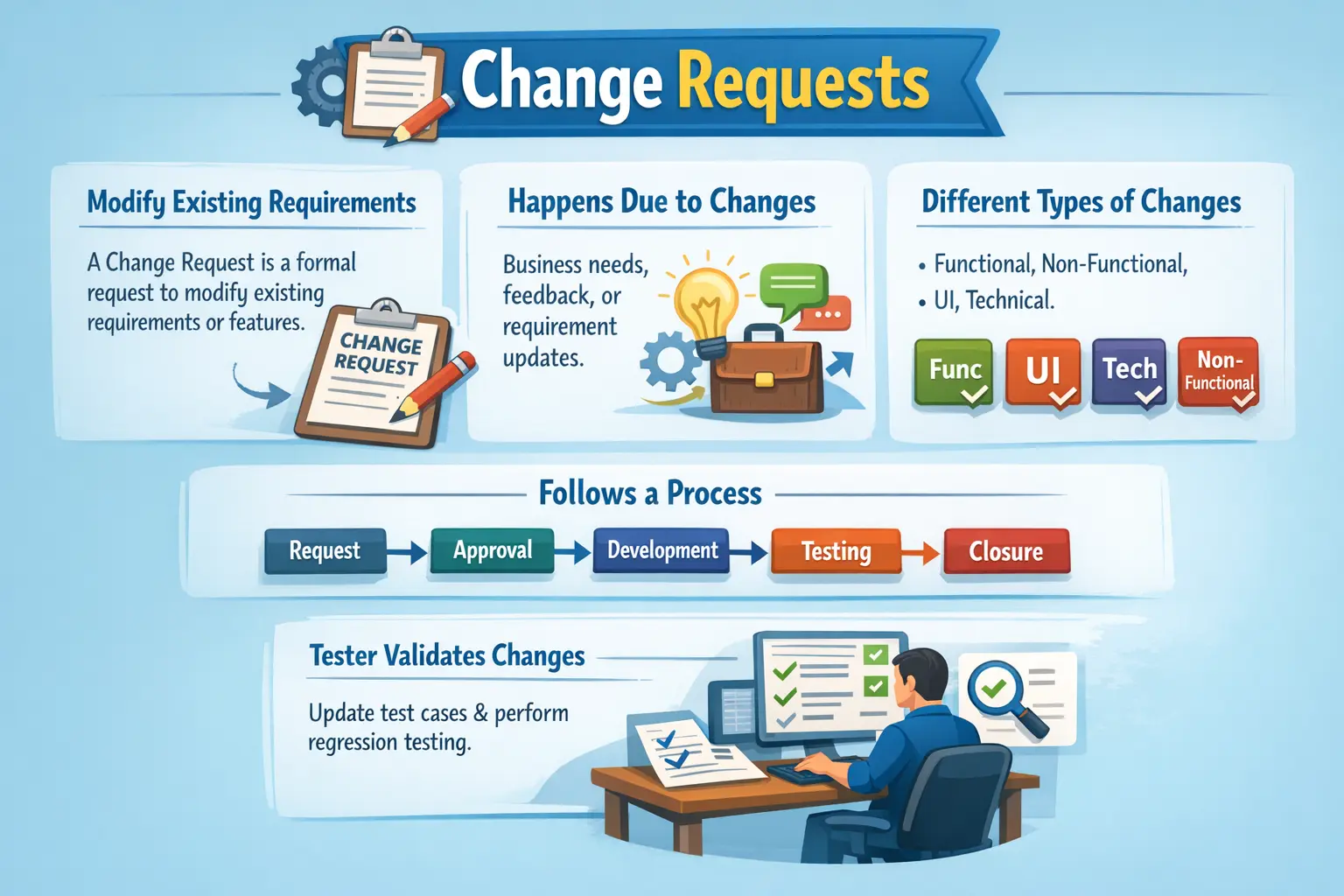
A Change Request is a formal request to modify an existing requirement, feature, design, or functionality after it has already been approved or implemented. It documents what needs to change, why the change is necessary, and how the change will be implemented and validated.
Change Requests answer an important question in software projects: “What needs to change, and why?”
For manual testers, change requests are a regular part of real-world projects. Testers must analyze the impact of changes, update test cases, and ensure that new changes do not introduce defects into existing functionality. Effective handling of change requests ensures controlled evolution of the software while maintaining quality and stability.
Definition of Change Requests
A Change Request is a formal process used to request and manage modifications to approved requirements or implemented functionality. Change Requests may affect system behavior, user interfaces, performance characteristics, or technical configurations.
Unlike initial requirements, which define what the system should do from the beginning, change requests represent adjustments made after development has already started or even after features have been completed.
A Change Request typically includes a description of the change, the reason for the change, affected components, and the expected outcome after implementation.
Change Requests ensure that modifications are documented and evaluated before implementation. Without formal change requests, projects can quickly become disorganized and unpredictable.
Why Change Requests Occur
Change Requests occur because software projects operate in dynamic environments. Requirements defined at the beginning of a project often need adjustment as new information becomes available.
Business needs frequently evolve during development. Organizations may change processes, introduce new policies, or refine business rules. These changes require updates to software functionality.
Stakeholder feedback is another major source of change requests. Users and business representatives often identify improvements after seeing working features. These improvements are captured as change requests.
Regulatory or compliance updates can also require modifications to existing systems. Industries such as banking, healthcare, and finance often introduce new regulations that must be implemented in software systems.
Defects in original requirements sometimes lead to change requests. If a requirement was incomplete or incorrect, it must be modified through a formal change request.
Market conditions and customer demands may also drive changes. Competitive pressure often requires organizations to introduce new features or modify existing ones quickly.
Change Requests reflect the reality that software development is an evolving process rather than a fixed plan.
Types of Change Requests
Change Requests can affect different aspects of a software system. Understanding these types helps testers perform effective impact analysis and testing.
Functional changes modify system behavior or business logic. These changes may introduce new features, modify existing functionality, or remove outdated features. Functional changes often require updates to test scenarios and test cases.
Non-functional changes affect quality attributes such as performance, security, usability, or reliability. For example, a system may need to handle more users or meet stricter security standards. Non-functional changes often require specialized testing approaches.
User interface and user experience changes modify visual layout or workflow behavior. These changes may include new labels, updated screens, or simplified navigation. UI changes may appear small but often require careful regression testing.
Technical or system changes involve configuration updates, database modifications, or integration adjustments. Although manual testers may not implement technical changes, they must validate the functional impact of such modifications.
Understanding the type of change request helps testers determine the appropriate testing scope and approach.
Change Request Lifecycle
Change Requests follow a structured lifecycle to ensure proper evaluation and implementation. A well-defined lifecycle prevents uncontrolled changes and maintains project stability.
The lifecycle begins when a change request is raised. A stakeholder, product owner, tester, or developer may identify the need for a change and submit a formal request.
After submission, impact analysis is performed. The team evaluates how the change will affect requirements, development, testing, timelines, and risks. Impact analysis helps determine whether the change is feasible.
Once analysis is complete, the change request is approved or rejected. Approval typically involves business stakeholders, project managers, and technical leads. Only approved changes proceed to implementation.
After approval, requirements and documentation are updated to reflect the change. Updated requirements provide a clear reference for development and testing.
Development and testing activities then implement and validate the change. Testers update test cases and execute testing to ensure the change works correctly.
Finally, the change request is validated and closed after successful testing and acceptance.
A structured lifecycle ensures that changes are implemented in a controlled and traceable manner.
Manual Tester’s Role in Change Requests
Manual testers play a critical role in managing change requests effectively. Testers ensure that modifications do not introduce new defects or reduce product quality.
Testers analyze the impact of changes on existing functionality. They identify which features and modules are affected by the change request.
Testers update test scenarios and test cases to reflect the new requirements. Updated test cases ensure accurate validation of modified functionality.
Regression testing is a major responsibility for testers during change requests. Changes to one area of the system may affect unrelated features. Regression testing helps detect such unintended impacts.
Testers update Requirement Traceability Matrix (RTM) entries to maintain requirement-to-test coverage. Updated RTM ensures that all requirements remain traceable.
Testers also update test reports and documentation to reflect changes accurately.
Effective tester involvement ensures that change requests are validated thoroughly and safely.
Impact Analysis from a Tester’s Perspective
Impact analysis is one of the most important activities during change request handling. Testers evaluate how a change affects the system and testing activities.
Testers identify affected modules and functionalities. Some changes affect only one feature, while others affect multiple components.
Testers determine which test cases require updates. Test cases that reference modified behavior must be revised.
Regression scope is determined during impact analysis. Testers identify which existing tests must be executed again to ensure stability.
Test data requirements may change due to modified business rules. Testers prepare updated data sets when necessary.
Timeline and risk impact are also considered. Large changes may require additional testing effort and schedule adjustments.
Accurate impact analysis prevents missed defects and incomplete testing.
Change Requests vs Defects
Change Requests and Defects are often confused, but they represent different concepts in software projects.
A Change Request represents a modification to existing requirements or functionality. It reflects a business decision or improvement rather than an error.
A Defect represents a deviation between expected behavior and actual behavior. Defects indicate that the system does not meet requirements.
Change Requests result in requirement updates and new testing activities. Defects result in bug fixes and validation testing.
Understanding this difference helps testers classify issues correctly.
Real-World Example of a Change Request
Consider a system that requires passwords to have a minimum length of eight characters.
After implementation, the business decides that stronger security is needed. A change request is created to increase the minimum password length to twelve characters.
This change affects validation logic, user interface messages, and error handling.
Testers update Boundary Value Analysis test cases to reflect the new limits. Test cases for valid and invalid passwords are modified accordingly.
Regression testing is performed to ensure that login and password reset features still function correctly.
RTM entries are updated to maintain requirement traceability.
This example illustrates how change requests affect multiple testing activities.
Risks of Poorly Managed Change Requests
Poorly managed change requests can introduce significant risks into software projects.
Scope creep occurs when changes are introduced without proper evaluation. Uncontrolled scope expansion leads to delays and resource issues.
Missed regression defects are another common risk. If regression testing is incomplete, new defects may appear in production.
Inconsistent documentation creates confusion among teams. When requirements and test cases are not updated, misunderstandings occur.
Release delays may occur if change requests are introduced late without sufficient planning.
Controlled change management reduces these risks significantly.
Best Practices for Handling Change Requests
Effective change request management requires structured processes and strong communication.
Formal approval should always occur before implementation. Unauthorized changes create confusion and instability.
Changes should be documented clearly. Documentation ensures consistent understanding across teams.
Impact analysis should be performed before implementation. Understanding risks prevents unexpected problems.
Regression testing should always be included when functionality changes. Regression testing ensures system stability.
Stakeholders should be informed about approved changes. Communication ensures alignment between teams.
Following best practices ensures successful change implementation.
Change Requests in Agile Environments
Change Requests are handled differently in Agile environments compared to traditional projects.
In Agile, changes are often captured as updated user stories or backlog items rather than formal documents.
Backlog refinement sessions help evaluate and prioritize changes regularly.
Sprint planning determines when approved changes will be implemented.
Testers update test scenarios continuously as stories evolve.
Agile environments still require structured change management even though documentation may be lighter.
Importance of Traceability for Change Requests
Traceability ensures that change requests are properly tracked throughout the project.
Requirements should be updated to reflect approved changes.
Test cases must map to updated requirements.
Defects related to change requests should be tracked separately.
RTM updates ensure complete coverage after changes.
Traceability provides auditability and accountability.
Why Change Requests Need Formal Control
Change is natural in software projects, but unmanaged change is one of the fastest ways for a project to lose direction. A team may start with a clear requirement baseline, but if changes are accepted through casual conversations, chat messages, or undocumented meetings, the system quickly becomes difficult to understand. Developers may code based on one version of the requirement, testers may test based on another version, and business users may expect something else entirely. Formal change request control prevents this drift by giving every change a visible path from request to approval, implementation, testing, and closure.
Formal control does not mean slowing down the team unnecessarily. It means making sure the right questions are answered before effort is spent. What exactly is changing? Why is the change needed? Which users, modules, reports, workflows, integrations, and test cases are affected? Is the change urgent, or can it wait for a future release? These questions help teams separate useful changes from unclear or low-value changes. A good change control process protects the project from confusion while still allowing the product to evolve.
For testers, formal control is especially important because testing depends on clarity. A tester cannot confidently update test cases or define regression scope if the change is vague. When a change request is documented properly, the tester can trace the new requirement, identify impacted areas, prepare test data, and validate the expected outcome objectively. Without formal control, testing becomes assumption-based, and assumption-based testing often leads to missed defects.
Change request control also creates accountability. When a change is approved, the approval confirms that business stakeholders understand the impact on scope, timeline, cost, and quality. If a release is delayed because of a late change, the decision is visible and justified. If a lower-priority change is postponed, the decision is also visible. This transparency helps teams avoid blame and focus on informed project decisions.
Information That a Change Request Should Contain
A useful change request should provide enough information for analysis, implementation, and testing. At a minimum, it should describe the current behavior, the requested new behavior, the business reason for the change, and the expected benefit. If the request only says "modify the login screen" or "improve report performance," the team still does not know what has to be changed. A clear change request turns a general desire into a testable requirement.
The current behavior section explains how the system works today. This matters because the team must understand what is being replaced, extended, or removed. The requested behavior section explains how the system should work after the change. This should be written in specific, measurable, and business-readable language. The business reason explains why the change matters, such as compliance, usability, customer feedback, operational efficiency, or risk reduction.
A strong change request also identifies affected modules and dependencies. For example, a change to password rules may affect registration, login, password reset, profile update, administrator user creation, API validation, error messages, help text, and documentation. If the change request lists only one screen, the team may underestimate the actual testing scope. Testers should actively look for these hidden dependencies during review.
Acceptance criteria are another important part of a change request. Acceptance criteria define how the team will know that the change has been implemented correctly. They should include positive scenarios, negative scenarios, boundary conditions, and any non-functional expectations. For a password length change, acceptance criteria should specify the exact minimum length, valid and invalid examples, expected error messages, and whether existing users are affected. This level of detail makes the change testable.
Change requests may also include priority, target release, requester name, approval status, estimated effort, risk level, and links to related requirements or defects. These fields help project teams manage the change throughout its lifecycle. For testers, these details provide context for planning, execution, and reporting.
Change Request Approval Process
The approval process is the point where a requested change becomes an authorized project activity. Not every change request should be accepted immediately. Some changes are urgent and necessary, while others are optional enhancements that may create more risk than value. Approval ensures that business value, technical feasibility, testing effort, and schedule impact are reviewed before the change enters development.
In many projects, the approval process involves a product owner, business analyst, project manager, development lead, test lead, and sometimes a change control board. The business representative evaluates whether the change is valuable and aligned with business goals. The development team evaluates technical complexity. The testing team evaluates validation effort and regression impact. The project manager evaluates timeline and resource consequences. Together, these views create a balanced decision.
A change request may be approved, rejected, deferred, or sent back for clarification. Approval means the change will be planned and implemented. Rejection means the change is not accepted, usually because it does not provide enough value or conflicts with project goals. Deferral means the change is valid but will be handled in a later release. Returning for clarification means the request is incomplete or ambiguous. Testers should pay attention to this status because testing work should begin only after the change is clear and approved.
Approval is also important for scope control. If every stakeholder request is accepted without analysis, the project scope expands continuously. This is known as scope creep. Scope creep causes missed deadlines, incomplete testing, unstable releases, and frustrated teams. A disciplined approval process helps the team protect the release plan while still responding to genuine business needs.
Detailed Impact Analysis for Change Requests
Impact analysis is the bridge between approving a change and implementing it safely. It identifies what the change touches and what must be retested. Testers should not treat impact analysis as a quick checklist activity. A small change in one area can affect validation rules, data flow, reports, notifications, APIs, permissions, and downstream systems. Good impact analysis reduces the chance of missing hidden side effects.
The first step is to understand the direct impact. Direct impact includes the screens, fields, rules, and workflows explicitly mentioned in the change request. If a change request updates the maximum file upload size, the direct impact includes the upload screen, client-side validation, server-side validation, error message, and successful upload confirmation. These areas must be tested because they are directly modified.
The second step is to identify indirect impact. Indirect impact includes areas that rely on the changed functionality. For file uploads, indirect impact may include preview, download, delete, virus scanning, storage limit validation, user permissions, audit logs, and email notifications. These areas may not be mentioned in the change request, but they can still break if the change affects shared logic or shared components.
The third step is to evaluate test data impact. Many change requests require new data combinations. If a discount rule changes, testers may need data for eligible customers, ineligible customers, expired discounts, maximum discount limits, and overlapping offers. If test data is not updated, test execution may produce false failures or miss important scenarios. Test data preparation should be part of the impact analysis, not an afterthought.
The fourth step is to assess regression impact. Regression testing should cover both the changed area and high-risk dependent areas. The regression scope should be neither too small nor unnecessarily large. If the scope is too small, defects may escape. If it is too large, testing becomes inefficient. Experienced testers use requirement knowledge, architecture awareness, defect history, and business criticality to select the right regression coverage.
Testing Strategy for Change Requests
Testing a change request requires more than checking whether the new behavior works. The tester must validate the change itself, confirm that old behavior has been modified correctly, and ensure that existing functionality remains stable. A strong testing strategy combines focused testing, regression testing, data validation, negative testing, and documentation updates.
Focused testing validates the specific change described in the request. If the change request says that the system should allow twelve-character passwords instead of eight-character passwords, focused testing checks the new rule directly. The tester verifies valid inputs, invalid inputs, boundary values, and expected messages. This confirms that the requested behavior has been implemented correctly.
Regression testing validates that related functionality still works. For password rule changes, regression testing may include registration, login, password reset, profile update, account lockout, and administrator user management. The goal is to ensure that the change has not damaged existing flows. Regression testing is especially important when the change touches shared validation logic.
Negative testing is also essential. Change requests often introduce new rules, and every new rule creates new failure paths. Testers should check what happens when users violate the updated rule. The system should reject invalid actions clearly, maintain data integrity, and avoid confusing messages. Negative testing confirms that the change is enforced properly, not merely supported in successful cases.
Testers should also validate user-facing text, help content, labels, and error messages. A business rule may be implemented correctly but explained incorrectly to users. For example, if the password rule changes to twelve characters but the error message still says eight characters, the user experience is poor and the defect is real. Change request testing must include communication accuracy, not just backend logic.
Updating Test Artifacts After a Change Request
Change requests often make existing test artifacts outdated. If requirements change but test cases remain the same, the test suite no longer represents the product accurately. Testers must update all affected artifacts so future testing remains reliable. This includes test scenarios, test cases, test data, traceability matrices, regression suites, and test execution reports.
Test scenarios should be reviewed first because they define high-level coverage. A new business rule may require a new scenario, while an obsolete rule may require a scenario to be removed. Test cases then need detailed updates. Steps, expected results, input values, and validation points must reflect the approved change. If old expected results remain in the test case, testers may incorrectly report valid behavior as a defect.
Test data must also be updated. A change request may alter valid ranges, field formats, eligibility conditions, or workflow states. For example, if the age eligibility rule changes from eighteen to twenty-one, testers need data for users below twenty-one, exactly twenty-one, and above twenty-one. Boundary data becomes especially important when business rules change.
The RTM should be updated to maintain traceability. The new or modified requirement should map to the relevant test cases. If a change request replaces an old requirement, the traceability record should make that relationship clear. This helps during audits, reviews, and release sign-off because the team can demonstrate that approved changes were tested.
Regression suites should be reviewed periodically after repeated change requests. Over time, many small changes can make a regression suite bloated or outdated. Some cases may no longer be relevant, while new critical flows may need to be added. Maintaining regression quality is part of managing change effectively.
Change Requests During Different Project Phases
The impact of a change request depends heavily on when it is raised. A change raised during requirement analysis is usually easier to handle because design, development, and testing may not have started yet. The team can revise requirements and plan the change with limited rework. Early change requests are generally less expensive and less risky.
A change raised during development has a higher impact. Developers may need to modify code that is already in progress, and testers may need to update test cases that were already prepared. The team must evaluate whether the change can fit into the current sprint or release. If the change is not urgent, it may be better to move it to a later iteration to avoid destabilizing current work.
A change raised during test execution is even more sensitive. Testers may already be executing cases based on the approved requirement. If the requirement changes suddenly, some reported defects may become invalid, some test cases may need revision, and regression scope may increase. The team must communicate clearly so that testing effort is not wasted.
A change raised close to release carries the highest risk. Late changes can affect production readiness, release timelines, documentation, training, and user communication. Such changes should be accepted only when the business value or risk reduction justifies the disruption. Testers should clearly communicate the minimum testing needed before release if a late change is approved.
Post-release change requests are usually handled as enhancement requests, production change tickets, or backlog items. Even after release, testers must validate the change in a controlled environment before it reaches users. The basic principles remain the same: document the change, analyze impact, update tests, execute validation, and confirm stability.
Change Requests and Regression Risk
Every change request carries regression risk because software components are connected. A field validation rule may be reused across multiple screens. A database change may affect reports. A workflow change may affect notifications or audit logs. Testers must assume that change can create side effects until regression testing proves otherwise.
Regression risk is higher when the changed area is business-critical, frequently used, complex, or historically defect-prone. Payment modules, authentication flows, user permissions, order processing, and integrations often require stronger regression coverage. A small change in these areas can have significant business impact if it fails in production.
Regression risk is also higher when requirements are unclear or implementation details are not well understood. If the team does not know which components are affected, the regression scope may be incomplete. Testers should ask developers and business analysts for clarification during impact analysis. Collaboration improves regression accuracy.
Automation can help manage regression risk, but automation does not replace analysis. Automated regression suites are useful for repeated validation of stable flows, but testers must still decide whether new or modified scenarios should be added. Change requests often require manual review before automation updates are made.
Change Requests and Communication
Communication is one of the most important success factors in change request management. A change request affects multiple roles, and each role needs accurate information. Business teams need to know whether the change is accepted and when it will be delivered. Developers need clear requirements. Testers need testable acceptance criteria and impact details. Project managers need schedule and effort estimates.
Poor communication creates duplicated work and inconsistent understanding. One team member may assume the change applies only to new users, while another assumes it applies to all users. One tester may update cases, while another continues testing old behavior. These problems are avoidable when change decisions and clarifications are documented in a shared location.
Testers should communicate testing impact clearly. If a change increases regression scope, the test lead should explain the additional effort and risk. If the change is unclear, testers should raise questions early rather than waiting until execution. If a late change affects release readiness, the risk should be reported transparently.
Good communication also includes confirming closure. Once a change request is implemented and tested, the team should know whether it passed validation, whether any defects remain, and whether the change is accepted for release. This prevents uncertainty during release discussions.
Common Change Request Scenarios in Real Projects
One common scenario is a business rule update. For example, a loan approval system may change the minimum credit score required for approval. This affects eligibility logic, rejection messages, reports, and possibly approval workflows. Testers must update decision table coverage and regression cases for related loan processing flows.
Another common scenario is a UI label or workflow change. A business team may request that a form be simplified by removing optional fields or changing the order of steps. While this may look like a simple user interface update, testers must verify that removed fields do not affect backend processing, saved data, validation rules, or reports.
Integration changes are also frequent. A third-party payment gateway may update its response format, requiring the application to handle new success and failure codes. Testers must validate successful payments, failed payments, timeout behavior, retry logic, transaction history, and user notifications. Integration change requests often require coordination with external systems.
Compliance-driven changes are especially important. A regulation may require masking sensitive information on screens or reports. Testers must verify that the data is hidden for unauthorized users, visible only where allowed, and not exposed in error messages or exported files. Compliance changes often require careful negative and role-based testing.
Performance-related change requests may require improving response time or increasing capacity. Manual testers may not perform full performance testing, but they can still validate visible responsiveness, timeout behavior, and user experience after the change. Specialized performance testing may be needed depending on the requirement.
Change Requests in Agile Backlogs
In Agile projects, change requests often appear as new backlog items, modified user stories, or changed acceptance criteria. Agile welcomes changing requirements, but that does not mean changes are uncontrolled. The product owner still prioritizes changes, the team still estimates effort, and testers still analyze impact. Agile changes are lighter in documentation, but they still require clarity.
Backlog refinement is an important place to discuss change requests. The team reviews the requested change, clarifies the business goal, identifies dependencies, and defines acceptance criteria. Testers should participate actively in refinement because this is where many testing risks can be discovered early.
If a change request comes during an active sprint, the team must decide whether it should interrupt current work. Urgent production or compliance changes may need immediate attention. Lower-priority changes are usually added to the backlog for future planning. This protects sprint focus and avoids constant disruption.
Agile testers should keep test cases, checklists, and automation aligned with evolving stories. When acceptance criteria change, tests must change. If the team uses living documentation or BDD scenarios, those scenarios should be updated to reflect the approved behavior. Agile change management is continuous, but it still depends on discipline.
Metrics Related to Change Requests
Change request metrics help teams understand how stable or unstable project requirements are. A high number of change requests may indicate evolving business needs, but it may also indicate poor initial requirement analysis. Metrics should not be used to blame stakeholders; they should be used to improve planning and communication.
Useful metrics include the number of change requests raised, approved, rejected, deferred, and implemented. Teams may also track average time to approve a change, average time to implement a change, and number of defects introduced by change requests. These metrics reveal whether the change process is efficient and whether changes are affecting quality.
Testing teams may track how many test cases were updated because of change requests and how much regression effort was added. This helps explain why testing timelines change when requirements change. It also provides evidence for future estimation. If similar changes repeatedly require significant regression effort, the team can plan better in future releases.
Another useful metric is change request leakage, where an approved change is implemented but not fully tested or not reflected in documentation. Leakage indicates a traceability or communication gap. Reducing such gaps improves release confidence.
Best Practices for Testers Working with Change Requests
Testers should never begin detailed test updates based only on informal change discussions. Informal discussions are useful for understanding context, but the final approved change should be documented. Testing should align with the approved requirement, not with memory or assumption.
Testers should ask clear questions whenever the change is incomplete. What existing behavior should remain unchanged? Does the change apply to all users or only specific roles? Does the change affect historical data? Are there boundary values? Are there new error messages? Are reports, exports, APIs, or notifications affected? These questions help expose hidden impact.
Testers should keep old and new behavior separate in their analysis. Some changes replace old behavior completely, while others add conditions to existing behavior. Understanding this distinction is important for designing tests. If old behavior still applies in some cases, regression coverage must include both old and new paths.
Testers should update traceability as soon as requirements are finalized. Delaying documentation updates leads to confusion later. When audit or release review happens, the team should be able to show which change request led to which test cases and what execution results were produced.
Testers should communicate residual risk when testing time is limited. If a late change is approved but only partial testing is possible, the test report should clearly state what was tested, what was not tested, and what risks remain. This allows stakeholders to make informed release decisions.
Common Mistakes When Handling Change Requests
A common mistake is treating every requested change as immediately approved. Stakeholders may suggest changes during demos, meetings, or chats, but suggestions are not the same as approved scope. If teams implement informal changes without approval, they may waste effort or introduce behavior that conflicts with business priorities.
Another mistake is updating only the changed test case and ignoring regression impact. Change requests often affect related workflows. If a tester validates only the modified screen, defects may escape in dependent areas. Impact analysis should always drive regression scope.
Some teams forget to update documentation after implementation. The application changes, but requirements, test cases, RTM, and user guides remain outdated. This creates long-term maintenance problems because future team members cannot understand the current behavior from the documents.
Another frequent mistake is failing to distinguish between defects and change requests. If the system does not meet an approved requirement, it is a defect. If the business wants to modify an approved requirement, it is a change request. Misclassification affects reporting, planning, and accountability.
Teams also make the mistake of accepting late change requests without discussing release risk. Some late changes are necessary, but every late change should be reviewed carefully. Testers should make the testing impact visible so that stakeholders understand the consequences.
Interview Perspective
Change Requests are frequently discussed in testing interviews because they demonstrate real project experience.
Interviewers often ask how testers handle requirement changes.
A short answer typically defines a Change Request as a formal modification to requirements.
A detailed answer explains impact analysis, test updates, and regression testing.
Providing examples demonstrates practical knowledge.
Understanding Change Requests is essential for manual testing roles.
Key Takeaway
A Change Request is a formal request to modify existing requirements or functionality after approval or implementation.
Change Requests occur because business needs evolve, requirements improve, and feedback emerges during development.
Manual testers play a critical role by performing impact analysis, updating test assets, and executing regression testing.
Controlled change management protects product quality and project stability.
Change Requests are inevitable in software development — controlled change maintains quality, while uncontrolled change creates chaos.