Quality Control (QC): Evaluating the Product for Quality
Introduction to Quality Control
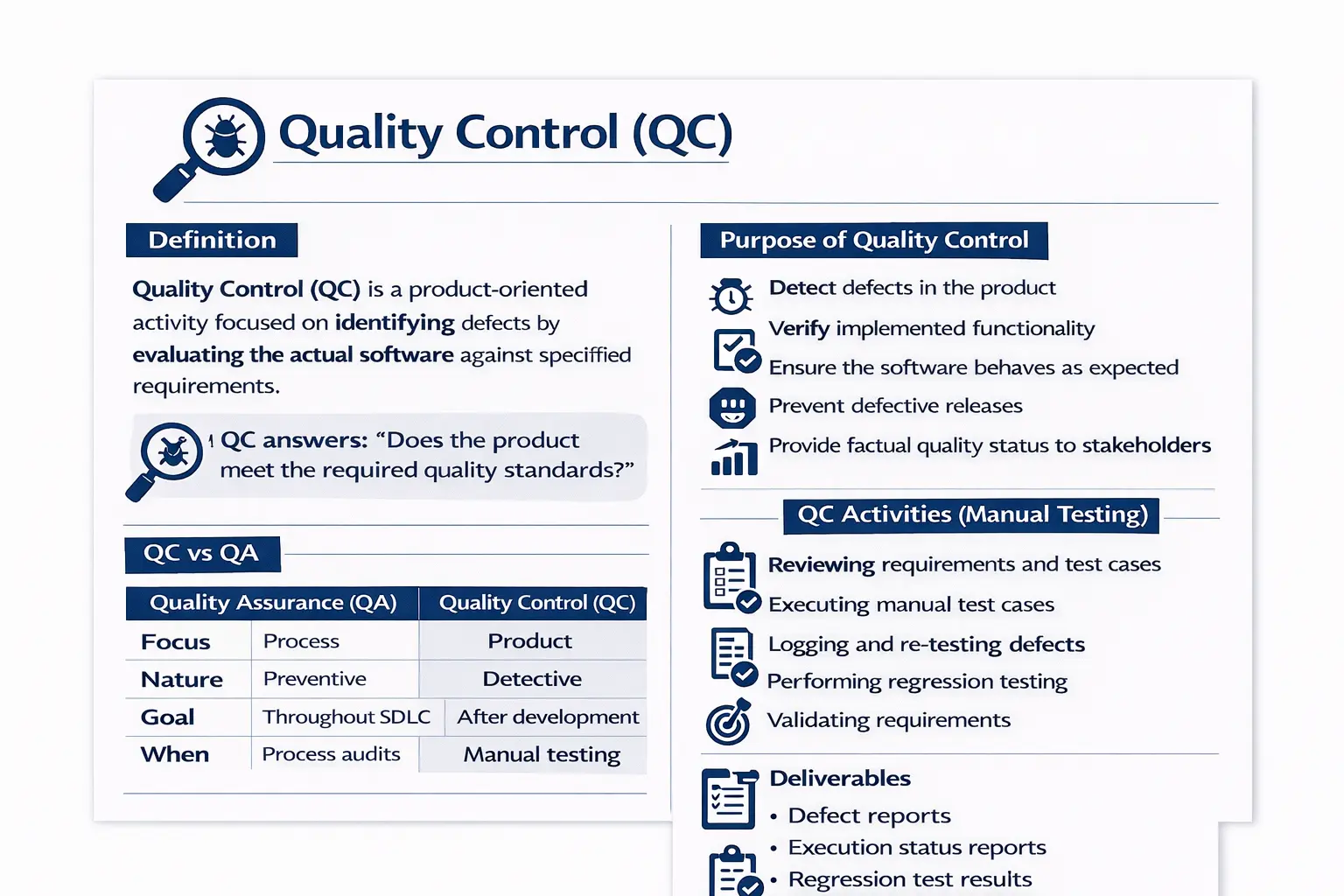
Quality Control, commonly referred to as QC, is a product-oriented discipline focused on identifying defects in the actual software by evaluating it against specified requirements. While Quality Assurance concentrates on how the software is built, Quality Control concentrates on what has been built. It answers a direct and practical question: does the product meet the required quality standards? QC provides a realistic picture of the product’s condition before it reaches users.
Why Quality Control Matters
Quality Control matters because every software product eventually has to face reality. Requirements, plans, designs, coding standards, and process documents are important, but users experience the actual working product. If the application crashes, saves incorrect data, shows wrong calculations, fails to process payments, or behaves differently from the requirement, the user is affected by the product defect, not by the intention behind the process. QC gives the team an honest view of what has actually been built.
In software projects, assumptions are common. A developer may assume the feature works because the code compiles. A product owner may assume the requirement was understood correctly. A tester may assume that an existing module is unaffected by a small change. Quality Control challenges these assumptions by evaluating the product directly. It executes scenarios, observes behavior, compares actual results with expected results, and reports evidence when the product does not meet quality expectations.
This product-focused evaluation is essential before release. Even strong Quality Assurance processes cannot guarantee that no defect will exist. Requirements may be misunderstood, integrations may fail, environments may behave differently, and edge cases may appear only during execution. QC acts as a practical safeguard that helps teams detect these issues before customers experience them.
QC as a Product-Oriented Discipline
The defining characteristic of Quality Control is its product orientation. QC is concerned with the actual software output: the screen, workflow, API response, database update, report, message, calculation, performance behavior, security response, and user experience. It asks whether the implemented product satisfies defined requirements and quality standards. This is different from QA, which focuses on whether the team followed the right process to build that product.
For example, QA may define that every user story must have reviewed acceptance criteria and approved test cases. QC takes the completed build and checks whether those acceptance criteria are actually satisfied. QA may define a defect reporting standard. QC uses that standard to log real defects found during product evaluation. QA may define regression testing guidelines. QC performs the regression testing and reports whether existing features still work.
This relationship makes QA and QC complementary. QA reduces the likelihood of defects by improving the way work is performed. QC detects defects that still exist in the product. A mature team needs both. Without QA, defects may be introduced repeatedly. Without QC, existing defects may remain hidden until users find them.
QC Starts When a Testable Product Exists
Quality Control becomes most visible when a testable product or product increment is available. This may be a full application, a new build, a sprint increment, an API endpoint, a module, a report, or a small feature. Once something can be evaluated against expected behavior, QC can begin. It does not have to wait until the final release. In modern Agile projects, QC happens continuously as features become ready for testing.
The timing of QC is important. If the team waits until the end of a large project to test everything, defects are discovered late and may be expensive to fix. If QC is performed frequently on smaller increments, feedback is faster and issues can be corrected earlier. This is why Agile teams test within sprints and why continuous testing is valuable in DevOps pipelines.
However, QC should not be rushed just because the team wants fast feedback. A build must be stable enough to test, requirements must be clear enough to evaluate, and test data must be available. Good QC depends on both disciplined execution and practical readiness. Testing a completely unstable build may waste time, while delaying QC too long increases release risk.
Manual Testing as a Core QC Activity
Manual testing is one of the most common and important forms of Quality Control. In manual testing, testers interact with the software like real users, execute planned test cases, explore workflows, and observe system behavior. They verify whether the product behaves according to requirements and whether unexpected issues appear during usage.
Manual testers contribute more than step execution. They use observation, reasoning, domain knowledge, and user empathy. A test case may say that a user should submit a form successfully, but a skilled tester may notice that the success message is unclear, the button remains enabled during processing, duplicate submissions are possible, or the confirmation page does not show important information. These findings are part of product quality evaluation.
Manual QC is especially valuable for usability, exploratory testing, business workflow validation, visual issues, unclear messages, and scenarios where human judgment is needed. Automation can execute repeated checks quickly, but manual testing often discovers problems that predefined scripts do not cover. A strong QC strategy uses both planned validation and thoughtful exploration.
QC and Requirement Validation
Quality Control evaluates the product against requirements. This means testers must understand what the software is supposed to do before deciding whether it passes or fails. A defect exists when the actual behavior differs from the expected behavior, but the expected behavior must be clear. If the requirement is vague, QC becomes difficult because testers may not know what result is correct.
For example, if a requirement says "the system should show results quickly," QC cannot evaluate it objectively unless "quickly" is defined. Does it mean under two seconds, under five seconds, or simply no visible delay? If a requirement says "invalid users should see an error," the expected message, timing, and conditions should be clear. QC depends on testable requirements.
When requirements are unclear during QC, testers should raise clarification questions. This is not a failure of testing; it is part of quality communication. Sometimes QC reveals not only product defects but also requirement gaps. Those gaps should be resolved so the product can be evaluated fairly and consistently.
QC Through Functional Testing
Functional testing is a major part of Quality Control. It checks whether the features of the software work according to requirements. Login, registration, search, payment, report generation, file upload, order placement, password reset, profile update, and notification workflows are examples of functional areas that QC commonly validates.
Functional QC usually includes positive scenarios, negative scenarios, boundary cases, business rules, and workflow combinations. A payment feature should work with valid details, reject invalid details, prevent duplicate transactions, calculate amounts correctly, handle timeout conditions, and update order status accurately. Testing only the happy path is not enough to understand product quality.
Good functional QC also checks integration points. A feature may appear to work on the screen but fail to update the database, trigger an email, call an external service, or generate the correct audit log. Product quality includes the full behavior, not only visible UI output. This is why testers often verify backend effects, reports, messages, and data persistence where access is available.
QC Through Non-Functional Checks
Quality Control is not limited to functional correctness. A product can satisfy functional requirements and still be poor quality if it is slow, insecure, inaccessible, unreliable, confusing, or incompatible with supported devices. Non-functional checks help evaluate these broader quality attributes.
Performance-related QC may check response times, page load behavior, or system stability under normal use. Usability checks may evaluate whether users can complete tasks easily. Compatibility checks may verify behavior across browsers, devices, or operating systems. Accessibility checks may confirm that labels, keyboard navigation, focus order, and color contrast support users with disabilities.
Not every manual tester performs deep performance or security testing, but QC should still recognize quality risks beyond simple functionality. If a page technically works but takes too long to load, the product may not be acceptable. If a form submits correctly but exposes sensitive data in an error message, the product has a quality problem. QC helps surface these issues before release.
Defect Reporting in QC
Defect reporting is one of the most visible outputs of Quality Control. When testers find a mismatch between expected and actual behavior, they document the issue so it can be understood, prioritized, fixed, and retested. A strong defect report is clear, reproducible, evidence-based, and useful for decision-making.
A good QC defect report usually includes a summary, environment, build version, steps to reproduce, test data, expected result, actual result, severity, screenshots, videos, logs, and related requirement or test case references. These details help developers reproduce the issue and help stakeholders understand its impact. Poor defect reports create delays because the team must ask for missing information.
QC also involves retesting fixed defects. When a developer marks a defect as fixed, the tester executes the same scenario again to confirm whether the issue is resolved. If it works correctly, the defect can be closed. If it still fails, it is reopened with updated evidence. This defect lifecycle is an important part of controlling product quality.
Regression Testing as Quality Control
Regression testing is a key QC activity because software changes can create unintended side effects. A new feature may break an old feature. A bug fix may introduce another defect. A configuration change may affect a workflow that was previously stable. Regression testing checks that existing behavior still works after changes.
In real projects, regression testing must be selected intelligently. Running every test case after every small change may be unrealistic. QC teams often use risk-based regression selection, focusing on impacted modules, critical business flows, high-defect areas, integration points, and frequently used features. Automation can help with repeated regression checks, but manual review is still important when changes are complex or user experience is affected.
Regression QC provides release confidence. Stakeholders do not only need to know that the new feature works; they also need to know that important existing features still work. This is especially critical in banking, healthcare, e-commerce, insurance, education, logistics, and any system where production defects can create financial, legal, or customer impact.
QC Deliverables and Their Value
Quality Control creates evidence. Test execution reports show what was tested, what passed, what failed, what was blocked, and what remains pending. Defect reports show the issues discovered during evaluation. Test summary reports provide an overall view of quality, risk, coverage, and release readiness. These deliverables are not paperwork for its own sake; they help teams make informed decisions.
For example, a test summary report may show that all critical flows passed, two medium defects remain open with workarounds, one browser-specific issue is deferred, and payment regression passed across supported environments. This information allows stakeholders to decide whether the release risk is acceptable. Without QC deliverables, release decisions may rely on assumptions or verbal confidence.
QC deliverables also support traceability. When test cases are linked to requirements and defects are linked to failed scenarios, the team can see which requirements are validated and which areas still carry risk. This visibility is important for audits, regulated domains, and projects where business stakeholders need clear quality status.
QC in Agile and DevOps
In Agile teams, Quality Control happens continuously. Instead of waiting for a final testing phase, testers validate stories inside the sprint. They check acceptance criteria, execute test cases, perform exploratory testing, raise defects, verify fixes, and provide quick feedback. This helps the team deliver a potentially releasable increment at the end of each sprint.
In DevOps environments, QC becomes even more continuous. Automated checks may run in CI/CD pipelines, manual exploratory testing may focus on high-risk changes, and release quality is monitored through both pre-release and post-release signals. QC does not disappear in DevOps; it adapts to faster delivery by combining automation, risk-based testing, environment checks, and production feedback.
Agile and DevOps also make communication important. QC findings should be shared quickly with developers and product owners. A defect found late in the sprint should not sit unnoticed in a tool. Fast feedback helps the team fix issues while context is fresh. QC is most effective when it is integrated with team collaboration rather than treated as a separate final gate.
QC Metrics and Product Quality Signals
Quality Control produces measurable signals about the product. Common QC metrics include test cases executed, pass percentage, fail percentage, blocked test cases, defect count, defect severity distribution, defect reopen rate, defect leakage, regression pass rate, and release defect trends. These metrics help the team understand current product condition.
Metrics must be interpreted carefully. A high pass percentage may look good, but if critical scenarios were not tested, the product may still be risky. A high defect count may look bad, but it may also show that testing is thorough and finding issues before production. QC metrics should support discussion, not blame. The goal is to understand risk and readiness.
The best QC reporting combines numbers with context. Instead of saying only "95% test cases passed," a useful report explains which areas passed, which areas failed, which defects are critical, what risks remain, what was not tested, and what recommendation the QA/QC team gives for release. This turns raw testing data into actionable quality insight.
Real-Time Example of QC
Consider an online shopping checkout flow. The requirement says that a user should add products to the cart, apply valid coupons, enter shipping details, make payment, and receive an order confirmation. Quality Control evaluates the working product against this expectation. The tester does not simply trust that development is complete; the tester executes the flow and observes the result.
QC would check whether products are added correctly, quantities update properly, coupon rules are applied accurately, invalid coupons are rejected, shipping charges are calculated, payment status is handled, order confirmation is generated, inventory is updated, and confirmation messages are sent. QC would also test negative cases such as expired coupons, payment failure, empty cart checkout, invalid address, duplicate payment attempt, and browser refresh during processing.
If the order is created but the confirmation email is not sent, QC reports a defect. If payment is charged but order status remains pending, QC reports a critical defect. If the success message has a spelling mistake, QC may report a low-severity issue. This example shows how QC gives a practical, evidence-based picture of product quality.
Interview-Ready View of Quality Control
In interviews, Quality Control should be explained as a product-focused and detective activity that evaluates the actual software to identify defects and verify whether it meets requirements. It is not the same as QA. QA focuses on process improvement and defect prevention, while QC focuses on product evaluation and defect detection. Testing is one of the main activities of QC.
A strong interview answer can be: Quality Control is a product-oriented process that checks the developed software against requirements and quality standards to identify defects, verify expected behavior, and provide release-quality information. In manual testing, QC includes test execution, defect reporting, retesting, regression testing, test summaries, and release readiness evaluation.
This answer is strong because it separates QC from QA, connects QC to real testing activities, and explains its value in release decisions. It also shows that QC is not only about finding bugs; it is about evaluating product condition and communicating quality status clearly.
Purpose of Quality Control
The purpose of Quality Control is to detect defects and verify that implemented features work as intended. QC evaluates whether the software behaves according to expectations and whether it is stable enough for release. By systematically checking the product, QC helps prevent defective releases and provides stakeholders with factual information about product quality. This transparency supports informed decision-making and reduces the likelihood of unpleasant surprises in production.
Quality Control and Quality Assurance
Quality Control and Quality Assurance are closely related but fundamentally different in focus. Quality Assurance is process-oriented and preventive, aiming to reduce the chance of defects being introduced. Quality Control is product-oriented and detective, aiming to find defects that already exist. QA operates throughout the lifecycle to shape how work is done, while QC evaluates the results of that work. Both are necessary, but they serve different purposes in achieving overall quality.
Quality Control in Manual Testing
In a manual testing context, QC is where hands-on evaluation happens. Testers review requirements and test cases, execute manual tests, and observe how the system behaves. They perform both functional and non-functional checks, record defects with clear details, and verify fixes once issues are resolved. Regression testing ensures that new changes do not break existing functionality. Through these activities, QC validates that requirements are truly met in the working product.
Quality Control Techniques
Quality Control relies on practical evaluation techniques. Test execution is central, but it is supported by exploratory approaches where testers investigate the system beyond predefined steps. Ad-hoc testing allows spontaneous checks based on experience and intuition. QC also supports user acceptance efforts and includes reviews or walkthroughs of test artifacts and outcomes. These techniques together create a thorough view of product quality.
Quality Control Deliverables
QC produces concrete outputs that reflect the product’s status. These include executed test records, defect reports, and test execution summaries that show coverage and results. Test summary reports consolidate findings and often contribute to release recommendations. Such deliverables provide visibility into quality and serve as evidence for release readiness discussions.
Quality Control in Real Projects
In real-world projects, QC ensures that each build can be tested and that critical business flows operate correctly. It helps teams identify problems before they affect customers. By catching issues early in the testing phase, QC reduces business risk and supports smoother releases. Consistent QC practices build trust in the product’s reliability.
Quality Control in Agile Environments
Within Agile teams, Quality Control is continuous rather than delayed. Testing and validation occur within each sprint, aligned with user stories. QC activities help confirm that stories meet acceptance criteria and that increments are releasable. Feedback gathered during QC activities informs the team about current quality and guides improvements in upcoming iterations.
Misconceptions About Quality Control
Quality Control is sometimes confused with Quality Assurance or seen as only final-stage testing. In reality, QC can occur at multiple points whenever a product increment is available. It is also more than just defect reporting. QC includes validation, assessment, and communication of quality status. Understanding this broader role helps teams use QC effectively.
Quality Control and Testing
Testing is a major component of Quality Control, but QC is broader than testing alone. QC includes evaluating results, assessing risk, and communicating quality status. Testing generates the data, while QC interprets and uses that data to judge readiness and quality levels.
Conclusion
Quality Control ensures that defects are detected and managed before the product reaches users. It provides an honest evaluation of the software’s condition and helps teams release with confidence. By focusing on the actual product, QC acts as a final safeguard between development and the user. When combined with strong Quality Assurance practices, it contributes to delivering reliable and high-quality software.