Root Cause Analysis (RCA)
Root Cause Analysis (RCA) is a systematic approach used to identify the fundamental reasons behind defects in software systems. Instead of focusing only on fixing the visible symptom of a problem, RCA tries to understand why the defect occurred in the first place and what must change so that similar defects do not keep appearing in future releases.
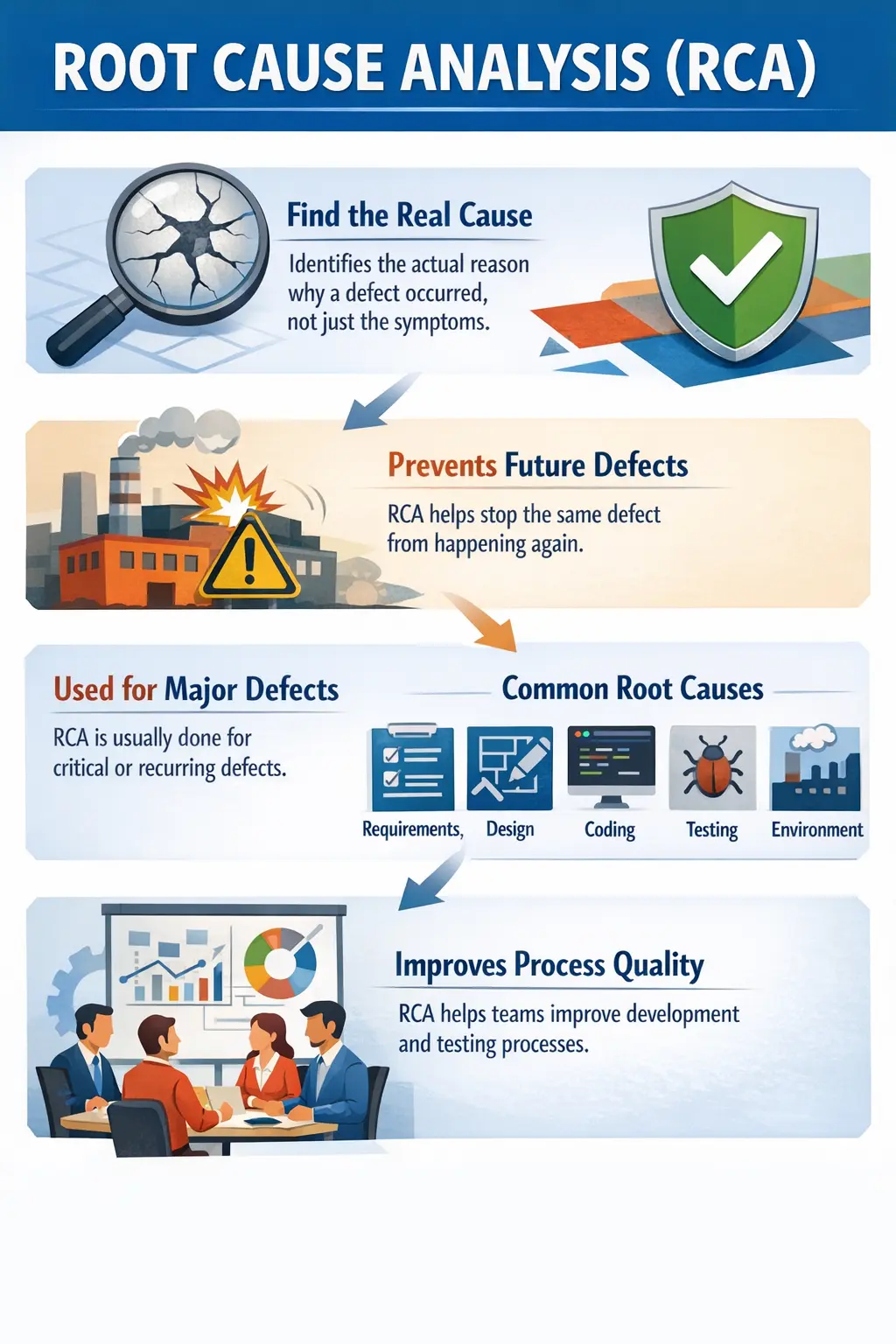
Root Cause Analysis answers an essential quality assurance question: why did this defect happen in the first place? This question is deeper than asking who wrote the code or which test failed. It looks at requirements, design, development practices, review quality, test coverage, communication, environment setup, release pressure, and process gaps that may have contributed to the defect.
In modern software development, fixing defects alone is not enough to ensure product quality. A defect fix may solve the immediate problem, but if the same kind of defect appears again next sprint, the team has not truly improved. RCA helps organizations learn from defects. It turns defects into information about weak points in the development and testing process.
Root Cause Analysis is widely used in professional software testing environments, especially after major releases, production incidents, critical defects, repeated failures, or customer-impacting issues. It plays an important role in continuous improvement because it helps teams reduce recurring defects, improve process discipline, and build more reliable software over time.
RCA should not be treated as a blame exercise. Its goal is not to identify a person to criticize. Its goal is to identify the process, communication, knowledge, tooling, environment, or coverage gap that allowed the defect to be created or escape. When RCA is done well, it creates a learning culture where teams improve together instead of hiding mistakes.
Understanding Root Cause Analysis
Root Cause Analysis is based on the principle that every defect has an underlying cause. A visible defect is often only the final result of a chain of earlier decisions, assumptions, gaps, or missed checks. While a defect may appear to be caused by a coding mistake or a configuration error, the real root cause may be deeper in the development process.
For example, a defect may appear to be caused by incorrect logic in the code, but the actual root cause might be an ambiguous requirement that was misunderstood by the developer. Similarly, a production defect may appear to be caused by missing test coverage, but the deeper cause may be incomplete acceptance criteria, insufficient test data, unclear business rules, or a rushed release cycle.
RCA goes beyond immediate defect correction by examining the full lifecycle of the defect. It asks how the defect was introduced, why it was not caught earlier, why existing reviews or tests failed to detect it, and what process change would reduce the chance of recurrence. This broader view is what makes RCA different from ordinary debugging.
RCA also recognizes that defects are often caused by multiple contributing factors. A production failure may involve an unclear requirement, missing code review, incomplete regression testing, and an environment mismatch. A good RCA does not stop at the first convenient explanation. It investigates until the team understands the most useful cause to address.
RCA helps organizations shift from a reactive approach to a proactive approach. A reactive team fixes defects as they appear but does not learn enough from them. A proactive team studies important defects, improves the process, and reduces future failures. Over time, this creates better requirements, stronger development practices, smarter testing, and more stable releases.
Purpose of Root Cause Analysis
The primary purpose of Root Cause Analysis is to prevent defects from recurring. If a team only fixes the visible defect, the same type of issue may return under a slightly different condition. By identifying the underlying cause, the team can implement preventive actions that reduce repeated failure patterns.
Another important purpose of RCA is to improve overall process quality. When teams analyze defects systematically, they often discover gaps in requirements, design, coding practices, testing procedures, deployment steps, communication, or review processes. Addressing these gaps improves software quality across the project, not just in one defect.
RCA also helps identify weaknesses in different phases of the Software Development Life Cycle. Repeated requirement-related defects may indicate weak requirement reviews. Repeated integration defects may indicate poor interface documentation. Repeated regression defects may indicate an outdated regression suite. RCA helps teams see patterns that individual defect fixes may hide.
RCA reduces the long-term cost of defects. Defects discovered in production are expensive because they may require emergency fixes, customer support, data correction, communication plans, retesting, redeployment, and reputation recovery. Preventing recurrence is often cheaper than repeatedly fixing similar failures after they escape.
RCA also supports continuous improvement initiatives. Many organizations use RCA findings to refine development standards, testing practices, review checklists, automation coverage, documentation rules, release gates, and training plans. A good RCA does not end with a document; it ends with practical improvements that change how the team works.
Another purpose of RCA is organizational learning. Software teams change over time. People join, leave, switch projects, and work under changing deadlines. RCA documentation preserves lessons learned so that future team members do not repeat the same mistakes.
When Root Cause Analysis Is Performed
Root Cause Analysis is not usually performed for every defect because deep analysis takes time. It is most valuable when the cost of recurrence is high or when a defect reveals a broader process weakness. Teams should apply RCA selectively but consistently for defects that justify deeper investigation.
RCA is commonly performed for critical or high-severity defects. These defects may cause system crashes, data loss, incorrect financial results, security failures, major workflow breakdowns, or customer-impacting outages. Understanding the cause of such defects is essential because recurrence could be costly.
RCA is also performed for recurring defects. When similar defects appear repeatedly, it indicates a systematic problem. For example, if every sprint produces validation defects in forms, the root cause may be weak validation requirements, missing shared UI standards, or incomplete test design. Fixing each defect separately will not solve the pattern.
Production defects are another common trigger for RCA. A defect that reaches production has escaped the team's normal detection process. RCA helps answer why the defect was not caught during requirement review, development, unit testing, integration testing, system testing, regression testing, or release validation.
RCA is frequently performed after major releases, especially when the release had many hotfixes, customer complaints, rollback decisions, or unexpected failures. Post-release analysis helps teams evaluate what went well and what must improve before the next release.
Many Agile teams perform RCA during retrospectives or post-mortem meetings. These sessions provide a practical opportunity to discuss defects, process gaps, communication failures, and improvement actions while the experience is still fresh.
Root Cause Categories
Root causes of defects usually fall into several common categories. Understanding these categories helps teams analyze defects more effectively because it prevents the discussion from focusing only on code. Defects can originate at many points in the software lifecycle.
Requirement-related issues are one of the most common root causes. Requirements may be incomplete, ambiguous, contradictory, outdated, or not testable. When requirements are unclear, developers and testers may interpret them differently. The resulting defect may appear during testing, but its origin is really in requirement definition.
Design-related issues are another major category. Poor architectural decisions, weak workflow design, missing validations, unclear data flow, or poor interface contracts can introduce defects even when requirements are understood. Design defects are often expensive because they may require structural changes rather than small code corrections.
Coding issues represent another common root cause. Logic errors, incorrect conditions, missing validations, incorrect exception handling, copy-paste mistakes, and incorrect assumptions can all cause unexpected system behavior. However, RCA should still ask why the coding issue was not prevented or detected through review, unit testing, or standards.
Testing gaps also contribute to escaped defects. Missing scenarios, inadequate regression coverage, insufficient boundary testing, weak negative testing, unrealistic test data, and incomplete environment coverage can allow defects to move into later stages. When testing gaps are found, RCA should improve test design rather than only adding one narrow test case.
Environment-related issues can also introduce or hide defects. Differences between development, testing, staging, and production environments may cause unexpected failures. Configuration mismatches, missing services, different database versions, incorrect permissions, or external integration differences can all become root causes.
Process-related issues often represent deeper root causes. Poor communication, inadequate reviews, unrealistic deadlines, lack of ownership, weak change control, insufficient documentation, or skipped quality gates can all contribute to defects. These causes are important because they may affect many future features if not addressed.
Manual Tester’s Role in Root Cause Analysis
Manual testers play a significant role in Root Cause Analysis because they understand how defects were observed, reproduced, and evaluated. Testers provide detailed information about defects, including reproduction steps, test data, environment details, screenshots, logs, expected behavior, actual behavior, and affected scenarios. This information helps the team analyze accurately instead of relying on assumptions.
Testers often help identify missed test scenarios. When defects escape detection, testers analyze whether existing test cases covered the scenario, whether the test data was realistic, whether the environment matched production, whether the expected result was clear, and whether the scenario was considered during test design.
Testers also help map defects to phases of the Software Testing Life Cycle. A defect may have originated during requirement analysis, test design, test execution, regression testing, or test closure. Mapping the defect to the phase where it could have been prevented helps the team improve the right activity.
Manual testers participate in RCA meetings by explaining the testing view. They can clarify which areas were tested, which were out of scope, which assumptions were made, and which constraints affected testing. This prevents unfair conclusions such as "testing missed it" when the real cause may have been missing requirements or late scope changes.
Testers may also suggest preventive actions such as improving test coverage, enhancing regression suites, adding boundary value scenarios, refining negative test cases, improving test data, updating checklists, adding peer review for test cases, or strengthening traceability between requirements and tests.
Effective tester participation improves RCA quality because testers connect the defect to real user behavior and quality risk. A tester who understands RCA becomes more valuable because they help prevent future defects, not just report current ones.
RCA Techniques
Several techniques are commonly used to perform Root Cause Analysis. These techniques help teams move from surface-level explanations to deeper causes. The goal is not to use a technique mechanically, but to structure thinking so that important contributing factors are not missed.
5 Whys Technique
The 5 Whys technique is one of the simplest and most effective RCA methods. It involves repeatedly asking "Why?" until the team reaches a useful root cause. The number five is not strict; sometimes three questions are enough, and sometimes more are needed. The point is to keep digging beyond the first answer.
Consider a payment failure defect. Why did the payment fail? Because validation failed. Why did validation fail? Because the input format was incorrect. Why was the input format incorrect? Because the requirement did not describe the accepted format clearly. Why was the requirement unclear? Because business rules were not reviewed with payment stakeholders. Why were business rules not reviewed? Because the story moved to development before requirement review was complete.
This analysis reveals that the root cause is not simply a validation error. The deeper cause is incomplete requirement review before development. The preventive action should therefore improve requirement review and acceptance criteria, not merely patch the validation rule.
The 5 Whys technique is effective because it is easy to apply and encourages teams to look beyond obvious answers. However, it requires discipline. If the team stops too early, the result may still be a symptom. If the discussion becomes blaming, the technique loses value.
Fishbone Diagram (Ishikawa Diagram)
The Fishbone Diagram, also known as the Ishikawa Diagram, is another popular RCA technique. It organizes possible causes into categories and helps teams visualize how different factors may contribute to a defect. It is especially useful for complex incidents where multiple causes may be involved.
Common categories include people, process, technology, environment, tools, data, and requirements. Under each category, the team lists possible contributing factors. For example, a production defect might include lack of training under people, missing reviews under process, outdated libraries under technology, configuration mismatch under environment, and insufficient test data under data.
The value of the Fishbone Diagram is that it prevents narrow thinking. Instead of assuming the defect was caused only by a developer mistake, the team examines many possible areas. This is useful when defects involve integrations, production environments, cross-team dependencies, or unclear ownership.
A good Fishbone discussion should end with prioritized causes and practical actions. Listing many possible causes is not enough. The team must decide which causes are most likely, which can be verified, and which actions will reduce future risk.
RCA vs Defect Fixing
Root Cause Analysis and defect fixing serve different purposes. Defect fixing focuses on correcting a specific issue. When a defect is fixed, the immediate problem is resolved. For example, a developer may correct a calculation formula, update a validation rule, or fix a broken API call.
Root Cause Analysis focuses on prevention. It asks why the defect existed and why the existing process failed to prevent or detect it. RCA may result in better requirement reviews, stronger code reviews, improved automation, enhanced regression coverage, clearer ownership, better test data, or changes to release practices.
Defect fixing usually happens soon after defects are discovered because the product must be corrected. RCA often happens after the defect is understood or fixed, because the team needs enough information to analyze the cause properly. In production incidents, immediate recovery comes first, and RCA follows after stability is restored.
Defect fixes usually result in code, configuration, or data changes. RCA usually results in process improvements, documentation updates, checklist changes, review changes, training, monitoring, or new test coverage. Both are essential. A fix without RCA may allow recurrence. RCA without a fix leaves the immediate defect unresolved.
Real-Time Example
Consider a defect involving incorrect tax calculations in an e-commerce application. The immediate fix may involve correcting the tax calculation logic. After the fix, the affected scenario may pass testing, and the release may continue. But if the team stops there, similar tax defects may appear later for another region, product type, or business rule.
Root Cause Analysis may reveal that the business rules for tax calculation were misunderstood during development. Further investigation may show that the requirement document lacked clear examples for different states or countries. The tester may also discover that test cases covered only one tax region and did not include boundary or exception scenarios.
The RCA may identify multiple preventive actions. The business analyst may update requirement templates to include calculation examples. The QA team may add tax calculation scenarios for multiple regions. Developers may add unit tests for tax rules. The team may introduce a review checklist for financial calculations.
This example shows how RCA addresses deeper causes. The code fix solves today's tax defect, but RCA improves the process so that future financial logic is specified, developed, reviewed, and tested more carefully.
Benefits of Root Cause Analysis
Root Cause Analysis provides several important benefits. The most important benefit is reduction of recurring defects. When underlying causes are addressed, similar defects become less likely in future releases. This improves product stability and reduces repeated rework.
RCA improves software development processes by identifying weak points. A team may discover that requirements are often unclear, code reviews are inconsistent, test data is unrealistic, or regression testing does not cover critical workflows. These findings help the team improve the system that produces software.
RCA enhances communication between teams. Defects often cross role boundaries. A requirement gap may affect developers and testers. A deployment issue may affect QA and operations. RCA creates a forum where teams can understand each other's challenges and agree on improvements.
RCA improves testing effectiveness by identifying coverage gaps. When a defect escapes testing, testers can ask whether the missing scenario should be added to regression, whether new test data is needed, whether exploratory testing should focus on similar risks, or whether automation should cover the path.
RCA reduces long-term maintenance costs. Repeated defects consume developer time, tester time, support time, and management attention. Preventing recurrence saves effort and allows teams to spend more time building value instead of repeatedly correcting preventable issues.
RCA also increases customer trust. Customers may forgive an occasional defect, but repeated similar failures damage confidence. When teams use RCA effectively, product reliability improves, support incidents reduce, and releases become more predictable.
Common Mistakes in Root Cause Analysis
One common mistake is blaming individuals instead of analyzing processes. RCA should focus on improving systems, not assigning personal fault. If the conclusion is only "developer mistake" or "tester missed it," the team has probably stopped too early. The better question is why the process allowed the mistake to happen or escape.
Another mistake is performing RCA only for production defects. Production defects are important, but critical defects found during testing can also reveal valuable process gaps. If a serious defect is caught before release, RCA can still prevent similar future defects and strengthen the process.
Some teams identify root causes but fail to implement preventive actions. Without implementation, RCA becomes a documentation exercise. The value of RCA comes from action: updated checklists, better reviews, improved test cases, new automation, training, monitoring, or process changes.
Another mistake is stopping analysis too early. Surface causes often hide deeper issues. "The validation was missing" may be true, but the deeper question is why the validation requirement was not documented, why code review did not catch it, and why testing did not include the case.
Poor documentation of RCA findings can also reduce effectiveness. If the root cause, evidence, decisions, and preventive actions are not recorded clearly, the team may forget the lesson. Future teams may repeat the same mistake because the learning was not preserved.
Another common mistake is creating actions that are too vague. "Improve testing" is not a useful preventive action. A stronger action would be "Add boundary and negative scenarios for all payment validation rules to the regression suite." Specific actions can be assigned, tracked, and verified.
Root Cause Analysis in Agile Environments
Root Cause Analysis is commonly used in Agile development, but it is usually lightweight and action-oriented. Agile teams often perform RCA during sprint retrospectives, defect review sessions, production incident reviews, or after repeated sprint defects. The goal is not to create heavy documentation, but to learn quickly and improve the next iteration.
Short feedback cycles make RCA powerful in Agile teams. If a defect pattern is discovered in one sprint, the team can adjust acceptance criteria, review practices, test design, or automation in the next sprint. This supports continuous improvement without waiting for a large end-of-project review.
Agile RCA often focuses on practical improvements. For example, if multiple defects come from unclear user stories, the team may improve backlog refinement. If defects come from missed edge cases, testers may add earlier test design discussions. If production issues come from deployment configuration, the team may improve release checklists or environment validation.
RCA in Agile should remain blameless. Agile teams depend on trust and collaboration. If RCA becomes a blame session, people may hide problems instead of exposing them. The strongest Agile teams treat defects as learning signals and use them to improve teamwork, not to criticize individuals.
Continuous RCA helps Agile teams improve quality incrementally. Each sprint becomes an opportunity to learn from defects, strengthen practices, and reduce future risk. Over time, this creates a healthier engineering and testing culture.
RCA Preventive Actions and Follow-Up
Root Cause Analysis is useful only when it leads to preventive action. Identifying the cause is the analytical part of RCA, but implementing improvement is the practical part. If a team concludes that a defect occurred because requirement examples were missing, the action should not be vague. The team should update requirement templates, add example sections for business rules, and make those examples part of story review.
Preventive actions should be specific, assignable, and measurable. A weak action is "improve testing." A stronger action is "add negative and boundary test cases for all mandatory fields in the registration flow." A weak action is "developers should be careful." A stronger action is "add validation-rule checks to the code review checklist." Specific actions are easier to track and verify.
RCA actions may involve different areas. Requirement actions may include better acceptance criteria, business rule examples, stakeholder walkthroughs, or requirement sign-off. Development actions may include coding standards, peer review, unit tests, static analysis, or shared component reuse. Testing actions may include improved regression coverage, better test data, exploratory sessions, or traceability updates. Environment actions may include configuration checks, deployment validation, or production-like test environments.
Follow-up is essential because many RCA actions fail after the meeting ends. Someone must own each action, and the team should decide when it will be completed. In Agile projects, actions can be added to the sprint backlog or improvement backlog. In traditional projects, they may be tracked through action items, quality improvement plans, or process review records.
Teams should also verify whether RCA actions are effective. If the same type of defect keeps recurring after an action is implemented, the action may not address the true root cause. In that case, the team should revisit the analysis and look for deeper or different causes. RCA is not a one-time ritual; it is a feedback loop.
Good RCA documentation includes the defect summary, impact, timeline, root cause, contributing factors, evidence, preventive actions, owners, target dates, and follow-up status. This documentation does not need to be lengthy, but it should be clear enough for future teams to understand what happened and what was changed.
Interview Perspective
Root Cause Analysis is an important topic in manual testing interviews because it shows whether a tester understands quality beyond defect reporting. A simple answer defines RCA as the process of identifying the underlying cause of a defect so that similar defects can be prevented in the future.
A stronger answer explains that RCA is not the same as fixing a defect. Fixing solves the immediate problem, while RCA identifies why the problem happened and what process improvement is needed. RCA may reveal gaps in requirements, design, coding, testing, environment setup, communication, or release process.
Interviewers may also ask when RCA is performed. A good answer mentions critical defects, recurring defects, production defects, post-release reviews, major incidents, and retrospectives. RCA is not usually required for every minor issue, but it is valuable when a defect indicates larger risk.
Testers should also be able to explain their role. They provide evidence, reproduction steps, environment details, test data, missed scenario analysis, defect history, and suggestions for preventive action. They may also help improve test coverage and update regression suites based on RCA findings.
An interview-ready answer could be: RCA is a systematic analysis used to find the real cause of a defect, not just the visible symptom. It helps teams prevent recurrence by improving requirements, development, testing, or process practices. Common techniques include 5 Whys and Fishbone Diagram.
Key Takeaway
Root Cause Analysis is a systematic approach used to identify the underlying causes of defects so that similar issues can be prevented in the future. It shifts the focus from only fixing defects to improving the process that allowed those defects to occur or escape.
RCA helps teams reduce recurring defects, improve requirements, strengthen test coverage, refine development practices, reduce production risk, and build a culture of continuous improvement. It is most useful when applied to critical, recurring, or production-impacting defects where prevention has real value.
The most important principle is that RCA should be practical and blameless. A good RCA identifies useful causes, creates specific preventive actions, assigns ownership, and follows through. When teams use RCA consistently, they build more reliable software and improve quality over time.