Sprint Planning
Sprint Planning is one of the most important events in the Scrum Framework. It establishes the direction for the entire sprint by defining what work will be completed and how the team will achieve the sprint objectives. A well-conducted Sprint Planning session ensures that the team starts the sprint with a clear understanding of requirements, priorities, responsibilities, and risks.
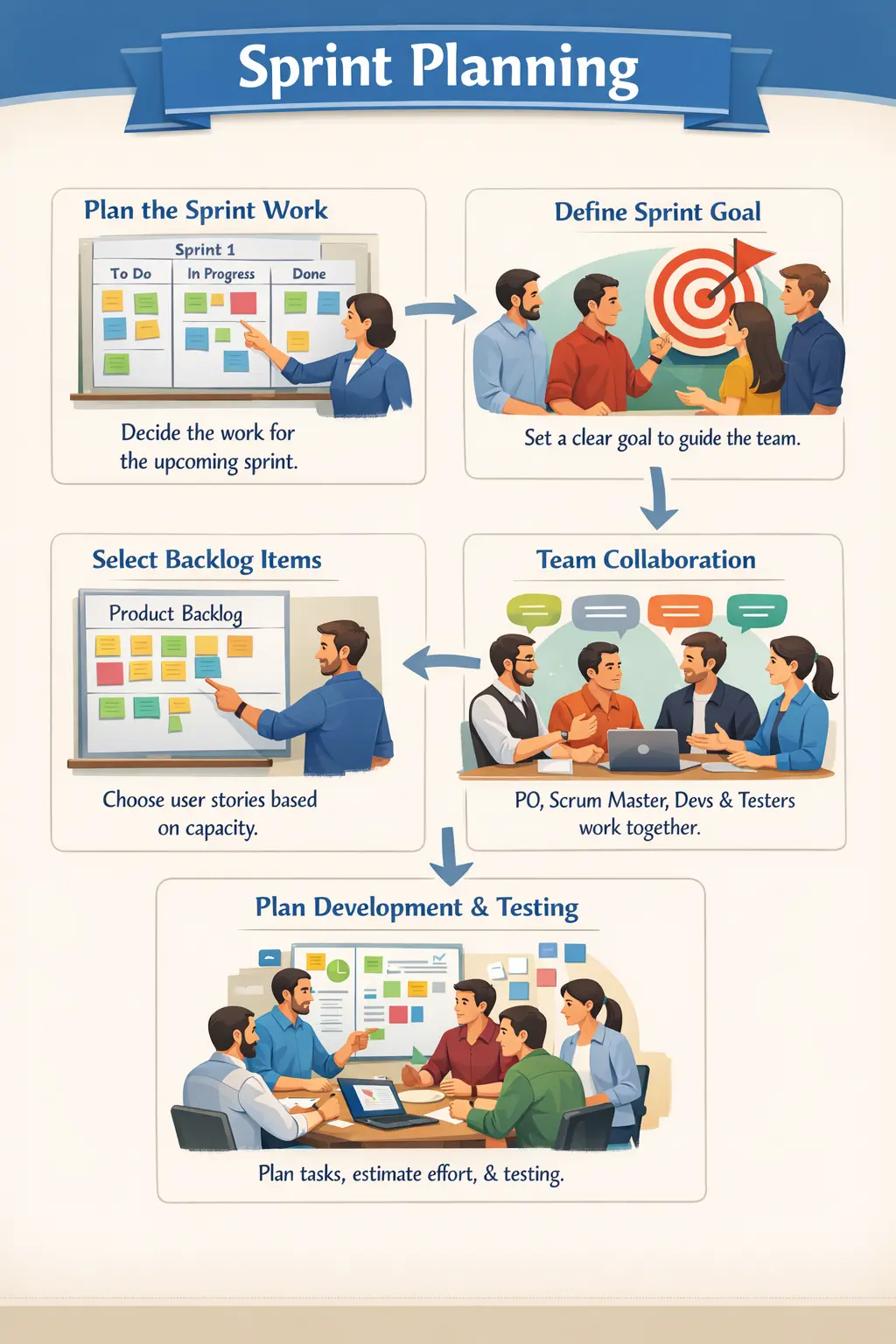
Sprint Planning is a collaborative event involving the Product Owner, Scrum Master, and Development Team, including testers. During this session, the team selects backlog items, defines the sprint goal, and determines how the selected work will be completed within the sprint duration.
Sprint Planning answers a fundamental question in Agile development: “What can we deliver in this sprint and how?”
Understanding Sprint Planning is essential for manual testers and Agile team members because it sets the foundation for effective testing and development activities throughout the sprint.
A sprint can succeed or struggle based on the quality of its planning. If Sprint Planning is clear, realistic, and collaborative, the team begins the sprint with confidence. If it is rushed or incomplete, the sprint may quickly become blocked by unclear requirements, missing test data, underestimated work, unstable environments, or unrealistic commitments. For this reason, Sprint Planning is not just a scheduling meeting; it is a quality and delivery alignment activity.
For manual testers, Sprint Planning is especially important because it is the first formal opportunity to understand the selected stories deeply. Testers can clarify acceptance criteria, identify risk areas, discuss edge cases, plan test data, and highlight regression impact before development begins. This early involvement helps prevent avoidable defects and reduces end-of-sprint testing pressure.
Definition of Sprint Planning
Sprint Planning is a Scrum event in which the Scrum Team collaborates to determine the work to be performed during the upcoming sprint and to create a practical plan for delivering that work.
The session defines the scope of the sprint and establishes a shared understanding among team members. It ensures that all participants agree on priorities, requirements, and expectations before development begins.
Sprint Planning is usually time-boxed based on sprint length. For example, a two-week sprint may have a Sprint Planning session lasting two to four hours.
The outcome of Sprint Planning is a well-defined sprint goal and a sprint backlog that guides the team throughout the sprint.
Sprint Planning should create shared understanding, not just a list of tasks. Everyone on the Scrum Team should understand what the team is trying to achieve, why the selected work matters, what quality expectations apply, what dependencies exist, and what risks may affect delivery. This shared understanding is what allows the team to coordinate effectively during the sprint.
The planning discussion should also make the work testable. A user story that cannot be tested clearly is usually not ready for sprint execution. If expected behavior is unclear, if acceptance criteria are missing, or if required test data is unavailable, the team should resolve those gaps before committing to the work or should adjust the sprint scope accordingly.
Purpose of Sprint Planning
Sprint Planning serves several important purposes that support successful sprint execution.
The primary purpose of Sprint Planning is to define the sprint goal. The sprint goal describes the main objective of the sprint and provides direction for the team.
Another important purpose is selecting backlog items for the sprint. The team chooses user stories and tasks that can realistically be completed within the sprint duration.
Sprint Planning also aligns the team on expectations. Team members gain a shared understanding of requirements, acceptance criteria, and priorities.
Risk identification is another key purpose. Potential challenges, dependencies, and uncertainties are discussed early so that the team can plan mitigation strategies.
Sprint Planning also helps plan testing activities. Testers identify required test scenarios, test data, and environment needs before the sprint begins.
Effective Sprint Planning improves predictability and reduces confusion during the sprint.
Sprint Planning also helps the team avoid hidden assumptions. Developers may assume one business rule, testers may assume another, and the Product Owner may expect something different. Planning brings these assumptions into discussion early. When assumptions are clarified before coding starts, the team saves time and reduces defect leakage.
Another purpose is balancing ambition with realism. Agile teams want to deliver value quickly, but selecting too much work can create unfinished stories, rushed testing, and low-quality increments. Sprint Planning helps the team choose work that is valuable and achievable within the sprint.
Participants in Sprint Planning
Sprint Planning involves all members of the Scrum Team. Each participant contributes to the planning process based on their role and expertise.
The Product Owner presents the prioritized product backlog and explains the business value of backlog items. The Product Owner clarifies requirements and acceptance criteria so that the team understands what needs to be delivered.
The Scrum Master facilitates the Sprint Planning session. The Scrum Master ensures that the session remains productive and that Scrum practices are followed. The Scrum Master also helps resolve issues that may arise during planning.
The Development Team participates actively in Sprint Planning. The Development Team includes developers, testers, and other technical specialists. Team members discuss implementation approaches, estimate effort, and commit to the sprint work.
Testers play an essential role by identifying testing requirements and ensuring that testing activities are properly planned.
Sprint Planning is a collaborative effort where all participants contribute to decision-making.
The Product Owner does not simply assign work to the team. The Product Owner explains priority and business value, but the Development Team decides how much work it can realistically complete. This distinction matters because the people doing the work are best positioned to understand effort, complexity, testing needs, dependencies, and risks.
Testers contribute by bringing a quality perspective to the discussion. They may ask what should happen when input is invalid, how error messages should behave, which user roles are involved, whether the feature affects existing flows, and what data is needed for validation. These questions improve the quality of the sprint plan.
Sprint Planning Structure
Sprint Planning typically consists of two major parts. The first part focuses on defining the sprint scope and goal. The second part focuses on creating an execution plan.
Defining Sprint Goal and Scope
The first part of Sprint Planning focuses on determining what will be delivered during the sprint.
The Product Owner presents the prioritized backlog items and explains their importance. These items are usually user stories that describe desired functionality.
The team reviews each backlog item carefully. Questions are discussed to ensure that requirements are clearly understood.
Acceptance criteria are reviewed and clarified. Acceptance criteria define the conditions that must be met for a story to be considered complete.
The team evaluates its capacity for the sprint. Capacity depends on factors such as team size, availability, holidays, and previous sprint performance.
Based on capacity and priorities, the team selects backlog items for the sprint.
After selecting backlog items, the team defines the sprint goal. The sprint goal describes the main objective of the sprint and provides a clear focus for the team.
The sprint goal helps guide decision-making throughout the sprint.
A good sprint goal is more than a collection of story names. It describes the business outcome the team wants to achieve. For example, "enable secure fund transfers for savings account users" is more useful than "complete stories 101, 102, and 103." A clear goal helps the team make tradeoff decisions if unexpected problems arise.
For testers, the sprint goal helps identify what must receive the most attention. If the sprint goal is centered on fund transfers, testing should focus strongly on transfer rules, validations, limits, user roles, security behavior, and regression around account balances. The sprint goal helps testers prioritize.
Execution Planning
The second part of Sprint Planning focuses on determining how the selected work will be completed.
The Development Team breaks down user stories into smaller tasks. These tasks represent the work required to implement and test each story.
Tasks may include development work, testing activities, environment setup, and documentation updates.
The team estimates the effort required for each task. Estimates help the team determine whether the planned work is realistic.
The team also discusses dependencies between tasks. Dependencies may include external systems, shared components, or data availability.
Testers identify testing strategies and requirements. This includes test scenario identification, test data preparation, and environment setup.
The execution plan provides a roadmap for the sprint.
Execution planning should include testing work explicitly. If the team breaks stories only into development tasks, testing can become invisible and get squeezed at the end. Testing tasks may include scenario design, test data preparation, environment checks, functional validation, exploratory testing, defect retesting, regression testing, and test evidence updates.
The team should also discuss the sequence of work. Some stories may need backend changes before UI validation can begin. Some tests may require third-party integrations or specific data setup. Some regression checks may need to happen after multiple stories are integrated. Good execution planning reduces waiting time during the sprint.
Manual Tester’s Role in Sprint Planning
Manual testers play a critical role in Sprint Planning. Early tester involvement helps prevent quality issues and improves sprint success.
Testers review user stories and acceptance criteria carefully. Clear understanding of requirements helps testers design effective test scenarios.
Testers identify possible test scenarios during Sprint Planning. Early scenario identification improves test coverage and reduces missed requirements.
Testers highlight test data requirements. Some test cases require specific data sets that must be prepared before execution.
Testers also identify environment requirements. Testing environments must be available and properly configured.
Testers raise risks and edge cases. Early risk identification helps the team avoid surprises later in the sprint.
Testers estimate testing effort. Testing activities must be included in sprint planning to avoid unrealistic commitments.
Active tester participation ensures that quality considerations are included in sprint planning.
Testers should not wait until development is finished to think about testing. During Sprint Planning, they can already identify positive scenarios, negative scenarios, boundary conditions, role-based checks, integration points, and likely regression areas. This early thinking makes later test execution faster and more focused.
Testers also help the team understand testing capacity. If the sprint includes several complex stories, each requiring heavy regression or data setup, the testing effort may be larger than expected. Raising this during planning helps prevent unrealistic commitments and protects the Definition of Done.
A strong tester also listens for ambiguity. Phrases like "properly," "as expected," "valid user," or "correct calculation" may hide missing details. Testers should ask what those terms mean in measurable behavior. This improves acceptance criteria and prevents defects caused by interpretation gaps.
Inputs to Sprint Planning
Sprint Planning relies on several important inputs that guide decision-making.
The refined product backlog is the most important input. Backlog items should be well-defined and ready for development.
Team velocity is another important input. Velocity represents the amount of work the team typically completes in a sprint.
Velocity helps the team select a realistic amount of work.
The Definition of Done is another key input. The Definition of Done defines quality standards that must be met before a backlog item is considered complete.
The Definition of Done may include requirements such as testing completion, defect resolution, and documentation updates.
Previous sprint learnings also influence Sprint Planning. Lessons from earlier sprints help teams improve planning accuracy.
These inputs help teams make informed decisions during Sprint Planning.
Another useful input is team capacity. Capacity is not the same as velocity. Velocity shows historical completion, while capacity considers current availability. If a tester is on leave, a developer is supporting production, or a holiday reduces working days, the sprint plan should reflect that reality.
Known risks and dependencies are also important inputs. A story that depends on an external API, a shared environment, a third-party vendor, or unavailable test data may be risky for the sprint. Discussing these factors early helps the team decide whether the story is truly ready.
Outputs of Sprint Planning
Sprint Planning produces several important outputs that guide sprint execution.
The sprint goal is one of the main outputs. The sprint goal defines the purpose of the sprint and provides direction for the team.
The sprint backlog is another key output. The sprint backlog contains the selected backlog items and associated tasks.
Clear acceptance criteria are also an important output. Acceptance criteria help ensure consistent understanding of requirements.
Testing scope and plan are also defined. Testers identify testing activities that will be performed during the sprint.
These outputs provide a clear roadmap for sprint execution.
A good Sprint Planning output should be understandable after the meeting ends. If someone asks what the team is trying to deliver, which stories are included, what done means, what testing is required, and what risks exist, the sprint backlog and related notes should answer those questions clearly.
For testers, one useful output is a visible testing approach for the sprint. This does not need to be a heavy test plan. It may be a set of test scenarios, a checklist, notes on test data, regression areas, and known dependencies. The goal is to make testing work visible and planned.
Sprint Planning vs Backlog Refinement
Sprint Planning is sometimes confused with backlog refinement, but the two activities serve different purposes.
Backlog refinement focuses on preparing backlog items for future sprints. During refinement sessions, backlog items are clarified, estimated, and prioritized.
Sprint Planning focuses on committing to work for the current sprint. The team selects backlog items and creates a plan for completing them.
Backlog refinement occurs continuously throughout the project. Sprint Planning occurs at the start of each sprint.
Backlog refinement produces a ready backlog. Sprint Planning produces a sprint backlog.
Understanding this distinction helps teams plan effectively.
If backlog refinement is weak, Sprint Planning becomes difficult. The team may spend planning time trying to understand unclear stories instead of selecting work and planning execution. This often leads to rushed commitments. Strong refinement makes Sprint Planning smoother because stories are already understood, estimated, and close to ready.
Testers should participate in both activities, but their focus differs. In backlog refinement, testers help prepare future work by clarifying risks and acceptance criteria. In Sprint Planning, testers help decide whether the current sprint scope is testable and achievable.
Importance of Sprint Planning
Sprint Planning plays a critical role in Agile development.
It provides a clear direction for the sprint.
It ensures that all team members understand the work to be completed.
It reduces misunderstandings and rework.
It improves coordination between development and testing.
It helps teams make realistic commitments.
Without effective Sprint Planning, teams may face confusion and delays during the sprint.
Proper Sprint Planning improves productivity and quality.
Sprint Planning improves quality because it creates space to discuss acceptance criteria before implementation. Many defects begin as misunderstood requirements. When testers, developers, and the Product Owner discuss expectations together, the team reduces the chance of building the wrong behavior.
It also improves predictability. A team that consistently plans based on realistic capacity, clear priorities, and known risks is more likely to finish what it starts. This helps stakeholders trust the team’s sprint commitments.
Sprint Planning and Definition of Done
Sprint Planning should always consider the Definition of Done. The team should not select work based only on development effort. A backlog item is not complete when coding is finished; it is complete when it meets the agreed quality standard. That may include testing completed, defects resolved, regression impact checked, documentation updated, and product owner acceptance.
For testers, the Definition of Done protects testing time. If the team agrees that stories must be tested before they are done, testing becomes part of the sprint commitment rather than an optional final activity. This prevents a common problem where stories are marked complete even though testing is pending.
During Sprint Planning, testers can ask whether selected stories can realistically meet the Definition of Done within the sprint. If the answer is no, the team may need to reduce scope, split stories, prepare test data earlier, or resolve dependencies before committing.
Quality Risks Discussed During Sprint Planning
Sprint Planning is an ideal time to discuss quality risks. A quality risk is anything that may prevent the team from delivering a reliable increment. Risks may include unclear requirements, complex integrations, unstable environments, missing test data, large stories, dependency on another team, or heavy regression impact.
Testers are often good at identifying these risks because they think about how the product can fail. They may ask whether old workflows are affected, whether boundary values are defined, whether error handling is expected, and whether multiple user roles need validation. These questions help the team plan better.
Discussing risk early does not mean the team avoids difficult work. It means the team enters the sprint with awareness and mitigation. For example, if a story depends on test data, the team can create a data preparation task. If regression impact is high, the team can plan regression effort instead of discovering the need late.
Real-World Sprint Planning Example
Consider a banking application development project.
During Sprint Planning, the Product Owner presents several user stories related to fund transfers.
The team reviews each story and clarifies acceptance criteria.
Testers identify scenarios such as valid transfers, insufficient balance cases, and transfer limits.
The team estimates development and testing effort.
Based on capacity, the team selects three stories for the sprint.
The sprint goal is defined as enabling secure and reliable fund transfers.
Tasks are created for development, testing, and environment setup.
The team begins the sprint with a clear plan.
In this example, the tester’s contribution is not limited to executing fund transfer tests later. The tester helps shape the sprint plan by identifying valid transfer scenarios, insufficient balance cases, daily limit checks, beneficiary validation, failed transaction messages, audit trail expectations, and regression around account balance updates. This improves the plan before development begins.
The team may also identify dependencies such as test accounts, transaction limits, mock banking services, or environment access. If these are discussed during Sprint Planning, the team can prepare them early. If they are discovered during test execution, they may delay the sprint.
Common Mistakes in Sprint Planning
Several mistakes can reduce the effectiveness of Sprint Planning.
One common mistake is unclear acceptance criteria. Poorly defined requirements lead to confusion during development and testing.
Another mistake is overcommitting work. Selecting too many backlog items increases the risk of incomplete work.
Ignoring testing effort is another serious mistake. Testing requires time and must be planned properly.
Late tester involvement reduces test coverage and increases risks.
Poor risk identification can lead to unexpected issues during the sprint.
Avoiding these mistakes improves sprint success.
Another common mistake is treating Sprint Planning as a Product Owner presentation instead of a team conversation. The Product Owner explains business needs, but the whole team must discuss feasibility, risks, and the plan. If developers and testers do not ask questions, hidden problems remain.
Some teams also ignore capacity. They use past velocity without considering current availability, holidays, production support, or team changes. This leads to overcommitment. Good planning uses both historical data and current reality.
A further mistake is failing to split large stories. Large stories are difficult to develop, test, and complete within a sprint. Smaller stories provide faster feedback and make it easier to validate increments. Testers can help identify natural splits based on workflows, rules, or user roles.
Best Practices for Sprint Planning
Effective Sprint Planning starts before the meeting. Backlog items should be refined, prioritized, and reasonably clear. Acceptance criteria should be available, dependencies should be known, and the team should understand its capacity. Planning works best when it is used to finalize the sprint plan, not to rescue unclear backlog items.
The team should keep the sprint goal visible. A clear sprint goal helps avoid a random collection of unrelated work. It gives the team a shared purpose and helps stakeholders understand what value the sprint is intended to deliver.
Testers should prepare by reviewing candidate stories before the meeting. They can note unclear acceptance criteria, possible test scenarios, data requirements, environment needs, and regression concerns. This preparation makes their participation more effective.
The team should also plan for testing and fixing time. A sprint plan that assumes everything will work on the first attempt is unrealistic. Defects, retesting, and regression checks are normal parts of delivery. Good planning leaves room for quality work.
Following the Sprint Plan During Execution
Sprint Planning creates the starting plan, but the team must inspect progress throughout the sprint. A plan has value only when the team uses it to guide daily decisions. During the sprint, team members should compare actual progress against the sprint goal, sprint backlog, testing status, and known risks.
For testers, following the sprint plan means tracking which stories are ready for testing, which are blocked, which defects are open, and which regression areas still need attention. If too many stories remain untested near the end of the sprint, the tester should raise the risk early rather than waiting until the final day.
The sprint plan may also need adjustment. Scrum allows adaptation when new information appears. If a dependency is delayed, a story becomes larger than expected, or a critical defect blocks progress, the team may need to renegotiate scope with the Product Owner. The sprint goal helps guide these tradeoff decisions.
Good teams do not treat Sprint Planning as a one-time promise that cannot change. They treat it as a shared plan that is inspected and adapted. This approach protects transparency and helps the team focus on delivering the most valuable completed work instead of hiding problems.
At the end of the sprint, the team can compare planned work with completed work. If many stories are repeatedly carried over, the team should inspect why. The cause may be overcommitment, unclear acceptance criteria, late testing, large stories, missing environments, or poor refinement. These lessons should feed into the next Sprint Planning session.
Interview Perspective
Sprint Planning is a common topic in Agile interviews.
A short answer defines Sprint Planning as a Scrum event where the team decides what work will be completed in the upcoming sprint.
A detailed answer explains backlog selection, sprint goal definition, and execution planning.
Interviewers often expect testers to explain their role in Sprint Planning.
Understanding Sprint Planning demonstrates practical Agile knowledge.
A strong interview answer should mention that Sprint Planning has two major concerns: what will be delivered and how it will be delivered. It should also mention the sprint goal, sprint backlog, team capacity, Definition of Done, acceptance criteria, and the tester’s role in identifying test scenarios and risks.
If asked about manual testers, the answer should explain that testers participate actively, clarify requirements, estimate testing effort, identify data and environment needs, plan test scenarios, raise risks, and ensure testing is included in the sprint plan.
Key Takeaway
Sprint Planning is a critical Scrum event that ensures the team starts each sprint with clear goals and realistic commitments.
By defining the sprint goal, selecting backlog items, and planning execution, Sprint Planning provides a strong foundation for successful sprint delivery.
For manual testers, Sprint Planning enables early involvement in testing activities and ensures that quality considerations are included from the beginning.
Effective Sprint Planning leads to better collaboration, improved predictability, and higher-quality software delivery.
The main lesson is that Sprint Planning is not only about selecting work. It is about creating shared understanding and a realistic path to done. When testers are involved early and quality work is planned properly, the sprint has a much better chance of delivering a stable and valuable increment.