Ad-hoc Testing: Informal and Experience-Driven Validation
Introduction to Ad-hoc Testing
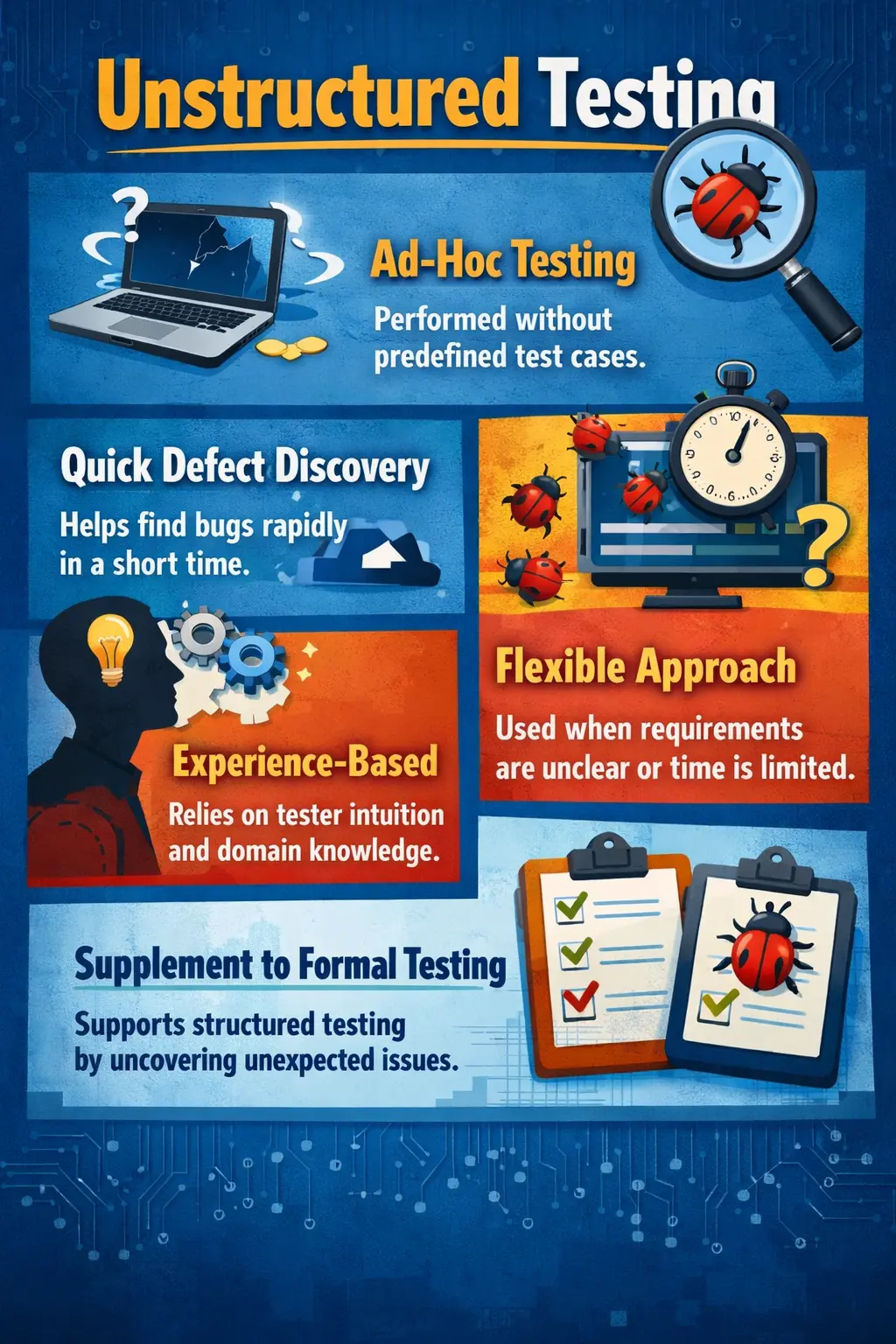
Ad-hoc Testing is an informal and unstructured testing approach in which the tester executes tests without predefined test cases or detailed documentation. It relies heavily on tester experience, intuition, and domain understanding. Ad-hoc testing answers a spontaneous question: what happens if I try this right now?
Unlike structured testing approaches, ad-hoc testing does not follow a planned script. Its strength lies in quick, creative exploration.
Purpose of Ad-hoc Testing
The primary purpose of ad-hoc testing is to identify defects quickly through informal exploration. It gives testers room to use experience, product understanding, and instinct to try actions that may not appear in formal test execution documents. Many real users do not follow perfect paths, and many defects appear only when someone interacts with the system in an unexpected way. Ad-hoc testing helps expose those conditions.
It helps testers validate assumptions, experiment with unusual scenarios, and supplement formal testing. A tester may ask: What if I click this twice? What if I submit without waiting? What if I enter a very long value? What if I navigate away during save? These questions may reveal problems that scripted tests do not cover because scripted tests usually follow expected and documented behavior.
Ad-hoc testing is particularly useful when time is limited or when rapid feedback is needed. It can uncover issues that structured test cases may not anticipate. When a team has only a short window to check a feature or when a build needs quick practical feedback, ad-hoc testing can provide immediate insight.
The purpose is not to replace planned testing. It is to add a fast, creative layer of validation. Formal test cases confirm known expectations; ad-hoc testing challenges the application with spontaneous and experience-driven actions. Together, they give a broader view of product behavior.
Key Characteristics
Ad-hoc testing does not use predefined test cases and involves minimal documentation. It is driven by the tester's experience, domain knowledge, intuition, and understanding of user behavior. The approach is flexible, fast, and adaptive. The tester does not need to wait for complete test design before interacting with the product.
Because it lacks formal structure, its effectiveness depends largely on the skill and critical thinking ability of the tester. A skilled tester does not click randomly. They use product knowledge to choose areas where defects are likely. They use past defect patterns to predict weak points. They use business knowledge to understand which failures would matter most.
Another characteristic is speed. Ad-hoc testing can begin almost immediately. If a tester receives a build and wants to quickly check whether a new screen feels stable, they can start testing without writing a full set of test cases. This makes ad-hoc testing useful during early builds, demos, quick fixes, and fast-moving Agile work.
Ad-hoc testing is also highly flexible. If the tester notices something unusual, they can follow that clue immediately. If a field behaves strangely, they can try different inputs. If a page slows down, they can try repeated actions. This flexibility is one of the main strengths of the technique.
When Ad-hoc Testing Is Performed
Ad-hoc testing is often performed when timelines are tight, during early builds, or after formal testing is completed. It is also useful when requirements are unclear and structured test design is not yet possible. In such situations, waiting for perfect documentation may delay useful feedback. Ad-hoc testing allows testers to start learning from the product immediately.
It is commonly used after scripted testing to see whether anything unexpected remains. Once formal test cases pass, a tester may spend additional time trying unusual paths, invalid combinations, rapid actions, and alternate navigation. This often reveals defects that planned cases missed.
Ad-hoc testing is also useful after small fixes or changes. If a developer fixes a minor issue and the tester wants quick confidence before deeper testing, ad-hoc checks around the changed area can reveal obvious problems quickly.
In Agile environments, ad-hoc testing may be used between formal test cycles to quickly validate changes. It can support daily development work, sprint testing, story verification, and release candidate checks. It is especially useful when the product is changing faster than documentation can be updated.
Role of the Manual Tester
The manual tester plays a creative role in ad-hoc testing. They experiment with unexpected inputs, unusual workflows, and edge conditions. The tester thinks critically about potential risks and explores areas that may not be covered in scripted tests. This requires strong observation and product curiosity.
A good manual tester uses experience to guide actions. If the tester knows that date fields often fail at boundary values, they may try past dates, future dates, invalid formats, and leap-year values. If the tester knows that repeated clicks have caused duplicate submissions in the past, they may rapidly click the submit button. These actions may look spontaneous, but they are guided by experience.
The tester also thinks from different user perspectives. A new user, expert user, impatient user, mobile user, admin user, and restricted user may interact with the same feature differently. Ad-hoc testing lets the tester simulate those behaviors without needing a formal case for every variation.
Although documentation is minimal, defect reporting must remain clear and detailed to ensure reproducibility. When a defect is found during ad-hoc testing, the tester should capture the exact path, data, environment, screenshots, and observed result. Without clear reporting, developers may not be able to reproduce the issue, and the value of the discovery may be lost.
Ad-hoc Testing Compared to Exploratory Testing
Ad-hoc testing is completely unstructured or very lightly structured, while exploratory testing follows a loosely defined objective or charter. Exploratory testing has light structure and documented sessions, whereas ad-hoc testing typically has no predefined plan. This difference matters because the two techniques are related but not identical.
Exploratory testing usually has a mission. A tester may have a charter such as "Explore checkout behavior with discount and payment combinations." The tester is free to adapt during the session, but the objective is still clear. Ad-hoc testing may begin more spontaneously, such as when a tester notices something suspicious and immediately tries related actions.
Both approaches rely on tester skill, but exploratory testing is generally more disciplined and goal-oriented. Ad-hoc testing is faster and more informal. It may produce quick findings, but it is less traceable unless the tester documents discoveries carefully.
In a mature testing strategy, both can exist. Exploratory testing is useful for planned investigation, while ad-hoc testing is useful for quick experience-driven checks. Neither should replace formal requirement validation or regression testing.
A Practical Example
Consider testing an online form. During ad-hoc testing, a tester may enter random characters, leave mandatory fields blank, rapidly click the submit button multiple times, paste long text into short fields, use special characters, or switch pages unexpectedly during submission. These spontaneous actions may reveal input validation issues or application instability.
The tester may also try browser back navigation after submitting the form, refresh the page while data is being saved, open the same form in multiple tabs, or submit duplicate entries. These actions are not always listed in formal test cases, but real users may perform them accidentally or intentionally.
Suppose the form accepts a phone number. A scripted test case may check one valid number and one blank value. During ad-hoc testing, the tester may try letters, symbols, spaces, country codes, very long values, copy-pasted text, and partially entered numbers. This can reveal weak validation, poor error messages, or formatting problems.
Such behaviors mimic unpredictable real-world user actions. They help the team understand whether the application is resilient when users behave outside the ideal path.
Common Defects Identified
Ad-hoc testing frequently exposes input validation problems, user interface glitches, missing error messages, improper error handling, and application crashes. Because it encourages creative interaction, it can reveal hidden weaknesses.
Input validation defects are common because ad-hoc testing often involves unusual values. A field may accept invalid characters, allow too many digits, fail with special symbols, or save blank values even when the field appears mandatory. These problems can affect data quality and downstream workflows.
User interface glitches may appear when testers resize windows, click rapidly, open and close popups, or navigate in unusual orders. Text may overlap, buttons may become disabled incorrectly, menus may remain open, or loading indicators may not disappear.
Error handling defects are also common. The application may show a technical message, crash, freeze, or fail silently when the user performs an unexpected action. Good applications should handle unusual behavior gracefully, even when the user's action is not ideal.
Ad-hoc testing can also reveal workflow gaps. A user may be able to skip an important step, return to a page that should no longer be available, or create inconsistent data by switching screens at the wrong time. These defects are often missed when scripted tests follow only the expected path.
Common Pitfalls
One major mistake is confusing ad-hoc testing with careless clicking. Effective ad-hoc testing still requires thoughtful exploration. Failing to document defects clearly reduces its value. Relying exclusively on ad-hoc testing without structured coverage can leave major requirement gaps untested.
Another pitfall is using ad-hoc testing as an excuse for lack of planning. If a team performs only ad-hoc testing, important requirements may never be validated systematically. Some flows may be tested repeatedly while others are ignored. This creates uneven coverage.
Poor reproducibility is another common issue. Because ad-hoc actions are spontaneous, testers may forget the exact sequence that caused a defect. When this happens, developers may not be able to reproduce the issue. Testers should pause and capture details as soon as a suspicious behavior appears.
Another mistake is spending too much time in low-risk areas. Since ad-hoc testing is informal, it can drift. Testers should still use judgment and focus on areas where defects would matter most.
Ad-hoc testing should complement, not replace, formal testing. It is most valuable when used as an additional layer of quick, creative validation.
Best Practices for Ad-hoc Testing
The first best practice is to focus on risk even when the testing is informal. Ad-hoc testing should not be completely directionless. Testers should spend more time on areas that are new, recently changed, business-critical, complex, or historically defect-prone. This keeps the effort useful even without formal test cases.
The second best practice is to use experience intentionally. A tester who has seen duplicate submission defects should try repeated clicks. A tester who has seen date issues should try boundary dates. A tester who has seen role-based access defects should switch users and permissions. Good ad-hoc testing converts past learning into practical checks.
The third best practice is to capture defects immediately. If a tester finds an issue, they should record the steps, data, browser, environment, and evidence before continuing. Waiting until the end of the session may lead to missing details.
The fourth best practice is to use ad-hoc testing after structured testing, not only before it. Once formal cases pass, ad-hoc testing can challenge the feature with unexpected behavior. This gives the team both requirement confidence and real-world resilience checks.
The fifth best practice is to share findings beyond defects. If ad-hoc testing reveals confusing behavior, weak messages, unclear workflows, or possible missing requirements, those observations should be raised even if they are not logged as defects immediately.
When Ad-hoc Testing Adds the Most Value
Ad-hoc testing adds strong value when the product is new or changing quickly. In early builds, formal test cases may not be ready, but testers can still interact with the application and identify obvious problems. This early feedback helps developers correct major issues before detailed test design begins.
It is also valuable when the tester has strong domain knowledge. An experienced tester can quickly think of risky combinations, unusual user behavior, and past failure patterns. This makes the testing faster and more targeted than random experimentation.
Ad-hoc testing can be useful before demos or releases as a final practical check. A tester may quickly walk through important screens, try a few unexpected actions, and look for obvious instability. This does not replace release testing, but it can catch embarrassing issues before stakeholders or users see them.
It is also helpful when production users report vague issues. If users say that something "sometimes does not work," ad-hoc testing can help testers experiment with conditions and search for patterns before a formal reproducible defect is available.
Ad-hoc Testing in Agile Projects
In Agile projects, ad-hoc testing often happens naturally during story validation. A tester may complete the planned acceptance checks and then spend a short time trying unusual paths around the new story. This helps identify issues while the developer still has context.
Ad-hoc testing also supports quick feedback. When a developer asks for a quick look at a small change, the tester can perform a few informal checks and share immediate observations. This speed can be useful during a sprint, especially when formal regression is scheduled later.
Agile teams should still be careful not to rely only on ad-hoc testing. Stories need acceptance criteria, important flows need repeatable coverage, and regression needs planning. Ad-hoc testing is an accelerator and supplement, not the entire quality strategy.
Documentation and Evidence in Ad-hoc Testing
Even though ad-hoc testing involves minimal documentation, defect evidence must be strong. The informal nature of the testing makes evidence even more important. If the tester cannot explain how the issue was found, the team may not be able to reproduce or fix it.
Useful evidence includes screenshots, short recordings, browser and device details, test data, timestamps, user role, environment, and the sequence of actions. The tester should especially capture the steps before and after the unusual behavior appeared.
Short notes can also be useful even when no defect is found. A tester may record areas explored, risky actions tried, and observations made. This helps the team understand what quick validation was performed and what areas may still need structured testing.
Limitations of Ad-hoc Testing
Ad-hoc testing has clear benefits, but it also has limitations. The biggest limitation is that coverage is difficult to measure. Since there are no predefined test cases, it may be hard to prove exactly which requirements, scenarios, data combinations, or workflows were validated. This makes ad-hoc testing unsuitable as the only testing method for important releases.
Another limitation is repeatability. A scripted test can be executed again by another tester with the same steps and expected result. An ad-hoc test may depend on the tester's memory, intuition, and sequence of actions. If notes are poor, the same path may not be repeated accurately.
Ad-hoc testing also depends heavily on tester skill. An experienced tester may find serious defects quickly, while an inexperienced tester may spend time clicking around without meaningful coverage. This does not make ad-hoc testing weak, but it means teams should use it thoughtfully and pair it with structured methods.
Finally, ad-hoc testing can be difficult to audit. Projects that require compliance, traceability, or formal evidence cannot rely on informal testing alone. In such cases, ad-hoc testing is still useful as a supplementary technique, but formal test cases and documented execution remain necessary.
Interview Perspective
In interviews, ad-hoc testing is usually described as informal testing performed without predefined test cases. A strong explanation highlights that it is based on tester experience and helps uncover unexpected defects beyond structured testing.
A stronger interview answer explains that ad-hoc testing is unstructured but should not be careless. It is driven by tester experience, product knowledge, risk awareness, and quick thinking. It is useful when time is limited, requirements are unclear, or additional creative checks are needed after formal testing.
If asked to compare ad-hoc testing with exploratory testing, the answer should mention structure. Exploratory testing usually has a charter, objective, notes, and session discipline. Ad-hoc testing is more informal and may not have a predefined plan. Both rely on tester skill, but exploratory testing is generally more organized.
If asked for an example, an online form is easy to explain. A tester may enter random characters, leave fields blank, click Submit repeatedly, refresh during save, or navigate away during submission. These actions can reveal validation defects, duplicate submissions, crashes, or poor error handling.
Key Takeaway
Ad-hoc Testing is powerful when used strategically. It provides quick insights and helps discover defects through spontaneous exploration. When applied thoughtfully and combined with structured testing, it strengthens overall test effectiveness and product quality.
The practical strength of ad-hoc testing is speed and creativity. It allows testers to challenge the product without waiting for detailed test cases. This makes it useful for quick feedback, early builds, uncertain requirements, and areas where real users may behave unpredictably.
Its limitation is coverage control. Ad-hoc testing cannot guarantee that all requirements have been validated. That is why it should work alongside scripted testing, exploratory testing, regression testing, and formal defect management. Used wisely, it becomes a valuable extra layer of real-world validation.