Operator Precedence in Java
Operator precedence is one of the most fundamental concepts in Java programming, yet it is also one of the most common sources of subtle and hard-to-detect bugs. At its core, operator precedence defines the order in which different operators in an expression are evaluated. When multiple operators appear in a single statement, Java does not evaluate them randomly or strictly from left to right—it follows a well-defined hierarchy that determines which operations are performed first.
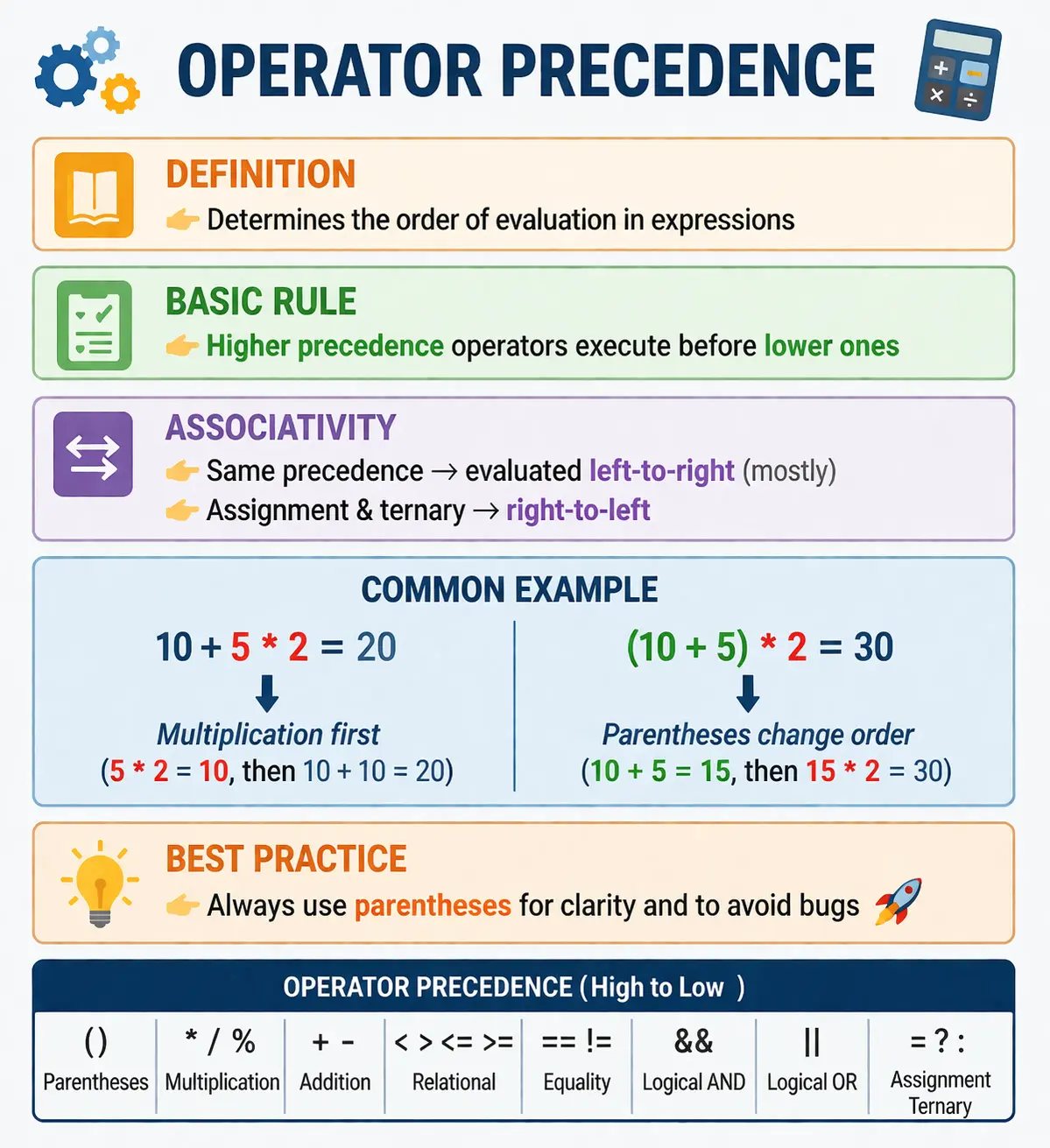
Understanding operator precedence is essential for writing correct, predictable, and maintainable code. It plays a crucial role in arithmetic calculations, conditional logic, and complex expressions. In real-world development, especially when dealing with legacy code or writing concise logic, a lack of clarity about precedence can lead to incorrect results that are difficult to debug. This is why operator precedence is a frequent topic in interviews and a core concept every Java developer must master.
Why Operator Precedence Matters
Operator precedence exists to eliminate ambiguity in expressions. Without a predefined order of evaluation, expressions like 10 + 5 * 2 could produce different results depending on how they are interpreted. By defining a clear hierarchy, Java ensures consistent and predictable behavior across all environments.
One of the primary reasons operator precedence is important is that it prevents unexpected results. Developers often assume that expressions are evaluated from left to right, but this is not always the case. Misunderstanding this can lead to logical errors that may not be immediately obvious.
Operator precedence is also essential when writing complex conditions involving multiple logical and relational operators. It ensures that conditions are evaluated correctly and that the intended logic is preserved. Additionally, it helps developers understand and maintain complex expressions in existing codebases, where multiple operators may be combined in a single statement.
The Basic Rule of Precedence
The fundamental rule of operator precedence is simple: operators with higher precedence are evaluated before those with lower precedence. When two operators have the same precedence, Java uses associativity rules to determine the order of evaluation.
Associativity defines whether operators are evaluated from left to right or right to left. Most operators in Java follow left-to-right associativity, but some, such as assignment and unary operators, follow right-to-left associativity.
This combination of precedence and associativity ensures that every expression is evaluated in a deterministic and consistent manner.
Understanding the Precedence Hierarchy
Java defines a fixed precedence hierarchy that determines how expressions are evaluated. At the top of the hierarchy are operators such as parentheses, array access, and member access, which have the highest priority. These operators are evaluated first because they explicitly define the structure of the expression.
Next come unary operators, including increment, decrement, and logical negation. These operators operate on a single operand and are evaluated before most other operations.
Arithmetic operators such as multiplication, division, and modulus follow, with higher precedence than addition and subtraction. This mirrors standard mathematical rules, where multiplication and division are performed before addition and subtraction.
Shift operators come next, followed by relational and equality operators. Logical operators such as AND and OR are evaluated after relational comparisons, ensuring that conditions are evaluated correctly.
At the lower end of the hierarchy are the ternary operator and assignment operators. These are evaluated last, as they depend on the results of previous computations.
Arithmetic Precedence in Practice
Arithmetic expressions provide the simplest and most intuitive examples of operator precedence. Consider an expression that combines addition and multiplication. Even though addition appears first in the expression, multiplication is performed first because it has higher precedence.
This behavior aligns with standard mathematical rules and ensures consistency. However, developers must be aware of this when writing code, as assuming left-to-right evaluation can lead to incorrect results.
Parentheses can be used to override the default precedence and force a specific order of evaluation. By grouping expressions within parentheses, developers can make their intentions explicit and improve code readability.
Relational and Logical Precedence
Operator precedence becomes more critical when dealing with relational and logical operators. In expressions that combine comparisons and logical conditions, relational operators are evaluated before logical operators.
For example, when evaluating a condition that checks whether one value is less than another and combines it with another condition using logical AND, the relational comparisons are evaluated first. Only after these comparisons are complete does the logical operator combine the results.
This ensures that conditions are evaluated correctly and prevents logical errors. However, developers must be careful when combining multiple logical operators, as precedence between operators like AND and OR can affect the outcome.
Assignment and Right-to-Left Associativity
Assignment operators in Java follow right-to-left associativity, which is different from most other operators. This means that in a chained assignment, the rightmost assignment is evaluated first.
For example, when multiple variables are assigned the same value in a single statement, the value is first assigned to the rightmost variable, and then the result is propagated to the left.
This behavior allows for concise code but can be confusing for beginners. Understanding associativity is essential for correctly interpreting such expressions.
Ternary Operator and Precedence
The ternary operator has relatively low precedence compared to most other operators, but it still plays an important role in conditional expressions. It is evaluated after relational and logical operators but before assignment operators.
This means that the condition in a ternary expression is evaluated first, and the result determines which expression is executed. Because of its position in the precedence hierarchy, the ternary operator often requires parentheses to ensure clarity.
Using parentheses with ternary expressions not only avoids ambiguity but also improves readability, making the code easier to understand.
Unary Operator Precedence
Unary operators, such as increment and decrement, have higher precedence than most arithmetic operators. This means they are applied before other operations in an expression.
For example, when a variable is incremented and then used in a multiplication, the increment operation is performed first. This behavior is particularly important in expressions involving pre-increment and post-increment operators, which have different evaluation orders.
Understanding how unary operators interact with other operators is essential for avoiding subtle bugs, especially in complex expressions.
String Concatenation and Evaluation Order
One of the more interesting aspects of operator precedence in Java is how it interacts with string concatenation. The + operator is overloaded in Java to perform both addition and string concatenation.
When an expression contains both numeric and string operands, the evaluation order can lead to unexpected results. Once a string is encountered, subsequent operations are treated as string concatenation rather than arithmetic addition.
This behavior is a common interview question and a frequent source of confusion for beginners. Understanding how precedence and evaluation order affect string operations is crucial for writing correct code.
Best Practices for Using Operator Precedence
While understanding operator precedence is important, relying on it too heavily can make code difficult to read and maintain. The best practice is to use parentheses to make the intended order of evaluation explicit.
Parentheses not only override default precedence but also improve readability by clearly indicating how an expression should be evaluated. This is especially important in complex conditions and calculations.
Developers should also avoid writing overly complex expressions that combine multiple operators. Breaking expressions into smaller, simpler parts can make the code easier to understand and reduce the risk of errors.
Clarity should always take precedence over brevity. Even if an expression can be written in a single line, it may be better to split it into multiple steps for better readability.
Common Mistakes
One of the most common mistakes is assuming that all expressions are evaluated from left to right. This misunderstanding can lead to incorrect results, especially in arithmetic and logical expressions.
Another frequent error is forgetting the precedence between logical operators such as AND and OR. Without proper use of parentheses, conditions may not be evaluated as intended.
Developers also often write complex chained expressions without considering readability. While such expressions may be technically correct, they can be difficult to understand and maintain.
Ignoring parentheses in ternary expressions is another common issue. Without proper grouping, ternary logic can become confusing and error-prone.
Interview Perspective
Operator precedence is a favorite topic in technical interviews because it tests both theoretical understanding and practical application. Interviewers often present expressions and ask candidates to determine the output, which requires a clear understanding of precedence rules.
A concise answer would define operator precedence as the order in which operators are evaluated in an expression. A more detailed answer would explain the hierarchy, associativity rules, and the importance of parentheses.
Candidates are also expected to demonstrate best practices, such as using parentheses for clarity and avoiding overly complex expressions.
Final Thoughts
Operator precedence is a fundamental concept that underpins all expression evaluation in Java. It ensures that operations are performed in a consistent and predictable manner, eliminating ambiguity and enabling complex calculations.
However, understanding precedence is not enough. Developers must also know how to use it effectively, balancing conciseness with readability. By using parentheses and writing clear, explicit expressions, developers can avoid common pitfalls and produce maintainable code.
Mastering operator precedence is not just about memorizing rules—it is about developing a deeper understanding of how Java evaluates expressions. This knowledge is essential for writing correct programs, debugging issues, and succeeding in technical interviews.
Precedence vs Evaluation Order
A common misunderstanding is treating precedence and evaluation order as the same thing. They are related, but they are not identical. Precedence decides how operators are grouped in an expression. Evaluation order describes when operands and subexpressions are actually evaluated. Java has well-defined left-to-right evaluation of operands in many cases, but the grouping of operators still follows precedence rules.
For example, in 10 + 5 * 2, multiplication has higher precedence than addition, so the expression is grouped as 10 + (5 * 2). That grouping determines the result. In expressions with method calls or side effects, the distinction becomes more important because an operand may be evaluated before the operator with higher precedence is applied. This is one reason complex expressions can be hard to reason about.
In production code, developers do not usually need to discuss this distinction every day, but they benefit from understanding it. It explains why some interview expressions behave differently than expected and why expressions with increments, assignments, and method calls should be written carefully. Precedence tells Java how to parse the expression; evaluation order tells how the expression runs.
Associativity in Detail
When two operators have the same precedence, associativity decides grouping. Most binary operators in Java are left-associative. This means a - b - c is grouped as (a - b) - c, not a - (b - c). For subtraction and division, this matters because changing grouping changes the result. Addition and multiplication often produce the same result with simple numbers, but not all operators are so forgiving.
Assignment operators are right-associative. A statement such as a = b = c = 10 is grouped from the right. First c receives 10, then b receives the result, and finally a receives it. The ternary operator is also right-associative, which affects nested ternary expressions. This is why a ? b : c ? d : e groups as a ? b : (c ? d : e).
Associativity is often ignored until code becomes confusing. A developer may know that two operators have the same precedence but still misunderstand how Java groups them. Parentheses remove the guesswork. When an expression relies on associativity in a way that is not immediately obvious, adding parentheses is usually the better engineering choice.
Parentheses as Communication
Parentheses do more than change precedence. They communicate intent to readers. Even if Java would evaluate an expression correctly without parentheses, adding them can make the expression easier to understand. Code is read far more often than it is written, so making the intended grouping visible is a practical maintainability improvement.
For example, isAdmin || isManager && isActive has a defined meaning because && has higher precedence than ||. But the business rule may not be obvious. Does the code mean that admins are always allowed, while managers must be active? Or does it mean the user must be active and must be either admin or manager? Parentheses make the answer clear: isAdmin || (isManager && isActive) is different from (isAdmin || isManager) && isActive.
This is why experienced developers often use parentheses in business rules even when they know precedence. The goal is not to prove knowledge of the precedence table. The goal is to preserve the business meaning and reduce future mistakes. Parentheses are cheap; misread conditions are expensive.
Arithmetic Precedence and Business Calculations
Arithmetic precedence follows familiar mathematical rules: multiplication, division, and modulus are evaluated before addition and subtraction. This is useful, but business calculations often need more explicit grouping. A tax calculation, discount formula, or average computation may be mathematically valid but still unclear if written as one long expression.
Consider a billing formula that combines subtotal, discount, tax, and service fee. The default precedence rules may produce the correct result, but readers should not have to mentally evaluate the expression to confirm the business logic. Breaking the calculation into named steps such as discountAmount, taxableAmount, and finalTotal improves clarity and makes testing easier.
Arithmetic precedence bugs are especially harmful because they often produce plausible numbers rather than obvious failures. A wrong total may be close enough to escape casual review. This is why calculations involving money, scoring, measurement, or reporting should favor explicit grouping and intermediate variables over compact expressions.
Logical Precedence and Business Rules
Logical precedence is a major source of real-world defects. In Java, && has higher precedence than ||. This means A || B && C is grouped as A || (B && C). If the intended rule is (A || B) && C, the unparenthesized expression is wrong. Both expressions compile, but they describe different business rules.
This matters in authorization, eligibility, validation, filtering, and workflow logic. A rule such as "user must be active and must be either admin or manager" should be written in a way that makes both parts clear. Without parentheses, a condition may accidentally allow inactive admins or reject valid users depending on how it is grouped.
For business logic, parentheses should be used generously. Logical expressions should read like the requirement. If the requirement contains grouped ideas, the code should contain grouped expressions. This makes the code easier for developers, testers, and reviewers to verify.
Unary Operators and Side Effects
Unary operators such as ++ and -- have high precedence, but their side effects make expressions more subtle. Prefix increment updates the variable before producing a value. Postfix increment produces the old value first and updates afterward. Precedence tells where the operator binds, but the side effect determines the stored value after evaluation.
An expression like a++ + ++a * 2 is a classic interview example because it combines precedence, associativity, and side effects. Java can evaluate it consistently, but it is not a good model for production code. Such expressions require step-by-step mental simulation and are easy to misunderstand.
The best practice is simple: avoid multiple mutations of the same variable in one expression. Increment or decrement in a separate statement when clarity matters. Use complex unary expressions for learning and interviews, not for business-critical code.
Ternary Precedence and Nested Conditions
The ternary operator has lower precedence than logical and relational operators but higher precedence than assignment. This usually allows expressions such as int max = a > b ? a : b to work naturally. The comparison becomes the condition, the ternary chooses a value, and assignment stores the result.
Nested ternary expressions are more difficult because ternary is right-associative. Java groups nested ternaries from the right unless parentheses say otherwise. A simple nested ternary can be acceptable for small classifications, but deep nesting quickly reduces readability. If a developer needs to stop and trace colons and question marks, the expression is too complex.
When ternary logic represents more than a simple two-outcome value selection, consider if-else, switch, or a separate method. Precedence rules make nested ternary possible, but maintainability decides whether it is wise.
Assignment Precedence and Chained Updates
Assignment operators have very low precedence and right-to-left associativity. This is why expressions such as a += b *= 2 work by updating b first and then using the result to update a. The expression is compact, but it combines multiple state changes in one line.
Chained assignment can be useful for initializing several variables to the same value, but chained compound assignment is often harder to read. A statement that updates multiple variables at once requires readers to know associativity and understand side effects. In most production code, separate statements are clearer.
Assignment precedence also explains why an expression can be calculated before a value is stored. In x = a + b * c, multiplication and addition happen before assignment. This aligns with intuition, but it is still part of the precedence hierarchy. Assignment should generally be the final step after the value is clearly computed.
String Concatenation and Left-to-Right Grouping
The + operator has the same precedence whether it performs numeric addition or string concatenation. What changes is the operand type. When Java encounters a string operand with +, it performs concatenation. Because addition operators group left to right, the position of the first string can change the result dramatically.
For example, 10 + 20 + "Java" becomes "30Java" because numeric addition happens first. But "Java" + 10 + 20 becomes "Java1020" because once the first string concatenation occurs, the remaining + operations continue as string concatenation. This behavior is not random; it follows grouping and operand types.
When building strings with calculations, use parentheses to make numeric intent clear. Write "Total: " + (price * quantity) rather than relying on readers to infer the grouping. This avoids output mistakes and makes the code more readable.
Method Calls, Array Access, and Member Access
At the top of the precedence hierarchy are operations that identify what value or member is being used: method calls, array access, and member access. Expressions such as user.getAddress().getCity() or items[index + 1] rely on these high-priority operations to resolve the target before other operators interact with the result.
This high precedence makes normal object-oriented code natural. A method call can be used inside an arithmetic expression, a comparison, or a ternary expression because Java first resolves the method call and then applies surrounding operators according to precedence. However, method calls can have side effects, so complex expressions with multiple calls should still be written carefully.
Array access also benefits from explicit grouping when the index expression is complex. The expression inside brackets is evaluated to determine the index. If index logic involves arithmetic, boundaries, or method calls, clarity matters because an incorrect index can produce runtime exceptions.
Testing Expressions Affected by Precedence
Expressions affected by precedence should be tested where they represent business logic. Arithmetic formulas should be tested with normal values and boundary values. Logical rules should be tested with combinations of true and false inputs. Ternary expressions should be tested for each branch. Expressions involving increments should be tested for both returned values and final variable state when relevant.
Tests are especially important when an expression has been refactored for brevity. A compact expression may look equivalent to a longer if-else or step-by-step calculation, but precedence can change behavior if parentheses are missing. Unit tests help confirm that the rewritten expression preserves the original meaning.
Good tests should assert business outcomes rather than only intermediate syntax. For example, instead of testing that a particular formula text exists, test that the correct discount, eligibility result, or final amount is produced. This protects the behavior even if the expression is later made clearer.
Best Practices for Operator Precedence
Use parentheses whenever they make intent clearer. Do not rely on other developers remembering the full precedence table. Keep expressions short enough to read comfortably. If an expression combines arithmetic, relational, logical, ternary, and assignment operators, it probably needs to be split into smaller statements.
Avoid multiple side effects in one expression. Do not update the same variable several times in a single statement. Use named intermediate variables for business calculations. Prefer clarity over cleverness in conditions, especially when access control, money, eligibility, or validation is involved.
Learn the precedence rules well enough to read Java code correctly, but write code so that others do not need to rely on memorized rules. This is the practical balance: understand precedence deeply, but communicate intent explicitly.
A Practical Mental Model
A useful way to remember precedence is to think in layers. First, Java resolves the most specific parts of an expression: grouped expressions, method calls, member access, and array access. Then it applies unary operations, followed by arithmetic operations, shifts, comparisons, equality checks, bitwise operations, logical operations, ternary selection, and finally assignment. This mental model is not a replacement for the official precedence table, but it helps when reading most everyday Java code.
Another practical habit is to ask what kind of result each layer produces. Arithmetic operators usually produce numbers. Relational and equality operators produce booleans. Logical operators combine booleans. The ternary operator chooses a value. Assignment stores a value. When you understand the type of result produced at each stage, expression evaluation becomes much easier to follow.
This mental model also helps detect impossible expressions. If a comparison produces a boolean and the next operator expects an integer, the expression may fail to compile. For example, mixing bitwise integer operations with equality checks without parentheses can accidentally ask Java to combine an integer with a boolean. Recognizing these type transitions makes precedence problems easier to debug.
How to Explain Operator Precedence in Interviews
A strong interview answer defines operator precedence as the rule that determines which operators are grouped and evaluated first in an expression. Then explain associativity as the rule used when operators have the same precedence. Most operators are left-associative, while assignment and ternary are right-associative.
The answer should include examples: multiplication before addition, relational comparisons before logical AND, logical AND before logical OR, and assignment near the bottom of the hierarchy. Mention that parentheses override precedence and are recommended for readability.
The strongest answers also explain practical concerns: string concatenation with +, prefix and postfix increment behavior, nested ternary readability, and why complex expressions should be split. Interviewers want to see that you can solve output questions, but also that you know how to write maintainable code.
1. Multiplication Before Addition
int result = 10 + 5 * 2;
System.out.println(result);
Explanation
	• * has higher precedence than +
	• Evaluated as 10 + (5 * 2) → 20
2. Parentheses Override Precedence
int result = (10 + 5) * 2;
System.out.println(result);
Explanation
	• Parentheses force addition first
	• (10 + 5) * 2 → 30
3. Division and Addition Together
int result = 20 + 10 / 5;
System.out.println(result);
Explanation
	• Division happens first
	• 20 + (10 / 5) → 22
4. Modulus with Addition
int result = 10 + 7 % 3;
System.out.println(result);
Explanation
	• % evaluated before +
	• 7 % 3 = 1, result → 11
5. Unary Minus Has Higher Precedence Than +
int a = 5;
int result = -a + 10;
System.out.println(result);
Explanation
	• Unary - applies first
	• (-5) + 10 → 5
6. Pre-Increment vs Addition
int a = 5;
int result = ++a + 10;
System.out.println(result);
Explanation
	• ++a executes first → a = 6
	• 6 + 10 → 16
7. Post-Increment Precedence Trap
int a = 5;
int result = a++ + 10;
System.out.println(result);
System.out.println(a);
Explanation
	• a++ uses old value first
	• 5 + 10 = 15, then a = 6
8. Multiple Unary Operators
int a = 5;
int result = -~a;
System.out.println(result);
Explanation
	• ~a → -6
	• -(-6) → 6
9. Relational Before Logical AND
int a = 10;
int b = 20;
System.out.println(a < b && b > 15);
Explanation
	• < and > evaluated first
	• Then && combines results
10. Logical AND Before Logical OR
boolean result = true || false && false;
System.out.println(result);
Explanation
	• && has higher precedence than ||
	• Evaluated as true || (false && false) → true
11. Parentheses with Logical Operators
boolean result = (true || false) && false;
System.out.println(result);
Explanation
	• Parentheses override precedence
	• (true || false) → true, then true && false → false
12. Equality vs Relational
int a = 10;
System.out.println(a == 5 + 5);
Explanation
	• + evaluated before ==
	• 5 + 5 = 10, so comparison is 10 == 10
13. Bitwise AND vs Equality
int a = 3;   // 011
int b = 1;   // 001
System.out.println(a & b == 1);
Explanation
	• == has higher precedence than &
	• Interpreted as a & (b == 1)
	• Causes compile-time error
	• Must use parentheses

System.out.println((a & b) == 1);
14. Shift vs Addition
int result = 1 << 2 + 1;
System.out.println(result);
Explanation
	• + has higher precedence than <<
	• Evaluated as 1 << (2 + 1) → 1 << 3 → 8
15. Assignment Has Very Low Precedence
int a = 5;
int b = 10;
a += b *= 2;
System.out.println(a);
System.out.println(b);
Explanation
	• b *= 2 executes first → b = 20
	• a += 20 → a = 25
16. Ternary vs Assignment
int a = 10;
int b = 20;
int max = a > b ? a : b;
System.out.println(max);
Explanation
	• Ternary evaluated before assignment
	• Result assigned to max
17. Ternary with Nested Conditions
int a = 10, b = 20, c = 15;
int max = a > b ? a : b > c ? b : c;
System.out.println(max);
Explanation
	• Ternary associates right to left
	• Equivalent to:

a > b ? a : (b > c ? b : c)
18. Logical NOT Has Very High Precedence
boolean result = !true == false;
System.out.println(result);
Explanation
	• ! evaluated first → !true → false
	• Then false == false → true
19. Combined Unary, Arithmetic, and Relational
int a = 5;
System.out.println(++a * 2 > 10);
Explanation
	• ++a → 6
	• 6 * 2 = 12
	• 12 > 10 → true
20. Interview Summary Example
int a = 5;
int result = a++ + ++a * 2;
System.out.println(result);
System.out.println(a);
Explanation
	• Step 1: a++ → uses 5, then a = 6
	• Step 2: ++a → a = 7
	• Step 3: 7 * 2 = 14
	• Result: 5 + 14 = 19
	• Final a = 7