Logical Operators in Java for Decision-Making and Real-World Logic
In Java programming, writing code is not just about executing instructions—it is about making decisions. Every real-world application depends on logic that determines what should happen under specific conditions. Whether it is validating a user login, processing a payment, enforcing business rules, or controlling program flow, logical operators play a central role in combining and evaluating conditions.
Logical operators in Java are used to work with boolean expressions and produce a boolean result—either true or false. While they appear simple, their behavior—especially short-circuit evaluation—has deep implications for performance, safety, and correctness. Misusing logical operators can lead to unexpected results, runtime exceptions, or inefficient code.
This article provides a complete, structured, and real-world understanding of logical operators in Java, covering their behavior, use cases, pitfalls, and interview-critical concepts.
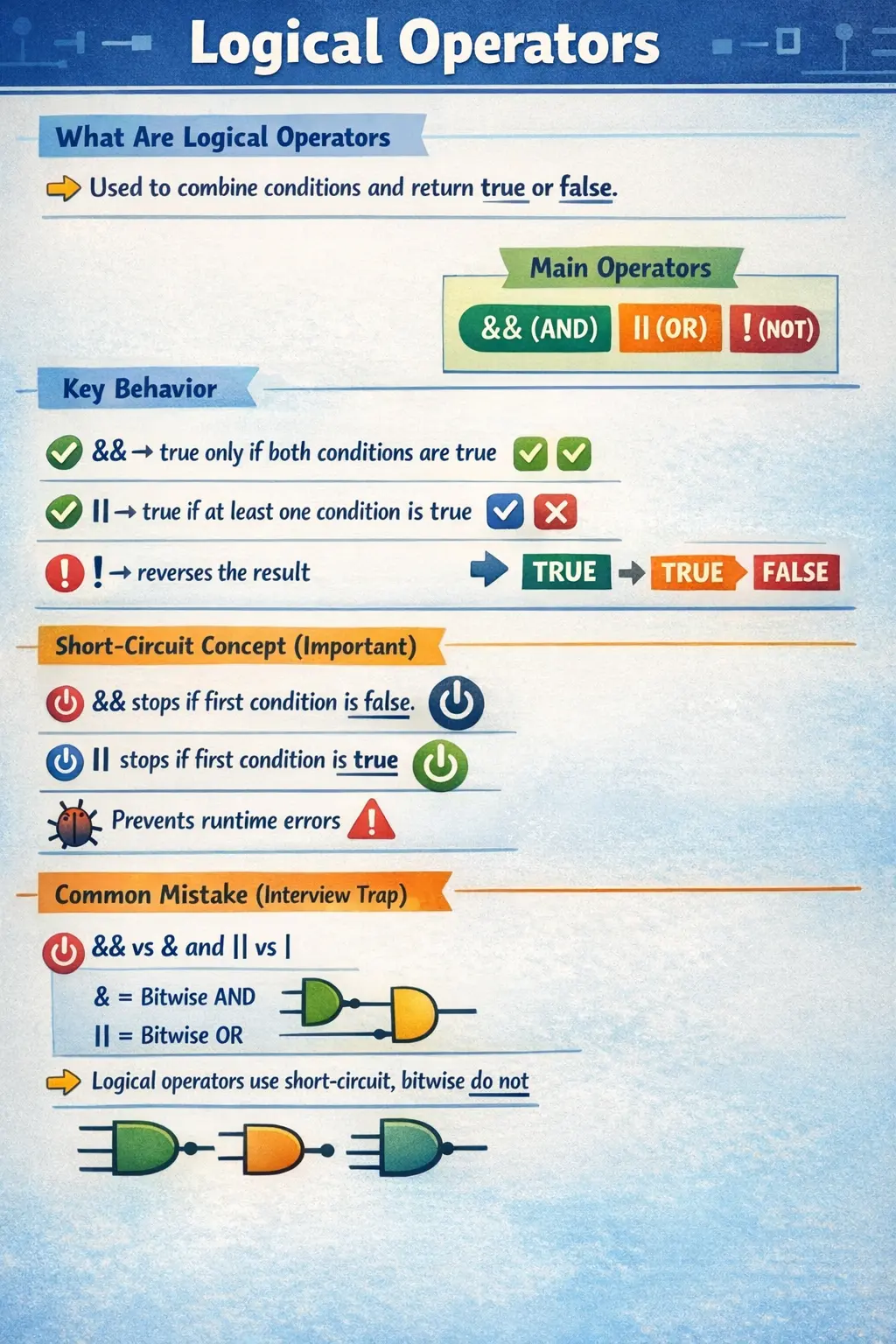
What Are Logical Operators?
Logical operators are used to combine multiple boolean conditions and evaluate them as a single expression. They operate strictly on boolean values and return a boolean result.
At a conceptual level, logical operators answer questions like:
- “Are all conditions true?”
- “Is at least one condition true?”
- “Can we invert a condition?”
They are essential in:
- Conditional statements (if, else if)
- Loops (while, for)
- Validation logic
- Authorization and access control
Without logical operators, it would be impossible to build meaningful decision-making logic in applications.
Types of Logical Operators in Java
Java provides three primary logical operators:
- Logical AND (&&)
- Logical OR (||)
- Logical NOT (!)
Each operator has a specific purpose and behavior, especially when evaluating multiple conditions.
Logical AND (&&) – Strict Condition Evaluation
The logical AND operator returns true only when both conditions are true. If even one condition is false, the entire expression evaluates to false.
int age = 25;
boolean hasId = true;

if (age >= 18 && hasId) {
    System.out.println("Entry allowed");
}
In this example, access is granted only if both conditions are satisfied. This reflects real-world scenarios where multiple validations must pass together.
Short-Circuit Behavior of AND
One of the most important features of && is short-circuit evaluation.
int a = 10;
int b = 0;

if (b != 0 && a / b > 2) {
    System.out.println("Safe division");
}
Here, Java evaluates the first condition (b != 0). Since it is false, Java does not evaluate the second condition (a / b > 2). This prevents a division-by-zero exception.
This behavior is critical because it:
- Improves performance by skipping unnecessary evaluations
- Prevents runtime errors
- Enables safe condition chaining
Logical OR (||) – Flexible Condition Evaluation
The logical OR operator returns true if at least one condition is true. It only returns false when both conditions are false.
boolean isAdmin = false;
boolean isManager = true;

if (isAdmin || isManager) {
    System.out.println("Access granted");
}
This operator is commonly used in scenarios where multiple paths can lead to the same outcome, such as role-based access or alternative validations.
Short-Circuit Behavior of OR
Like AND, the OR operator also supports short-circuit evaluation.
int x = 5;

if (x > 0 || x / 0 > 1) {
    System.out.println("No exception");
}
Since the first condition (x > 0) is true, Java skips the second condition (x / 0 > 1). This avoids an exception.
Short-circuit OR is especially useful when:
- The first condition is sufficient to determine the result
- The second condition is expensive or risky
Logical NOT (!) – Reversing Conditions
The logical NOT operator is a unary operator that reverses a boolean value.
boolean isActive = false;

if (!isActive) {
    System.out.println("User is inactive");
}
This operator is useful for:
- Negating conditions
- Simplifying boolean expressions
- Improving readability
For example, instead of writing if (isActive == false), using if (!isActive) is cleaner and more expressive.
Logical Operators Truth Table
Understanding how logical operators behave under all combinations of conditions is essential.
| Condition A | Condition B | A && B | A || B |
|---|---|---|---|
| true | true | true | true |
| true | false | false | true |
| false | true | false | true |
| false | false | false | false |
This table is frequently used in interviews and helps in reasoning about complex conditions.
Logical Operators vs Bitwise Operators (Critical Interview Topic)
A very common interview trap is confusing logical operators (&&, ||) with bitwise operators (&, |).
Key Difference
- Logical operators → Short-circuit evaluation
- Bitwise operators → No short-circuit evaluation
Example
int a = 10;
int b = 0;

if (b != 0 & a / b > 1) {
    // ❌ ArithmeticException
}
Here, the bitwise AND (&) evaluates both conditions, even if the first is false. This leads to a division-by-zero exception.
This difference is critical because:
- Logical operators are safer for conditional checks
- Bitwise operators should not be used for boolean logic unless required
Operator Precedence and Evaluation Order
Logical operators follow a specific precedence order:
- ! (highest priority)
- &&
- || (lowest priority)
Example:
boolean result = true || false && false;
This evaluates as:
true || (false && false) → true
Using parentheses improves readability and prevents logical errors:
boolean result = (true || false) && false;
Real-World Use Cases of Logical Operators
Logical operators are used extensively in real-world applications.
Input Validation
if (username != null && password.length() >= 8) {
    // valid input
}
Authorization Checks
if (isAdmin || isManager) {
    // grant access
}
Business Rules
if (orderAmount > 1000 && isPremiumUser) {
    // apply discount
}
Loop Control
while (isRunning && attempts < 5) {
    // retry logic
}
In all these cases, logical operators help combine multiple conditions into a single decision.
Short-Circuit Evaluation – The Most Important Concept
Short-circuit evaluation is one of the most critical concepts related to logical operators.
It means:
- AND (&&) stops when the first condition is false
- OR (||) stops when the first condition is true
This behavior:
- Prevents runtime exceptions
- Improves efficiency
- Enables safe chaining of conditions
Understanding short-circuiting is essential for writing safe and optimized code.
Common Beginner Mistakes
Logical operators are simple in syntax but often misused in practice.
One common mistake is confusing && with & and || with |. This can lead to unexpected execution and runtime errors.
Another mistake is ignoring short-circuit behavior, especially when writing conditions that involve risky operations like division or null checks.
Many beginners also create overly complex conditions, reducing readability and increasing the chance of bugs.
Ignoring operator precedence can also lead to incorrect logic, especially in combined expressions.
Writing Clean and Maintainable Logical Conditions
Good logical expressions should be:
- Simple
- Readable
- Well-structured
Instead of writing:
if (a > 10 && b < 20 || c == 5 && d != 0)
It is better to break conditions:
boolean condition1 = a > 10 && b < 20;
boolean condition2 = c == 5 && d != 0;

if (condition1 || condition2) {
    // logic
}
This improves clarity and maintainability.
Interview Perspective
Logical operators are a high-frequency interview topic. Questions often focus on:
- Short-circuit behavior
- Difference between && and &
- Operator precedence
- Real-world use cases
A strong answer should include:
- Definition
- Examples
- Explanation of short-circuiting
- Practical implications
Key Takeaway
Logical operators are the foundation of decision-making logic in Java. They allow developers to combine multiple conditions, control execution flow, and implement complex business rules.
While they may seem simple, understanding their behavior—especially short-circuit evaluation and operator differences—is essential for writing safe, efficient, and bug-free code.
At a deeper level, logical operators are not just about combining conditions—they are about enabling intelligent behavior in applications. Mastering them ensures that your programs make correct decisions under all scenarios, which is the essence of reliable software development.
How Logical Operators Build Business Rules
Logical operators become meaningful when they express real business decisions. A condition such as age >= 18 && hasId is not merely a programming expression; it represents a rule that both requirements must be satisfied before access is allowed. Similarly, isAdmin || isManager represents a rule where either role is enough to grant permission. The symbols are small, but the meaning behind them can control important application behavior.
This is why logical operators must be chosen based on requirement language. Words such as "and", "all", "must", and "required" usually map to &&. Words such as "or", "any", "either", and "alternative" usually map to ||. A rule that says a discount applies when the customer is premium and the order amount is above a threshold is very different from a rule that says the discount applies when the customer is premium or the order amount is above a threshold.
In real projects, incorrect logical operators can create serious defects. A payment may be approved when only one required validation passes. A user may be denied access even though one valid role should be enough. A retry loop may stop too early or continue too long. Logical operators are therefore not just syntax; they are the way business rules become executable decisions.
Boolean Expression Design
A boolean expression should communicate intent clearly. While Java allows complex expressions with many comparisons and logical operators, readable code is more valuable than compact code. A condition that combines several rules in one line may work today, but it becomes difficult to debug when the requirement changes. This is especially true in enterprise applications where eligibility, authorization, validation, and workflow rules evolve over time.
One practical technique is to break complex logic into named boolean variables. Instead of writing a long expression directly inside an if statement, assign meaningful parts to variables such as hasValidAge, hasRequiredBalance, isPremiumCustomer, or isWithinRetryLimit. Then combine those names in the final condition. This makes the code read closer to business language.
Readable boolean expressions also reduce testing effort because each part of the logic can be understood and verified independently. If a defect occurs, developers can inspect which named condition failed rather than mentally parsing a dense expression. Logical operators are powerful, but they should be used in a way that keeps intent visible.
Short-Circuit Evaluation as a Safety Mechanism
Short-circuit evaluation is one of the most important reasons to prefer && and || in conditional logic. With &&, Java stops evaluating as soon as one condition is false because the final result cannot become true. With ||, Java stops as soon as one condition is true because the final result cannot become false. This behavior improves efficiency, but its greater value is safety.
Safe null checks are the most common example. A condition like name != null && name.length() > 3 works because Java checks whether name is not null before calling length(). If name is null, the second condition is skipped. Reversing the order causes a NullPointerException because Java tries to call a method on a null reference before checking it.
The same idea applies to division, list access, map lookup, optional configuration, and method calls that may be expensive or unsafe. A condition can first confirm that an operation is safe, then perform the operation only if needed. This pattern is common in production-quality Java code and is frequently tested in interviews.
Logical AND in Real Validation Rules
The logical AND operator is used when every condition must be true. This is common in validation flows. A login request may require that the username is present, the password is present, the account is active, and the credentials are correct. If any one of these conditions fails, the login should not proceed. The AND operator naturally models this requirement.
AND conditions are also common in eligibility rules. A user may be eligible for a loan only if income is above a threshold, credit score is sufficient, age is within range, and required documents are verified. Each condition is necessary. Using OR in such a rule would weaken the validation and potentially approve users who do not satisfy all requirements.
When many AND conditions are chained, order matters for both readability and safety. Place cheap and safe checks first, such as null checks and simple flags. Place expensive operations or method calls later. This uses short-circuit behavior effectively and makes the condition easier to reason about. It also reduces unnecessary work when an early requirement already fails.
Logical OR in Alternative Rules
The logical OR operator is used when at least one condition is enough. Role-based access is a common example. A page may be available to administrators, managers, or auditors. The user does not need all roles; any one of the allowed roles is sufficient. OR expresses this flexible rule directly.
OR is also common in fallback logic and exception handling. A form may accept either email or phone number as contact information. A discount may apply to premium users or to orders above a promotional threshold. A notification may be sent if payment fails or inventory is unavailable. In each case, multiple paths lead to the same outcome.
As with AND, order matters. If the first OR condition is true, Java skips the remaining conditions. This is useful when one condition is simple and another involves a costly method call. It also matters when later conditions could fail if earlier assumptions are not met. Developers should order OR conditions deliberately rather than casually.
Logical NOT and Readability
The logical NOT operator reverses a boolean result. It is useful when the code needs to act on the negative form of a condition. For example, if (!isActive) clearly means the logic applies when the user is not active. This is usually cleaner than writing if (isActive == false).
However, excessive negation can hurt readability. Conditions such as if (!(user == null || !user.isActive())) are difficult to understand quickly. In such cases, it is better to simplify the expression or use a named boolean variable. The goal is not merely to make the compiler accept the expression; the goal is to make the decision understandable.
Negation is especially important in validation and guard clauses. A method may return early when a required condition is not met. For example, if (!isValidRequest) can stop processing before deeper logic runs. Used well, logical NOT helps keep code focused and safe. Used excessively, it makes logic feel inverted and error-prone.
Logical Operators vs Bitwise Operators
Java allows & and | to be used with boolean operands, but they do not short-circuit. This is the key difference from && and ||. When & is used, both sides are evaluated even if the first side is false. When | is used, both sides are evaluated even if the first side is true. This can create runtime errors or unnecessary method calls.
There are rare cases where evaluating both sides is intentional, but ordinary conditional logic should usually use && and ||. Most validation, null checking, and access control logic benefits from short-circuit behavior. Accidentally using & instead of && is a common beginner mistake and a classic interview trap.
Bitwise operators have their own purpose when working with bits, flags, masks, and low-level numeric operations. They are not wrong operators, but they are often wrong for business condition checks. A professional Java developer understands the distinction and chooses the operator based on intention.
Operator Precedence and Parentheses
Logical operators follow precedence rules. The NOT operator has the highest priority, followed by AND, followed by OR. This means true || false && false is evaluated as true || (false && false), producing true. If the developer intended the OR part to happen first, parentheses are required.
Even when precedence rules are known, parentheses often improve readability. Business logic should not force readers to remember operator precedence every time they inspect a condition. A condition such as (isAdmin || isManager) && isActive is clearer than relying on implicit grouping. It immediately communicates that the user must have one allowed role and must also be active.
Parentheses also reduce mistakes during future changes. When another developer modifies a condition, explicit grouping helps preserve the original intent. This matters in business-critical logic where a small change in grouping can change access, pricing, eligibility, or validation behavior.
Wrapper Boolean and Null Safety
Java has both primitive boolean and wrapper Boolean. A primitive boolean can only be true or false. A wrapper Boolean can also be null. This difference matters when logical operators are used. If a Boolean object is null and Java tries to unbox it in an expression such as flag && true, a NullPointerException occurs.
Wrapper Booleans often appear in data transfer objects, API responses, database fields, configuration values, and framework models because missing values may need to be represented. In such cases, developers must be careful before using the value directly in logical expressions. A null wrapper is not the same as false unless the business rule explicitly says missing means false.
A common defensive pattern is Boolean.TRUE.equals(flag). This returns true only when the wrapper is explicitly true and safely returns false when the value is null. For checks where false is meaningful, Boolean.FALSE.equals(flag) can be used. This approach avoids accidental unboxing and makes null handling explicit.
XOR and Exclusive Conditions
Although the main logical operators are &&, ||, and !, Java also supports XOR with booleans using ^. XOR returns true when exactly one operand is true. If both operands are true or both are false, the result is false. This makes it useful for exclusive rules where one option is allowed but not both.
For example, a checkout flow may allow the user to apply either a coupon or a gift card, but not both together. A validation rule may require either email or phone number, but not both. XOR can express this kind of "exactly one" requirement compactly. However, because XOR is less commonly used, a named boolean expression may sometimes be clearer.
In interviews, XOR questions test whether the candidate understands boolean logic beyond the most common operators. In real code, use XOR only when the exclusivity is clear. If the business rule is complex, writing the two allowed cases explicitly may be more readable than relying on a less familiar operator.
Logical Operators in Loops
Loops often use logical operators to combine stopping conditions. A retry loop may continue while the operation has not succeeded and the attempt count is below the maximum. A game loop may continue while the application is running and the player has not exited. A file-processing loop may continue while more records exist and no fatal error has occurred.
These conditions must be designed carefully because a wrong logical operator can change loop behavior drastically. Using OR where AND is required can make a loop continue longer than expected. Using AND where OR is required can stop it too early. Loop conditions should be read aloud in business language to confirm that the logic matches the intended behavior.
Short-circuit evaluation is useful in loops too. If the first condition determines that processing should stop, Java does not evaluate later conditions. This can avoid unnecessary method calls or unsafe access. As with conditional statements, placing safe checks first leads to more reliable loop logic.
Logical Operators in Real-World Applications
Logical operators appear in nearly every real application. Authentication uses them to combine checks such as username presence, password validity, account status, and session state. Authorization uses them to combine roles and permissions. E-commerce systems use them to apply offers, validate stock, check payment state, and enforce delivery rules.
Testing frameworks and automation code use logical operators heavily as well. A Selenium test may continue only when an element is visible and enabled. A retry utility may run while a timeout has not expired and the expected condition is not met. A reporting utility may mark a test as failed if the actual result differs from expected or a required screenshot is missing.
Because logical operators are everywhere, clarity matters. Poorly written conditions can become hidden sources of defects. A bug in a logical expression may not throw an error; it may simply make the wrong decision. This is why business rule conditions deserve the same care as database queries, API contracts, and UI workflows.
Testing Logical Conditions
Logical expressions should be tested with combinations of true and false inputs. For an AND condition, tests should verify what happens when all conditions are true and when each individual condition is false. For an OR condition, tests should verify each condition independently causing success and all conditions being false causing failure. This helps confirm that the logical operator matches the requirement.
Short-circuit behavior should also be tested when safety depends on it. For example, a null check should be placed before method access, and tests should include the null case. Division checks should include a zero divisor. Wrapper Boolean logic should include true, false, and null values. These tests catch defects that normal happy-path testing may miss.
For complex business rules, decision tables are often useful. They list combinations of conditions and expected outcomes, making logical coverage visible. This is especially valuable when several AND and OR conditions interact. Logical operators are simple individually, but combinations can become difficult to reason about without structured testing.
Best Practices for Logical Operators
Use && and || for ordinary boolean decision-making because they short-circuit and support safe checks. Reserve & and | for cases where non-short-circuit evaluation or bitwise behavior is truly intended. Place null checks and cheap validations before risky or expensive operations. Use parentheses to make grouping obvious when multiple operators are combined.
Keep conditions readable. If a condition becomes long, split it into named boolean variables. Avoid double negatives and unclear negation. Prefer if (!isActive) over if (isActive == false), but avoid expressions where the reader must mentally reverse several layers of logic. The best logical expressions read naturally and reveal business intent.
Handle wrapper Boolean values carefully. Do not assume a Boolean object is always non-null. Use null-safe checks such as Boolean.TRUE.equals(flag) when the value may come from external data. In critical business logic, document or encode what null means rather than allowing accidental unboxing to decide behavior through an exception.
How to Explain Logical Operators in Interviews
A strong interview answer begins with the definition: logical operators combine boolean expressions and return a boolean result. Java's primary logical operators are &&, ||, and !. AND requires all conditions to be true, OR requires at least one condition to be true, and NOT reverses a boolean value.
The answer should then emphasize short-circuit evaluation. With &&, if the first condition is false, Java skips the second. With ||, if the first condition is true, Java skips the second. This improves performance and prevents errors such as null pointer exceptions or division by zero when conditions are ordered correctly.
The strongest answers include the difference between && and &, the difference between || and |, operator precedence, null-safe Boolean checks, and real examples such as login validation or role-based access. This shows practical understanding rather than memorized syntax.
Practical Logical Operator Examples
1. Logical AND (&&) – Both Conditions Must Be True
int a = 10;
int b = 20;
System.out.println(a > 5 && b > 15);
Explanation
- Returns true only if both conditions are true.
- Most commonly used logical operator.
2. Logical OR (||) – At Least One Condition True
int age = 16;
System.out.println(age < 18 || age > 60);
Explanation
- Returns true if any one condition is true.
3. Logical NOT (!) – Negates the Condition
boolean isActive = false;
System.out.println(!isActive);
Explanation
- Inverts the boolean value.
4. Combining Relational + Logical Operators
int marks = 75;
if (marks >= 35 && marks <= 100) {
System.out.println("Valid and Passed");
}
Explanation
- Relational operators evaluate first.
- Logical operator combines the results.
5. Short-Circuit AND (&&) – Second Condition Not Evaluated
int x = 0;
if (x != 0 && 10 / x > 1) {
System.out.println("Safe");
}
Explanation
- Second condition is skipped because x != 0 is false.
- Prevents ArithmeticException.
6. Non–Short-Circuit AND (&) – Both Evaluated (Risky)
int x = 0;
// if (x != 0 & 10 / x > 1) { } // ArithmeticException
Explanation
- & evaluates both conditions.
- Rarely recommended for boolean logic.
7. Short-Circuit OR (||) – Second Condition Skipped
boolean isAdmin = true;
if (isAdmin || checkPermission()) {
System.out.println("Access granted");
}
Explanation
- If first condition is true, second is not evaluated.
- Improves performance and safety.
8. Non–Short-Circuit OR (|) – Both Evaluated
boolean a = true;
boolean b = false;
System.out.println(a | b);
Explanation
- Evaluates both operands.
- Valid but usually unnecessary.
9. Logical Operators with Method Calls (Short-Circuit Benefit)
boolean isLoggedIn = false;
if (isLoggedIn && validateSession()) {
System.out.println("Welcome");
}
Explanation
- validateSession() is not called.
- Prevents unnecessary computation.
10. Logical Operators with null Check (Best Practice)
String name = null;
if (name != null && name.length() > 3) {
System.out.println("Valid name");
}
Explanation
- Prevents NullPointerException.
- Classic interview example.
11. Incorrect Order Causing Exception
String name = null;
// if (name.length() > 3 && name != null) { } // NullPointerException
Explanation
- Left condition executes first.
- Always put null check first.
12. Logical NOT with Compound Condition
int age = 20;
if (!(age < 18)) {
System.out.println("Adult");
}
Explanation
- Entire expression is negated.
- Useful for reversing logic.
13. Logical Operators with Boolean Variables
boolean hasLicense = true;
boolean hasInsurance = false;
System.out.println(hasLicense && hasInsurance);
Explanation
- Result is false because both must be true.
14. Chaining Multiple Conditions
int score = 85;
if (score >= 60 && score < 90 && score != 75) {
System.out.println("Eligible");
}
Explanation
- Conditions evaluated left to right.
- Stops at first false.
15. Operator Precedence (! > && > ||)
boolean result = true || false && false;
System.out.println(result);
Explanation
- && evaluated before ||.
- Expression becomes: true || (false && false) → true.
16. Parentheses to Control Precedence
boolean result = (true || false) && false;
System.out.println(result);
Explanation
- Parentheses override precedence.
- Result becomes false.
17. Logical Operators in while Loop
int i = 0;
while (i < 5 && i != 3) {
System.out.println(i);
i++;
}
Explanation
- Loop continues while both conditions are true.
18. Logical Operators with Ternary Operator
int age = 17;
String status = (age >= 18 && age <= 60) ? "Working Age" : "Not Working Age";
System.out.println(status);
Explanation
- Logical condition decides ternary outcome.
19. Logical Operators with Wrapper Boolean
Boolean flag = Boolean.TRUE;
if (flag && true) {
System.out.println("True");
}
Explanation
- Wrapper is unboxed to primitive boolean.
- Beware of null wrappers.
20. Wrapper Boolean null Trap
Boolean flag = null;
// if (flag && true) { } // NullPointerException
Explanation
- Unboxing null causes runtime exception.
- Always check for null.
21. Safe Wrapper Boolean Check
Boolean flag = null;
if (Boolean.TRUE.equals(flag)) {
System.out.println("True");
}
Explanation
- Null-safe comparison.
- Recommended defensive approach.
22. Logical XOR (^) with Booleans
boolean a = true;
boolean b = false;
System.out.println(a ^ b);
Explanation
- Returns true if exactly one operand is true.
23. XOR Use Case (Exactly One Condition)
boolean hasCoupon = true;
boolean hasGiftCard = true;
System.out.println(hasCoupon ^ hasGiftCard);
Explanation
- Returns false because both are true.
- Useful for exclusive conditions.
24. Logical Operators in Real-World Validation
int age = 25;
boolean hasID = true;
if (age >= 18 && hasID) {
System.out.println("Entry allowed");
}
Explanation
- Typical access-control logic.
25. Interview Summary Example
int a = 10;
int b = 20;
System.out.println(a < b && b > 15);   // true
System.out.println(a > b || b == 20);  // true
System.out.println(!(a == 10));        // false
Explanation
- Demonstrates &&, ||, and ! together.
- Common output-based interview question.