Assignment Operators in Java for Clean, Efficient, and Safe Code
In Java programming, variables are meaningless unless they can store and update values. This is where assignment operators come into play. Every program—from simple scripts to large enterprise systems—relies on assigning, updating, and managing values efficiently. Assignment operators are not just syntactic tools; they directly influence code readability, maintainability, performance, and correctness.
At first glance, assignment operators may seem trivial—simply placing a value into a variable. However, Java provides more than just the basic assignment (=). It introduces compound assignment operators, which combine operations with assignment in a concise and efficient way. These operators also introduce subtle behaviors such as implicit type casting, which are frequently tested in interviews and often misunderstood by developers.
This article provides a complete, structured, and real-world explanation of assignment operators in Java, covering their types, internal behavior, edge cases, and best practices.
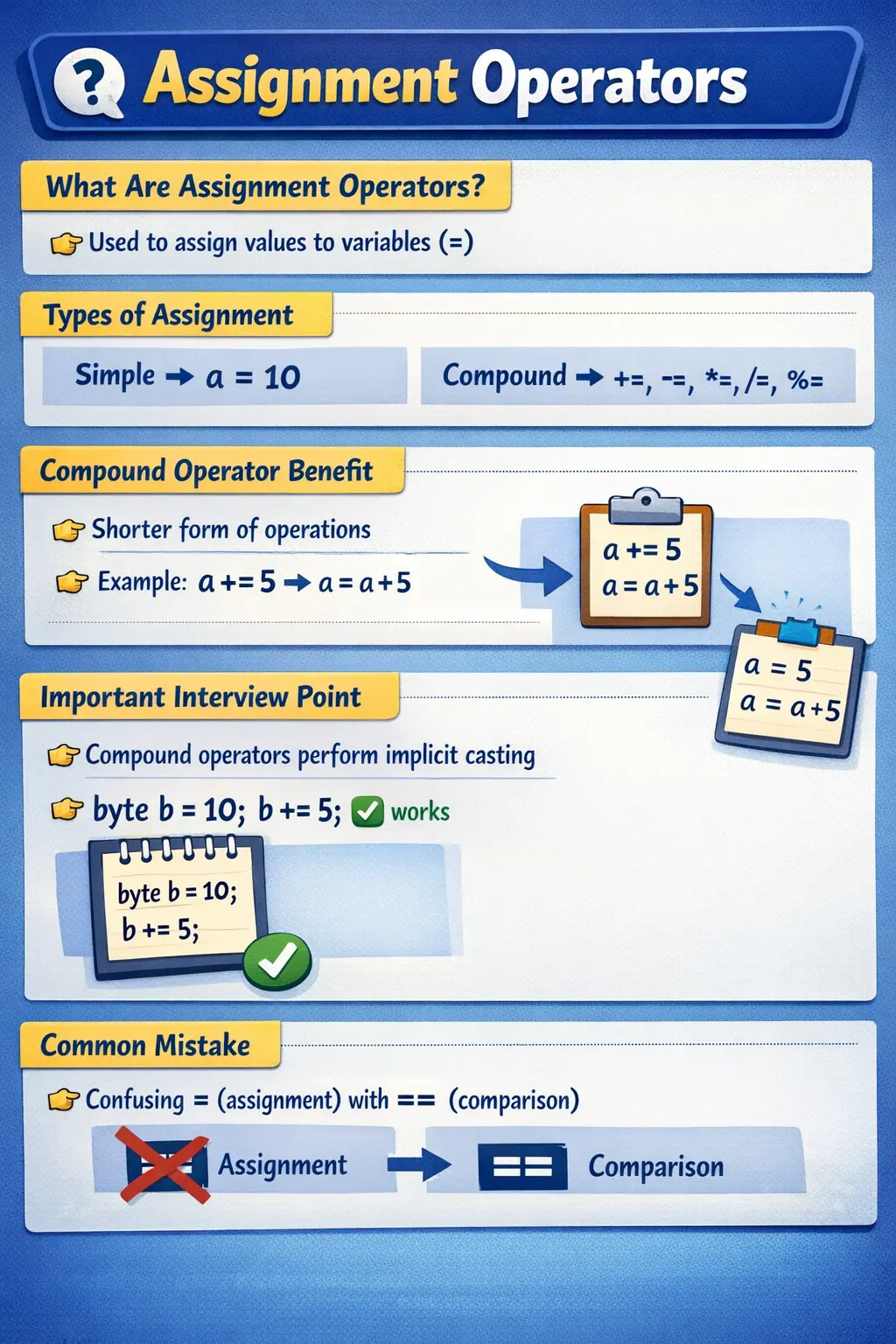
What Are Assignment Operators?
Assignment operators in Java are used to assign values to variables. They take the value on the right-hand side and store it in the variable on the left-hand side.
At a deeper level, assignment operators answer a fundamental programming question:
“How do we store and update data in memory?”
They serve multiple purposes:
- Assign initial values to variables
- Update existing values
- Combine operations with assignment
- Improve code readability and conciseness
Assignment operators are used extensively in:
- Variable initialization
- Calculations and updates
- Loops and counters
- Business logic transformations
Understanding them properly ensures that your code behaves predictably and efficiently.
Types of Assignment Operators in Java
Java provides two main categories of assignment operators:
- Simple Assignment Operator (=)
- Compound Assignment Operators (+=, -=, *=, /=, %=)
Each type serves a different purpose and has distinct behavior.
Simple Assignment Operator (=) – The Foundation
The simple assignment operator (=) assigns a value directly to a variable.
int a = 10;
Here, the value 10 is stored in the variable a. This is the most basic and widely used form of assignment.
How Assignment Works Internally
When Java executes an assignment:
- The right-hand side expression is evaluated
- The result is assigned to the left-hand variable
This process is straightforward but becomes more interesting when multiple assignments are chained.
Chained Assignment – Right-to-Left Evaluation
Java allows chaining multiple assignments in a single statement.
int x, y, z;
x = y = z = 5;
In this case:
- z is assigned 5
- y is assigned the value of z
- x is assigned the value of y
Assignment happens from right to left. This behavior is important because it ensures consistency in value propagation across variables.
Compound Assignment Operators – Combining Operation and Assignment
Compound assignment operators combine an arithmetic (or bitwise) operation with assignment. They provide a shorter and more readable way to update variables.
Common Compound Operators
- += → Addition assignment
- -= → Subtraction assignment
- *= → Multiplication assignment
- /= → Division assignment
- %= → Modulus assignment
These operators simplify expressions that would otherwise require repetition.
Addition Assignment (+=)
int a = 10;
a += 5;   // a = 15
Equivalent to:
a = a + 5;
This operator is widely used in loops, counters, and accumulators.
Subtraction Assignment (-=)
int a = 20;
a -= 8;   // a = 12
Equivalent to:
a = a - 8;
It is useful for decrementing values or reducing quantities.
Multiplication Assignment (*=)
int a = 4;
a *= 3;   // a = 12
Equivalent to:
a = a * 3;
This is commonly used in scaling calculations and iterative multiplications.
Division Assignment (/=)
int a = 10;
a /= 3;   // a = 3
Equivalent to:
a = a / 3;
Here, integer division truncates the decimal part, which is an important detail.
Modulus Assignment (%=)
int a = 10;
a %= 3;   // a = 1
Equivalent to:
a = a % 3;
This operator is often used in cyclic logic, remainder calculations, and validations.
Implicit Type Casting in Compound Assignment (Critical Concept)
One of the most important and frequently asked interview concepts is implicit casting in compound assignment.
byte b = 10;
b += 5;   // ✅ allowed
Internally, Java converts this to:
b = (byte)(b + 5);
This means:
- The operation (b + 5) produces an int
- Java automatically casts it back to byte
Compare with Simple Assignment
byte b = 10;
b = b + 5;   // ❌ compilation error
This fails because:
- b + 5 results in an int
- Java does not automatically cast it back to byte
Why This Matters
- Data loss
- Unexpected results
- Hard-to-debug issues
Understanding this behavior is essential for writing safe code.
Assignment with Different Data Types
Assignment operators behave differently when multiple data types are involved.
int a = 10;
double d = 2.5;

a += d;   // a = 12
Here:
- a + d results in double
- It is implicitly cast back to int
- The decimal part is lost
This demonstrates how compound assignment can silently truncate values, which can lead to logical errors.
Assignment Operators with Strings
The += operator also works with strings.
String s = "Java";
s += " Programming";

System.out.println(s); // Java Programming
Internally, this creates a new String object, because strings in Java are immutable.
This behavior has performance implications:
- Each concatenation creates a new object
- Frequent use can lead to memory overhead
For heavy string operations, StringBuilder is preferred.
Operator Precedence and Evaluation
Assignment operators have lower precedence than arithmetic operators.
int x = 10 + 5 * 2; // x = 20
Here:
- Multiplication happens first
- Addition happens next
- Assignment happens last
Assignment also follows right-to-left associativity, which is important in chained assignments.
Real-World Use Cases of Assignment Operators
Assignment operators are used in almost every part of a Java program.
Updating Counters
count += 1;
Accumulating Values
total += price;
Reducing Balance
balance -= withdrawal;
Loop Control
for (int i = 0; i < 10; i++) {
    // i += 1
}
These examples show how assignment operators simplify real-world logic.
Performance Considerations
Compound assignment operators are not just shorter—they can also be more efficient.
They:
- Reduce code verbosity
- Avoid repeated variable references
- Improve readability
However, they can also:
- Hide implicit casting
- Introduce subtle bugs
Therefore, they should be used carefully.
Common Beginner Mistakes
Assignment operators are simple but often misused.
One common mistake is confusing = with ==. The first assigns values, while the second compares values.
Another mistake is ignoring implicit casting in compound assignments, leading to unexpected results.
Many beginners expect rounding behavior during division, but Java truncates decimal values in integer operations.
Overusing compound operators can also make code harder to read, especially when expressions become complex.
Interview Perspective
Assignment operators are a frequent interview topic, especially in questions involving:
- Implicit casting
- Chained assignment
- Difference between = and ==
- Compound operator behavior
A strong answer should include:
- Definition
- Examples
- Explanation of implicit casting
- Real-world implications
Key Takeaway
Assignment operators are fundamental to Java programming because they control how data is stored and updated. While the simple assignment operator (=) provides basic functionality, compound assignment operators (+=, -=, etc.) offer concise and efficient ways to perform operations.
However, with this convenience comes responsibility. Features like implicit casting, truncation, and evaluation order can introduce subtle bugs if not properly understood.
At a deeper level, assignment operators are not just about assigning values—they are about managing state, controlling logic, and ensuring predictable behavior in a program.
Mastering assignment operators helps you write cleaner, safer, and more efficient Java code, making them an essential part of both interviews and real-world development.
Assignment Operators and Program State
Assignment operators are the mechanism through which Java programs maintain state. State simply means the current values held by variables, objects, fields, counters, flags, and data structures at a particular moment during execution. When a variable receives a value, the program remembers something. When that value changes, the state of the program changes. This is why assignment is not just a syntax operation; it is the foundation of how programs remember and evolve.
For example, a banking application updates an account balance after a deposit or withdrawal. An e-commerce application updates cart total after an item is added. A test automation framework updates retry count after a failed attempt. In all these cases, assignment operators are responsible for moving the program from one state to another. If the assignment is wrong, the program may continue running, but it will be working with incorrect state.
Understanding assignment as state management helps developers write safer code. Every assignment should answer a clear question: what value should this variable hold after this statement runs? If the answer is not obvious, the code may need a better variable name, a simpler expression, or a separate intermediate step. Clean assignment logic makes programs easier to reason about and easier to debug.
Right-Hand Side Evaluation Before Assignment
Java evaluates the right-hand side of an assignment before storing the result in the left-hand variable. This rule applies whether the expression is simple or complex. In int total = price * quantity, Java first calculates price * quantity and then stores the result in total. In a = a + 5, Java first reads the current value of a, adds 5, and then stores the new result back into a.
This rule becomes important when the same variable appears on both sides of the assignment. A statement like count = count + 1 does not mean the variable is somehow updated while the expression is still being calculated. The old value is used to compute the new value, and then the new value replaces the old one. This is the basis for counters, accumulators, and many update patterns.
It also matters when method calls or complex expressions appear on the right side. If the expression throws an exception before assignment completes, the variable may not be updated. If multiple method calls appear in an expression, they run before the final value is assigned. Developers should keep right-hand expressions understandable because they directly determine the state that will be stored.
Simple Assignment vs Initialization
Initialization is the first assignment of a value to a variable. Reassignment is changing the value later. Both use the assignment operator, but they have different meanings in program design. Initialization answers what value a variable should start with. Reassignment answers how that value changes as the program runs. Confusing these ideas can lead to unclear code, especially when variables are declared far away from where they are assigned.
Local variables in Java must be definitely assigned before use. This means Java will not allow a local variable to be read until the compiler can confirm that it has received a value. Fields behave differently because they receive default values when an object is created. Numeric fields default to zero, boolean fields default to false, and object references default to null. Even though these defaults exist, relying on them without intention can make code less clear.
Good Java code usually initializes variables close to where they are used. This reduces mental effort for the reader. If a variable must be reassigned several times, each assignment should represent a clear stage in the logic. When assignments are scattered or hidden inside complex expressions, debugging becomes harder because it is less obvious where the value changed.
Compound Assignment and Readability
Compound assignment operators are useful because they express an update to an existing value. A statement like total += price clearly says that the price is being added to the current total. A statement like balance -= withdrawal clearly says that the withdrawal amount is being removed from the current balance. These operators reduce repetition and make common update patterns easier to read.
However, compound assignment should not be used just to make code shorter. If the expression after the operator is complex, the compact form may hide important behavior. For example, total += calculateTax(order) - discount + fee may be valid, but it may be clearer to calculate tax, discount, and fee separately before updating the total. Readability matters more than saving a few characters.
The best use of compound assignment is for straightforward updates: counters, totals, balances, indexes, remainders, and loop increments. When the operation has business meaning, variable names should make that meaning visible. availableStock -= orderedQuantity is much clearer than x -= y. Assignment operators are cleanest when the surrounding names explain the story.
Implicit Casting: Convenience and Risk
The most interview-critical behavior of compound assignment is implicit casting. In Java, arithmetic involving byte, short, or char often promotes values to int. A normal assignment such as b = b + 5 fails for a byte variable because b + 5 produces an int. Java will not assign that result back to byte without an explicit cast.
Compound assignment behaves differently. A statement such as b += 5 compiles because Java performs an implicit cast back to the type of b. Conceptually, it behaves like b = (byte)(b + 5). This makes the code shorter, but it can also hide narrowing conversion. If the result does not fit in the smaller type, data may wrap or be truncated.
This is why compound assignment is both convenient and risky. It removes boilerplate in common cases, but it can silently narrow a result. Developers should be especially careful when compound assignment is used with smaller numeric types or mixed numeric types. If losing precision or range would be unacceptable, explicit calculation and validation are safer than relying on implicit casting.
Assignment with Mixed Numeric Types
Mixed numeric assignment can produce surprising results. Consider int a = 10; double d = 2.5; a += d;. The arithmetic expression a + d naturally produces a double, but compound assignment casts the result back to int. The final value becomes 12, not 12.5. The decimal part is lost silently.
This behavior is legal because compound assignment includes implicit casting, but it may not match business expectations. In calculations involving money, measurement, scoring, or averages, silent truncation can create incorrect results. The code may look clean but hide a precision problem. A normal assignment with an explicit cast would make the narrowing more visible, which can sometimes be better.
When mixed numeric types appear in assignment logic, developers should decide whether precision should be preserved. If the result must contain decimals, the target variable should be a decimal-capable type. If truncation is intentional, the code should make that intention clear. Assignment operators should not accidentally decide precision policy.
Assignment Operators with Strings
The += operator is commonly used with strings because it provides a simple way to append text. A statement such as message += " completed" creates a new string from the old value plus the appended text. This is convenient for small amounts of text and is often seen in examples, logging, and simple formatting.
However, strings in Java are immutable. Once a string object is created, it cannot be changed. When += is used on a string, Java creates a new string rather than modifying the old one. For occasional concatenation, this is fine. For repeated concatenation inside loops, it can create many temporary objects and reduce performance.
For heavy string-building operations, StringBuilder is usually preferred. This does not mean string assignment is bad; it means developers should understand the cost. Use += for simple, readable string updates. Use a builder when constructing text repeatedly or at scale.
Assignment in Loops and Counters
Loops rely heavily on assignment operators. A loop counter is initialized, checked, updated, and checked again. The update step often uses assignment or compound assignment. In a typical for loop, i++ or i += 1 updates the counter after each iteration. If the assignment update is wrong, the loop may skip values, run too many times, or never end.
Compound assignment is also useful when loops move in steps other than one. A loop may use i += 2 to process every second item, or index += pageSize to move through paginated records. These updates communicate movement through a sequence. They are small statements, but they control how the loop progresses.
Loop assignments should be simple and predictable. If a loop updates several variables at once, or if the update expression contains complex logic, the loop becomes harder to verify. For testing and maintenance, it is usually better to keep loop assignments direct and move complex state changes into clearly named statements inside the loop body.
Assignment with Objects and References
Assignment behaves differently with objects than many beginners expect. When an object reference is assigned to another variable, Java copies the reference, not the object itself. If two variables point to the same object, changes made through one reference are visible through the other. This is a core Java concept and is essential for understanding object behavior.
For example, if user2 = user1, both variables refer to the same user object. This is not a clone. If the object is mutable and one reference changes a field, the other reference sees the updated state because there is only one object. Assignment creates another way to reach the same object, not a separate copy.
This matters in real applications when passing objects between layers, storing objects in collections, or reusing references. If independent copies are required, the program must create them explicitly. Assignment alone is not enough. Understanding reference assignment prevents bugs where one part of the program accidentally changes data used elsewhere.
Assignment Inside Conditions
Java allows assignment expressions in some places where the assigned value can be used immediately. For numeric values, assignment may be combined with a comparison, such as if ((a = 5) > 0). This is legal because the assignment produces a value, and that value is then compared. Although legal, this style is often risky because it can be mistaken for comparison logic.
The more famous mistake is confusing = with ==. Java prevents many accidental assignment-in-condition cases with booleans less dangerously than some languages, but assignment inside conditions can still reduce readability. A reader may wonder whether the assignment was intentional or a typo. In production code, clarity is more important than clever compactness.
A safer approach is to separate assignment and condition checking. First assign the value, then check it in the next statement. This makes the state change visible and prevents confusion during code review. Assignment inside conditions may appear in interview questions, but it should be used cautiously in real code.
Final Variables and Assignment Rules
The final keyword changes assignment behavior. A final variable can be assigned only once. After it receives a value, it cannot be reassigned. This makes final useful for constants, configuration values, and variables that should not change after initialization. It communicates intent to both the compiler and the reader.
For local final variables, Java requires assignment before use, but only one assignment is allowed. For final fields, the value must be assigned during declaration, in an initializer block, or in every constructor. These rules ensure that a final variable always has a value and that the value cannot later be replaced.
It is important to understand that final prevents reassignment of the variable, not necessarily mutation of the object it refers to. A final reference to a mutable object cannot be changed to point somewhere else, but the object itself may still be modified unless the object is immutable. This distinction is important in object-oriented Java design.
Assignment, Autoboxing, and Wrapper Types
Assignment operators interact with wrapper classes through autoboxing and unboxing. A statement such as Integer a = 10 boxes the primitive value into an Integer. A compound assignment such as a += 5 causes unboxing, arithmetic, and boxing again. The code looks simple, but several conversion steps happen behind the scenes.
This behavior is convenient in ordinary code, but it can affect performance in loops and calculations. Repeatedly updating wrapper values creates more overhead than updating primitives. It can also introduce null risk. If the wrapper reference is null and Java tries to unbox it during compound assignment, a NullPointerException occurs.
The practical rule is to use primitives for required numeric state and calculations whenever possible. Use wrappers when object behavior, generics, null representation, or framework compatibility is needed. When wrappers are used in assignment logic, be aware of the hidden conversions.
Assignment Operators in Real-World Applications
Assignment operators appear constantly in real-world Java applications. In a billing system, totals are initialized and updated as line items are processed. In a banking system, balances are updated after deposits, withdrawals, fees, and interest calculations. In an inventory system, available stock is reduced when orders are placed and increased when items are returned.
In testing and automation code, assignment operators are equally common. A retry counter is updated after each failed attempt. A result status is assigned after validation. A report count is accumulated across executed test cases. A timeout value may be adjusted based on environment configuration. These are all assignment-driven state changes.
Because assignment changes state, it should be handled carefully in business-critical code. Incorrect assignment may not cause an immediate exception. It may quietly store the wrong value and allow later logic to make decisions based on incorrect data. This is why assignment statements deserve careful review, especially when they involve money, eligibility, limits, counts, and workflow status.
Testing Assignment Logic
Assignment logic should be tested wherever it affects business behavior. Simple assignments may not need separate tests, but calculations and state updates should be verified. If a total is accumulated using +=, tests should confirm that multiple items produce the correct total. If balance is reduced using -=, tests should confirm normal withdrawals, boundary values, and insufficient balance cases.
Compound assignment deserves special test attention when smaller numeric types or mixed types are involved. Tests should cover values near type limits, decimal inputs where truncation might occur, and repeated updates that could overflow. These cases catch defects that ordinary happy-path testing may miss.
For object references, tests should confirm whether assignment is expected to share an object or create an independent copy. If changes through one reference should not affect another part of the system, assignment alone is not sufficient. Testing helps reveal these reference-sharing mistakes before they become production issues.
Best Practices for Assignment Operators
Use simple assignment when setting an initial value or replacing a value directly. Use compound assignment when updating an existing value in a clear and simple way. Avoid overly complex right-hand expressions because they hide how the new state is produced. If an assignment represents an important business calculation, break the calculation into named intermediate variables.
Be cautious with implicit casting in compound assignment. If precision loss or narrowing conversion would matter, use explicit logic and make the conversion visible. Avoid assignment inside conditions unless there is a strong reason and the intention is unmistakable. Prefer clear separate statements in production code.
Use final when a variable should not be reassigned. Prefer primitives for required numeric calculations and wrappers only when their object behavior or null representation is needed. In loops, keep assignment updates predictable. In object code, remember that assigning references does not clone objects. These habits make assignment logic safer and easier to maintain.
How to Explain Assignment Operators in Interviews
A strong interview answer starts with the definition: assignment operators store values in variables. The basic assignment operator is =, and compound assignment operators such as +=, -=, *=, /=, and %= combine an operation with assignment. The right-hand expression is evaluated first, and assignment happens afterward.
The answer becomes stronger when it explains compound assignment behavior. For example, byte b = 10; b += 5; compiles because compound assignment includes an implicit cast, while b = b + 5; fails because b + 5 is promoted to int. This is one of the most common assignment operator interview traps.
The best answers also mention right-to-left associativity, chained assignment, the difference between = and ==, assignment with final variables, and real-world state updates such as counters, totals, balances, and loop increments. That shows practical understanding instead of just memorizing operator symbols.
1. Simple Assignment (=)
int a = 10;
Explanation
- Assigns value 10 to variable a.
- Right-hand side is evaluated first.
2. Multiple Assignments in One Statement
int a, b, c;
a = b = c = 5;
Explanation
- Assignment is right associative.
- c gets 5, then b, then a.
3. Assignment with Expression
int a = 10;
int b = a + 5;
Explanation
- Expression is evaluated first.
- Result is assigned to b.
4. Compound Assignment (+=)
int a = 10;
a += 5;
System.out.println(a);
Explanation
- Equivalent to a = a + 5.
- Performs implicit casting if needed.
5. Compound Assignment with Different Types
byte b = 10;
b += 5;
System.out.println(b);
Explanation
- No explicit cast required.
- Internally casts result back to byte.
6. Normal Assignment Requires Casting
byte b = 10;
// b = b + 5; // compile-time error
b = (byte) (b + 5);
Explanation
- Arithmetic promotes byte to int.
- Explicit cast is mandatory.
7. Subtraction Assignment (-=)
int a = 20;
a -= 5;
System.out.println(a);
Explanation
- Equivalent to a = a - 5.
8. Multiplication Assignment (*=)
int a = 4;
a *= 3;
System.out.println(a);
Explanation
- Equivalent to a = a * 3.
9. Division Assignment (/=)
int a = 20;
a /= 4;
System.out.println(a);
Explanation
- Performs integer division.
- Result is truncated.
10. Modulus Assignment (%=)
int a = 10;
a %= 3;
System.out.println(a);
Explanation
- Stores remainder.
- Commonly used in loops.
11. Assignment with char
char c = 'A';
c += 1;
System.out.println(c);
Explanation
- char is treated as numeric.
- Result is 'B'.
12. Assignment with boolean (Only = Allowed)
boolean flag = true;
// flag += false; // compile-time error
Explanation
- Compound assignment not allowed for boolean.
13. Bitwise AND Assignment (&=)
int a = 6;  // 110
a &= 3;     // 011
System.out.println(a);
Explanation
- Performs bitwise AND.
- Result: 2 (010).
14. Bitwise OR Assignment (|=)
int a = 4;  // 100
a |= 3;     // 011
System.out.println(a);
Explanation
- Sets bits present in either operand.
- Result: 7.
15. Bitwise XOR Assignment (^=)
int a = 5;  // 101
a ^= 3;     // 011
System.out.println(a);
Explanation
- Toggles bits.
- Result: 6 (110).
16. Left Shift Assignment (<<=)
int a = 2;   // 0010
a <<= 2;
System.out.println(a);
Explanation
- Shifts bits left.
- Multiplies value by 2^n.
17. Right Shift Assignment (>>=)
int a = 8;   // 1000
a >>= 2;
System.out.println(a);
Explanation
- Shifts bits right.
- Divides value by 2^n.
18. Unsigned Right Shift Assignment (>>>=)
int a = -8;
a >>>= 1;
System.out.println(a);
Explanation
- Fills leftmost bits with 0.
- Produces large positive number.
19. Assignment Inside Condition (Valid but Risky)
int a = 10;
if ((a = 5) > 0) {
System.out.println(a);
}
Explanation
- Assignment happens before comparison.
- Can cause logic bugs.
- Avoid in production code.
20. Assignment Operator Precedence
int a = 5;
int b = 10;
a += b *= 2;
System.out.println(a);
Explanation
- b *= 2 executes first → b = 20
- Then a += 20 → a = 25
21. Assignment with Ternary Operator
int a = 10;
int b = (a > 5) ? 1 : 0;
System.out.println(b);
Explanation
- Conditional expression result is assigned.
22. Assignment in for Loop
for (int i = 0; i < 5; i += 2) {
System.out.println(i);
}
Explanation
- Compound assignment controls loop increment.
23. Assignment with Wrapper (Autoboxing)
Integer a = 10;
a += 5;
System.out.println(a);
Explanation
- Unboxing → arithmetic → boxing occurs.
- Performance impact in loops.
24. Assignment with final Variable (Not Allowed)
final int a = 10;
// a = 20; // compile-time error
Explanation
- final variables cannot be reassigned.
25. Interview Summary Example
int a = 10;
a += 5;   // 15
a *= 2;   // 30
a -= 10;  // 20
System.out.println(a);
Explanation
- Demonstrates chaining of compound assignments.
- Very common interview output question.