What Is Java? A Complete Introduction
Introduction to Java
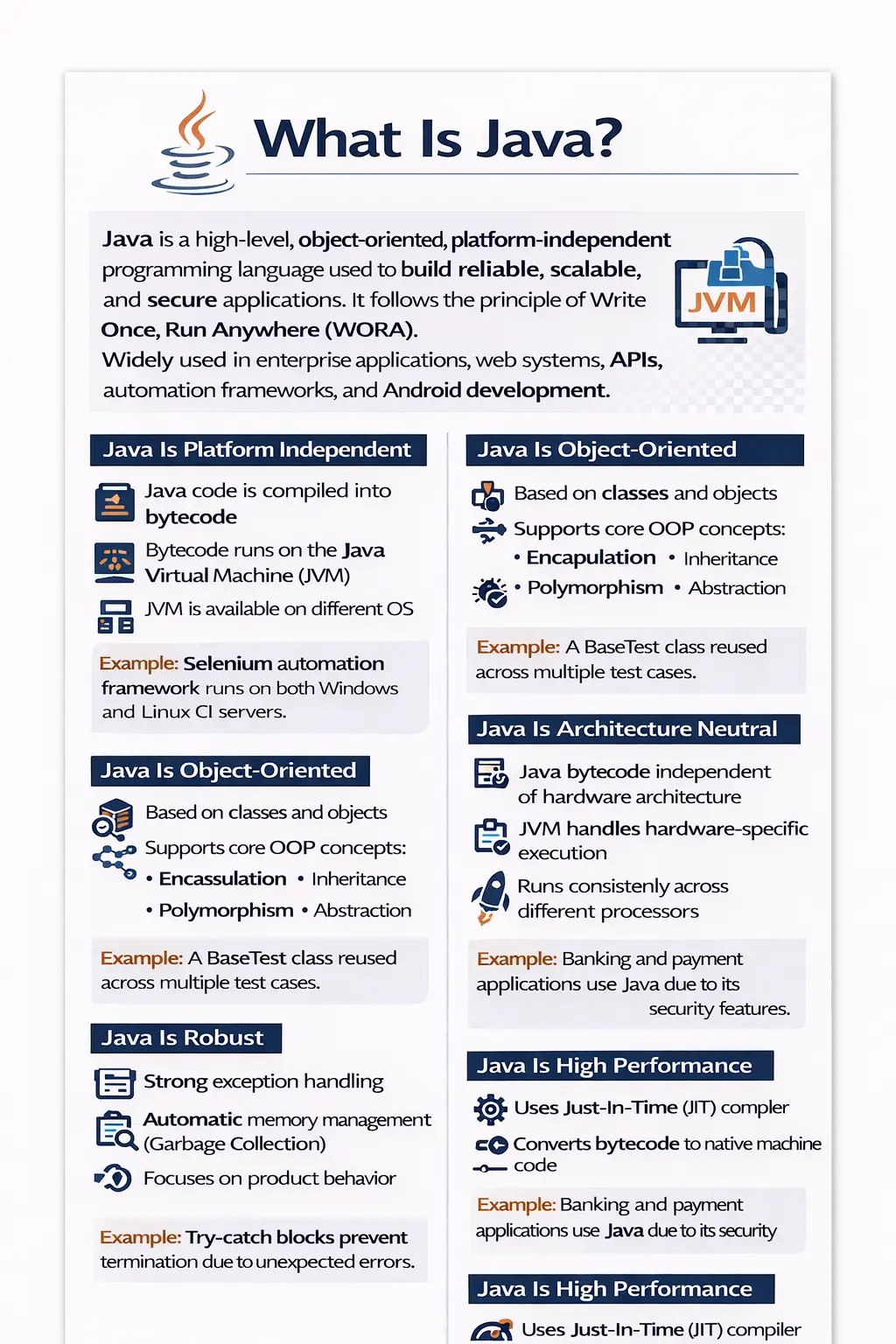
Java is a high-level, object-oriented, and platform-independent programming language designed to build reliable, scalable, and secure applications. One of Java’s defining ideas is Write Once, Run Anywhere (WORA), meaning code written once can run on multiple platforms without modification. Because of this, Java has become a popular choice for enterprise systems, web applications, APIs, test automation frameworks, and Android development.
Java focuses on stability, readability, and long-term maintainability, which is why it remains widely used in real-world, large-scale projects.
Java as a General-Purpose Programming Language
Java is best understood as a general-purpose language built for practical, long-lived software systems. It is not limited to one narrow domain. Developers use Java to build backend services, enterprise applications, desktop tools, Android applications, cloud services, APIs, automation frameworks, distributed systems, and data-processing applications. This wide usage comes from Java’s balance of readability, structure, reliability, tooling, and platform support. A Java program can start as a simple class written by a beginner and grow into a large application maintained by many teams.
One reason Java remains important is that it gives developers a stable foundation. The language encourages explicit structure through classes, methods, packages, interfaces, and access modifiers. This structure may feel verbose at first, but it becomes valuable in real projects where code must be maintained for years. In large applications, clarity matters more than cleverness. Java’s design supports this by making code organization, type checking, and modular development central parts of the language.
Why Java Became Popular
Java became popular because it solved several important problems that developers and organizations faced. Before Java, many applications were strongly tied to specific operating systems or hardware. Moving software from one platform to another could require major changes. Java introduced a model where source code is compiled into bytecode, and bytecode runs on the Java Virtual Machine. This made portability one of Java’s strongest advantages and helped the language spread across enterprise environments.
Java also arrived with a strong standard library, memory management, security features, and network programming support. These capabilities made it suitable for internet-era software and business applications. Over time, the ecosystem grew with frameworks, build tools, testing libraries, application servers, IDEs, and community support. Java was not only a language; it became a platform for building and running serious software. That ecosystem is one of the main reasons Java continues to be widely used.
Write Once, Run Anywhere
Write Once, Run Anywhere is one of Java’s most famous ideas. It means that a developer can write Java code, compile it into bytecode, and run that compiled bytecode on any machine that has a compatible JVM. The source code does not need to be rewritten for Windows, Linux, or macOS. The JVM handles the platform-specific execution details. This model made Java attractive for organizations that needed applications to run in different environments.
In practical terms, this helps development and testing teams. A developer may write code on a Windows laptop, run tests locally, commit the code, and then execute the same application on a Linux-based CI server. A Selenium automation framework written in Java can run on multiple machines as long as the required Java runtime and dependencies are available. This portability reduces environment friction and makes Java suitable for enterprise delivery pipelines.
Java Source Code, Bytecode, and JVM
Java execution involves three important ideas: source code, bytecode, and the JVM. Developers write source code in files with the .java extension. The Java compiler, called javac, checks the code and converts it into bytecode stored in .class files. Bytecode is not native machine code for a specific processor. It is an intermediate instruction format understood by the JVM.
When the program runs, the JVM loads the bytecode, verifies it, manages memory, and executes instructions. The JVM acts as a layer between the Java program and the operating system. This layered model is what allows Java to provide portability, security checks, runtime services, garbage collection, and performance optimization. Beginners often think Java is simply interpreted, but the real execution model is more sophisticated because it combines compilation, interpretation, and runtime optimization.
JDK, JRE, and JVM in Simple Terms
Beginners often confuse JDK, JRE, and JVM, so it is important to separate them clearly. The JVM is the virtual machine that executes Java bytecode. The JRE, or Java Runtime Environment, contains the JVM and libraries needed to run Java applications. The JDK, or Java Development Kit, contains everything needed to develop Java applications, including the compiler, tools, libraries, and runtime components.
A user who only needs to run a Java application may need a runtime environment. A developer who writes and compiles Java code needs the JDK. In modern development, installing the JDK is the normal choice because it includes the tools required for compilation, execution, debugging, packaging, and development workflows. Understanding this distinction is a common interview expectation and a useful practical foundation.
Java and Object-Oriented Programming
Java is strongly associated with object-oriented programming. In Java, programs are built around classes and objects. A class is a blueprint that defines data and behavior. An object is an instance of a class. This model helps developers represent real-world concepts and organize code logically. For example, an application may have classes such as User, Account, Product, Order, Payment, Report, or TestCase. Each class groups related data and behavior together.
Object-oriented programming helps reduce duplication and improve maintainability. Encapsulation hides internal details and exposes controlled access. Inheritance allows one class to reuse or extend another class. Polymorphism allows the same interface or method call to behave differently depending on the object. Abstraction allows developers to focus on essential behavior while hiding unnecessary complexity. These concepts are central to Java and appear frequently in real projects and interviews.
Java in Enterprise Applications
Java is heavily used in enterprise applications because it supports scalability, maintainability, security, and long-term stability. Banks, insurance companies, telecom systems, government platforms, healthcare applications, retail systems, and large internal business tools often rely on Java. Enterprise software usually has complex business rules, many integrations, strict security requirements, and long maintenance lifecycles. Java fits this environment well because it has mature frameworks, strong tooling, and a large developer community.
Frameworks such as Spring and Jakarta EE have made Java especially important in backend development. These frameworks help teams build APIs, web applications, microservices, database-backed systems, and enterprise integrations. Even when modern architectures change, Java remains relevant because it adapts to new patterns while preserving reliability. This is why Java skills continue to be valuable for developers, testers, and automation engineers.
Java in Web and API Development
Java is commonly used to build web applications and APIs. In a typical backend system, Java code receives requests, applies business logic, interacts with databases, communicates with other services, and returns responses. REST APIs, authentication services, payment systems, reporting engines, and workflow services are often built with Java. The language is well suited for this because it supports strong typing, reusable design, exception handling, multithreading, and mature libraries.
From a tester’s perspective, Java knowledge is useful because many automation frameworks, API tests, and backend systems are Java-based. A tester who understands Java can read application behavior more confidently, write test automation code, debug failures, and communicate better with developers. Java is not only a programming language for application developers; it is also a practical skill for quality engineering.
Java in Test Automation
Java is one of the most common languages used in Selenium automation frameworks. Many testing teams use Java with Selenium WebDriver, TestNG, JUnit, Maven, Gradle, Cucumber, Rest Assured, and reporting tools. The language provides strong structure for building maintainable automation projects. Page Object Model, reusable utility classes, base test classes, configuration readers, data-driven testing, and reporting integrations are commonly implemented in Java.
Java is useful in automation because test code must be readable, reusable, and stable. Automation frameworks can become large software projects in their own right. Poorly organized automation code becomes difficult to maintain, just like poorly organized application code. Java’s class-based structure, package organization, access modifiers, exception handling, and ecosystem make it a strong choice for building test automation that can scale with the product.
Java and Android Development
Java has also played a major role in Android development. For many years, Java was the primary language for building Android applications. Although Kotlin is now widely used in Android development, Java remains important because many existing Android applications, libraries, tutorials, and systems still use Java. Understanding Java helps developers read legacy Android code and understand the object-oriented foundations of Android programming.
Android development also demonstrates Java’s flexibility. The same language concepts used in backend systems, automation frameworks, and desktop tools can also support mobile application development. Classes, objects, interfaces, exceptions, collections, and threading all appear in Android development. This broad applicability gives Java learners a strong base that transfers across domains.
Java and Memory Management
Java manages memory automatically through garbage collection. In languages where developers manually allocate and free memory, memory mistakes can cause leaks, crashes, and security vulnerabilities. Java reduces this burden by allowing the JVM to identify objects that are no longer used and reclaim memory. This does not mean Java developers can ignore memory completely, but it does reduce many low-level memory risks.
Garbage collection helps make Java more robust, especially for large applications. Developers can focus more on business logic and application design instead of manually managing memory addresses. However, developers still need to avoid holding unnecessary references, creating excessive objects, or designing inefficient data structures. Automatic memory management is a safety feature, not a substitute for good engineering judgment.
Java and Exception Handling
Java has a structured exception handling mechanism that helps programs respond to unexpected situations. Exceptions represent abnormal conditions such as invalid input, missing files, failed network calls, database errors, or arithmetic problems. Java allows developers to handle these conditions using try, catch, finally, throw, and throws. This structure makes error handling explicit and manageable.
Good exception handling improves reliability. Instead of crashing without explanation, a program can log the error, show a meaningful message, retry an operation, close resources, or follow a fallback path. In test automation, exception handling is also important because automation code must handle missing elements, timeouts, stale references, file issues, and unexpected browser behavior. Java gives testers and developers tools to manage such failures cleanly.
Java and Multithreading
Java supports multithreading, which allows multiple tasks to run concurrently. This is useful when an application needs to handle many users, process background jobs, perform network operations, or keep a user interface responsive. Threads allow different parts of a program to progress independently, though they must be managed carefully to avoid synchronization problems, race conditions, and inconsistent data.
In testing and automation, multithreading is visible in parallel execution. TestNG, Selenium Grid, and CI pipelines can run multiple tests at the same time to reduce execution duration. Understanding Java threads, synchronization, and thread safety helps automation engineers design frameworks that work reliably under parallel execution. Multithreading is powerful, but it requires discipline.
Java Performance and JIT Compilation
Java performance has improved greatly over time. One important reason is Just-In-Time compilation. When Java bytecode runs, the JVM can identify frequently executed code paths and compile them into optimized native machine code at runtime. This allows Java to combine portability with strong performance. The program is not simply interpreted line by line forever; the runtime can optimize hot code paths.
Performance also depends on application design. Efficient algorithms, proper data structures, database tuning, caching, thread management, and resource handling all affect Java application speed. The language and JVM provide strong tools, but developers still need to write thoughtful code. This is another reason Java is used in enterprise systems: it offers both portability and performance when used well.
Java Syntax and Readability
Java syntax is designed to be explicit. A Java program usually declares classes, methods, variables, return types, access modifiers, and exception behavior clearly. Beginners sometimes feel this is verbose compared to some scripting languages, but explicit syntax helps large teams understand code. In enterprise projects, readability and predictability are valuable because many developers may work on the same codebase over several years.
Java’s readability also supports learning. Concepts such as variables, data types, operators, control statements, loops, methods, classes, objects, arrays, collections, exceptions, and interfaces build gradually. Once learners understand the structure, they can read and write Java code confidently. This makes Java a strong language for developing disciplined programming habits.
Java Ecosystem and Tooling
Java’s ecosystem is one of its biggest strengths. Developers commonly use IDEs such as IntelliJ IDEA, Eclipse, and NetBeans. Build tools such as Maven and Gradle manage dependencies, compile code, run tests, and package applications. Testing frameworks such as JUnit and TestNG support automated testing. Libraries and frameworks such as Spring, Hibernate, Selenium, Cucumber, Rest Assured, and Jackson extend Java into many development and testing areas.
This ecosystem reduces the need to build everything from scratch. A Java developer can use mature libraries for database access, JSON processing, logging, web development, API testing, reporting, file handling, security, and cloud integration. The strength of the ecosystem is one reason Java remains practical. Learning Java opens access to a large set of production-proven tools.
Java for Beginners
For beginners, Java is valuable because it teaches structured programming and object-oriented thinking. A beginner learns how to define variables, use data types, write methods, control flow with loops and conditions, create classes, instantiate objects, handle exceptions, and organize code into packages. These skills transfer to many other programming languages and frameworks.
The challenge for beginners is that Java has several concepts that must be understood clearly. JVM, JDK, JRE, classpath, packages, static methods, object creation, constructors, inheritance, interfaces, and exceptions can feel overwhelming at first. The best way to learn Java is to build step by step. Start with simple programs, understand the main method, learn data types and control flow, then move into object-oriented programming and collections. A strong foundation makes advanced topics easier.
Common Mistakes Beginners Make in Java
Beginners often write Java code in a procedural style and avoid using objects properly. They may place too much logic in the main method, duplicate code instead of creating reusable methods, or expose data directly instead of using encapsulation. Another common mistake is ignoring exception handling or catching exceptions without understanding the cause. Some beginners also confuse equality operators, misuse static members, or struggle with object references.
These mistakes are normal during learning, but they should be corrected early. Java rewards clear structure. Learners should practice writing small classes with clear responsibilities, using meaningful names, handling errors thoughtfully, and understanding how objects interact. Good habits formed early make it easier to work on real projects and automation frameworks later.
Java in Interviews
In interviews, Java is often introduced as a high-level, object-oriented, platform-independent programming language. A strong answer should go beyond memorized phrases. It should explain that Java source code is compiled into bytecode, bytecode runs on the JVM, and this architecture enables platform independence. It should also mention object-oriented programming, automatic memory management, exception handling, multithreading, security, and the large ecosystem.
Interviewers may also expect practical understanding. They may ask why Java is called platform-independent, how Java code runs, what the difference is between JDK, JRE, and JVM, why Java is robust, what garbage collection does, or why Java is used in Selenium automation. Clear examples make answers stronger. For example, explaining that the same Java Selenium tests can run on a Windows laptop and Linux CI server demonstrates platform independence in a real testing context.
Why Java Still Matters Today
Java still matters because many important systems depend on it and because it continues to evolve. Large organizations value stability, backward compatibility, performance, security, and maintainability. Java provides these qualities along with modern language improvements and strong framework support. Even when new languages become popular, Java remains deeply embedded in enterprise software, backend systems, automation frameworks, and Android ecosystems.
For learners, Java is a practical investment. It builds a strong programming foundation and opens paths into backend development, test automation, API testing, enterprise systems, and mobile development. For testers, Java is especially useful because many automation frameworks are written in Java. Understanding Java helps testers move from manual execution to automation engineering and deeper technical testing.
Platform Independence
A key strength of Java is platform independence. Java source code is compiled into an intermediate form called bytecode rather than into machine-specific instructions. This bytecode runs on the Java Virtual Machine (JVM), which is available for different operating systems.
Because each operating system has its own JVM implementation, the same compiled Java program can run on Windows, Linux, or macOS without code changes. This allows teams to develop once and deploy anywhere. For example, a Selenium automation framework written in Java can run on both Windows laptops and Linux-based CI servers without modification.
Object-Oriented Nature
Java is fundamentally object-oriented. Programs are structured around classes and objects, which represent data and behavior together. Java supports the core object-oriented principles of encapsulation, inheritance, polymorphism, and abstraction.
This approach encourages modular design and reuse. Code becomes easier to maintain and extend over time. In automation frameworks, for instance, a common base class can be reused across multiple test classes, reducing duplication and improving consistency.
Robustness and Reliability
Java is known for being robust. It includes strong exception handling mechanisms, compile-time and runtime checks, and automatic memory management through garbage collection. These features reduce common programming errors such as memory leaks and invalid memory access.
Because of these safeguards, Java applications tend to be more stable and less prone to crashes. Structured error handling using try-catch blocks allows programs to handle unexpected situations gracefully instead of terminating abruptly.
Security Features
Security is built into Java’s design. Java does not allow direct memory access through pointers, which prevents many low-level vulnerabilities. Bytecode verification ensures that code follows safety rules before execution. In controlled environments, security managers can restrict access to system resources.
These features make Java a strong choice for systems that handle sensitive data, such as banking, financial services, and enterprise platforms where security is critical.
Architecture Neutrality
Java is architecture-neutral because its bytecode is not tied to a specific processor or hardware type. The JVM handles hardware-specific execution. This ensures consistent behavior across different systems and processors, which is especially important in distributed and enterprise environments.
Multithreading Support
Java has built-in support for multithreading, allowing multiple tasks to run concurrently within the same application. This improves responsiveness and resource utilization.
Multithreading is valuable in scenarios where tasks can run in parallel. In test automation, for example, parallel test execution can significantly reduce total execution time and improve efficiency in CI/CD pipelines.
Performance Considerations
Although Java is not purely compiled to native code upfront, it achieves strong performance through the Just-In-Time (JIT) compiler. The JIT converts frequently used bytecode into native machine code at runtime, improving execution speed.
This approach allows Java to balance portability with performance, making it suitable for both large enterprise systems and performance-sensitive applications.
How a Java Program Runs
A Java program follows a clear execution flow. Developers write source code in .java files. The Java compiler (javac) converts this source code into bytecode stored in .class files. The JVM then executes this bytecode and interacts with the operating system and hardware as needed.
- Java source code (.java) is written
- Compiled by javac into bytecode (.class)
- Bytecode is executed by JVM
- JVM interacts with OS and hardware
This layered execution model is what enables Java’s portability and security.
Common Beginner Misunderstandings
Many beginners initially think Java is purely interpreted, but it is actually a combination of compilation and interpretation. Others confuse JVM, JRE, and JDK, even though each has a distinct role. Some new developers also write Java in a procedural style instead of leveraging object-oriented principles. Ignoring proper exception handling is another frequent issue that can reduce program stability.
Recognizing and correcting these misunderstandings early helps build a strong foundation.
Interview Perspective
From an interview standpoint, Java is often described as a platform-independent, object-oriented language used for building secure and scalable applications. A more detailed explanation highlights that Java compiles source code into bytecode executed by the JVM and supports object orientation, garbage collection, multithreading, and strong security features. These qualities make it suitable for enterprise, web, and automation projects.
Key Takeaway
Java’s long-standing popularity comes from its portability, object-oriented design, reliability, and security. It is a language built for large, maintainable systems and long-term projects. For developers and testers alike, a solid understanding of Java opens doors to enterprise development, automation frameworks, and modern backend systems.
Java is not just a language—it is a mature ecosystem designed for building dependable software at scale.