Test Summary Report (TSR)
Software testing does not end with the execution of test cases. Once testing activities are completed for a release or test cycle, stakeholders need a clear understanding of what was tested, what issues were found, and whether the product is ready for release. The document that provides this final assessment is known as the Test Summary Report (TSR).
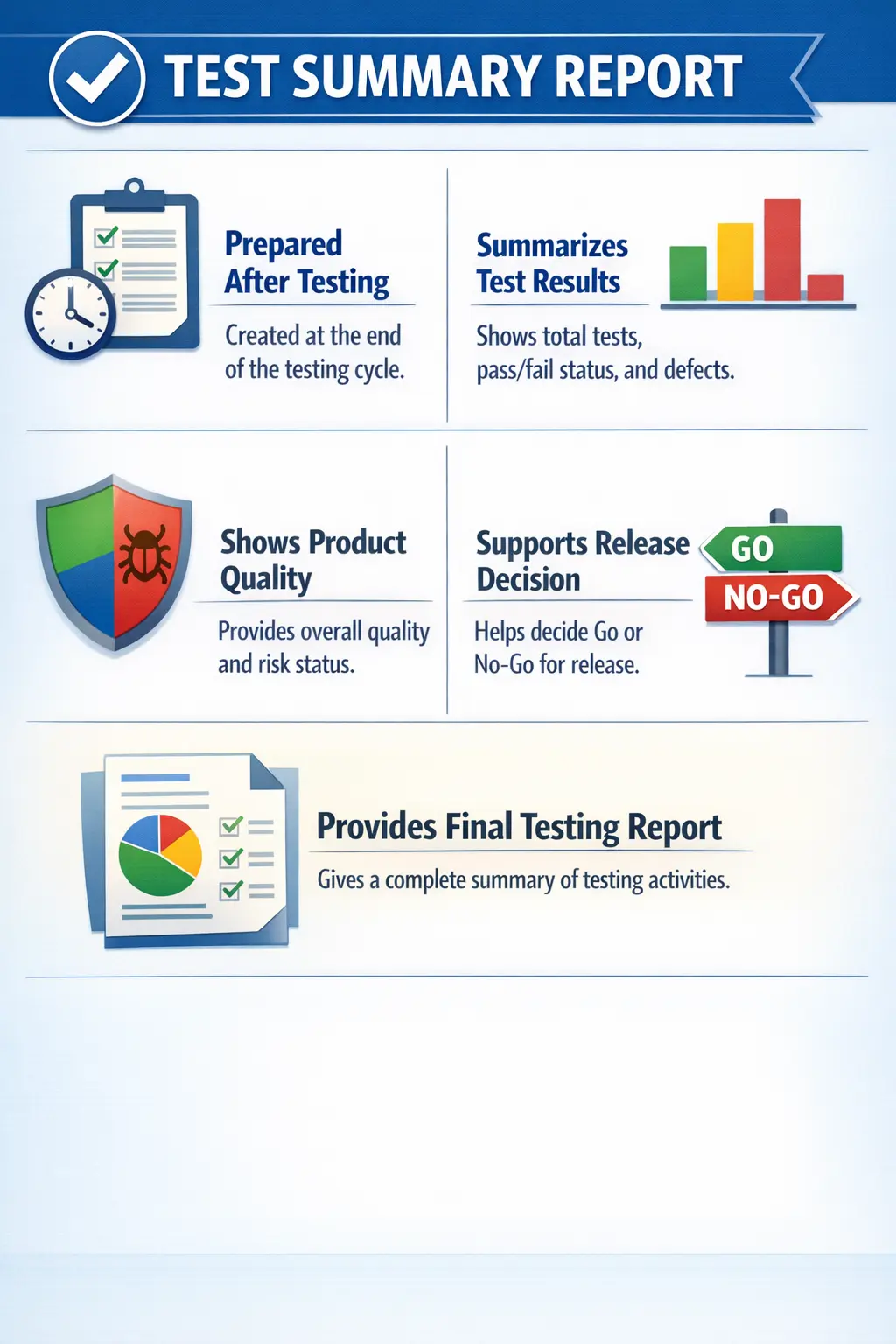
A Test Summary Report is a formal document prepared at the end of a testing phase or release cycle that provides a comprehensive overview of testing activities and product quality. It consolidates information about the testing scope, execution results, defects, risks, and overall quality evaluation. The Test Summary Report answers three fundamental questions: What was tested? What problems were found? Is the product ready for release?
The TSR serves as the final communication artifact between the testing team and stakeholders such as project managers, developers, and business representatives. It provides transparency and confidence in the product’s readiness and acts as an official record of testing activities.
Understanding the Role of a Test Summary Report
In structured software development processes, testing is planned, executed, and controlled through well-defined activities. However, without a final report summarizing the results, stakeholders cannot easily evaluate product quality.
The Test Summary Report plays a crucial role in bridging this gap. It converts detailed testing data into meaningful information that can be used for decision-making. Instead of reviewing hundreds of individual test cases and defects, stakeholders can review the TSR to understand the quality status of the system.
The TSR also represents the formal closure of testing activities. It indicates that planned testing tasks have been completed and that the testing phase has reached a conclusion.
A strong Test Summary Report does not merely repeat raw execution numbers. It explains what the numbers mean. For example, ninety-eight percent test execution may look excellent, but if the remaining two percent belongs to payment, security, or data migration, the product may still carry serious release risk. Similarly, a small number of open defects may be acceptable if they are cosmetic, but one open critical defect may block release. The TSR converts these facts into a clear quality assessment.
The TSR also helps stakeholders understand the difference between testing completion and product readiness. Testing may be completed according to plan, but release readiness depends on coverage, defect severity, known risks, business acceptance, and unresolved limitations. A responsible TSR presents all of these factors together so that the final decision is informed rather than assumed.
In many organizations, the TSR becomes part of the official project record. It may be stored with release notes, test plans, execution evidence, defect reports, and sign-off records. This historical value is important because future teams can review previous reports to understand what was tested, where defects occurred, which risks were accepted, and what improvements were recommended.
Purpose of a Test Summary Report
The primary purpose of the Test Summary Report is to summarize the outcomes of testing in a structured and understandable format. It consolidates execution data, defect statistics, and quality assessments into a single document.
One of the most important objectives of the TSR is presenting product quality status to stakeholders. Management and business teams rely on the TSR to determine whether the product meets acceptable quality standards.
Another important purpose is supporting release decisions. The TSR provides factual data about test coverage, defect severity, and remaining risks. Based on this information, stakeholders decide whether the release should proceed or be delayed.
The TSR also documents risks and limitations. Even when a product is ready for release, there may be known issues or constraints that must be acknowledged. The TSR ensures these risks are clearly communicated.
The report also serves as a historical reference. Future projects and releases often refer to past TSRs to understand testing challenges, defect patterns, and quality trends.
Another important purpose is creating a shared understanding of quality. Testers may know the product condition deeply because they executed the cases and analyzed defects, but stakeholders may not have that detailed view. The TSR translates testing knowledge into a format that project managers, product owners, business users, developers, support teams, and release managers can understand.
The TSR also supports accountability. When the report states that certain modules were tested, certain defects remain open, and certain risks were accepted, the release decision becomes traceable. If a known issue appears after release, the team can review whether it was documented, whether it was accepted, and whether the risk assessment was accurate.
In addition, the TSR helps future estimation and planning. If a previous release required more regression effort than expected, suffered environment delays, or had many reopened defects, that information can guide planning for the next release. In this way, the TSR contributes to continuous improvement rather than serving only as a final document.
Importance of Test Summary Reports in Real Projects
In real-world projects, releases are often time-bound and involve multiple teams. Without a structured summary report, it becomes difficult to evaluate whether testing objectives have been achieved.
The TSR provides a clear picture of the testing effort. It shows how much testing was completed, what issues were identified, and how those issues were resolved.
The TSR also improves accountability. Since the report is formally reviewed and approved, it ensures that all testing activities are documented and traceable.
In regulated industries such as finance and healthcare, the TSR is often required as part of compliance documentation. Auditors may review the TSR to confirm that proper testing procedures were followed.
The TSR also promotes transparency. Stakeholders can clearly see the strengths and weaknesses of the product before release.
Real projects often involve pressure to release quickly. Deadlines, client commitments, market events, and business priorities may push teams toward release even when some uncertainty remains. The TSR does not remove business pressure, but it makes the quality position visible. It gives stakeholders a factual basis for deciding whether to release, delay, reduce scope, or accept known risks.
The report is especially valuable when multiple teams contribute to one release. Development teams may complete different modules, QA teams may test different areas, DevOps teams may manage deployments, and business teams may handle acceptance. The TSR brings these testing results into one consolidated view. Without it, each team may understand only its own part of the release.
TSRs also help support teams prepare for production. If known limitations, accepted defects, or workarounds are documented clearly, support teams can respond better if users report related issues after release. This reduces confusion and improves operational readiness.
When Test Summary Reports Are Prepared
Test Summary Reports are typically prepared at specific milestones in the testing lifecycle.
One common point for TSR preparation is the end of system testing. At this stage, all planned test cases have been executed, and defect resolution has progressed to an acceptable level.
TSRs are also prepared before User Acceptance Testing sign-off. Business stakeholders use the TSR to understand the system's stability before beginning acceptance testing.
Another important stage is before production release. The TSR provides the final quality evaluation required for release approval.
TSRs are also created during the test closure phase of the Software Testing Life Cycle. This phase formally concludes testing activities and archives testing artifacts.
In Agile environments, a lightweight TSR may be prepared at the end of a sprint, especially when the sprint contains release-ready increments. For larger releases, a more complete TSR may be prepared before deployment. The level of detail depends on project size, risk, compliance needs, and stakeholder expectations.
In maintenance projects, a TSR may be prepared after a patch release, hotfix, or regression cycle. Even if the change is small, stakeholders may need confirmation that the fix was tested and that related areas were not broken. In such cases, the TSR may focus on impacted scope, retesting, regression evidence, and remaining risk.
For UAT, the TSR may be used to hand over system testing results to business users. It helps them understand which areas are stable, which defects remain open, and which scenarios may need extra attention during acceptance testing. This prevents UAT from starting blindly.
Overview Section of Test Summary Report
The overview section provides basic information about the testing cycle and project context.
This section typically includes the project name, release version, and test cycle details. It also describes the objectives of testing and the scope of the testing effort.
The overview gives stakeholders the necessary background information to understand the rest of the report. It ensures that readers know which version of the product was tested and what testing activities were performed.
This section may also include testing timelines, including start and end dates of the test cycle.
A good overview should be brief but complete. It should identify the application or module, release number, build version, test phase, testing team, testing period, and purpose of the report. This context prevents confusion when multiple releases, builds, or test cycles exist at the same time.
The overview may also mention the testing objective. For example, the objective may be to validate a new release, complete regression testing, verify production defect fixes, assess UAT readiness, or confirm release readiness after system testing. Stating the objective helps readers interpret the rest of the report correctly.
If there were important assumptions or dependencies, the overview can mention them briefly. For example, testing may have been performed using a specific staging environment, masked data, sandbox payment gateway, or limited third-party service. Such context helps stakeholders understand the boundaries of the results.
Scope of Testing
The scope section explains what was included and excluded from testing.
This section identifies the features and modules that were tested during the cycle. It provides clarity about which functionalities were validated.
Equally important is identifying features that were not tested. These exclusions may occur due to time constraints, incomplete development, or environmental limitations.
Clearly defining testing scope prevents misunderstandings. Stakeholders understand exactly what has been validated and what remains outside testing boundaries.
This section ensures that release decisions are made with complete awareness of testing coverage.
The scope section should be written carefully because it defines the meaning of the whole report. If a feature was not part of the test cycle, the TSR should say so. If a module was partially tested because development was incomplete, that limitation should be visible. If a third-party integration was mocked instead of tested end to end, that should be documented.
Scope exclusions are just as important as scope inclusions. Stakeholders sometimes assume that "testing completed" means every feature in the application was tested. In reality, testing may cover only a release scope, changed modules, high-risk areas, or agreed regression suite. The TSR must prevent misunderstanding by clearly stating what was outside the testing boundary.
When exclusions exist, the report should also mention why they were excluded. Common reasons include feature not delivered, environment unavailable, test data unavailable, dependency blocked, requirement deferred, or business decision to exclude. This gives stakeholders a complete view of residual risk.
Test Execution Summary
The execution summary provides quantitative information about test case execution.
This section typically includes the total number of test cases planned and executed. It also includes statistics for passed, failed, and blocked test cases.
Execution statistics help stakeholders understand the effectiveness of testing. A high percentage of passed test cases generally indicates product stability, while a high number of failures may indicate quality concerns.
Blocked test cases indicate environmental or dependency issues that prevented execution.
Execution summaries provide measurable evidence of testing progress and completion.
Execution summary should not be interpreted only by pass percentage. A high pass percentage is meaningful only when the planned scope is relevant and critical test cases have been executed. If low-risk cases passed but high-priority cases were blocked, the report should make that clear.
A useful execution summary may include planned test cases, executed test cases, passed cases, failed cases, blocked cases, not executed cases, pass percentage, fail percentage, and execution completion percentage. In larger projects, the data may also be broken down by module, priority, test type, or requirement area.
Blocked and not executed cases require explanation. A blocked case means execution could not proceed due to a dependency such as environment, build, data, access, or unresolved prerequisite defect. A not executed case may mean the team did not reach that case before closure or that it was removed from scope. These two statuses should not be mixed.
The TSR should also explain whether failed test cases were retested after fixes. If failed cases are still open, that affects release readiness. If they were fixed and retested successfully, the report should show that closure clearly.
Defect Summary
The defect summary section provides a comprehensive view of defects identified during testing.
This section typically includes the total number of defects logged during the test cycle. It also provides severity-wise distribution of defects.
Severity classification helps stakeholders understand the impact of defects. Critical defects indicate major functionality failures, while minor defects may involve cosmetic issues.
The defect summary also includes the number of open and closed defects. Open defects represent unresolved issues that may impact release readiness.
This section is essential for assessing product quality. A product with many unresolved critical defects is usually not considered release-ready.
Defect summary should include more than total defect count. It should show severity-wise and status-wise distribution, such as critical, high, medium, low, open, fixed, closed, reopened, deferred, and rejected defects. This gives stakeholders a clearer view of defect health.
Open critical and high-severity defects deserve special attention. Even if the number is small, these defects may block release. Medium and low defects may be accepted if business stakeholders agree and if the impact is clearly understood. Deferred defects should be listed or summarized because they represent known issues carried forward.
Reopened defects may indicate fix quality problems or incomplete understanding of requirements. If many defects were reopened during a cycle, the TSR can mention this as a quality observation or lesson learned. Defect trends are often as useful as defect totals.
The defect summary can also identify defect concentration. If most defects occurred in one module, workflow, or integration, that area may require additional regression or future improvement. This insight helps teams improve beyond the current release.
Quality Assessment
The quality assessment section provides a high-level evaluation of the product's readiness.
This section interprets execution results and defect statistics to determine overall quality status. It explains whether the system meets expected quality standards.
Quality assessment includes risk analysis. Even if most test cases pass, certain high-risk areas may still exist.
Known issues are also documented in this section. These issues may be accepted for release if their impact is considered low.
This section often includes a release recommendation. The testing team may recommend either proceeding with release or delaying it until issues are resolved.
The quality assessment should be written as a reasoned conclusion, not just a statement that testing is complete. It should explain whether the product satisfies expected quality based on executed scope, defect status, risk level, and exit criteria. If quality is acceptable with limitations, those limitations should be stated clearly.
Risk analysis is a key part of this section. A risk may come from untested scope, blocked scenarios, open defects, environment differences, performance concerns, security concerns, or dependency limitations. The TSR should explain whether each risk is low, medium, or high, and whether mitigation or business acceptance exists.
The release recommendation should be direct. It may say that QA recommends release, recommends release with known issues, recommends release after specific defects are fixed, or does not recommend release due to unresolved critical risks. Ambiguous recommendations reduce the value of the report.
When the testing team recommends release with known issues, the TSR should explain which issues remain, why they are acceptable, who accepted them, and whether workarounds exist. This prevents later confusion when those known issues are encountered in production.
Environment Details
Testing environments play an important role in validating system behavior.
The environment section describes the hardware, software, operating systems, browsers, and databases used during testing.
Environment documentation ensures that test results are reproducible. If issues occur in production, teams can compare production configuration with test environments.
Environment details also help future testing cycles replicate the same conditions.
This section should mention application URL or environment name, build version, database version, browser versions, operating systems, devices, API endpoints, integration systems, and any special configuration used during testing. If mobile testing was performed, device models and OS versions may also be relevant.
Environment differences can strongly affect results. A feature may pass in QA but fail in production because of configuration, data volume, network rules, third-party service behavior, or infrastructure differences. By documenting the test environment, the TSR makes these differences visible.
If any environment limitations existed, they should be documented. For example, email notifications may have been disabled, payment processing may have used sandbox cards, SMS delivery may have been mocked, or production-like data may not have been available. Such notes help stakeholders understand the level of confidence the testing actually provides.
Lessons Learned
The lessons learned section captures knowledge gained during the testing cycle.
This section identifies what worked well and what could be improved in future projects.
Lessons learned may include improvements in test planning, environment setup, defect tracking, or communication processes.
Documenting lessons learned helps organizations continuously improve their testing practices.
Future projects benefit from the experience gained in previous cycles.
Lessons learned should be practical and specific. A weak lesson says "testing should improve." A stronger lesson says "test data for role-based access should be prepared before execution because three high-priority scenarios were blocked for two days." Specific lessons are more likely to lead to real process improvement.
Lessons may be positive as well as negative. If early requirement review reduced defects, if automation helped regression, if daily defect triage improved closure speed, or if environment monitoring reduced downtime, those practices should be captured and repeated in future cycles.
The TSR can also identify recurring problems. Repeated environment instability, late builds, unclear acceptance criteria, missing test data, or high defect reopen rates are not just one-time observations. They are signals that the team should improve planning, communication, development quality, or test readiness.
Sign-Off Section
The sign-off section represents formal approval of testing completion.
This section typically includes signatures or approvals from QA leads and project stakeholders.
QA sign-off confirms that planned testing activities were completed.
Business sign-off confirms acceptance of product quality.
Sign-off provides official confirmation that testing has been completed and that release decisions can proceed.
Sign-off does not always mean that the product is perfect. It means that stakeholders have reviewed the testing evidence, understood remaining risks, and agreed on the next step. In many projects, sign-off may include acceptance of known low-priority defects or deferred enhancements.
The sign-off section should identify who approved the report and in what capacity. QA sign-off confirms testing completion and quality recommendation. Business sign-off confirms acceptance of business readiness. Project or release management sign-off confirms approval to proceed according to organizational process.
If sign-off is conditional, the conditions should be documented. For example, release may be approved only after one high-priority defect is fixed, after a final smoke test is completed, or after business users approve a workaround. Conditional approval should not be hidden inside informal messages; it should be visible in the TSR.
Test Summary Report vs Test Execution Report
Although Test Summary Reports and Test Execution Reports appear similar, they serve different purposes.
Test Execution Reports are prepared during testing. They provide ongoing updates about test progress and defect status.
Test Summary Reports are prepared at the end of testing. They provide a final evaluation of product quality.
Execution reports focus on operational details, while summary reports focus on analytical conclusions.
Execution reports are used by the testing team, while summary reports are used by management and stakeholders.
Understanding this distinction is important in real projects and interviews.
A simple way to understand the difference is timing. A Test Execution Report is prepared while testing is ongoing. It answers, "What is the current testing status?" A Test Summary Report is prepared after testing is completed. It answers, "What was the final testing outcome and is the product ready?"
Execution reports are operational. They help teams manage daily progress, blockers, failed cases, and open defects. Summary reports are evaluative. They help stakeholders review final coverage, defect status, risks, lessons, and release recommendation.
In many projects, execution reports feed into the final TSR. Daily status, test execution data, defect metrics, and risk logs collected during testing are consolidated and interpreted in the summary report. If execution reporting is inaccurate, the final TSR will also be weak.
Manual Tester’s Role in Test Summary Reports
Manual testers contribute essential information for TSR preparation.
Testers provide accurate execution data, including pass and fail results.
They ensure that defect data is complete and correctly classified.
Testers also help identify risks and limitations discovered during testing.
Experienced testers often contribute insights for the quality assessment section.
Although TSR preparation is usually led by a Test Lead or QA Manager, tester input is critical for accuracy.
Manual testers must ensure that test case statuses are accurate before the report is prepared. A test case should not remain outdated in the test management tool. Passed, failed, blocked, not executed, and deferred statuses should reflect actual execution. Incorrect status data can mislead the final report.
Testers also help validate defect information. Defect severity, priority, status, retest result, and reopen information should be accurate. If a defect was fixed but not retested, that should be visible. If a defect was deferred with business approval, that should be documented.
Testers are often closest to the product behavior, so their qualitative input matters. They can identify unstable modules, risky workflows, recurring failure patterns, confusing requirements, weak test data, and environment issues. These insights make the TSR more useful than a simple statistics document.
Real-Time Example
Consider a web-based banking application undergoing release testing.
During system testing, 500 test cases were planned. Of these, 490 were executed successfully. Approximately 480 test cases passed, and 10 failed.
Defect analysis showed no open critical defects. A few minor user interface issues remained unresolved but were accepted by stakeholders.
The Test Summary Report documented these results and recommended release approval.
Based on TSR findings, stakeholders approved the release.
This example demonstrates how TSR supports release decisions.
Consider another example from an e-commerce release. The TSR may show that login, product search, cart, checkout, payment, and order history were tested. It may also show that invoice download testing was limited because the reporting service was unstable. Two medium defects in coupon display may remain open, but payment calculation and order creation passed successfully. The testing team may recommend release with a note that invoice download should be monitored after deployment.
In a healthcare application, the TSR may show that appointment booking, patient registration, doctor search, and prescription upload were tested. If one open defect affects display alignment, the release risk may be low. But if one open defect affects patient data visibility across users, release should not proceed. The TSR helps stakeholders see the difference between cosmetic risk and data privacy risk.
These examples show that the value of a TSR lies in interpretation. The report should not simply say that defects exist. It should explain whether those defects affect critical business flows, compliance, user safety, financial accuracy, security, or customer experience.
Common Mistakes in Test Summary Reports
One common mistake is hiding risks or known issues. Stakeholders must be fully informed about product limitations.
Another mistake is including incomplete or inaccurate data. Incorrect statistics reduce report credibility.
Some reports use overly technical language. TSRs should be understandable to non-technical stakeholders.
Another problem is missing release recommendations. TSRs should clearly indicate whether the product is ready.
Avoiding these mistakes improves TSR effectiveness.
Another common mistake is writing the TSR as if it is only for testers. The report may include too many internal details, tool-specific terms, or raw tables without explanation. Stakeholders need clear conclusions. Detailed evidence can be linked or attached, but the main report should be readable by non-technical decision-makers.
Some reports also exaggerate success by highlighting pass percentages while hiding blocked cases, excluded scope, or known issues. This creates false confidence. A trustworthy TSR presents both positive results and remaining concerns. Transparency is more valuable than making the report look perfect.
Another mistake is failing to connect the report to exit criteria. If the project defined exit criteria such as no open critical defects, ninety-five percent pass rate, and completion of regression testing, the TSR should explicitly state whether those criteria were met. Without this connection, release readiness becomes subjective.
TSRs can also become weak when they are prepared too late from memory. The best reports are built from accurate execution data, defect tracking, daily reports, and risk logs maintained throughout the testing cycle. Waiting until the end and reconstructing details manually increases the chance of errors.
Interview Perspective
Test Summary Reports are frequently discussed in testing interviews.
A short answer typically defines TSR as a document summarizing testing results and product quality.
A detailed answer explains that TSR includes testing scope, execution statistics, defect status, risks, and release recommendations.
Interviewers may also ask about the difference between Test Summary Reports and Test Execution Reports.
Clear understanding of TSR demonstrates maturity in testing processes.
In interviews, a strong answer should include purpose, timing, contents, and usage. For example: "A Test Summary Report is prepared at the end of a test cycle or release to summarize testing scope, execution results, defect status, risks, environment details, lessons learned, and release recommendation. It helps stakeholders decide whether the product is ready for release."
If asked about contents, mention overview, scope, test execution summary, defect summary, coverage, environment, risks, known issues, quality assessment, lessons learned, and sign-off. This shows that you understand TSR as a structured document rather than just a pass/fail report.
If asked about your role, explain that testers provide accurate execution status, defect details, risk observations, blocker information, and retest results. Test leads may prepare the final report, but tester input ensures the report is factual and complete.
Best Practices for Test Summary Reports
A good Test Summary Report should be clear and structured.
It should include accurate execution statistics.
It should present defect data transparently.
It should clearly describe testing scope.
It should document risks and known issues.
It should provide a clear release recommendation.
Following these practices ensures that TSR remains a reliable decision-making tool.
A good TSR should also distinguish facts from recommendations. Execution numbers, defect counts, and environment details are facts. Quality assessment and release recommendation are conclusions based on those facts. Keeping this distinction clear improves credibility.
The report should be concise but not incomplete. Stakeholders should be able to understand the release condition quickly, but they should also have access to enough detail to verify the conclusion. Summary tables, short narratives, and clear risk notes usually work better than long unstructured paragraphs.
Known issues should be documented honestly. If issues are accepted for release, the report should mention their impact, workaround if available, and ownership for future resolution. Accepted risk should be visible, not hidden.
Finally, the TSR should be reviewed before sign-off. QA leads, project managers, and business stakeholders should confirm that the report accurately reflects testing status and release expectations. A reviewed TSR becomes a trusted project artifact.
Sample TSR Narrative
A practical TSR narrative may read like this: "System testing for Release 3.2 was completed between May 5 and May 18 in the QA environment. The testing scope included login, profile management, product search, checkout, payment, order history, and reporting. Out of 420 planned test cases, 412 were executed. 398 passed, 8 failed, and 6 were blocked due to reporting service instability. No critical defects remain open. Two medium defects and three low defects are accepted for release with business approval. QA recommends release after final smoke testing in the staging environment."
This narrative is useful because it tells the reader what was tested, what the numbers were, what remains unresolved, what risk exists, and what recommendation is being made. It avoids vague statements and gives stakeholders a clear basis for decision-making.
TSR and Release Readiness
Release readiness is not determined by one metric. It is determined by a combination of scope completion, critical test coverage, defect status, risk acceptance, environment stability, business approval, and operational readiness. The TSR brings these factors together.
A product may be release-ready even with some open defects if those defects are low impact, documented, accepted, and supported by workarounds. A product may not be release-ready even with a high pass percentage if critical flows are untested or high-severity defects remain open. The TSR helps stakeholders make this distinction.
The final recommendation should be practical and clear. It should not simply say "testing completed." It should say whether QA recommends release, recommends release with conditions, or does not recommend release. This clarity is the most important value of the Test Summary Report.
Key Takeaway
The Test Summary Report is the final and most important document produced at the end of a testing cycle. It provides a comprehensive view of testing activities, defect status, and overall product quality.
By summarizing what was tested, what issues were found, and whether the product is ready for release, the TSR provides the confidence and transparency required for informed release decisions.
A well-prepared Test Summary Report ensures that testing is not only completed but also properly communicated and documented.
For manual testers and QA teams, the TSR is a chance to communicate the real quality story of the release. It should show coverage, evidence, risk, limitations, and recommendation in a balanced way. When prepared well, it protects users, supports stakeholders, and strengthens the professionalism of the testing process.
In short, the Test Summary Report closes the testing cycle with clarity. It turns test execution data into release intelligence and ensures that the final decision is based on facts rather than assumptions.