Daily Status Report (DSR)
Software testing activities involve continuous progress tracking, defect discovery, and collaboration between multiple stakeholders such as testers, developers, product owners, and project managers. Because testing is dynamic and issues may arise at any point, it is essential for teams to maintain transparency regarding daily progress and risks. One of the most common and effective ways to achieve this transparency is through a Daily Status Report (DSR).
A Daily Status Report is a concise communication document that summarizes the testing progress, defect updates, blockers, and risks for a specific day. It provides stakeholders with a clear picture of where the testing effort currently stands and whether any issues may impact timelines or product quality.
A DSR answers an important operational question in software testing: “Where do we stand today, and is anything at risk?”
For manual testers and QA teams, preparing and sharing a daily status report is an essential responsibility. It ensures that everyone involved in the project remains informed about progress and potential risks, enabling faster decision-making and better coordination.
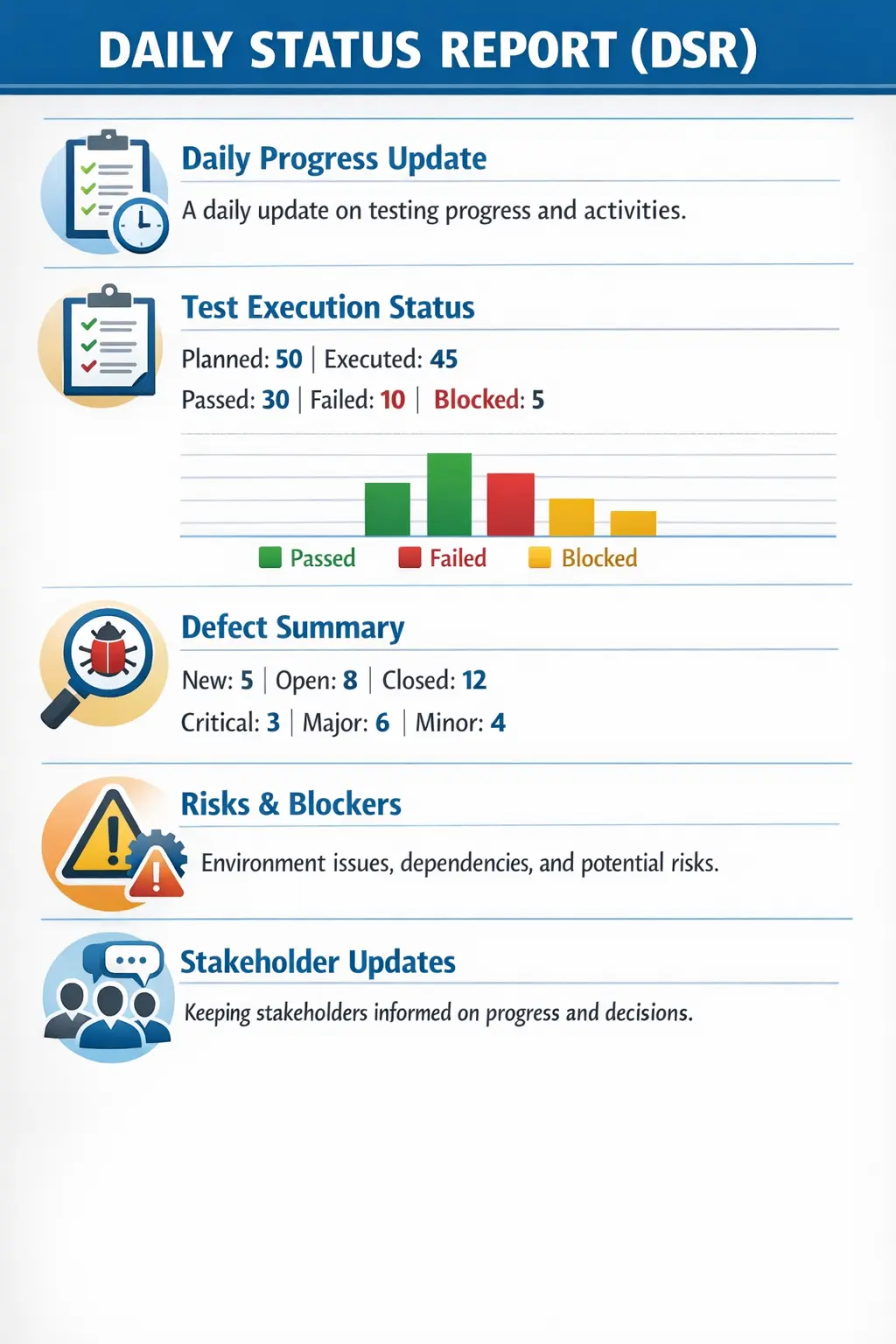
Definition of a Daily Status Report
A Daily Status Report (DSR) is a structured update shared with stakeholders that summarizes the progress of testing activities on a daily basis. It includes information such as the number of test cases executed, defects identified, blockers encountered, and plans for the next day.
The report serves as a communication bridge between the testing team and the broader project team. It allows stakeholders to understand how testing is progressing without reviewing detailed test cases or execution logs.
A DSR is usually brief, factual, and focused on key metrics. It avoids unnecessary technical details and instead highlights important updates and risks that may affect the project timeline.
By presenting testing progress in a structured format, the DSR enables teams to track progress consistently and identify issues early.
Purpose of a Daily Status Report
The primary purpose of a Daily Status Report is to provide transparency into the testing process. Testing involves numerous activities such as executing test cases, logging defects, validating fixes, and performing regression testing. A DSR ensures that stakeholders remain aware of these activities and their outcomes.
Another important purpose is highlighting risks and blockers early. Testing may encounter issues such as environment instability, unavailable services, or incomplete test data. Reporting these issues promptly allows teams to address them quickly.
The DSR also enables quick decision-making. When project managers and product owners receive daily updates, they can adjust priorities, allocate resources, or escalate issues if necessary.
Additionally, the report helps align stakeholders on priorities and timelines. Everyone involved in the project understands which areas are being tested, which defects have been identified, and what tasks remain pending.
Finally, the DSR tracks day-to-day movement toward testing goals. It provides a continuous view of progress throughout the testing cycle.
Audience of the Daily Status Report
The Daily Status Report is typically shared with several key stakeholders within the project.
Project managers rely on the DSR to monitor progress and ensure that testing activities remain aligned with project timelines. They use the report to identify risks and manage project schedules.
Product owners review the report to understand the current quality status of the product. It helps them determine whether functionality meets business expectations.
Test leads or QA managers use the report to track execution progress and manage testing resources effectively.
Developers may also review the DSR to identify new defects and understand areas where fixes are required.
By providing consistent updates, the DSR ensures that all stakeholders remain informed and aligned.
Typical Contents of a Daily Status Report
A well-structured DSR typically includes several key components that provide a complete overview of the day’s testing activities.
Summary of Activities
The summary section provides a brief overview of the testing work completed during the day. It may include information about which modules were tested, which user stories were validated, or which builds were executed.
This section gives stakeholders a quick understanding of the day’s progress without reviewing detailed metrics.
The summary should remain concise and focused on major accomplishments.
Test Execution Status
The test execution section provides quantitative information about executed test cases.
It typically includes the number of test cases planned for execution and the number actually executed.
The report also includes counts of passed, failed, and blocked test cases.
These metrics help stakeholders understand the progress and stability of the application.
A steady increase in passed test cases usually indicates improving product stability.
Defect Status
The defect section summarizes defects discovered during the day.
It includes the number of new defects logged and their severity levels.
The report may also include counts of open, fixed, or closed defects.
This information helps stakeholders understand the quality of the application and the rate at which defects are being resolved.
Tracking defect severity distribution is especially important because high-severity defects may affect release decisions.
Blockers and Risks
Blockers and risks are important components of a DSR because they highlight potential issues that may affect testing progress.
Blockers may include environment outages, unavailable services, missing test data, or dependency delays.
Risks may include high defect density in critical modules or delayed build availability.
Clearly communicating blockers allows teams to resolve issues quickly and avoid delays.
Transparent reporting of risks helps stakeholders take proactive action.
Plan for the Next Day
The final section of the DSR outlines planned testing activities for the next day.
This may include executing pending test cases, performing regression testing, validating defect fixes, or testing newly deployed builds.
Providing a clear plan helps stakeholders understand how testing will progress and what areas will receive attention.
This forward-looking section also demonstrates proactive planning by the testing team.
Sample Conceptual Daily Status Report
A typical DSR may include information such as the date and build version being tested.
The report may show that forty test cases were planned for execution and thirty-five were executed.
Out of these executed test cases, thirty passed, five failed, and five remained blocked due to an environment issue.
The defect section may indicate that four new defects were logged during the day, including one critical defect, two high-severity defects, and one medium-severity defect.
The report may also indicate that three defects were closed during the day.
A blocker such as payment service downtime may be highlighted as impacting testing progress.
The next day’s plan may include re-testing payment fixes and executing regression tests for the checkout module.
This structured format provides a clear snapshot of daily testing progress.
Manual Tester’s Responsibilities in DSR Preparation
Manual testers play an important role in preparing accurate daily status reports.
They must update execution data accurately based on the day’s testing activities.
They must log defects with correct severity and priority so that the defect summary reflects actual risk levels.
Testers must clearly report blockers and risks without hiding issues.
They must ensure that the report remains concise and factual.
The DSR should always be shared on time according to the project’s daily reporting schedule.
Maintaining accuracy and consistency in the report is critical for stakeholder trust.
Daily Status Report vs Test Execution Report
Although both reports provide information about testing progress, they serve different purposes.
A Daily Status Report is shared every day and focuses on high-level updates.
A Test Execution Report is usually generated periodically and provides more detailed information about test execution results.
The DSR emphasizes progress tracking and immediate communication.
The execution report provides a comprehensive view of test results over a longer period.
Both reports complement each other within the testing lifecycle.
Best Practices for Writing a Daily Status Report
A well-written DSR should always be precise and honest.
Testers should highlight risks early to prevent surprises later in the project.
The report should avoid unnecessary technical details that may confuse non-technical stakeholders.
Maintaining a consistent format across all reports helps stakeholders compare progress easily.
Using numerical metrics rather than lengthy explanations improves clarity.
Consistency and transparency are essential characteristics of effective reporting.
Common Mistakes in Daily Status Reporting
One common mistake is overloading the report with excessive technical details.
Another mistake is hiding blockers or risks to present a positive status.
Inconsistent metrics across days make it difficult to track progress accurately.
Late or missed updates reduce the usefulness of the report.
A poorly prepared DSR can create confusion rather than clarity.
Avoiding these mistakes ensures effective communication.
Importance of Timely Reporting
Timely reporting is critical for effective project management.
If stakeholders receive updates too late, they may miss opportunities to resolve issues quickly.
Daily reporting ensures that risks are identified and addressed promptly.
Timely communication supports efficient collaboration between testers, developers, and managers.
Consistency in reporting builds confidence in the testing process.
Daily Status Reports in Agile Projects
In Agile environments, daily reporting often complements the daily stand-up meeting.
During stand-ups, team members discuss progress and blockers verbally.
The DSR provides a documented record of those updates.
Agile teams benefit from quick feedback cycles, and daily reporting helps maintain visibility into testing activities.
The DSR ensures that information shared during stand-ups is captured formally.
Why a DSR Is More Than a Progress Update
A Daily Status Report is often misunderstood as a simple list of completed tasks. In reality, a good DSR is a risk communication tool. It tells the project team not only what was done, but also what the results mean for quality, schedule, and release readiness. If a tester executed twenty test cases, that number is useful only when stakeholders also know how many passed, how many failed, what defects were found, and whether any critical area is blocked.
The value of a DSR comes from turning daily testing activity into decision-ready information. Project managers use it to check whether the test cycle is on track. Product owners use it to understand whether business-critical features are stable. Developers use it to identify defect pressure and areas needing fixes. Test leads use it to allocate testers, adjust priorities, and escalate blockers.
A weak DSR says only, "Testing is in progress." A useful DSR says, "Thirty cases were executed today, twenty-six passed, three failed in the payment module, one is blocked due to payment gateway downtime, and tomorrow's focus is re-testing payment fixes and continuing checkout regression." The second version provides clarity and supports action.
For manual testers, writing a DSR is part of professional communication. Testing work may be thorough, but if results are not communicated clearly, stakeholders cannot benefit from that work. A well-written DSR makes the tester's observations visible and helps the project respond quickly to quality risks.
Core Metrics in a Daily Status Report
A DSR should include a small set of meaningful metrics. These metrics should be easy to read and consistent from day to day. Common metrics include planned test cases, executed test cases, passed cases, failed cases, blocked cases, defects logged, defects fixed, defects re-tested, defects closed, and remaining test cases. These numbers provide a quick health snapshot.
Planned versus executed test cases show execution progress. If forty cases were planned and only twenty were executed, stakeholders need to know why. The reason may be a blocker, build delay, high defect investigation effort, environment instability, or underestimated test complexity. The metric becomes useful when paired with explanation.
Pass, fail, and blocked counts show product and execution status. Passed cases indicate validated behavior. Failed cases indicate defects or mismatches. Blocked cases indicate unknown quality because testing could not be completed. Blocked counts should never be ignored, especially when they involve critical workflows.
Defect metrics show quality movement. New defects reveal issues discovered during the day. Fixed defects show development progress. Re-tested and closed defects show verification progress. If new defects are increasing faster than fixes, the project may need stabilization. If high-severity defects remain open, the release may be at risk.
How to Write the Summary Section
The summary section should be short but meaningful. It should capture the most important testing work performed during the day and the overall quality signal. Stakeholders should be able to read the summary and understand the day's status without reading every detail below it.
A good summary mentions the main module or feature tested, the execution progress, and any major quality concern. For example, "Completed functional testing for user registration and started regression testing for login. Most registration scenarios passed, but two validation defects were logged for duplicate email handling." This is concise but informative.
The summary should avoid vague statements such as "worked on testing," "tested some scenarios," or "found issues." These statements do not help stakeholders understand progress. Instead, testers should mention specific modules, test types, and outcomes. Specific reporting builds confidence.
The summary should also avoid excessive technical detail. A DSR is usually read by mixed audiences. If a technical detail matters, it can be included under blockers, defects, or notes. The summary should remain readable and focused on the most important message.
Reporting Test Execution Progress Clearly
Test execution progress should be reported in a way that shows both daily progress and cumulative progress. Daily progress explains what happened today. Cumulative progress explains where the test cycle stands overall. Both views are useful.
For example, a daily update may say that thirty test cases were executed today. A cumulative update may say that one hundred twenty out of two hundred planned cases have been executed so far. This helps stakeholders understand whether the team is on track against the full testing scope.
Execution progress should also show status distribution. Instead of saying "one hundred twenty cases executed," the report should show how many passed, failed, and blocked. A high execution count is not necessarily good if many cases failed or critical cases are blocked. Status distribution gives meaning to the execution count.
If execution progress is behind plan, the DSR should explain why. Common reasons include delayed build deployment, environment instability, missing data, high defect volume, or additional regression effort. Reporting the reason helps the team solve the real problem rather than simply noticing delay.
Reporting Defect Status Effectively
Defect status is one of the most important sections of a DSR because it directly reflects product quality. The report should include new defects logged during the day, defects fixed by developers, defects re-tested by testers, defects closed, defects reopened, and important open defects. The exact structure may vary by project, but the status must be clear.
Severity distribution should be included when relevant. A report that says "five defects logged" is less useful than "five defects logged: one critical, two high, two medium." Severity helps stakeholders understand business risk. One critical defect may be more important than many low-severity defects.
The DSR should highlight defects that block testing or threaten release readiness. For example, a critical login defect, payment failure, data corruption issue, or security defect should be called out clearly. Stakeholders should not have to search through a defect tracking tool to discover major risks.
Defect reporting in a DSR should remain concise. The report does not need full reproduction steps for every defect if those details already exist in the defect management tool. Instead, it should provide defect IDs, short descriptions, severity, status, and impact. Links to defect records can provide deeper detail.
Reporting Blockers and Dependencies
Blockers are issues that prevent testing from continuing. They should be reported clearly and early because they directly affect coverage and timelines. A blocker hidden for even one day can create schedule pressure later. The DSR is one of the best places to make blockers visible.
A good blocker entry should explain what is blocked, why it is blocked, who owns the resolution, and what impact it has. For example, "Payment regression is blocked because the payment gateway sandbox is down. Owner: environment team. Impact: twelve checkout and refund test cases cannot be executed." This gives stakeholders enough information to act.
Dependencies should also be reported. Testing may depend on a new build, test data setup, API availability, access approval, third-party service configuration, or defect fix. If these dependencies are delayed, the test schedule may be affected. Reporting them early helps prevent surprises.
Blockers should be tracked until closure. The next day's DSR should indicate whether the blocker remains open, is resolved, or has changed impact. This continuity helps stakeholders see whether issues are being actively managed.
Communicating Risks in a DSR
Risks are different from blockers. A blocker is already preventing progress. A risk is a potential issue that may affect quality, schedule, or release readiness if not handled. Good DSRs communicate both. Risks allow the team to act before a problem becomes a blocker.
Common testing risks include high defect density in a critical module, repeated defect reopenings, delayed builds, incomplete regression coverage, unstable environments, unclear requirements, or insufficient test data. These may not stop testing immediately, but they can affect release confidence.
Risk statements should be specific. "There is a risk" is not enough. A useful statement is, "Checkout module has four high-severity defects and regression coverage is only forty percent complete; release readiness may be affected if fixes are not available by tomorrow." This gives stakeholders context and urgency.
Testers should not hide risks to make status look positive. Transparent risk reporting protects the team and the product. If a risk is known but not reported, stakeholders may make decisions based on incomplete information. A professional DSR presents reality clearly.
Next-Day Plan and Why It Matters
The next-day plan is not a formality. It helps stakeholders understand the direction of testing and gives the test team a clear short-term focus. It also allows project managers and test leads to identify whether planned work aligns with priorities and release goals.
A good next-day plan should be specific and realistic. Instead of saying "continue testing," the report might say, "Execute remaining checkout regression cases, re-test defects PAY-102 and PAY-108, and start order history validation if the new build is deployed." This gives a clear view of expected progress.
The next-day plan should reflect blockers and risks. If payment testing is blocked, the plan may include alternate work such as testing profile management or preparing regression data. If high-priority defects are expected to be fixed, the plan may focus on re-testing and regression.
Planning also helps testers manage their own work. Daily reporting creates discipline because testers must think about what was completed, what remains, and what should happen next. This improves execution control across the test cycle.
DSR Format for Manual Testing Projects
A practical DSR format should be simple enough to prepare daily but complete enough to support decision-making. A common format includes date, project name, build version, tester or team name, modules tested, test execution summary, defect summary, blockers, risks, next-day plan, and remarks.
The execution summary can include planned, executed, passed, failed, blocked, and pending test case counts. The defect summary can include new defects, open defects, fixed defects, closed defects, reopened defects, and critical or high-severity defects. These sections provide measurable progress.
The blocker section should include owner and impact. The risk section should include potential impact and required action. The next-day plan should list specific testing activities. Remarks can include important notes such as build deployment delays, scope changes, or dependency updates.
The best format is one that stakeholders actually read and use. If a DSR is too long, people may ignore it. If it is too short, it may hide risk. The format should be concise, consistent, and focused on decisions.
Example: Strong DSR Narrative
A strong DSR narrative gives a clear story of the day. For example: "Testing was performed on build 2.4.1 for checkout and payment modules. Thirty-five test cases were executed out of forty planned. Twenty-eight passed, five failed, and two were blocked due to payment gateway timeout. Four defects were logged today, including one critical defect related to duplicate payment capture. Tomorrow's plan is to re-test payment fixes if a new build is deployed and continue refund regression."
This narrative is effective because it includes build context, tested modules, execution numbers, defect status, blocker information, risk, and next steps. It does not overload the reader with every test case detail, but it gives enough information to understand quality status.
A weak version of the same report would say: "Checkout testing done. Some bugs found. Payment issue exists. Will continue tomorrow." This version lacks numbers, severity, impact, ownership, and plan. Stakeholders cannot make decisions from it.
The difference between strong and weak reporting is not language complexity. It is clarity. A good DSR uses simple words but provides complete status.
DSR in Defect Triage
A DSR often becomes an input for defect triage meetings. When the report shows new defects, high-severity issues, reopened defects, or blocked cases, the triage team can decide what must be fixed first. This makes the DSR an operational tool, not just a record.
During triage, stakeholders may review defects listed in the DSR and assign priorities. Critical defects may be planned for immediate fixes. Low-priority defects may be deferred. Blockers may be escalated to environment or support teams. The DSR helps focus the meeting on current risk.
Testers should ensure that defect IDs in the DSR are correct and that defect statuses are updated before sharing. Incorrect defect information can waste triage time. If a defect is already fixed or closed, the DSR should reflect that accurately.
Defect triage outcomes may influence the next day's DSR. If a critical defect is accepted for immediate fix, the next-day plan may include re-testing. If a defect is deferred, the risk or known issue section may mention it. This creates a continuous reporting loop.
DSR and Release Readiness
Daily status reports contribute to release readiness by showing how testing progresses over time. A single DSR gives a daily snapshot, but multiple DSRs together reveal trends. Stakeholders can see whether pass rates are improving, blockers are reducing, and critical defects are being resolved.
Near release, DSRs become especially important. They show whether critical flows have been tested, whether regression is complete, whether high-severity defects remain open, and whether any important test cases are blocked. This information feeds into Go or No-Go discussions.
A release should not be judged only by the final test summary. Daily reports help stakeholders understand how the team reached that final state. If testing was blocked for several days or critical defects were fixed very late, additional regression may be needed even if the final status looks acceptable.
DSRs also create accountability. If a risk was reported early but not addressed, the project can learn from that. If a blocker was resolved quickly because it was visible, the value of transparent reporting becomes clear.
DSR in Agile vs Traditional Projects
In traditional projects, the DSR is often a formal daily email or document shared during test execution phases. It may include detailed metrics because testing is usually planned as a dedicated phase. Project managers use the report to track progress against the test schedule.
In Agile projects, reporting may be lighter and more frequent. Some teams use dashboards, stand-up updates, or test management tool summaries instead of long emails. Even then, the same information is needed: what was tested, what passed, what failed, what is blocked, and what is planned next.
Agile does not eliminate the need for daily reporting. It changes the style. The report may be shorter, more visual, or integrated into tools, but testing risks still need visibility. A sprint can fail if blockers and defects are not communicated early.
The best approach depends on team culture and project risk. A regulated project may need formal daily records. A small Agile team may use a concise Slack update with dashboard links. The principle remains the same: communicate current testing status clearly and consistently.
Common DSR Templates and Fields
Most DSR templates contain repeated fields so stakeholders can compare status across days. A simple template may begin with project name, date, tester name, build number, and testing environment. These fields establish context and prevent confusion when multiple builds or environments are active.
The next fields usually cover execution metrics: planned cases, executed cases, passed cases, failed cases, blocked cases, pending cases, and cumulative execution percentage. These values show progress and help identify delays.
Defect fields may include new defects, open defects, closed defects, reopened defects, and severity-wise defect count. Some teams also include links to critical defects or a short list of top issues. This allows stakeholders to quickly identify quality concerns.
The final fields usually include blockers, risks, dependencies, next-day plan, and remarks. These sections make the report actionable. Metrics show what happened; blockers, risks, and plans show what needs attention.
How to Keep a DSR Concise
A DSR should be complete but not unnecessarily long. Stakeholders read daily reports quickly, so the information must be easy to scan. Long paragraphs, excessive technical details, and repeated explanations reduce effectiveness.
The best way to keep the report concise is to use structured sections and clear numbers. Instead of writing a long paragraph about execution, use a short summary followed by metrics. Instead of describing every defect, list only important defect IDs and severity while linking to the defect tool for details.
Testers should avoid including raw test case logs in the DSR. Detailed execution records belong in the test management tool. The DSR should summarize results and highlight decisions needed. It is a communication document, not a full testing database.
Concise does not mean hiding information. Critical risks, blockers, and release-impacting defects must be included. The skill is to present important information clearly without adding unnecessary noise.
How to Avoid Misleading Status
Misleading status is one of the biggest risks in daily reporting. A report may look positive because many cases passed, but it may hide serious blockers or critical defects. Testers should ensure that the DSR reflects the real quality picture, not only the most favorable numbers.
One way to avoid misleading status is to separate executed, blocked, and pending cases clearly. Pending and blocked cases should not be counted as passed. Another way is to highlight critical failures even if overall pass percentage is high. One critical defect can be more important than dozens of passed low-risk cases.
The report should also mention scope changes. If test scope was reduced, deferred, or changed, stakeholders should know. Otherwise, they may assume that all planned testing was completed. Scope transparency is essential for release decisions.
Honest reporting protects the tester and the project. It is better to communicate risk early than to explain a production issue later. A professional DSR presents facts, not wishful thinking.
Best Practices for Professional DSR Writing
The first best practice is to update execution and defect tools before preparing the report. The DSR should reflect current data, not memory. If the test management tool is outdated, the report may contain inaccurate numbers.
The second best practice is to use a consistent format. Stakeholders should not have to search for information in a different place every day. Consistency makes trends easier to identify and improves readability.
The third best practice is to call out risks clearly. If a risk affects release, say so directly. Avoid soft language that hides urgency. A DSR should help the team act, not merely record activity.
The fourth best practice is to keep the tone factual. Avoid blame, emotional language, or unsupported conclusions. State what happened, what is blocked, what impact exists, and what action is needed.
The fifth best practice is to send the report on time. A late DSR loses value because decisions may already have been made. Daily reporting is effective only when it supports same-day awareness and action.
Interview Perspective
Daily status reporting is a common topic in manual testing interviews.
A short answer typically explains that a DSR summarizes testing progress, defects, and risks on a daily basis.
A detailed answer describes the report structure, including execution status, defect summary, blockers, and next-day plans.
Interviewers may ask how testers handle blockers or communicate risks.
Demonstrating clear reporting practices reflects strong professional communication skills.
Key Takeaway
A Daily Status Report is a structured update that communicates testing progress, defect status, blockers, and next steps on a daily basis.
It provides transparency into testing activities and enables stakeholders to track progress and manage risks effectively.
Manual testers play a key role in preparing accurate and timely reports that reflect real testing outcomes.
A well-prepared DSR keeps stakeholders informed, aligned, and proactive, helping prevent surprises and ensuring smoother project execution.