Daily Stand-up (Daily Scrum)
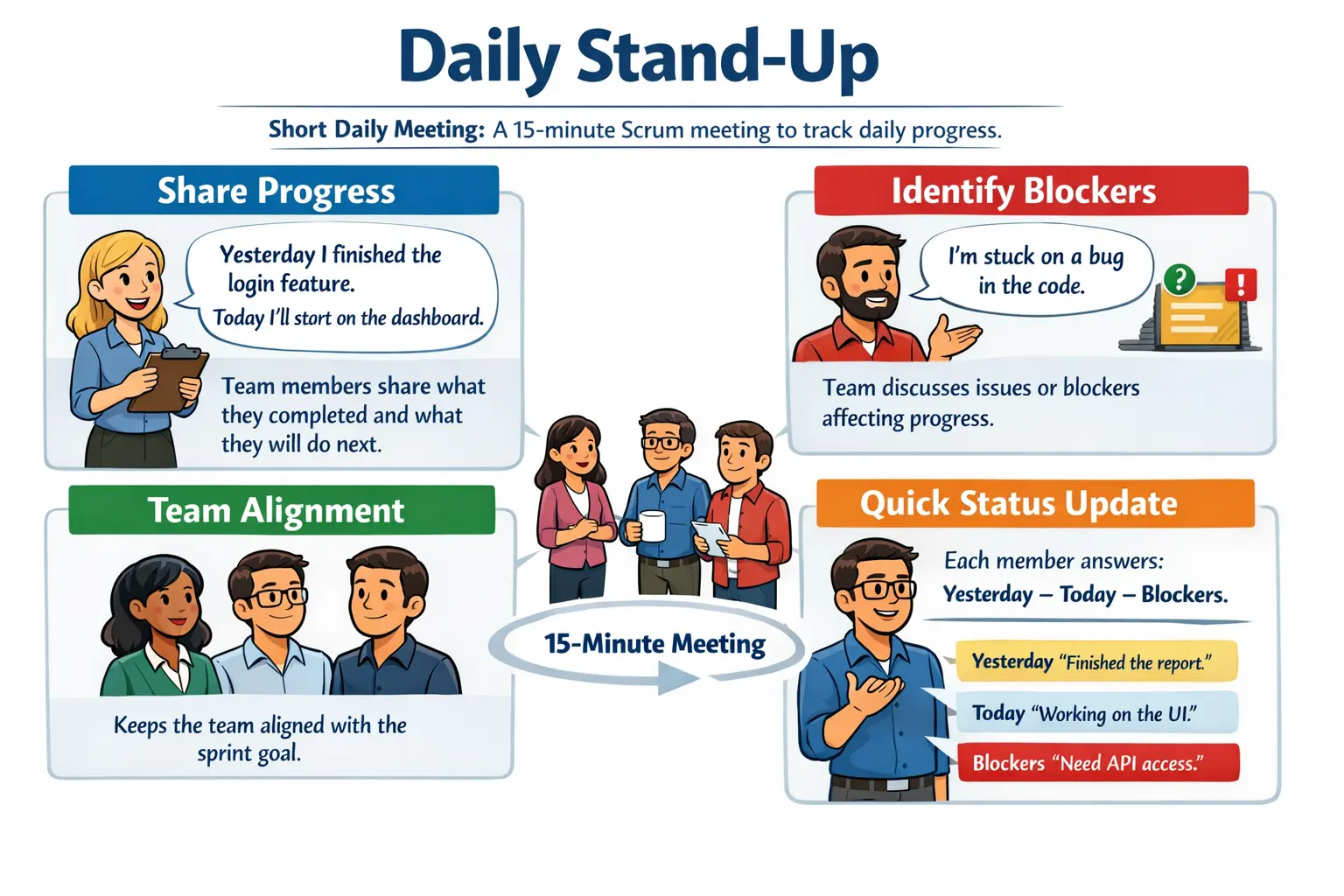
The Daily Stand-up, also known as the Daily Scrum, is one of the most important events in the Scrum Framework. It is a short, focused meeting where the Scrum Team synchronizes work, reviews progress toward the sprint goal, and identifies any obstacles that may affect delivery. The Daily Stand-up helps ensure that the team stays aligned and responsive throughout the sprint.
The Daily Stand-up is a time-boxed event that typically lasts no more than fifteen minutes. It is held every working day of the sprint at the same time and place whenever possible. This consistency helps teams maintain discipline and develop a regular rhythm of communication.
The Daily Stand-up answers a simple but essential question in Agile development: “Are we on track today?”
For manual testers and development team members, the Daily Stand-up is a key opportunity to share progress, coordinate activities, and address challenges quickly. A well-run Daily Stand-up improves collaboration, reduces delays, and helps teams deliver sprint goals successfully.
The Daily Stand-up is valuable because sprint work changes every day. A story may move from development to testing, a defect may block another story, an environment may become unavailable, or a new risk may appear. Without daily synchronization, these changes can remain hidden until they cause delays. The stand-up gives the team a short, reliable moment to inspect the current situation and adjust the day’s work.
For testers, the meeting is not just a place to say what was tested yesterday. It is a place to make quality visible. Testers can tell the team which stories are ready for validation, which defects are blocking progress, which regression areas need attention, and what support is needed from developers or the Product Owner. This helps testing stay integrated with sprint execution.
Definition of Daily Stand-up
The Daily Stand-up is a short Scrum event in which members of the Scrum Team meet to synchronize activities, inspect progress toward the sprint goal, and plan work for the next twenty-four hours.
Unlike traditional meetings, the Daily Stand-up is not intended for detailed discussions or problem-solving. Instead, it is a coordination meeting designed to ensure that everyone understands the current state of the sprint.
The Daily Stand-up is called a "stand-up" meeting because teams often stand during the meeting to keep it short and focused. Standing encourages participants to communicate efficiently and avoid unnecessary discussions.
The Daily Stand-up promotes transparency and helps the team maintain a shared understanding of progress and priorities.
The event is intentionally short because its purpose is synchronization, not detailed analysis. When a complex technical issue appears, the team should acknowledge it during the stand-up and then continue the discussion afterward with only the people needed. This keeps the meeting useful for everyone and prevents it from becoming a long status call.
The Daily Stand-up is also not meant to be controlled by a manager. In Scrum, team members speak to one another. The goal is to coordinate around the sprint goal, not to report to a supervisor. This difference is important because it encourages ownership and collaboration.
Purpose of Daily Stand-up
The Daily Stand-up serves several important purposes that support effective sprint execution.
One primary purpose is to provide transparency. Team members share updates on their work so that everyone understands current progress.
Another important purpose is identifying blockers early. Obstacles such as environment issues, dependency delays, or unclear requirements can slow down progress if not addressed quickly. The Daily Stand-up provides an opportunity to raise these issues before they become serious problems.
The Daily Stand-up also helps align the team toward the sprint goal. When team members understand the overall objective of the sprint, they can coordinate their efforts more effectively.
The meeting enables quick adjustments. If priorities change or new issues arise, the team can adapt their plans accordingly.
Daily synchronization improves team coordination and helps maintain steady progress throughout the sprint.
Another purpose of the Daily Stand-up is early risk control. Many sprint failures do not happen suddenly. They build slowly through small blockers, unclear stories, delayed testing, missing data, or unresolved defects. Daily communication helps the team notice these signals early enough to act.
The meeting also supports flow. If developers know which story testers will validate next, they can be ready to answer questions or fix issues. If testers know which build is coming, they can prepare test data and scenarios. This coordination reduces waiting time and handoff delays.
Structure of a Daily Stand-up
The Daily Stand-up follows a simple and consistent structure. Each team member provides a brief update on their work.
The meeting typically proceeds in a round-robin format where each participant speaks in turn.
Updates should be concise and focused on work related to the sprint goal. Long explanations or technical discussions should be avoided during the meeting.
If detailed discussions are needed, they should be scheduled separately after the stand-up.
The Scrum Master usually ensures that the meeting stays within the time limit and remains focused.
Consistency in structure helps teams conduct effective Daily Stand-ups.
Some teams organize the stand-up around people, where each person gives an update. Other teams organize it around the sprint board, moving story by story from highest priority to lowest. The board-based approach can be useful because it keeps attention on work items and flow rather than individual activity. Either format can work if the discussion stays focused on progress toward the sprint goal.
A good structure also makes blockers visible. If a story is stuck in testing, waiting for code fix, or blocked by environment access, the team should see it clearly. The stand-up should help the team decide what needs attention today, not merely list completed tasks.
Standard Stand-up Questions
Many Scrum teams use three standard questions to guide Daily Stand-up updates. These questions help keep updates focused and meaningful.
The first question is about completed work. Each team member explains what was accomplished since the previous stand-up. This helps the team understand progress.
The second question focuses on planned work. Team members describe what they intend to work on next. This helps coordinate activities across the team.
The third question identifies blockers. Team members mention any issues that may prevent them from completing their work.
These questions help the team track progress and identify risks quickly.
Although the three-question format is common, teams may adapt the structure as needed as long as the meeting remains focused on sprint progress.
Some mature Scrum teams move away from the exact three questions and instead ask what is needed to move sprint work forward today. This can make the meeting more outcome-focused. The important point is not the wording of the questions, but whether the team inspects progress, identifies blockers, and plans the next day’s work.
Testers can adapt these questions to quality work. They may say what testing was completed, what story or regression area will be tested today, and what is blocking validation. This gives the team a clear picture of quality progress without turning the update into a detailed test report.
Manual Tester’s Role in Daily Stand-up
Manual testers play an important role in Daily Stand-up meetings. Testers provide visibility into testing progress and help the team understand product quality.
Testers share updates on completed testing activities. This may include executed test cases, verified features, or completed regression tests.
Testers also communicate current testing activities. This helps developers understand which features are being tested and what feedback may be expected.
Defect reporting is another key responsibility. Testers inform the team about important defects discovered during testing, especially those affecting sprint goals.
Testers highlight blockers that affect testing progress. These blockers may include missing builds, unavailable environments, or incomplete features.
Testers coordinate with developers regarding defect fixes and retesting activities.
Clear tester communication helps the team maintain quality throughout the sprint.
A tester’s update should be specific enough to help the team act. Saying "testing is in progress" is less useful than saying "checkout validation is complete, two high-priority defects are open, and payment testing is blocked until the new build is deployed." Specific updates help developers and the Scrum Master understand what needs attention.
Testers also use the stand-up to coordinate retesting. If a developer fixed a defect yesterday, the tester can mention that retesting is planned today. If retesting fails, the team can discuss the issue quickly after the stand-up. This short feedback loop helps defects move through the lifecycle faster.
Manual testers should also listen carefully to developer updates. If a developer mentions changes in a shared component, API, validation rule, or database field, the tester can identify possible regression impact. Listening is as important as speaking in a stand-up.
Information Testers Should Communicate
Effective Daily Stand-up communication requires testers to share relevant and meaningful information.
Testers should clearly communicate which stories or features have been tested. This helps the team understand testing coverage.
Testers should also indicate which stories are currently in progress. This helps developers anticipate feedback and plan fixes.
Defects that impact sprint goals should be highlighted. Critical or high-severity defects require immediate attention.
Testers should communicate dependency risks. Waiting for builds, test data, or environment access can delay testing activities.
Testers should also explain planned testing activities for the day. This helps the team understand testing priorities.
Clear communication improves coordination between testing and development.
Testers should avoid giving unnecessary low-level details during the stand-up. The team does not need every step executed or every minor observation. The useful information is what affects sprint progress, quality risk, defect resolution, or coordination. Details can be shared later with the people involved.
If a tester has no blocker, that should also be clear. A simple update such as "registration testing is complete, password reset testing is next, and there are no blockers" gives the team confidence that testing is moving as planned.
Daily Stand-up and Sprint Goal Alignment
The Daily Stand-up is not just a progress update meeting. It is also a planning session focused on achieving the sprint goal.
Every update should be related to the sprint goal. Work that does not support the sprint goal should be minimized or postponed.
When blockers are identified, the team can adjust plans to stay aligned with the sprint goal.
If new risks emerge, the team can respond quickly.
Sprint goal alignment ensures that Daily Stand-ups remain meaningful and focused.
Without sprint goal alignment, stand-ups can become a list of disconnected personal activities. A team member may talk about work that is not important for the current sprint, while critical sprint work remains blocked. Keeping the sprint goal visible helps the team focus on what matters most.
For testers, sprint goal alignment helps prioritize testing. If the sprint goal is to deliver secure checkout, then checkout testing, payment validation, order creation, and related regression should receive attention before lower-priority exploratory areas. The tester’s daily update should reflect this priority.
Daily Stand-up vs Status Meeting
The Daily Stand-up is often misunderstood as a status meeting, but the two are fundamentally different.
A Daily Stand-up is short and focused on sprint progress. It is intended for the Scrum Team only.
A status meeting is usually longer and focused on reporting progress to management.
Daily Stand-ups emphasize collaboration rather than reporting. Team members share updates with each other, not with a manager.
Status meetings often involve detailed reports and presentations. Daily Stand-ups focus on quick synchronization.
Understanding this difference helps teams conduct effective Daily Stand-ups.
When a Daily Stand-up becomes a status meeting, team members often speak to the Scrum Master or manager instead of one another. This weakens collaboration. The strongest stand-ups feel like a team planning conversation, not a reporting ceremony. Everyone listens for where they can help move work forward.
A status meeting may ask whether each person is busy. A Daily Stand-up asks whether the team is progressing toward the sprint goal. This difference changes the tone of the meeting. The focus is not proving activity; the focus is improving coordination.
Importance of Daily Stand-up
The Daily Stand-up plays a critical role in Agile development.
It improves communication among team members.
It helps teams identify problems early.
It supports faster decision-making.
It reduces misunderstandings and delays.
It improves team accountability.
Without Daily Stand-ups, teams may lose alignment and encounter unexpected delays.
Regular communication helps teams maintain consistent progress.
The Daily Stand-up is important because it shortens the feedback cycle. If a blocker appears on Monday and is not discussed until Friday, the sprint may already be at risk. If the blocker is raised during the next stand-up, the team has time to respond. This is especially important for testing blockers such as unavailable builds, missing data, and environment issues.
It also improves accountability in a healthy way. Team members become aware of how their work affects others. A developer understands that a delayed fix may block retesting. A tester understands that delayed validation may block story acceptance. This shared awareness supports teamwork.
Real-Time Example of Tester Update
A typical tester update during Daily Stand-up might be simple and focused.
The tester may explain that login and checkout features were tested the previous day. Several defects were reported and shared with developers.
The tester may then explain that payment functionality will be tested during the current day.
The tester may also mention a blocker such as waiting for an updated build.
This type of update provides useful information without unnecessary detail.
Clear updates help the team respond quickly to issues.
A stronger tester update might sound like this: "Yesterday I completed login regression and tested the checkout happy path. I found one high-severity defect in payment confirmation and shared the details with the developer. Today I will retest that fix if the new build is available and continue with negative payment scenarios. My blocker is that test card data for declined payments is still missing."
This update is useful because it tells the team what was completed, what defect matters, what is planned next, and what help is needed. It does not provide excessive detail, but it gives enough information for the team to coordinate.
Daily Stand-up and Defect Management
The Daily Stand-up is closely connected to defect management during a sprint. When testers find defects, the team needs to know which ones affect the sprint goal, which ones block testing, and which ones require immediate developer attention. The stand-up provides a daily opportunity to make these issues visible.
Not every defect needs detailed discussion during the stand-up. Minor defects can be tracked in the defect tool and discussed later if needed. However, defects that block a story, affect acceptance criteria, prevent regression completion, or threaten the sprint goal should be mentioned clearly.
The stand-up also helps coordinate retesting. If a developer plans to fix a defect today, the tester can plan retesting accordingly. If a fix is delayed, the tester can shift focus to another story or regression area. This coordination prevents idle time and keeps quality work moving.
Daily Stand-up and Testing Flow
Testing flow is the movement of work from ready for testing to tested, defect-fixed, retested, and accepted. The Daily Stand-up helps protect this flow by exposing where testing is waiting or blocked. If several stories are ready for testing at once, the tester can communicate priority and ask for support if needed.
In a healthy sprint, testing does not pile up at the end. The stand-up helps the team notice whether stories are reaching testing early enough. If development work is repeatedly completed late, the tester can raise the risk and the team can adapt by slicing stories smaller or improving collaboration.
The Daily Stand-up also helps with regression planning. If a developer mentions changes to shared functionality, the tester can identify related regression checks. This makes regression more responsive to actual sprint changes instead of being a fixed checklist detached from current work.
Daily Stand-up in Remote and Distributed Teams
Remote and distributed teams can benefit from Daily Stand-ups just as much as colocated teams, but they need extra discipline. Time zones, network issues, unclear updates, and reduced informal communication can make coordination harder. A consistent stand-up rhythm helps remote teams maintain alignment.
In remote teams, the sprint board becomes especially important. Since people cannot see a physical board or have quick hallway conversations, the digital board should reflect current status accurately. Testers should update testing status, blocked items, defect links, and retesting progress before or during the stand-up.
Remote stand-ups should still remain short. If a defect needs detailed discussion, the relevant tester and developer can stay back after the call or create a separate follow-up. This keeps the meeting useful for the full team while still ensuring that important quality issues are addressed.
Written asynchronous updates can also help distributed teams. If some members cannot attend due to time zone differences, they can share a concise update in the team channel. The update should still focus on completed work, planned work, and blockers related to the sprint goal.
Quality Signals Raised in Daily Stand-up
The Daily Stand-up is a useful place to raise quality signals. A quality signal is any information that helps the team understand whether the sprint increment is becoming stable and ready. These signals may include completed testing, open defects, blocked validation, unstable builds, failing regression checks, or unclear acceptance criteria.
Positive quality signals include stories passing acceptance tests, critical defects being fixed, regression checks progressing well, test data being available, and environments remaining stable. These signals show that the sprint is moving toward a potentially shippable increment.
Warning signals include repeated build failures, many stories waiting for testing, unresolved high-severity defects, unclear requirements, blocked test environments, and late code delivery. When testers raise these signals early, the team can adapt before the sprint is at risk.
Quality signals should be brief but clear. A tester does not need to give a full test report during the stand-up, but they should communicate anything that affects progress toward the sprint goal. This helps the team treat quality as shared information rather than a separate testing concern.
Best Practices for Effective Daily Stand-ups
Effective Daily Stand-ups require discipline and good communication practices.
Meetings should start on time every day. Consistency helps teams maintain momentum.
Updates should be brief and focused. Long explanations reduce meeting effectiveness.
Team members should listen carefully to others. Understanding team progress improves coordination.
Blockers should always be mentioned. Hidden blockers can delay the sprint.
Follow-up discussions should be scheduled separately. This keeps the stand-up meeting short.
These practices help teams conduct productive Daily Stand-ups.
Another best practice is to keep the sprint board updated before the meeting. If the board is outdated, the team wastes time trying to understand the real status. A current board makes the stand-up more focused because work items, blockers, and progress are visible.
Teams should also avoid solving every issue with the whole group. If only a tester and one developer need to discuss a defect, they should take that conversation after the stand-up. This respects everyone’s time while still ensuring that the blocker is visible.
Remote teams should follow the same discipline. Even if the meeting happens over a call, updates should remain concise, blockers should be visible, and follow-up discussions should be separated. The format may change, but the purpose remains the same.
Common Mistakes in Daily Stand-up
Several mistakes can reduce the effectiveness of Daily Stand-ups.
One common mistake is turning the stand-up into a problem-solving session. Detailed discussions should occur after the meeting.
Another mistake is providing too much detail. The stand-up is not intended for technical deep dives.
Failing to mention blockers is another serious issue. Blockers must be visible so that the team can address them.
Treating the stand-up as a report to the manager is another mistake. The meeting is for team coordination, not supervision.
Irregular attendance also reduces effectiveness. All team members should participate regularly.
Avoiding these mistakes improves Daily Stand-up quality.
Another mistake is giving vague updates. Statements like "I am working on testing" or "everything is fine" do not help the team. Updates should identify the story, the testing status, and any risk or blocker. Vague updates hide problems and reduce the value of the meeting.
Some teams also allow the stand-up to become too long. When a fifteen-minute meeting regularly becomes thirty or forty minutes, people stop paying attention. Long conversations should be moved into smaller follow-up discussions with the relevant people.
A further mistake is ignoring the sprint goal. If the team discusses many activities but does not inspect progress toward the sprint goal, the meeting becomes unfocused. The sprint goal should guide what gets discussed and what receives priority.
Benefits for Manual Testers
Manual testers gain significant benefits from participating in Daily Stand-ups.
Testers receive early information about new builds and feature updates.
Testers can coordinate testing with development activities.
Testers can escalate blockers quickly.
Testers gain visibility into sprint progress.
Testers can plan regression and exploratory testing effectively.
Active participation helps testers contribute more effectively to sprint success.
Daily Stand-ups also help testers build stronger relationships with developers. Frequent communication reduces the distance between finding a defect and getting it fixed. Developers understand testing priorities, and testers understand development progress. This improves teamwork and reduces delays.
Testers also gain better visibility into upcoming work. If a developer says a story will be ready later in the day, the tester can prepare relevant data and scenarios. If a story is delayed, the tester can adjust priorities instead of waiting without information.
For manual testers, the stand-up is also a place to show quality leadership. By communicating risks clearly, raising blockers early, and coordinating retesting, testers help the whole team deliver a better increment.
Interview Perspective
Daily Stand-up is a common topic in Agile interviews.
A short answer defines Daily Stand-up as a fifteen-minute Scrum meeting where team members share progress and blockers.
A detailed answer explains synchronization, sprint goal tracking, and impediment identification.
Interviewers often expect testers to explain what they report during Daily Stand-ups.
Understanding Daily Stand-ups demonstrates practical Scrum knowledge.
A strong interview answer should explain that the Daily Stand-up is not a manager status meeting. It is a short Scrum event for the team to inspect progress, identify blockers, coordinate work, and plan the next twenty-four hours. This shows practical understanding of Scrum, not just memorization.
If asked what a tester reports, the answer should include testing completed, testing planned, defects affecting the sprint goal, blockers such as build or environment issues, retesting needs, and regression risks. A good tester update is brief, clear, and useful for coordination.
Key Takeaway
The Daily Stand-up is a critical Scrum event that keeps the team aligned, transparent, and responsive throughout the sprint.
By sharing progress, identifying blockers, and coordinating activities, Daily Stand-ups help teams maintain steady progress toward sprint goals.
For manual testers, Daily Stand-ups provide an opportunity to communicate testing progress, highlight risks, and coordinate defect resolution.
Effective Daily Stand-ups improve collaboration, reduce delays, and support successful sprint delivery.
The most important lesson is that the Daily Stand-up creates daily visibility. For testers, that visibility includes quality progress, testing blockers, defect risks, and retesting needs. When used well, the Daily Stand-up helps the whole team protect the sprint goal and deliver a stable increment.
A disciplined Daily Stand-up turns small daily updates into better teamwork, faster feedback, and fewer sprint surprises overall.