Agile Testing
Agile Testing is a modern software testing approach that aligns closely with Agile development methodologies. It emphasizes continuous testing, rapid feedback, collaboration, and iterative improvement throughout the development lifecycle. Unlike traditional testing models where testing occurs after development is complete, Agile testing integrates testing activities into every stage of development.
Agile testing answers a critical question in modern software delivery environments: “How do we ensure continuous quality while delivering software quickly?”
In Agile environments, software is developed in small increments called sprints, typically lasting two to four weeks. Each sprint produces a working version of the product. Testing must therefore keep pace with development, ensuring that each increment meets quality expectations before the next iteration begins.
Agile testing focuses on delivering high-quality software through collaboration, adaptability, and continuous improvement. It is widely used in modern software organizations because it supports fast delivery without compromising product quality.
The biggest change in Agile testing is the mindset around quality. Testing is no longer treated as a final checkpoint owned only by testers. It becomes a continuous responsibility shared by developers, testers, product owners, business analysts, designers, and stakeholders. Everyone contributes to quality by clarifying requirements, reviewing acceptance criteria, building testable features, fixing defects quickly, and learning from every sprint.
Agile testing does not mean reducing testing or rushing validation. It means testing earlier, testing more frequently, and keeping feedback close to development. When a defect is found while a story is still being built, the developer can fix it quickly with full context. When a defect is found weeks later, the team may need more time to understand, correct, retest, and regress the change.
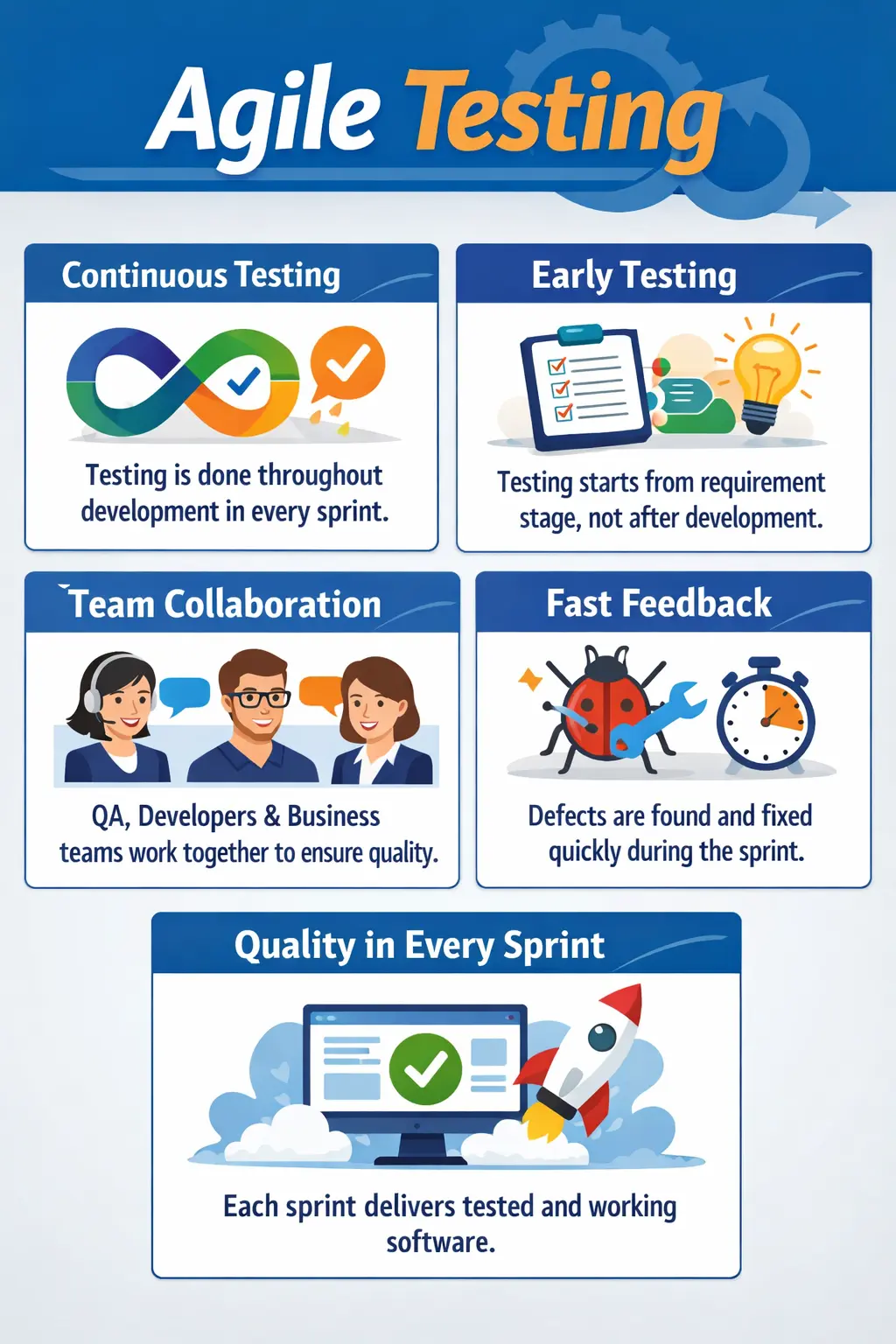
Understanding Agile Testing
Agile testing is not simply testing performed within Agile projects. It represents a fundamental shift in testing philosophy. Instead of testing being a separate phase performed after development, Agile testing integrates testing into the development process itself.
In traditional models, development teams complete coding before handing the product to testers. Testing begins only after development is finished, which often leads to delayed feedback and late discovery of defects. Agile testing eliminates this separation by encouraging testers and developers to work together continuously.
Agile testing promotes the idea that quality is the responsibility of the entire team, not just the testing team. Developers write better code, product owners clarify requirements, and testers validate functionality continuously.
The Agile testing approach emphasizes early defect detection. Detecting defects early reduces fixing costs and improves product stability.
Agile testing also supports rapid changes in requirements. Agile projects often evolve as business needs change, and testing must adapt quickly to new requirements.
This does not mean Agile testing is unplanned. Agile testing still requires strategy, coverage, risk analysis, regression thinking, acceptance validation, and clear communication. The difference is that planning is lighter, faster, and continuously adjusted as the product evolves. Testers plan enough to guide quality, but they also remain flexible enough to respond to change.
Agile testing is most successful when testers are included early in discussions. If testers hear about a story only after development is complete, they lose the chance to prevent misunderstandings. When testers participate in refinement and planning, they can raise questions about business rules, negative scenarios, edge cases, data needs, and regression impact before the team commits to implementation.
Core Principles of Agile Testing
Agile testing is based on a set of principles that guide testing activities throughout the development lifecycle.
Testing begins as early as possible in the development process. Instead of waiting for completed features, testers start analyzing requirements and designing test scenarios as soon as user stories are defined.
Testing continues throughout development. Each new feature is tested as soon as it is implemented, ensuring early defect detection and faster feedback.
Agile testing promotes shared ownership of quality. Developers, testers, business analysts, and product owners all contribute to maintaining product quality.
Frequent feedback is another core principle. Testers provide immediate feedback to developers, enabling quick corrections and preventing defect accumulation.
Agile testing values working software over extensive documentation. While documentation still exists, it is typically lightweight and focused on essential information.
Customer collaboration is also emphasized. Acceptance testing ensures that the product meets real user needs rather than just technical specifications.
These principles allow Agile teams to maintain quality while delivering software rapidly.
Another important principle is prevention over late detection. Agile testers try to prevent defects by asking useful questions before coding begins. If an acceptance criterion is unclear, if an edge case is missing, or if a workflow has multiple possible interpretations, the tester raises it early. This reduces rework and helps the team build the right behavior the first time.
Agile testing also values transparency. Defects, risks, blockers, assumptions, environment issues, and testing progress should be visible to the team. If testing is blocked by an unstable build or missing data, the team should know immediately. Hidden testing problems become sprint problems later.
Agile Testing Lifecycle Within a Sprint
Agile testing occurs continuously within each sprint. Each sprint represents a complete development and testing cycle.
The lifecycle typically begins with backlog refinement. During this stage, user stories are reviewed and clarified. Testers help identify acceptance criteria, risks, and potential test scenarios.
Sprint planning follows backlog refinement. During sprint planning, the team selects user stories to be developed and tested. Testers estimate testing effort and identify testing risks.
Test design begins early in the sprint. Testers design test scenarios and test cases based on acceptance criteria. This preparation allows testing to start immediately after development begins.
Test execution occurs in parallel with development. As developers complete features, testers validate them. This parallel execution ensures continuous feedback.
Defect triage occurs regularly during the sprint. Defects are reviewed, prioritized, and assigned quickly to prevent delays.
Sprint review occurs at the end of the sprint. The team demonstrates completed features to stakeholders. Testing ensures that features meet acceptance criteria before demonstration.
The sprint retrospective follows the sprint review. The team analyzes what went well and identifies improvement opportunities for future sprints.
This iterative lifecycle ensures continuous improvement and consistent product quality.
In a healthy sprint, testing is not squeezed into the final day. Testers start during refinement by questioning requirements. They prepare scenarios during planning. They test stories as soon as development slices are ready. They communicate defects quickly and retest fixes while developers still have context. This flow reduces end-of-sprint pressure and helps the team finish stories cleanly.
Agile teams often use story readiness and story completion rules to support this lifecycle. A story should not enter a sprint unless it is clear enough to build and test. A story should not be called done unless it satisfies acceptance criteria, passes agreed validation, and has no unresolved critical defects. These rules keep quality visible.
Role of Manual Testers in Agile
Manual testers play an essential role in Agile environments. Their responsibilities extend beyond traditional test execution.
During backlog refinement, testers help clarify requirements. They ask questions to ensure acceptance criteria are clear and testable. Early clarification prevents misunderstandings and reduces defects.
Testers also identify risks during backlog refinement. They anticipate complex scenarios and potential problem areas.
During sprint planning, testers estimate testing effort. They help determine how much testing can be completed within the sprint.
During the sprint, testers design and execute tests continuously. They verify completed features as soon as development is finished.
Manual testers perform exploratory testing to discover unexpected defects. Exploratory testing is particularly valuable in Agile environments where requirements evolve frequently.
Testers perform regression testing to ensure new changes do not break existing functionality. Regression testing is critical in Agile projects because frequent updates increase the risk of unintended side effects.
Testers log defects and verify fixes quickly. Rapid defect resolution is essential to maintain sprint velocity.
During sprint reviews, testers confirm that acceptance criteria are satisfied. Their validation ensures that features are ready for demonstration.
During retrospectives, testers share quality insights and suggest process improvements. Their feedback helps the team improve testing efficiency and product quality.
Manual testers also act as risk advisors in Agile teams. They identify which areas need deeper testing, which stories are likely to create regression impact, which acceptance criteria are weak, and which workflows need business confirmation. This advisory role is valuable because Agile teams make fast decisions and need quick quality insight.
Another important responsibility is collaboration with developers. Agile testers discuss defects directly with developers, clarify reproduction steps, verify expected behavior, and retest fixes quickly. This direct communication reduces delay and prevents defects from turning into long ticket conversations.
Manual testers also collaborate with product owners. They help confirm that user stories describe real business behavior, not only screen-level actions. When testers understand user intent, they can design stronger scenarios and identify gaps that may not be obvious from acceptance criteria alone.
Test Artifacts in Agile
Agile testing uses lightweight test artifacts that support rapid development and testing cycles.
User stories and acceptance criteria serve as the foundation for testing. Acceptance criteria define expected behavior and guide test design.
Test scenarios provide a high-level view of what needs to be tested. They help ensure coverage without excessive documentation.
Test cases are created when detailed validation is required. However, Agile testing avoids unnecessary test case documentation.
Checklists are commonly used to track testing activities. They provide a simple way to ensure coverage without extensive documentation.
Exploratory testing notes capture observations and defects discovered during testing sessions.
Defect reports document issues found during testing. Clear defect reporting supports quick resolution.
Agile artifacts focus on practicality and efficiency rather than completeness.
Agile documentation should be useful, not excessive. A test artifact is valuable when it helps the team understand coverage, reproduce behavior, validate acceptance criteria, or support future regression. It is wasteful when it is created only to satisfy a process and never used. Agile testing encourages teams to document the right information at the right level of detail.
For many Agile teams, a combination of acceptance criteria, test scenarios, exploratory notes, regression checklists, and defect reports is enough. More detailed test cases may be created for complex workflows, compliance-heavy areas, financial calculations, integrations, or high-risk features. The amount of documentation should match the risk.
Types of Testing in Agile Environments
Agile testing includes multiple types of testing performed continuously throughout development.
Story-level functional testing verifies individual user stories. Each story is tested against acceptance criteria.
Regression testing ensures that existing functionality continues to work after new changes. Regression testing becomes increasingly important as the product grows.
Exploratory testing helps discover defects that structured testing might miss. Testers use their experience and intuition to identify potential issues.
Usability testing evaluates how easily users can interact with the system. Agile teams often gather usability feedback during sprint reviews.
Acceptance testing verifies that features meet business requirements. Acceptance testing ensures stakeholder satisfaction.
Non-functional testing activities may also be performed conceptually by manual testers. These include basic checks related to performance, security, and compatibility.
These testing activities ensure comprehensive quality coverage in Agile projects.
Agile teams often combine structured testing with exploratory testing. Structured testing validates agreed acceptance criteria and known business rules. Exploratory testing investigates unexpected behavior, unusual combinations, usability issues, and gaps that may not be captured in written tests. Both are needed because Agile products change frequently.
Regression testing is one of the biggest testing responsibilities in Agile. Every sprint introduces new code that can affect existing behavior. Without regression testing, teams may deliver new features while silently breaking old ones. Mature Agile teams use a mix of manual regression, risk-based regression, and automation to manage this workload.
Non-functional testing should not be ignored in Agile. Performance, security, accessibility, compatibility, reliability, and usability concerns should be considered continuously. Manual testers may not perform advanced tool-based testing in every sprint, but they can still observe slow pages, confusing workflows, accessibility barriers, browser issues, and security-related behavior.
Agile Testing vs Traditional Testing
Agile testing differs significantly from traditional testing approaches.
In traditional testing models, testing occurs after development is complete. In Agile testing, testing is continuous and integrated into development.
Traditional testing relies heavily on documentation. Agile testing uses lightweight documentation focused on essential information.
Traditional testing often produces delayed feedback. Agile testing provides immediate feedback to developers.
Traditional models treat requirement changes as costly disruptions. Agile testing embraces change and adapts quickly.
Traditional testing may involve separate development and testing teams. Agile testing promotes collaboration among all team members.
These differences make Agile testing more suitable for modern software development environments.
The most practical difference is feedback timing. In traditional testing, defects may be found after developers have moved on to other work. Fixing them then requires context switching and may delay the release. In Agile testing, feedback is given while the story is still active, making correction faster and less expensive.
Another difference is how change is handled. Traditional projects often try to freeze requirements early. Agile projects expect requirements to evolve through feedback. Agile testing supports this by keeping test design flexible, focusing on behavior, and continuously updating regression coverage as the product changes.
Entry and Exit Criteria in Agile
Agile projects use practical entry and exit criteria to manage testing activities.
Entry criteria typically include having a user story that is ready for development and testing. Acceptance criteria must be clear and testable. The testing environment must be available.
Exit criteria are usually defined through the Definition of Done. A story is considered complete when acceptance criteria are satisfied, testing is completed, and no critical defects remain.
Exit criteria also require that tests are reviewed and validated by the team.
Definition of Done ensures consistent quality across sprints.
In Agile, entry criteria are often expressed through Definition of Ready. A story is ready when it has clear business value, understandable acceptance criteria, manageable scope, testable behavior, and no major unresolved dependency. If a story is not ready, testing becomes difficult because the expected behavior is unclear.
Exit criteria are usually expressed through Definition of Done. Done should mean more than development complete. It should include testing completed, acceptance criteria met, defects resolved or accepted, regression impact considered, documentation updated where needed, and product owner acceptance obtained when required.
Agile Testing and Shift-Left Quality
Agile testing strongly supports the idea of shift-left quality. Shift-left means moving quality activities earlier in the lifecycle instead of waiting until the end. In Agile, testers review user stories early, question assumptions early, identify risks early, and prepare tests before the feature is fully implemented.
Shift-left quality reduces rework. If a missing business rule is discovered during backlog refinement, it can be clarified before coding starts. If the same issue is discovered after development, the team may need code changes, retesting, regression testing, and schedule adjustment. Early clarification is cheaper and cleaner.
Shift-left does not mean testers stop testing later. It means testing knowledge is used earlier to prevent defects. Agile testers still execute tests, explore the application, validate fixes, and perform regression checks. The difference is that they also influence quality before implementation begins.
Agile Testing and Automation Support
Agile testing often benefits from automation because frequent releases increase regression workload. If every sprint requires repeated validation of existing functionality, manual testing alone can become slow and tiring. Automation helps run stable regression checks quickly and gives the team faster feedback.
However, automation does not replace manual testing. Automation is best for repeatable checks, smoke tests, regression flows, API validations, and stable business-critical scenarios. Manual testing remains important for exploratory testing, usability judgment, requirement clarification, visual observation, edge case thinking, and new feature validation.
A balanced Agile testing strategy uses automation where it adds speed and reliability, while preserving manual testing where human judgment is essential. The goal is not to automate everything. The goal is to get the right feedback at the right time.
Challenges for Manual Testers in Agile
Agile testing presents several challenges for manual testers.
Requirements may be incomplete or evolving. Testers must adapt quickly to changing requirements.
Sprint timelines are often tight. Testers must prioritize testing activities effectively.
Frequent changes increase regression testing workload. Testers must ensure existing functionality remains stable.
Rapid development may leave limited time for detailed documentation.
These challenges can be managed through strong collaboration and effective communication.
Exploratory testing helps testers adapt to changing requirements.
Prioritization helps testers focus on critical functionality.
Automation support may reduce regression workload in mature Agile teams.
Another challenge is context switching. A tester may need to refine upcoming stories, test current stories, retest fixed defects, attend sprint ceremonies, update regression coverage, and support production issues in the same sprint. Strong prioritization is essential because not every activity can receive equal attention at the same time.
Communication gaps can also create problems. If developers finish stories late, testers may not get enough time. If product owners are unavailable, acceptance criteria may remain unclear. If defects are discussed only through tickets, simple misunderstandings may take too long to resolve. Agile testing works best when communication is frequent and direct.
Common Mistakes in Agile Testing
One common mistake is assuming Agile means no documentation. Agile encourages lightweight documentation, not the absence of documentation.
Another mistake is performing testing only at the end of the sprint. Testing should occur continuously throughout development.
Ignoring regression testing is another common mistake. Frequent changes require regular regression testing.
Poor acceptance criteria can lead to unclear requirements and incomplete testing.
Lack of collaboration between testers and developers can reduce testing effectiveness.
Avoiding these mistakes improves Agile testing success.
Another common mistake is treating testing as a separate mini-phase at the end of each sprint. This creates a waterfall pattern inside Agile. The team may claim to be Agile, but quality feedback still arrives too late. Testing must move alongside development, not trail far behind it.
Teams also make mistakes when they ignore technical debt and unstable regression areas. Agile delivery becomes difficult if every sprint is slowed by unstable tests, unclear environments, and repeated defects. Continuous improvement is part of Agile testing because the team must keep improving the way it validates quality.
Best Practices for Agile Testing
Effective Agile testing starts with clear acceptance criteria. A tester should be able to read a user story and understand what behavior must be validated, what business rules apply, what data is needed, and what outcome proves that the story is complete. If acceptance criteria are vague, testing becomes guesswork and defects become more likely.
Another best practice is to test in small slices. Instead of waiting for a large feature to be fully completed, testers should validate usable pieces as they become available. This gives developers faster feedback and reduces the amount of unfinished work at the end of the sprint.
Risk-based testing is also important in Agile. Sprint time is limited, so testers must focus first on critical workflows, changed areas, business rules, integrations, and regression-sensitive features. Low-risk checks can be handled later or through lightweight validation, but high-risk areas need deeper attention.
Agile teams should keep regression coverage healthy. As the product grows, the regression suite must evolve. Old checks that no longer provide value should be removed or updated, and new business-critical flows should be added. A stale regression suite gives false confidence and slows the team.
Testers should communicate risk clearly. Agile teams move quickly, so a tester must be able to say what has been tested, what has not been tested, what is blocked, what defects remain, and what risk exists if the team proceeds. Clear risk communication helps product owners and managers make informed decisions.
Agile testing also improves when teams learn from defects. If the same type of defect appears repeatedly, the team should discuss why. The cause may be unclear requirements, weak unit testing, missing regression coverage, unstable environments, or late code delivery. Retrospectives should turn these patterns into practical improvements.
Quality Signals in Agile Testing
Agile teams need quality signals throughout the sprint. Passing acceptance tests, low defect reopen rate, stable regression results, clear test coverage, and working demo-ready features are positive signals. Repeated blocked testing, many late defects, unclear acceptance criteria, and unfinished stories are warning signs.
Quality signals should be visible during daily collaboration. If a story is development complete but not tested, it is not truly done. If several stories are waiting for testing at the end of the sprint, the team may have a flow problem. If defects are found late, the team may need earlier testing or smaller story slices.
Agile testing is strongest when quality is measured continuously rather than only at the end. Teams may track open defects, escaped defects, test progress, automation results, story completion, regression stability, and sprint carryover. These signals help the team improve delivery predictability.
The purpose of quality signals is not to blame testers or developers. The purpose is to make quality visible so the team can act early. When quality information is transparent, Agile teams can adjust scope, fix blockers, improve collaboration, and protect release confidence.
Agile Testing in Real Projects
In real projects, Agile testing enables teams to deliver software quickly while maintaining quality.
Testers collaborate closely with developers to ensure early defect detection.
Continuous testing prevents defect accumulation.
Rapid feedback improves development efficiency.
Stakeholders receive frequent updates through sprint reviews.
Agile testing supports incremental delivery, allowing organizations to release features faster.
Modern software companies rely heavily on Agile testing to maintain competitiveness.
In a real Agile project, a tester may start the week by reviewing user stories for the next sprint, then test a story completed by a developer, then join a defect discussion, then update a regression checklist, then perform exploratory testing on a newly integrated feature. This variety is normal because Agile testing is continuous and collaborative.
For example, in an e-commerce sprint, the team may build a new coupon feature. The tester reviews acceptance criteria during refinement, asks how expired coupons should behave, prepares positive and negative scenarios, tests the feature when development is complete, checks that checkout still works, logs defects quickly, retests fixes, and confirms that the story is ready for sprint review. This is Agile testing in practice.
Agile testing also gives stakeholders frequent visibility. Instead of waiting months to see a finished product, stakeholders can review working software at the end of each sprint. Testing supports this by ensuring the demonstrated functionality is stable, meaningful, and aligned with acceptance criteria.
Interview Perspective
Agile testing is an essential topic in software testing interviews.
A short answer typically defines Agile testing as continuous testing integrated with Agile development.
A detailed answer explains that Agile testing involves early and continuous validation, collaboration among team members, and iterative improvement.
Interviewers often expect testers to understand Agile workflows and testing responsibilities.
Understanding Agile testing demonstrates readiness for modern software development environments.
A strong interview answer should explain that Agile testing starts early, continues throughout the sprint, and involves the whole team. It should mention backlog refinement, acceptance criteria, sprint planning, story testing, exploratory testing, regression testing, defect triage, sprint review, and retrospective participation.
Interviewers may also ask about the manual tester's role. A practical answer should say that testers clarify requirements, identify risks, prepare scenarios, test continuously, perform exploratory and regression testing, report and retest defects, validate acceptance criteria, and contribute improvement ideas during retrospectives.
Another good interview point is that Agile does not mean no documentation and no process. It means lightweight, useful documentation and adaptive process. The tester must balance speed with sufficient coverage and communicate risks clearly.
Key Takeaway
Agile Testing ensures that quality keeps pace with rapid software development. By integrating testing into every stage of development, Agile testing enables teams to deliver reliable software in short iterations.
Agile testing emphasizes collaboration, continuous feedback, and adaptability. These principles allow teams to maintain high quality standards while delivering value quickly.
In modern software development, Agile testing has become essential for achieving both speed and quality.
The heart of Agile testing is continuous quality. Testers do not wait for a finished product to begin thinking about quality. They participate early, test often, provide fast feedback, adapt to change, and help the team learn from every sprint. This is what allows Agile teams to move quickly without losing control of product quality.