Sprint Review
Sprint Review is one of the key Scrum events conducted at the end of every sprint. It is a collaborative session where the Scrum Team demonstrates the work completed during the sprint and gathers feedback from stakeholders. The Sprint Review ensures that the product increment delivered during the sprint aligns with business expectations and user needs.
The Sprint Review provides an opportunity for the Scrum Team and stakeholders to inspect the product increment and determine whether the sprint goal has been achieved. It allows stakeholders to evaluate the delivered features and provide feedback that can guide future development.
Sprint Review answers a fundamental question in Agile development: “What did we build, and does it meet expectations?”
For manual testers, Sprint Review is an important event where quality status is communicated and validated features are demonstrated. The Sprint Review helps ensure that the delivered product increment is usable, reliable, and aligned with business objectives.
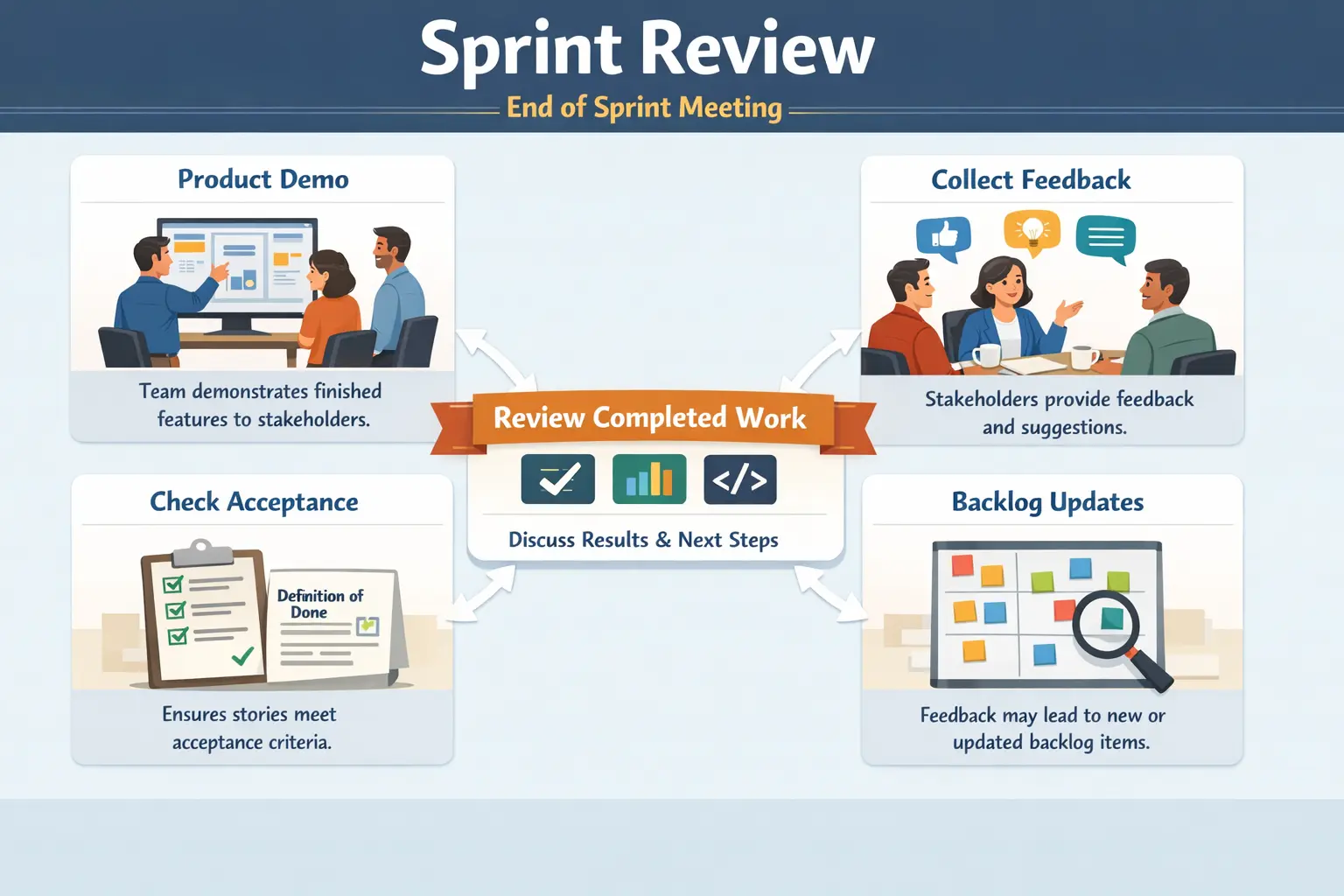
Definition of Sprint Review
Sprint Review is a Scrum event held at the end of a sprint where the Scrum Team and stakeholders inspect the completed product increment and discuss what should happen next. It is not merely a meeting where the team reports progress, and it is not just a screen-sharing demo. A proper Sprint Review brings the product into the center of the conversation. The team shows working functionality, stakeholders respond with questions and feedback, and the Product Owner uses the discussion to improve future product decisions.
The word review is important because the event is about inspection. The team inspects what was actually built, not what was planned in a document. Stakeholders inspect whether the delivered increment supports real business needs, not whether the team completed a checklist. The Product Owner inspects whether the product backlog still reflects the best direction for the product. This makes the Sprint Review one of the strongest feedback loops in Scrum.
In traditional projects, stakeholders may see working software only after long development phases. By that time, misunderstandings are expensive to correct. Sprint Review reduces this risk by creating regular opportunities to validate direction. Every sprint becomes a chance to ask whether the product is moving closer to customer value, business goals, and user expectations.
A Sprint Review is collaborative in nature. Stakeholders are expected to participate, ask questions, compare the increment with business needs, and share new insights. The Scrum Team is expected to be transparent about what is complete, what is not complete, what problems were found, and what decisions may be needed. When both sides participate openly, the Sprint Review becomes a practical product conversation rather than a ceremonial meeting.
The Sprint Review is also an adaptation point. Feedback gathered during the event may lead to new backlog items, revised priorities, changed acceptance criteria, or removal of low-value work. This is where Agile development becomes visible: the product does not follow a fixed plan blindly; it evolves through evidence, feedback, and changing business understanding.
Purpose of Sprint Review
The main purpose of Sprint Review is to inspect the product increment and adapt the product backlog based on what is learned. The team demonstrates completed user stories and functionality so stakeholders can see real progress. This is different from saying that work is done. The review allows people to experience the behavior, ask questions, and judge whether the feature is useful in a real business context.
Another purpose is validating that completed work meets business expectations and acceptance criteria. Acceptance criteria may look clear during planning, but real understanding often improves when stakeholders see the feature working. A button, workflow, message, or decision rule may technically match a requirement but still feel incomplete from a business perspective. Sprint Review brings those gaps into the open early.
Sprint Review also supports transparency. Stakeholders can see what the team finished, what remains open, and how the product is progressing toward release goals. This transparency prevents unrealistic assumptions. Instead of relying on status percentages such as “eighty percent complete,” stakeholders see actual working software and can make better decisions based on evidence.
The event also strengthens collaboration between business and delivery teams. Product Owners, developers, testers, customers, and business users often hold different pieces of product knowledge. The Sprint Review gives them a shared space to connect those pieces. A tester may explain a risk, a business user may identify a workflow gap, a developer may clarify a technical limitation, and the Product Owner may translate all of that into backlog decisions.
For Agile teams, Sprint Review helps prevent building the wrong product efficiently. A team can be highly productive and still deliver low business value if feedback is delayed or ignored. Regular reviews keep the team connected to the real purpose of the product. They allow small corrections before the product direction becomes too expensive to change.
Participants in Sprint Review
Sprint Review involves the Scrum Team and relevant stakeholders. The Scrum Team includes the Product Owner, Scrum Master, developers, and testers. Stakeholders may include business users, customers, product sponsors, operations teams, support teams, compliance representatives, or domain experts. The right participant list depends on the product and the decisions that need feedback.
The Product Owner plays a central role because the Product Owner owns the product backlog and product direction. During the review, the Product Owner explains the sprint goal, clarifies what backlog items were completed, discusses what was not completed, and listens carefully to stakeholder feedback. After the review, the Product Owner uses that feedback to refine and reprioritize the product backlog.
Developers demonstrate the implemented functionality and answer questions about how the system behaves. In many teams, developers explain the user journey at a business level rather than presenting technical implementation details. Good demonstrations show value and behavior. They do not require stakeholders to understand code, architecture, or internal design decisions.
Testers contribute by confirming the quality status of completed work. They explain whether acceptance criteria were validated, whether critical test scenarios passed, whether important defects remain open, and whether there are known limitations. This makes the review more trustworthy because stakeholders are not only seeing a polished demonstration; they are also hearing the quality context behind the increment.
The Scrum Master helps facilitate the event. The Scrum Master ensures that the review stays collaborative, focused, and time-boxed. If the meeting turns into a blame session, a status report, or a one-way presentation, the Scrum Master helps redirect it toward inspection and adaptation. The Scrum Master also encourages stakeholder participation because a Sprint Review without meaningful feedback loses much of its value.
Stakeholders are not passive viewers. Their role is to evaluate the increment from the perspective of business value and real usage. They may confirm that a feature is acceptable, identify missing behavior, challenge assumptions, propose improvements, or highlight changes in business priority. Their involvement ensures that product decisions are grounded in actual needs instead of assumptions made inside the team.
Sprint Review Agenda
A Sprint Review usually follows a practical flow, even though Scrum does not require a rigid agenda. The event often begins with the Product Owner reminding everyone of the sprint goal. This matters because the review should not be a random list of completed tasks. The sprint goal gives context to the work and helps stakeholders understand what the team attempted to achieve.
The team then explains what was completed and what was not completed. This should be done honestly. If a story was started but not finished, it should not be presented as done. If a feature works but has known limitations, those limitations should be stated clearly. Transparency is more valuable than a perfect-looking presentation because the review is meant to guide real decisions.
The central part of the agenda is the demonstration of completed work. The demonstration should use realistic business scenarios. Instead of clicking through screens quickly, the team should show a workflow in a way that stakeholders can relate to. For example, instead of saying “we implemented validation logic,” the team can show how a user submits a request, how the system validates it, and how the user receives meaningful feedback.
After each feature or group of related features, stakeholders should be invited to ask questions and provide feedback. Some teams wait until the end of the demo, but shorter feedback moments often work better because the feature is still fresh in everyone’s mind. The Product Owner may record new backlog items, changes, defects, or follow-up questions as the discussion happens.
The review often ends with a discussion of next steps. The Product Owner may explain how feedback will affect upcoming priorities. Stakeholders may confirm whether the increment supports release planning. The team may identify areas that need additional testing, refinement, or business clarification. A good Sprint Review ends with shared understanding, not just applause for a demo.
What Is Demonstrated During Sprint Review
The Sprint Review should focus on working software or a working product increment. Only completed and tested functionality should be shown as finished. If something is incomplete, the team may mention it for transparency, but it should not be presented as part of the completed increment. This protects the meaning of “done” and prevents stakeholders from believing unfinished work is ready for use.
Demonstrations should be business-focused. Stakeholders usually care less about internal classes, database tables, APIs, or code branches and more about whether a user can complete a meaningful task. A strong review shows how the product supports a customer, employee, administrator, or business process. It connects functionality to value.
Realistic data makes the demonstration more useful. If the team uses artificial or confusing test data, stakeholders may struggle to understand the workflow. Good test data reflects real business situations without exposing sensitive information. For example, an insurance application review should use realistic policy types, claim statuses, and customer profiles rather than meaningless placeholder values.
Demonstrations should also include important variations where appropriate. The team does not need to show every test case, but it should show enough behavior to build confidence. A payment feature may demonstrate successful payment, payment failure, and retry behavior. A login feature may show valid authentication and a meaningful locked-account message. These examples help stakeholders understand both normal and controlled failure behavior.
The team should avoid turning the review into a technical walkthrough. Technical details may be important for internal engineering discussions, but Sprint Review is primarily a product inspection event. The best demonstrations are clear enough for non-technical stakeholders and detailed enough to support informed feedback.
Manual Tester’s Role in Sprint Review
Manual testers play an important role before, during, and after the Sprint Review. Before the review, testers validate the stories that may be demonstrated. They confirm that acceptance criteria are met, important scenarios are executed, and serious defects are resolved or clearly understood. This preparation helps prevent a situation where a feature fails during the review because basic validation was skipped.
Testers also help prepare test data and environments. A demonstration can lose credibility if accounts are missing, data is inconsistent, integrations are unavailable, or the environment is unstable. Testers often know the practical conditions required to show a feature reliably because they have already executed the scenarios during testing.
During the review, testers may explain quality coverage in simple language. They do not need to list every test case, but they can state whether happy paths, negative scenarios, boundary conditions, and regression checks were performed. This gives stakeholders confidence that the feature has been validated beyond the exact path shown in the demo.
Testers may also clarify known defects or limitations. This must be done professionally and without creating unnecessary alarm. For example, a tester might say that the core workflow is working and accepted, but a low-priority alignment issue remains open for a later story. This kind of transparency allows stakeholders to make informed decisions about release readiness and priority.
After the review, testers convert feedback into testing insight. Stakeholder comments may reveal missing scenarios, unclear business rules, or future regression risks. A good tester listens carefully and updates test scenarios, exploratory charters, regression suites, or defect reports based on what was learned. In this way, Sprint Review improves not only the backlog but also the quality strategy.
Quality Validation in Sprint Review
Quality validation is essential because stakeholders often judge the increment based on what they see in the review. If the team demonstrates functionality that has not been properly tested, the review may create false confidence. For this reason, testing activities should be completed before the review for any story presented as done.
Validation should be tied to the acceptance criteria agreed during sprint planning and refinement. Acceptance criteria define the conditions that must be satisfied for a story to be considered complete. Testers should use those criteria as a foundation and then extend coverage with realistic user behavior, negative conditions, edge cases, and regression checks where needed.
Quality status should be communicated in a way stakeholders can understand. Instead of using only technical defect language, testers can explain business impact. For example, “the order is saved correctly, but the confirmation email is delayed in some cases” is more useful to stakeholders than a vague statement about a background job issue. Clear quality communication helps stakeholders evaluate risk.
If critical defects exist, the feature should not normally be presented as completed. Critical defects mean the increment may not be reliable or usable. Lower-severity issues may be acceptable if the Product Owner and stakeholders understand them and decide they do not block current goals. The key is conscious decision-making, not hidden risk.
Sprint Review is not a substitute for testing, but it is supported by testing. The review demonstrates validated behavior; it does not validate everything live in the meeting. When teams confuse demonstration with testing, they risk discovering preventable defects in front of stakeholders. Strong QA preparation keeps the review focused on product feedback instead of avoidable execution failures.
What Is Considered Done
Sprint Review focuses on work that meets the Definition of Done. The Definition of Done is a shared quality standard that tells the team when a product backlog item or increment is complete. It may include coding, review, testing, documentation, configuration, accessibility checks, security checks, and other expectations depending on the organization.
A feature is considered done only when acceptance criteria have been satisfied and required testing has passed. It should function correctly in the test environment, integrate with related components, and avoid unresolved critical or high-severity defects. If the work is still waiting for testing, still blocked by a defect, or still dependent on incomplete integration, it should not be treated as done.
This distinction is important because Sprint Review influences stakeholder confidence. If incomplete work is repeatedly shown as completed, stakeholders may lose trust in the team’s reporting. The product backlog also becomes harder to manage because the true state of work is unclear. A disciplined Definition of Done keeps progress honest.
Sometimes a team may show work that is not done for early feedback, but it should be clearly labeled as incomplete. For example, a design prototype or partially implemented workflow may be shown to gather direction. That is acceptable if everyone understands that the work is not part of the completed increment. Transparency is the difference between useful early feedback and misleading progress.
Sprint Review vs Sprint Retrospective
Sprint Review and Sprint Retrospective are both Scrum events conducted near the end of the sprint, but they serve different purposes. Sprint Review focuses on the product. Sprint Retrospective focuses on the process. Confusing these two events often weakens both of them.
In Sprint Review, the team and stakeholders inspect the product increment. The main questions are: what did we build, does it meet expectations, what feedback do stakeholders have, and how should the product backlog change? The conversation is outward-facing because it includes people who care about product value, customer needs, and business outcomes.
In Sprint Retrospective, the Scrum Team inspects how it worked during the sprint. The main questions are: what went well, what problems affected us, what should we improve, and what action will we take in the next sprint? The conversation is inward-facing because it focuses on teamwork, communication, engineering practices, testing flow, and delivery improvement.
The outputs are different as well. Sprint Review may produce backlog changes, new stories, updated priorities, accepted feedback, or release insights. Sprint Retrospective produces process improvement actions. Both are important. A product can be moving in the right direction while the team still needs process improvement, and a team can improve its process while still needing stakeholder feedback about the product.
Sprint Review vs Demo
Many teams use the words Sprint Review and demo interchangeably, but they are not the same. A demo is usually one activity inside a Sprint Review. It shows working functionality. The Sprint Review is broader because it includes inspection, discussion, feedback, backlog adaptation, and shared decision-making.
When teams reduce Sprint Review to a demo, stakeholders may watch silently and leave without meaningful conversation. That limits the value of the event. The team may feel that it completed the ceremony, but the product may not benefit from stakeholder insight. A true Sprint Review encourages questions, challenges assumptions, and connects the increment to future priorities.
A demo can be polished and still miss the point. The goal is not to impress stakeholders with a flawless performance. The goal is to learn whether the increment is useful, understandable, valuable, and aligned with current needs. A slightly imperfect but honest review often produces more value than a polished presentation that avoids real discussion.
Importance of Stakeholder Feedback
Stakeholder feedback is one of the most valuable outcomes of Sprint Review because stakeholders bring business reality into the development process. They understand customer pain points, operational constraints, compliance concerns, market changes, and organizational priorities. Their feedback helps the team avoid building features based only on internal assumptions.
Early feedback reduces rework. If a stakeholder identifies a missing condition after one sprint, the Product Owner can adjust the backlog quickly. If the same issue is discovered after months of development, correction may require redesign, retesting, retraining, and release delays. Sprint Review turns feedback into a regular habit rather than a late-stage surprise.
Feedback also helps distinguish must-have behavior from nice-to-have behavior. Stakeholders may realize that a feature is sufficient as delivered, or they may identify a critical gap that changes priority. This information helps the Product Owner make better trade-offs. In Agile delivery, backlog priority should respond to learning, not remain frozen because of an old plan.
For testers, stakeholder feedback is especially useful because it reveals real-world scenarios that may not appear in written requirements. A business user may describe an exception path, unusual customer condition, or operational workaround that testers can convert into meaningful test coverage. In this way, Sprint Review improves both product direction and testing depth.
Inputs and Outputs of Sprint Review
The main inputs to Sprint Review include the sprint goal, completed backlog items, the product increment, acceptance criteria, test results, known defects, and stakeholder expectations. These inputs help the team frame the discussion around actual outcomes. Without them, the review can become vague and unfocused.
The sprint goal gives the event direction. Completed backlog items show what was actually delivered. The increment provides working evidence. Acceptance criteria provide a baseline for judging correctness. Quality information provides risk context. Stakeholder expectations provide the business lens through which the increment is evaluated.
The outputs of Sprint Review usually include stakeholder feedback, new backlog items, changed priorities, clarified requirements, acceptance decisions, defect follow-ups, and release considerations. These outputs should not disappear after the meeting. They should be captured and reflected in product backlog refinement, planning, and testing activities.
A review is weak if it produces no learning. Sometimes stakeholders approve everything because the product truly meets expectations. But even then, the team may learn that release confidence is increasing or that upcoming priorities remain valid. The value of Sprint Review lies in converting product inspection into future action.
Real-Time Example
Consider an e-commerce team that completed a sprint focused on checkout improvements. The sprint goal was to allow registered users to apply a discount code and complete payment with clearer confirmation messages. Before the Sprint Review, testers validated the happy path, invalid coupon behavior, expired coupon behavior, payment failure messages, and regression coverage around cart totals.
During the review, the Product Owner begins by explaining the sprint goal and which stories were completed. A developer demonstrates a customer adding items to the cart, applying a valid discount code, completing payment, and seeing the order confirmation page. A tester then helps demonstrate invalid and expired coupon messages because those rules were important acceptance criteria.
Stakeholders observe that the successful checkout flow works well, but a customer support representative notices that the expired coupon message may confuse users. The message says “code invalid,” but support teams prefer “this coupon has expired” because it reduces customer calls. The Product Owner captures this as a backlog improvement. The feature may still be accepted, but the feedback becomes future work.
This example shows the real purpose of Sprint Review. The team did not simply announce completion. Stakeholders inspected the working increment, identified a useful improvement, and helped the Product Owner make a better backlog decision. The product improved because feedback arrived while the context was still fresh.
Benefits of Sprint Review
Sprint Review improves transparency by replacing abstract progress reporting with working product inspection. Stakeholders do not need to guess whether the team is moving forward. They can see the increment, ask questions, and understand the current state of delivery. This strengthens trust between the Scrum Team and the business.
It also improves product quality by exposing gaps early. Some gaps are functional, such as missing validation. Some are usability-related, such as unclear labels. Some are business-related, such as a workflow that does not match real operations. Sprint Review helps identify these issues before they become expensive production problems.
Sprint Review supports better prioritization. When stakeholders see the product evolve, they may change their view of what matters most. A feature that seemed important during planning may become less urgent after reviewing the increment. Another requirement may become more important because the review reveals a user pain point. This continuous reprioritization helps the team focus on value.
The event also improves team morale when used well. Teams can see the impact of their work and receive direct feedback from people who need the product. This creates a stronger connection between daily development tasks and business outcomes. However, this benefit appears only when the review is constructive, respectful, and focused on learning rather than blame.
For testers, Sprint Review reinforces the importance of quality as a shared responsibility. Testing is not hidden at the end of the sprint. Quality becomes part of the product conversation. Stakeholders learn what was validated, Product Owners understand risk, and developers see how test findings support better product decisions.
Common Mistakes in Sprint Review
One common mistake is demonstrating unfinished work as if it is complete. This damages the meaning of done and can mislead stakeholders. If work is incomplete, the team should be transparent. It may be discussed, but it should not be counted as a completed increment.
Another mistake is treating the Sprint Review as a formal approval gate only. Stakeholder acceptance can be part of the discussion, but the event is broader than sign-off. Its purpose is inspection and adaptation. If the review becomes only a yes-or-no approval meeting, the team loses opportunities for richer feedback.
A third mistake is making the review too technical. Stakeholders may not understand discussions about internal APIs, database changes, branch merges, or automation frameworks. Technical context may be needed occasionally, but the review should primarily explain business behavior and value. If stakeholders cannot understand the demonstration, they cannot provide meaningful feedback.
Poor preparation is another frequent issue. Unstable environments, missing test data, unclear demo flow, or unresolved basic defects can distract from product feedback. Preparation does not mean hiding problems. It means making sure the event is ready to inspect the increment effectively.
Some teams also make the mistake of ignoring feedback after the meeting. Stakeholders may spend time sharing useful insights, but if those insights are not captured in the backlog or discussed during refinement, the review becomes performative. Feedback must flow into real product decisions.
Preparation for Sprint Review
Good preparation starts before the final day of the sprint. The team should know which stories are likely to meet the Definition of Done and which stories are at risk. Testers should complete validation early enough for critical defects to be fixed before the review. Product Owners should be aware of incomplete work before the meeting begins.
The demonstration flow should be planned around business scenarios. Instead of presenting stories in a random order, the team can group related functionality into a coherent user journey. This makes it easier for stakeholders to understand how the increment supports real usage. A review that tells a business story is usually more effective than a disconnected sequence of screens.
Test data should be prepared carefully. Data should be realistic, stable, and appropriate for the demonstration. Sensitive production information should not be exposed. If integrations are involved, the team should confirm that required services are available or have a clear fallback explanation.
The team should also prepare quality notes. These may include completed test coverage, remaining defects, risks, and known limitations. The goal is not to overload stakeholders with testing details but to support transparent decision-making. A short, clear quality summary often adds more value than a long defect list.
Sprint Review from a Tester’s Perspective
From a tester’s perspective, Sprint Review is a validation checkpoint and a learning opportunity. It is a checkpoint because the tester helps ensure that only properly validated work is presented as done. It is a learning opportunity because stakeholder reactions reveal whether the test coverage reflects real business expectations.
Testers should listen for phrases that indicate hidden scenarios. If a stakeholder says, “What happens when the customer has an expired account?” or “In our region, this rule works differently,” the tester should recognize that as potential test coverage. These comments often become future scenarios, regression cases, or exploratory testing ideas.
Testers should also observe whether stakeholders understand the workflow easily. Confusion during a review may indicate usability or requirement clarity issues. Even if the feature technically works, difficulty explaining or understanding it can reveal product quality concerns.
A tester’s communication style matters. The tester should explain quality status honestly but constructively. The goal is not to embarrass the team or create fear. The goal is to make risk visible so stakeholders and the Product Owner can make informed decisions. Professional quality communication builds trust.
Best Practices for Effective Sprint Review
An effective Sprint Review is short enough to stay focused but rich enough to support useful feedback. The team should demonstrate only completed work, use business language, and connect each feature to the sprint goal or product goal. Stakeholders should be invited to participate actively instead of silently watching.
The review should include real product behavior rather than slide-heavy reporting. Slides may help summarize goals or context, but they should not replace the increment. Scrum emphasizes working product because actual behavior reveals truth more clearly than status reports.
Feedback should be captured immediately. The Product Owner or another agreed person should record new ideas, defects, questions, and priority changes. If feedback is vague, the team should clarify it before the meeting ends. Clear feedback is easier to refine, estimate, test, and deliver.
Teams should review the quality of the Sprint Review itself over time. If stakeholders stop attending, if feedback becomes shallow, or if the review feels like a routine performance, the team should inspect why. The Sprint Retrospective can be used to improve how Sprint Reviews are prepared and facilitated.
Interview Perspective
In interviews, Sprint Review is commonly explained as a Scrum event conducted at the end of the sprint where completed work is demonstrated to stakeholders and feedback is collected. A stronger answer goes beyond that definition and explains inspection, adaptation, stakeholder collaboration, product backlog refinement, and the tester’s quality role.
A practical answer can say that Sprint Review is product-focused, while Sprint Retrospective is process-focused. It can also mention that the review is not just a demo and not simply a sign-off meeting. Its real purpose is to inspect the product increment and adapt future work based on feedback.
For a manual testing interview, it is useful to explain that testers validate completed stories before the review, prepare test data, support demonstrations, communicate quality status, clarify known defects, and convert stakeholder feedback into future test scenarios. This shows that the tester understands Agile collaboration, not only test execution.
A concise interview-ready answer would be: Sprint Review is a Scrum event held at the end of each sprint where the Scrum Team presents the completed product increment to stakeholders, gathers feedback, and uses that feedback to adapt the product backlog. It improves transparency, confirms whether delivered work meets business expectations, and helps the team continue building the right product.
Key Takeaway
Sprint Review is a critical Scrum event because it connects delivery with business feedback. It ensures that the team does not work in isolation and that stakeholders do not wait until the end of a project to see working software. By inspecting the increment every sprint, teams reduce misunderstanding, improve product direction, and strengthen transparency.
The best Sprint Reviews are collaborative, honest, and product-focused. They demonstrate completed work, explain quality status, welcome feedback, and translate learning into backlog decisions. They are not status meetings, technical showcases, or ceremonial approvals. They are practical inspection and adaptation events.
For manual testers, Sprint Review is an opportunity to show the value of validation, communicate risk clearly, support stakeholder confidence, and learn new scenarios from real business feedback. When testers participate actively, the review becomes stronger because product quality is discussed openly and responsibly.
In simple terms, Sprint Review helps Scrum teams answer the most important product question at the end of every sprint: what did we build, what did we learn, and what should we do next?