Sprint Retrospective
Sprint Retrospective is one of the most important events in the Scrum framework because it focuses on improving how the team works rather than what the team builds. While other Scrum events focus on delivering product features, the Sprint Retrospective concentrates on enhancing team processes, collaboration, and efficiency. It allows the team to reflect on the recently completed sprint and identify practical improvements that can make future sprints more successful.
Sprint Retrospective is conducted at the end of every sprint, after the Sprint Review and before the next Sprint Planning session. It provides the Scrum Team with a structured opportunity to examine their workflow and identify ways to improve performance and quality.
Sprint Retrospective answers a key question in Agile development: “How can we work better next time?”
For manual testers, the Sprint Retrospective is an important event where testing challenges, quality issues, and process improvements can be discussed openly. It helps testers influence improvements that make testing more effective in future sprints.
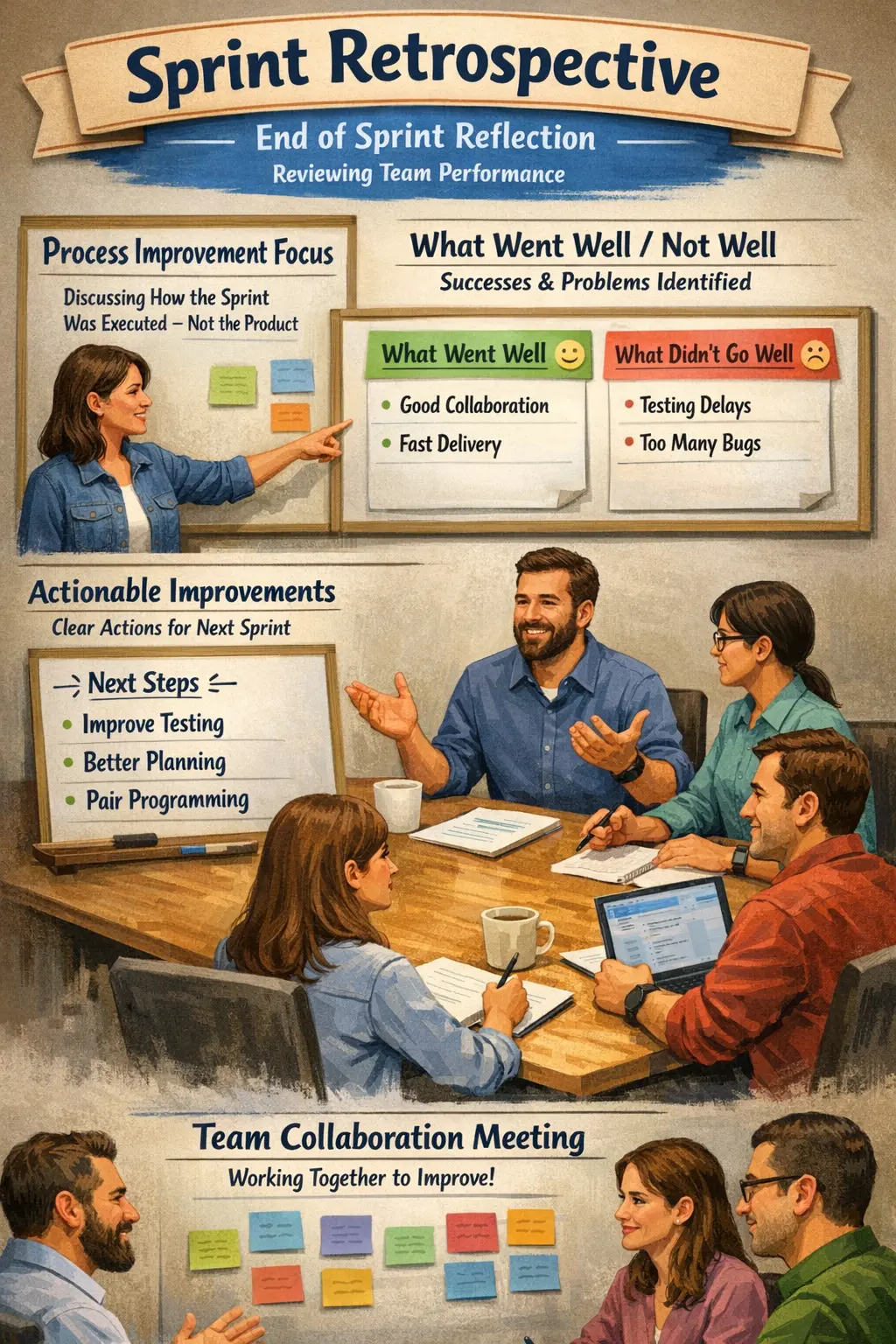
Definition of Sprint Retrospective
Sprint Retrospective is a Scrum event where the Scrum Team inspects the way it worked during the completed sprint and agrees on improvements for the next sprint. It is different from reviewing the product increment. The retrospective is about the team’s process, collaboration, tools, communication, quality practices, and delivery habits. It gives the team a regular opportunity to pause, reflect, and make its own way of working better.
The Sprint Retrospective is held near the end of the sprint, usually after the Sprint Review and before the next Sprint Planning. This timing is intentional. The team has just completed a sprint, so the experience is fresh. The team also has an immediate chance to apply improvements in the next sprint. A retrospective is valuable because it turns recent experience into practical action.
The focus of the retrospective is continuous improvement. Scrum does not assume that a team will become effective only by following events mechanically. Real improvement comes from inspecting reality and adapting behavior. A team may discover that requirements were unclear, testing started too late, builds were unstable, meetings were unproductive, or defect turnaround took too long. The retrospective creates a structured space to discuss these issues honestly.
A good Sprint Retrospective is not about blaming individuals. It is about improving the system in which the team works. If testing was delayed, the useful question is not “who caused the delay?” The useful questions are “why did testing start late, what conditions created the delay, and what can we change next sprint?” This process-focused mindset keeps the retrospective constructive.
For manual testers, Sprint Retrospective is especially important because many testing problems are process problems. Testers may face late builds, incomplete acceptance criteria, unstable environments, missing test data, unclear defect ownership, or insufficient time for regression. These problems cannot always be solved by working harder. They require team-level improvement, and the retrospective is the right event to raise them.
Purpose of Sprint Retrospective
The primary purpose of the Sprint Retrospective is to inspect and improve the team’s working process. The event helps the team understand what helped delivery, what slowed delivery, what affected quality, and what should change. Without this reflection, teams often repeat the same problems sprint after sprint while hoping that the next sprint will somehow be better.
One important purpose is identifying what went well. This is not just a positive opening exercise. Recognizing good practices matters because teams should preserve and strengthen the behaviors that help them succeed. If early collaboration between developers and testers reduced defects, the team should continue that practice. If daily requirement clarifications prevented confusion, that behavior should become part of the team’s rhythm.
Another purpose is identifying problems and obstacles. Every sprint reveals friction. Some friction may be technical, such as unstable builds or slow environments. Some may be process-related, such as stories entering the sprint without clear acceptance criteria. Some may be collaboration-related, such as delayed responses to tester questions. Retrospective discussion makes these issues visible so they can be addressed intentionally.
The retrospective also helps convert observations into actionable improvements. Talking about problems is not enough. A team must decide what it will change. For example, instead of saying “testing time was less,” the team may agree that stories must be handed to QA at least two days before sprint end where possible, or that large stories will be split during refinement. Practical actions create measurable improvement.
Another purpose is strengthening team ownership. The Scrum Team improves its own process rather than waiting for management to solve every issue. This does not mean the team can control every organizational constraint, but it can usually improve communication, planning, quality practices, and collaboration within its own boundaries. Retrospectives build this habit of ownership.
Participants in Sprint Retrospective
Sprint Retrospective is primarily for the Scrum Team. This includes developers, testers, the Scrum Master, and the Product Owner. Participation from all team members matters because each person experiences the sprint differently. Developers may notice technical friction. Testers may notice quality risks. The Product Owner may notice backlog clarity issues. The Scrum Master may notice collaboration patterns.
The Scrum Master usually facilitates the retrospective. Facilitation does not mean controlling the answers. It means creating a space where the team can speak honestly, stay focused, and move toward useful action. The Scrum Master may choose a retrospective format, time-box discussions, manage conflict, and ensure that quieter team members have a chance to contribute.
Developers bring insights about implementation challenges, code quality, dependencies, design decisions, build pipelines, and technical blockers. Their perspective helps the team understand why certain work took longer than expected or why certain defects appeared. When developers participate openly, retrospectives can lead to better engineering practices and smoother delivery.
Testers bring a quality-focused perspective. They can explain how requirement clarity, build timing, defect turnaround, environment readiness, and test data affected validation. Testers often see the complete behavior of the product across workflows, so their observations can reveal cross-functional process problems that are not obvious from individual development tasks.
The Product Owner may participate to discuss backlog readiness, acceptance criteria, priority changes, stakeholder communication, and requirement questions. However, the Product Owner’s presence should not make the team hesitant to discuss real problems. If the team does not feel safe speaking honestly, the Scrum Master must address that environment. Psychological safety is essential for useful retrospectives.
External stakeholders typically do not attend Sprint Retrospectives. Stakeholders belong in Sprint Review, where product feedback is discussed. The retrospective is an internal improvement event for the Scrum Team. Keeping it internal helps the team discuss process issues openly without turning the meeting into a performance review.
Importance of Sprint Retrospective
Sprint Retrospective is essential because Agile development depends on adaptation. A team cannot inspect only the product; it must also inspect the way it builds the product. If a team keeps delivering late, accumulating defects, or struggling with unclear stories, the product will suffer even if everyone is working hard. The retrospective helps improve the conditions that produce the work.
Without retrospectives, teams often normalize recurring problems. Late testing becomes normal. Unclear requirements become normal. Defects found at the end of the sprint become normal. Emergency fixes become normal. Over time, these patterns reduce morale and product quality. Regular retrospectives interrupt that cycle by asking the team to notice and improve its habits.
Small improvements made consistently can create major long-term gains. A team may start by improving story refinement, then improve test data readiness, then improve defect triage, then improve regression selection. Each change may look small in isolation, but together they make delivery smoother, faster, and more reliable. This is why Sprint Retrospective is often called the engine of continuous improvement in Scrum.
The retrospective also improves communication. Developers and testers may understand the sprint differently. A developer may believe a story was ready for testing, while a tester may have been blocked by missing data or unclear expected results. Discussing these differences helps the team build shared understanding. Shared understanding leads to fewer assumptions and fewer avoidable delays.
From a quality perspective, the retrospective is powerful because many quality issues have upstream causes. A defect may appear during testing, but the root cause may be ambiguous acceptance criteria, rushed development, missing design discussion, or lack of regression coverage. Retrospectives help teams look beyond the symptom and improve the process that allowed the issue to happen.
Typical Structure of a Sprint Retrospective
Sprint Retrospectives can follow many formats, but most effective retrospectives move through a simple pattern: create a safe setting, gather observations, identify insights, choose improvements, and close with action ownership. The exact format can change from sprint to sprint, but the flow should help the team move from reflection to action.
The meeting often begins by setting the tone. The Scrum Master may remind the team that the goal is learning, not blame. This matters because people will not share honest feedback if they fear judgment. A respectful tone allows the team to discuss problems directly while still treating each other professionally.
The team then gathers data about the sprint. This may include what went well, what did not go well, what surprised the team, what slowed progress, what improved quality, and what created risk. The data can be based on personal experience, sprint metrics, defect trends, blocked tasks, build stability, or delivery flow. The goal is to understand the sprint as it actually happened.
After gathering observations, the team looks for patterns. If several people mention late clarification, the issue may be backlog readiness. If testers repeatedly mention blocked validation, the issue may be build timing or test environment stability. If developers mention frequent context switching, the issue may be uncontrolled priority changes. Identifying patterns prevents the team from treating every symptom as a separate problem.
Finally, the team selects a small number of action items. It is better to choose one or two meaningful improvements than ten vague intentions. The team should agree on what will be done, who will own it, and how the team will know whether it helped. A retrospective without action is only a discussion; a retrospective with follow-up becomes improvement.
Common Retrospective Formats
One of the simplest retrospective formats is “Start, Stop, Continue.” The team identifies what it should start doing, what it should stop doing, and what it should continue doing. This format is easy for beginners and works well when the team needs a practical conversation without complex facilitation.
Another common format is “What went well, what did not go well, and what can be improved?” This approach is direct and familiar. It works well when the team has clear observations and needs to convert them into action. However, the facilitator must prevent the discussion from becoming a complaint list. The improvement part is the most important part.
The “Mad, Sad, Glad” format helps teams discuss emotional signals from the sprint. This can be useful when morale, frustration, or team stress is affecting delivery. It allows people to express how the sprint felt, not only what happened. Emotional data can reveal hidden process problems such as overload, lack of support, or unclear ownership.
The “Sailboat” format uses a metaphor where the team identifies winds that helped, anchors that slowed progress, rocks that represent risks, and the destination that represents the goal. This format can make discussion more engaging and can help teams think about improvement from multiple angles.
No format is automatically best. The right format depends on the team’s maturity, current problems, and meeting goal. A new team may need a simple format. A mature team may benefit from deeper root cause analysis. A team experiencing conflict may need a format that supports safety and balanced participation.
Manual Tester’s Role in Sprint Retrospective
Manual testers should participate actively in Sprint Retrospectives because they see many practical delivery problems. Testing is often affected by decisions made earlier in the sprint. If requirements are unclear, testers struggle to design accurate scenarios. If builds arrive late, testers lose execution time. If environments are unstable, defects become harder to isolate. Retrospectives allow testers to raise these issues constructively.
Testers can share testing challenges encountered during the sprint. These may include delayed builds, unclear acceptance criteria, insufficient test data, incomplete integration, unstable environments, excessive late changes, or defect fixes arriving too close to sprint end. The tester should explain the impact clearly. For example, “testing started late” is less useful than “three stories reached QA on the final day, so regression coverage was reduced.”
Testers should also share what worked well. If early collaboration with developers helped prevent defects, that should be recognized. If the Product Owner clarified rules quickly, that should be continued. If pairing with developers on complex scenarios improved quality, the team should consider repeating it. Retrospectives are not only for problems; they are also for reinforcing good practices.
Testers can provide insights into defect trends. If many defects came from missing validations, the team may need better acceptance criteria. If many defects came from integration points, the team may need earlier integration testing. If many defects were reopened, the team may need better developer verification before handing fixes back to QA. These observations help the team improve root causes rather than only fixing individual bugs.
Testers can also propose improvements related to test planning, regression scope, exploratory testing, automation support, environment stability, and defect communication. The best suggestions are practical and framed as team improvements. Instead of saying “developers should stop giving late builds,” a tester might suggest “let us define a mid-sprint integration checkpoint for large stories so QA can start earlier.”
Example Retrospective Inputs from Testers
A tester may report that late build availability reduced testing time. This is common in sprints where development work remains in progress until the final days. The improvement might be to split stories smaller, move technical uncertainty earlier, or create intermediate handoff points for partial validation. The goal is to avoid compressing all testing into the sprint end.
A tester may highlight that acceptance criteria were unclear. For example, a story may say that a user should receive an error message, but not specify the conditions, wording, or behavior after the error. The improvement might be to involve testers earlier in backlog refinement or add example-based acceptance criteria before sprint planning.
A tester may identify that test data was not ready. If data must be created manually during execution, testing slows down and becomes inconsistent. The improvement might be to prepare reusable test accounts, create controlled data scripts, or define test data needs during story refinement.
A tester may observe that defect resolution was faster when developers and testers discussed issues directly. This can lead to an action item such as using short defect clarification calls for high-priority issues instead of long comment threads. Faster clarification often reduces rework and improves team flow.
A tester may recommend automation support for repeated regression checks. Not every test should be automated, but repetitive stable checks can consume manual time every sprint. The retrospective can help the team decide which regression areas are good candidates for automation and how developers and testers will support that effort.
Creating Actionable Improvements
Actionable improvements are the most important output of a Sprint Retrospective. A retrospective should not end with vague intentions such as “communicate better,” “test earlier,” or “improve quality.” These statements sound reasonable, but they do not tell the team what to do differently. Effective action items are specific enough to execute in the next sprint.
A weak action item might say, “Improve requirements.” A stronger action item might say, “For every story planned next sprint, add at least two acceptance examples during refinement before sprint planning.” This is specific, observable, and connected to a real problem. A weak action item might say, “Reduce testing delay.” A stronger action item might say, “Stories larger than three days of development must be split or have a mid-sprint QA checkpoint.”
Action items should also have ownership. Ownership does not mean one person must do all the work, but someone should ensure the action is followed up. If nobody owns an action item, it is easy for it to disappear. The team should also decide when it will review whether the action helped, usually in the next retrospective.
The team should avoid selecting too many improvements at once. Too many actions create overload, and overloaded teams abandon improvement work when delivery pressure increases. One meaningful improvement completed is better than five improvement ideas forgotten. Retrospectives work best when improvement becomes a steady habit rather than a large occasional initiative.
Good action items are practical, realistic, measurable, and connected to root causes. They should be within the team’s influence whenever possible. If an issue requires support outside the team, the action may be to escalate it clearly, gather evidence, or create a proposal. Even then, the team should define what it will do next rather than only state that someone else should fix the problem.
Sprint Retrospective vs Sprint Review
Sprint Retrospective and Sprint Review are often confused because both happen near the end of a sprint. Their focus is different. Sprint Review focuses on the product increment. Sprint Retrospective focuses on the team’s process. Sprint Review asks, “What did we build, and what feedback do stakeholders have?” Sprint Retrospective asks, “How did we work, and how can we improve?”
Sprint Review includes stakeholders because product feedback must come from the people who understand business needs, user expectations, and market priorities. The output of Sprint Review may be backlog changes, new ideas, accepted feedback, or revised priorities. It is a product-facing event.
Sprint Retrospective is internal to the Scrum Team because it requires honest discussion about collaboration, planning, quality, tooling, and team behavior. The output is process improvement. It may include actions to improve refinement, development flow, testing readiness, defect handling, or communication. It is a team-facing event.
Both events support Agile adaptation. Sprint Review helps adapt the product. Sprint Retrospective helps adapt the process. A strong Scrum team uses both. If the team reviews only the product but never improves its process, delivery problems continue. If the team improves process but ignores stakeholder feedback, it may become efficient at building the wrong thing.
Common Challenges in Sprint Retrospectives
One common challenge is lack of participation. Some team members may speak often, while others remain silent. Silence does not always mean agreement. It may mean hesitation, fatigue, fear of conflict, or a belief that nothing will change. A facilitator should use techniques that invite balanced participation, such as silent writing before discussion or round-robin sharing.
Another challenge is lack of honesty. If people believe that raising problems will create blame, they will avoid real issues. The retrospective then becomes shallow. Trust grows when the team consistently treats feedback as process input rather than personal attack. Scrum Masters play an important role in protecting this environment.
Time pressure can also weaken retrospectives. Teams may rush the event because they are eager to start the next sprint or finish pending work. But skipping reflection often causes more waste later. A short, focused retrospective is better than none, but the team still needs enough time to identify and commit to meaningful improvement.
Another challenge is repeated issues. If the same problem appears every sprint, the retrospective is not producing effective change. The team may be discussing symptoms instead of root causes, choosing vague actions, failing to follow up, or selecting actions outside its control. Repetition is a signal that the retrospective process itself needs improvement.
Remote or distributed teams may face additional difficulty. Communication gaps, time zones, tool fatigue, and reduced informal conversation can make retrospectives harder. These teams may need more deliberate facilitation, clear shared boards, written prompts, and explicit follow-up to ensure everyone participates.
Common Mistakes in Sprint Retrospectives
A major mistake is blaming individuals. Retrospectives should focus on how the team system can improve. If one person made a mistake, the team should still ask what process allowed the issue to happen and how similar issues can be prevented. Blame reduces openness and makes future retrospectives less honest.
Another mistake is allowing the retrospective to become only a complaint session. Complaints may contain useful signals, but the meeting must move toward solutions. A facilitator can acknowledge frustration and then guide the team toward questions such as “what is within our control?” and “what is the smallest improvement we can try next sprint?”
Failing to follow up on action items is also common. If the team identifies improvements but never checks them again, people stop believing in retrospectives. The next retrospective should begin by reviewing previous action items. Did the team complete them? Did they help? Should they continue, change, or stop?
Another mistake is choosing actions that are too broad. “Improve quality” is too broad to guide behavior. “Add tester review to acceptance criteria before sprint planning” is actionable. Specific actions allow the team to experiment and learn. Broad actions create good intentions without execution.
Some teams repeat the same retrospective format every sprint until it becomes boring. Familiarity can reduce engagement. Changing formats occasionally can help the team think differently. However, the goal is not entertainment; the goal is meaningful inspection and improvement. Format should support the conversation, not distract from it.
Benefits of Sprint Retrospective
Sprint Retrospective improves team efficiency by identifying workflow bottlenecks. If work repeatedly waits for review, testing, environment access, or Product Owner clarification, the team can adjust its process. Removing bottlenecks helps work flow more smoothly from planning to completion.
It reduces recurring problems. Teams often know their problems but do not create time to solve them. The retrospective creates that time. It encourages teams to look at repeated defects, repeated delays, and repeated communication gaps, then decide what to change. Over multiple sprints, this reduces waste.
It strengthens collaboration. Developers, testers, Product Owners, and Scrum Masters hear each other’s experience directly. This builds empathy. A developer may understand how late code handoff affects testing. A tester may understand why a story became technically difficult. A Product Owner may understand why examples are needed earlier. Better understanding leads to better teamwork.
It improves product quality indirectly. The retrospective does not test the product directly, but it improves the process that produces the product. Better requirements, earlier testing, clearer defect handling, stronger review practices, and better environment readiness all lead to higher quality outcomes.
It also improves team morale when done well. Teams feel more ownership when they can influence their working conditions. People are more engaged when problems are acknowledged and improvement is visible. A team that sees its own process improving is more likely to trust Agile practices.
Real-Time Example
Consider a sprint where testing was delayed because most stories reached QA in the final two days. Testers completed the highest-priority checks but could not perform full regression. Several defects were found late, and one story moved back to the backlog. During the Sprint Retrospective, the team discusses the issue openly.
Developers explain that two stories were larger than expected and had hidden dependencies. Testers explain that because all stories arrived late, they had to switch quickly between features and could not prepare complete data in advance. The Product Owner explains that some acceptance criteria were added during the sprint because business rules were unclear earlier.
Instead of blaming each other, the team identifies three process causes: stories were too large, refinement did not uncover enough examples, and QA handoff happened too late. The team selects two action items for the next sprint. First, any story with unclear business rules must include example-based acceptance criteria before sprint planning. Second, large stories must be split or reviewed mid-sprint so testers can start validation earlier.
In the next sprint, testers join refinement earlier, developers split one large story, and QA begins testing earlier in the sprint. Testing pressure reduces, defects are found sooner, and the team completes more work confidently. This example shows how a retrospective converts a painful sprint experience into a practical process improvement.
Measuring Retrospective Effectiveness
The effectiveness of retrospectives can be measured by observing whether the team improves over time. The most basic sign is whether action items are completed. If every retrospective produces actions but none are followed, the event is not effective. Completion alone is not enough, but it is a necessary starting point.
Reduced recurring issues may indicate improvement. If late testing was a repeated problem and the team’s actions reduce it, the retrospective is working. If environment issues are discussed and then become less frequent, the retrospective is producing value. Improvement should be visible in the team’s day-to-day work.
Quality indicators can also provide insight. Fewer reopened defects, faster defect resolution, reduced critical defects near sprint end, and better acceptance criteria quality may show that the team is improving its delivery process. These metrics should be used carefully. The goal is learning, not punishing people with numbers.
Sprint predictability can be another signal. If the team becomes better at selecting realistic sprint work and completing it without constant spillover, retrospectives may be helping. Improved predictability often comes from better refinement, better story sizing, earlier risk identification, and better collaboration.
Team engagement is also important. If team members participate more openly and believe that retrospective actions matter, the event is becoming healthier. If people remain silent or treat the meeting as a formality, the team may need to change facilitation approach or rebuild trust.
Sprint Retrospective from a Tester’s Perspective
From a tester’s perspective, Sprint Retrospective is an opportunity to improve the conditions required for effective testing. Testers should not use the meeting only to report that testing was hard. They should explain why it was hard, what impact it had, and what change could improve the next sprint.
Testers can request better requirement clarity by asking for earlier involvement in refinement. They can suggest that acceptance criteria include examples, negative scenarios, boundary cases, and expected error behavior. This reduces ambiguity and helps testers design better cases before development is complete.
Testers can raise environment and data issues with evidence. If a test environment was unavailable for six hours, that is useful information. If missing data blocked three stories, that should be discussed. Evidence helps the team see process impact clearly and prevents the discussion from sounding like personal frustration.
Testers can also identify collaboration improvements. For example, pairing briefly with developers on complex defects may reduce back-and-forth. Joining story design discussions may prevent misunderstood requirements. Reviewing acceptance criteria before sprint planning may improve testability. These are practical improvements that directly affect quality.
Active tester involvement strengthens Agile quality practices because it shifts testing left. Instead of waiting until the end of the sprint to discover problems, testers help the team improve the upstream activities that prevent problems. This makes quality a shared team responsibility.
Best Practices for Effective Retrospectives
Keep retrospectives focused on improvement, not blame. The team should be honest about problems but respectful toward people. A useful retrospective discusses behaviors, systems, and decisions. It avoids personal attacks. This creates the safety needed for real feedback.
Use evidence where possible. Defect trends, blocked time, cycle time, spillover stories, build failures, and test environment downtime can help the team understand what happened. Evidence should support learning, not create defensiveness. The best retrospectives combine data with human experience.
Choose only a small number of action items. One or two well-defined actions are usually enough. Each action should have an owner, a timeline, and a way to evaluate whether it helped. The next retrospective should review these actions before starting new discussion.
Vary the format when needed. If the team is disengaged, try silent brainstorming first. If the team keeps discussing symptoms, use root cause analysis. If emotions are high, use a format that allows people to express concerns safely. Facilitation should match the team’s current need.
Make improvements visible during the next sprint. Action items should not live only in meeting notes. They can be placed on the team board, added as improvement tasks, or reviewed during daily discussions. Visibility helps the team remember that improvement work is real work.
Interview Perspective
In interviews, Sprint Retrospective is commonly defined as a Scrum event where the team reflects on the completed sprint and identifies improvements for future sprints. A stronger answer explains that the retrospective is process-focused, internal to the Scrum Team, and intended to produce actionable improvements rather than general discussion.
It is useful to explain the difference between Sprint Retrospective and Sprint Review. Sprint Review inspects the product increment with stakeholders. Sprint Retrospective inspects the team’s working process internally. Sprint Review leads to product feedback and backlog adaptation. Sprint Retrospective leads to process improvement actions.
For manual testing interviews, mention that testers use retrospectives to discuss testing challenges, requirement clarity, test data, environment issues, defect trends, regression pressure, and collaboration with developers. Testers should propose improvements, not only report problems. This shows practical Agile maturity.
A concise interview-ready answer would be: Sprint Retrospective is a Scrum event held at the end of each sprint where the Scrum Team reflects on how the sprint went, identifies what worked and what did not, and agrees on actionable improvements for the next sprint. It supports continuous improvement, better collaboration, and stronger product quality.
Key Takeaway
Sprint Retrospective is the continuous improvement engine of Scrum. It helps the team inspect how it worked, understand problems, preserve good practices, and choose practical improvements for the next sprint. Without retrospectives, teams may continue repeating the same delays, communication gaps, and quality problems.
The best retrospectives are honest, respectful, focused, and action-oriented. They do not blame individuals, and they do not end with vague wishes. They produce clear changes that the team can try immediately. Over time, these small changes make the team more predictable, collaborative, and effective.
For manual testers, Sprint Retrospective is a powerful opportunity to improve testing conditions and influence quality at the process level. By raising issues such as unclear acceptance criteria, late builds, environment instability, missing test data, and recurring defects, testers help the whole Scrum Team build better habits.
In simple terms, Sprint Retrospective helps the team answer one of the most important Agile questions after every sprint: how can we work better next time?