Alpha Testing: An Internal Stability Check Before Public Exposure
Introduction to Alpha Testing
Alpha testing is a type of internal acceptance testing performed before software is released to external users. It acts as a controlled validation step to ensure that the application is stable, usable, and ready for broader exposure. In simple terms, alpha testing answers the question: is the system ready to be used outside the development team?
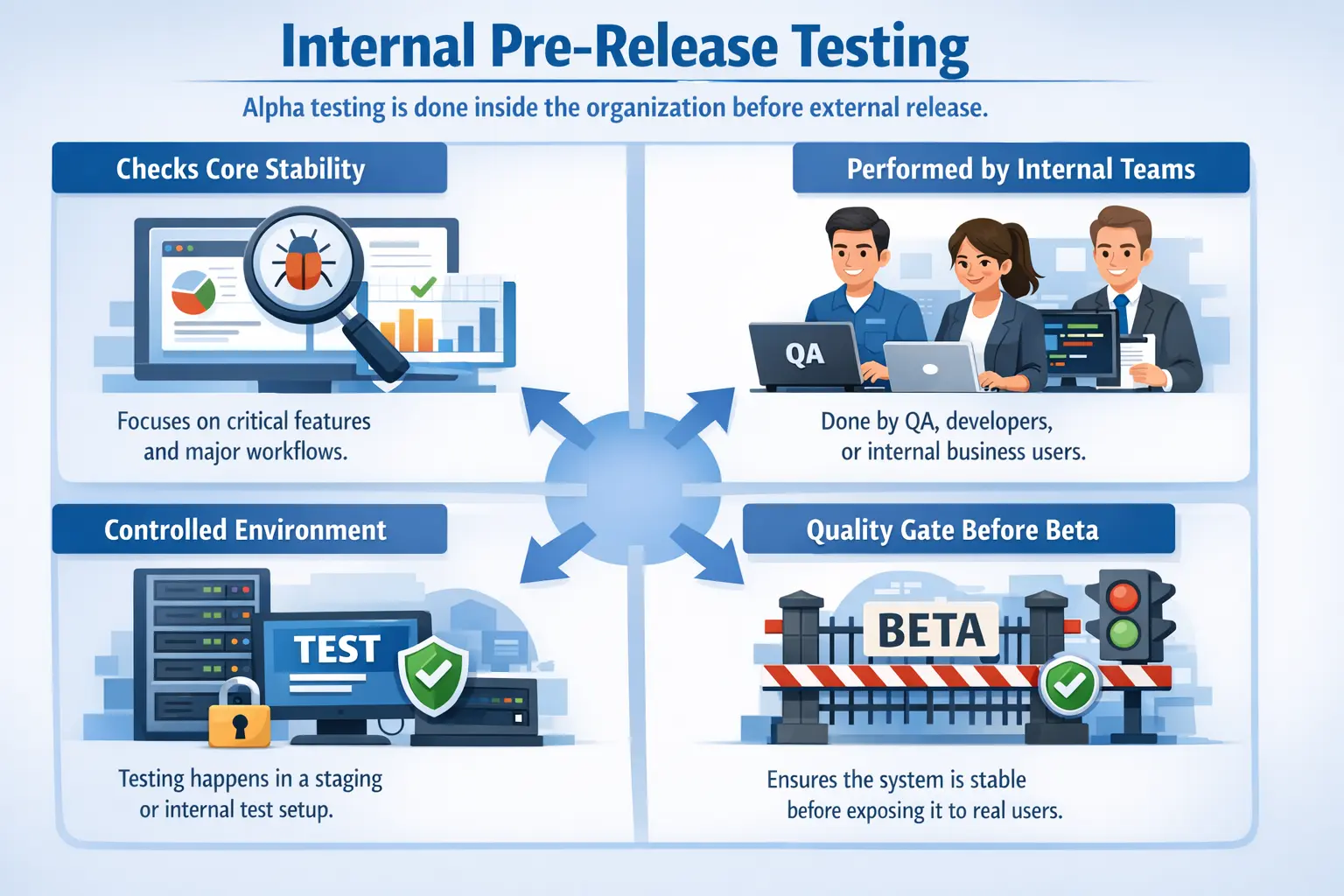
Why Alpha Testing Matters in Real Projects
Alpha testing matters because it gives the organization one more controlled opportunity to find serious issues before the product reaches external users. A product may pass several internal testing activities and still contain problems that become obvious only when it is used more realistically. Alpha testing creates a safe internal rehearsal where core workflows, major business rules, usability, and overall stability can be checked before beta users, customers, or the public see the application.
This is especially important for products that can affect customer trust, financial transactions, business operations, or brand reputation. If an application crashes during login, fails during payment, displays incorrect balances, loses submitted data, or confuses users during a basic workflow, releasing it outside the organization can create visible damage. Alpha testing helps catch these problems while the product is still under internal control.
Alpha testing is not just another name for system testing. It is a readiness checkpoint. System testing verifies the complete system against requirements. Alpha testing asks whether the internally tested product is stable enough for broader exposure. It is a bridge between internal validation and external confidence.
The Internal Nature of Alpha Testing
The defining feature of alpha testing is that it is performed internally. The participants may include QA testers, internal business users, product team members, support representatives, developers, or selected employees who understand the product. Because the activity remains inside the organization, the team can monitor behavior closely, collect feedback quickly, and fix critical defects without public impact.
Internal execution gives the team flexibility. Testers can use controlled data, switch builds quickly, capture logs, observe failures, and work directly with developers when serious issues appear. If a critical defect is found, the team can stop testing, fix the issue, redeploy the build, and retest without affecting customers. This control is one of the major advantages of alpha testing.
At the same time, alpha testing should not be too artificial. If the test environment, data, and workflows are unrealistic, alpha testing may miss important problems. The best alpha testing uses internal control but realistic usage. It should simulate the way the product will be used outside the development team while still allowing fast feedback and correction.
Purpose of Alpha Testing
The primary purpose of alpha testing is to identify critical defects before external exposure. These defects may include application crashes, blocked workflows, data corruption, wrong calculations, incomplete features, unstable navigation, or major usability issues. Finding these problems internally protects users and reduces the chance of reputational damage during beta testing or production release.
Alpha testing also validates core business functionality. The team focuses on the features that matter most: login, registration, search, transaction processing, approval, reporting, payment, account management, notifications, and other critical flows depending on the product. The question is not whether every minor option has been exhaustively tested. The question is whether the product is stable enough in its important scenarios.
Another purpose is to strengthen confidence before the product leaves internal control. Once a product is released to beta users or customers, issues become more visible and harder to manage quietly. Alpha testing gives teams a chance to stabilize the product first. It reduces avoidable embarrassment and improves the quality of feedback received later from external users.
Who Performs Alpha Testing
Alpha testing is usually performed by internal QA teams, internal business users, product team members, and sometimes developers. QA testers bring testing discipline, defect reporting skills, regression awareness, and risk-based coverage. Internal business users bring practical workflow understanding. Developers may support investigation, debugging, and fast fixes when issues are found.
The exact participants depend on the product and organization. In a startup, alpha testing may involve the product team, developers, testers, and selected employees. In an enterprise project, it may involve QA, business analysts, operations users, support teams, and internal subject matter experts. The common element is that participants are internal and trusted.
This differs from beta testing, where selected external users may participate, and from UAT, where business stakeholders validate acceptance. Alpha testing is more focused on internal stability and defect discovery. It may include business users, but the objective is not primarily formal business sign-off. It is to decide whether the product is stable enough for the next stage.
When Alpha Testing Occurs
Alpha testing usually occurs after system testing has been completed or after the product has reached a reasonably stable internal build. It is performed before beta testing, pilot release, or public exposure. In some projects, alpha testing may also happen before formal UAT to ensure that business users are not given a build with obvious critical problems.
Timing is important. If alpha testing starts too early, testers may spend most of their time finding basic defects that should have been caught during system testing. This creates noise and slows progress. If alpha testing starts too late, the team may not have enough time to fix important issues before beta or release. The best timing is when the product is complete enough for realistic internal use but still early enough to correct serious problems.
In iterative or Agile projects, alpha testing may happen incrementally for major releases or product milestones. A team may run internal alpha validation before opening a feature to a wider internal audience, beta group, or production rollout. The concept remains the same: controlled internal validation before broader exposure.
Scope of Alpha Testing
The scope of alpha testing usually includes core features, critical workflows, high-risk areas, major business rules, important integrations, and visible user experience concerns. It should focus on the parts of the product that would create the greatest risk if they failed externally. For a banking application, this may include login, balance display, fund transfer, beneficiary management, and transaction history. For an e-commerce application, it may include search, cart, checkout, payment, and order confirmation.
Alpha testing is not usually the place for large-scale load testing, broad compatibility testing, or exhaustive edge-case coverage unless those areas are part of the alpha goal. Performance, security, and compatibility may be observed, but the primary focus is stability, correctness, and readiness for broader validation. The team wants to know whether the product is fundamentally safe to expose.
A practical alpha test scope should be risk-based. Critical flows should receive deeper coverage. Minor cosmetic issues or rarely used features may receive lighter coverage. The goal is not to prove perfection. The goal is to remove major blockers and serious defects before external users encounter them.
Alpha Testing Environment
Alpha testing is performed in an internal staging, QA, or controlled test environment. This environment should be stable enough for realistic testing and close enough to production to reveal meaningful issues. It should include appropriate configuration, user roles, test data, integrations, and monitoring where possible. A weak environment can reduce the value of alpha testing.
Access is usually limited to selected internal participants. This keeps the activity controlled and prevents unfinished software from reaching unintended users. Test data should be managed carefully. If the product handles sensitive information, alpha testing should avoid unsafe use of real customer data unless proper controls and approvals exist.
The controlled environment also helps investigation. When a defect is found, logs, screenshots, test data, user account details, build version, and environment configuration can be captured quickly. Developers and testers can reproduce issues more easily than they could if the problem appeared first in a public release.
Alpha Testing Compared to UAT
Alpha testing and UAT are both acceptance-level validations in a broad sense, but their focus is different. Alpha testing is internal and emphasizes stability, usability, defect detection, and readiness for broader exposure. UAT is business-led and emphasizes whether the system is acceptable for business use and formal release approval.
In alpha testing, internal teams may actively look for serious issues. They may explore workflows, stress important paths, check late changes, and validate whether the product is stable. In UAT, business users validate whether the product supports real business operations and provide sign-off. UAT is less about internal defect hunting and more about business acceptance.
Alpha testing can protect UAT. If a build is unstable, business users may lose confidence and UAT may become inefficient. Running alpha testing first can remove obvious critical defects before business stakeholders spend time validating acceptance. This makes UAT more meaningful and professional.
Alpha Testing Compared to Beta Testing
Alpha testing happens internally, while beta testing usually involves external or real users in a more realistic environment. Alpha testing is controlled, private, and focused on internal stability. Beta testing is broader, more user-centered, and helps collect real-world feedback from people outside the development organization or from a wider user group.
During alpha testing, the organization still controls who uses the product, what data is used, what environment is available, and how issues are handled. During beta testing, the product is exposed to users who may behave in unexpected ways, use different devices, have different network conditions, and provide feedback from real usage. Beta testing is valuable, but it carries more visibility and risk.
A strong alpha phase improves beta quality. If critical defects are removed internally, beta users can focus on usability, real-world fit, device differences, workflow feedback, and enhancement suggestions instead of reporting basic crashes and blocked flows. This makes beta testing more productive.
A Practical Banking Example
Consider a banking application preparing for launch. During alpha testing, internal employees and QA testers validate login, account balance display, fund transfers, beneficiary creation, transaction history, and notification behavior. These are critical workflows. If any of them fail publicly, customers may lose trust immediately.
Suppose alpha testing finds that fund transfer succeeds but transaction history does not update immediately, or that balance displays incorrectly after a failed transfer. These issues may not always be obvious in isolated testing, but they are serious from a user trust perspective. Alpha testing exposes them before customers ever see the product.
This internal rehearsal reduces reputational risk. It allows the team to fix important issues, improve user messages, verify data consistency, and ensure that critical flows are stable enough for broader validation.
Common Defects Found During Alpha Testing
Alpha testing often uncovers serious issues such as application crashes, blocked workflows, broken navigation, data inconsistencies, missing validations, incorrect business rules, major usability flaws, and late-change regressions. These defects may have been missed earlier or introduced during final development changes. Because alpha testing simulates realistic internal use, it can expose hidden weaknesses.
Usability defects are also common. Internal testers may notice that a workflow is confusing, a button label is unclear, an error message does not guide the user, or a required action is hard to find. These problems may not always be severe technical defects, but they can affect user adoption and support costs.
Data-related defects can be especially important. A transaction may complete but store incorrect data. A profile update may appear successful but fail to persist. A report may show stale information. Alpha testing catches these problems while the team can still correct them before external exposure.
Entry and Exit Criteria for Alpha Testing
Alpha testing should begin when the build is stable enough for internal validation. Typical entry criteria include completion of major development work, successful system testing for critical flows, resolved blocking defects, available test environment, prepared test data, selected internal participants, and a defined alpha test scope. Starting without these basics reduces the value of the activity.
Exit criteria may include execution of planned alpha scenarios, resolution of critical and high-severity defects, retesting of important fixes, documented known issues, product team review, and agreement that the product is ready for beta, UAT, pilot, or broader release. Exit does not mean the product has no defects. It means the remaining risk is understood and acceptable for the next exposure level.
Clear entry and exit criteria keep alpha testing professional. Without them, alpha testing may become vague, informal, and difficult to evaluate. With them, it becomes a useful quality gate.
Common Pitfalls in Alpha Testing
One common pitfall is skipping alpha testing to save time. This may appear efficient, but it increases the chance that serious defects will be found by beta users or customers. Finding these issues externally is more damaging than finding them internally. Alpha testing is a risk-reduction activity, not an optional ceremony.
Another pitfall is treating alpha testing as a replacement for UAT. Alpha testing checks internal stability and readiness. UAT confirms business acceptance. Both may involve business users, but they serve different purposes. Skipping UAT because alpha testing was completed can leave business readiness unvalidated.
A third pitfall is limiting alpha coverage too narrowly. If only one or two simple happy paths are tested, important issues may slip into beta or production. Alpha testing should cover critical workflows, high-risk areas, and realistic internal usage. The scope should be practical but meaningful.
Best Practices for Alpha Testing
Effective alpha testing starts with clear scope. Define which features, workflows, roles, and risks are included. Select participants who understand the product and can provide useful feedback. Prepare realistic test data and ensure the environment is stable. Explain how defects and observations should be reported.
Testing should focus on critical workflows first. If core functionality fails, minor features matter less. The team should validate that the product can perform its main purpose reliably. Exploratory testing can also be useful because internal users may interact with the system in ways scripted tests did not cover.
Feedback should be triaged quickly. Critical defects need immediate attention. Usability observations should be reviewed with product owners. Known issues should be documented clearly. Fast feedback loops are one of the strengths of alpha testing, and teams should take advantage of that internal control.
Interview-Ready Understanding of Alpha Testing
In interviews, alpha testing should be explained as internal testing performed before beta testing or public release. It validates whether the application is stable, usable, and ready for broader exposure. It is usually performed by internal QA teams, internal users, product teams, and sometimes developers in a controlled environment.
A strong answer should distinguish alpha testing from UAT and beta testing. Alpha testing is internal and focused on stability and defect detection. UAT is business-led and focused on acceptance. Beta testing involves external or wider user feedback. Mentioning this distinction shows practical understanding.
A concise interview answer could be: Alpha testing is an internal acceptance-level testing activity performed before beta or external release to identify critical defects, validate core functionality, and confirm that the product is stable enough for broader exposure.
Final Practical Guidance
Alpha testing should be treated as an internal quality checkpoint before the product leaves the safety of the organization. It helps teams find serious defects, improve stability, and reduce the risk of exposing unfinished or unstable software to external users. It is especially valuable when brand trust, customer experience, or business continuity is at stake.
When alpha testing is done well, beta testing and UAT become more productive. External users and business stakeholders can focus on real feedback and acceptance instead of basic instability. This makes the overall release process smoother and more controlled.
It serves as a quality gate between internal development/testing and external release.
Purpose of Alpha Testing
The primary purpose of alpha testing is to identify critical defects before the software reaches customers or external users. It validates core business functionality and ensures that the system is reasonably stable. By catching major issues early, alpha testing reduces the risk of negative user experience during beta testing or production release.
Alpha testing focuses on strengthening confidence before the product leaves internal control.
Who Performs Alpha Testing
Alpha testing is typically conducted by internal QA teams, internal business users, and sometimes developers. Since it is performed within the organization, the environment is controlled and monitored closely.
Unlike UAT, which is led by business stakeholders for acceptance, alpha testing emphasizes stability and defect detection from an internal perspective.
When Alpha Testing Occurs
Alpha testing is generally performed after system testing has been completed and before beta testing or external release. In some project structures, it may also occur before formal UAT to ensure the build is stable enough for business users.
The timing ensures that most functional defects are already addressed and the focus is on overall readiness.
Scope of Alpha Testing
Alpha testing concentrates on validating core features, critical workflows, major business rules, and high-risk areas. The objective is to confirm that the system behaves reliably in key scenarios.
It does not usually focus on large-scale performance testing or broad user behavior simulation. The emphasis is stability and correctness, not scalability or mass usage patterns.
Alpha Testing Environment
The testing is performed in an internal staging or controlled test environment. Test data is managed carefully, and access is limited to selected participants. This setup ensures issues can be addressed without public impact.
The controlled nature allows quick feedback loops and immediate fixes.
Alpha Testing Compared to UAT
While both are acceptance-level validations, their focus differs. Alpha testing is carried out internally to detect stability issues. UAT is conducted by business users to confirm business acceptance.
Alpha testing focuses on identifying remaining defects, whereas UAT focuses on confirming business readiness. Alpha testing protects the organization before external validation begins.
A Practical Example
Consider a banking application about to launch. During alpha testing, internal employees validate login functionality, fund transfers, and balance checks. If critical defects are found, they are fixed before customers ever see the product.
This internal rehearsal significantly reduces reputational risk.
Common Defects Found
Alpha testing often uncovers serious issues such as application crashes, broken core workflows, data inconsistencies, or major usability flaws. These defects might not have appeared earlier or may have been introduced during late changes.
Because alpha testing simulates realistic use internally, it often exposes hidden weaknesses.
Common Pitfalls
Skipping alpha testing to save time increases risk. Treating alpha testing as a full UAT replacement reduces business involvement. Limiting coverage too narrowly may allow important issues to slip into beta or production.
Effective alpha testing requires sufficient scope and proper internal participation.
Interview Perspective
In interviews, alpha testing is commonly described as internal testing performed before releasing software externally. A strong explanation emphasizes that it validates stability and core functionality in a controlled environment before beta testing or public release.
Key Takeaway
Alpha testing acts as a protective layer before exposing software to real users. It ensures that critical defects are resolved internally, strengthening confidence and reducing business risk. By serving as an internal quality checkpoint, alpha testing helps ensure smoother external releases.