Test Data Management (TDM)
In software testing, test data is one of the most important factors behind reliable execution. A well-written test case can still fail for the wrong reason if the data is missing, outdated, corrupted, duplicated, locked, or not in the required state. Even worse, a test case can pass incorrectly if the data does not truly represent the business condition being validated. Test Data Management, commonly called TDM, is the discipline that ensures testers have the right data, at the right time, in the right state, and in a secure form for meaningful testing.
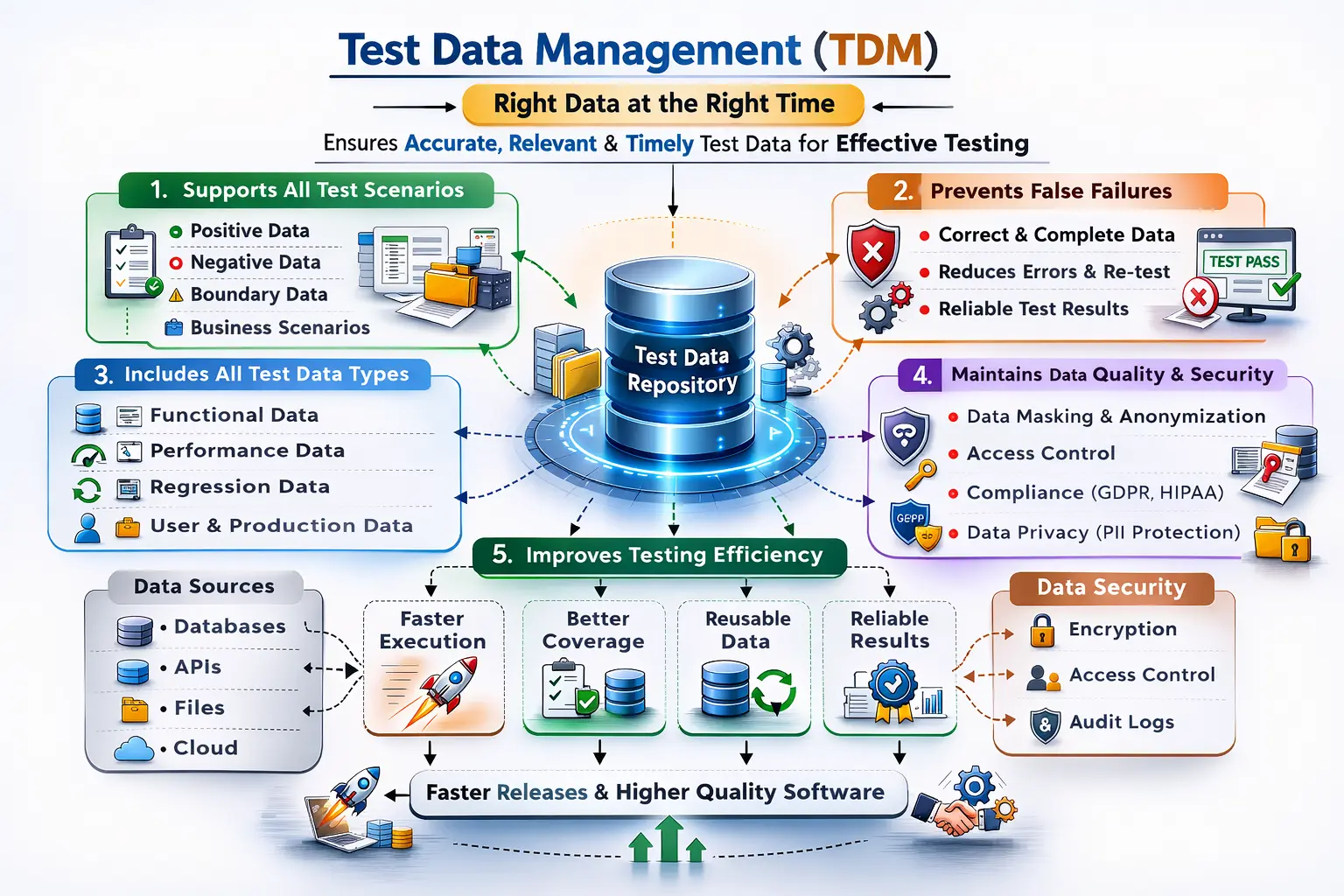
TDM is not simply the act of typing values into a form before execution. It is a structured approach that includes identifying data needs, creating or obtaining data, maintaining that data across test cycles, validating whether the data is usable, protecting sensitive information, and resetting or refreshing data when required. In real projects, testers depend on data for almost every activity: functional testing, regression testing, exploratory testing, integration testing, UAT support, and production smoke validation.
Poor test data management creates avoidable noise. Testers may log defects that are actually data problems. Developers may spend time investigating failures that are not application defects. Test execution may be blocked because required accounts, orders, transactions, roles, or configurations are unavailable. Inconsistent data can also hide real defects because the same test behaves differently across cycles. Strong TDM makes testing more repeatable, more accurate, and more trustworthy.
The central question of TDM is simple: do we have the right data, at the right time, in the right state, to test effectively? A tester who can answer this question confidently is better prepared for execution, defect reporting, regression planning, and release readiness discussions.
Why Test Data Management Is Critical
Test Data Management is critical because test results are only as reliable as the data behind them. If a test case fails because the data is incorrect, the failure does not provide useful product-quality information. For example, if a payment test fails because the test card is expired, that is not the same as a payment module defect. If a login test fails because the user account is locked, the failure may not indicate an authentication issue. TDM helps prevent these false failures by ensuring that data is prepared and verified before execution.
TDM also supports realistic validation. Applications are built for real users, real business workflows, real transactions, and real decision-making. If testers use unrealistic or incomplete data, they may validate only superficial behavior. For example, an e-commerce checkout flow cannot be tested properly without products, inventory, customer profiles, addresses, tax rules, discount conditions, shipping methods, payment methods, and order statuses. Test data must reflect the business workflow being tested.
Another major benefit is improved test coverage. Positive scenarios require valid data. Negative scenarios require invalid or restricted data. Boundary scenarios require values at minimum and maximum limits. Role-based scenarios require users with specific permissions. Regression scenarios require stable baseline data that can be reused or reset. Without proper data planning, coverage becomes accidental and incomplete.
TDM also reduces execution delays. When data is not ready, testers spend execution time creating accounts, searching for records, resetting statuses, or waiting for environment support. This slows down the cycle and can create pressure near release. Preparing data early allows testers to execute with fewer interruptions and report progress more accurately.
Finally, TDM protects privacy and compliance. Many applications contain personal, financial, medical, or confidential information. Using raw production data in test environments can create legal and security risks. Proper test data management includes masking, anonymization, access control, and careful handling of sensitive data. Quality testing should never compromise data privacy.
Types of Test Data
Different testing goals require different types of test data. A mature tester does not rely on a single generic data set for every scenario. Instead, the tester identifies what kind of data is needed for each condition. The most common categories include positive data, negative data, boundary data, business scenario data, and configuration-based data.
Positive data represents valid inputs that satisfy all business rules. For example, valid login credentials, a correctly formatted email address, an active customer account, a valid payment method, or a product that is in stock can all be positive test data. This data is used to confirm that the application works correctly under normal expected conditions. Positive testing is usually the baseline because the application must first prove that standard workflows succeed.
Negative data represents invalid, incomplete, or restricted inputs used to validate error handling. Examples include wrong passwords, missing mandatory fields, invalid phone numbers, expired coupons, unsupported file formats, inactive accounts, or values outside allowed rules. Negative data helps testers verify that the system rejects bad input gracefully, displays meaningful error messages, and protects data integrity.
Boundary and edge data focuses on limits. If a password must be between 8 and 20 characters, testers should prepare data at 7, 8, 20, and 21 characters. If a transfer amount has a minimum and maximum limit, test data should cover values just below, exactly at, and just above those limits. Boundary data is important because many defects appear at the edges of business rules rather than in normal values.
Business scenario data represents complete end-to-end conditions. For example, testing a refund process may require a completed order, a successful payment, an eligible return window, inventory status, tax calculations, and different payment methods. This type of data is more complex than single-field input data because it supports realistic business workflows across modules.
Configuration-based data is tied to roles, regions, feature flags, product settings, or environment configuration. A feature may be visible only for premium users, enabled only in one country, or available only when a flag is turned on. Testing such behavior requires users, settings, and records that match each configuration. Without configuration-based data, testers may miss defects related to permissions, regional logic, or feature rollout.
Sources of Test Data
Test data can come from several sources depending on the project, environment, privacy constraints, and testing objective. The simplest source is manual data creation, where testers create records directly through the application or supporting tools. This approach is useful for small scenarios, but it can become slow when large volumes or complex workflows are needed.
Another source is seeded baseline data. Many projects maintain predefined data that is loaded into the test environment before each cycle. Baseline data may include standard users, roles, products, lookup values, configuration settings, and sample transactions. This is useful for regression testing because it gives testers a stable starting point and makes results easier to compare across builds.
Some teams use production-like data that has been masked or anonymized. This can be valuable because it reflects real-world variety, volume, and complexity. However, it must be handled carefully. Sensitive information such as names, addresses, phone numbers, emails, account numbers, health data, payment data, or personally identifiable information must not be exposed in lower environments. Masking and anonymization reduce privacy risk while preserving useful data patterns.
Reference or master data is another important source. Applications often depend on fixed lookup values such as country codes, states, currencies, product categories, order statuses, tax codes, or user roles. If this data is missing or inconsistent, test cases may fail even when the application code is correct. Testers should understand which master data is required for their modules.
External system feeds may also supply test data, especially in integration-heavy applications. For example, a banking system may receive account updates from another platform, or an insurance system may receive policy data from an external service. When test data depends on external systems, testers must coordinate availability, timing, and data state carefully.
Core Test Data Management Activities
Test Data Management begins with data planning. During test design, testers should identify what data is required for each scenario. This includes input values, user roles, account states, transaction statuses, dependency records, file types, configuration flags, and expected post-conditions. Data planning prevents execution-time surprises because testers know in advance what must be prepared.
Data creation is the next activity. Testers create or request the data needed for positive, negative, boundary, regression, and business-flow scenarios. In some cases, data is created through the application UI. In others, it may be loaded through scripts, APIs, database setup, batch jobs, or support from backend teams. Whatever the method, the data should be documented so that the test can be repeated.
Data maintenance ensures that test data remains usable across cycles. In shared environments, multiple testers may use or modify the same records. One tester may complete an order that another tester planned to use. A user account may become locked. A transaction may move from pending to completed. Without maintenance, data becomes polluted and unreliable. Resetting, refreshing, reserving, or recreating data helps keep test execution stable.
Data validation is also essential. Before running a test, the tester should confirm that the data is in the required state. If a test case needs an active user, the user must not be disabled. If a refund test needs a completed order, the order must actually be completed and eligible for refund. After execution, testers may also validate that data changed as expected, such as confirming that an order status changed or a report value updated.
Data security and privacy must be considered throughout the lifecycle. Test data should not expose confidential production information unnecessarily. Teams should use masking, anonymization, synthetic data, or controlled access where appropriate. Testers should avoid sharing sensitive data in screenshots, defect reports, emails, or chat messages unless the organization’s policy allows it and the data is protected.
Manual Tester’s Responsibilities in TDM
Manual testers play a direct role in TDM because they are closest to test execution. During test design, they identify data requirements for each scenario. They think about valid inputs, invalid inputs, boundary values, special user roles, workflow states, and business conditions. This planning ensures that test cases are not only written correctly but also executable.
Testers are also responsible for preparing and documenting test data. If a test case depends on a specific user account, order ID, customer type, product category, transaction status, or configuration flag, that dependency should be recorded. Clear documentation helps other testers execute the same case and helps developers reproduce defects.
Before execution, testers should validate that the data is ready. This includes checking whether accounts are active, records exist, statuses are correct, required permissions are assigned, and dependent systems are available. If test data is not ready, testers should report the blocker early instead of discovering it in the middle of a test cycle.
Testers should also distinguish between data issues and application defects. If a test fails because required data is missing, it should not be reported as a product defect unless the application itself caused the missing data incorrectly. Data-related issues should be tracked separately so they can be fixed without distorting defect metrics.
In Agile teams, testers may coordinate with developers, BAs, DevOps, database teams, or environment support to refresh data or create complex conditions. Good TDM is collaborative. The tester does not need to perform every technical setup alone, but the tester must know what data is needed and whether it is ready for testing.
Common Challenges in Test Data Management
One of the most common TDM challenges is data conflict in shared environments. When multiple testers use the same records, the data state can change unexpectedly. For example, one tester may cancel an order that another tester needs for shipment testing. This creates false failures and execution delays. Unique identifiers, reserved data sets, and clear ownership can reduce this problem.
Another challenge is incomplete or outdated data. A test case may require an active account with specific permissions, but the available account may be inactive or missing the required role. A regression test may rely on records created in an older build that no longer match current business rules. Data must be reviewed and refreshed regularly to remain useful.
Creating edge case data can also be difficult. Some boundary conditions require unusual states that are hard to create through the UI. For example, an expired token, a transaction at the exact daily limit, a file at maximum size, or a policy that expires at midnight may need special setup. Testers may need support from developers, APIs, database scripts, or controlled configuration changes.
External dependencies create another challenge. If a test scenario depends on a third-party service, payment gateway, email provider, SMS service, or external feed, test data availability may depend on systems outside the tester’s control. In such cases, teams may use stubs, mocks, sandbox environments, or planned integration windows.
Privacy restrictions can also limit data availability. Production-like data is useful, but organizations must protect sensitive information. Testers should understand data privacy policies and avoid using real personal or financial information unless it is properly masked and approved for testing.
Best Practices for Test Data Management
A practical TDM best practice is to maintain a test data checklist for each module. The checklist can include required user roles, accounts, records, statuses, files, configuration settings, and negative data conditions. This helps testers prepare before execution and reduces the chance of blocked test cases.
Using unique identifiers is another useful practice. If multiple testers create users, orders, or transactions, unique naming conventions help avoid confusion. For example, including tester initials, date, sprint number, or scenario name in test records makes data easier to identify and maintain. Unique data also reduces conflicts in shared environments.
Baseline datasets should be maintained for regression testing. Regression works best when testers have stable data that can be reused or reset between cycles. If every regression cycle starts with different data, failures become harder to compare. A controlled baseline improves repeatability and confidence.
Test data assumptions should be documented clearly. If a test depends on a user being active, a product being in stock, a feature flag being enabled, or a transaction being in pending status, that assumption should be visible. Hidden assumptions create confusion when a test fails. Clear documentation makes execution and defect reproduction easier.
Data-related issues should be tracked separately from application defects. If a test is blocked because a required account is missing, that should be logged as a data or environment issue rather than a product defect. This keeps defect metrics accurate and helps teams solve the real blocker quickly.
Real-Time Example
Consider a refund processing scenario in an e-commerce application. To test this workflow properly, the tester needs much more than a random order. The order must be completed, paid successfully, within the allowed refund window, eligible for partial or full refund, and linked to a payment method that supports refund processing. The product tax, discount, shipping amount, and payment status may all affect the expected result.
If the tester uses an incomplete order, the refund option may not appear. If the order is outside the refund window, the test may fail for the wrong reason. If the payment method does not support refunds, the scenario may be blocked. If tax and discount data are missing, the refund amount cannot be validated correctly. In this example, poor data preparation can make a valid feature look defective.
With proper TDM, the tester prepares different refund data sets: full refund, partial refund, expired refund window, invalid refund request, different payment methods, tax-inclusive order, discounted order, and already refunded order. This allows the tester to validate happy path, negative scenarios, edge cases, and business rules with confidence.
TDM vs Test Data Creation
Test Data Management is often confused with test data creation, but they are not the same. Test data creation is one activity within TDM. It focuses on generating or preparing the values and records needed for testing. TDM is broader. It includes planning, creation, maintenance, validation, refresh, security, documentation, and reuse of test data across the testing lifecycle.
For example, creating a user account is data creation. Ensuring that the account has the correct role, remains active, is reset after execution, does not expose sensitive information, is documented for reuse, and is available during regression is Test Data Management. Creation gives you data once. TDM keeps data reliable over time.
This distinction is important in interviews. A candidate who explains TDM only as creating test data may sound limited. A stronger answer explains that TDM is a controlled process that supports repeatable and secure testing.
Interview Perspective
In interviews, Test Data Management is usually discussed to check whether the candidate understands real execution challenges. A short answer can be: "Test Data Management is the process of planning, creating, maintaining, validating, and securing test data so that testing can be performed accurately and efficiently." This definition is clear and complete.
A stronger interview answer adds a practical example. You can say that for a refund scenario, the tester needs a completed order, valid payment, refund eligibility, correct tax and discount data, and different refund conditions. Without this data, the test cannot be executed properly. This shows that you understand TDM as a real project activity, not just a theory.
Interviewers may also ask what happens when test data is poor. You can explain that poor data causes false failures, delays execution, creates confusion, blocks regression, and may lead to incorrect defect reporting. Good TDM improves reliability, coverage, and confidence in test results.
Key Takeaway
Test Data Management is a critical discipline that supports accurate, repeatable, efficient, and secure testing. It ensures that testers have suitable data for positive scenarios, negative scenarios, boundary conditions, business workflows, roles, configurations, and regression cycles. Without proper TDM, even strong test cases can produce unreliable results.
Effective TDM includes planning, creation, maintenance, validation, documentation, refresh, and security. It reduces false failures, improves coverage, protects sensitive information, and helps testers execute with confidence. In real-world manual testing, good test data management often determines whether testing runs smoothly or becomes blocked by avoidable data problems.