Pairwise / Combinatorial Testing
Modern software applications often include numerous input parameters, configuration settings, and environment combinations. Testing all possible combinations of these inputs is usually impractical because the number of test cases grows exponentially as the number of parameters increases. Testers must therefore use intelligent techniques that provide strong coverage without requiring excessive effort. One of the most effective techniques for this purpose is Pairwise Testing, also known as Combinatorial Testing.
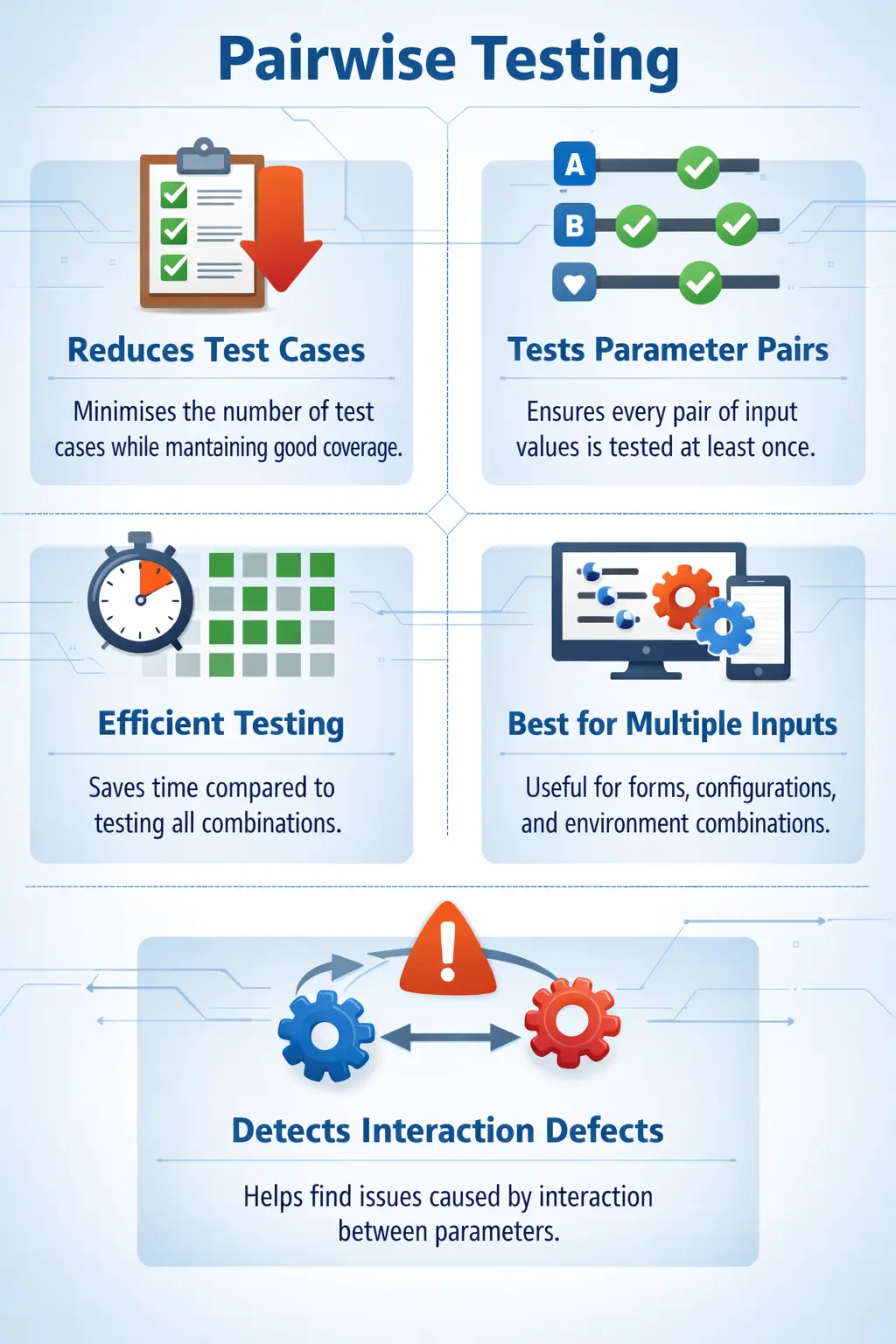
Pairwise Testing is a test case design technique in which test cases are created to ensure that every possible pair of input parameter values is tested at least once. Instead of testing all possible combinations, which can be extremely large, Pairwise Testing focuses on combinations of two parameters at a time. This approach significantly reduces the number of required test cases while still providing high defect detection capability.
Pairwise Testing addresses a key testing challenge:
“Can we reduce combinations while still covering interactions effectively?”
This technique is widely used in both manual and automated testing, particularly when dealing with configuration testing, environment combinations, and forms with multiple input fields. Pairwise Testing is especially valuable in real-world projects where testing time and resources are limited.
Pairwise Testing is important because modern applications rarely run in one fixed situation. A page may be used by different roles, on different browsers, in different languages, with different subscription plans, payment methods, regions, feature flags, and device types. Each individual option may work correctly, but a defect may appear only when two options meet. For example, a report may work for Admin users and may work on Safari separately, but fail specifically for Admin users on Safari. Pairwise Testing is designed to find these interaction defects efficiently.
This technique also helps teams move away from two weak extremes. One extreme is exhaustive testing, where the team tries to test everything and quickly becomes overwhelmed. The other extreme is random selection, where the team tests a few combinations without knowing what coverage has been achieved. Pairwise Testing provides a practical middle path: fewer test cases, but selected with a clear coverage goal.
Understanding the Need for Pairwise Testing
Software systems often require testing across multiple variables. Each variable may have several possible values, and the total number of combinations increases rapidly. Testing every possible combination, known as exhaustive testing, quickly becomes impossible even for moderately complex systems.
Consider a simple system with five parameters where each parameter has four possible values. Exhaustive testing would require:
4 × 4 × 4 × 4 × 4 = 1024 test cases
If the number of parameters increases to ten, the number of combinations becomes extremely large. Executing thousands or millions of test cases is rarely practical within project timelines.
Pairwise Testing solves this problem by focusing on interactions between pairs of parameters. Research and practical experience have shown that most software defects are caused by interactions between two variables rather than complex interactions involving many variables simultaneously. By ensuring that every pair of parameter values is tested, Pairwise Testing provides strong defect detection with far fewer test cases.
This approach allows testers to maintain effective coverage while keeping testing effort manageable.
The need becomes clearer when parameters are multiplied. Suppose a web application must be tested with 4 browsers, 3 operating systems, 4 user roles, 3 languages, 3 subscription plans, and 4 payment methods. Exhaustive testing would require 4 x 3 x 4 x 3 x 3 x 4, which equals 1,728 combinations. If each test takes even five minutes, the execution effort becomes unrealistic. Pairwise Testing can reduce this to a much smaller set while still ensuring that every two-way interaction appears at least once.
Pairwise Testing does not claim that all defects are caused by two-factor interactions. Some defects do require three or more factors. However, many practical compatibility and configuration failures are caused by one factor interacting with another. This is why the technique is highly useful in projects where the full combination space is too large to test.
The Concept Behind Pairwise Testing
The core idea behind Pairwise Testing is based on the observation that many defects occur because of interactions between two input parameters. For example, a system might function correctly for each parameter individually but fail when certain parameter values are combined.
Pairwise Testing ensures that every possible pair of input values appears in at least one test case. This means that if a defect is caused by the interaction between two parameters, the defect is likely to be detected.
Instead of attempting to test every possible combination, Pairwise Testing identifies a minimal set of test cases that still covers all parameter pairs. This significantly reduces the number of required tests while maintaining strong coverage.
The effectiveness of Pairwise Testing comes from balancing efficiency and thoroughness. It does not guarantee detection of defects involving complex interactions among many parameters, but it detects a large percentage of real-world defects with much less effort than exhaustive testing.
A parameter is any input, option, setting, condition, or environment factor that can vary. A value is one possible choice for that parameter. In a browser compatibility example, Browser is a parameter and Chrome, Firefox, Edge, and Safari are values. In a user access example, Role is a parameter and Admin, Manager, Customer, and Guest are values. Pairwise Testing begins by listing these parameters and values clearly.
The technique then creates a test set where every value of one parameter is paired with every value of every other parameter at least once. This does not mean every full combination is tested. It means every two-value relationship is represented somewhere in the set. The reduced test suite is smaller, but it still has a defined coverage purpose.
Pairwise vs Combinatorial Testing
Pairwise Testing is often discussed as part of Combinatorial Testing. Combinatorial Testing is the broader idea of testing combinations of parameter values. Pairwise Testing is a specific form of combinatorial testing that focuses on two-way combinations. In some projects, teams may use three-way or higher-strength combinatorial testing when risk requires deeper interaction coverage.
Two-way coverage means every pair of values is covered. Three-way coverage means every combination of three parameter values is covered. Higher-strength coverage increases defect detection for more complex interactions, but it also increases the number of test cases. This is why pairwise is commonly used as the practical default: it gives strong value without creating an unmanageable suite.
The decision between pairwise and stronger combinatorial coverage should be based on risk. A low-risk UI setting may be fine with pairwise coverage. A safety-critical medical dosage system or complex financial rules engine may require deeper combination testing for selected parameters. The technique should serve the risk, not become a mechanical rule.
Situations Where Pairwise Testing Is Most Useful
Pairwise Testing is particularly useful when systems include multiple parameters that can vary independently. Many real-world applications include such scenarios.
Configuration-based systems are a common example. Software often needs to work across different operating systems, browsers, devices, or hardware configurations. Testing every combination may be impossible, but Pairwise Testing allows testers to verify compatibility efficiently.
Forms with multiple input fields also benefit from Pairwise Testing. A registration form might include fields such as country, language, subscription type, and payment method. Testing all combinations may be impractical, but Pairwise Testing ensures that interactions between fields are validated.
Environment testing is another important area. Applications may need to run correctly across combinations of operating systems, browsers, and network conditions. Pairwise Testing helps ensure coverage of important interactions without excessive test cases.
Pairwise Testing is also valuable in large enterprise applications where many system settings interact with each other. Testing all combinations would require enormous effort, but Pairwise Testing provides a practical alternative.
Pairwise Testing is also useful for role and permission testing. A feature may behave differently for Admin, Editor, Viewer, and Guest roles. It may also vary by account type, region, or feature flag. Pairwise combinations help ensure that each role is tested with each important condition at least once, without multiplying every possible scenario.
Another strong use case is localization. Applications may support multiple languages, currencies, date formats, and regions. Testing every locale with every browser, device, and user type may be too expensive. Pairwise Testing helps select representative combinations so that language and environment interactions are not ignored.
Real-Time Example of Pairwise Testing
Consider a login system that must support multiple environments. Suppose the system has three parameters:
Browser with values Chrome and Firefox
Operating System with values Windows and macOS
User Role with values Admin and User
If exhaustive testing were used, the total number of test cases would be:
2 × 2 × 2 = 8 combinations
Although this number is small, real systems often have many more parameters. Pairwise Testing can reduce the number of test cases while still covering all pairs of values.
A reduced set of four test cases might still include all possible pairs of browser, operating system, and user role values. This reduction becomes far more significant when the number of parameters increases.
For example, a system with six parameters each having three values would require:
3⁶ = 729 combinations
Pairwise Testing might reduce this to around 15–20 test cases, providing enormous savings in effort while maintaining effective coverage.
The exact number of pairwise test cases depends on the number of parameters, the number of values in each parameter, and any constraints between values. Testers should not assume a fixed reduction percentage. The important point is that the generated set is intentionally constructed to cover all pairs, not randomly shortened.
In manual testing, the reduced set must still be readable and executable. For each generated combination, the tester should know what scenario is being validated. If a test case says Chrome, macOS, Admin, English, Premium plan, and Credit Card, the tester should understand how to set up that combination and what outcome to verify. Pairwise generation is only useful when it produces executable, meaningful tests.
Real-Time Example: Registration Form
Consider a registration form with several parameters: country, language, account type, verification method, and subscription plan. Each parameter may have multiple values. Country may be India, USA, or UK. Language may be English, Tamil, or Hindi. Account type may be Personal or Business. Verification method may be Email or SMS. Subscription plan may be Free, Standard, or Premium.
Exhaustive testing would require every possible combination. Pairwise Testing instead ensures that every pair, such as India with Email, USA with Business, Tamil with Premium, SMS with Free, and so on, appears at least once across the test set. This gives much stronger coverage than selecting a few registration cases casually.
This example is practical because registration defects often appear through interactions. A language may not support a specific country format. SMS verification may fail for one region. Business accounts may have additional fields that behave differently for one plan. Pairwise Testing helps expose these interaction points efficiently.
Real-Time Example: Browser and Device Compatibility
Compatibility testing is one of the most common areas for Pairwise Testing. Suppose an application must be tested across browsers, operating systems, screen sizes, device types, and network conditions. Exhaustive coverage can quickly become impossible, especially when mobile devices are included.
Pairwise Testing helps select a smaller but meaningful compatibility matrix. Instead of testing every browser on every operating system with every network and device, the generated set ensures that each browser appears with each operating system, each device type, each screen size, and each network condition at least once. This makes the test plan defensible.
A tester should still add high-risk combinations manually. If analytics show that most users are on Chrome Android and Safari iOS, those combinations should be tested even if the pairwise tool does not emphasize them enough. Pairwise coverage is a guide, not a replacement for product knowledge.
Comparison Between Pairwise and Exhaustive Testing
Exhaustive testing attempts to validate every possible input combination. Although this approach provides complete coverage, it is rarely feasible for real-world systems because of the exponential growth in combinations.
Pairwise Testing focuses on testing all pairs of input values rather than all combinations. This approach dramatically reduces the number of test cases while still detecting a high percentage of defects.
Exhaustive testing provides maximum coverage but is usually impractical. Pairwise Testing provides high coverage with reasonable effort, making it far more practical for real projects.
Pairwise Testing therefore represents a compromise between thoroughness and efficiency. It allows testers to achieve meaningful coverage without excessive testing effort.
Exhaustive testing is still useful as a concept because it shows the full size of the problem. When testers calculate the total possible combinations, stakeholders can understand why a smarter approach is needed. Pairwise Testing then provides a practical answer. It does not pretend to test everything; it tests the most important interaction level in a controlled way.
Random testing, on the other hand, may reduce test count but does not guarantee pair coverage. A random set of 20 tests may accidentally miss an important browser-role pair or language-payment pair. Pairwise Testing gives the reduced test set a measurable purpose. This is the main reason it is more defensible than simply choosing a few combinations by intuition.
How to Identify Parameters and Values
The quality of Pairwise Testing depends heavily on choosing the right parameters and values. If important parameters are missed, the generated combinations will not provide useful coverage. Testers should study requirements, configuration documents, user roles, environment details, feature flags, and business rules before preparing the pairwise model.
Parameters should be independent enough to combine meaningfully. Browser, operating system, user role, language, payment method, product type, and account plan are typical examples. Values should be realistic and important. For example, if a browser parameter includes Chrome, Firefox, Edge, and Safari, those values should reflect supported browsers, not random choices.
Testers should avoid adding too many low-value values. If a parameter has ten values but only three are meaningful from a risk perspective, it may be better to select representative values. The goal is not to model every theoretical possibility, but to model the combinations that matter for testing.
Handling Invalid and Impossible Combinations
Not every generated combination is valid. Some values cannot exist together. For example, Safari may not be supported on Windows in the target environment. Cash on delivery may not be available for international shipping. A guest user may not have a premium subscription. These combinations should be marked as constraints or removed from the test set.
There is an important difference between impossible combinations and negative combinations. An impossible combination cannot happen in the system and should usually be excluded. A negative combination can happen or can be attempted, but should be rejected by the system. For example, a user trying to use an expired coupon with a valid cart is a negative scenario worth testing. Safari on Windows may simply be irrelevant.
Good pairwise testing requires reviewing generated combinations before execution. A tool can produce mathematically valid pair coverage, but testers must verify whether the combinations make business sense. This review prevents wasted effort and improves the quality of the test suite.
Role of Manual Testers in Pairwise Testing
Manual testers play an important role in applying Pairwise Testing effectively. The first step is identifying the parameters that influence system behavior. Testers must understand the application and determine which inputs or configurations are relevant.
Once parameters are identified, testers determine possible values for each parameter. These values may include valid inputs, configuration options, or environment settings.
Testers must then design test cases that ensure all pairs of parameter values are covered. In simple cases, this can be done manually. For more complex systems, specialized tools may be used to generate pairwise combinations automatically.
Manual testers also evaluate whether the generated combinations make sense from a business perspective. Some combinations may be unrealistic or unnecessary and can be removed.
Another important responsibility is validating interaction defects. When failures occur, testers must analyze which parameter combinations caused the issue and report defects clearly.
Manual testers also bring domain judgment to pairwise testing. A tool may generate combinations, but it cannot always know which combinations are business-critical. For example, in a banking system, the combination of high-value transfer, international beneficiary, mobile device, and weak network may be much riskier than an ordinary low-value transfer. Testers must add such high-risk cases even if they go beyond pairwise coverage.
Another responsibility is maintaining the model. When a new browser is supported, a new role is added, a new payment method is introduced, or a feature flag changes, the pairwise set should be regenerated or reviewed. Pairwise testing is not a one-time activity; it evolves with the product.
Pairwise Testing Tools
For small examples, testers can manually create pairwise combinations. For real projects with many parameters, tools are usually more reliable. Pairwise tools generate a reduced test set based on parameters, values, and constraints. They help avoid mistakes that are easy to make when combinations are built manually.
The tool output should still be reviewed. Testers should check whether all important values are included, whether constraints are handled correctly, whether combinations are realistic, and whether high-risk scenarios need to be added manually. Tool-generated tests are a starting point, not the end of test design.
In automation projects, pairwise data can be stored in CSV, Excel, JSON, database tables, or test data providers. The same test flow can run repeatedly using each generated row. This gives broad interaction coverage without writing separate scripts for every combination.
Benefits of Pairwise Testing
Pairwise Testing provides significant advantages in real-world testing projects. One of the most important benefits is the dramatic reduction in the number of test cases. This allows teams to complete testing within limited timeframes.
Pairwise Testing also provides better coverage than random testing. Random selection of test cases may miss important combinations, but Pairwise Testing ensures that all parameter pairs are covered systematically.
Another benefit is improved efficiency. Testers can focus their effort on meaningful test cases rather than executing redundant combinations.
Pairwise Testing is particularly effective for configuration testing. Systems that must support multiple environments can be tested efficiently without requiring exhaustive combinations.
The technique also supports scalable testing. As the number of parameters increases, Pairwise Testing continues to provide manageable test sets.
Pairwise Testing also improves communication with stakeholders. Instead of saying that the team selected combinations randomly, testers can explain that every pair of parameter values has been covered. This makes the test strategy easier to justify when full exhaustive testing is impossible.
Another benefit is regression efficiency. When a large compatibility or configuration matrix must be checked repeatedly, pairwise coverage can keep regression suites smaller and faster. This is useful in Agile and CI/CD environments where feedback speed matters.
Defects Commonly Detected by Pairwise Testing
Pairwise Testing is especially effective at detecting defects related to parameter interactions. Many software failures occur only when specific combinations of inputs are used together.
Configuration conflicts are one common example. A feature might work correctly on one browser and one operating system individually but fail when those two are combined.
Environment-specific defects are also frequently discovered through Pairwise Testing. Applications sometimes behave differently depending on the environment, and these differences may only appear for certain combinations.
Feature interaction defects are another common category. Two features that work correctly individually may interfere with each other when used together.
These types of defects can be difficult to detect without systematic combination testing.
Pairwise Testing can also reveal localization and formatting issues. A feature may work in English and may work for a specific country separately, but fail when a certain language, region, and browser are combined. Date formats, currency symbols, decimal separators, and text length expansion often create such interaction defects.
Role and permission defects are another common category. A feature may work for an Admin on one platform and for a User on another, but fail when a specific role interacts with a specific subscription plan or account state. Pairwise combinations help expose these hidden access and behavior differences.
Limitations of Pairwise Testing
Although Pairwise Testing is highly effective, it is not a complete replacement for other testing techniques. Some defects are caused by interactions among three or more parameters. Pairwise Testing may not detect these issues.
Another limitation is that some parameter combinations may be more critical than others. Pairwise Testing treats all pairs equally, but testers must still identify and prioritize high-risk combinations.
Pairwise Testing also assumes that parameters are independent. If parameters depend on each other, some combinations may be invalid or meaningless.
Because of these limitations, Pairwise Testing should be combined with other techniques such as Boundary Value Analysis and Error Guessing.
Another limitation is that pairwise tests may not deeply validate business rules. They ensure combinations are represented, but testers still need strong expected results. A generated row is not useful unless the tester knows what should happen for that combination. Pairwise Testing reduces data selection effort, but it does not remove the need for business understanding.
Pairwise Testing may also miss workflows where sequence matters. If the problem is about state movement or lifecycle behavior, State Transition Testing may be more appropriate. If the problem is about user goals across a complete process, Use Case Testing may be needed. Pairwise Testing is strongest for combinations of parameters, not every testing problem.
Common Mistakes in Pairwise Testing
One common mistake is applying Pairwise Testing when parameters are dependent on each other. If certain combinations cannot occur in real usage, including them in pairwise tests wastes effort.
Another mistake is relying entirely on reduced test sets without considering business-critical scenarios. Important combinations must always be tested even if they are not required for pairwise coverage.
Some testers also assume that Pairwise Testing guarantees complete coverage. While it provides strong coverage of parameter pairs, it does not detect every possible defect.
Blindly trusting automatically generated combinations without reviewing them is another common problem. Testers must ensure that generated test cases are meaningful and realistic.
Another mistake is modeling too many parameters at once. If the model becomes huge and confusing, testers may struggle to execute or interpret the generated set. It is often better to create focused pairwise models for specific areas, such as browser compatibility, payment options, or role-permission behavior, rather than one massive model for the entire application.
Testers may also forget to include mandatory high-risk scenarios. Pairwise generation may cover all pairs, but a business-critical full combination might still deserve explicit testing. For example, the most common production environment or highest revenue customer path should be tested directly even if pairwise coverage already includes its pairs elsewhere.
Importance in Modern Software Testing
Pairwise Testing has become increasingly important as software systems grow more complex. Modern applications must support numerous configurations and environments, making exhaustive testing impossible.
This technique allows teams to maintain high test coverage while keeping testing effort manageable. It is especially useful in agile development environments where testing time is limited.
Pairwise Testing is also widely used in automation frameworks. Automated test suites can execute pairwise combinations efficiently, providing broad coverage without excessive runtime.
Many large organizations rely on Pairwise Testing as part of their standard testing strategy because it balances quality and efficiency effectively.
Pairwise Testing is especially relevant for products that support many customers with different configurations. SaaS platforms, enterprise tools, mobile applications, learning platforms, banking systems, and e-commerce sites often support multiple roles, regions, plans, devices, and settings. Testing all combinations is impossible, but ignoring combinations is risky. Pairwise Testing gives teams a practical way to manage that risk.
It also supports release planning. Test leads can use pairwise matrices to decide what to test manually, what to automate, and what to defer based on risk. This makes combination testing more intentional and less chaotic.
Pairwise Testing in Agile Projects
In Agile projects, Pairwise Testing is useful because teams need efficient coverage within short sprint cycles. When a user story introduces multiple configuration options, testers can quickly model the parameters and generate a focused set of combinations. This gives better coverage than testing only one or two sample combinations.
During backlog refinement, testers can ask which parameters affect behavior and which values are supported. If the team cannot answer, the requirement may be incomplete. Pairwise thinking therefore helps improve requirements before development begins.
During regression, pairwise sets can be used for critical configuration coverage. The team may run a small pairwise suite on every major release and a broader suite before production deployment. This balances speed and confidence.
Pairwise Testing in Automation
Pairwise Testing works very well with data-driven automation. A single automated test can read generated combinations and execute the same flow with different parameter values. This avoids writing separate scripts for every combination and keeps the automation framework maintainable.
For example, an automated login compatibility test can run across generated combinations of browser, role, language, and account type. A checkout automation test can run across generated combinations of payment method, shipping method, customer type, coupon status, and region. The script stays the same; the data changes.
Automation teams should still keep execution time in mind. Pairwise reduces test count, but a generated suite can still be large if many parameters are included. Teams should prioritize stable, high-value flows and use parallel execution where appropriate.
Interview Perspective
Pairwise Testing is a common topic in software testing interviews because it demonstrates understanding of efficient test design.
A short answer might be:
Pairwise testing is a test design technique where test cases are created to cover all possible pairs of input parameter values.
A more detailed answer might explain that Pairwise Testing reduces the number of test cases while still detecting interaction defects by ensuring that every pair of input values is tested at least once.
Candidates may also be asked to provide examples involving configuration combinations or input fields.
Project-based answer:
In a real project, I use Pairwise Testing when there are many parameters and testing every combination is not practical. I identify the parameters, list their values, remove impossible combinations, generate a reduced pairwise set, and review whether the generated tests make business sense. For example, if a feature must work across browsers, operating systems, roles, languages, and subscription plans, pairwise testing helps ensure every two-way interaction is covered without running every possible combination.
A strong interview answer should also mention limitations. Pairwise Testing covers two-way interactions, but it may miss defects caused by three or more parameters. It should be combined with risk-based testing, business-critical scenarios, Boundary Value Analysis, and Error Guessing where needed.
Practical Pairwise Testing Checklist
Before creating pairwise tests, testers should identify the feature or area where combinations matter. They should list all relevant parameters and values, confirm supported configurations, and remove values that are out of scope. They should check whether any parameters depend on each other and define constraints for impossible combinations.
After generating the test set, testers should review it for business realism. They should add high-risk or high-usage combinations manually if needed. They should confirm expected results for each row and ensure the required test data and environment setup are available. A generated pairwise case is useful only if it can be executed and verified clearly.
After execution, testers should analyze failures by parameter interaction. If a defect appears only for a specific browser and operating system, or a specific role and plan, the report should highlight that interaction. This helps developers reproduce and fix the issue faster.
Best Practices for Pairwise Testing
Start with clear parameters. A poor parameter model produces poor test cases. Keep the model focused on one feature or risk area instead of mixing unrelated concerns. Use realistic values, not artificial values that do not represent actual usage. Review generated combinations before execution, especially when business constraints exist.
Combine pairwise coverage with risk-based judgment. If one combination is extremely important to the business, test it directly even if pairwise logic does not require it. If a combination has caused defects in the past, include it in regression. If a parameter has boundary values, use Boundary Value Analysis to select meaningful values before adding them to the pairwise model.
Keep the pairwise set maintainable. When supported browsers, roles, plans, or environments change, update the model. Old pairwise data can become misleading if the product configuration changes. Treat the pairwise matrix as a living test design artifact.
Key Takeaway
Pairwise Testing is a powerful and practical test design technique that reduces the number of test cases while maintaining effective coverage. By ensuring that all pairs of parameter values are tested, it detects many interaction defects that would otherwise go unnoticed.
This technique provides a balance between efficiency and thoroughness, making it ideal for complex systems with many input combinations. When combined with other testing techniques, Pairwise Testing helps teams achieve high-quality software within realistic project constraints.
Pairwise Testing demonstrates that effective testing is not about executing the maximum number of test cases but about designing the right test cases to uncover defects efficiently.
When used thoughtfully, Pairwise Testing gives teams a realistic way to handle configuration complexity, environment diversity, and multi-parameter behavior. It helps testers explain coverage clearly, reduce waste, and focus effort on combinations that are most likely to reveal interaction problems.