Software Development Life Cycle (SDLC):
Introduction to SDLC
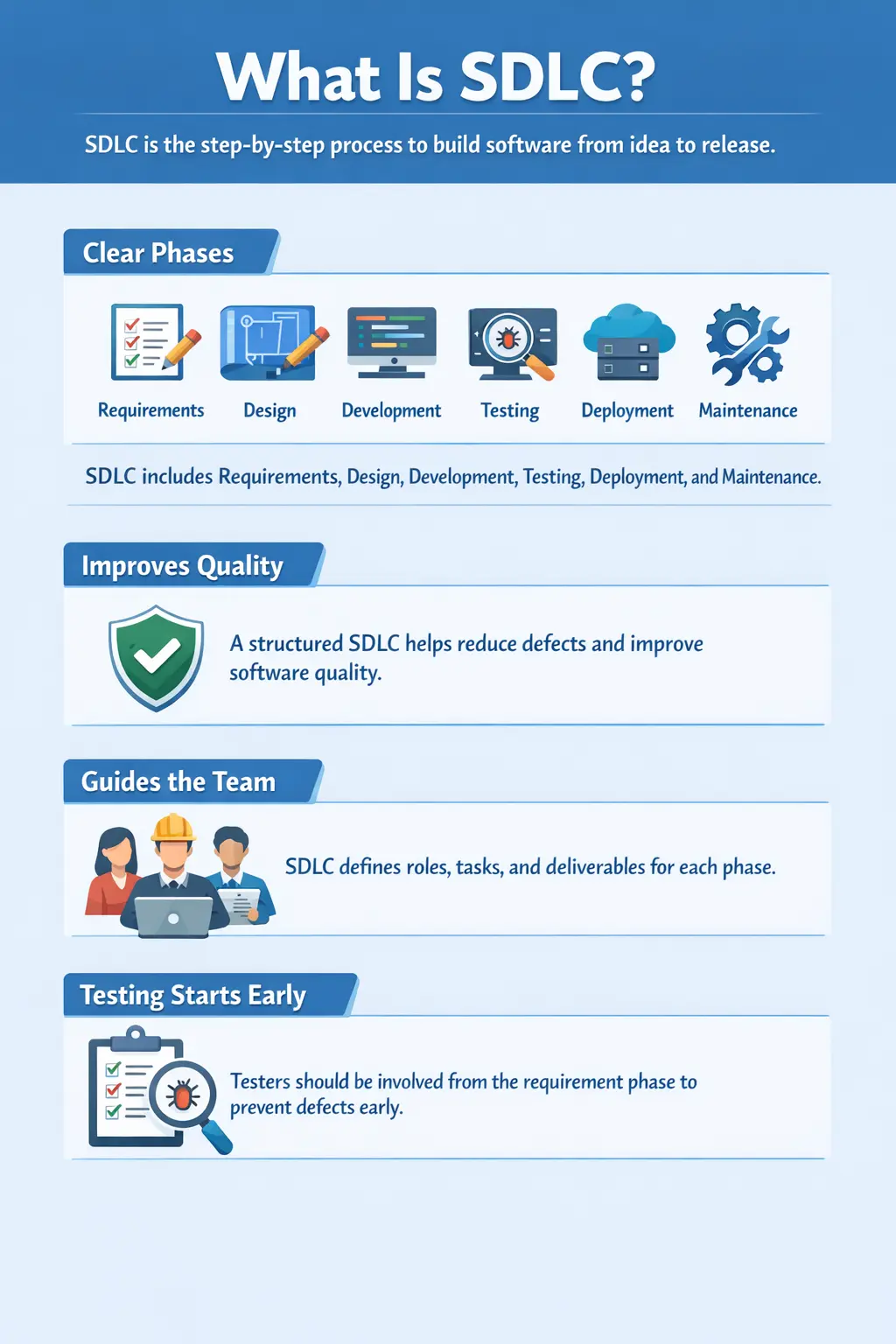
The Software Development Life Cycle, commonly known as SDLC, is a structured process that defines how software is planned, built, tested, deployed, and maintained. It provides a clear framework for transforming an idea into a working software product. In simple terms, SDLC answers the question: how is software built from idea to production?
SDLC is not just a technical concept; it is a project discipline that ensures software is developed in a controlled, predictable, and quality-focused manner.
SDLC as a Quality and Delivery Framework
SDLC is often introduced as a sequence of phases, but in real projects it is more than a checklist. It is a quality and delivery framework that helps teams move from an idea to a usable product with controlled risk. Every phase exists for a reason. Requirement analysis reduces misunderstanding. Design reduces technical uncertainty. Development turns the plan into working software. Testing evaluates behavior and exposes defects. Deployment moves the product into real use. Maintenance keeps the product valuable after release.
Without SDLC discipline, software work can become reactive and chaotic. Teams may start coding before requirements are clear, discover design problems late, test only at the end, or release without enough confidence. SDLC provides structure so that work is not driven only by urgency. It gives teams a way to plan, review, validate, and improve. This structure is especially important when projects involve multiple stakeholders, changing requirements, complex integrations, compliance needs, or high business risk.
Why SDLC Matters to Business Stakeholders
Business stakeholders care about outcomes: useful features, predictable delivery, controlled cost, and reliable software. SDLC supports these goals by creating visibility and checkpoints. Stakeholders can see what requirements are being gathered, what designs are proposed, what is being developed, what has been tested, what defects remain, and whether the product is ready for release. This visibility helps prevent unpleasant surprises near the end of a project.
SDLC also supports decision-making. If a requirement changes, the team can analyze its impact on design, development, testing, deployment, and schedule. If a defect is found late, the team can assess severity, business impact, and release risk. If testing reveals gaps, stakeholders can decide whether to fix, defer, or adjust scope. A disciplined lifecycle turns software delivery into a managed process rather than a series of disconnected tasks.
Why SDLC Matters to Testers
SDLC knowledge is essential for testers because testing is not limited to test execution. Testers add value throughout the lifecycle. During requirement analysis, they identify ambiguity, missing rules, edge cases, and testability gaps. During design, they think about validation approach, data needs, environment needs, and integration risks. During development, they prepare test cases and understand feature behavior. During testing, they execute, report, retest, and communicate quality. During deployment and maintenance, they support release checks, regression testing, and production defect analysis.
A tester who understands SDLC can work proactively. Instead of waiting for a completed build, they participate early and reduce defect cost. They understand when to prepare test data, when to review requirements, when to raise environment concerns, and when to perform regression. This makes testing more strategic. SDLC helps testers understand not only what to test but also when and why to test.
Requirement Analysis in Depth
Requirement analysis is the foundation of SDLC because every later phase depends on the quality of requirements. If requirements are unclear, incomplete, contradictory, or unrealistic, design and development will carry those problems forward. Requirement defects are often expensive when found late because the team may have already built the wrong behavior. Strong requirement analysis prevents this by clarifying user needs, business rules, constraints, and acceptance expectations early.
Functional requirements describe what the system should do, such as allowing login, generating reports, processing payments, or creating orders. Non-functional requirements describe how well the system should perform, such as security, performance, usability, reliability, compatibility, and scalability. Both are important. A system may meet functional requirements but still fail users if it is slow, insecure, confusing, or unstable.
Manual testers play an important role in this phase. They review requirements with a testing mindset. They ask what should happen with invalid data, missing fields, duplicate records, boundary values, unauthorized users, expired sessions, or interrupted workflows. These questions help reveal gaps that may not be obvious during business discussion. Early tester involvement is one of the strongest ways to reduce downstream defects.
Design Phase in Depth
The design phase converts requirements into a solution approach. This may include high-level architecture, low-level design, database design, user interface design, API design, integration design, security design, and deployment architecture. The purpose is to decide how the system will satisfy the requirements before coding begins. Good design reduces technical risk and makes development more predictable.
Testers contribute by thinking about testability. Can the feature be tested through the UI, API, or database? Is there a way to create required test data? Are error states visible? Are logs available for troubleshooting? Are user roles and permissions clear? Does the design support automation? Are integrations mockable or controllable in test environments? These questions help avoid designs that are technically possible but difficult to validate.
Design reviews are valuable because they catch problems before code exists. For example, if a report design does not define sorting, filtering, export format, or access permissions, testers can raise those gaps early. If an API design does not define error responses clearly, QA and developers can clarify before implementation. Design-phase feedback improves both quality and efficiency.
Development Phase in Depth
The development phase is where the software is implemented. Developers write code, create database changes, build APIs, implement user interfaces, integrate services, and perform unit testing. In disciplined teams, development also includes code reviews, static analysis, local testing, and adherence to coding standards. These practices reduce defects before the software reaches formal testing.
Testers are not idle during development. They prepare detailed test cases, test data, traceability, exploratory charters, and automation scripts where appropriate. They clarify open questions with developers and business stakeholders. They may review unit test scope, understand implementation risks, and prepare regression coverage. This parallel preparation makes the testing phase more efficient once a build is available.
Collaboration during development reduces rework. If a developer is unsure about expected behavior, the tester and business analyst can clarify before code is complete. If QA identifies that a feature will be hard to test without an API or specific data setup, the team can adjust early. SDLC does not require testers to wait passively; it encourages coordinated work across roles.
Testing Phase in Depth
The testing phase evaluates the developed software against requirements, acceptance criteria, business expectations, and quality attributes. Testers execute planned test cases, perform exploratory testing, validate positive and negative flows, check boundary conditions, verify integrations, log defects, retest fixes, and perform regression testing. The goal is not only to find bugs but also to provide reliable information about product quality.
Testing can include multiple levels and types. Functional testing checks whether features work correctly. Integration testing checks whether components interact properly. System testing validates the complete application. Regression testing checks whether existing behavior still works after changes. Non-functional checks may include usability, compatibility, accessibility, performance observations, and security-related validation depending on project scope.
The output of testing is evidence. Test execution status, defect reports, screenshots, logs, test summary reports, risk notes, and release recommendations help stakeholders decide whether the product is ready. A mature tester communicates not only pass and fail counts but also coverage, open risks, blocked areas, critical defects, and confidence level.
Deployment Phase in Depth
Deployment is the transition from a controlled development or test environment to a live or production-like environment. This phase may involve release planning, build packaging, configuration, database migration, infrastructure changes, environment validation, user communication, release notes, rollback planning, and production smoke testing. Deployment is critical because a feature that works in a test environment may fail if configuration, data, permissions, or integrations differ in production.
Testers often support deployment by performing smoke checks after release. Smoke testing verifies that critical functionality is available and that the deployed build is usable. Testers may also support user acceptance testing before final release, validate release notes, confirm defect fixes included in the build, and help assess release readiness. In some teams, QA signs off based on test results and known risks.
A good deployment process includes rollback thinking. If a release fails, the team should know how to recover. Testing does not end when the build passes in QA. The deployed product must still be checked in the target environment. This is why deployment is a distinct SDLC phase rather than simply copying files or pushing code.
Maintenance Phase in Depth
Maintenance begins after release and continues for the life of the product. Software rarely remains unchanged. Users report issues, business needs evolve, security updates become necessary, performance tuning is required, and new enhancements are requested. The maintenance phase handles bug fixes, minor changes, upgrades, environment updates, and continuous improvement.
Testers are important in maintenance because every change can create regression risk. A small bug fix may affect related workflows. A library upgrade may introduce compatibility issues. A production defect may require root cause analysis and a new regression test. Test cases must be updated as the product evolves. Maintenance testing keeps the product stable over time.
Production feedback is also valuable. Defects found by users reveal gaps in earlier SDLC phases. If many production issues come from unclear requirements, requirement review must improve. If many issues come from integration failures, integration testing may need strengthening. Maintenance is not only support; it is a source of learning for improving future delivery.
SDLC Models and How They Change the Flow
SDLC phases are common, but different models arrange them differently. In the Waterfall model, phases generally move in a linear sequence. Requirements are completed before design, design before development, development before testing, and so on. This model can work when requirements are stable and the project needs formal documentation, but it is less flexible when change is frequent.
The V-Model connects development phases with corresponding testing phases. Requirement analysis maps to acceptance testing, system design maps to system testing, architecture design maps to integration testing, and module design maps to unit testing. This model emphasizes early test planning and traceability. Agile models, on the other hand, organize work into iterations where requirements, design, development, testing, and feedback happen continuously in smaller increments.
Iterative and incremental models allow the product to evolve through repeated cycles. Each cycle delivers part of the system, receives feedback, and improves. The best model depends on project context, regulatory requirements, team maturity, requirement stability, delivery urgency, and risk. A tester should understand the model because it affects when testing activities happen and how feedback is handled.
SDLC and Shift-Left Testing
Shift-left testing means moving testing activities earlier in the lifecycle. Instead of waiting until after development, testers participate in requirement review, design discussions, test planning, and early validation. This approach aligns strongly with SDLC because it improves quality at each phase rather than treating testing as a final gate.
Shift-left testing reduces cost because defects found early are cheaper to fix. A missing business rule found during requirement review may take minutes to correct. The same issue found after release may require code changes, retesting, deployment, user communication, and support work. Early testing is not only a QA practice; it is a business cost-control practice.
Manual testers can shift left by asking better questions, reviewing acceptance criteria, identifying test data needs, planning negative scenarios, and checking testability before development begins. Automation engineers can shift left by creating unit, API, and integration checks earlier. The principle is the same: quality should be built in, not inspected only at the end.
SDLC Deliverables
Each SDLC phase produces deliverables that help the project move forward. Requirement analysis may produce business requirement documents, user stories, acceptance criteria, use cases, and requirement traceability. Design may produce architecture diagrams, database designs, wireframes, API contracts, and technical design documents. Development produces source code, unit tests, builds, and code review records.
Testing produces test plans, test scenarios, test cases, test data, defect reports, execution reports, test summary reports, and sign-off recommendations. Deployment produces release notes, deployment plans, rollback plans, production verification results, and release approvals. Maintenance produces change requests, hotfix records, updated documentation, regression results, and production issue analysis.
These deliverables are not paperwork for its own sake. They create traceability, communication, and evidence. In regulated or enterprise environments, deliverables may be required for audit and compliance. Even in Agile teams, lightweight deliverables help preserve shared understanding and support future maintenance.
Common SDLC Risks
Common SDLC risks include unclear requirements, unstable scope, poor communication, weak design review, insufficient testing, unrealistic schedules, environment instability, poor test data, late defect discovery, and weak deployment planning. These risks affect quality, cost, and delivery confidence. A structured SDLC helps identify and manage them, but only if the team actually follows the process thoughtfully.
One major risk is treating SDLC phases as isolated handoffs. If business analysts write requirements and disappear, developers may misinterpret them. If developers build without QA involvement, testability gaps may appear. If testers are involved only at the end, defects become expensive. Collaboration across phases is essential. SDLC should connect roles, not separate them.
Another risk is excessive process without practical value. SDLC should provide clarity and control, not unnecessary bureaucracy. The right level of process depends on project context. A safety-critical system requires more rigor than a small internal tool. The goal is disciplined delivery, not blind documentation.
Real-World Example: Password Reset Feature
Consider a password reset feature. During requirement analysis, the team defines who can request a reset, how the reset link is sent, how long it remains valid, what password rules apply, and what messages users see. Testers ask about invalid emails, expired links, reused links, locked accounts, and security concerns. During design, the team decides token generation, email integration, database storage, expiry handling, and audit logging.
During development, developers implement the workflow and unit test token logic. Testers prepare functional, negative, boundary, security-related, and regression scenarios. During testing, QA validates successful reset, invalid email handling, expired link behavior, password complexity, old password invalidation, email delivery, and login with the new password. During deployment, smoke checks confirm that reset works in the target environment. During maintenance, production issues or enhancements are tested and regression coverage is updated.
This example shows SDLC as a connected lifecycle. A simple feature passes through requirement, design, development, testing, deployment, and maintenance. Each phase adds value, and each role contributes. If any phase is weak, the final product becomes riskier.
Interview-Ready Understanding of SDLC
In interviews, SDLC can be explained as a structured process used to plan, build, test, deploy, and maintain software. The major phases are requirement analysis, design, development, testing, deployment, and maintenance. A strong answer should explain that SDLC improves quality, predictability, collaboration, risk control, and project visibility. It should also mention that testers add value from the early phases, not only during test execution.
A practical answer should connect SDLC with real tester responsibilities. During requirement analysis, testers review requirements and identify gaps. During design, they check testability. During development, they prepare test cases. During testing, they execute and report defects. During deployment, they support smoke and acceptance testing. During maintenance, they validate fixes and perform regression. This shows practical understanding rather than memorized phase names.
Purpose of SDLC
The purpose of SDLC is to bring structure and discipline to software development. By following defined phases, teams can plan work more effectively, track progress, and manage risks. SDLC helps improve quality by introducing checkpoints and reviews throughout the lifecycle. It also clarifies roles, responsibilities, and deliverables so that everyone understands their contribution.
A well-followed SDLC reduces surprises, improves collaboration, and increases the likelihood of successful delivery.
Key Phases of SDLC
Requirement Analysis
This is the foundation of the entire lifecycle. During this phase, business and user needs are gathered and analyzed. Both functional and non-functional requirements are identified and documented.
Manual testers play an important role here by reviewing requirements for clarity and completeness. They look for ambiguities, missing scenarios, and edge cases. By asking “what-if” questions, testers help prevent misunderstandings before development begins. Typical outputs from this phase include requirement documents and user stories.
Design
In the design phase, the solution is planned in detail. This includes system architecture, database structures, and interface designs. The goal is to define how the system will meet the requirements.
Manual testers contribute by participating in design walkthroughs and identifying testability concerns. They start thinking about how features can be validated and may outline high-level test scenarios. Design documents and wireframes are common outcomes of this phase.
Development
This is the phase where coding takes place and unit testing is performed by developers. Features are built according to the design specifications.
Manual testers use this time to deeply understand feature behavior and prepare detailed test cases. They review test cases internally to ensure good coverage. The main outputs here are source code and unit test results.
Testing
The testing phase focuses on evaluating the developed software. Test cases are executed, defects are logged, and fixes are verified. Regression testing ensures that new changes do not break existing functionality.
Manual testers validate requirements, perform functional and relevant non-functional checks, and communicate quality status. Test execution reports and defect reports are key deliverables in this phase.
Deployment
During deployment, the software is released to production or a live environment. This is a critical transition from development to real-world usage.
Manual testers often support user acceptance testing, perform smoke checks on the deployed build, and provide release recommendations. Release notes and sign-off documents are typically produced.
Maintenance
After release, the software enters the maintenance phase. Bug fixes, enhancements, and updates are handled here.
Manual testers validate fixes, perform regression testing, and help investigate production issues. Test cases and reports are updated as the system evolves.
SDLC Models Overview
SDLC can be implemented using different models depending on project needs. Common models include Waterfall, V-Model, Agile, and Iterative approaches. Each model organizes the same core phases differently, with varying emphasis on sequence, feedback, and flexibility.
SDLC and STLC
SDLC represents the full software lifecycle, while STLC (Software Testing Life Cycle) focuses specifically on testing activities. STLC exists within SDLC and aligns testing tasks with development progress. Understanding this relationship helps testers know when and how to contribute.
Importance of SDLC for Manual Testers
For manual testers, SDLC knowledge is essential. It shows where testing fits and why early involvement matters. When testers engage from the requirement and design stages, they can plan better, collaborate more effectively with developers, and help reduce defect costs. Testing is most effective when it is continuous, not delayed.
A Practical Scenario
If requirement analysis is weak, the impact spreads across later phases. Test cases become unclear, misunderstandings increase, and more defects appear during testing. Fixing these issues later raises cost and delays delivery. Strong early-phase involvement prevents these problems.
Common Pitfalls
Some teams assume testing begins only after development, which limits its value. Others skip requirement reviews or exclude testers from early discussions. These practices often lead to higher defect rates and rework.
Interview Perspective
In interviews, SDLC is typically described as the structured process that guides software from requirements to maintenance. A strong answer highlights how SDLC ensures quality, predictability, and risk control. Mentioning tester involvement across phases demonstrates practical understanding.
Key Takeaway
Manual testers add the most value when they are involved early and remain engaged throughout the SDLC. SDLC is not just a sequence of steps; it is a quality framework. When followed thoughtfully, it helps teams build better software with fewer surprises and lower risk.