Unit Testing: A Foundation for Early Defect Detection
Introduction to Unit Testing
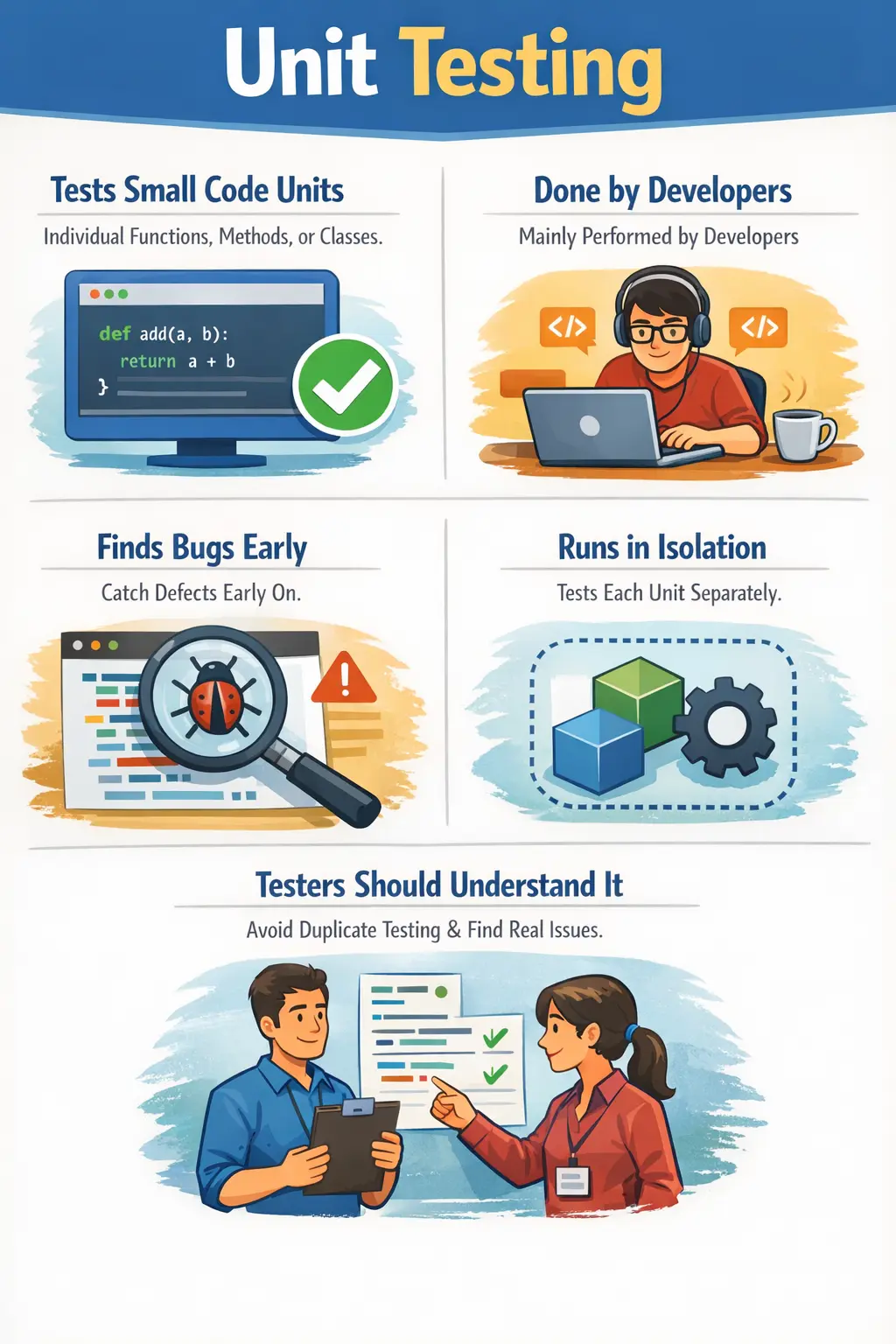
Unit testing is the practice of testing individual units of code—such as functions, methods, or classes—to verify that they work correctly in isolation. A “unit” is the smallest testable part of an application. The goal is to confirm that each piece of logic behaves as expected before it is combined with other parts of the system.
Why Unit Testing Is a Foundation for Quality
Unit testing is often described as the first practical testing layer in the software development process. It works close to the code, before the application is assembled into larger workflows and before testers begin validating the product from a user or business perspective. This early position makes unit testing important because many defects begin as small logic mistakes. A wrong condition, an incorrect calculation, an unexpected null value, or a missed boundary case may look minor inside a function, but it can later create serious failures when that function becomes part of a larger business process.
In a real software project, quality is strongest when defects are prevented or detected as early as possible. If a developer writes a method to calculate tax, discount, eligibility, interest, or account balance, that logic should not wait until system testing to be checked for the first time. By then, the code may already be connected to screens, APIs, databases, and other services. A small issue becomes harder to isolate because many parts are involved. Unit testing checks the logic while it is still small and understandable.
For manual testers, unit testing is not usually a hands-on responsibility, but it is still important to understand. A tester who knows the role of unit testing can better understand why some defects should have been caught earlier, why some issues appear only during integration, and why higher-level testing should focus on behavior rather than repeating every internal code path. This knowledge helps testers work more effectively with developers and test leads.
Understanding the Meaning of a Unit
A unit is the smallest testable piece of software logic. In one application, a unit may be a function that returns a calculated value. In another, it may be a method inside a class, a validation rule, a service method, a utility function, or a small module. The exact size of a unit depends on the programming language, architecture, and design style, but the principle remains the same: the unit should be testable in isolation from the rest of the system.
Isolation is the key idea. When a unit is tested, the test should focus only on that unit's logic, not on the database, network, user interface, third-party services, or external systems. If a function depends on another service, developers may use mocks, stubs, or fake objects to simulate that dependency. This allows the test to check whether the unit behaves correctly without being affected by unrelated failures outside the unit.
This is very different from system testing. In system testing, the goal is to see whether the full application works together. In unit testing, the goal is narrower: does this small piece of logic return the expected result for a given input? Because the focus is narrow, unit tests can be executed quickly and repeatedly. That speed is one of their biggest strengths.
Purpose of Unit Testing in the Development Lifecycle
The main purpose of unit testing is to verify that small code components work correctly before they are combined with other components. This supports early defect detection. When a defect is found during unit testing, the developer is usually still working in the same code area. The logic is fresh in mind, the failure is easier to debug, and the cost of fixing it is low. This is much more efficient than finding the same issue weeks later during system testing or after production release.
Unit testing also supports better code design. Code that is hard to unit test is often tightly coupled, overly complex, or dependent on too many external systems. When developers write unit tests, they are encouraged to break logic into smaller, clearer, reusable components. This improves maintainability. A well-tested method usually has a clear responsibility, predictable inputs, and understandable outputs.
Another purpose of unit testing is to protect existing behavior from accidental breakage. When developers make code changes, existing unit tests can be rerun quickly. If a previously working unit now fails, the developer receives immediate feedback. This makes unit testing an important part of regression prevention at the code level. It does not replace full regression testing, but it reduces the number of technical issues that reach later test phases.
Who Performs Unit Testing and Why
Unit testing is mainly performed by developers because it requires knowledge of code structure, programming logic, and internal implementation. Developers write the unit tests, execute them during development, and maintain them when the code changes. In many teams, unit tests are also executed automatically as part of build pipelines so that code changes are checked before they are merged or deployed.
Manual testers normally do not write unit tests. This is an important boundary to understand. Manual testing focuses more on business behavior, user workflows, integration behavior, usability, data flow, and end-to-end validation. Unit testing focuses on internal code correctness. However, testers may still review unit test reports, ask whether critical logic has unit coverage, or discuss repeated defects with developers to understand whether unit test coverage should be improved.
In mature teams, unit testing is not treated as a private developer activity with no connection to QA. Instead, it becomes part of the overall quality conversation. Developers own the unit tests, but testers benefit from knowing which logic has been validated and which areas may still require stronger higher-level coverage. This collaboration creates a layered testing approach.
How Unit Testing Works in Practice
A unit test usually follows a simple pattern. First, the test prepares the required input or setup. Then it calls the unit being tested. Finally, it checks whether the actual output matches the expected output. This pattern is often described as arrange, act, and assert. Arrange means preparing test data or objects. Act means executing the method or function. Assert means verifying the result.
For example, suppose an application has a function that calculates the final price after applying a discount. A unit test may pass a base price of 100 and a discount of 10 percent, then expect the result to be 90. Another test may check what happens when the discount is zero. Another may check an invalid discount value. By writing several small tests, developers verify that the calculation behaves correctly for normal, boundary, and negative situations.
Unit tests are usually automated because they need to run frequently. Developers may run them after every code change. Build systems may run them whenever code is committed. Continuous integration pipelines may block a merge if unit tests fail. This gives the team fast feedback and prevents obvious technical mistakes from moving forward.
Positive, Negative, and Edge Case Unit Tests
Good unit testing does not check only the happy path. A happy path verifies that the unit works when valid and expected input is provided. This is necessary, but it is not enough. Real defects often appear when data is missing, values are at boundaries, inputs are invalid, or assumptions are broken. Strong unit tests cover these situations as well.
Positive unit tests confirm expected behavior. For example, a login validation method may return true when the username and password follow all required rules. Negative unit tests check invalid situations. The same method may return false when the password is empty, too short, or contains unsupported characters. Edge case tests check boundary values, such as the minimum allowed password length or the maximum allowed transaction amount.
This is where unit testing becomes especially valuable. Many defects occur at boundaries. A calculation may work for normal values but fail for zero, negative numbers, maximum values, decimals, empty strings, or null input. When developers write unit tests for these cases, they reduce the chance that basic logic defects will reach integration or system testing.
Isolation, Mocks, and Stubs
Isolation is one of the defining characteristics of unit testing. A unit should be tested independently so that the result clearly shows whether the unit itself works. In real applications, however, code often depends on databases, APIs, file systems, message queues, configuration services, or other classes. If a unit test depends on all of these real systems, it becomes slower, less reliable, and harder to diagnose.
To solve this, developers often use mocks and stubs. A stub provides predefined responses to support the test. A mock can also verify whether a dependency was called correctly. For example, if a service method sends an email after registration, a unit test should not send a real email. Instead, a mock email service can confirm that the method attempted to send the email with the expected details.
Manual testers do not need to become experts in mocking frameworks, but they should understand the concept. Unit testing isolates logic. Higher-level testing checks whether real components work together. If a feature passes unit tests but fails in system testing, the issue may be in integration, configuration, data flow, environment setup, or interaction between components rather than in the isolated unit itself.
Unit Testing and Integration Testing
Unit testing and integration testing are closely connected but have different goals. Unit testing verifies small pieces of code independently. Integration testing verifies whether multiple components work together correctly. A unit may pass all its tests and still fail when connected to another unit because of mismatched data formats, wrong assumptions, incorrect contracts, missing configuration, or timing issues.
For example, a unit test may confirm that a method correctly creates an order object. Another unit test may confirm that a payment service accepts a payment request object. But integration testing is needed to verify whether the order component sends the payment request in the exact format expected by the payment service. This is why unit testing cannot replace integration testing.
Manual testers often become more involved from integration testing onward. They validate workflows, component interactions, API behavior, data movement, and business scenarios. Understanding unit testing helps them avoid blaming the wrong layer. If individual units are validated but the workflow fails, the likely defect may be in the connection between units.
Unit Testing and System Testing
System testing evaluates the complete application as a whole. It checks whether the product meets business requirements and supports real user workflows. Unit testing, on the other hand, evaluates internal logic at the code level. Both are necessary because they answer different questions. Unit testing asks, "Does this small piece of logic work?" System testing asks, "Does the application work correctly for the user?"
A feature can pass unit testing and still fail system testing. For example, each calculation method may work correctly in isolation, but the user interface may send the wrong input. The database may store values in the wrong format. The business workflow may call functions in the wrong order. The application may fail under real user conditions. These issues are outside the scope of unit testing.
This layered approach is important for quality. Unit testing reduces technical defects early. Integration testing checks component communication. System testing validates full behavior. User acceptance testing confirms business suitability. When each level does its job, overall testing becomes more efficient and reliable.
Manual Tester Perspective on Unit Test Results
Manual testers may not execute unit tests, but unit test results can still provide useful context. If a build arrives for testing with many failed unit tests, the build may not be ready for higher-level validation. Starting system testing on such a build can waste time because failures may be caused by basic code defects that developers already know about. In this sense, unit test results can act as an early quality signal.
Testers can also use unit test awareness during defect analysis. Suppose a tester finds an issue in a business calculation. If the calculation method has no unit tests, the defect may indicate a gap at the code level. If the method has strong unit tests, the issue may be due to wrong input, integration behavior, or business rule misunderstanding. This helps testers write clearer defect reports and collaborate more effectively with developers.
Testers can ask practical questions without overstepping responsibility boundaries. Has this business rule been covered by unit tests? Are boundary values covered? Are negative cases covered? Did the unit tests run successfully in the latest build? These questions improve quality conversations and help teams prevent repeated defects.
Benefits of Unit Testing
Unit testing provides several important benefits. The first benefit is early defect detection. Defects found during development are usually cheaper and faster to fix than defects found during system testing or production. Early detection also reduces rework because the problem is corrected before it spreads into other components.
The second benefit is fast feedback. Unit tests run quickly, so developers can execute them many times during coding. This encourages frequent checking and reduces the risk of accumulating hidden defects. Fast feedback supports continuous integration and helps teams maintain stable builds.
The third benefit is safer code change. When developers refactor code or add new features, existing unit tests help confirm that old behavior still works. This reduces the fear of changing code and supports better maintainability. Unit tests also serve as a form of technical documentation because they show expected behavior through examples.
Limitations of Unit Testing
Unit testing is powerful, but it has clear limitations. It does not validate complete user workflows. It does not confirm whether the user interface is usable. It does not prove that all components communicate correctly. It does not validate deployment configuration, browser behavior, environment differences, database migration, or real production-like usage. These areas require higher-level testing.
Unit testing also depends on the quality of the tests themselves. Poor unit tests may check only simple cases and miss important boundaries. Tests may be written after the fact only to increase coverage numbers, without meaningful assertions. High unit test coverage does not automatically mean high quality. Coverage tells how much code was executed by tests, but it does not guarantee that the right behaviors were verified.
Another limitation is that unit tests may become outdated if requirements change and tests are not updated. A test that once represented correct behavior may later represent old behavior. Developers must maintain unit tests along with production code. Otherwise, tests can become misleading or burdensome.
Common Misconceptions About Unit Testing
A common misconception is that unit testing eliminates the need for manual testing. This is incorrect. Unit testing validates internal logic, while manual testing often validates workflows, user behavior, visual behavior, exploratory scenarios, and business usefulness. A system with excellent unit tests can still have confusing screens, broken integrations, missing validations, or incorrect business flow.
Another misconception is that manual testers do not need to know anything about unit testing. While testers do not need to write unit tests in most manual testing roles, understanding the concept improves their ability to reason about defects. It helps them distinguish code-level problems from integration problems and communicate more clearly with developers.
A third misconception is that passing unit tests means a feature is bug-free. Passing unit tests means the tested units behaved as expected under the conditions covered by those tests. It does not mean every input, interaction, environment, or business scenario has been validated. Unit testing is a foundation, not a final guarantee.
Real-World Example of Unit Testing Impact
Consider a banking application that calculates loan eligibility. The calculation may depend on income, credit score, age, employment type, existing debt, and loan amount. If this logic is not unit tested, many basic defects may reach system testing. Testers may find that eligible users are rejected, ineligible users are approved, or boundary values are handled incorrectly. Each defect then requires investigation across the user interface, service layer, database, and business rules.
If the calculation method has strong unit tests, many of these defects are caught earlier. Developers can test valid applicants, invalid applicants, boundary ages, minimum income, maximum debt, missing values, and special business rules directly at the code level. By the time the feature reaches system testing, manual testers can focus on end-to-end flows: entering applicant details, saving data, viewing decisions, checking approval messages, and confirming integration with downstream systems.
This does not reduce the importance of manual testing. It makes manual testing more valuable by allowing testers to spend less time discovering basic code defects and more time validating real business behavior. That is the practical benefit of a strong unit testing foundation.
How Unit Testing Supports Better Collaboration
Unit testing can improve collaboration between developers and testers when both sides understand its role. Developers use unit tests to protect code correctness. Testers use higher-level tests to validate behavior and risk. When a defect is found, both can discuss the likely layer of failure. Is the logic wrong? Is the input wrong? Is the integration wrong? Is the requirement misunderstood? This shared language reduces blame and speeds up root cause analysis.
Testers can also help by sharing defect patterns. If the same type of boundary defect appears repeatedly in system testing, the team may need better unit tests around boundary values. If negative scenarios frequently fail, developers may need stronger unit tests for invalid input. This feedback loop turns manual testing discoveries into improvements at the unit level.
In strong teams, testing is not separated into isolated ownership boxes. Developers care about product quality, testers understand technical quality signals, and both groups work toward fewer defects reaching users. Unit testing is one part of that shared quality system.
Interview-Ready Understanding of Unit Testing
In interviews, unit testing should be explained as the testing of individual code components in isolation to verify that they work correctly. A strong answer should mention that it is mainly performed by developers, usually automated, fast to execute, and focused on internal logic. It should also clarify that unit testing does not replace integration testing, system testing, or user acceptance testing.
For a manual testing interview, the best explanation connects unit testing to the tester's work. You can say that manual testers do not usually write unit tests, but they should understand unit testing because it helps them analyze defects, avoid duplicate effort, understand test coverage at different levels, and focus system testing on business workflows and integration behavior. This shows practical understanding rather than just memorization.
A concise interview answer could be: Unit testing is a developer-level testing activity where individual functions, methods, or classes are tested independently to confirm their logic works as expected. It helps catch defects early, improves code quality, and provides fast feedback. Manual testers should understand it so they can design better higher-level tests and collaborate effectively with developers.
Final Practical Guidance
Unit testing should be seen as an early quality filter. It catches many technical defects before the application reaches broader testing. It improves developer confidence, supports clean design, and reduces avoidable failures in later phases. However, it is only one layer of testing. It cannot prove that the full product meets business needs or works correctly in real user scenarios.
Manual testers should respect unit testing as a foundation while also recognizing its limits. The goal is not to duplicate developer unit tests manually. The goal is to build on them. If internal logic is already checked at the unit level, testers can focus on workflows, integrations, usability, data consistency, negative scenarios, and user value.
The simplest way to remember unit testing is this: it checks the smallest pieces before the full system is tested. When those pieces are reliable, higher-level testing becomes more focused and effective. Strong software quality depends on this layered approach, where unit testing catches early code defects and manual testing validates the product from a user and business perspective.
From a manual tester’s perspective, unit testing is primarily a developer activity. However, understanding it is important because it influences overall product quality and affects how higher-level testing should be approached.
Purpose of Unit Testing
Unit testing focuses on validating the correctness of small code components. By catching defects at the earliest stage, it prevents issues from spreading into integration or system testing. This early detection improves code quality and often leads to better design, since code that is easy to unit test is usually modular and well-structured.
Finding problems at the unit level is cheaper and faster than discovering them later in the lifecycle.
Who Performs Unit Testing
Unit testing is mainly performed by developers as part of development. They write and run tests to verify their code. Manual testers typically do not execute unit tests themselves, but they may review unit test results, understand failures reported at this level, and collaborate with developers when issues appear.
This shared understanding helps avoid confusion about where a defect originates.
What Counts as a Unit
A unit can be a single function, a method within a class, a full class, or a small module. The defining idea is that the component can be tested independently from the rest of the system. External dependencies are often mocked or simulated so that the test focuses only on the unit’s logic.
Key Characteristics of Unit Testing
Unit tests concentrate on internal logic rather than user-facing behavior. They run in isolation and execute quickly, which allows developers to run them frequently. Good unit tests cover both expected inputs and edge or negative scenarios, ensuring logic is reliable under different conditions.
Because they are fast and automated, unit tests support rapid feedback during development.
Manual Tester’s Role and Perspective
Manual testers are not responsible for writing or running unit tests, but they benefit from understanding what has already been validated. Knowing which components are unit tested helps testers focus on integration points and business workflows instead of re-checking internal logic unnecessarily.
Testers can also identify potential gaps in coverage by noticing patterns of repeated defects. This can prompt useful discussions with developers about strengthening unit tests.
Unit Testing Compared to System Testing
Unit testing and system testing serve different purposes. Unit testing examines a single component in a development environment and focuses on code correctness. System testing evaluates the entire application in a test environment and focuses on business behavior and user flows.
Both are necessary. Unit testing builds a strong foundation, while system testing validates real-world behavior.
Why Manual Testers Should Understand Unit Testing
When testers understand unit testing, they can analyze defects more effectively and identify likely root causes. This reduces invalid defect reports and improves communication with developers. It also clarifies responsibility boundaries, making collaboration smoother.
A tester who knows what was already unit tested can design smarter and more targeted system tests.
Common Misunderstandings
A frequent misconception is that unit testing can replace system testing. In reality, even perfectly unit-tested code can fail when components interact. Another myth is that testers do not need to know anything about unit testing, which limits their effectiveness. It is also incorrect to assume that passing unit tests means a feature is completely bug-free.
Unit testing improves quality, but it does not guarantee it.
A Practical Scenario
If a calculation method has strong unit tests, a manual tester does not need to repeatedly verify every internal calculation path. Instead, the tester can focus on how that calculation fits into business scenarios and integrations. This avoids duplication and makes testing more efficient.
Interview Perspective
In interviews, unit testing is typically defined as testing individual code components in isolation. A tester-focused explanation highlights that it is mainly a developer activity, but testers should understand it to ensure proper coverage and avoid redundant testing.
Key Takeaway
Manual testers are not expected to execute unit tests, but understanding unit testing helps them test more intelligently at higher levels. Unit testing catches many technical issues early, allowing testers to concentrate on integration, workflows, and user value. This layered approach leads to stronger overall quality.