Scrum Framework
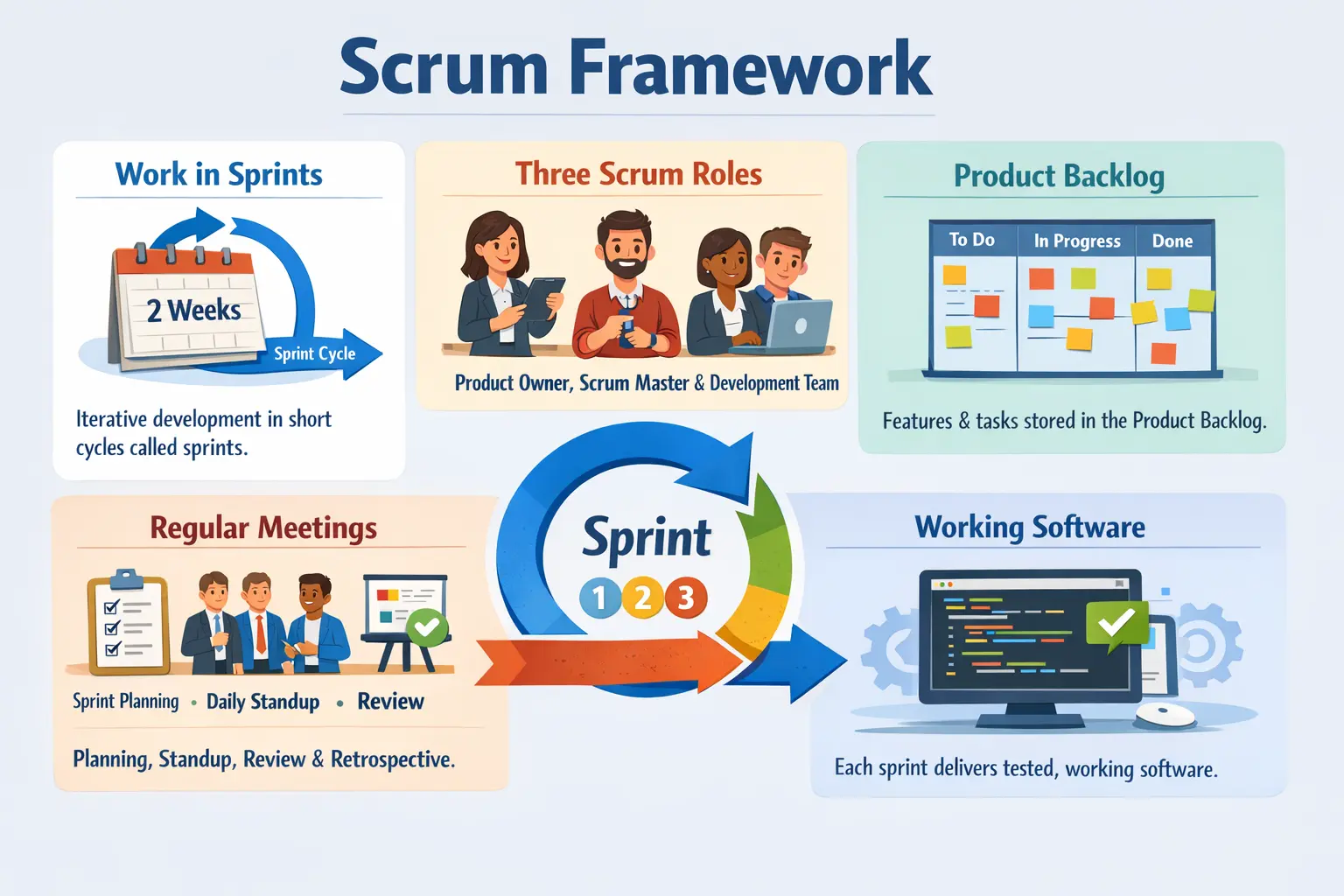
The Scrum Framework is one of the most widely used Agile frameworks for managing and delivering complex software products. Scrum provides a structured yet flexible approach that enables teams to deliver value incrementally through short development cycles called sprints. Instead of building an entire product over a long period and releasing it at once, Scrum focuses on delivering small, usable portions of the product regularly.
Scrum is built on the principles of collaboration, transparency, and continuous improvement. It allows teams to respond quickly to changing requirements while maintaining consistent product quality. By working in short iterations and gathering feedback frequently, Scrum helps teams reduce risks and improve outcomes.
Scrum answers an important question in modern software development: “How do we deliver value incrementally with continuous feedback?”
Understanding Scrum is essential for manual testers and software professionals because Scrum is widely used in real-world projects. Many organizations rely on Scrum to manage development and testing activities, making it a critical topic for both practical work and interviews.
For testers, Scrum changes the way quality work is planned and executed. Testing is not treated as a final phase after development. Instead, testers participate throughout the sprint, starting from backlog refinement and continuing through planning, development, test execution, defect verification, review, and retrospective. This continuous involvement helps teams find defects earlier and deliver usable increments more reliably.
Scrum is simple to describe but requires discipline to apply well. The framework gives teams a structure, but the team must still communicate clearly, refine work properly, manage risks, keep the backlog transparent, define quality expectations, and inspect progress honestly. When Scrum is used only as a set of meetings, it becomes shallow. When it is used as a framework for transparency, inspection, and adaptation, it becomes a strong delivery model.
Definition of Scrum Framework
The Scrum Framework is an Agile framework used to develop and maintain complex products through short, time-boxed iterations called sprints. It emphasizes transparency, regular inspection of progress, and continuous adaptation based on feedback.
Scrum provides a lightweight structure that defines roles, events, and artifacts to guide team collaboration and product development. It does not prescribe technical practices but instead focuses on managing work effectively.
The framework encourages teams to deliver working software frequently and improve continuously through feedback and reflection.
Scrum is called lightweight because it does not attempt to define every activity in detail. It does not tell teams exactly how to code, how to test, which tools to use, or how to design architecture. Instead, it defines a few essential roles, events, artifacts, and commitments. The team then chooses practical engineering and testing practices that help them meet sprint goals and deliver a valuable increment.
This flexibility is one reason Scrum is widely adopted. A web application team, mobile application team, API team, or enterprise product team can all use Scrum, but their technical practices may differ. What remains common is the use of short iterations, visible work, frequent feedback, and continuous improvement.
Origins and Evolution of Scrum
Scrum was introduced in the early 1990s as a way to improve software development productivity and adaptability. Traditional development approaches often struggled with changing requirements and long development cycles.
Scrum introduced an iterative approach where teams deliver small increments of functionality regularly. This approach allowed organizations to reduce risk and respond quickly to new business needs.
Over time, Scrum became one of the most popular Agile frameworks. Today, Scrum is used not only in software development but also in product management, marketing, and other industries.
The success of Scrum comes from its simplicity and effectiveness. It provides enough structure to guide teams while allowing flexibility to adapt to different project needs.
Scrum became popular because it addresses a common problem in software development: teams often learn important information only after they start building. Requirements may be unclear, technical assumptions may be wrong, and users may change their expectations after seeing working software. Scrum accepts this reality and creates regular opportunities to inspect and adapt.
Over time, Scrum has also influenced the way testing is performed. Instead of waiting for a full product to be ready, testers validate small increments. Instead of writing all tests from a complete specification at the beginning, testers refine test scenarios as stories become clearer. This makes testing more responsive to actual product evolution.
Core Pillars of Scrum
Scrum is based on three fundamental pillars: transparency, inspection, and adaptation. These pillars support the Scrum process and ensure continuous improvement.
Transparency
Transparency ensures that all aspects of the development process are visible to everyone involved. Work progress, requirements, and issues must be clearly communicated so that stakeholders can understand the current state of the project.
Transparency builds trust among team members and stakeholders. When everyone understands the current status of the project, decisions can be made more effectively.
In Scrum, transparency is achieved through artifacts such as product backlogs and sprint boards. These tools make work visible and help teams stay aligned.
For testers, transparency means sharing testing progress, defect status, and quality risks with the team. Clear communication helps prevent surprises and improves planning.
Transparency is especially important near the end of a sprint. If testing is incomplete, defects remain open, acceptance criteria are unclear, or regression impact is unknown, the team must know that clearly. Scrum does not benefit from hiding unfinished work. The purpose of transparency is to help the team make realistic decisions before problems become release surprises.
Inspection
Inspection involves regularly reviewing progress and product quality. Scrum includes several events where teams inspect their work and identify areas for improvement.
Regular inspection allows teams to detect problems early. Instead of discovering issues at the end of a project, Scrum teams identify and address problems continuously.
Inspection occurs during sprint reviews, daily scrums, and retrospectives. These events allow teams to evaluate their work and adjust as needed.
For testers, inspection includes validating features, reviewing defects, and ensuring that acceptance criteria are met.
Frequent inspection improves product quality and reduces risks.
Inspection is not limited to meetings. Test execution is also a form of inspection because testers inspect whether the software behaves as expected. Code review, test case review, product demos, exploratory testing, and defect triage all support inspection. The more frequently the team inspects the product and process, the earlier it can detect problems.
Adaptation
Adaptation involves making adjustments based on inspection results. When teams identify issues or improvement opportunities, they adapt their processes or plans.
Adaptation allows Scrum teams to respond quickly to changing requirements and challenges. Instead of following rigid plans, Scrum teams adjust their approach to achieve better results.
Adaptation occurs during sprint planning and retrospectives. Teams use feedback to improve future work.
For testers, adaptation may involve updating test scenarios, improving test coverage, or refining testing techniques.
Continuous adaptation ensures that the product evolves in the right direction.
Adaptation is valuable only when teams act on what they learn. If a sprint review reveals that a feature does not meet user expectations, the backlog should be adjusted. If a retrospective reveals that testing starts too late, the team should change its workflow. If defects repeatedly appear in one module, testing and development practices for that module should improve. Adaptation turns feedback into action.
Scrum Roles
Scrum defines three primary roles that work together to deliver the product. Each role has clear responsibilities that support the Scrum process.
Product Owner
The Product Owner is responsible for maximizing the value of the product. This role represents the business and ensures that the development team works on the most important features.
The Product Owner manages the product backlog, which contains all planned work for the product. Backlog items are prioritized based on business value.
The Product Owner also defines acceptance criteria for backlog items. Acceptance criteria describe the conditions that must be satisfied for a feature to be considered complete.
The Product Owner communicates with stakeholders and ensures that the product meets business needs.
For testers, the Product Owner is an important source of information. Testers often collaborate with the Product Owner to clarify requirements and acceptance criteria.
The Product Owner is also important for priority decisions. When testers find defects or identify unclear behavior, the Product Owner helps decide business impact. Some issues must be fixed before a story can be accepted, while others may become backlog items for later improvement. This collaboration keeps testing aligned with business value.
A strong Product Owner helps testers by writing clear user stories, maintaining a prioritized backlog, answering questions quickly, and being available during sprint execution. When the Product Owner is unavailable or requirements are vague, testing becomes slower and defects become more likely.
Scrum Master
The Scrum Master is responsible for ensuring that the Scrum framework is followed correctly. The Scrum Master acts as a facilitator and helps the team work efficiently.
The Scrum Master organizes Scrum events and removes obstacles that slow down the team. These obstacles may include technical issues, communication problems, or resource limitations.
The Scrum Master also helps team members understand Scrum principles and practices.
Unlike traditional project managers, Scrum Masters do not assign tasks. Instead, they support self-organizing teams.
For testers, the Scrum Master helps resolve testing environment issues and removes testing blockers.
The Scrum Master ensures that the team can focus on delivering quality work.
For testers, the Scrum Master can be very helpful when testing is blocked. Common blockers include unstable environments, delayed builds, missing test data, unclear dependencies, unavailable stakeholders, or repeated interruptions. The Scrum Master helps surface and remove these blockers so the team can maintain sprint flow.
The Scrum Master also protects Scrum values. If testing is always pushed to the end of the sprint, the Scrum Master may help the team inspect its workflow and adapt. If team members work in silos, the Scrum Master encourages collaboration. If retrospectives do not lead to improvement, the Scrum Master helps the team create practical action items.
Development Team
The Development Team consists of professionals who build and deliver the product. The team is cross-functional, meaning it includes developers, testers, and other specialists.
The Development Team is responsible for delivering a potentially shippable product increment at the end of each sprint.
Scrum teams are self-organizing, meaning team members decide how to complete their work. This approach encourages collaboration and ownership.
Testers are full members of the Development Team. Testing is not a separate phase but an integral part of development.
Testers design test scenarios, execute tests, report defects, and validate features throughout the sprint.
Cross-functional teams improve efficiency and reduce delays between development and testing.
In a cross-functional team, testers are not external approvers. They are part of the team that owns the increment. This means testers participate in story discussions, test design, execution, defect verification, regression decisions, and quality improvement. The team succeeds or fails together based on whether it delivers a done increment.
Scrum teams work best when developers and testers collaborate continuously. Developers can share technical context, and testers can share risk and user-flow context. This collaboration helps avoid handoff delays and allows defects to be fixed while the work is still fresh.
Scrum Artifacts
Scrum artifacts represent work and progress. They provide transparency and help teams manage their work effectively.
Product Backlog
The product backlog is a prioritized list of features, enhancements, bug fixes, and technical improvements.
Each backlog item typically represents a user story that describes a user need.
The Product Owner maintains and prioritizes the backlog.
The backlog evolves over time as new requirements are discovered.
Testers review backlog items to identify testing requirements and risks.
Backlog refinement is one of the most important places for tester involvement. Testers can ask whether acceptance criteria are clear, whether negative scenarios are covered, whether business rules are complete, whether test data is available, and whether the story has hidden dependencies. These questions improve readiness before the story enters a sprint.
Sprint Backlog
The sprint backlog contains the backlog items selected for the current sprint.
The Development Team commits to completing these items during the sprint.
The sprint backlog includes tasks needed to complete the selected work.
Testers use the sprint backlog to plan testing activities.
The sprint backlog helps testers understand what must be validated during the sprint. It also helps them identify testing sequence. Some stories may depend on others, some may require environment preparation, and some may have regression impact. By reviewing the sprint backlog early, testers can plan work more effectively instead of reacting late.
Increment
The increment is the working product delivered at the end of the sprint.
The increment must meet the Definition of Done, which defines quality standards.
Each increment adds value to the product.
Testers ensure that the increment meets acceptance criteria and quality expectations.
The increment is meaningful only if it is truly usable and meets the Definition of Done. A feature that is coded but not tested is not a reliable increment. A story that passes basic checks but leaves critical defects open is not fully done. Testers help protect the integrity of the increment by validating behavior, confirming acceptance criteria, and communicating unresolved risks.
Scrum Events
Scrum defines several events that structure team activities.
Sprint
A sprint is a fixed-length iteration, typically lasting one to four weeks.
Most teams use two-week sprints.
During a sprint, the team develops and tests features from the sprint backlog.
Sprints provide a consistent rhythm for development and testing.
Testing activities occur continuously throughout the sprint.
The time-boxed nature of the sprint creates discipline. The team cannot allow all development to finish at the last moment and expect testing to happen properly. To deliver a done increment, work must flow through development, testing, fixing, and verification throughout the sprint. This encourages smaller stories and better collaboration.
Sprint Planning
Sprint planning marks the beginning of a sprint.
During sprint planning, the team selects backlog items and defines the sprint goal.
Testers clarify acceptance criteria and identify testing requirements.
Testers also estimate testing effort and identify potential risks.
Effective sprint planning ensures that testing activities are realistic and achievable.
Good sprint planning includes quality planning. Testers should help the team consider test data, environments, regression needs, integration points, acceptance criteria, and known risks. If a story is too large to develop and test within the sprint, the team should split it or adjust scope. Planning only development effort and ignoring testing effort leads to unfinished work.
Daily Scrum
The daily scrum is a short meeting held every day, usually lasting about fifteen minutes.
Team members share progress and identify blockers.
Testers report testing progress and highlight issues such as environment problems or blocked test cases.
Daily scrums improve communication and coordination.
For testers, the daily scrum is a chance to make quality risks visible. A tester may report that a story is blocked because the build is unavailable, a defect is preventing validation, or acceptance criteria require clarification. When these issues are raised early, the team can act before the sprint goal is threatened.
Sprint Review
The sprint review occurs at the end of the sprint.
The team demonstrates completed features to stakeholders.
Stakeholders provide feedback on the product increment.
Testers validate that features meet acceptance criteria and quality standards.
Sprint reviews ensure that the product meets business expectations.
The sprint review also gives testers indirect feedback on test effectiveness. If stakeholders discover an obvious gap during the review, the team should ask whether acceptance criteria were unclear or whether testing missed an important user expectation. This feedback can improve future story refinement and test design.
Sprint Retrospective
The sprint retrospective follows the sprint review.
The team discusses what went well and what could be improved.
Testers share insights about testing challenges and improvement opportunities.
Retrospectives support continuous improvement.
Retrospectives are especially valuable for improving testing flow. Testers can raise issues such as late story completion, unclear requirements, unstable environments, repeated regression failures, or insufficient automation support. The goal is not to complain; the goal is to identify process improvements that help the next sprint run better.
Manual Tester’s Role in Scrum
Manual testers play a critical role in Scrum teams.
Testers participate in backlog refinement sessions to understand requirements and identify risks.
Testers design test scenarios early in the sprint to ensure adequate coverage.
Testing occurs continuously rather than at the end of development.
Testers perform exploratory testing to identify unexpected defects.
Testers support acceptance testing by validating user stories.
Testers provide quality feedback throughout the sprint.
Active tester involvement improves product quality.
Manual testers also support the team by thinking from the user’s point of view. Developers may focus on implementation, and product owners may focus on business value. Testers connect these perspectives by asking how a real user will experience the feature, what can go wrong, and whether the behavior is clear, consistent, and reliable.
In Scrum, testers should avoid waiting passively for completed stories. They can prepare scenarios, review acceptance criteria, arrange test data, identify regression areas, and collaborate with developers as the story is being built. This proactive approach reduces bottlenecks near the end of the sprint.
Testing Flow Inside a Scrum Sprint
A strong Scrum testing flow begins before sprint execution. During backlog refinement, testers identify risks and clarify expected behavior. During sprint planning, they estimate testing effort and confirm that stories are testable. During development, they prepare scenarios and validate completed slices as soon as they become available.
As defects are found, testers communicate them quickly. Developers fix issues while the context is fresh, and testers retest fixes promptly. Regression testing is performed based on risk and change impact. At the end of the sprint, testers help confirm that stories meet the Definition of Done and are ready for sprint review.
This flow prevents the common anti-pattern where all testing happens at the end of the sprint. If testing is delayed until the last day, defects have little time to be fixed, retested, and regressed. Scrum works best when testing is continuous and work moves steadily through the team.
Scrum vs Traditional Development
Scrum differs significantly from traditional development approaches.
Traditional models deliver software in large releases. Scrum delivers software incrementally.
Traditional testing occurs after development. Scrum testing occurs continuously.
Traditional approaches resist requirement changes. Scrum welcomes change.
Scrum provides faster feedback and better risk management.
These advantages make Scrum suitable for modern development environments.
The major difference for testers is timing. In traditional development, testers may receive a large completed build and then begin validation. In Scrum, testers validate smaller increments throughout the sprint. This allows faster feedback and prevents large defect piles from appearing late.
Scrum also changes how requirements are handled. Traditional projects often try to finalize requirements early. Scrum allows the backlog to evolve as the team learns. Testers must therefore be flexible and keep test coverage aligned with current product priorities.
Challenges for Testers in Scrum
Scrum presents several challenges for manual testers.
Short sprint timelines require efficient testing.
Frequent requirement changes require flexibility.
Regression testing must be performed regularly.
Testing environments must be available continuously.
Testers must collaborate closely with developers.
Early involvement and strong communication help overcome these challenges.
Exploratory testing helps testers adapt quickly.
Another challenge is sprint carryover. If stories are repeatedly not tested before the sprint ends, the team may have too much work in progress or stories may be too large. Testers can help identify this pattern and suggest smaller stories, earlier builds, or better readiness criteria.
Regression pressure is also a common challenge. As the product grows, every sprint adds more behavior that must continue working. Teams need a smart regression strategy that combines automation, manual checks, exploratory testing, and risk-based selection. Without this strategy, Scrum teams may move fast but lose stability.
Common Scrum Mistakes
One common mistake is treating Scrum as only a meeting schedule. A team may conduct daily scrums, planning, reviews, and retrospectives but still work in silos. True Scrum requires transparency, inspection, adaptation, collaboration, and a focus on delivering a done increment.
Another mistake is ignoring the Definition of Done. If a story is marked complete without testing, defect verification, or acceptance validation, the team is creating false progress. Done should mean that the work meets agreed quality standards.
Some teams also overload the sprint backlog. When too much work is selected, testing is compressed, defects are rushed, and stories carry over. Sustainable Scrum requires realistic planning that includes development, testing, fixing, and review effort.
A further mistake is excluding testers from early discussions. If testers join only after development, they lose the chance to prevent defects through early clarification. Testers should be involved in refinement and planning so quality thinking starts before coding.
Quality Practices That Support Scrum
Scrum provides the management framework, but teams still need strong quality practices to deliver reliable increments. Clear acceptance criteria, Definition of Done, testable user stories, peer reviews, exploratory testing, regression testing, and defect triage all support Scrum delivery. Without these practices, Scrum ceremonies alone cannot guarantee quality.
Definition of Done is one of the most important quality practices. It should clearly state what must be completed before a story or increment is considered done. For testers, this may include acceptance testing completed, no open critical defects, regression impact checked, test evidence updated, and product owner acceptance obtained where required.
Backlog refinement is another important quality practice. Testers can improve quality before development starts by asking about business rules, invalid inputs, edge cases, data dependencies, user roles, integration impact, and acceptance criteria. These questions reduce ambiguity and prevent avoidable defects.
Defect triage also supports Scrum quality. Defects found during the sprint must be reviewed quickly so the team can decide whether they block the story, need immediate fixing, can be deferred, or require clarification from the Product Owner. Slow defect decisions can prevent the team from completing sprint work.
Regression testing must be managed carefully in Scrum. Each sprint adds new behavior, and existing behavior must continue to work. Teams often use automation for stable regression checks and manual testing for new, complex, or exploratory areas. A balanced approach keeps sprint testing realistic while protecting product stability.
Interview Perspective
Scrum is a common interview topic for testers.
A short answer describes Scrum as an Agile framework that delivers software in short iterations using defined roles, events, and artifacts.
A detailed answer explains Scrum roles, events, artifacts, and principles.
Understanding Scrum demonstrates readiness for Agile environments.
A strong interview answer should mention Scrum’s three pillars: transparency, inspection, and adaptation. It should also explain the three roles, the main artifacts, and the Scrum events. For testing interviews, it is important to connect Scrum to continuous testing, early involvement, collaboration, and Definition of Done.
Interviewers may ask about the tester’s role in Scrum. A practical answer should say that testers participate in refinement, clarify acceptance criteria, estimate test effort, design scenarios, test throughout the sprint, log and retest defects, perform regression testing, support sprint review, and contribute improvements during retrospectives.
Key Takeaway
The Scrum Framework enables teams to deliver software incrementally through short iterations with continuous feedback.
By emphasizing transparency, inspection, and adaptation, Scrum helps teams maintain high product quality while responding quickly to change.
For manual testers, Scrum provides opportunities for continuous involvement, collaboration, and quality improvement.
Scrum enables consistent delivery of valuable software through teamwork, discipline, and continuous feedback.
For testers, the key lesson is that Scrum creates opportunities to influence quality early and continuously. Testers are not isolated at the end of the process. They are active members of the Scrum team, helping the team deliver increments that are valuable, tested, and ready for feedback.