Go / No-Go Decision
In software development, releasing a build to production is one of the most important decisions a team makes. A release is not only a technical deployment; it is a business event that can affect customers, operations, revenue, support teams, compliance, and the reputation of the organization. Even after development, testing, UAT, and defect fixes are completed, some uncertainty always remains. The Go / No-Go Decision is the formal checkpoint where stakeholders decide whether the build should move forward to production or whether the release should be stopped until unacceptable risks are resolved.
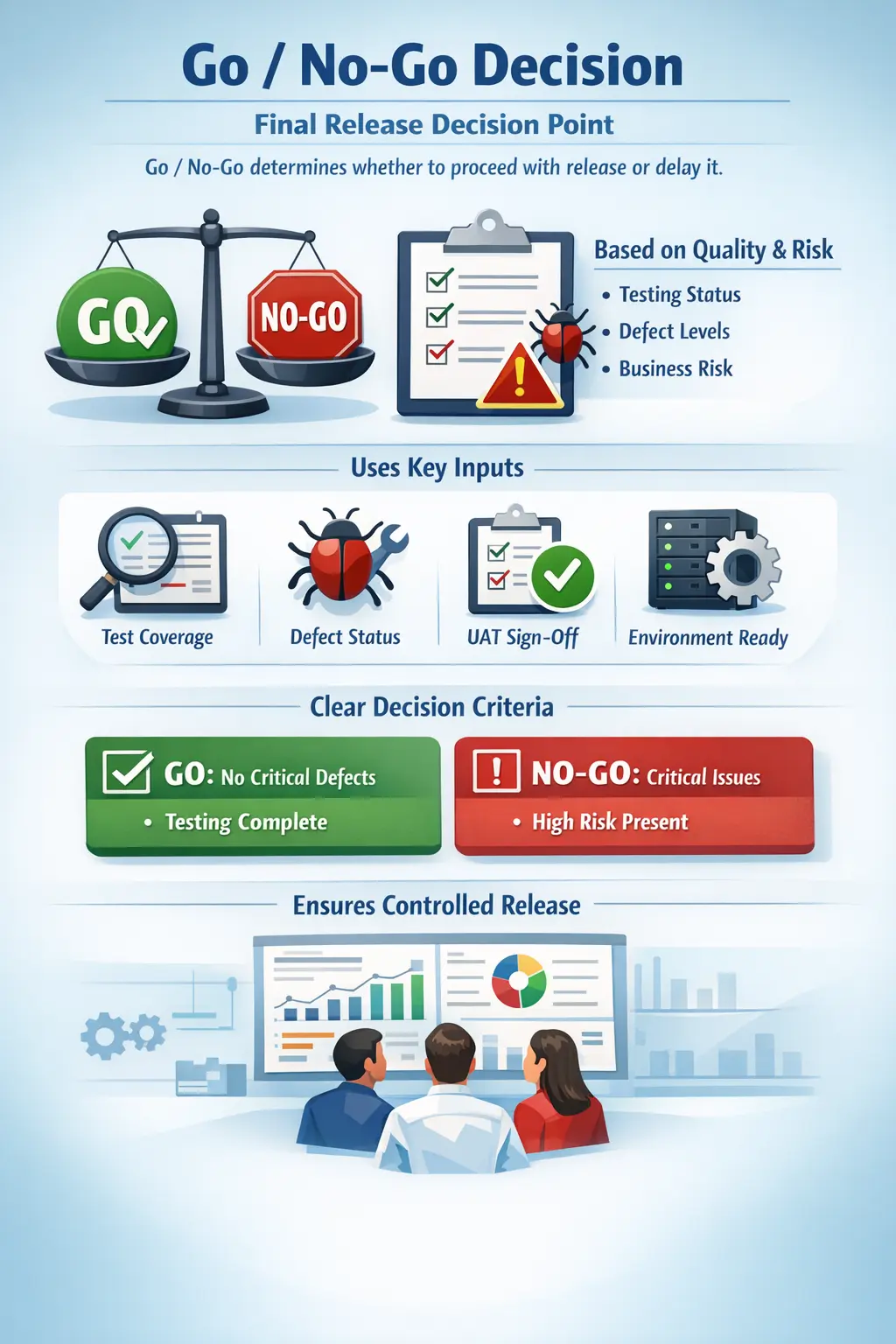
A Go / No-Go Decision should never be based only on pressure, assumptions, or a fixed calendar date. It should be based on clear inputs such as test execution results, defect status, regression completion, business approval, environment stability, deployment readiness, rollback preparedness, and known residual risks. The decision answers a practical release question: do we release now, or do we stop and fix?
The goal is not to release only when the product is perfect. In real projects, some low-risk issues may remain open, and a release may still be acceptable if stakeholders understand and accept those risks. The purpose of the Go / No-Go process is to make the decision transparent, evidence-based, and accountable. It turns release approval from a hopeful guess into a controlled decision.
Why Go / No-Go Decision Is Critical
The Go / No-Go Decision is critical because release failure can be expensive. A defect found in testing may affect only the project team, but a defect released to production can affect real users, business transactions, customer trust, and support workload. A poor release decision can lead to emergency fixes, rollback, customer complaints, financial loss, and reputational damage. The decision checkpoint helps prevent avoidable production issues by reviewing risk before deployment.
One major benefit of the Go / No-Go process is risk control. Not all defects are equal. A spelling mistake on an internal page is very different from a payment failure, data exposure issue, login outage, or broken order submission flow. The decision meeting helps stakeholders evaluate whether remaining defects are acceptable based on severity, priority, business impact, workaround, and release urgency.
Another benefit is data-driven decision-making. Instead of relying on statements like "it looks okay" or "we need to release today," the team reviews evidence. This evidence may include test coverage, execution status, defect trends, open defect list, UAT outcome, regression results, environment readiness, and release notes. Evidence makes the decision more objective.
The Go / No-Go Decision also creates alignment across QA, development, business, product, operations, and release management. Each group may see the release from a different angle. QA focuses on quality and risk, development focuses on technical readiness, business focuses on value and timing, and operations focuses on deployment and support. The checkpoint brings these views together before production impact occurs.
Finally, the process establishes accountability. When a release is approved, stakeholders collectively accept the known risks. When a release is stopped, the team understands why and what must be fixed before trying again. This prevents confusion and makes release management more disciplined.
When Go / No-Go Decision Is Taken
A Go / No-Go Decision is usually taken when enough information is available to evaluate release readiness. In many projects, this happens after system testing is completed, because the QA team has already validated major requirements and identified the main defect patterns. It may also happen after User Acceptance Testing, where business users confirm whether the system supports real-world workflows.
Another common point is during the release readiness assessment. At this stage, the team reviews testing status, defect status, scope completion, UAT outcome, deployment plan, rollback strategy, and support readiness. The final Go / No-Go Decision may also be confirmed just before the production deployment window to ensure no late blocker has appeared.
In Agile and CI/CD environments, the decision may happen more frequently and may be lighter in format. For example, teams may make Go / No-Go decisions for sprint releases, feature flag enablement, hotfixes, incremental deployments, or release trains. Even when deployments are frequent, the principle remains the same: release only when risks are understood and acceptable.
For emergency releases or hotfixes, the Go / No-Go process may be compressed, but it should not be skipped entirely. A hotfix may solve one urgent issue but create another if it is released without testing and rollback planning. A short, focused Go / No-Go review is still valuable in urgent situations.
Key Inputs to Go / No-Go Decision
The Go / No-Go Decision should be based on multiple inputs, not a single metric. A high pass percentage does not always mean the system is ready, and a few open defects do not always mean the release must be stopped. The decision requires a complete view of testing status, defect status, business readiness, environment readiness, and operational preparedness.
Testing status shows how thoroughly the application has been validated. Stakeholders review whether planned test cases were executed, whether exit criteria were met, whether smoke and sanity testing passed, whether regression testing is complete, and whether critical business scenarios were covered. It is not enough to say that many test cases passed. The team must understand whether the right test cases passed.
Defect status is one of the most important inputs. Open critical defects usually lead to No-Go because they indicate unacceptable release risk. High and medium defects must be reviewed in context. Some may block release, while others may be accepted if the business impact is low or a workaround exists. Defect trends also matter. If defects are increasing or the same module keeps failing, the build may be unstable even if the current open count looks manageable.
Business readiness confirms whether the release meets business expectations. This is often validated through UAT, product owner approval, stakeholder review, and acceptance of known issues. A release can be technically working but still not business-ready if the workflow does not meet user needs, support teams are not prepared, or the release timing conflicts with business priorities.
Environment and operational readiness confirm whether production deployment can be performed safely. The team should know whether the production environment is stable, whether configuration values are correct, whether feature flags are set properly, whether deployment steps are defined, whether rollback is possible, and whether monitoring and support are ready. Many real production failures happen because of configuration or deployment issues rather than application code defects.
Decision Criteria
A Go decision means the release can proceed because the known risks are acceptable. Typically, this requires no open critical defects, high defects reviewed and accepted or fixed, regression completed for critical flows, business approval received, production deployment plan ready, rollback plan available, and support teams informed. A Go decision does not mean the product is defect-free. It means stakeholders agree that the release is stable enough and the remaining risk is controlled.
A No-Go decision means the release should be stopped or delayed because the risk is unacceptable. This may happen when a critical defect is open, key functionality is untested, regression is incomplete, UAT has not passed, the environment is unstable, deployment steps are unclear, rollback is not available, or business stakeholders do not accept the remaining risk. A No-Go decision is not a failure of QA. It is a responsible decision that protects users and the business.
In real projects, there may also be a conditional Go decision. This means the release can proceed only with specific controls in place. For example, known issues may be documented, monitoring may be enabled, a rollback team may stay on standby, support teams may be briefed, a fix plan may be scheduled, or a risky feature may remain disabled through a feature flag. Conditional Go balances release urgency with risk management.
The important point is that criteria should be defined before the decision meeting whenever possible. If teams decide criteria only at the last minute, the discussion can become emotional and deadline-driven. Predefined criteria make the decision more objective.
Manual Tester’s Role in Go / No-Go Decision
Manual testers play a key role in influencing the Go / No-Go Decision because they provide direct evidence about product quality. They know which test cases were executed, which cases failed, which defects were fixed, which fixes were retested, which modules were unstable, and which scenarios remain untested. Their input helps stakeholders understand the real state of the build.
A tester should present test execution status, defect summary, regression status, coverage metrics, blocked cases, known risks, and QA recommendation clearly. The information should be accurate and unbiased. If critical areas were not tested, the tester should say so. If a module showed repeated defects, the tester should highlight it. If a defect is accepted by business, that acceptance should be documented.
Testers should avoid optimistic bias. It is tempting to present everything as green when the release date is close, but hiding risk can lead to production failures. A professional tester acts as a quality advocate. The tester does not block releases for personal reasons and does not approve releases blindly. The tester provides facts so stakeholders can make a responsible decision.
In interviews, this is an important point. QA does not always have final authority to release or stop a build, but QA has a responsibility to communicate quality status and risk clearly. The business may still choose to proceed, but that decision should be informed.
Go / No-Go vs Release Sign-Off
Go / No-Go Decision and Release Sign-Off are closely related, but they are not exactly the same. The Go / No-Go Decision is the evaluation and discussion process where stakeholders decide whether to proceed with the release. Release Sign-Off is the formal approval or documented confirmation of that decision.
In simple terms, Go / No-Go is the decision, while release sign-off is the authorization. During the Go / No-Go discussion, the team reviews testing results, open defects, risk, business readiness, and operational readiness. If the decision is Go, the release sign-off may then be completed according to the organization’s process.
This distinction is useful in interviews because it shows process understanding. QA may recommend Go, No-Go, or conditional Go based on quality evidence. Final sign-off may involve business owners, product owners, release managers, or leadership depending on the organization.
Real-Time Example
Consider a web application that is ready for release. Testing results show 98 percent test coverage, no open critical defects, two medium defects accepted by the business, UAT completed successfully, regression testing completed for critical flows, and the production environment confirmed stable. In this case, the decision is likely Go because the remaining risks are known, limited, and accepted.
Now consider a different release. A critical defect remains open in the payment module, regression testing is incomplete, and the production environment has unstable configuration. Even if many test cases passed, this release should be No-Go because the risk is too high. Payment defects can affect revenue and customer trust, incomplete regression creates unknown risk, and environment instability can cause deployment failure.
A conditional Go example may involve a release where one non-critical report defect remains open, but the business accepts it because the report is not used during the first week after release. The team documents the defect, schedules a fix, informs support, and proceeds with monitoring. This demonstrates that release decisions are based on risk evaluation, not perfection.
Common Mistakes in Go / No-Go Decision
A common mistake is treating the Go / No-Go Decision as a formality. In some teams, the release is assumed to proceed regardless of quality evidence. This weakens the process and makes the meeting meaningless. A real Go / No-Go review should allow stakeholders to stop, delay, or conditionally approve a release based on risk.
Another mistake is focusing only on pass percentage. A release with 99 percent passed test cases can still be unsafe if the failed cases are related to login, payment, data privacy, or order processing. Defect severity and business impact matter more than raw numbers. Teams should look at what failed, not only how many passed.
Downplaying known risks to meet deadlines is another serious mistake. If risks are hidden, stakeholders cannot accept them consciously. Lack of rollback planning is also dangerous. If a release fails and there is no fallback strategy, the production impact can become much worse. Poor communication between QA, development, business, and operations can also lead to misaligned expectations.
Best Practices for Effective Go / No-Go Decision
The first best practice is to make the decision data-driven. The team should review test execution, defect status, regression results, UAT outcome, environment readiness, deployment plan, rollback plan, and known risks. Opinions are useful, but they should be supported by evidence.
All relevant stakeholders should be involved. QA can explain quality status, development can explain technical risks, business can explain user impact and priorities, and operations can explain deployment readiness. A release decision made without the right people may miss important context.
The discussion should focus on risk, not just numbers. A small number of high-impact defects can be more dangerous than many low-impact cosmetic defects. Known risks should be documented with owner, impact, workaround, and acceptance decision. This creates accountability and helps future analysis if production issues occur.
A rollback plan should always be prepared and understood. Even when the decision is Go, the team should know what to do if deployment fails or post-release monitoring detects serious issues. Clear rollback and monitoring plans make releases safer and more controlled.
Interview Perspective
In interviews, a short answer can be: "A Go / No-Go Decision is a release checkpoint where stakeholders decide whether to proceed with production deployment based on testing status, defect status, business readiness, operational readiness, and risk." This answer is concise and covers the main idea.
A detailed answer can be: "The Go / No-Go Decision is made before release after reviewing test execution, regression status, open defects, defect severity, UAT sign-off, environment stability, deployment plan, rollback readiness, and residual risks. A Go decision means risks are acceptable, a No-Go decision means release risk is too high, and a conditional Go means release can proceed with specific controls such as monitoring, workaround, or planned fix." This shows practical understanding.
If asked about the tester’s role, explain that manual testers provide unbiased quality information. They share execution status, defect summary, coverage gaps, untested areas, unstable modules, and QA recommendation. They do not hide risks to make the status look good. This answer demonstrates maturity and release awareness.
Key Takeaway
The Go / No-Go Decision is not about achieving a defect-free product. It is about understanding risk, communicating clearly, and making an informed release decision. Even well-tested systems may contain known issues, but those issues must be visible, evaluated, and accepted before release.
A strong Go / No-Go process transforms releases from uncertain events into controlled outcomes. It helps teams release when quality is acceptable, delay when risk is too high, and proceed conditionally when business urgency and risk controls justify it. Ultimately, release success depends not only on testing, but also on how responsibly the decision to release is made.